
Revision Notes
Cambridge IGCSE World History (0470): To What Extent Was the League of Nations a Success? – Revision Notes
Recall notes for Cambridge IGCSE History 0470 key question 2.2: League structure, 1920s disputes, humanitarian work, the 1930s crises and a self-test.
- Subject
- World History
- Level
- IGCSE
- Topic
- Core Content – Option B: International Relations since 1919
- Author
- Marlbridge Academic Team
- Updated
- Reviewed by
- Azam Siddique (what this means)
Aligned to Cambridge IGCSE World History (0470), 2024-2026. Official specification .
Syllabus page (what it covers and how it is assessed): Cambridge IGCSE World History.
Syllabus points this page covers
0470
- 2.2 To what extent was the League of Nations a success?
Found an error? Report a correction.
Need help with this topic? Request a free trial class for IGCSE World History (0470).
Key question 2.2, Cambridge IGCSE History 0470: “To what extent was the League of Nations a success?” Learn the structure, aims and membership; the four named disputes of the 1920s; the four areas of humanitarian work; and the Manchurian and Abyssinian crises. Explanations are in the League of Nations study guide; practise with the League of Nations practice questions.
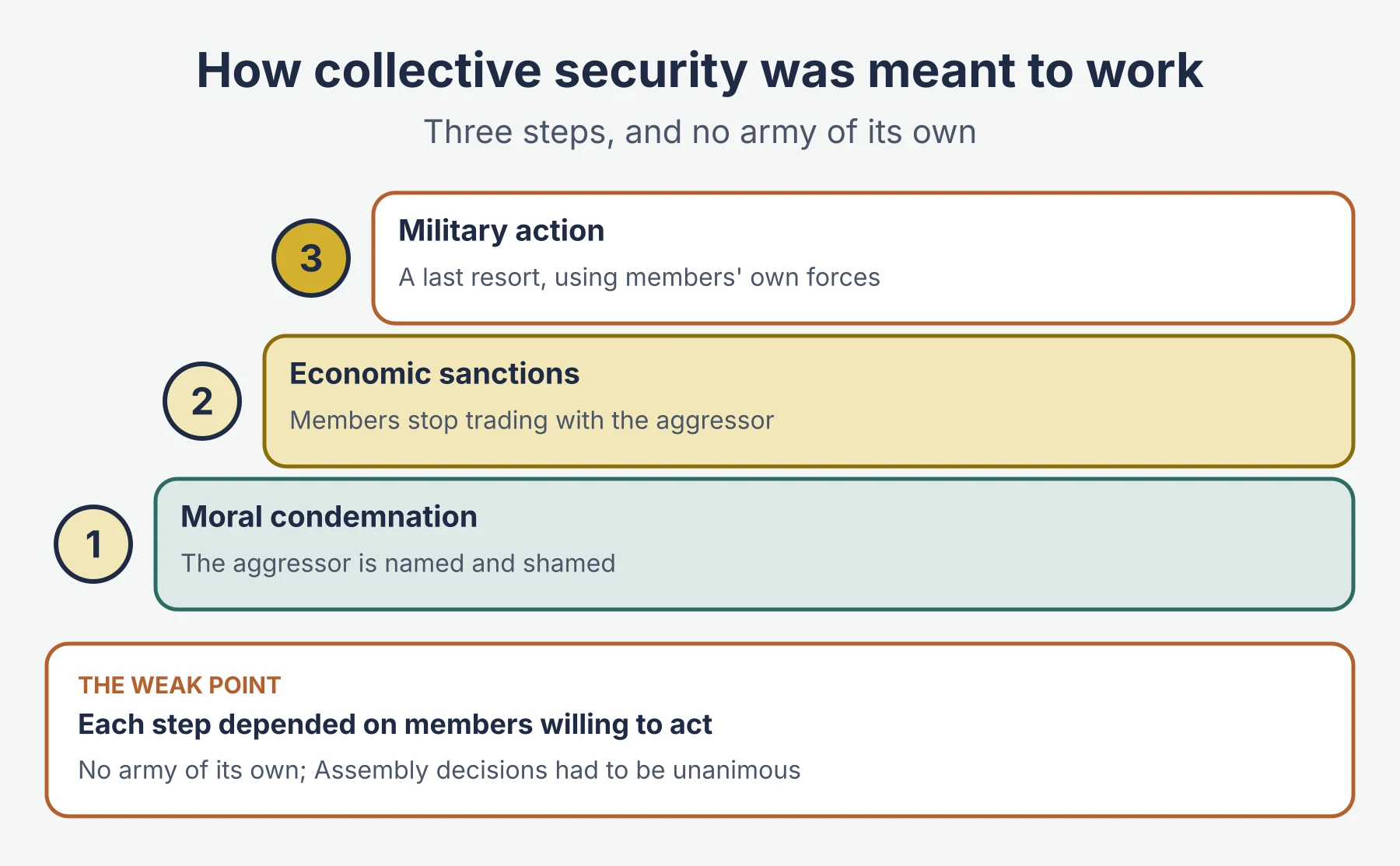
Structure and weaknesses
| Feature | Weakness it created |
|---|---|
| Assembly: unanimous decisions | Slow; one member could block action |
| Council: Britain, France, Italy, Japan permanent at first | Depended on great powers with their own interests |
| No army | Military action relied on members’ willingness |
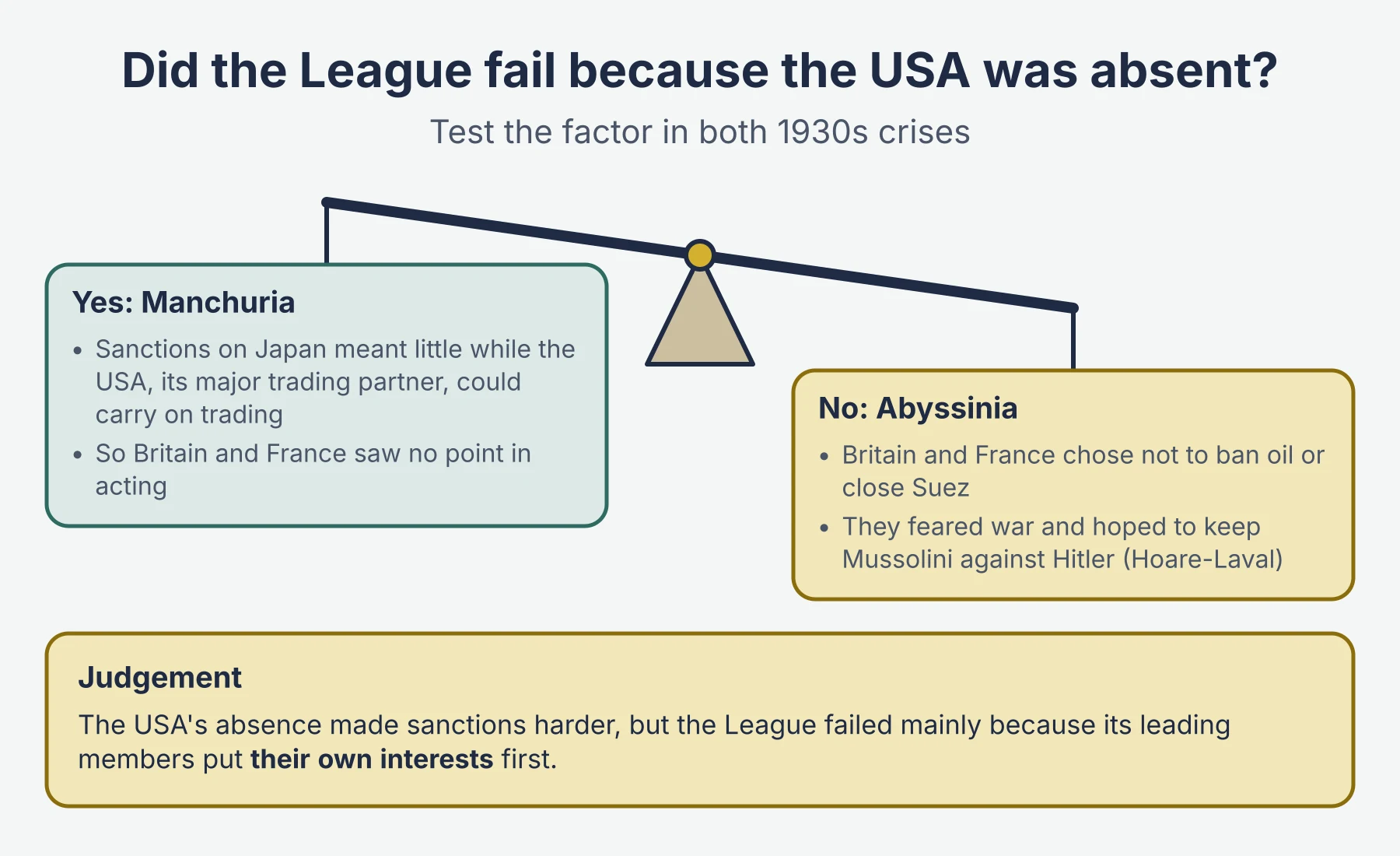
| Sanctions: condemnation, economic, military | Economic sanctions weak without the USA |
| Permanent Court of International Justice | Could not enforce its rulings |
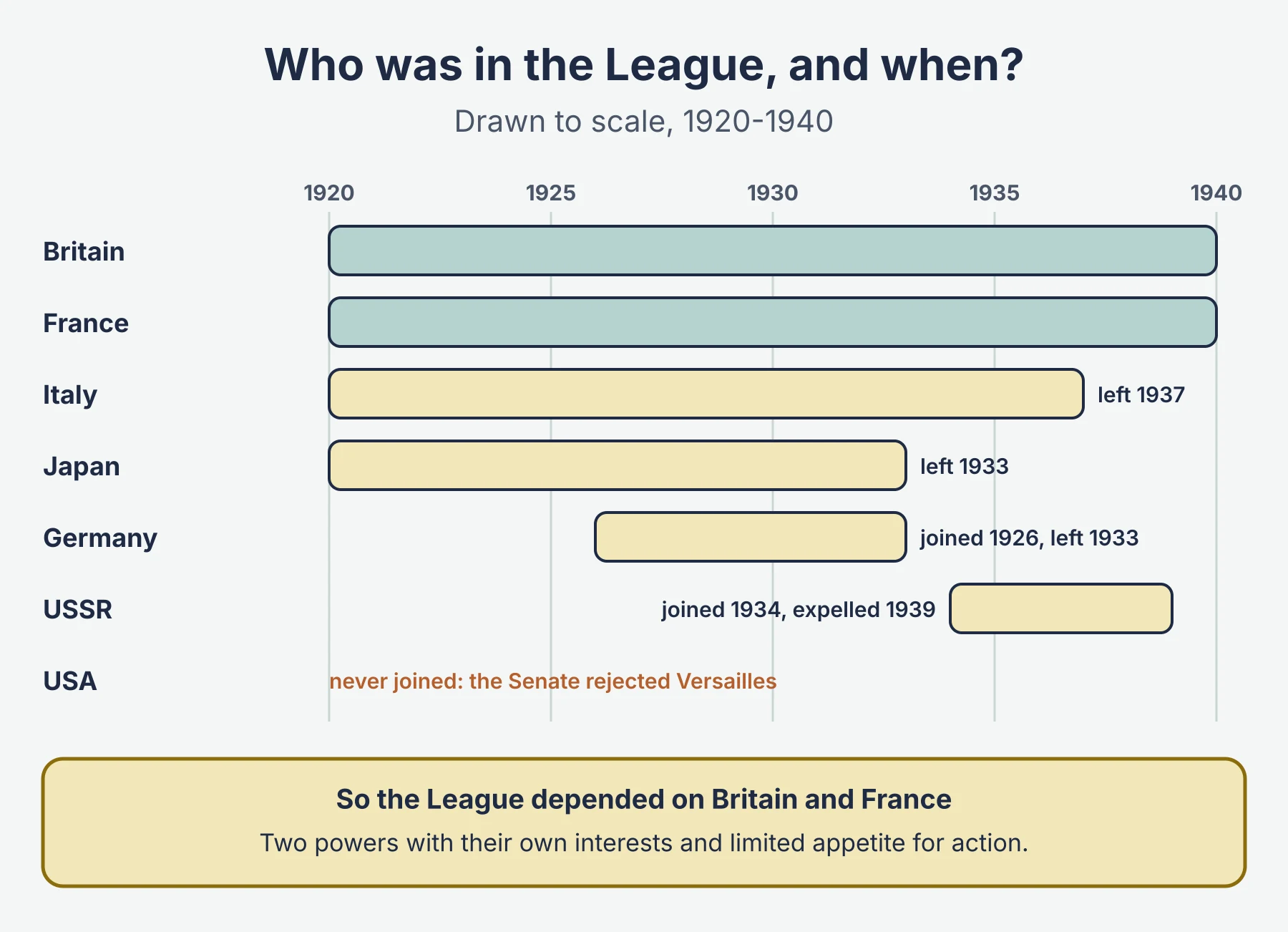
| USA never joined; Germany 1926-33; USSR 1934-39 | Never had all the great powers at once |
Membership dates
| Country | Joined | Left |
|---|---|---|
| USA | Never | – |
| Germany | 1926 | 1933 |
| Japan | Founder | 1933 |
| USSR | 1934 | Expelled 1939 |
| Italy | Founder | 1937 |
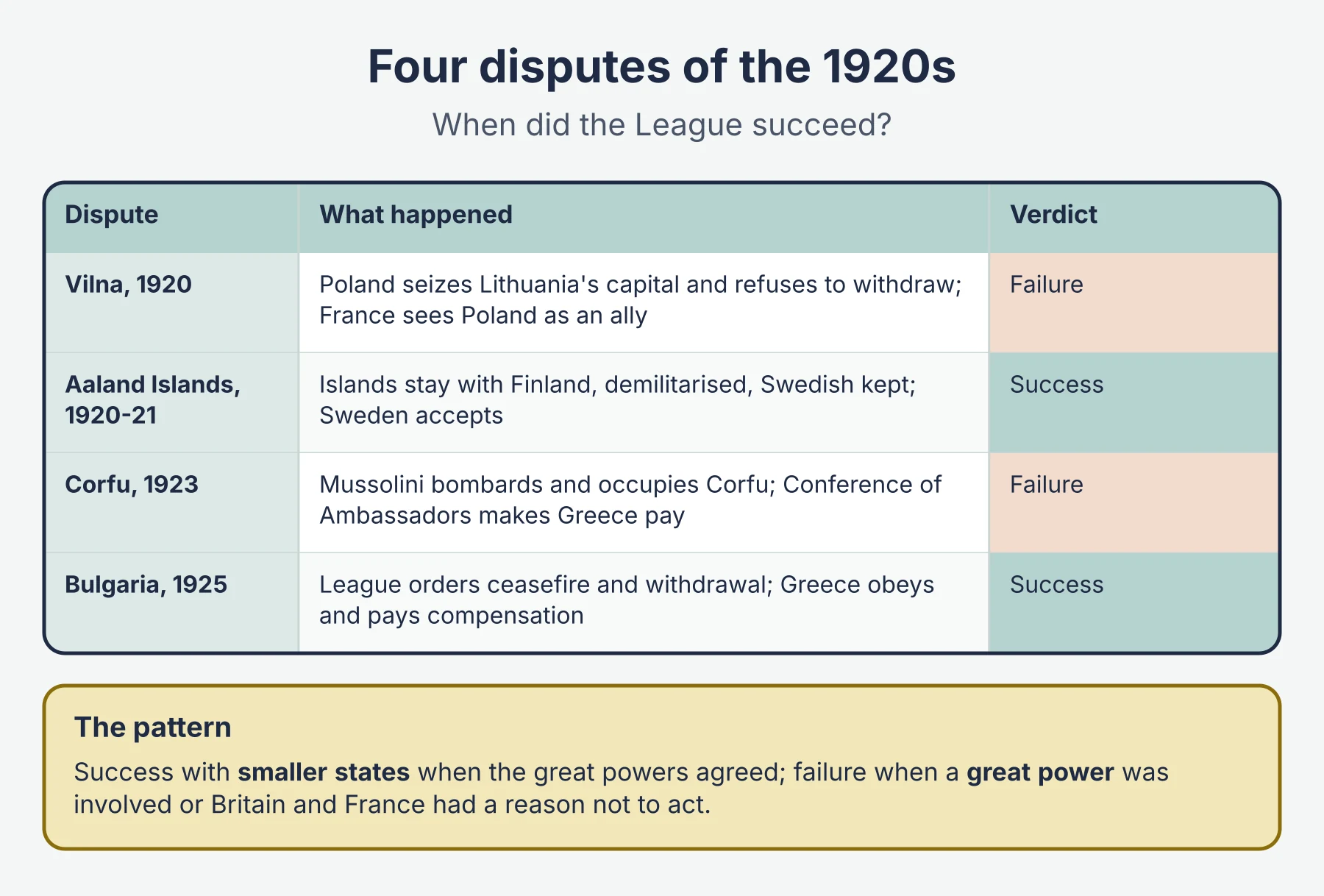
The four disputes of the 1920s
| Dispute | Who | Outcome | Success? |
|---|---|---|---|
| Vilna, 1920 | Poland and Lithuania | Poland kept Vilna; League did not act | No |
| Aaland Islands, 1920-21 | Sweden and Finland | Islands to Finland, demilitarised, Swedish culture protected; Sweden accepted | Yes |
| Corfu, 1923 | Italy and Greece | Mussolini occupied Corfu; Conference of Ambassadors made Greece pay; Italy withdrew | No |
| Bulgaria, 1925 | Greece and Bulgaria | Greece withdrew and paid compensation | Yes |
The pattern: success with small states; failure when a great power or a great power’s ally was involved.
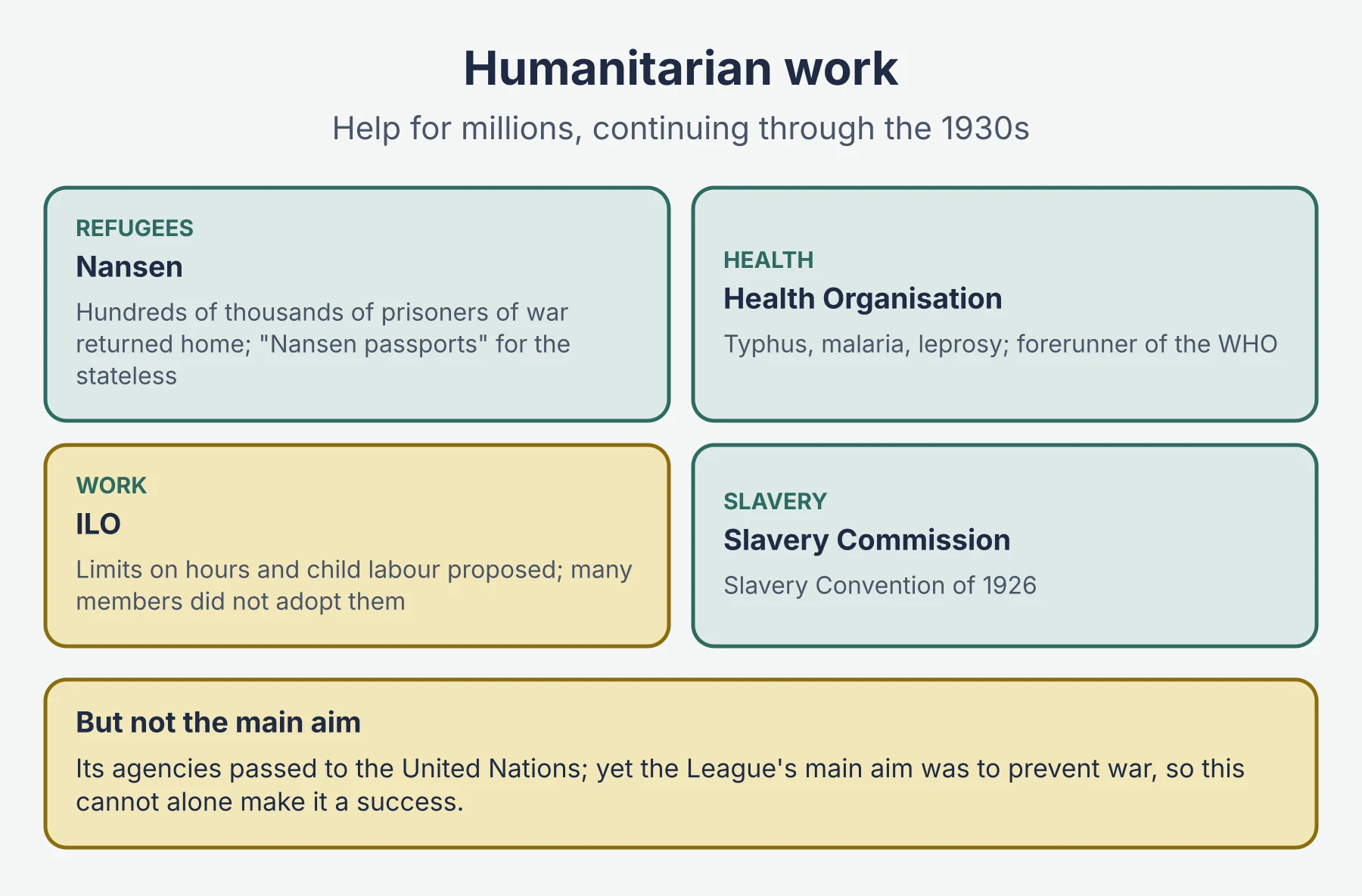
Humanitarian work
| Area | Achievement | Limit |
|---|---|---|
| Refugees | Nansen; return of hundreds of thousands of prisoners of war; Nansen passports | Refugee crises continued into the 1930s |
| Health | Fought epidemics such as typhus; work on malaria and leprosy; forerunner of the WHO | Depended on members’ funding |
| Working conditions | ILO recommendations on working hours and child labour | Many members did not adopt them |
| Slavery | Slavery Commission; Slavery Convention (1926) | Forced labour continued in many colonies |
The 1930s
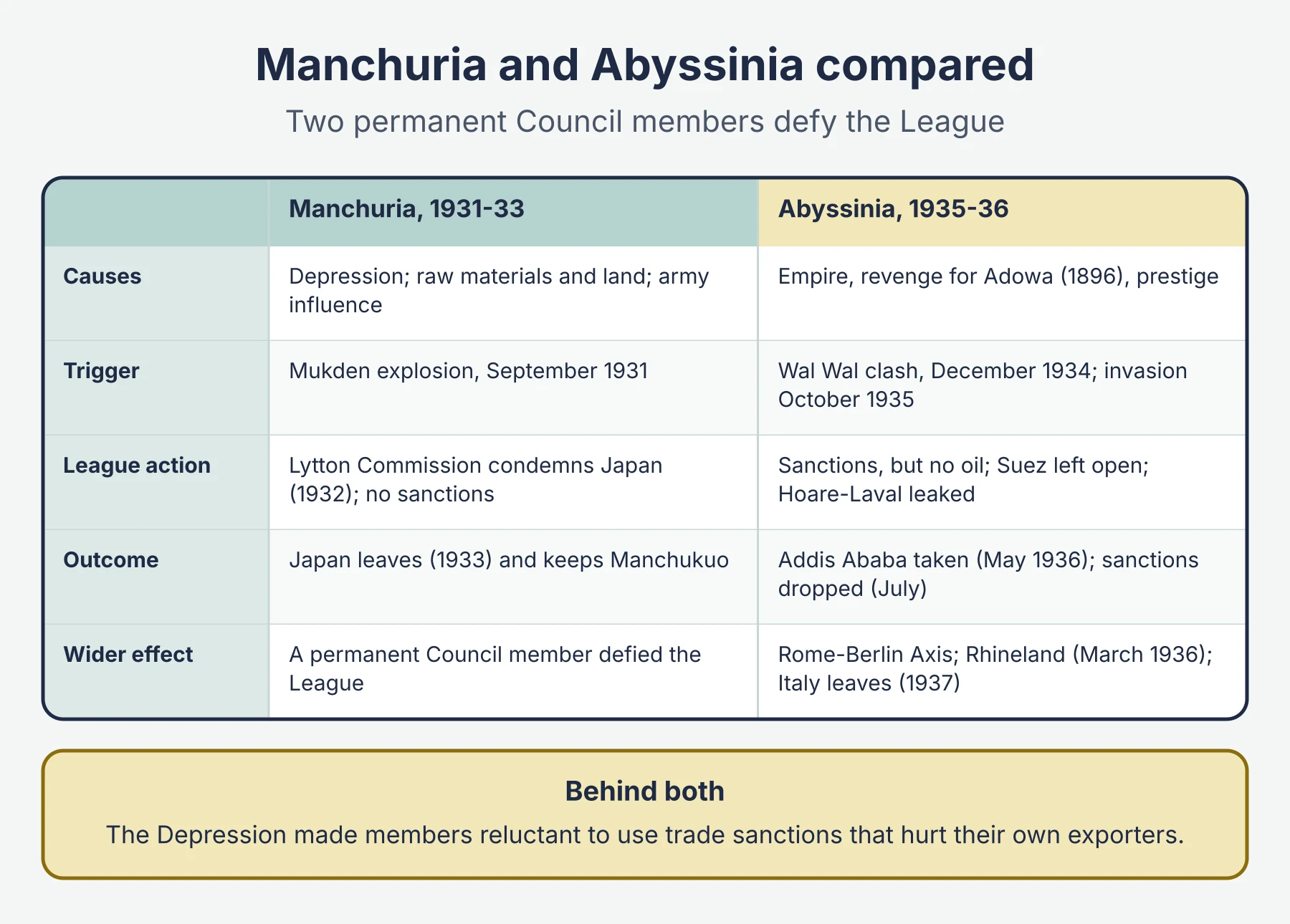
| Manchuria, 1931-33 | Abyssinia, 1935-36 | |
|---|---|---|
| Aggressor | Japan | Italy |
| Motives | Raw materials, land, army influence, Depression | Empire, prestige, revenge for Adowa (1896) |
| Trigger | Mukden incident, September 1931 | Wal Wal clash, December 1934 |
| League response | Lytton Commission; report condemned Japan | Condemnation; sanctions without oil |
| Key failure | No sanctions; distance; no US involvement | Suez Canal left open; Hoare-Laval Pact (December 1935) |
| Result | Manchukuo; Japan leaves League (1933) | Italy conquers Abyssinia (May 1936); sanctions dropped; Italy leaves (1937) |
| Wider effect | League shown powerless against a great power | Collective security collapses; Rome-Berlin Axis; Rhineland remilitarised |
How the Depression made things harder
- Members would not risk trade sanctions that hurt their own economies.
- Nationalist and militarist groups gained support in Japan, Italy and Germany.
- Britain and France cut spending, including on armed forces, and feared war.
- The Disarmament Conference (1932-34) failed; Germany left it and the League in 1933.
Key terms
| Term | Meaning |
|---|---|
| Covenant | The League’s founding rules, part of the peace treaties |
| Collective security | Members acting together against an aggressor |
| Sanctions | Penalties, especially trade bans, against an aggressor |
| Conference of Ambassadors | Body of Allied ambassadors that settled some post-war disputes, including Corfu |
| Mandate | Former colony run by a League member under League supervision |
| ILO | International Labour Organization, improving working conditions |
| Nansen passport | Identity document for stateless refugees |
| Lytton Commission | League inquiry into Manchuria |
| Hoare-Laval Pact | Secret British and French plan (1935) to give Italy much of Abyssinia |
| Manchukuo | Japanese puppet state in Manchuria |
One-line answers to the focus points
- Did weaknesses make failure inevitable? They made failure likely against great powers, but the League still solved disputes between smaller states in the 1920s.
- How successful was peacekeeping in the 1920s? Mixed: success in the Aaland Islands and Bulgaria, failure in Vilna and Corfu.
- How important was humanitarian work? It helped millions and outlived the League through the United Nations, but it was not the League’s main purpose.
- How far did the Depression make the League’s work harder? Greatly: it encouraged aggression by Japan and Italy and made members unwilling to impose sanctions that hurt their own trade.
Exam traps
- Corfu is a failure. Italy got compensation and the League was bypassed.
- Abyssinia sanctions existed but excluded oil.
- “Inevitable” questions need both structure and circumstances.
- Humanitarian work counts as part of “success”, but weigh it against peacekeeping.
- Dates matter. Mukden 1931; Japan leaves 1933; invasion of Abyssinia 1935.
Self-test
- Where was the League based? Geneva.
- Why did the USA not join? The Senate refused to ratify the Treaty of Versailles.
- What were the three stages of collective security? Moral condemnation, economic sanctions, military action.
- Who kept Vilna, and why did the League not act? Poland; France saw Poland as an ally and Britain would not act alone.
- Why is the Aaland Islands case seen as a success? Both Sweden and Finland accepted the League’s ruling.
- Who was murdered in 1923, leading to the Corfu crisis? The Italian general Tellini.
- What did the League order in 1925? Greece to withdraw from Bulgaria and pay compensation.
- Who led the League’s work for refugees? Fridtjof Nansen.
- What did the Slavery Convention of 1926 aim to do? End slavery and the slave trade.
- What did the Lytton Commission conclude? That Japan was in the wrong and should withdraw, with Manchuria governed under Chinese sovereignty.
- Why were sanctions against Italy ineffective? Oil was excluded and the Suez Canal stayed open.
- What was the Hoare-Laval Pact? A secret plan by Britain and France to give Italy much of Abyssinia.
Related resources
-
Study guides
Cambridge IGCSE World History (0470): Was the Treaty of Versailles Fair?
Study guide to Cambridge IGCSE History 0470 key question 2.1: the Big Three, the terms, the impact on Germany to 1923 and opinions of the Treaty.
World History · Cambridge · IGCSE
Read guide -
Practice questions
Cambridge IGCSE World History (0470): Was the Treaty of Versailles Fair? – Practice Questions
Twelve original questions with mark-scheme answers on the Big Three, the terms and Germany to 1923, for Cambridge IGCSE History 0470 key question 2.1.
World History · Cambridge · IGCSE
Try questions -
Revision notes
Cambridge IGCSE World History (0470): Was the Treaty of Versailles Fair? – Revision Notes
Recall notes for Cambridge IGCSE History 0470 key question 2.1: the Big Three, the terms, Germany to 1923, opinions of the Treaty and a self-test.
World History · Cambridge · IGCSE
Revise topic
Get free revision emails (optional)
Occasional emails with practice questions, worked explanations and links to free resources for the qualification and subjects you choose. No spam, and you can unsubscribe from any email. The free tools on this site never need an email.