
Study Guides
Cambridge IGCSE World History (0470): How Far Was Hitler’s Foreign Policy to Blame for the Outbreak of War in Europe in 1939?
Study guide to Cambridge IGCSE History 0470 key question 2.3: Hitler's aims, the steps to war, appeasement, the Nazi-Soviet Pact and September 1939.
- Subject
- World History
- Level
- IGCSE
- Topic
- Core Content – Option B: International Relations since 1919
- Author
- Marlbridge Academic Team
- Updated
- Reviewed by
- Azam Siddique (what this means)
Aligned to Cambridge IGCSE World History (0470), 2024-2026. Official specification .
Syllabus page (what it covers and how it is assessed): Cambridge IGCSE World History.
Syllabus points this page covers
0470
- 2.3 How far was Hitler’s foreign policy to blame for the outbreak of war in Europe in 1939?
Found an error? Report a correction.
Need help with this topic? Request a free trial class for IGCSE World History (0470).
This guide covers key question 3 of Core Content Option B in Cambridge IGCSE History 0470 (2024-2026): “How far was Hitler’s foreign policy to blame for the outbreak of war in Europe in 1939?” The five focus points ask about the long-term consequences of the Treaty of Versailles, the consequences of the League’s failures in the 1930s, whether appeasement was justified, how important the Nazi-Soviet Pact was, and why Britain and France declared war in September 1939. The specified content runs through Hitler’s aims, rearmament, the Saar, the Rhineland, the Rome-Berlin Axis and Anti-Comintern Pact, the Spanish Civil War, Anschluss, Czechoslovakia and Munich, and the Polish crisis. This was the Paper 2 prescribed topic for November 2025.
Use it with the Hitler’s foreign policy revision notes and the Hitler’s foreign policy practice questions. The earlier key questions are covered in the Versailles study guide and the League of Nations study guide.
Hitler’s aims
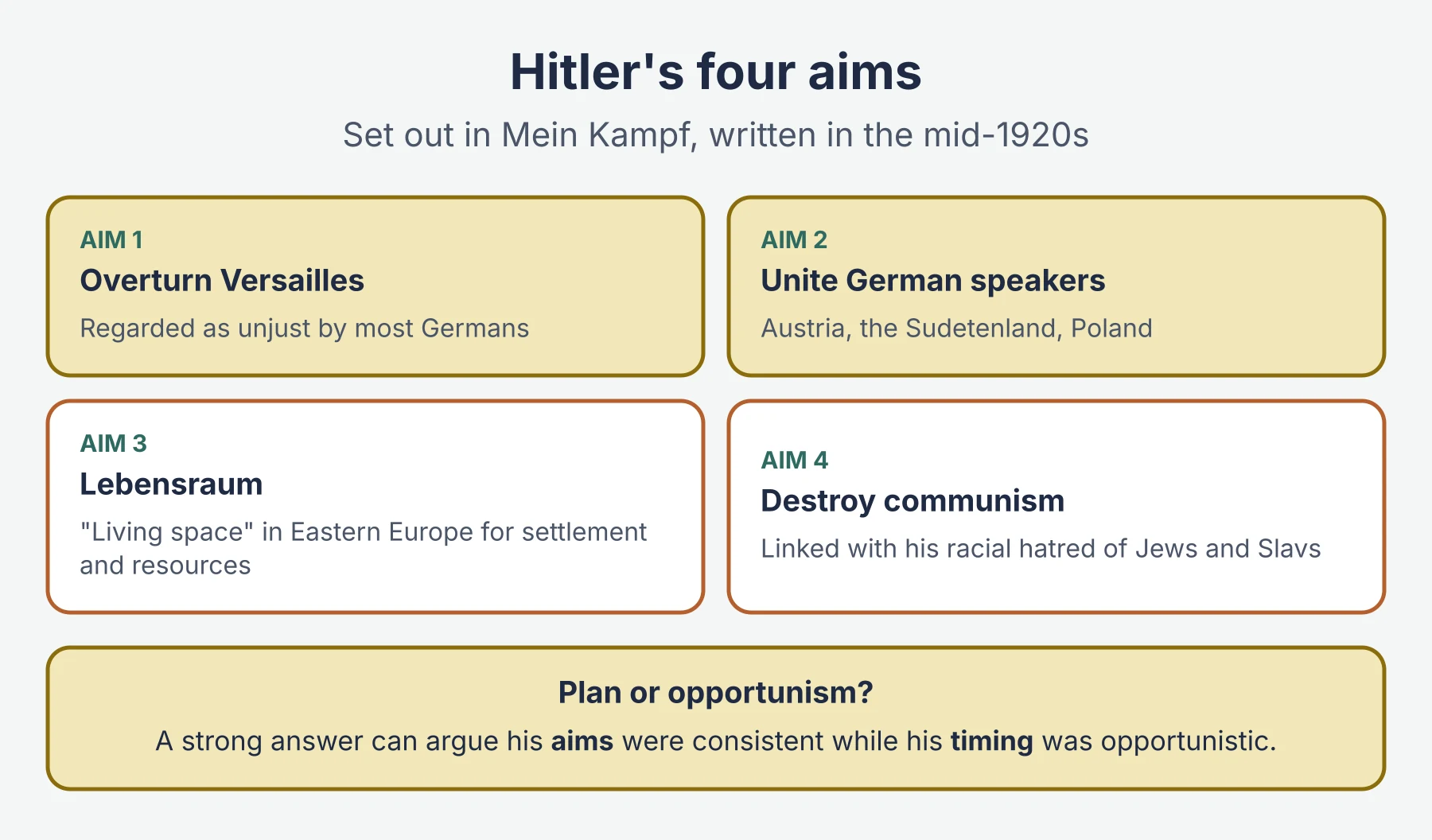
Hitler set out his ideas in Mein Kampf (written in the mid-1920s). His aims were to:
- Overturn the Treaty of Versailles, which most Germans regarded as unjust.
- Unite all German speakers in one Reich, including those in Austria, the Sudetenland and Poland.
- Win Lebensraum (“living space”) in Eastern Europe for German settlement and resources.
- Destroy communism, which he linked with his racial hatred of Jews and Slavs.
A key debate is whether Hitler followed these aims as a plan or took opportunities as they arose. Strong answers can argue that his aims were consistent while his timing was opportunistic.
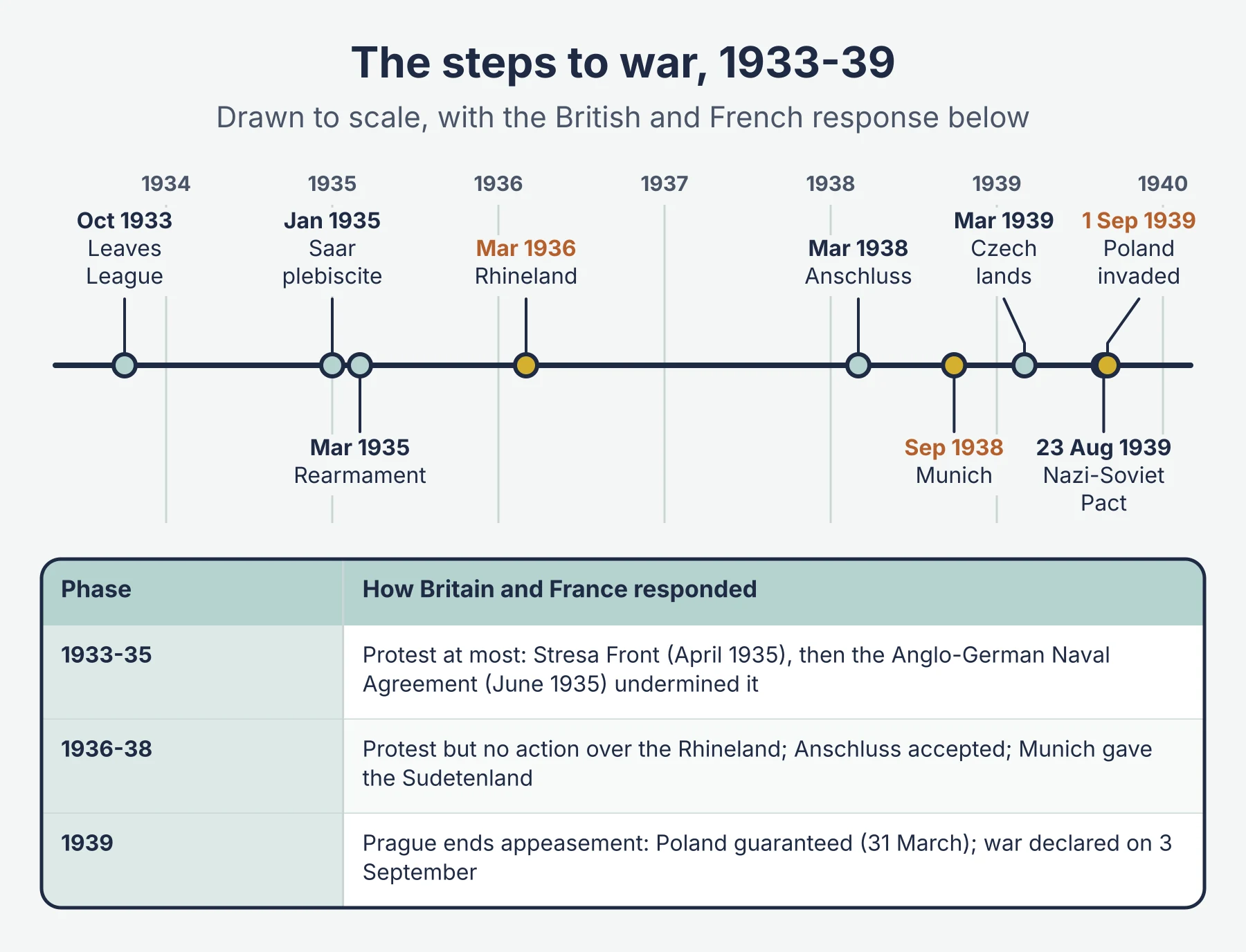
The steps to war, 1933-39
| Date | Step | Response |
|---|---|---|
| October 1933 | Germany leaves the Disarmament Conference and the League | No action |
| January 1934 | Non-aggression pact with Poland | Seemed to show peaceful intentions |
| July 1934 | Nazis murder the Austrian chancellor Dollfuss in a failed coup | Mussolini moves troops to the border; Hitler backs off |
| January 1935 | Saar plebiscite: over 90% vote to return to Germany | A legal, popular victory |
| March 1935 | Rearmament: conscription announced; the Luftwaffe revealed | Stresa Front (April): Britain, France and Italy protest |
| June 1935 | Anglo-German Naval Agreement: German navy up to 35% of Britain’s | Britain accepted a breach of Versailles; Stresa undermined |
| March 1936 | Rhineland remilitarised | Britain and France protested but did not act |
| 1936-39 | Spanish Civil War: German and Italian help for Franco, including the Condor Legion’s bombing of Guernica (1937) | Britain and France followed non-intervention |
| October-November 1936 | Rome-Berlin Axis; Anti-Comintern Pact with Japan (Italy joined 1937) | Aggressor states drew together |
| March 1938 | Anschluss with Austria; a controlled vote approved it | Britain and France accepted it |
| September 1938 | Munich Agreement: Sudetenland given to Germany | Appeasement at its height |
| March 1939 | German troops occupy the rest of the Czech lands | Britain guarantees Poland (31 March) |
| 23 August 1939 | Nazi-Soviet Pact | Removed the threat of a two-front war |
| 1 September 1939 | Germany invades Poland | Britain and France declare war on 3 September |
The long-term consequences of Versailles
Versailles gave Hitler grievances that many Germans shared and that many in Britain accepted as fair: the Saar, the Rhineland and the Polish Corridor were all created by the Treaty, and the ban on Anschluss denied self-determination. Because British opinion often saw these demands as reasonable, Hitler’s early moves met little resistance. However, the Treaty did not make war certain: under Stresemann in the 1920s Germany pursued revision peacefully, through Locarno and League membership.
The consequences of the League’s failures
The League’s failures over Manchuria and especially Abyssinia showed that collective security did not work. They gave Hitler confidence that aggression would not be punished, drove Mussolini into partnership with Germany, and distracted Britain and France at the moment Hitler remilitarised the Rhineland. After 1936, Britain and France dealt with Hitler directly, outside the League.
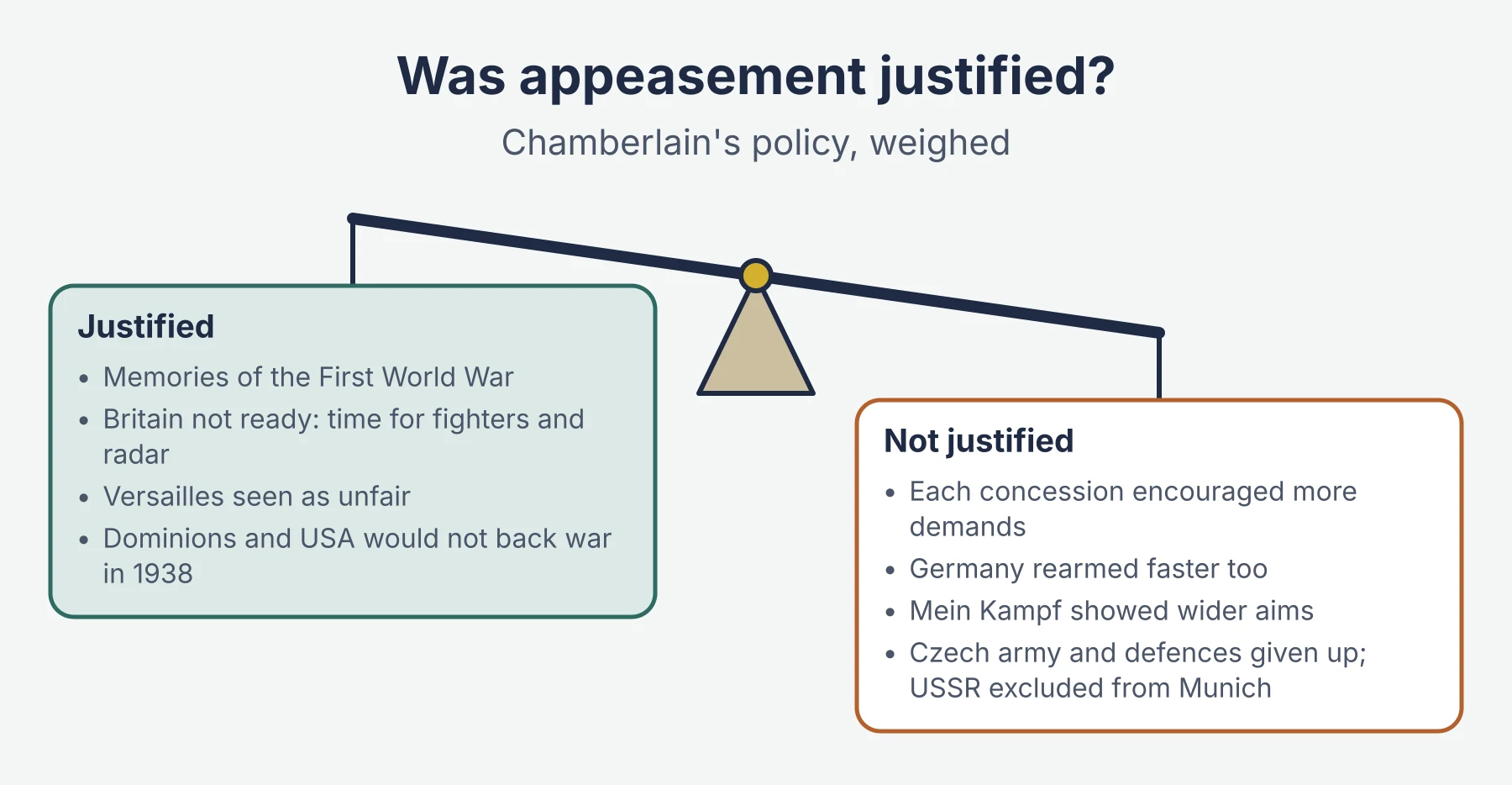
Was appeasement justified?
Appeasement was the policy, led by British Prime Minister Neville Chamberlain (from 1937), of meeting Hitler’s “reasonable” demands to avoid war.
| Justified | Not justified |
|---|---|
| Memories of the First World War made public opinion strongly against war | Each concession encouraged Hitler to demand more |
| Britain was not ready: rearmament only sped up from the later 1930s, and it bought time to build fighters and radar | Germany also gained time and rearmed faster |
| Many thought Versailles unfair, so German demands seemed reasonable | Mein Kampf showed his aims went far beyond revising the Treaty |
| The Dominions and the USA would not support war in 1938 | Czechoslovakia had a strong army and border defences, given up at Munich |
| Communism seemed a greater threat to some | Excluding the USSR from Munich pushed Stalin towards Hitler |
Munich in detail
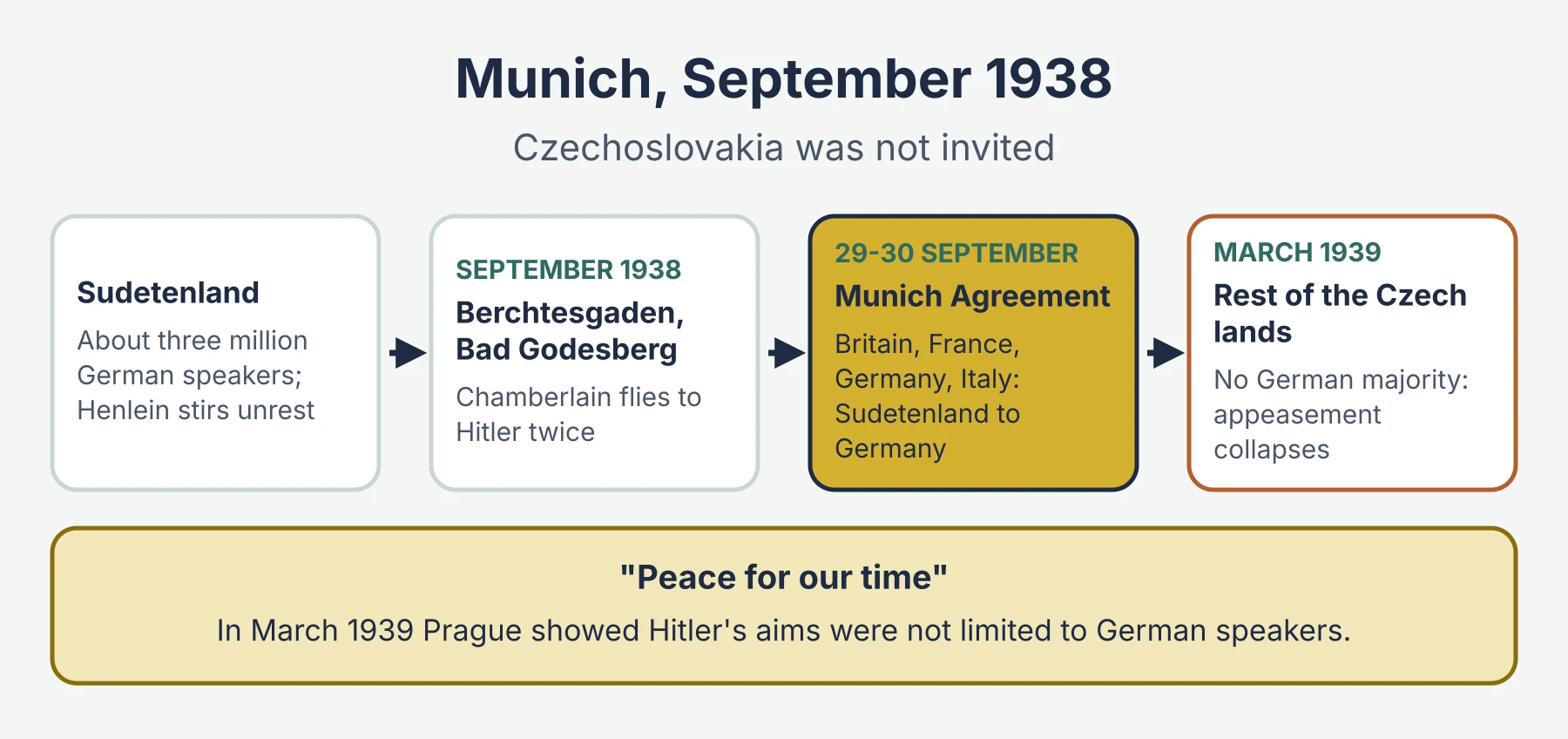
Hitler demanded the Sudetenland, home to about three million German speakers, using the Sudeten German Party under Konrad Henlein to stir unrest. Chamberlain flew to meet Hitler at Berchtesgaden and Bad Godesberg in September 1938, and at Munich (29-30 September) Britain, France, Germany and Italy agreed that Germany would take the Sudetenland. Czechoslovakia was not invited. Chamberlain returned claiming “peace for our time”. In March 1939 Hitler took the rest of the Czech lands, the first territory he seized with no German majority, and appeasement collapsed.
How important was the Nazi-Soviet Pact?
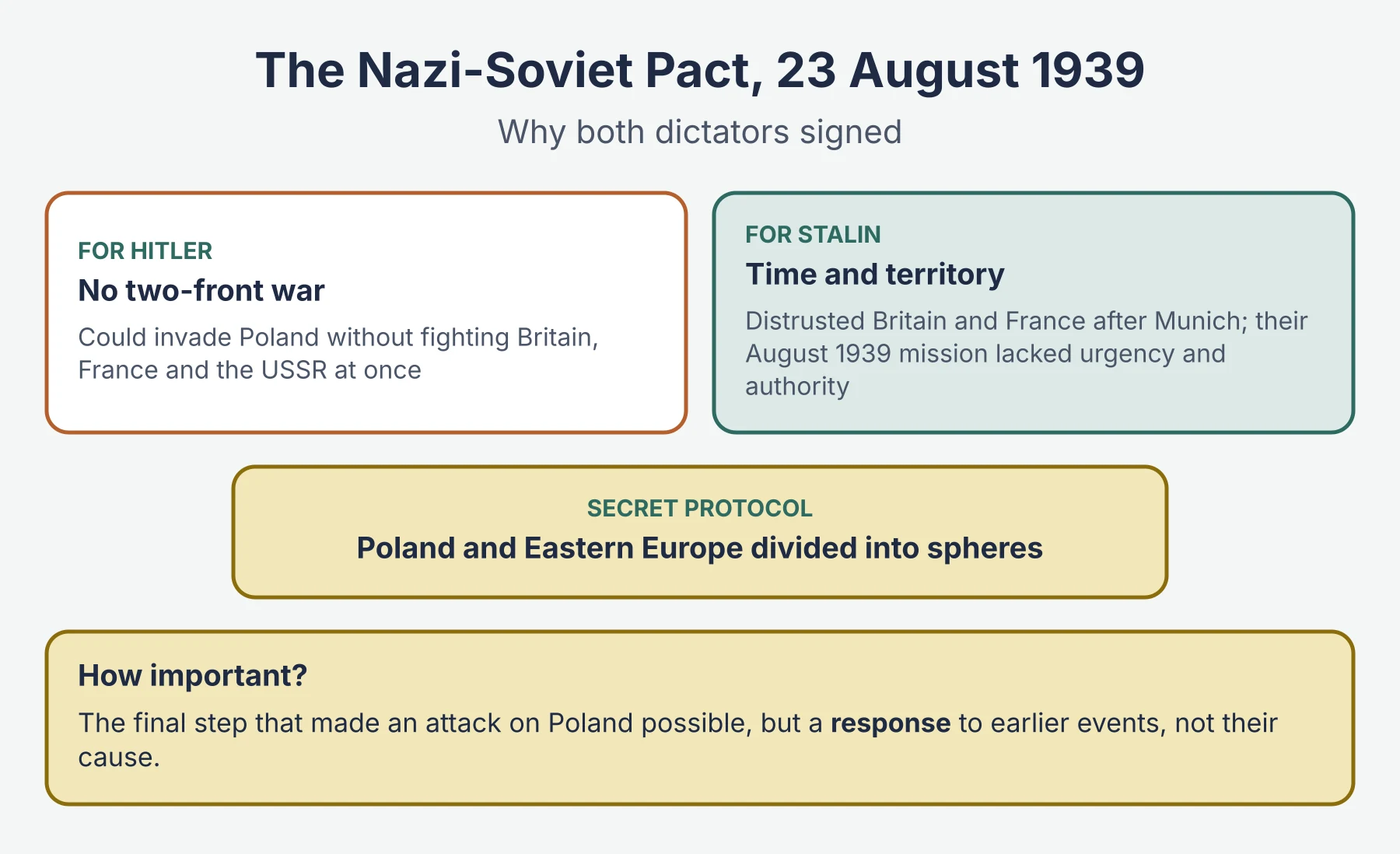
Signed on 23 August 1939, the pact between Germany and the USSR promised neutrality; a secret protocol divided Poland and Eastern Europe into spheres of influence.
- For Hitler, it removed the danger of fighting Britain, France and the USSR at once, so he could invade Poland.
- For Stalin, it bought time to build up Soviet forces and gained territory. He distrusted Britain and France after Munich, and their military mission to Moscow in August 1939 lacked urgency and authority.
The pact was the final step that made an attack on Poland possible, but it was a response to earlier events rather than their cause.
Why did Britain and France declare war in September 1939?
- Hitler’s occupation of Prague in March 1939 proved his promises worthless and his aims were not limited to German speakers.
- Britain and France had guaranteed Poland in March 1939, and Britain signed a formal alliance with Poland on 25 August.
- Public opinion had swung against appeasement.
- Germany ignored their ultimatum to withdraw from Poland, so war was declared on 3 September 1939.
Annotated model answer
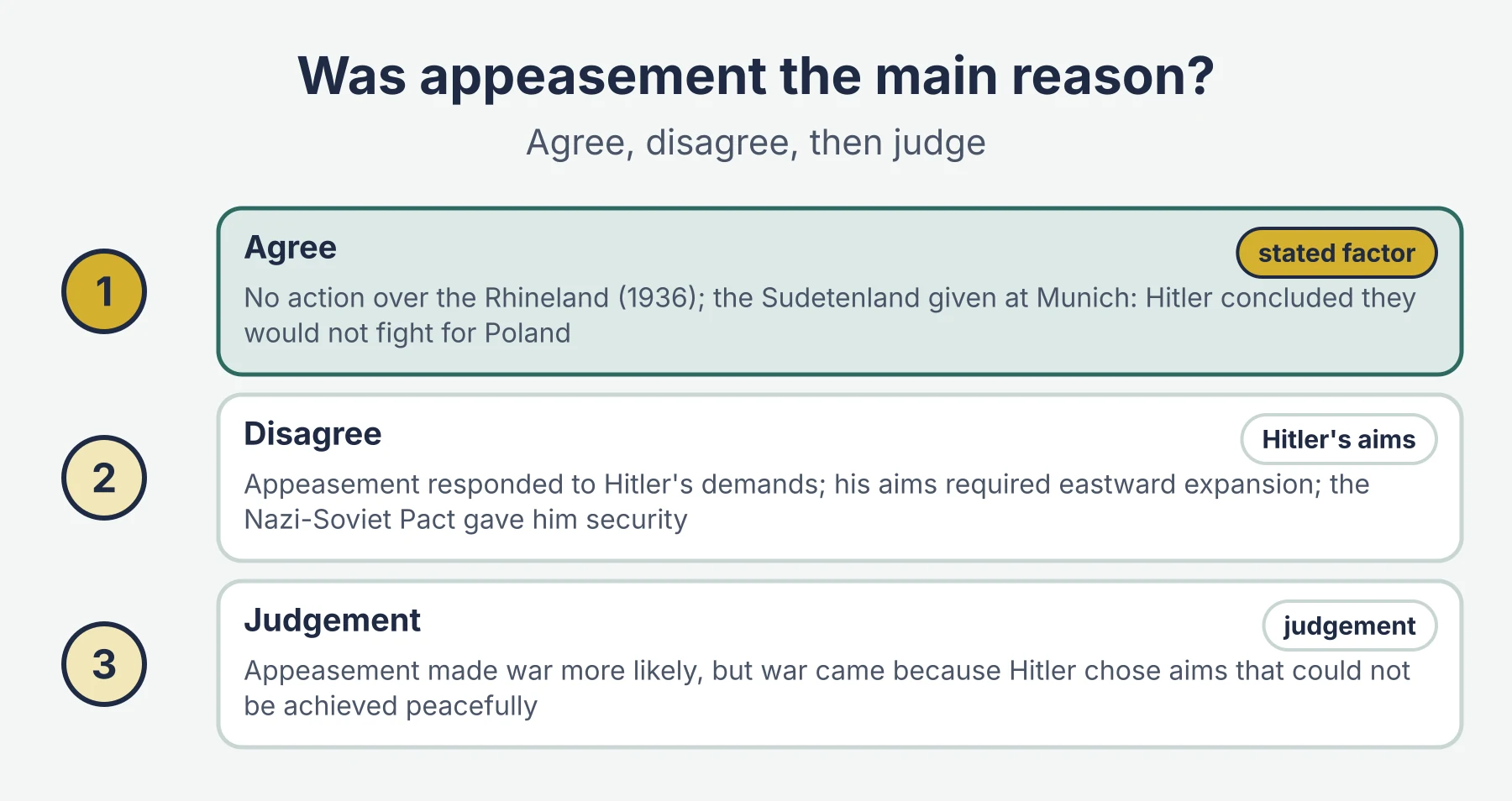
An original practice question: “Appeasement was the main reason war broke out in 1939.” How far do you agree? [10]
Appeasement encouraged Hitler. Britain and France did nothing over the Rhineland in 1936 and gave him the Sudetenland at Munich, so he concluded they would not fight for Poland either. [Agree, explained.] But appeasement was a response to Hitler’s demands, not their cause. His aims of uniting German speakers and winning Lebensraum required expansion eastward, and the Nazi-Soviet Pact gave him the security to invade Poland whatever Britain and France did. [Disagree, explained.] Appeasement made war more likely by encouraging Hitler, but the war began because he chose to pursue aims that could not be achieved peacefully. [Judgement.]
Common mistakes
- Describing the steps to war without linking each to the question of blame.
- Saying Britain and France went to war over Czechoslovakia. They did so over Poland.
- Forgetting the Saar and the Spanish Civil War, both named in the specification.
- Ignoring the USSR’s role and Stalin’s motives in August 1939.
Exam technique
“How far was Hitler to blame” needs Hitler’s aims and actions weighed against Versailles, the League, appeasement and the Nazi-Soviet Pact. A judgement might rank them or distinguish long-term causes from the decisions of 1939.
Official syllabus
Cambridge IGCSE History (0470) syllabus for 2024, 2025 and 2026, Core Content Option B, key question 3 – cambridgeinternational.org.
Related resources
-
Practice questions
Cambridge IGCSE World History (0470): How Far Was Hitler’s Foreign Policy to Blame for the Outbreak of War in Europe in 1939? – Practice Questions
Twelve original questions with mark-scheme answers on Hitler's aims, appeasement, Munich and the Nazi-Soviet Pact, for Cambridge IGCSE History 0470.
World History · Cambridge · IGCSE
Try questions -
Revision notes
Cambridge IGCSE World History (0470): How Far Was Hitler’s Foreign Policy to Blame for the Outbreak of War in Europe in 1939? – Revision Notes
Recall notes for Cambridge IGCSE History 0470 key question 2.3: Hitler's aims, steps to war 1933-39, appeasement, the Nazi-Soviet Pact and a self-test.
World History · Cambridge · IGCSE
Revise topic -
Study guides
Cambridge IGCSE World History (0470): To What Extent Was the League of Nations a Success?
Study guide to Cambridge IGCSE History 0470 key question 2.2: League structure, 1920s disputes, humanitarian work, Manchuria and Abyssinia.
World History · Cambridge · IGCSE
Read guide
Get free revision emails (optional)
Occasional emails with practice questions, worked explanations and links to free resources for the qualification and subjects you choose. No spam, and you can unsubscribe from any email. The free tools on this site never need an email.