
Study Guides
Cambridge IGCSE World History (0470): Who Was to Blame for the Cold War?
Study guide to Cambridge IGCSE History 0470 key question 2.4: the 1945 conferences, Soviet expansion, US reactions, the Berlin Blockade and who was to blame.
- Subject
- World History
- Level
- IGCSE
- Topic
- Core Content – Option B: International Relations since 1919
- Author
- Marlbridge Academic Team
- Updated
- Reviewed by
- Azam Siddique (what this means)
Aligned to Cambridge IGCSE World History (0470), 2024-2026. Official specification .
Syllabus page (what it covers and how it is assessed): Cambridge IGCSE World History.
Syllabus points this page covers
0470
- 2.4 Who was to blame for the Cold War?
Found an error? Report a correction.
Need help with this topic? Request a free trial class for IGCSE World History (0470).
This guide covers key question 4 of Core Content Option B in Cambridge IGCSE History 0470 (2024-2026): “Who was to blame for the Cold War?” The syllabus sets five focus points: why the US-Soviet alliance began to break down in 1945, how the USSR gained control of Eastern Europe by 1948, how the United States reacted to Soviet expansionism, the consequences of the Berlin Blockade, and who was more to blame for starting the Cold War. The specified content names the 1945 summit conferences, Soviet expansion to 1948 and American reactions, the occupation of Germany and the Berlin Blockade, and NATO and the Warsaw Pact. For the whole of Option B, see the Twentieth Century 1919-1989 guide.
Condensed facts are in the Cold War origins revision notes and you can test yourself with the Cold War origins practice questions.
Where this key question is examined
On Paper 1, Section A sets four questions on Option B, two from key questions 1-3 and two from key questions 4-6, so a question on the origins of the Cold War is possible in any series. Each is a structured essay in three parts: (a) describe, (b) explain why, and (c) “how far do you agree”. The syllabus also names this key question as the Paper 2 prescribed topic for November 2024; prescribed topics change each series, so check which one applies to your exam.
Why did the wartime alliance break down in 1945?
The USA, Britain and the USSR were allies only because they shared an enemy. Once Germany was close to defeat, the differences between a capitalist democracy and a one-party communist state came back into the open.
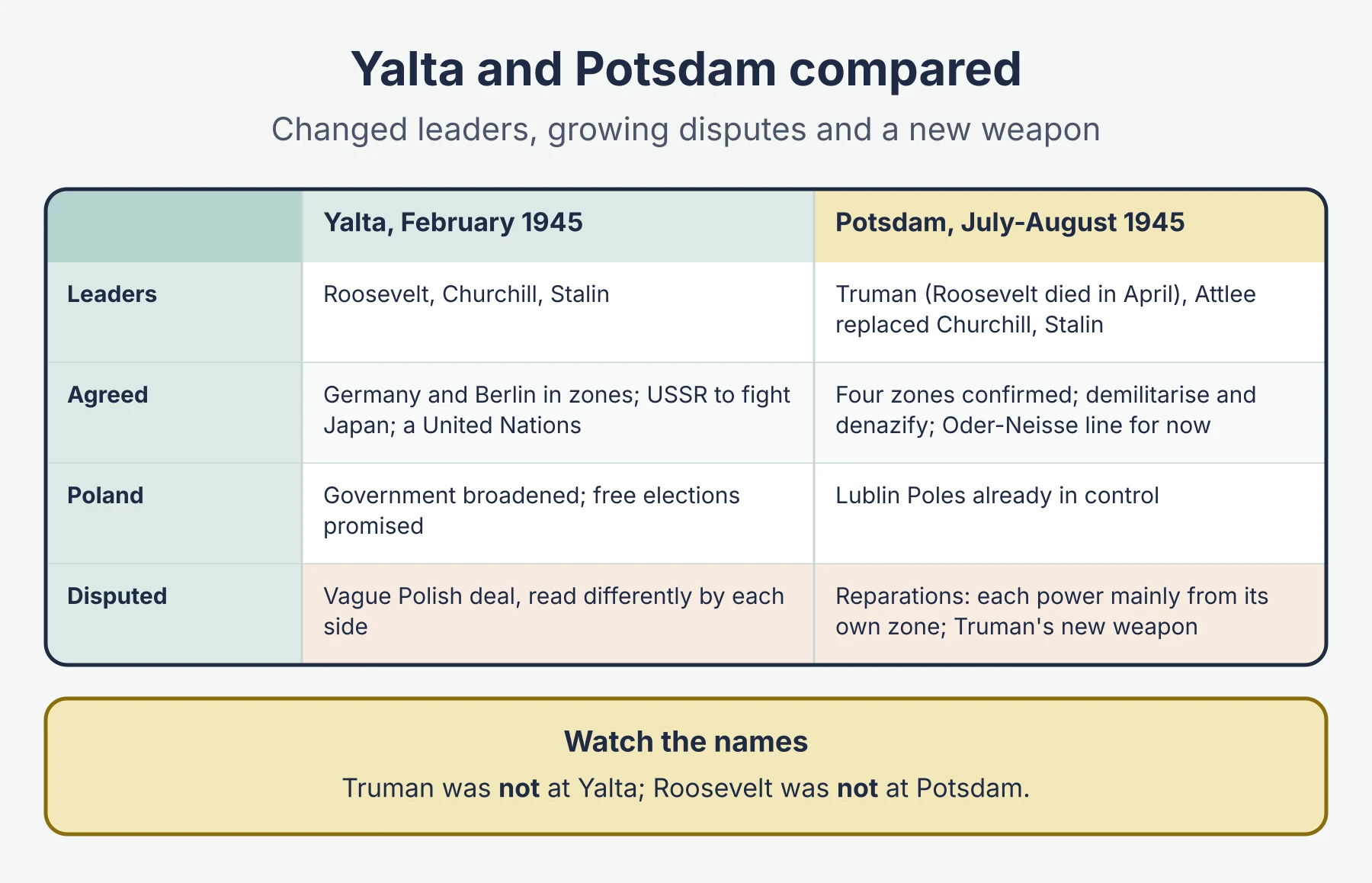
Yalta (February 1945). Roosevelt, Churchill and Stalin agreed that Germany and Berlin would be divided into zones of occupation, that the USSR would join the war against Japan after Germany’s defeat, and that a United Nations organisation would be set up. On Poland they reached a compromise: the Soviet-backed government would be broadened to include members of the Polish government in exile in London, and free elections would follow. The Declaration on Liberated Europe promised that liberated peoples could choose their own governments. Yalta is often seen as the high point of co-operation, but the Polish agreement was vague, and each side read it differently.
Potsdam (July-August 1945). The cast had changed. Roosevelt had died in April, and Truman distrusted Stalin far more; during the conference Churchill was replaced by Attlee after Labour won the British election. The leaders confirmed the four zones, agreed to demilitarise and denazify Germany, and accepted the Oder-Neisse line as Poland’s western border for the time being. They clashed over reparations, settling for each power taking them mainly from its own zone. Truman told Stalin of a powerful new weapon; the atomic bombs dropped on Japan in August showed what it was, and Stalin pushed ahead with a Soviet bomb.
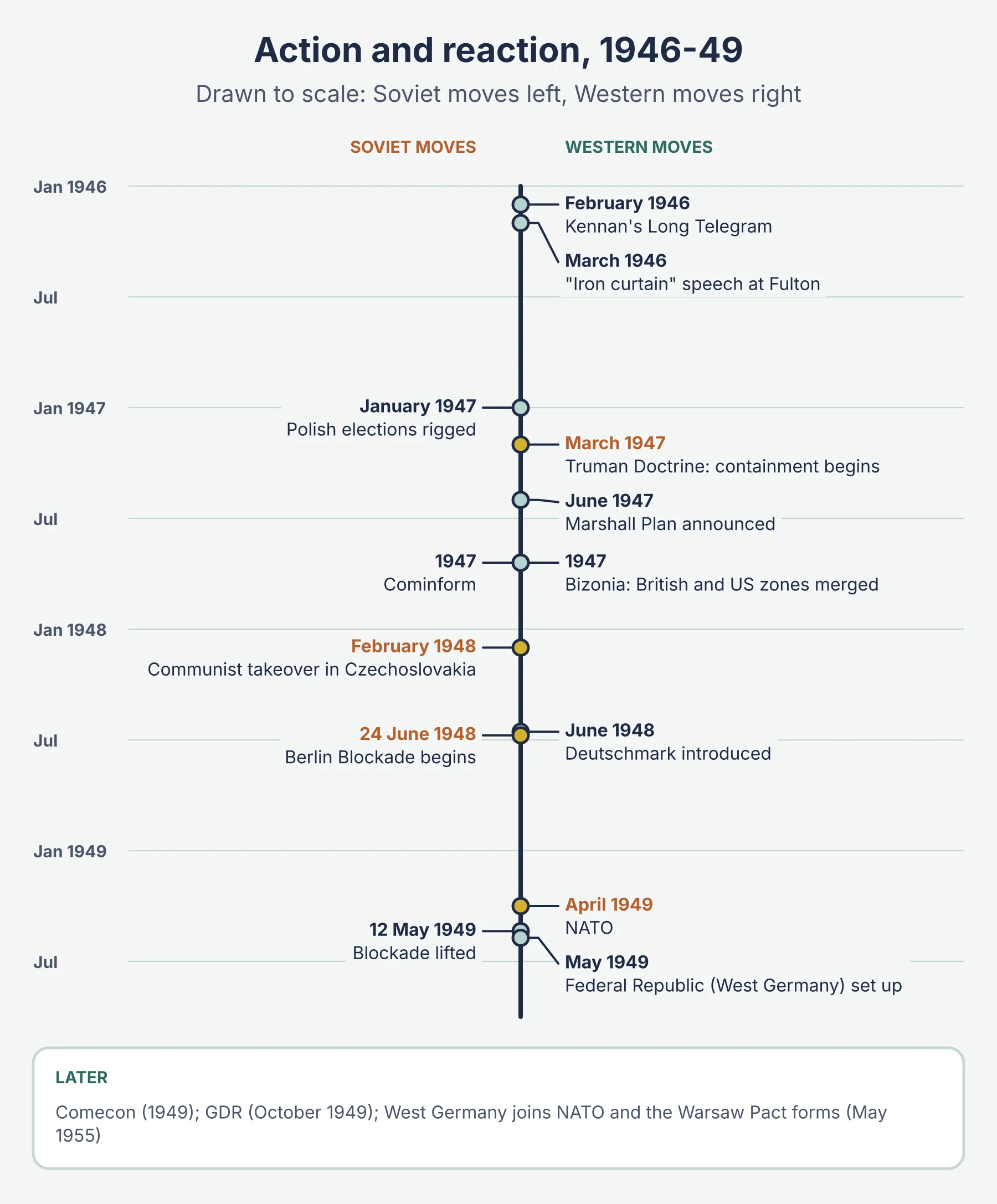
1946: words turn hostile. George Kennan’s “Long Telegram” from Moscow (February 1946) argued that the USSR was expansionist and would respond only to firmness. In March 1946, at Fulton, Missouri, Churchill (by then out of office) said an “iron curtain” had descended across Europe. Soviet troops stayed in northern Iran beyond the agreed date until American and UN pressure forced them out. Each side now saw the other’s actions as proof of hostile intent.
How had the USSR gained control of Eastern Europe by 1948?
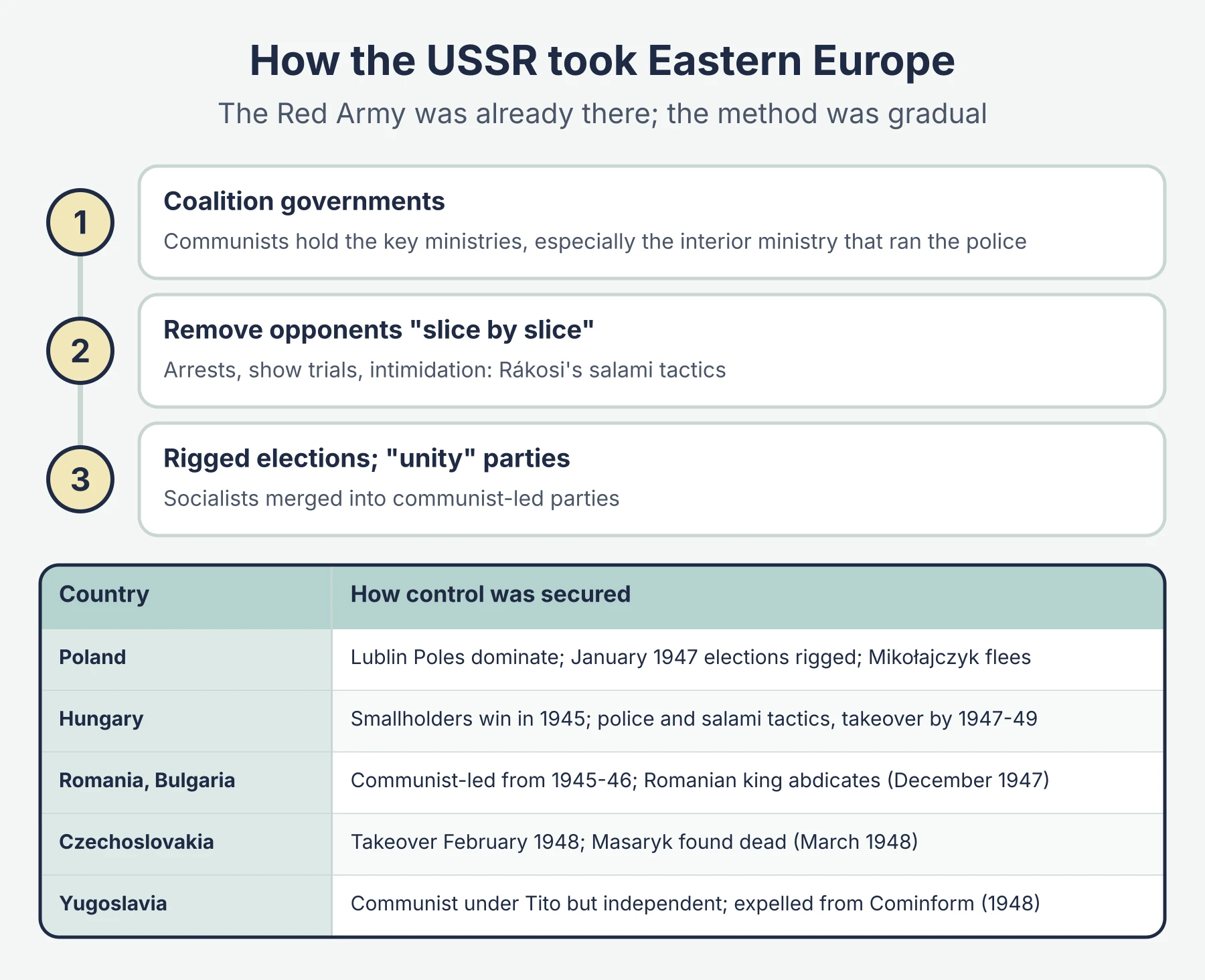
The key fact is that the Red Army was already there in 1945. Stalin wanted a buffer zone of friendly states, because Russia had been invaded through Poland in 1914 and 1941 and the war had cost well over 20 million Soviet lives. The method was usually gradual:
- Coalition governments in which communists held the key ministries, especially the interior ministry that ran the police.
- Removal of opponents by arrests, show trials and intimidation. The Hungarian communist leader Mátyás Rákosi called this cutting away rivals “slice by slice” (salami tactics).
- Rigged elections and the merger of socialist parties into communist-led “unity” parties.
| Country | How control was secured |
|---|---|
| Poland | Soviet-backed Lublin Poles dominated; elections of January 1947 rigged; opposition leader Mikołajczyk fled |
| Hungary | Smallholders won the 1945 election, but communists used the police and salami tactics to take over by 1947-49 |
| Romania and Bulgaria | Communist-led governments from 1945-46; the Romanian king forced to abdicate (December 1947) |
| Czechoslovakia | Communist takeover in February 1948; Foreign Minister Jan Masaryk found dead in March 1948 |
| Yugoslavia | Communist under Tito, but independent of Moscow; expelled from Cominform in 1948 |
Stalin tightened his grip with Cominform (1947), which co-ordinated communist parties, and Comecon (1949), which tied the satellites’ economies to the USSR.
How did the United States react?
- The Truman Doctrine (March 1947). When Britain could no longer afford to support the Greek government against communist guerrillas, Truman asked Congress for $400 million for Greece and Turkey and promised to support “free peoples” resisting subjugation. This was the start of containment: stopping communism spreading further.
- The Marshall Plan (announced June 1947). Economic aid to rebuild Europe, on the reasoning that poverty bred communism. About $13 billion went to western Europe from 1948. Stalin forbade the satellites to accept it and called it dollar imperialism; to Moscow it looked like an attempt to buy influence in its sphere.
The occupation of Germany and the Berlin Blockade
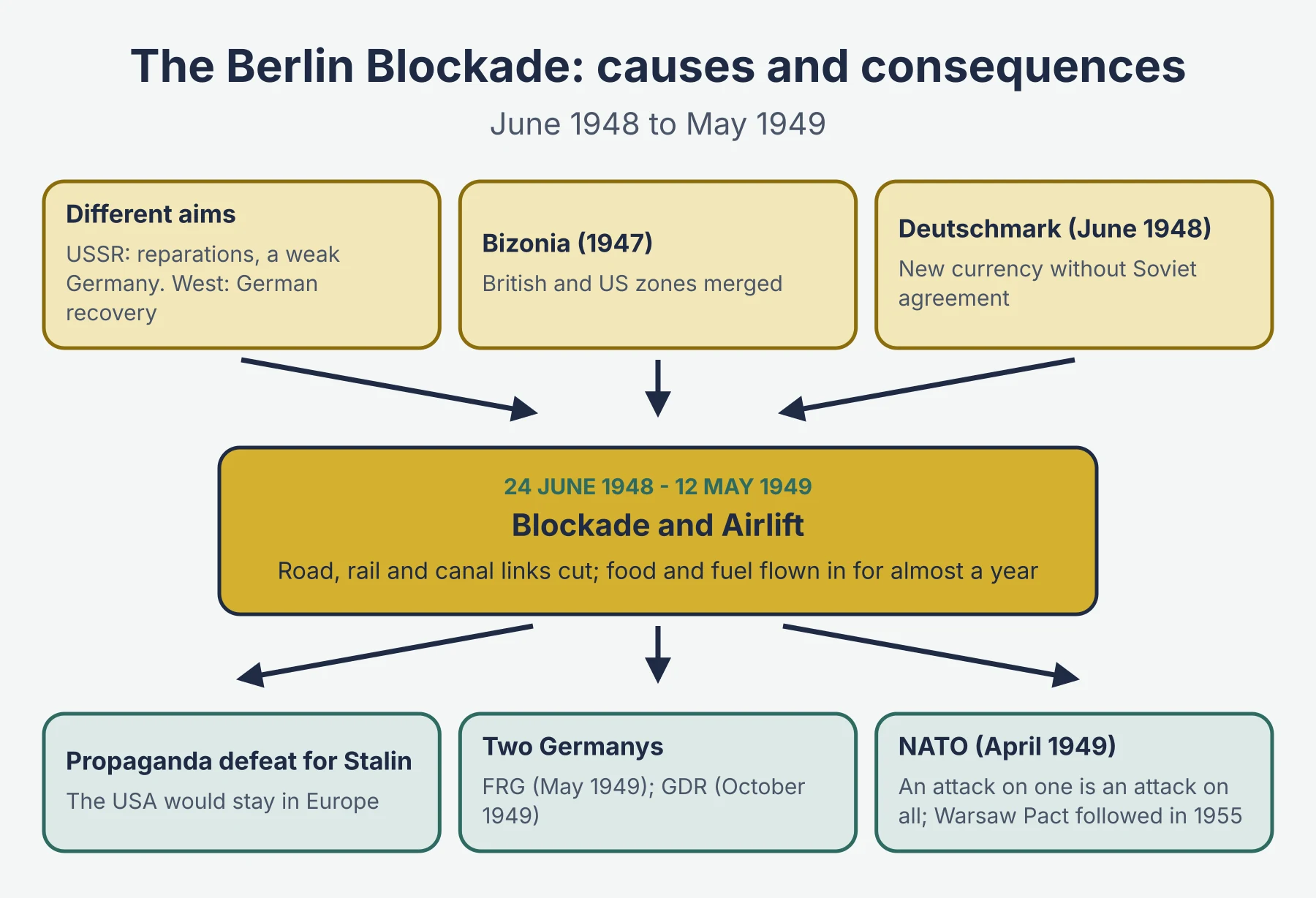
Germany and Berlin (deep inside the Soviet zone) were each divided into four zones. The USSR wanted reparations and a weak Germany; the western powers wanted German recovery to help rebuild Europe. Britain and the USA merged their zones into Bizonia (1947), and in June 1948 the western zones introduced a new currency, the Deutschmark, without Soviet agreement.
On 24 June 1948 Stalin cut all road, rail and canal links to West Berlin. The West answered with the Berlin Airlift, flying in food and fuel for almost a year. Stalin lifted the blockade on 12 May 1949.
Consequences. The blockade was a propaganda defeat for Stalin and showed the USA would stay in Europe. It hardened the division of Germany: the Federal Republic (West Germany) was set up in May 1949 and the German Democratic Republic (East Germany) in October 1949. It also led directly to NATO (April 1949), a military alliance in which members promised to treat an attack on one as an attack on all. When West Germany joined NATO in 1955, the USSR formed the Warsaw Pact (May 1955).
Who was more to blame?
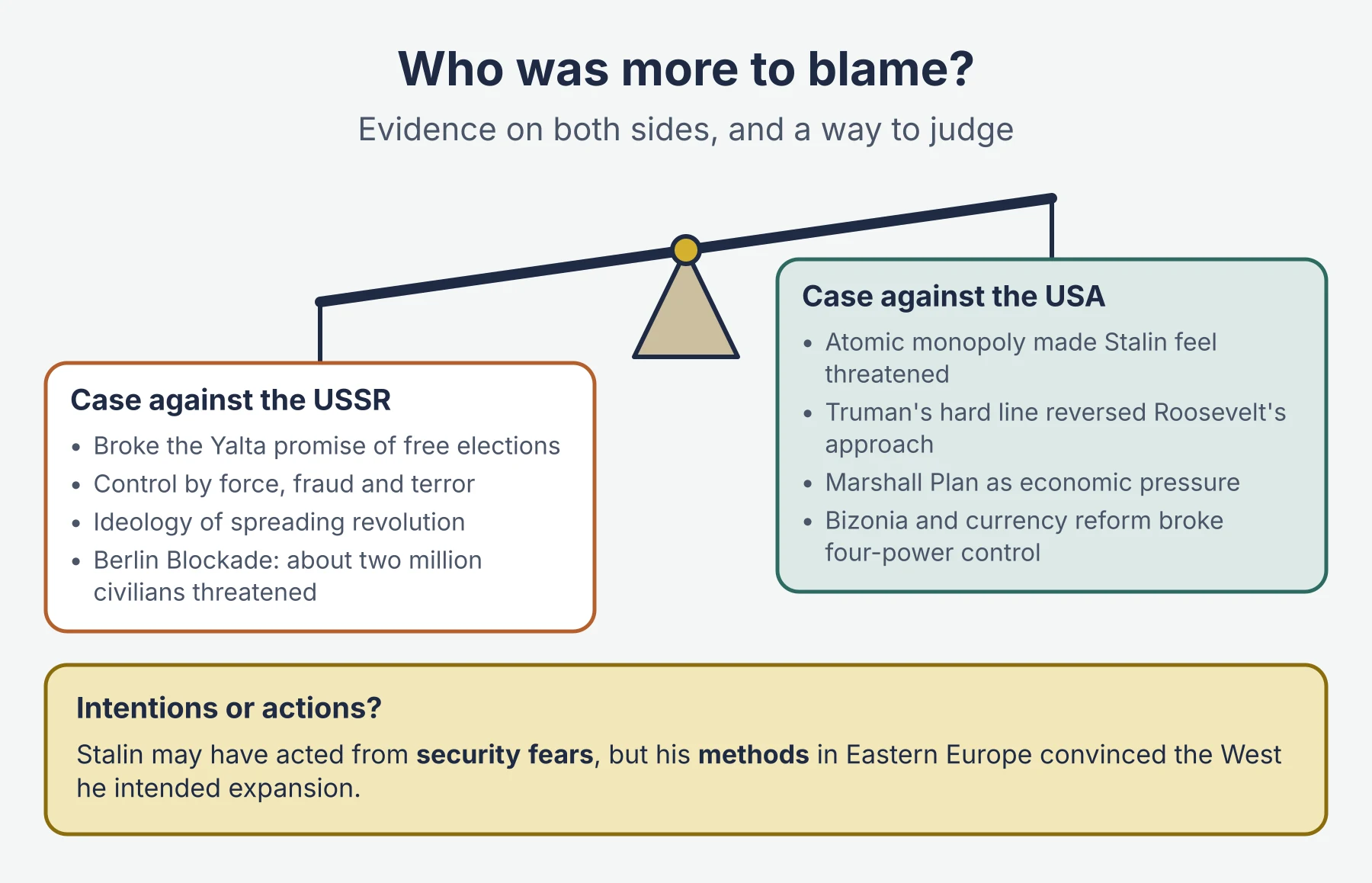
This is the judgement the (c) part asks for. Historians have argued three broad positions: the USSR was to blame (the view common in the West in the late 1940s and 1950s), the USA was to blame (a revisionist view that grew in the 1960s), and both share the blame through mutual fear and misunderstanding (a later post-revisionist view). You do not need historians’ names; you need evidence on both sides.
| Case against the USSR | Case against the USA |
|---|---|
| Broke the Yalta promise of free elections in Eastern Europe | Atomic monopoly made Stalin feel threatened |
| Took control by force, fraud and terror | Truman’s hard line reversed Roosevelt’s approach |
| Communist ideology aimed at spreading revolution | Marshall Plan seen as economic pressure on the Soviet sphere |
| Started the Berlin Blockade, threatening about two million civilians | Western currency reform and Bizonia broke four-power control of Germany |
A strong judgement often distinguishes intentions from actions: Stalin may have acted mainly from security fears, but his methods in Eastern Europe convinced the West that he intended expansion.
Worked example: a (b) answer
Why did the US-Soviet alliance break down in 1945? [6]
One reason was disagreement over Poland. At Yalta Stalin agreed to broaden the Polish government and allow free elections, but by Potsdam his Lublin Poles were in control. Truman saw this as a broken promise, so trust collapsed. A second reason was the atomic bomb. Truman told Stalin of the weapon at Potsdam without sharing it, and its use in August 1945 made Stalin fear the USA would use its monopoly to pressure the USSR, so he became more determined to secure Eastern Europe.
Why it works: two reasons, each linked to the breakdown with “so”, each supported by specific detail. That reaches the top level for (b).
Worked example: a (c) plan
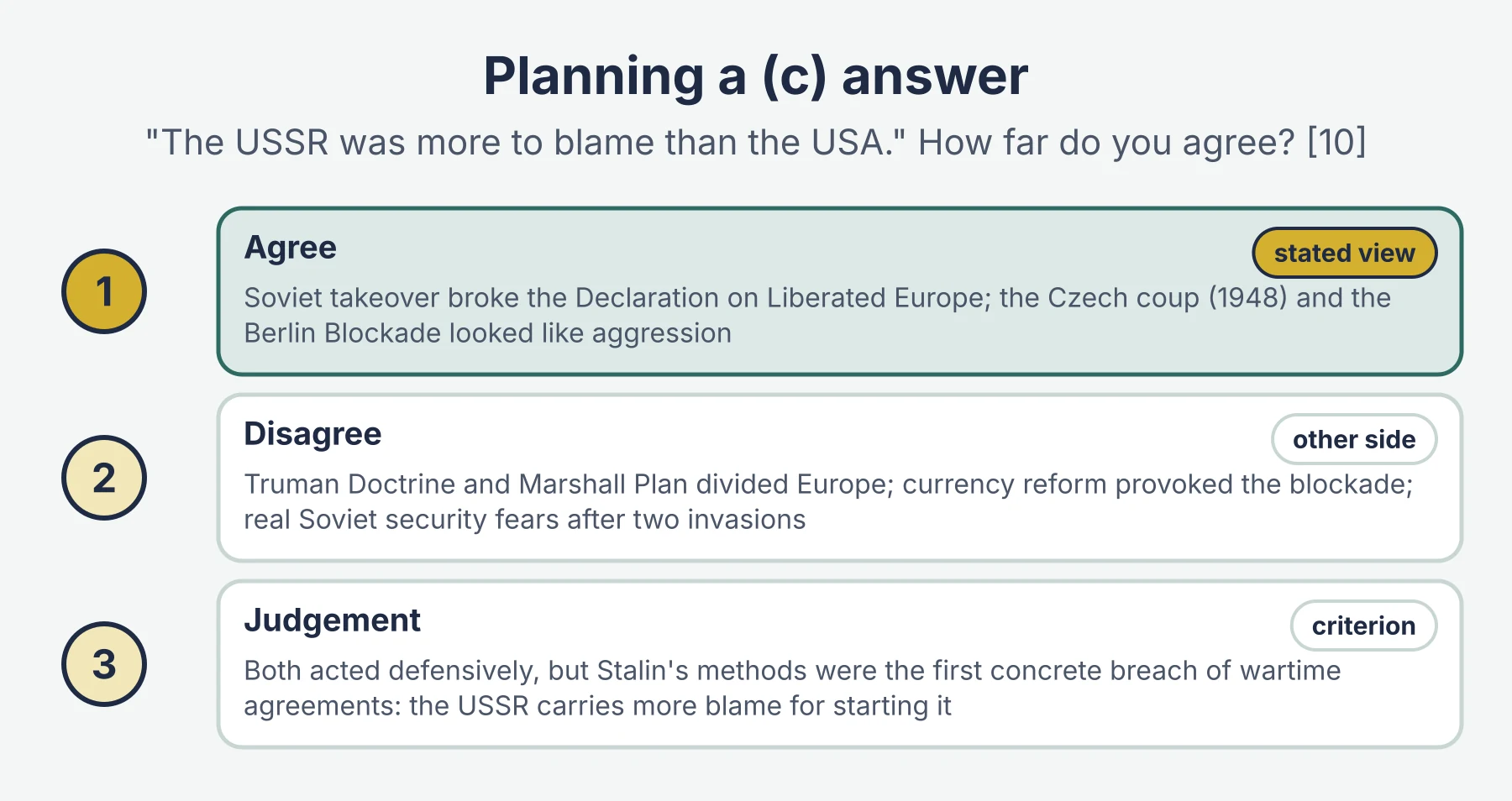
“The USSR was more to blame than the USA for the Cold War.” How far do you agree? [10]
- Agree: Soviet takeover of Eastern Europe broke the Declaration on Liberated Europe; the Czech coup of 1948 and the Berlin Blockade looked like aggression.
- Disagree: the Truman Doctrine and Marshall Plan divided Europe economically and ideologically; western currency reform provoked the blockade; Soviet security fears were real after two invasions.
- Judgement: for example, both sides acted defensively, but Stalin’s methods in Eastern Europe were the first concrete breach of wartime agreements, so the USSR carries more of the blame for starting it.
Common mistakes
- Putting Truman at Yalta or Roosevelt at Potsdam.
- Saying Churchill was prime minister when he gave the Fulton speech in 1946.
- Describing the Marshall Plan as military aid; it was economic. The Truman Doctrine was the political statement.
- Confusing the Berlin Blockade (1948-49) with the Berlin Wall (1961, key question 6).
- Dating the Warsaw Pact to 1949. It was 1955, after West Germany joined NATO.
- Writing a one-sided (c) answer that blames one superpower without explaining the other side.
Exam technique
- Describe (a): four accurate, specific points earn the marks; no need for analysis.
- Explain (b): give two separate reasons, each with a specific example and a “because” or “so” that links it to the question.
- How far (c): explain both sides, then reach a judgement that states what “more to blame” depends on, such as who broke agreements first.
Official syllabus
Cambridge IGCSE History (0470) syllabus for 2024, 2025 and 2026, Core Content Option B, key question 4 – cambridgeinternational.org.
Related resources
-
Practice questions
Cambridge IGCSE World History (0470): Who Was to Blame for the Cold War? – Practice Questions
Twelve original questions with mark-scheme answers on the origins of the Cold War, 1945-55, for Cambridge IGCSE History 0470 key question 2.4.
World History · Cambridge · IGCSE
Try questions -
Revision notes
Cambridge IGCSE World History (0470): Who Was to Blame for the Cold War? – Revision Notes
Recall notes for Cambridge IGCSE History 0470 key question 2.4: Yalta, Potsdam, Soviet takeover of Eastern Europe, Truman's response, Berlin and NATO.
World History · Cambridge · IGCSE
Revise topic -
Study guides
Cambridge IGCSE World History (0470): How Effectively Did the United States Contain the Spread of Communism?
Study guide to Cambridge IGCSE History 0470 key question 2.5: US decisions in Korea, Cuba and Vietnam, how to judge effectiveness, and Paper 2 source skills.
World History · Cambridge · IGCSE
Read guide
Get free revision emails (optional)
Occasional emails with practice questions, worked explanations and links to free resources for the qualification and subjects you choose. No spam, and you can unsubscribe from any email. The free tools on this site never need an email.