
Study Guides
Cambridge IGCSE World History (0470): How Effectively Did the United States Contain the Spread of Communism?
Study guide to Cambridge IGCSE History 0470 key question 2.5: US decisions in Korea, Cuba and Vietnam, how to judge effectiveness, and Paper 2 source skills.
- Subject
- World History
- Level
- IGCSE
- Topic
- Core Content – Option B: International Relations since 1919
- Author
- Marlbridge Academic Team
- Updated
- Reviewed by
- Azam Siddique (what this means)
Aligned to Cambridge IGCSE World History (0470), 2024-2026. Official specification .
Syllabus page (what it covers and how it is assessed): Cambridge IGCSE World History.
Syllabus points this page covers
0470
- 2.5 How effectively did the United States contain the spread of communism?
Found an error? Report a correction.
Need help with this topic? Request a free trial class for IGCSE World History (0470).
This guide covers key question 5 of Core Content Option B in Cambridge IGCSE History 0470 (2024-2026): “How effectively did the United States contain the spread of communism?” The syllabus explores it through three case studies: the United States and events in Korea, 1950-53, in Cuba, 1959-62, and American involvement in Vietnam, 1955-75. The specified content asks for American reactions to North Korea’s invasion of the South, the role of the UN and the course of the war to 1953; American reactions to the Cuban Revolution, the Missile Crisis and its aftermath; and the reasons for involvement in Vietnam, tactics and strategy, and reasons for withdrawal.
This page concentrates on the decisions American leaders took in each case and on how to judge effectiveness. For the narrative of each case study, read the Korea, Cuba and Vietnam overview. Condensed facts are in the containment revision notes and you can test yourself with the containment practice questions.
Where this key question is examined
On Paper 1 it can appear in Section A as one of the questions set from key questions 4-6. It is also named in the syllabus as the Paper 2 prescribed topic for June 2024 and for November 2026 (and for March 2026 in India), so many candidates will meet it as a document paper. Prescribed topics change each series, so check which applies to your exam.
What “containment” committed the USA to
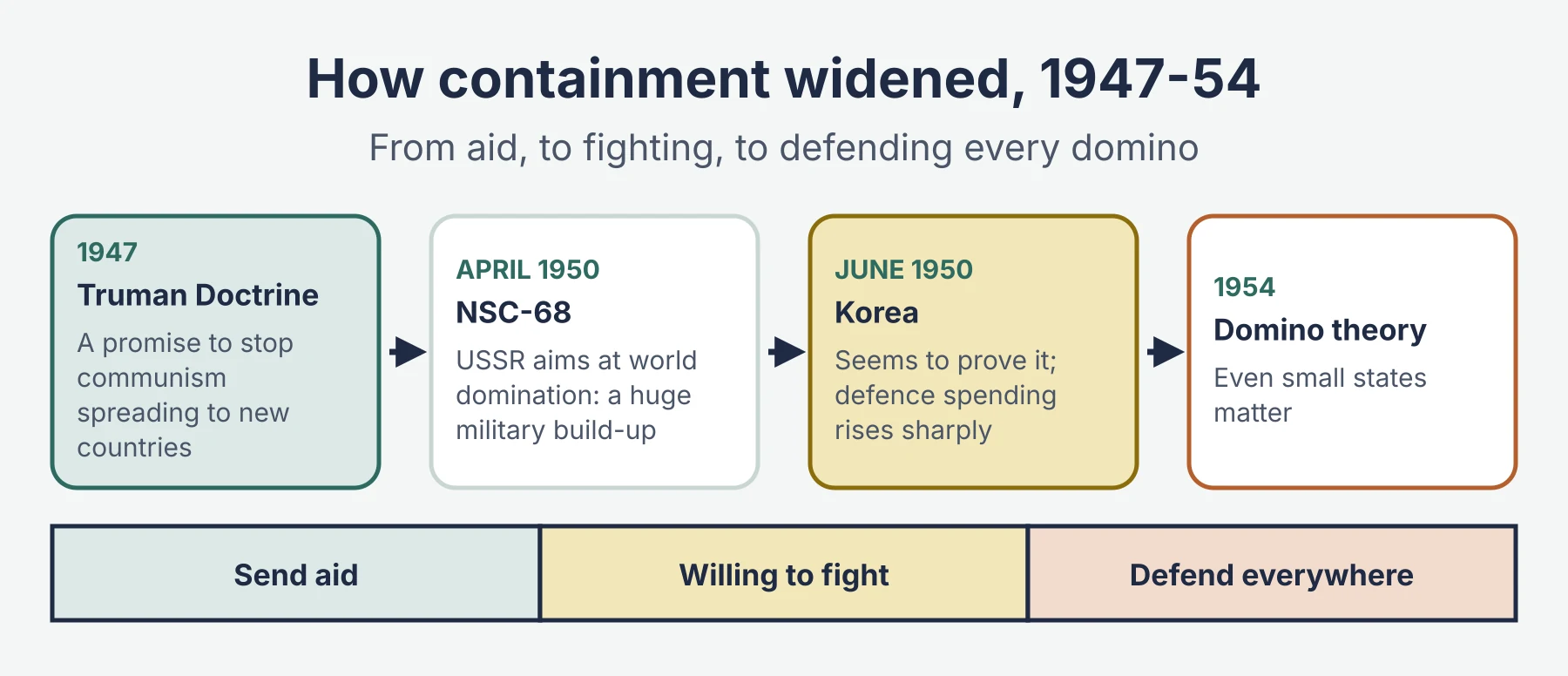
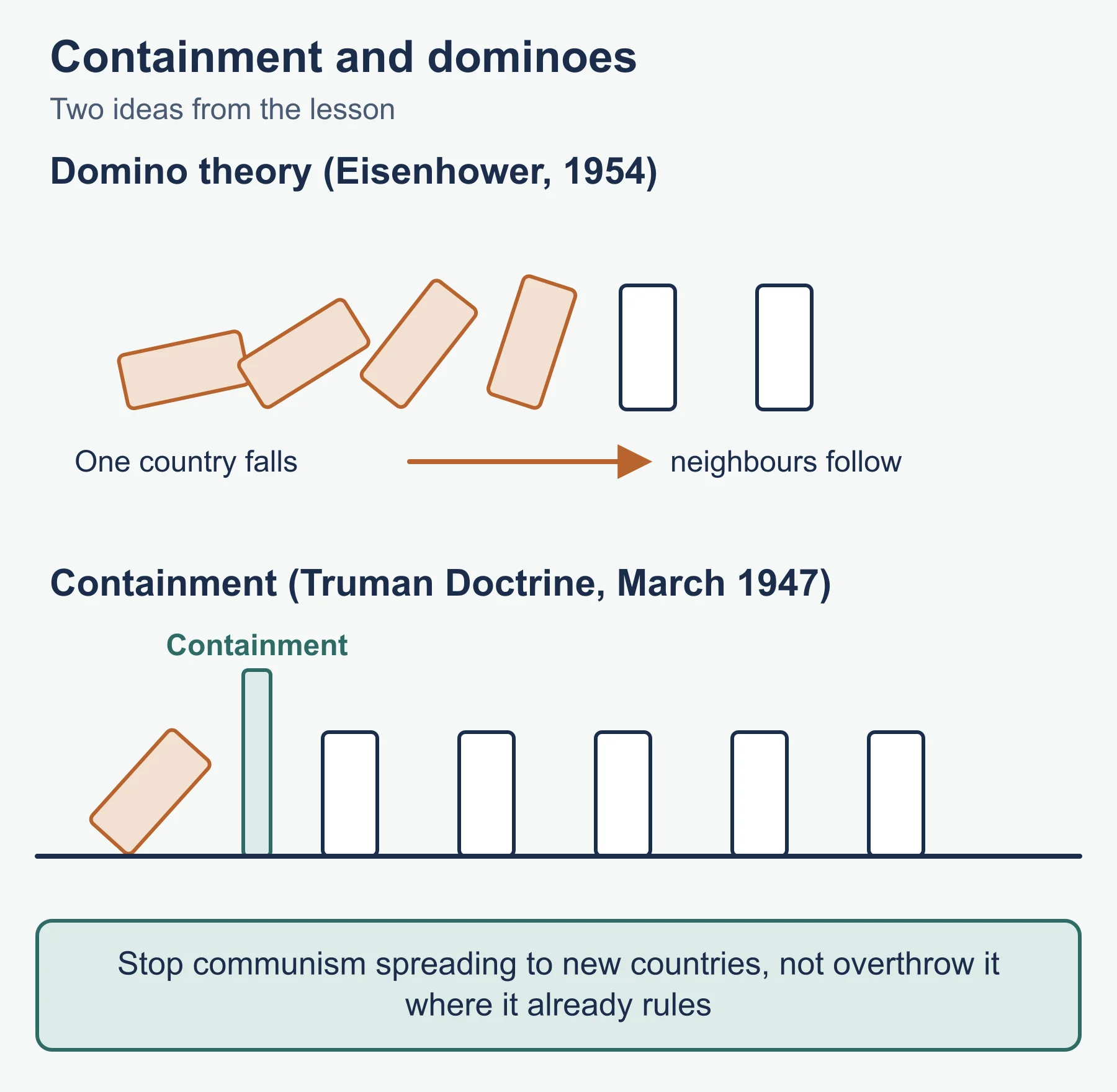
Containment began with the Truman Doctrine in 1947 as a promise to stop communism spreading to new countries. In April 1950 a secret policy paper, NSC-68, argued that the USSR aimed at world domination and that the USA needed a huge military build-up to resist it everywhere. The outbreak of war in Korea two months later seemed to prove the point, and American defence spending rose sharply. From then on, containment meant a willingness to fight, not only to send aid. Eisenhower’s domino theory (1954) widened it further: the loss of one country would lead to the loss of its neighbours, so even small states mattered.
Korea, 1950-53: key decisions
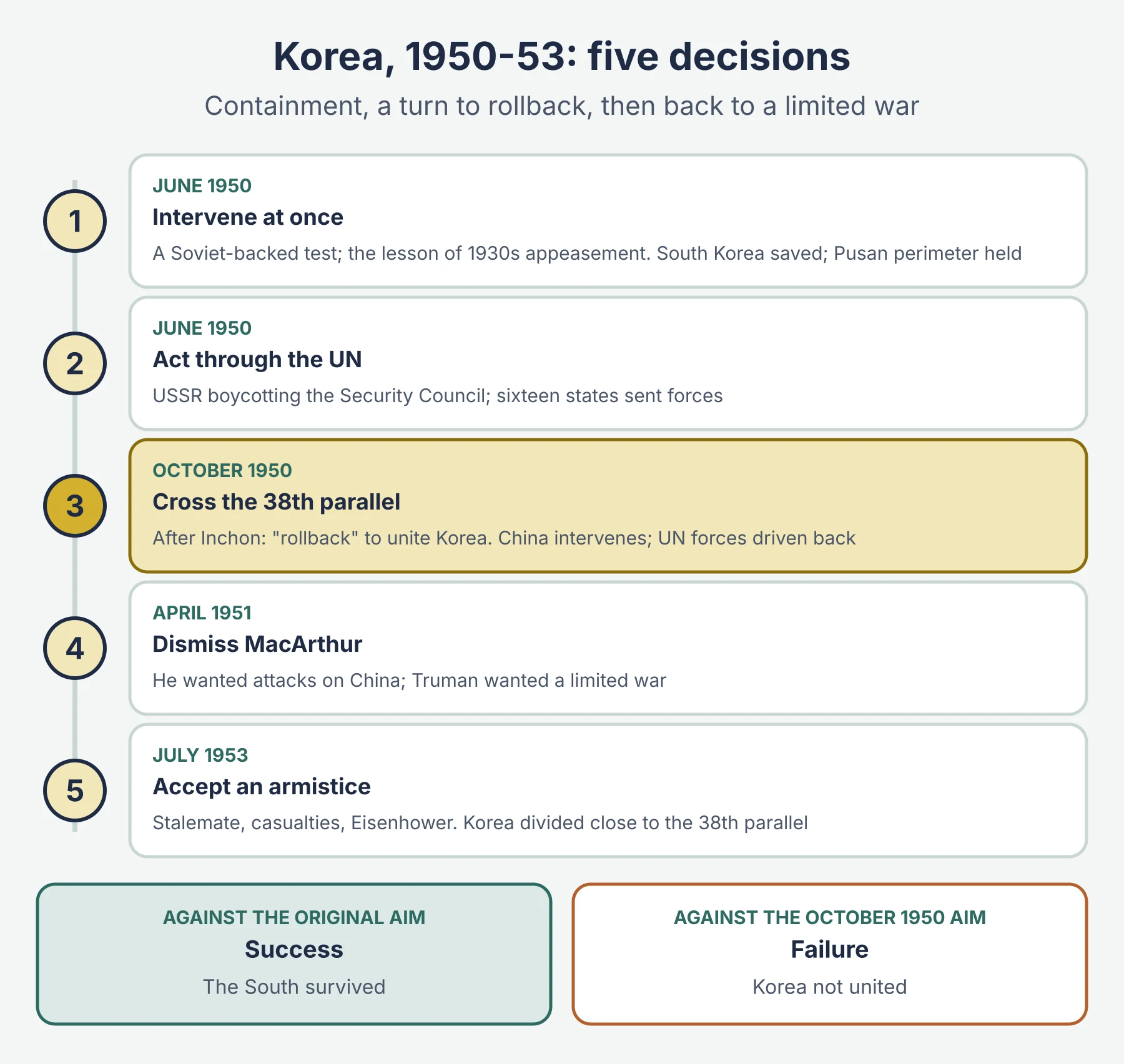
| Decision | Why it was taken | Effect |
|---|---|---|
| Intervene at once (June 1950) | Truman saw the invasion as a Soviet-backed test; appeasement in the 1930s had shown the cost of not acting | South Korea saved from collapse; US troops held the Pusan perimeter |
| Act through the UN | Gave the action international legitimacy; the USSR was boycotting the Security Council over China’s seat | Sixteen member states sent fighting forces, though the USA provided most |
| Cross the 38th parallel (October 1950) | Success at Inchon tempted Truman to unite Korea, moving from containment to “rollback” | China intervened, and UN forces were driven back south |
| Dismiss MacArthur (April 1951) | MacArthur publicly demanded attacks on China; Truman wanted a limited war | Avoided a wider war with China and possibly the USSR |
| Accept an armistice (July 1953) | Stalemate, rising casualties and a new president, Eisenhower, keen to end the war | Korea stayed divided close to the 38th parallel |
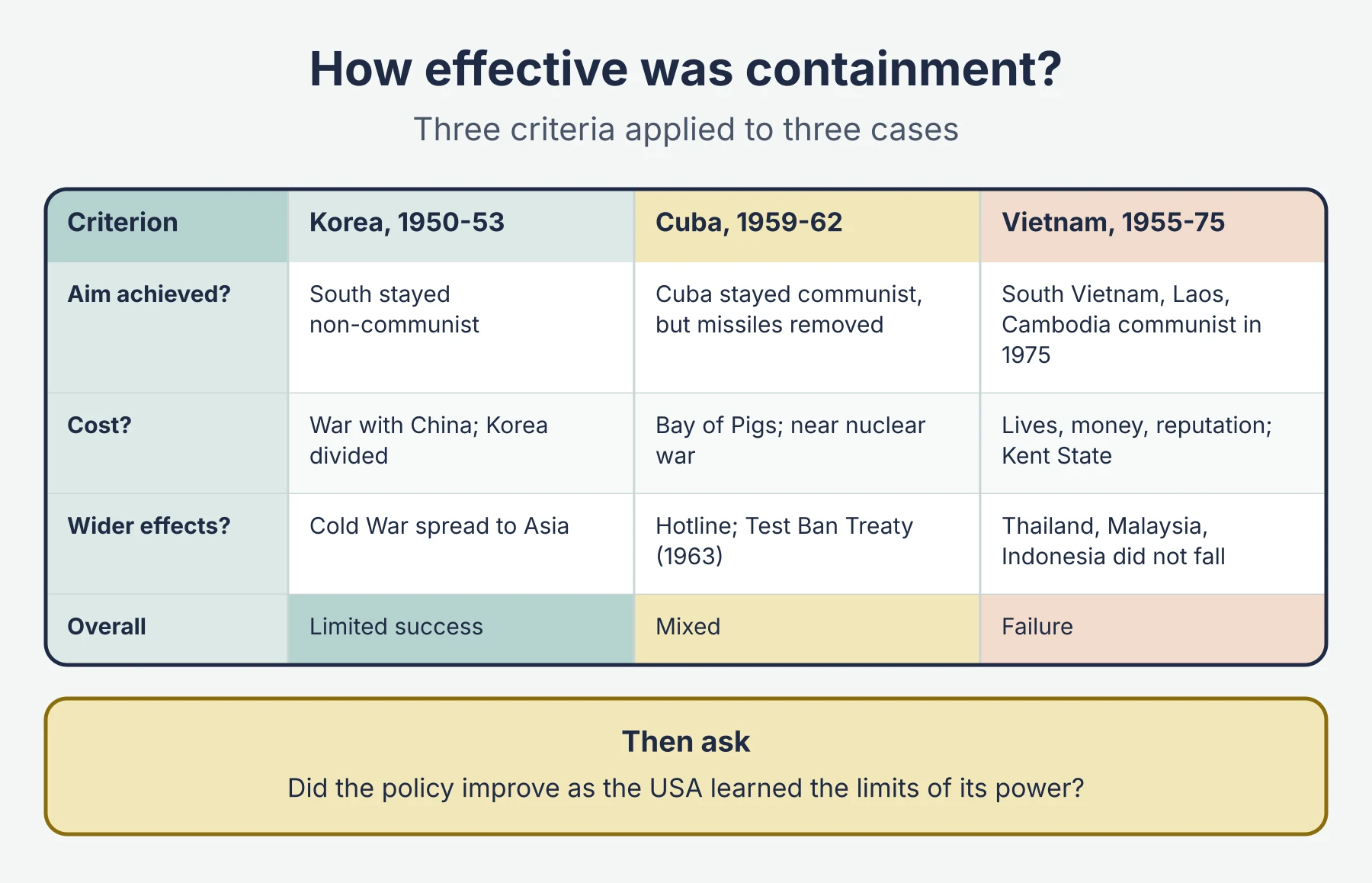
Judging Korea. Measured against the original aim, containment worked: the South survived. Measured against the October 1950 aim of uniting Korea, it failed. Korea also widened the Cold War: the USA now treated China as an enemy, built up its forces and signed defensive pacts in Asia.
Cuba, 1959-62: a containment failure, then a success
American reactions to the revolution. Castro’s land reform and nationalisation hit American companies. The Eisenhower administration cut imports of Cuban sugar (1960), banned most exports to Cuba and broke off diplomatic relations in January 1961. Each step pushed Castro towards the USSR, which agreed to buy Cuban sugar and supply oil. The CIA plan inherited by Kennedy, the Bay of Pigs landing of April 1961, failed in days and convinced Castro and Khrushchev that an American invasion would follow. Covert sabotage (Operation Mongoose) and Cuba’s expulsion from the Organisation of American States in January 1962 kept the pressure on.
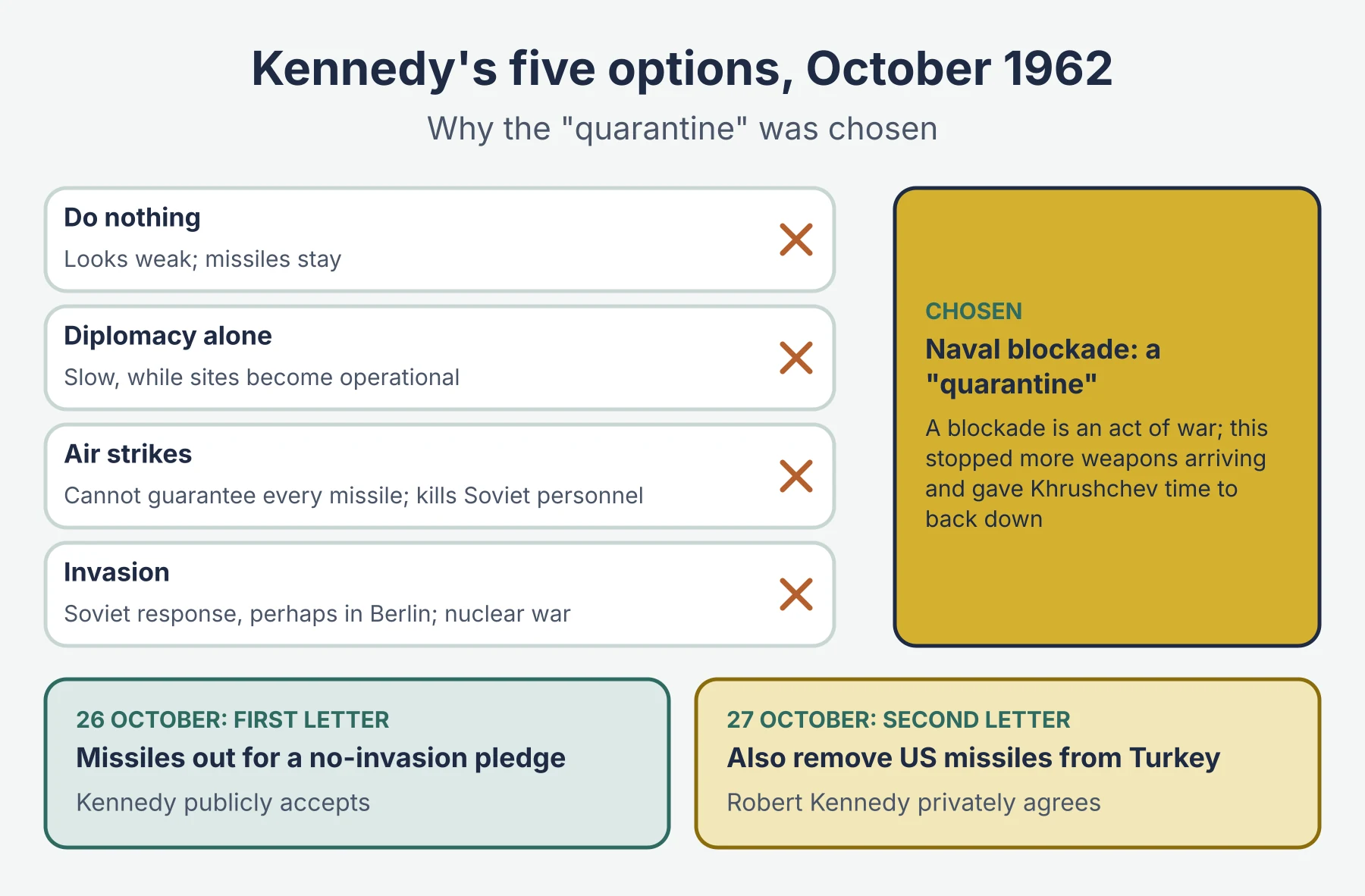
The Missile Crisis: Kennedy’s options. After U-2 photographs revealed Soviet missile sites in October 1962, Kennedy’s advisers (the ExComm) weighed:
- Do nothing – would look weak and leave the missiles in place.
- Diplomacy alone – slow, while the sites became operational.
- Air strikes – could not guarantee destroying every missile and would kill Soviet personnel.
- Invasion – risked a Soviet response, possibly in Berlin, and nuclear war.
- Naval blockade – chosen, and called a “quarantine” because a blockade is an act of war. It stopped further weapons arriving and gave Khrushchev time to back down.
Khrushchev’s first letter (26 October) offered to remove the missiles for a pledge not to invade Cuba; his second (27 October) added the removal of American missiles from Turkey. Kennedy publicly accepted the first, while his brother Robert privately assured the Soviet ambassador that the Turkish missiles would go.
Judging Cuba. Containment failed to prevent a communist state 145 kilometres from Florida, and the Bay of Pigs made things worse. But the crisis kept Soviet nuclear missiles out of the Americas without war, and the hotline and Partial Test Ban Treaty of 1963 began a period of more careful superpower relations.
Vietnam, 1955-75: why containment failed
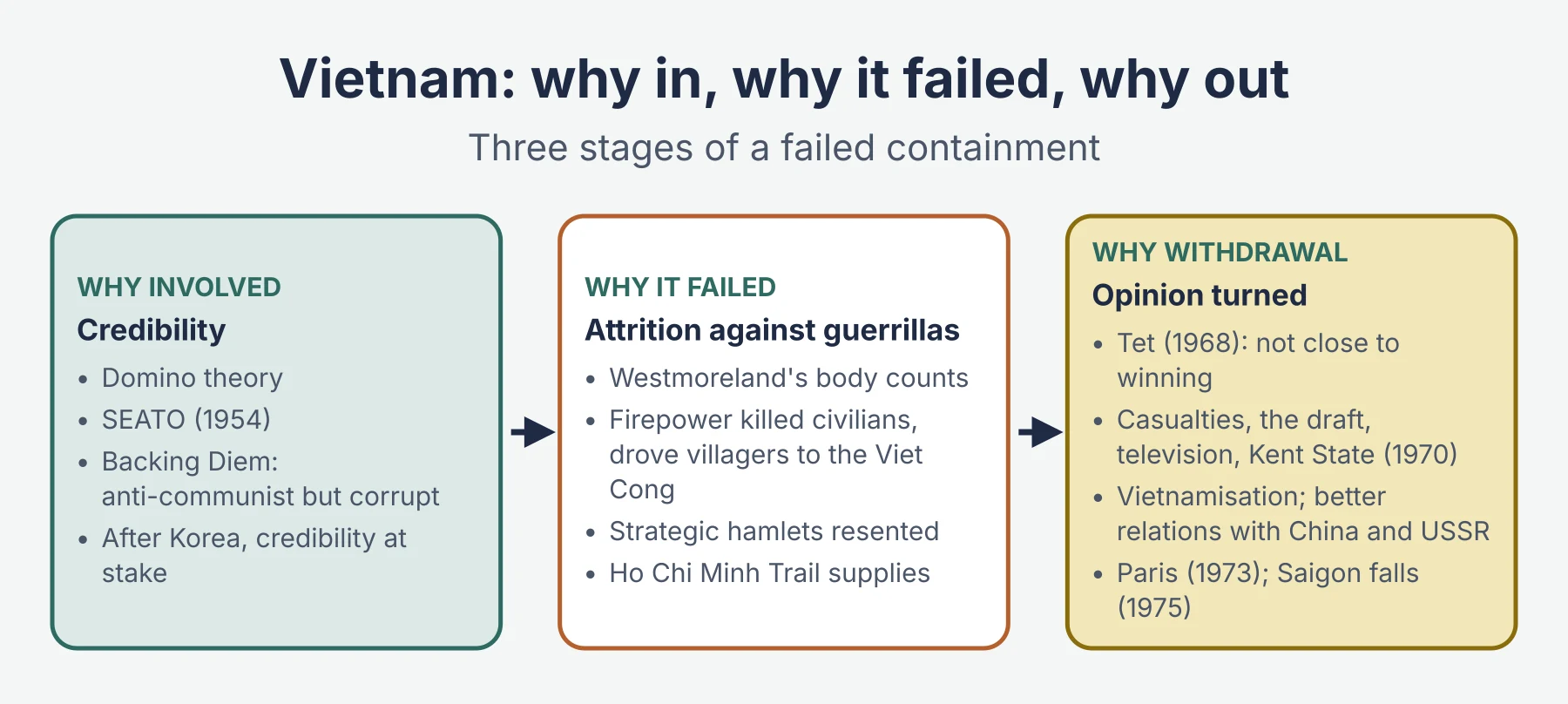
Reasons for involvement: the domino theory; the creation of SEATO (1954) to defend South-East Asia; backing for Ngo Dinh Diem, a strong anti-communist, even though his government was corrupt and favoured the Catholic minority; and a belief after Korea that American credibility was at stake.
Tactics and strategy. Under General Westmoreland the USA fought a war of attrition: kill more enemy fighters than could be replaced, measured by “body counts”. Search-and-destroy missions, the bombing of the North and chemical defoliation of the jungle used enormous firepower but often killed civilians and drove villagers towards the Viet Cong. The strategic hamlet programme, which moved peasants into fortified villages, was resented. The Viet Cong fought a guerrilla war, avoided pitched battles, hid among the population and were supplied along the Ho Chi Minh Trail through Laos and Cambodia.
Reasons for withdrawal. The Tet Offensive (1968) was a military defeat for the communists but showed Americans that the war was not close to being won; Johnson announced he would not stand for re-election. Rising casualties, the draft, television coverage and protest (four students were shot dead at Kent State University in May 1970) turned opinion against the war. Nixon’s Vietnamisation handed the fighting to South Vietnam’s army while American troops were withdrawn, and improved relations with China and the USSR made Vietnam seem less vital. The Paris Peace Accords (1973) ended American combat involvement; Congress then limited further aid, and Saigon fell in 1975.
Judging Vietnam. By its own aim, a clear failure: South Vietnam, Laos and Cambodia all became communist in 1975. Yet the wider dominoes, such as Thailand, Malaysia and Indonesia, did not fall, which some use to argue the policy bought time for the rest of the region.
How to judge “how effectively”
Use explicit criteria and apply them to each case:
- Aim achieved? Did the country concerned stay or become non-communist?
- Cost? Lives, money and American reputation.
- Wider consequences? Did the action strengthen or weaken the USA’s position in the Cold War?
A sound overall judgement often ranks the cases: Korea as a limited success, Cuba as mixed, Vietnam as a failure, then asks whether the policy improved as the USA learned the limits of its power.
Worked example: a (c) plan
“The Cuban Missile Crisis was a success for containment.” How far do you agree? [10]
- Agree: the missiles were removed; the USA secured this without war; the blockade showed firmness while leaving Khrushchev a way out; a hotline and test ban treaty followed.
- Disagree: Castro stayed in power and Cuba remained communist and allied to Moscow; the USA had to promise not to invade and secretly remove its Turkish missiles; the world came close to nuclear war.
- Judgement: for example, a success in stopping the spread of Soviet military power, but not in removing communism from Cuba, so a partial success.
Paper 2 source skills for this topic
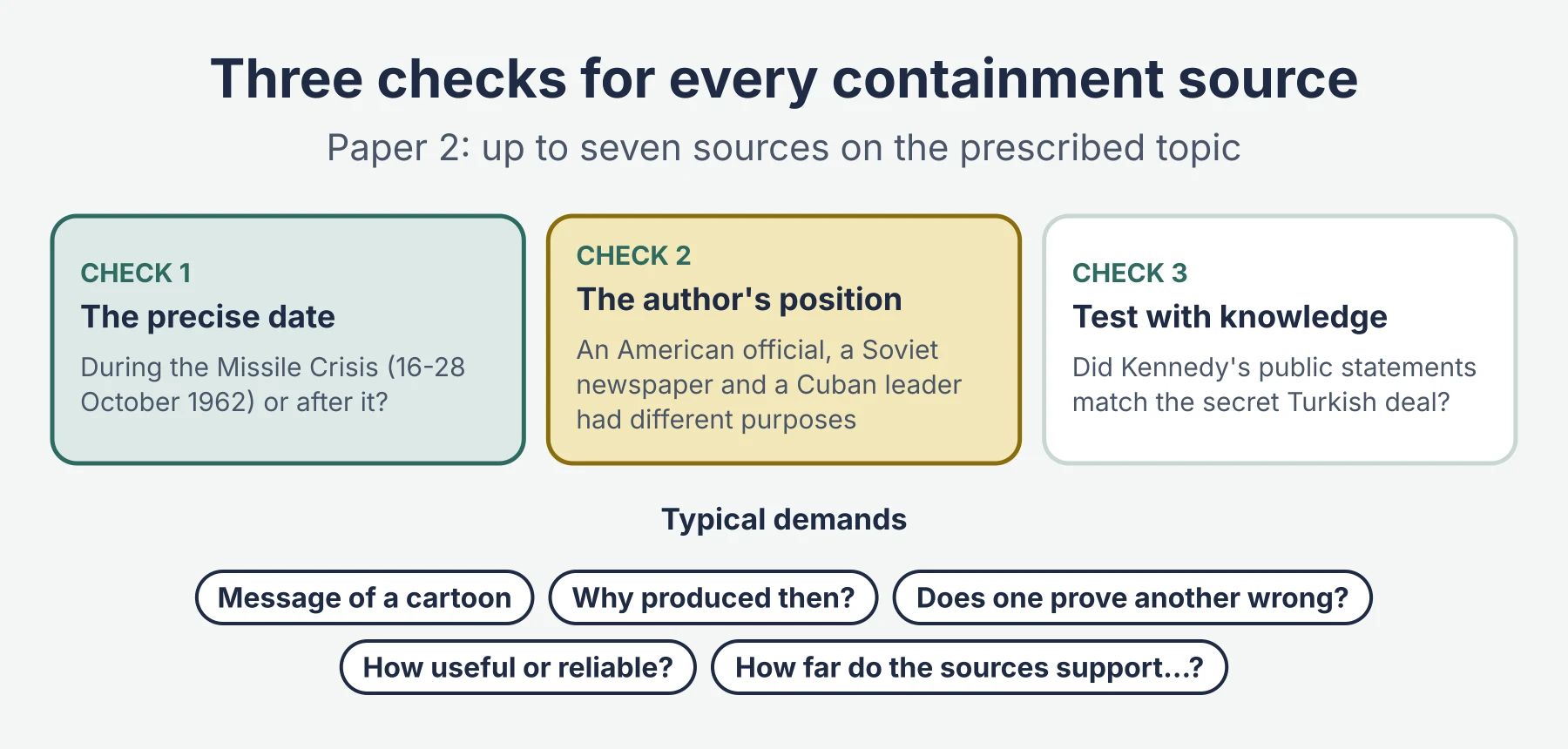
Paper 2 sets one question with up to seven sources on the prescribed topic. Typical demands include the message of a cartoon, why a source was produced at a particular time, whether one source proves another wrong, how useful or reliable a source is, and how far the sources support a statement. For containment sources:
- Know the date precisely. A speech during the Missile Crisis (16-28 October 1962) means something different from one after it.
- Identify the author’s position. An American official, a Soviet newspaper and a Cuban leader had different purposes.
- Use your case-study knowledge to test claims, for example whether Kennedy’s public statements matched the secret Turkish deal.
Common mistakes
- Treating containment as the same thing as destroying communism. Containment meant stopping its spread.
- Forgetting that the Korean War was fought under the UN flag.
- Giving the Bay of Pigs as part of the Missile Crisis; it came eighteen months earlier.
- Describing the Tet Offensive as a communist military victory.
- Judging each case without a criterion, so “effective” is never defined.
Official syllabus
Cambridge IGCSE History (0470) syllabus for 2024, 2025 and 2026, Core Content Option B, key question 5 – cambridgeinternational.org.
Related resources
-
Practice questions
Cambridge IGCSE World History (0470): How Effectively Did the United States Contain the Spread of Communism? – Practice Questions
Thirteen original questions with mark-scheme answers on US containment in Korea, Cuba and Vietnam for Cambridge IGCSE History 0470 key question 2.5.
World History · Cambridge · IGCSE
Try questions -
Revision notes
Cambridge IGCSE World History (0470): How Effectively Did the United States Contain the Spread of Communism? – Revision Notes
Recall notes for Cambridge IGCSE History 0470 key question 2.5: decision timelines for Korea, Cuba and Vietnam, key terms, exam traps and a self-test.
World History · Cambridge · IGCSE
Revise topic -
Study guides
Cambridge IGCSE World History (0470): How Far Was Hitler’s Foreign Policy to Blame for the Outbreak of War in Europe in 1939?
Study guide to Cambridge IGCSE History 0470 key question 2.3: Hitler's aims, the steps to war, appeasement, the Nazi-Soviet Pact and September 1939.
World History · Cambridge · IGCSE
Read guide
Get free revision emails (optional)
Occasional emails with practice questions, worked explanations and links to free resources for the qualification and subjects you choose. No spam, and you can unsubscribe from any email. The free tools on this site never need an email.