
Revision Notes
Cambridge IGCSE World History (0470): Who Was to Blame for the Cold War? – Revision Notes
Recall notes for Cambridge IGCSE History 0470 key question 2.4: Yalta, Potsdam, Soviet takeover of Eastern Europe, Truman's response, Berlin and NATO.
- Subject
- World History
- Level
- IGCSE
- Topic
- Core Content – Option B: International Relations since 1919
- Author
- Marlbridge Academic Team
- Updated
- Reviewed by
- Azam Siddique (what this means)
Aligned to Cambridge IGCSE World History (0470), 2024-2026. Official specification .
Syllabus page (what it covers and how it is assessed): Cambridge IGCSE World History.
Syllabus points this page covers
0470
- 2.4 Who was to blame for the Cold War?
Found an error? Report a correction.
Need help with this topic? Request a free trial class for IGCSE World History (0470).
These notes condense key question 4 of Core Content Option B in Cambridge IGCSE History 0470: “Who was to blame for the Cold War?” The specified content runs from the 1945 summit conferences to the formation of the Warsaw Pact in 1955. For explanation and worked answers, read the Cold War origins study guide; to apply the facts, try the Cold War origins practice questions.
Timeline to memorise
| Date | Event |
|---|---|
| February 1945 | Yalta Conference: Roosevelt, Churchill, Stalin |
| April 1945 | Roosevelt dies; Truman becomes president |
| July-August 1945 | Potsdam Conference: Truman, Stalin, Churchill then Attlee |
| August 1945 | Atomic bombs on Hiroshima and Nagasaki |
| February 1946 | Kennan’s Long Telegram |
| March 1946 | Churchill’s “iron curtain” speech at Fulton, Missouri |
| January 1947 | Rigged elections in Poland |
| March 1947 | Truman Doctrine: $400 million for Greece and Turkey |
| June 1947 | Marshall Plan announced |
| September 1947 | Cominform set up |
| February 1948 | Communist takeover in Czechoslovakia |
| June 1948 | Deutschmark introduced in western zones; Berlin Blockade begins (24 June) |
| January 1949 | Comecon set up |
| April 1949 | NATO founded |
| May 1949 | Blockade lifted (12 May); West Germany (FRG) founded |
| August 1949 | First Soviet atomic bomb test |
| October 1949 | East Germany (GDR) founded |
| May 1955 | West Germany joins NATO; Warsaw Pact formed |
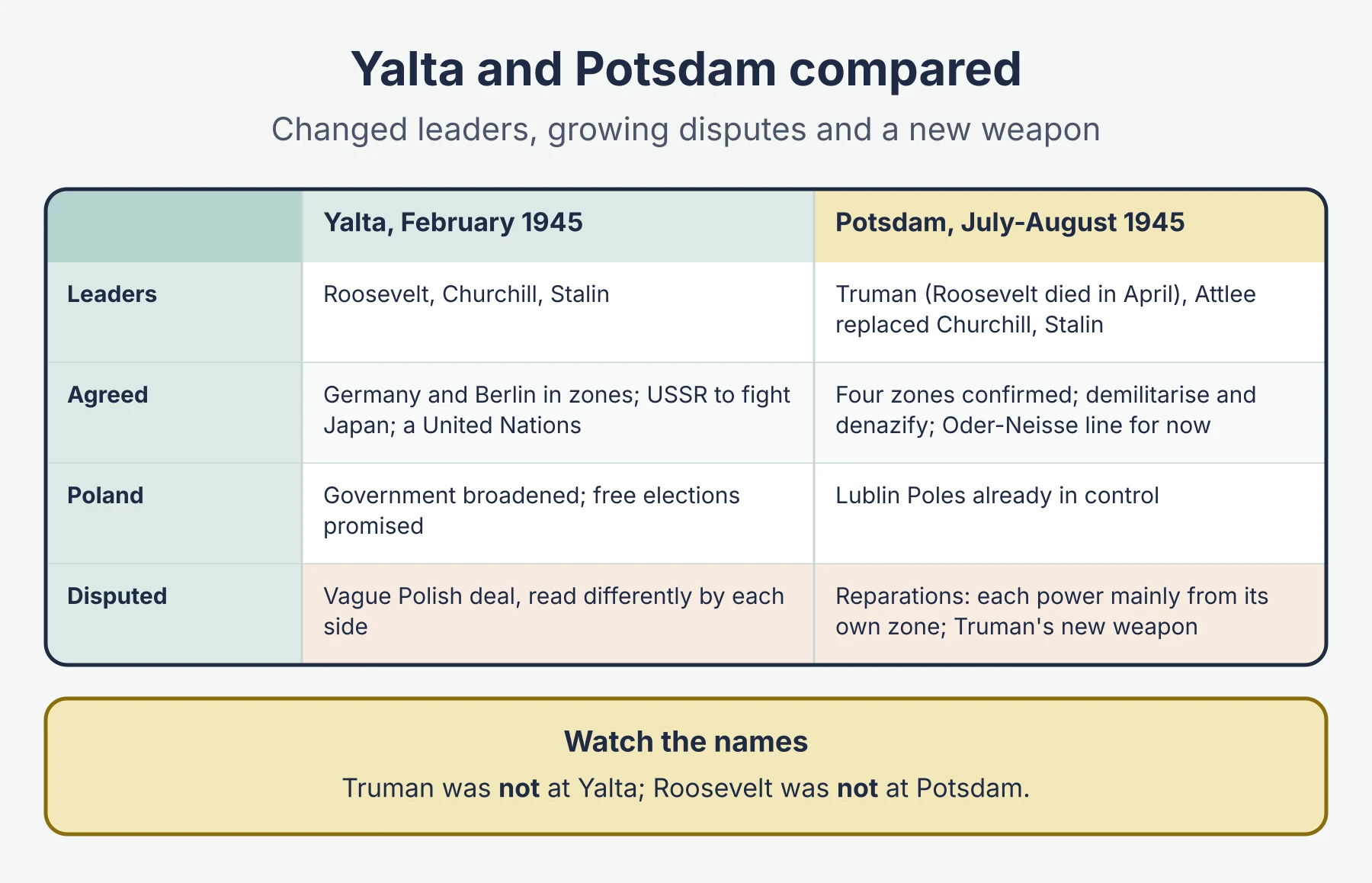
The two conferences compared
| Yalta, February 1945 | Potsdam, July-August 1945 | |
|---|---|---|
| Leaders | Roosevelt, Churchill, Stalin | Truman, Stalin, Churchill replaced by Attlee |
| Mood | Co-operative; war still being fought | Suspicious; Germany defeated |
| Germany | Division into four zones agreed in principle | Zones confirmed; denazification and demilitarisation |
| Poland | Government to be broadened; free elections promised | Oder-Neisse line as western border for now; Lublin Poles in power |
| Disputes | Size of reparations; meaning of “free elections” | Reparations from own zones; Soviet control of Eastern Europe |
| Other | USSR to fight Japan; United Nations planned | Truman mentions a new weapon |
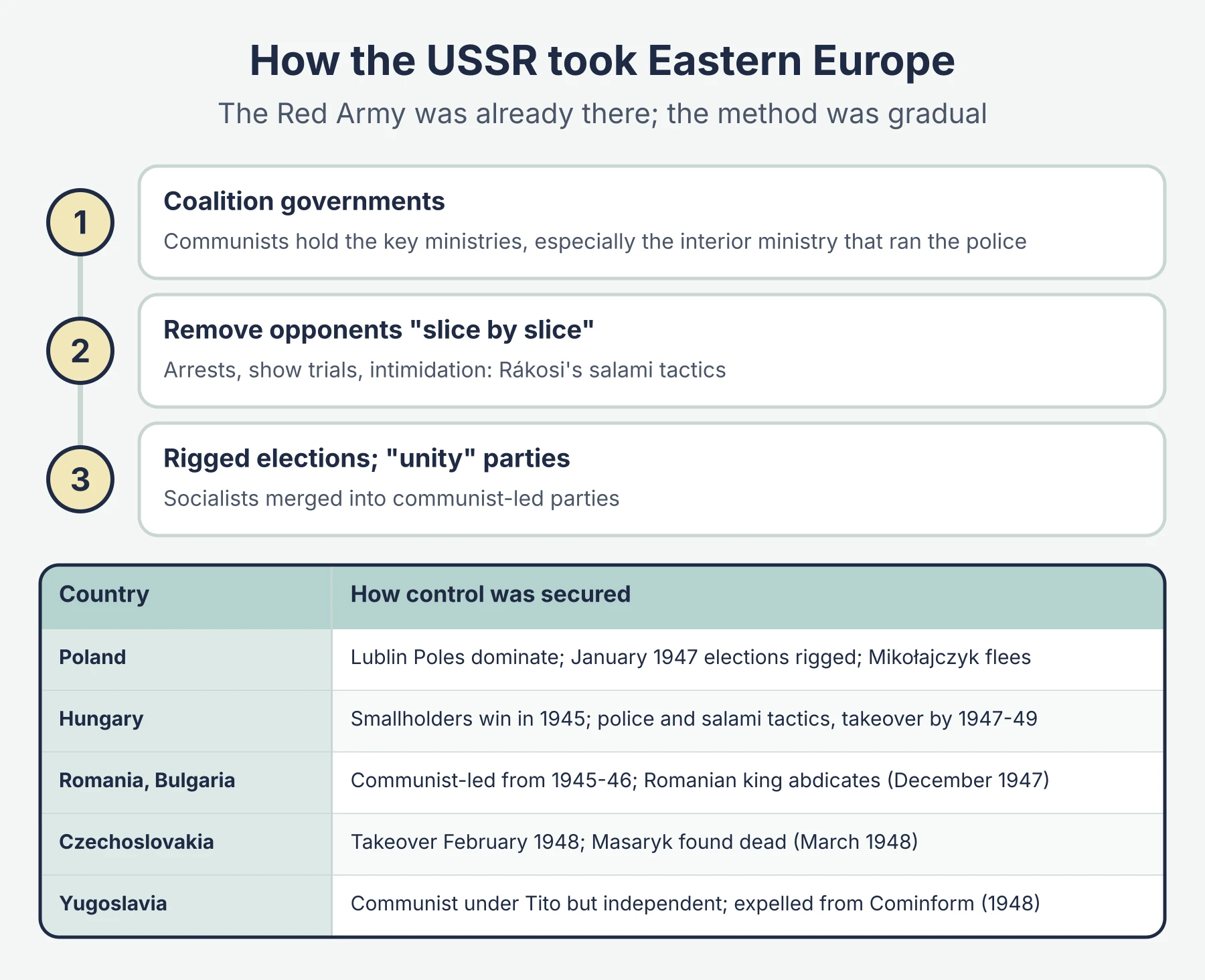
Soviet expansion in four steps
- Liberation by the Red Army, which stayed after 1945.
- Coalition governments with communists holding the police and interior ministries.
- Salami tactics: rivals removed slice by slice through arrest, trial and intimidation.
- One-party rule after rigged elections and forced mergers of left-wing parties.
Motives to quote: security after invasions through Poland in 1914 and 1941; huge wartime losses; ideology; reparations and economic control.
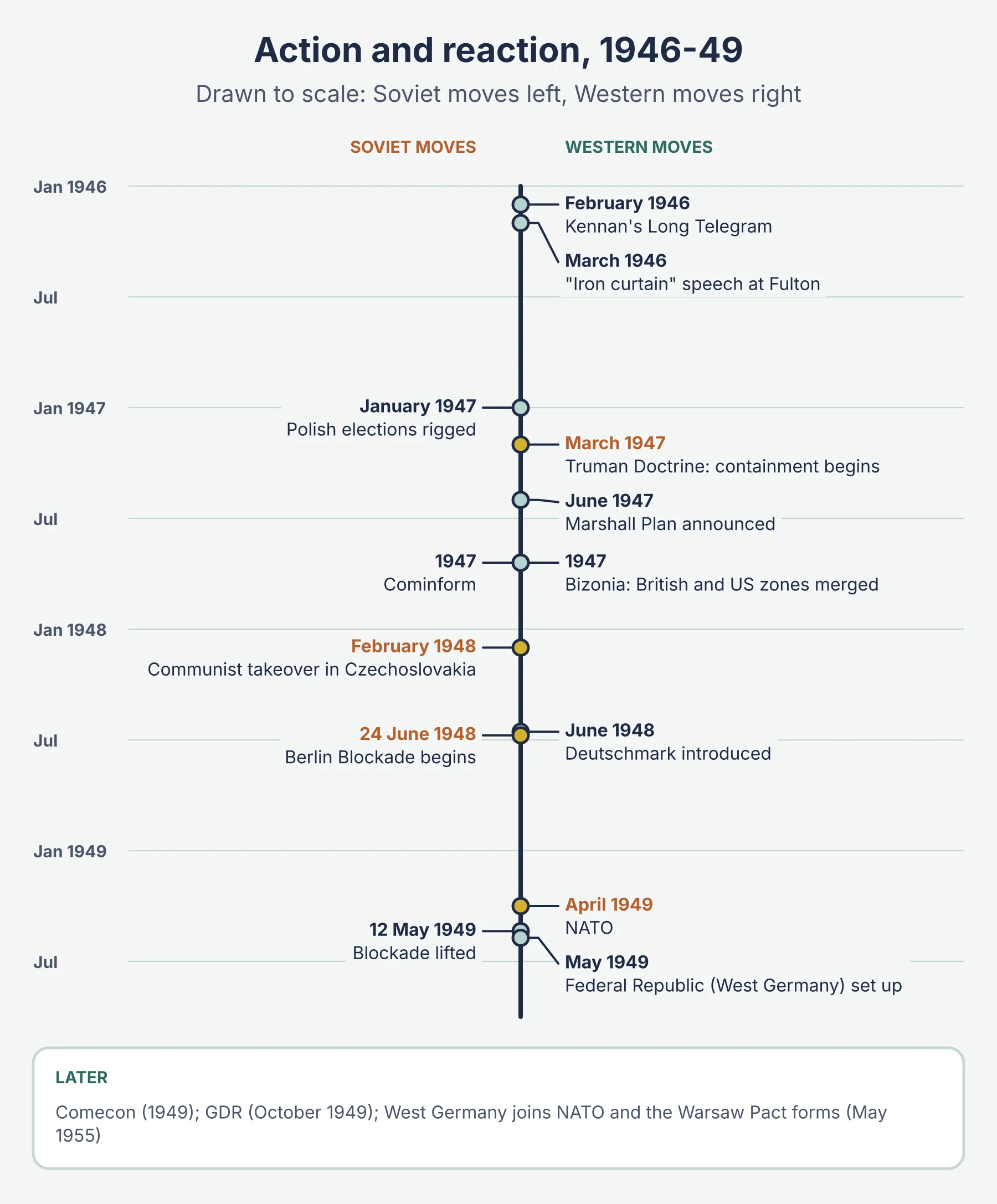
The American answer: containment
- Truman Doctrine: political promise to support “free peoples” against outside pressure; aid to Greece and Turkey.
- Marshall Plan: economic aid of about $13 billion to rebuild Europe and remove the poverty that fed communism; rejected by the USSR and its satellites.
- Soviet counter-moves: Cominform (parties) and Comecon (economies).
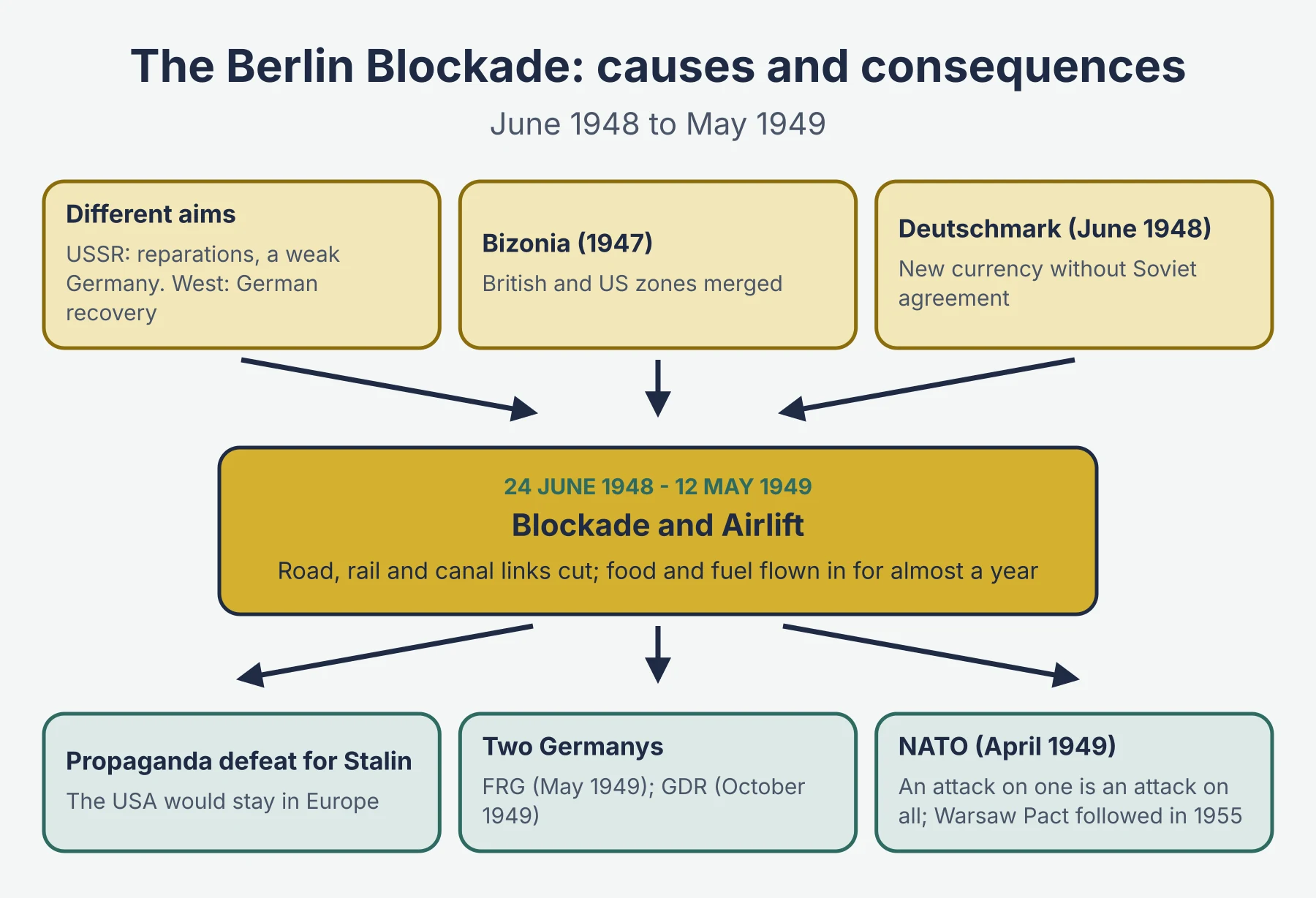
Berlin: causes and consequences
Causes of the blockade: western plans for a West German state; Bizonia; the new Deutschmark; Stalin’s wish to force the West out of Berlin or stop a strong West Germany.
Consequences: the airlift kept West Berlin supplied; Stalin backed down; Germany split into FRG and GDR in 1949; NATO founded; the USA committed to the defence of western Europe; the Cold War in Europe became a military stand-off.
Key terms
| Term | Meaning |
|---|---|
| Cold War | Hostility between the USA and USSR short of direct war: propaganda, alliances, arms race |
| Iron curtain | Churchill’s image (1946) for the division of Europe between East and West |
| Satellite state | A country nominally independent but controlled by the USSR |
| Salami tactics | Removing opponents one group at a time |
| Containment | US policy of stopping communism spreading to new countries |
| Truman Doctrine | 1947 promise of US support for states resisting communism |
| Marshall Aid | US economic aid to Europe from 1948 under the European Recovery Programme |
| Cominform | Communist Information Bureau (1947), co-ordinating communist parties |
| Comecon | Council for Mutual Economic Assistance (1949), the Soviet bloc’s economic organisation |
| Bizonia | British and American zones of Germany merged in 1947 |
| Airlift | Supplying West Berlin by air during the blockade |
| NATO | North Atlantic Treaty Organisation (1949), a western defence alliance |
| Warsaw Pact | Soviet-led military alliance of Eastern European states (1955) |
Arguments on blame, condensed
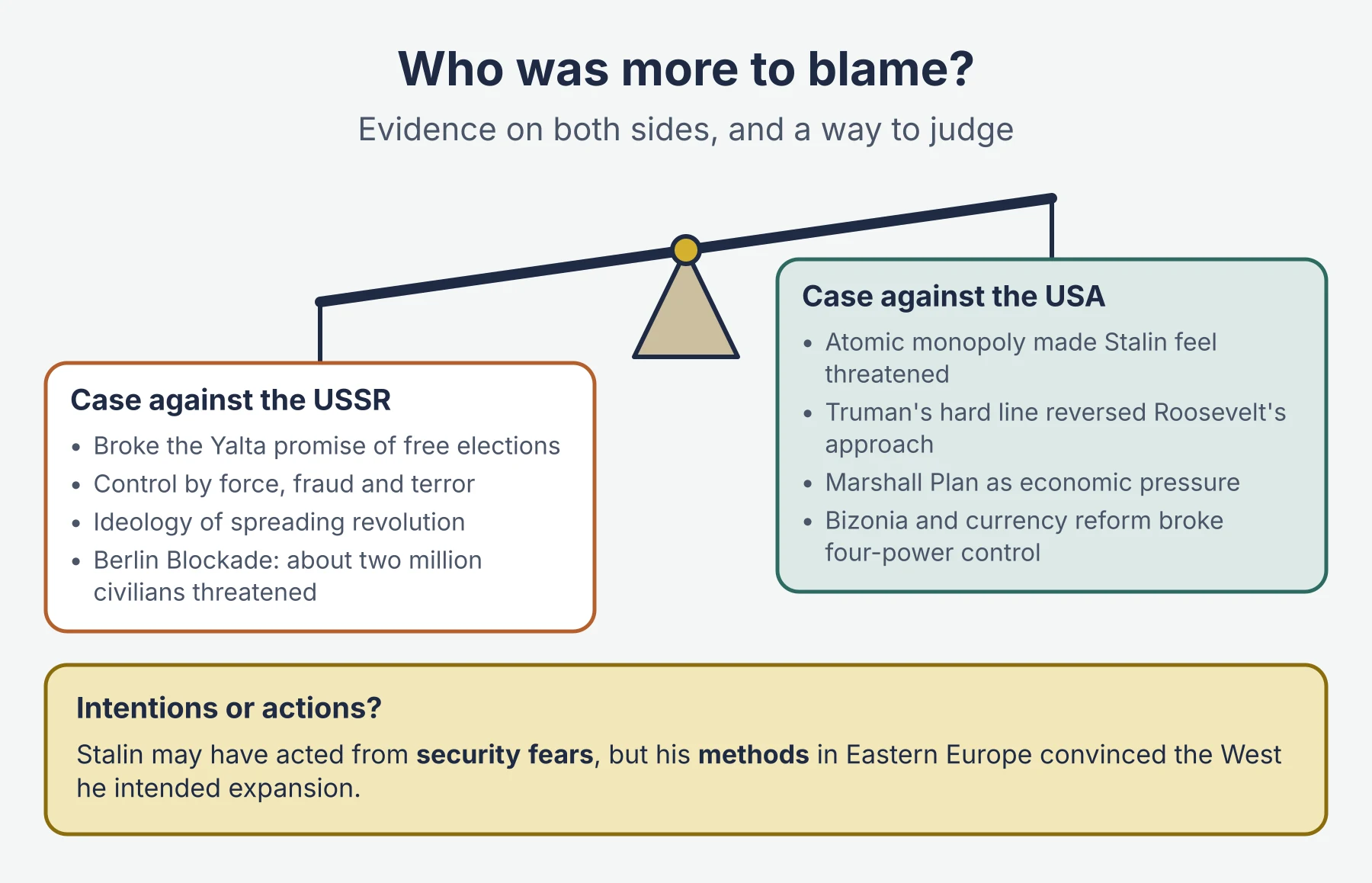
- USSR to blame: broke Yalta’s promise of free elections; used terror to impose communism; Czech coup; started the blockade; refused Marshall Aid for the whole bloc.
- USA to blame: atomic diplomacy; Truman more confrontational than Roosevelt; Marshall Plan as economic leverage; western moves in Germany broke four-power co-operation.
- Both / neither: ideological opposites; each side’s defensive actions looked aggressive to the other; the collapse of Germany left a power vacuum both had to fill.
Exam traps
- Yalta versus Potsdam. Roosevelt is only at Yalta; Truman and Attlee are only at Potsdam.
- Doctrine versus Plan. The Truman Doctrine is the policy; the Marshall Plan is the money.
- Blockade versus Wall. 1948-49 versus 1961. They belong to different key questions.
- NATO versus Warsaw Pact. Six years apart: 1949 and 1955.
- “Most to blame” needs a criterion. Say whether you judge by intentions, by who acted first, or by who escalated.
- Out-of-range evidence. Korea (1950) belongs to key question 5; use it only as context, not as a reason the Cold War started.
Self-test
- Name the three leaders at Yalta. Roosevelt, Churchill and Stalin.
- What did Stalin promise at Yalta about Poland? To broaden the government and allow free elections.
- Who replaced Churchill during the Potsdam Conference? Clement Attlee.
- Where did Churchill make his “iron curtain” speech? Fulton, Missouri, in March 1946.
- What was the Long Telegram? Kennan’s 1946 message arguing the USSR was expansionist and must be met with firmness.
- Which two countries received aid under the Truman Doctrine? Greece and Turkey.
- Why did Stalin reject Marshall Aid? He saw it as US economic control and a threat to Soviet influence in Eastern Europe.
- Which country fell to a communist takeover in February 1948? Czechoslovakia.
- What event in June 1948 triggered the Berlin Blockade? The introduction of the Deutschmark in the western zones.
- When did the blockade end? 12 May 1949.
- Give two consequences of the blockade. Formation of NATO; division of Germany into the FRG and GDR in 1949.
- Why was the Warsaw Pact formed in 1955? As the Soviet response to West Germany joining NATO.
Related resources
-
Study guides
Cambridge IGCSE World History (0470): How Effectively Did the United States Contain the Spread of Communism?
Study guide to Cambridge IGCSE History 0470 key question 2.5: US decisions in Korea, Cuba and Vietnam, how to judge effectiveness, and Paper 2 source skills.
World History · Cambridge · IGCSE
Read guide -
Practice questions
Cambridge IGCSE World History (0470): How Effectively Did the United States Contain the Spread of Communism? – Practice Questions
Thirteen original questions with mark-scheme answers on US containment in Korea, Cuba and Vietnam for Cambridge IGCSE History 0470 key question 2.5.
World History · Cambridge · IGCSE
Try questions -
Revision notes
Cambridge IGCSE World History (0470): How Effectively Did the United States Contain the Spread of Communism? – Revision Notes
Recall notes for Cambridge IGCSE History 0470 key question 2.5: decision timelines for Korea, Cuba and Vietnam, key terms, exam traps and a self-test.
World History · Cambridge · IGCSE
Revise topic
Get free revision emails (optional)
Occasional emails with practice questions, worked explanations and links to free resources for the qualification and subjects you choose. No spam, and you can unsubscribe from any email. The free tools on this site never need an email.