
Study Guides
Cambridge O Level Commerce (7100): Commercial enterprises
Cambridge O Level Commerce 7100 sub-topic 2.1 in depth: forms of ownership, public corporations, multinationals, franchises and location factors.
- Subject
- Commerce
- Level
- O LEVELS
- Topic
- Topic 2 – Commercial Operations
- Author
- Marlbridge Academic Team
- Updated
- Reviewed by
- Salman Ahmad (what this means)
Aligned to Cambridge O Level Commerce (7100), 2026-2028. Official specification .
Syllabus page (what it covers and how it is assessed): Cambridge O Level Commerce.
Syllabus points this page covers
7100
- 2.1 Commercial enterprises
Found an error? Report a correction.
Need help with this topic? Request a free trial class for O Level Commerce (7100).
Sub-topic 2.1 of Cambridge O Level Commerce (7100) is about the organisations that carry out commerce: who owns them, how they are run, and where they choose to operate. It has five parts: private and public sector enterprises (2.1.1), types of enterprise (2.1.2), multinational companies (2.1.3), franchises (2.1.4) and physical and ecommerce location factors (2.1.5). Three of the five ask you to judge appropriateness in a given situation, so this sub-topic rewards applied answers more than lists.
The Commercial Operations overview introduces each form briefly. This guide adds the detail you need to compare forms and justify a recommendation.
What the specification asks for
| Section | Content statements |
|---|---|
| 2.1.1 | The difference between private and public sector enterprises |
| 2.1.2 | Features of sole trader, cooperative, partnership, private limited company and public limited company; features of and reasons for public corporations; appropriateness of types of ownership |
| 2.1.3 | Features of MNCs; reasons they exist; positive and negative impacts on a host country |
| 2.1.4 | Features, advantages and disadvantages of franchises |
| 2.1.5 | Physical location factors; ecommerce location factors; their appropriateness in given situations |
Private and public sector
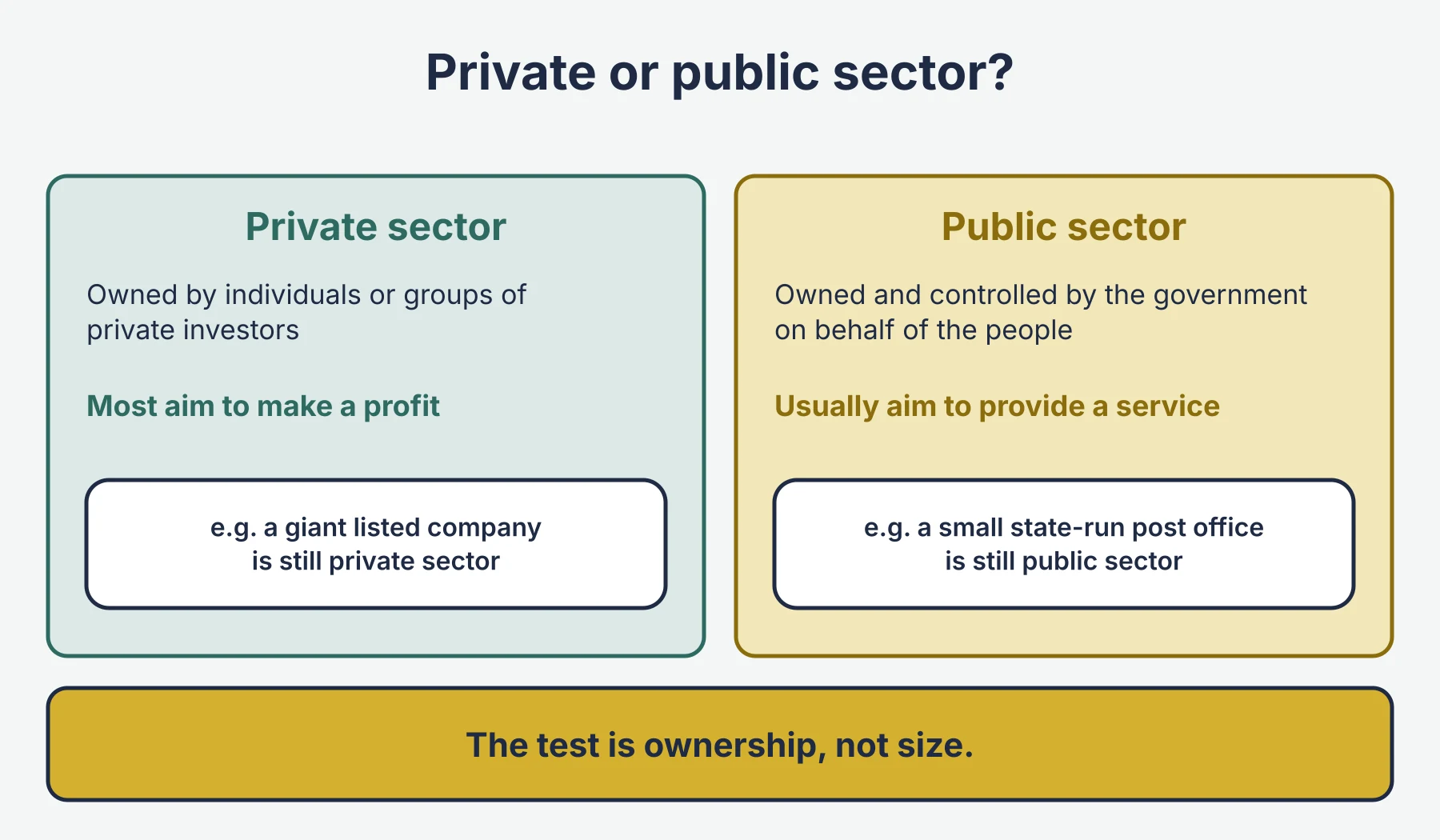
Private sector enterprises are owned by individuals or groups of private investors, and most aim to make a profit. Public sector enterprises are owned and controlled by the government on behalf of the people, and usually aim to provide a service. The test is ownership, not size: a giant listed company is still private sector, while a small state-run postal office is public sector.
Features of the five private sector forms
Two ideas run through every comparison.
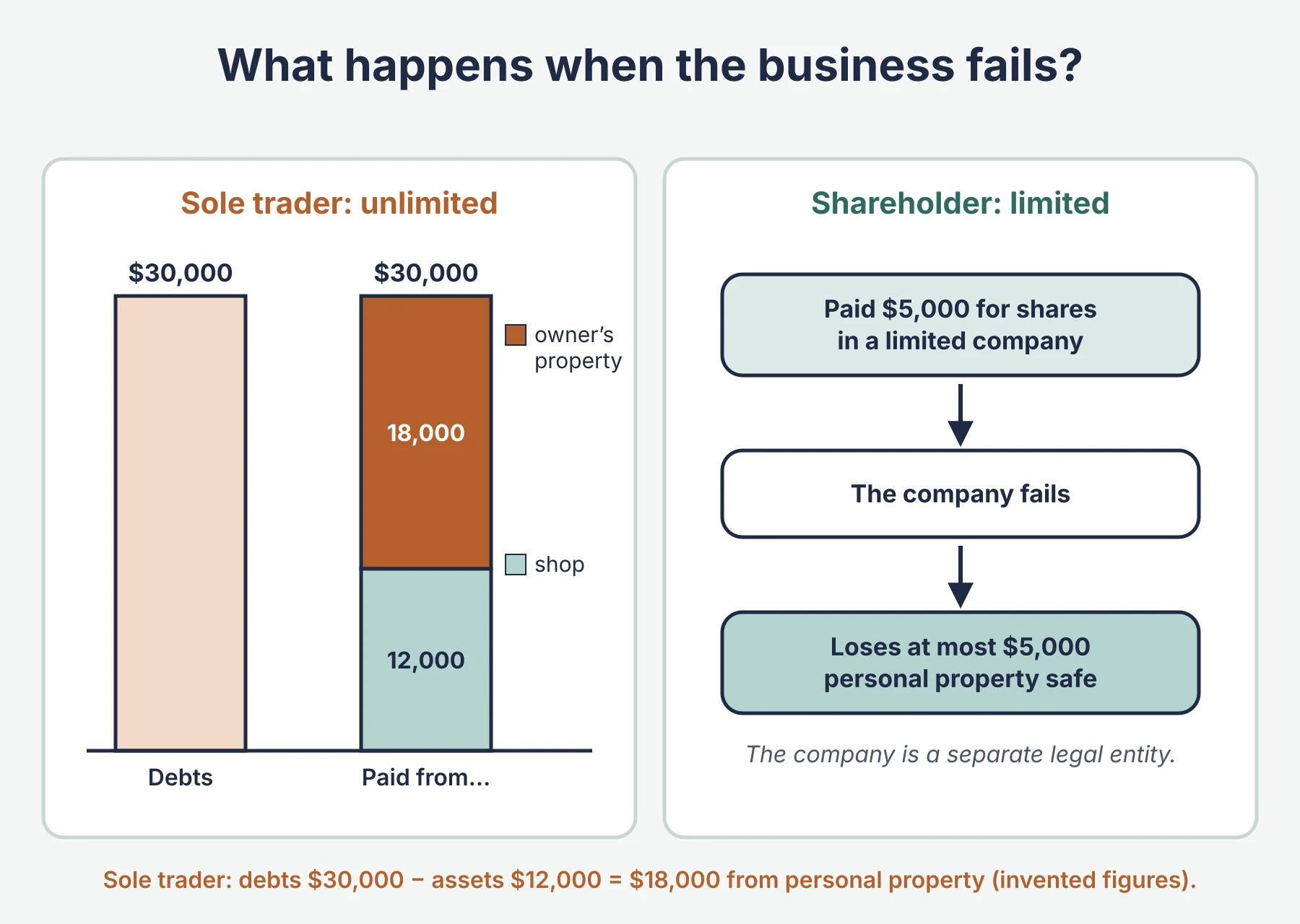
- Liability. With unlimited liability the owner’s personal possessions can be used to pay the business’s debts. With limited liability an owner can lose only the money invested in shares. Invented example: a sole trader’s shop fails owing $30,000 but has assets of only $12,000; the owner may have to sell personal property to pay the remaining $18,000. A shareholder in a failed limited company who paid $5,000 for shares loses at most that $5,000.
- Incorporation. A company is a separate legal entity: it can own property, make contracts and be sued in its own name, and it continues if a shareholder dies. Sole traders and ordinary partnerships are unincorporated, so the business and the owners are legally the same.
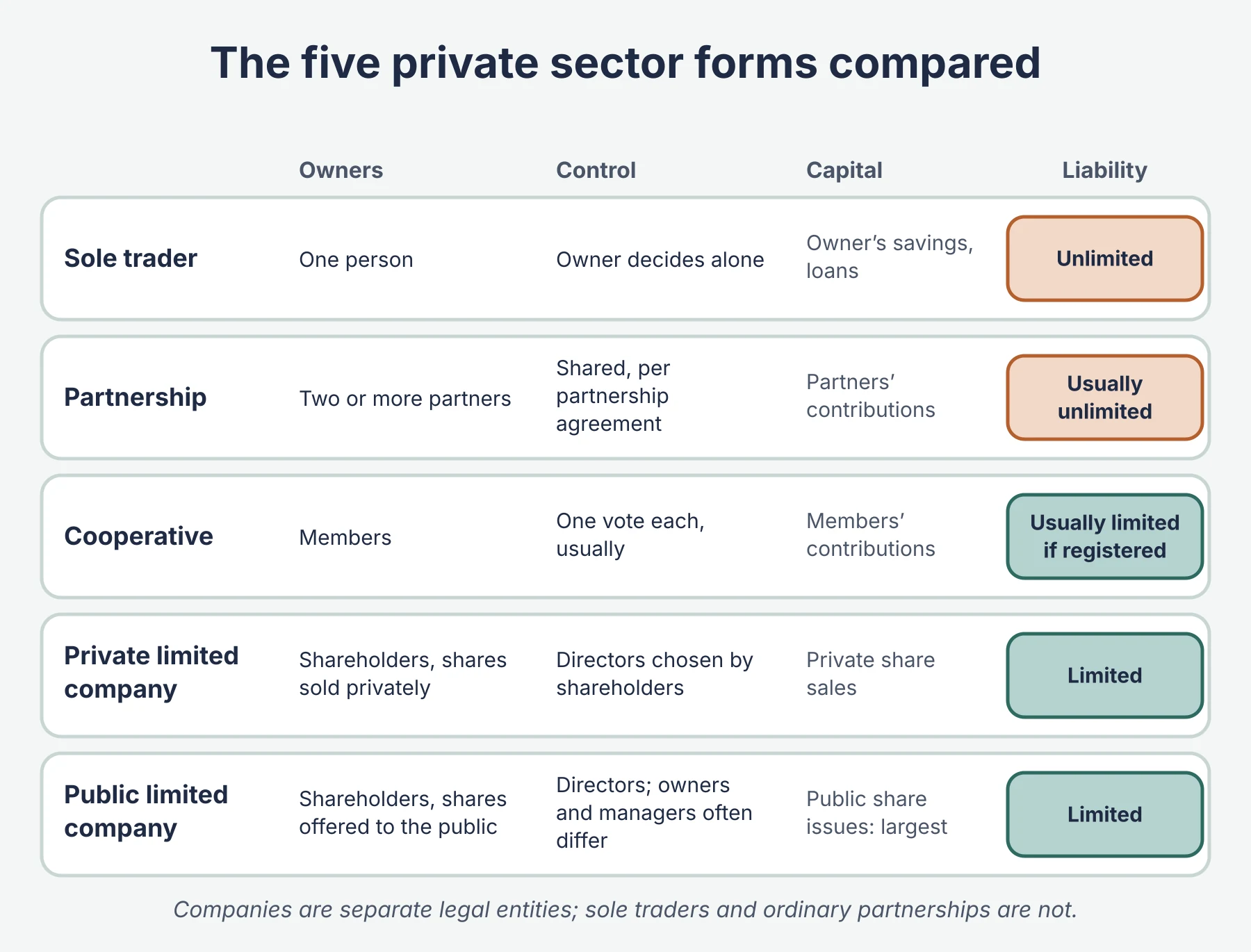
| Feature | Sole trader | Partnership | Cooperative | Private limited company | Public limited company |
|---|---|---|---|---|---|
| Owners | One person | Two or more partners | Members | Shareholders, shares sold privately | Shareholders, shares offered to the public, often through a stock exchange |
| Liability | Unlimited | Usually unlimited | Usually limited for registered cooperatives | Limited | Limited |
| Control | Owner decides alone | Shared, per partnership agreement | Members, usually one vote each | Directors chosen by shareholders | Directors chosen by shareholders; owners and managers often different people |
| Profit | Kept by owner | Shared per agreement | Shared among members or reinvested for their benefit | Dividends to shareholders | Dividends to shareholders |
| Capital | Owner’s savings, loans | Partners’ contributions | Members’ contributions | Private share sales | Public share issues: largest capital |
| Accounts | Private | Private | Reported to members | Must be filed | Must be published |
Cooperatives are distinctive because they exist to serve their members rather than outside investors. Farmers may form a producer cooperative to share a milk-chilling plant and sell their milk together, gaining bargaining power that no single small farm has.
Public corporations
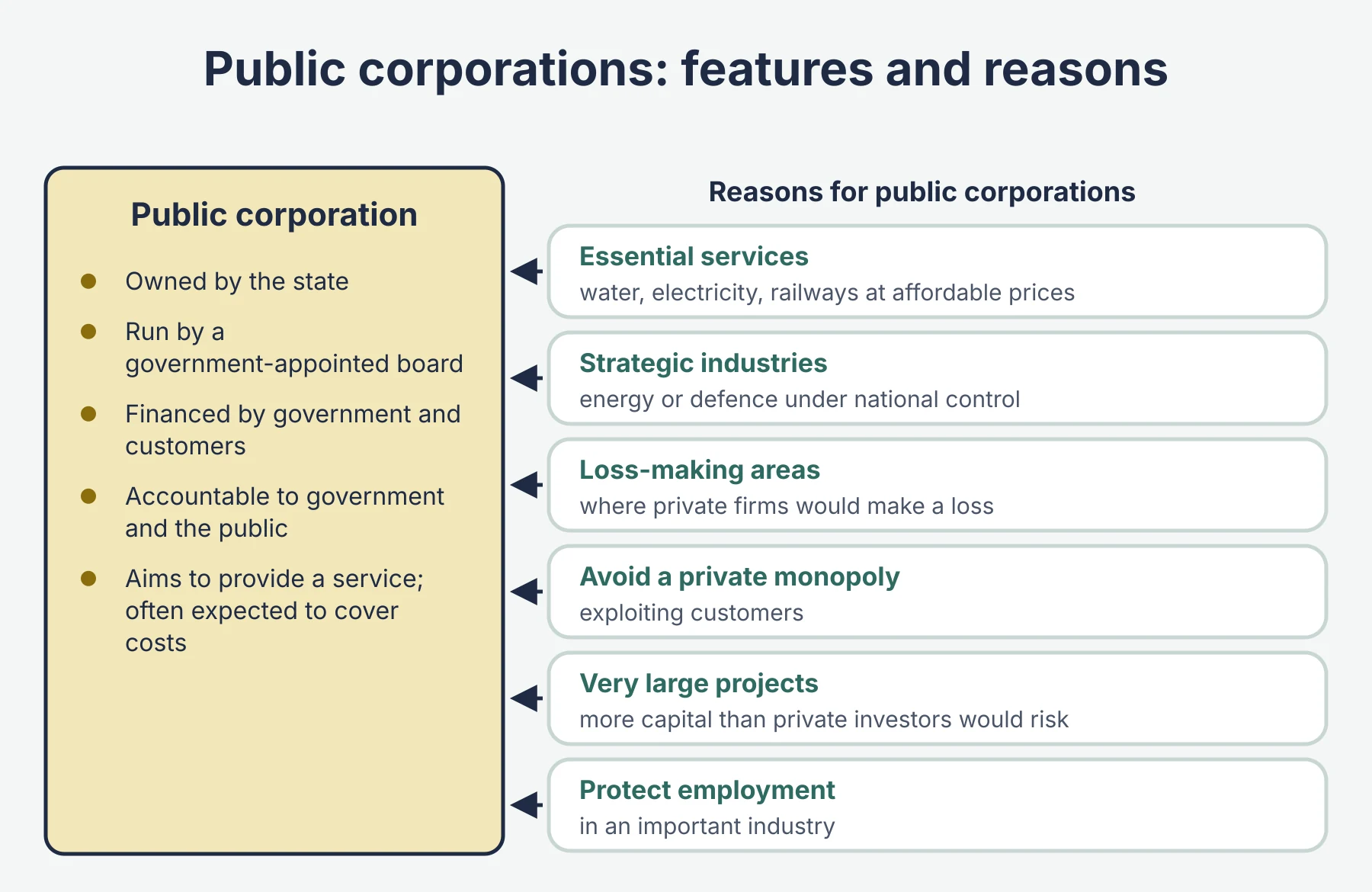
Features: owned by the state; run by a board appointed by the government; financed by government funds and by revenue from customers; accountable to the government and, through it, to the public; aim to provide a service, though many are expected to cover their costs.
Reasons for public corporations:
- to provide essential services such as water, electricity and railways at affordable prices;
- to keep strategic industries, such as energy or defence, under national control;
- to provide services in areas where private firms would make a loss;
- to avoid a private monopoly exploiting customers;
- to undertake projects needing more capital than private investors would risk;
- to protect employment in an important industry.
Choosing the appropriate form
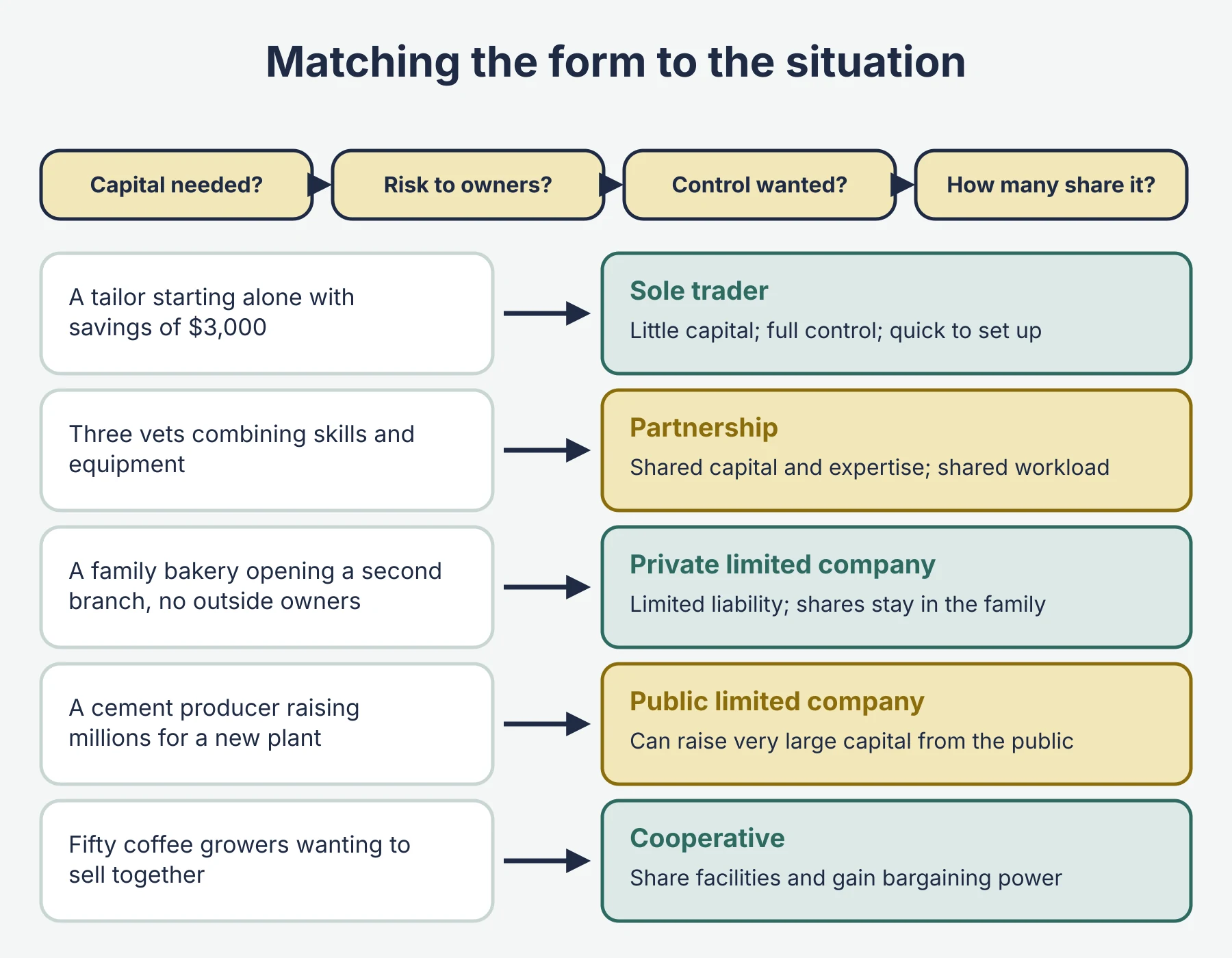
Appropriateness questions describe a situation; your answer must use its details. A useful sequence is: how much capital is needed, how much risk the owners face, how much control they want, and how many people will share the business.
| Situation | Appropriate form | Reason from the situation |
|---|---|---|
| A tailor starting alone with savings of $3,000 | Sole trader | Little capital needed; full control; quick to set up |
| Three vets combining skills and equipment | Partnership | Shared capital and expertise; shared workload |
| A family bakery opening a second branch, wanting limited liability but no outside owners | Private limited company | Limited liability while shares stay in the family |
| A cement producer raising millions to build a new plant | Public limited company | Can raise very large capital from the public |
| Fifty coffee growers wanting to sell together | Cooperative | Members share facilities and gain bargaining power |
Multinational companies (MNCs)
Features: an MNC has its headquarters in one country (the home country) and production or service operations in at least one other (the host country). MNCs are usually very large, with well-known brands, large capital and sales in many markets.
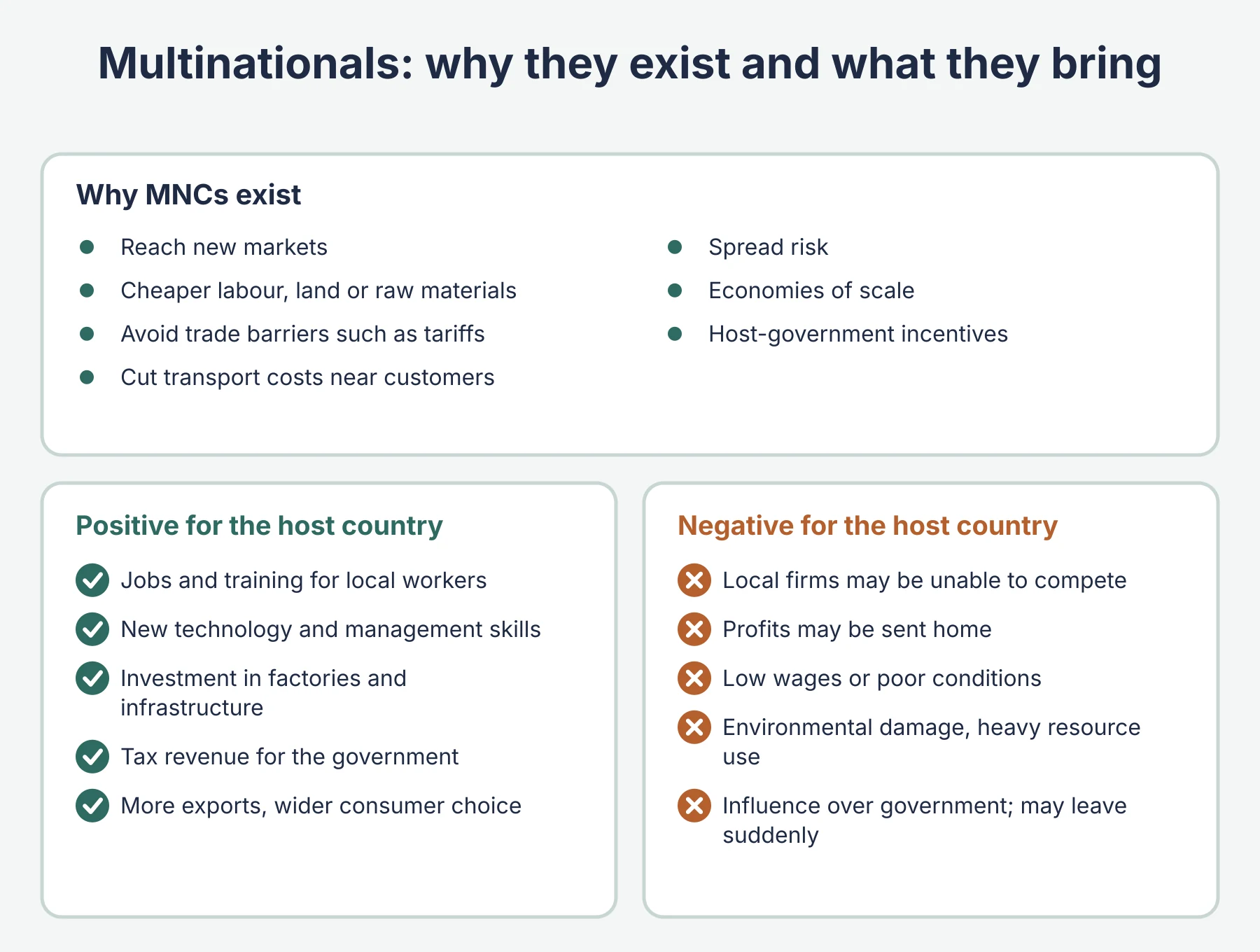
Reasons they exist: to reach new markets and customers; to use cheaper labour, land or raw materials; to produce inside a market and so avoid trade barriers such as tariffs; to cut transport costs by producing near customers; to spread risk across several countries; to gain economies of scale; and to benefit from incentives offered by host governments.
| Positive impacts on a host country | Negative impacts on a host country |
|---|---|
| Creates jobs and trains local workers | Local firms may be unable to compete and close |
| Brings new technology and management skills | Profits may be sent back to the home country |
| Investment in factories and infrastructure | Workers may be paid low wages or face poor conditions |
| Tax revenue for the government | Environmental damage or heavy use of natural resources |
| More exports and wider choice for consumers | The MNC may gain influence over government or leave suddenly |
Annotated model answer
Original question: “Assess whether a country should welcome a multinational car manufacturer.” (6 marks)
The MNC would create thousands of factory jobs (positive impact) and local suppliers of seats and tyres would gain orders, multiplying the benefit (analysis). Workers would learn new skills that stay in the country (positive impact). However, profits are likely to be sent to the home country, so less income stays locally (negative impact), and local vehicle assemblers may be forced out of business (negative impact). On balance the country should welcome it if the government agrees conditions such as training local managers, because the jobs and skills outweigh lost profits (judgement).
The judgement is conditional and linked to the case; that is what an assess question wants.
Franchises
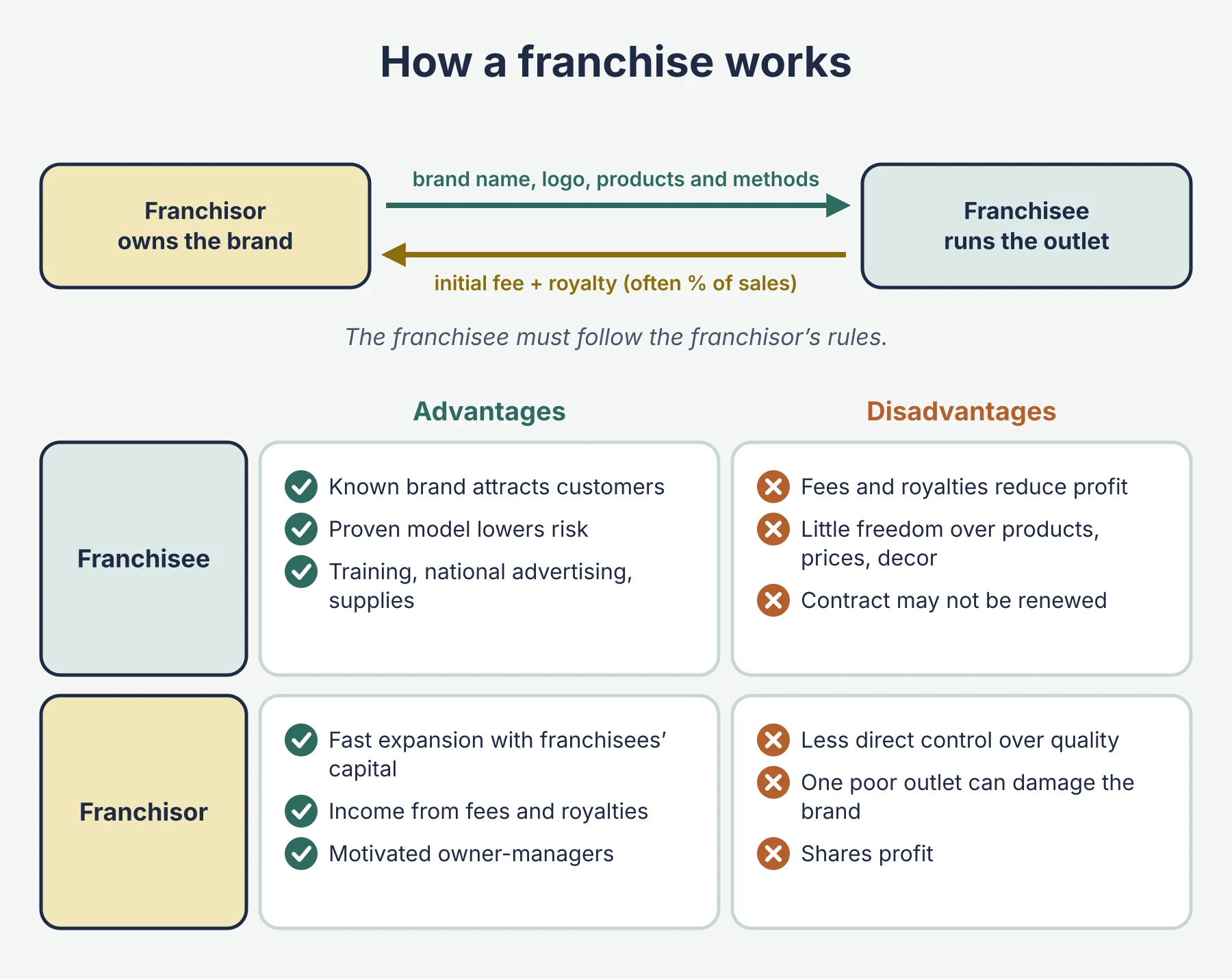
A franchise is an agreement in which a franchisor allows a franchisee to trade using its brand name, logo, products and methods. The franchisee usually pays an initial fee and a royalty, often a percentage of sales, and must follow the franchisor’s rules.
| Franchisee | Franchisor | |
|---|---|---|
| Advantages | Known brand attracts customers; proven business model lowers risk; training, national advertising and supplies provided | Fast expansion using franchisees’ capital; income from fees and royalties; motivated owner-managers run each outlet |
| Disadvantages | Fees and royalties reduce profit; little freedom over products, prices or decor; contract may not be renewed | Less direct control over quality; one poor outlet can damage the whole brand; shares profit with franchisees |
Location factors
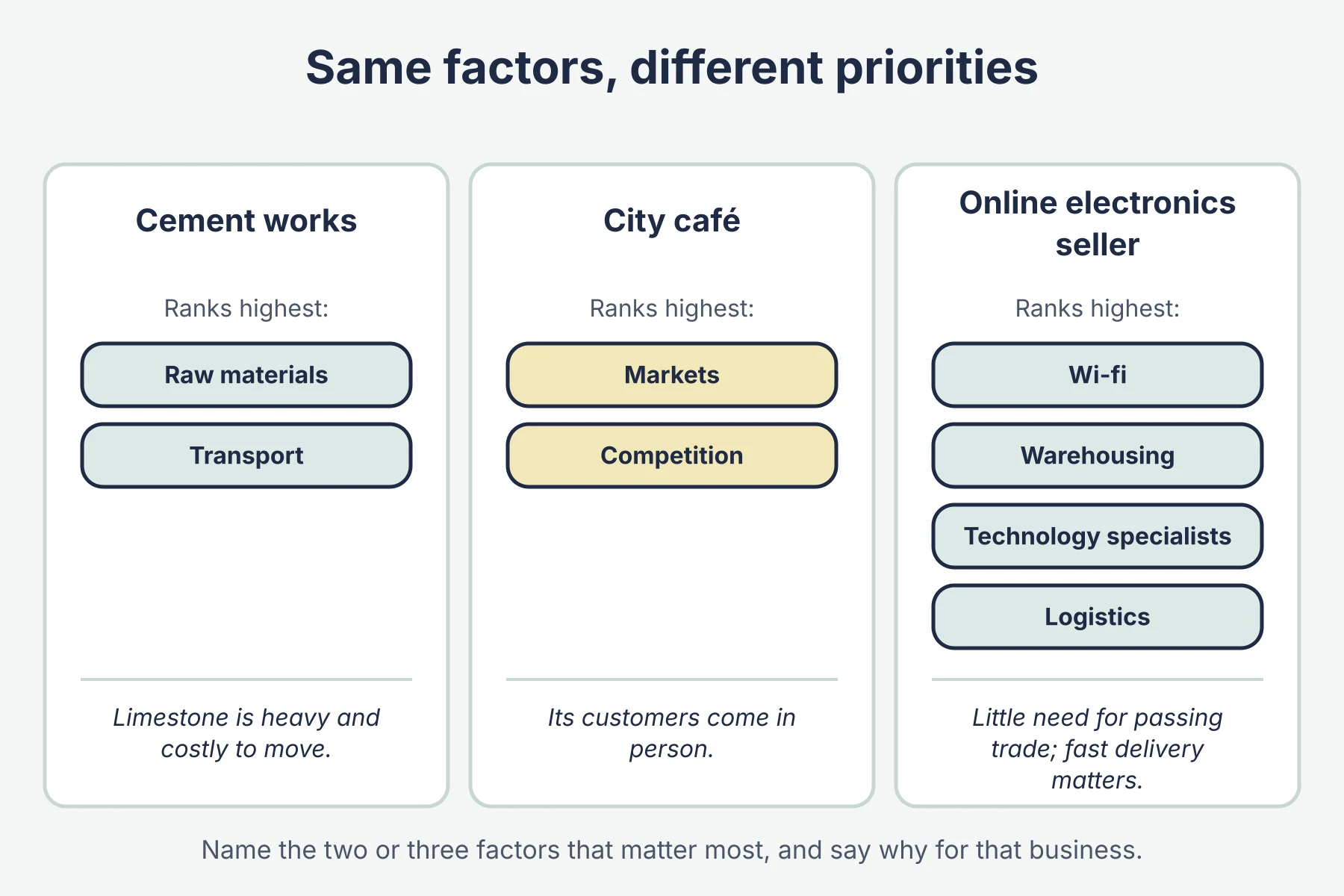
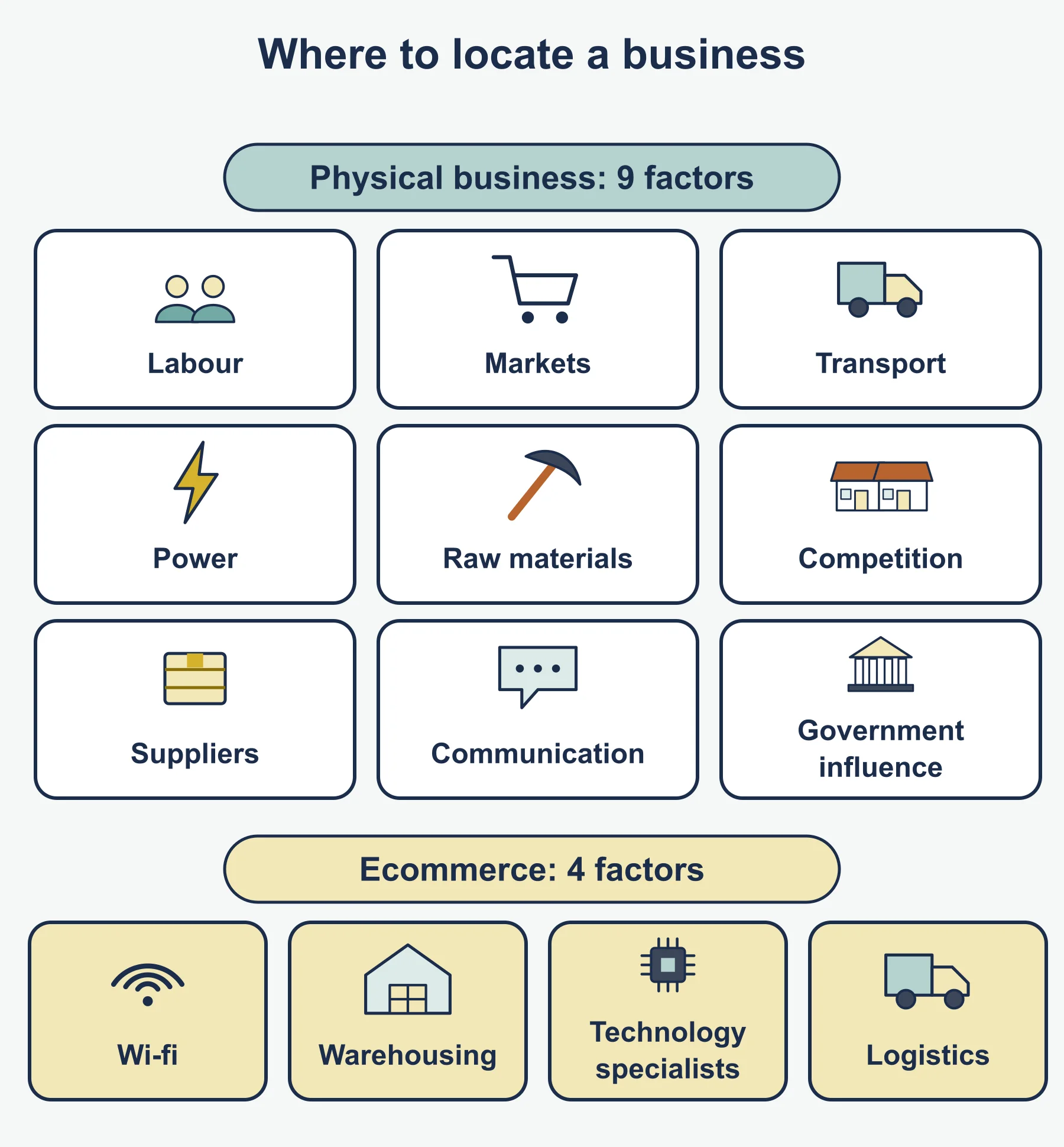
Physical location factors: labour, markets, transport, power, raw materials, competition, suppliers, communication and government influence. Ecommerce location factors: wi-fi, warehousing, technology specialists and logistics.
Judgement depends on the business. A cement works ranks raw materials and transport highest, because limestone is heavy and costly to move. A city café ranks markets and competition highest. An online electronics seller cares little about passing trade but needs reliable wi-fi, a warehouse near major roads, technology specialists to keep the website running, and logistics firms for fast delivery. Always name the two or three factors that matter most and say why for that business.
Common mistakes
- Defining the public sector as “businesses owned by the public” (that describes shareholders of a public limited company).
- Saying a private limited company sells shares on a stock exchange.
- Treating a cooperative as a partnership; members, not partners, own it.
- Giving only positive MNC impacts in a question about a host country.
- Describing franchise advantages without saying whether they apply to franchisee or franchisor.
- Listing all nine physical location factors instead of judging the most important for the case.
Practise this sub-topic
Recall the essentials with the commercial enterprises revision notes, then apply them in the commercial enterprises practice questions.
Official syllabus
Cambridge O Level Commerce (7100) syllabus for 2026, 2027 and 2028, sub-topic 2.1 Commercial enterprises: official syllabus PDF.
Related resources
-
Revision notes
Cambridge O Level Commerce: Commercial Operations — Revision Notes (7100)
Recall notes for Cambridge O Level Commerce 7100 Topic 2: enterprise types, multinationals, franchises, outsourcing, retail, wholesale and communication.
Commerce · Cambridge · O Level
Revise topic -
Practice questions
Cambridge O Level Commerce (7100): Commercial enterprises – Practice Questions
Thirteen original questions with full answers on Cambridge O Level Commerce 7100 sub-topic 2.1: ownership, public corporations, MNCs, franchises, location.
Commerce · Cambridge · O Level
Try questions -
Revision notes
Cambridge O Level Commerce (7100): Commercial enterprises – Revision Notes
Recall notes for Cambridge O Level Commerce 7100 sub-topic 2.1: ownership forms, liability, public corporations, MNC impacts, franchises and location factors.
Commerce · Cambridge · O Level
Revise topic
Get free revision emails (optional)
Occasional emails with practice questions, worked explanations and links to free resources for the qualification and subjects you choose. No spam, and you can unsubscribe from any email. The free tools on this site never need an email.