
Revision Notes
Cambridge O Level English Language (1123): Question 3a Summary Task – Revision Notes
Condensed notes for the 1123 Paper 1 Question 3a summary: facts, the reading and writing halves, a five-step method, own-words tools, traps and a self-test.
- Subject
- English
- Level
- O LEVELS
- Topic
- Paper 1 – Reading
- Author
- Marlbridge Academic Team
- Updated
- Reviewed by
- Ammar Bilal (what this means)
Aligned to Cambridge O Level English (1123), 2024-2026. Official specification .
Syllabus page (what it covers and how it is assessed): Cambridge O Level English Language.
Found an error? Report a correction.
Need help with this topic? Request a free trial class for O Level English Language (1123).
These notes cover Question 3a, the Summary task, of 1123 Paper 1: “a summary as continuous writing of no more than 150 words” in response to Text B. For the paper overview see the Paper 1 Reading study guide; for the full method and a worked example with plan see the Question 3a Summary study guide.
Key facts
| Fact | Detail |
|---|---|
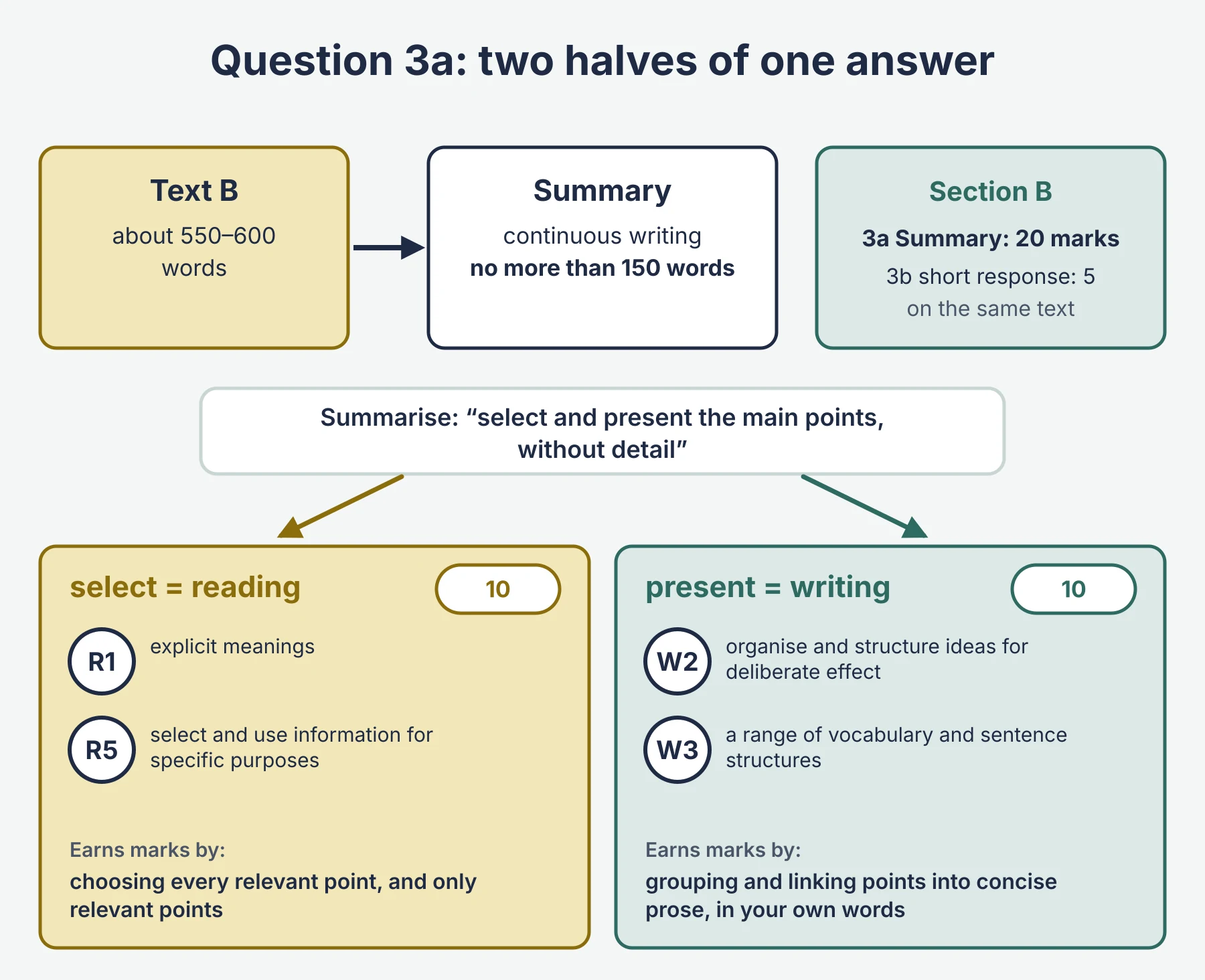
| Marks | 20: Reading 10 (R1, R5) + Writing 10 (W2, W3) |
| Text | Text B, about 550–600 words |
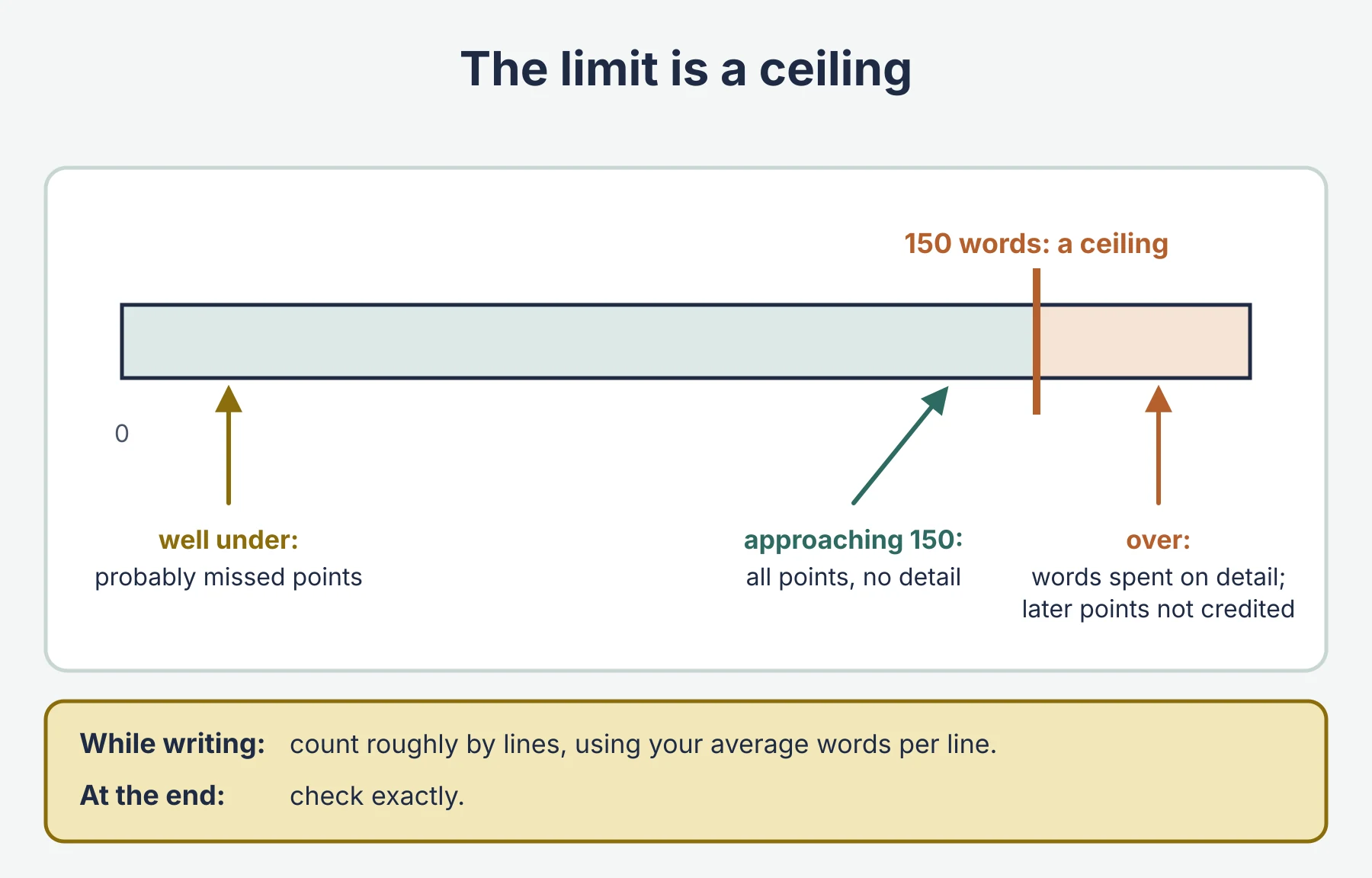
| Limit | no more than 150 words |
| Form | continuous writing |
| Next question | 3b short response on Text B (5 marks, R2) |
Command word: Summarise = “select and present the main points, without detail”.
The two halves
- Reading: every relevant point (R1, R5); nothing irrelevant.
- Writing: points organised and linked (W2); varied vocabulary and sentences, own words (W3).
A summary can lose marks on either half independently.
Five steps
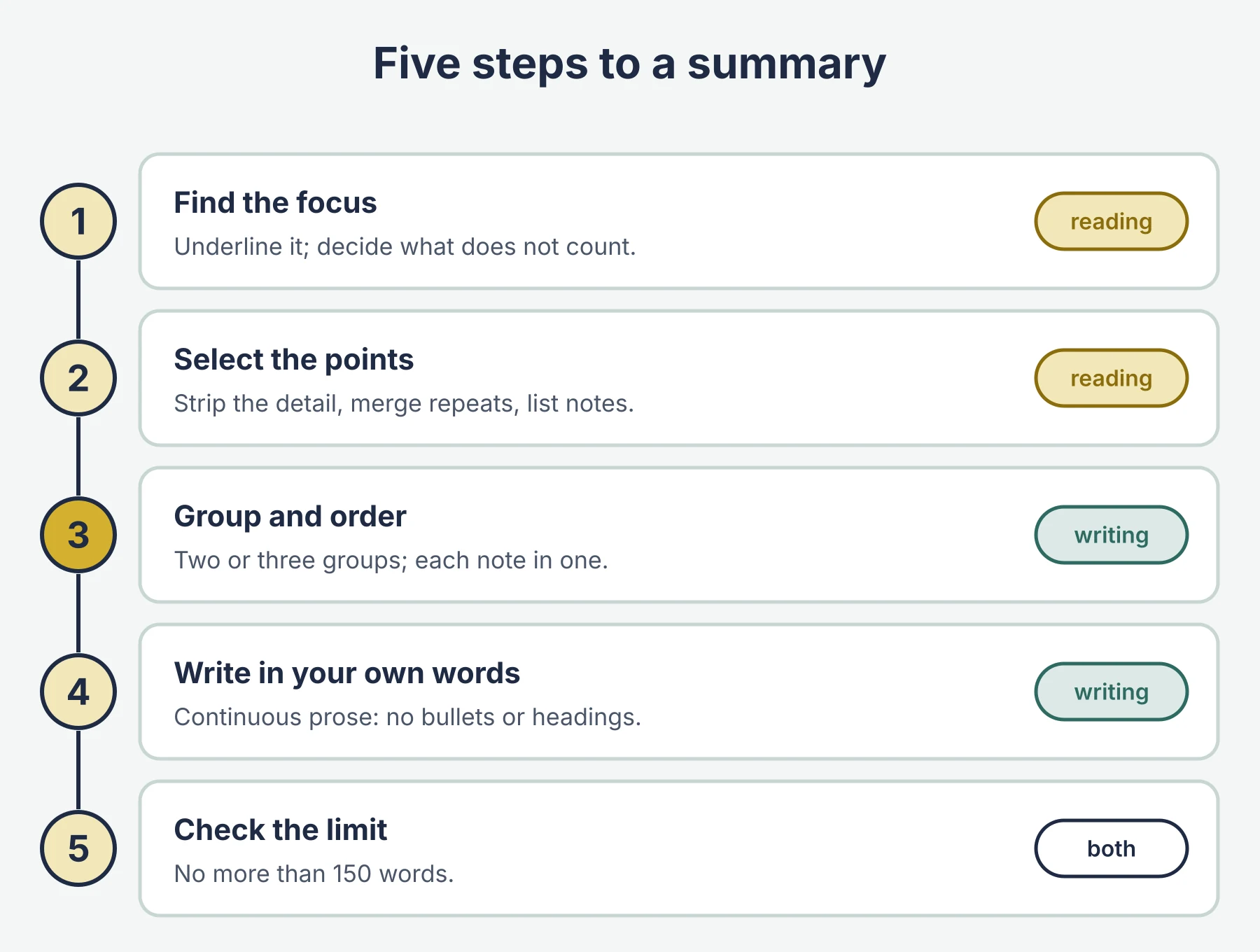
- Focus: underline what the question asks for; note what it excludes.
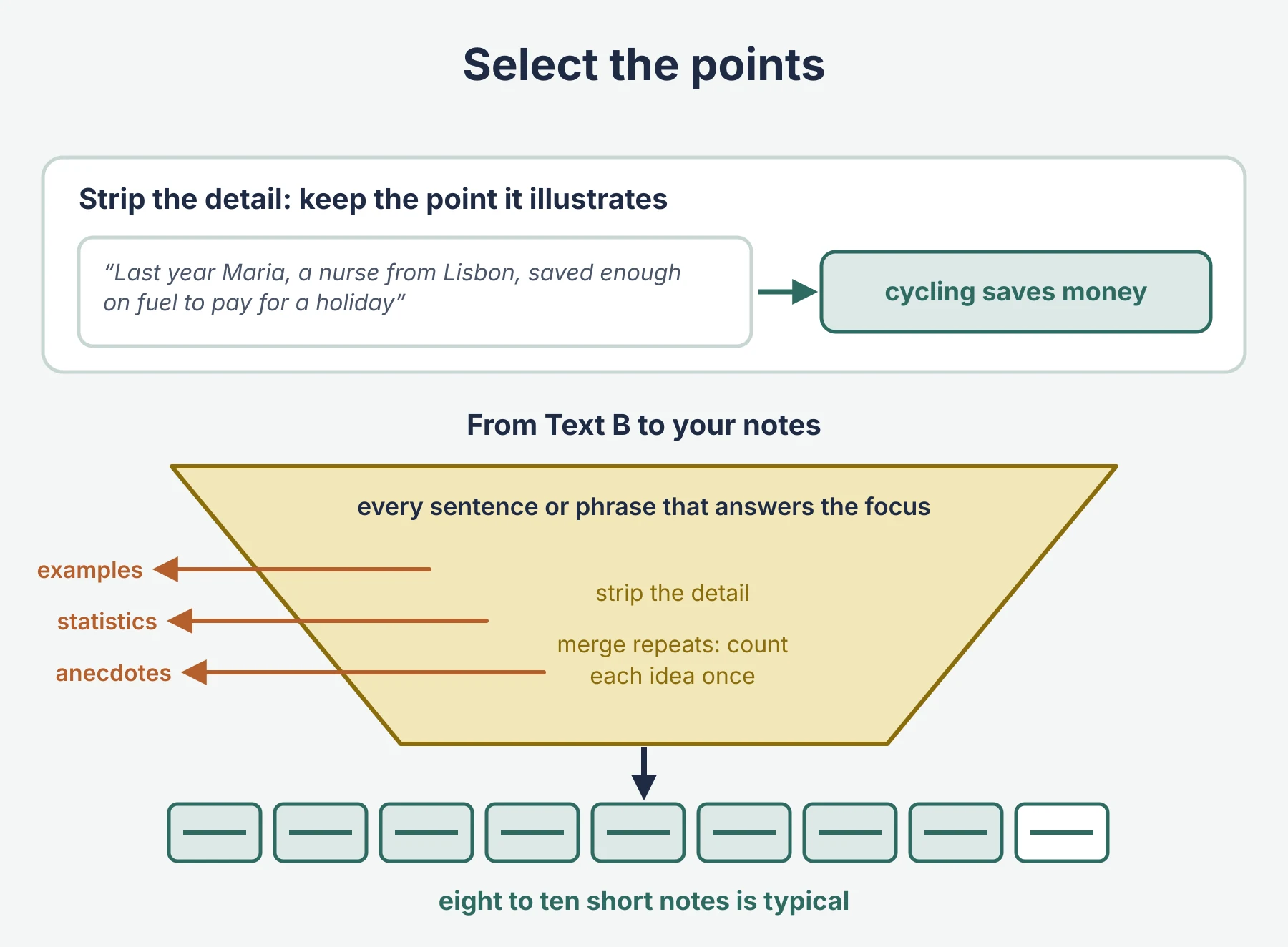
- Select: mark points; strip examples and figures; merge repeats; list as notes.
- Group: two or three categories; assign each note.
- Write: one sentence (or two) per group, own words, continuous prose.
- Check: count words; no point beyond 150 is credited.
Point or detail?
| In the text | Keep as point? |
|---|---|
| “Cycling saves money.” | yes |
| “Maria saved enough on fuel for a holiday.” | no: example of the point above |
| “Prices rose by 12 per cent.” | only as the idea “prices rose”, unless the figure is the point |
| A quotation from an expert | only the idea it expresses, if it answers the focus |
| The writer’s opinion | only if the focus asks for views |
Own-words tools
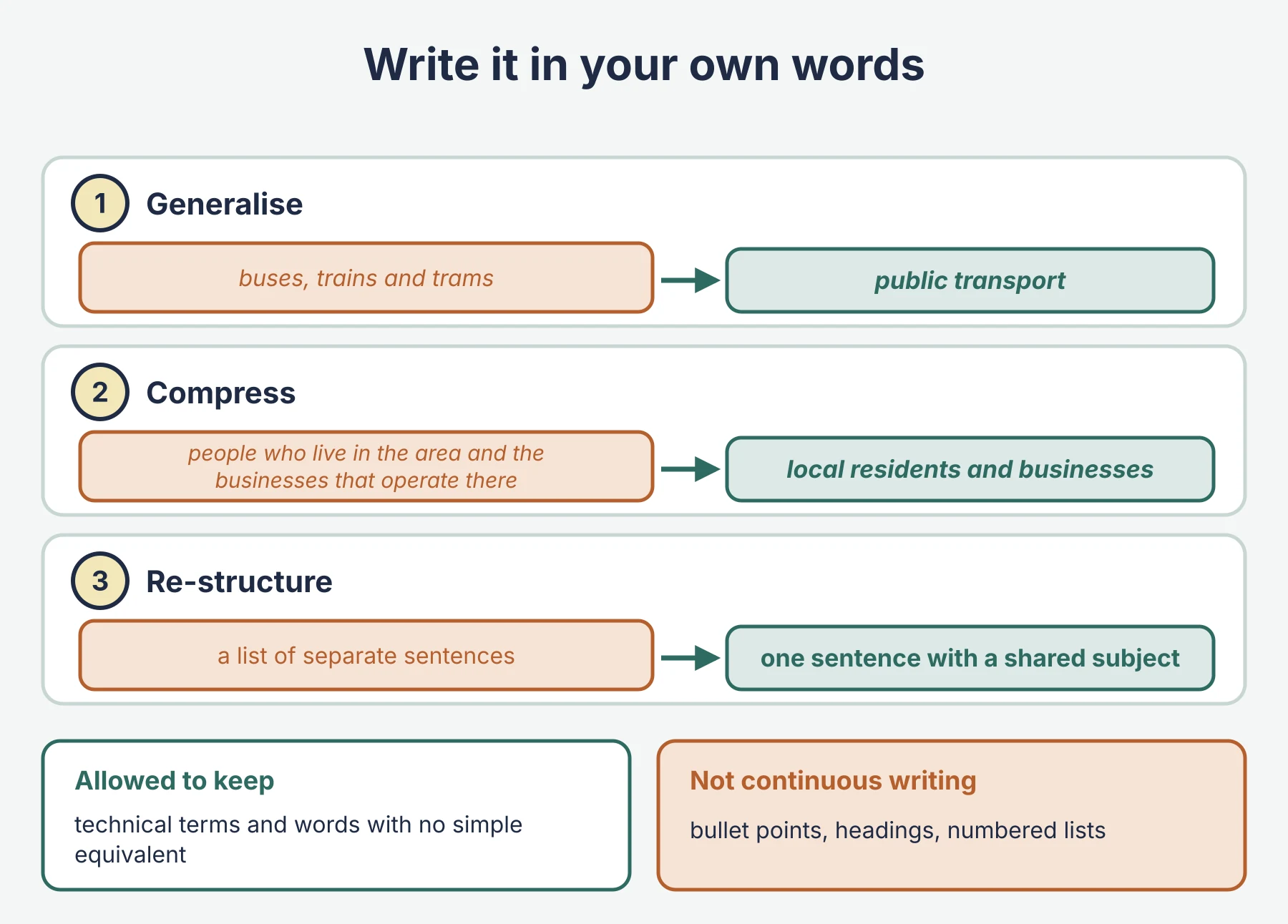
| Tool | Text | Summary |
|---|---|---|
| generalise | buses, trains and trams | public transport |
| compress | people who live in the area and businesses there | local residents and businesses |
| re-structure | three sentences on separate benefits | one sentence with a shared subject |
| replace | cools the surrounding streets | lowers the temperature nearby |
Linking for structure (W2)
Relationship words beat sequence words: as a result, in addition, however, because, while, beyond this, in turn. Avoid “Firstly… Secondly… Thirdly…” through every point: that is a list in disguise.
Compare: “Firstly, gardens calm pupils. Secondly, they help learning.” (sequence only) with “Gardens calm pupils, which in turn helps them learn.” (relationship shown). The second version is shorter and shows how the ideas connect, which is what “organise and structure ideas … for deliberate effect” asks for.
Typical focuses and their exclusions
| Focus | Exclude |
|---|---|
| benefits / advantages | drawbacks, worries |
| problems / difficulties | solutions, unless asked |
| reasons why | the results |
| what X did | what others did |
| how something works | why people like it |
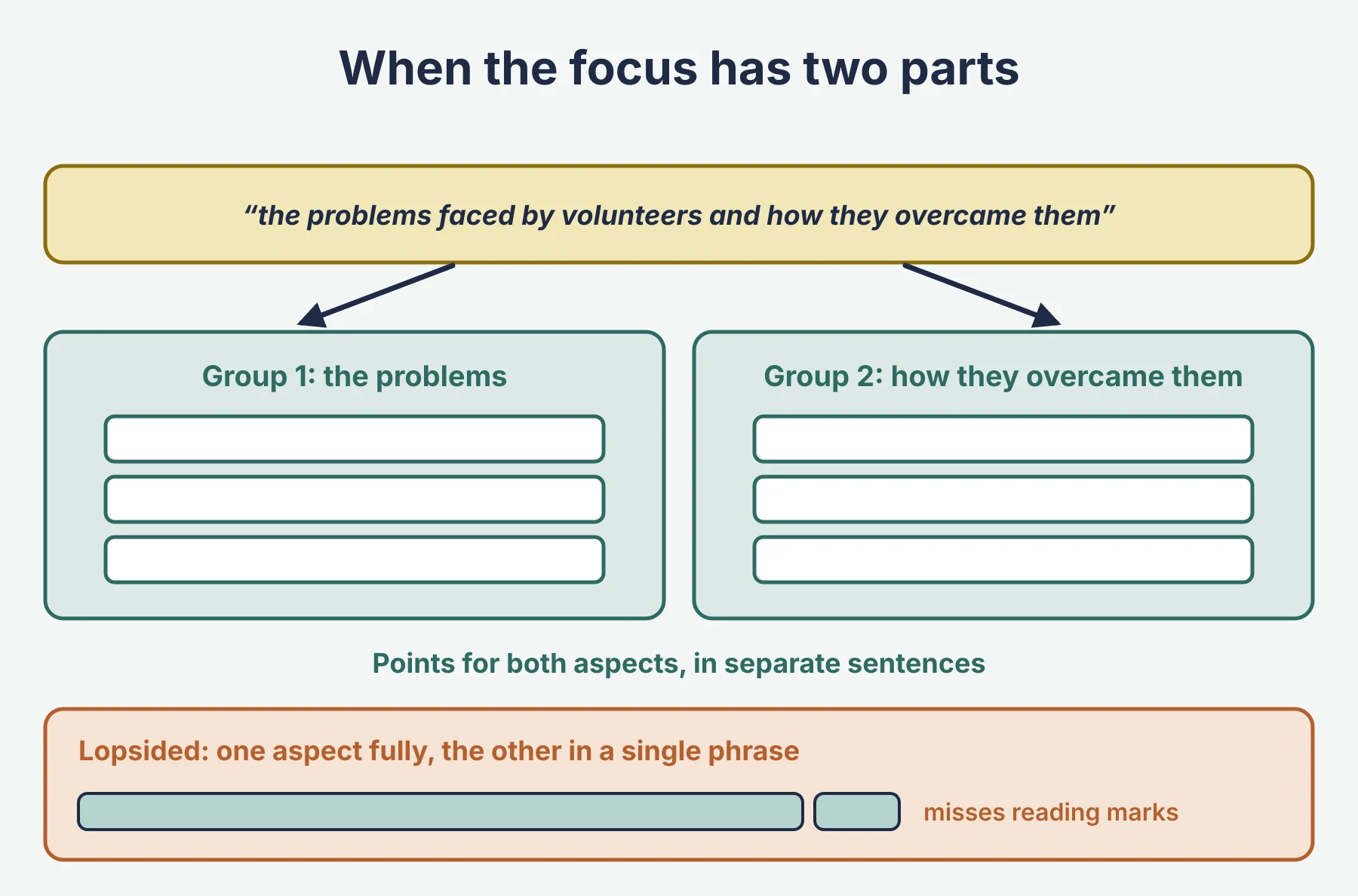
Mini example (original)
Text: Community gardens give city dwellers fresh vegetables. Mr Shah, for example, grows enough beans for his whole street. The gardens also bring neighbours together, although some councils say they are expensive to maintain.
Focus: benefits of community gardens.
- Points: fresh vegetables for city residents; bring neighbours together.
- Excluded: Mr Shah (example); cost to councils (drawback).
- Summary sentence: Community gardens supply city residents with fresh produce and help neighbours get to know one another.
Plan template
| Group | Notes |
|---|---|
| Group 1: … | point · point · point |
| Group 2: … | point · point · point |
| Group 3: … | point · point |
| Excluded | examples · drawbacks · repeats |
Word-count control
- Before the exam, count your words over five lines of your normal handwriting to find your average per line.
- During the exam, count lines, not words, as you write.
- Plan for about 120–140 words, leaving a margin for the final check.
- If over, cut linking padding first (“It is also the case that”), then any remaining detail; never cut a point to save a phrase.
Exam traps
- Summarising the whole text.
- Examples, anecdotes and statistics kept.
- Copied sentences.
- Bullet points or headings.
- Personal opinion added.
- More than 150 words.
- Rushing 3a and leaving no time for 3b.
Self-test
- How are Question 3a’s 20 marks divided?
- What is the word limit, and what happens to points beyond it?
- Define “summarise” as the syllabus does.
- Which writing objectives are tested?
- Why should you not keep an anecdote about a named person?
- Generalise: “apples, pears, plums and cherries”.
- A question asks for the problems of a scheme. Should the text’s suggested solutions appear?
- Why is “Firstly… Secondly… Thirdly…” for every point weak?
- What does “continuous writing” rule out?
- About how long is Text B?
- Which question follows 3a, and on which text?
- What is the purpose of grouping points before writing?
Answers
- 10 Reading (R1, R5) and 10 Writing (W2, W3).
- No more than 150 words; points made after the limit is reached are not credited.
- “Select and present the main points, without detail.”
- W2 and W3.
- It is detail illustrating a point; only the point belongs in the summary.
- “fruit”.
- No, unless the question also asks for them.
- It produces a list rather than organised, linked prose, which limits W2.
- Bullet points, headings, numbered lists and notes.
- About 550–600 words.
- Question 3b, the short response, on Text B.
- To give the summary deliberate structure and to show relationships between points.
More resources on this topic
Related resources
-
Study guides
Cambridge O Level English Language (1123): Question 3b Short Response
How to answer the 5-mark Question 3b short response on 1123 Paper 1: reading implicit meanings and attitudes in Text B, naming them precisely and proving them.
English · Cambridge · O Level
Read guide -
Practice questions
Cambridge O Level English Language (1123): Question 3b Short Response – Practice Questions
Original practice for the 1123 Question 3b short response: attitude-word drills, connotation questions and three 5-mark responses on new passages, with answers.
English · Cambridge · O Level
Try questions -
Revision notes
Cambridge O Level English Language (1123): Question 3b Short Response – Revision Notes
Condensed notes for the 1123 Question 3b short response: task facts, attitude signals, precise attitude words, a four-step method, traps and a self-test.
English · Cambridge · O Level
Revise topic
Get free revision emails (optional)
Occasional emails with practice questions, worked explanations and links to free resources for the qualification and subjects you choose. No spam, and you can unsubscribe from any email. The free tools on this site never need an email.