
Study Guides
Cambridge O Level English Language (1123): Question 3a Summary Task
Writing the 150-word 1123 Paper 1 Question 3a summary of Text B: finding the focus, selecting points, own words, grouping and linking, with a model.
- Subject
- English
- Level
- O LEVELS
- Topic
- Paper 1 – Reading
- Author
- Marlbridge Academic Team
- Updated
- Reviewed by
- Ammar Bilal (what this means)
Aligned to Cambridge O Level English (1123), 2024-2026. Official specification .
Syllabus page (what it covers and how it is assessed): Cambridge O Level English Language.
Found an error? Report a correction.
Need help with this topic? Request a free trial class for O Level English Language (1123).
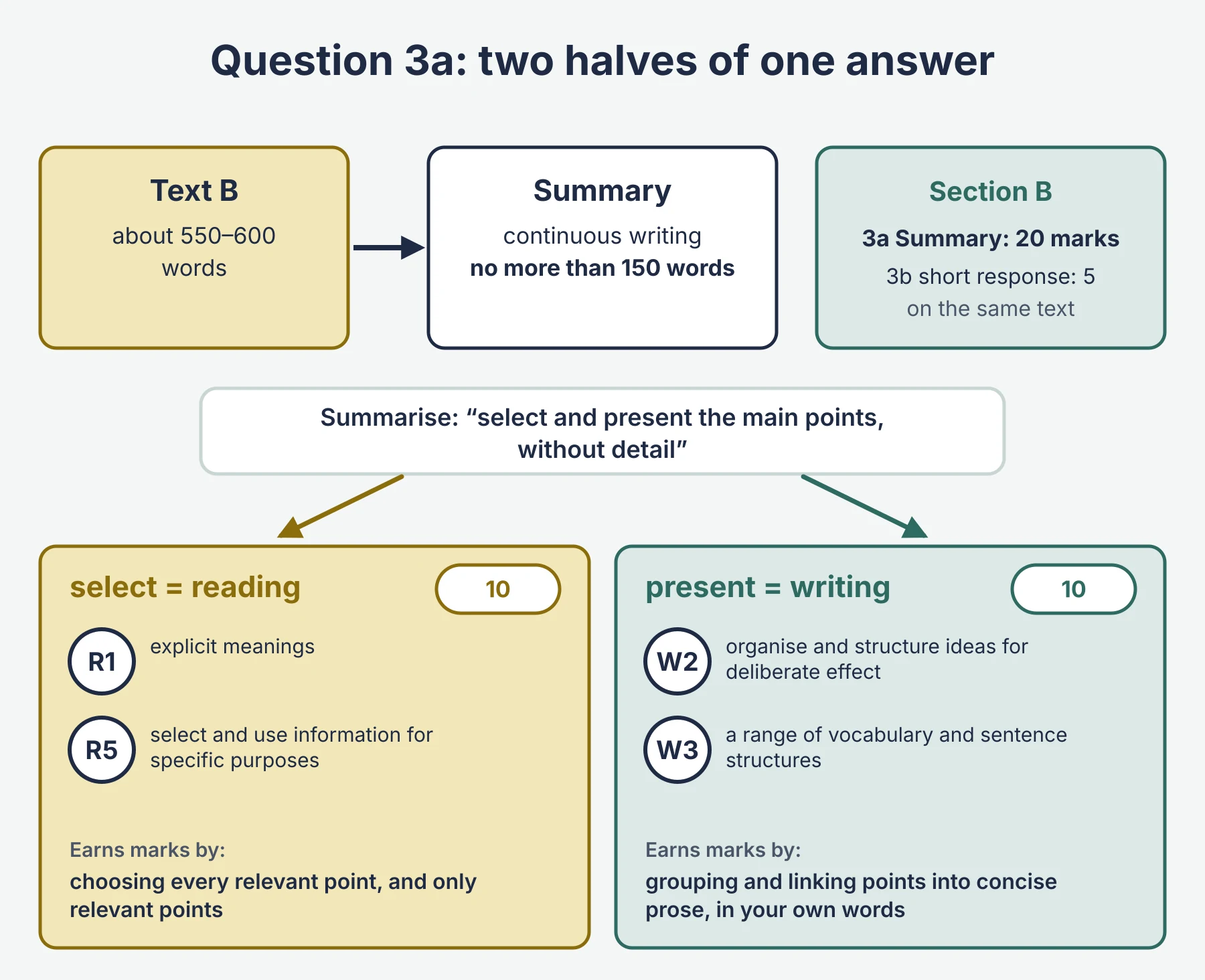
This guide covers Question 3a, the Summary task, in Section B of Cambridge O Level English Language 1123 Paper 1 Reading. The syllabus says: “Candidates answer a summary task in response to Text B. Candidates write a summary as continuous writing of no more than 150 words.” Text B is “approximately 550–600 words long”. The task tests reading objectives R1 and R5 (10 marks) and writing objectives W2 and W3 (10 marks). For the paper as a whole see the Paper 1 Reading study guide. This page is about the process of writing a summary that earns both sets of marks.
Two halves of one answer
| Half | Objectives | What earns the marks |
|---|---|---|
| Reading (10) | R1 explicit meanings; R5 select and use information for specific purposes | choosing every relevant point, and only relevant points |
| Writing (10) | W2 organise and structure ideas for deliberate effect; W3 a range of vocabulary and sentence structures appropriate to context | grouping and linking the points into clear, concise prose in your own words |
The syllabus defines Summarise as “select and present the main points, without detail”. Both halves are in that definition: select is the reading half; present is the writing half.
Step 1: find the focus
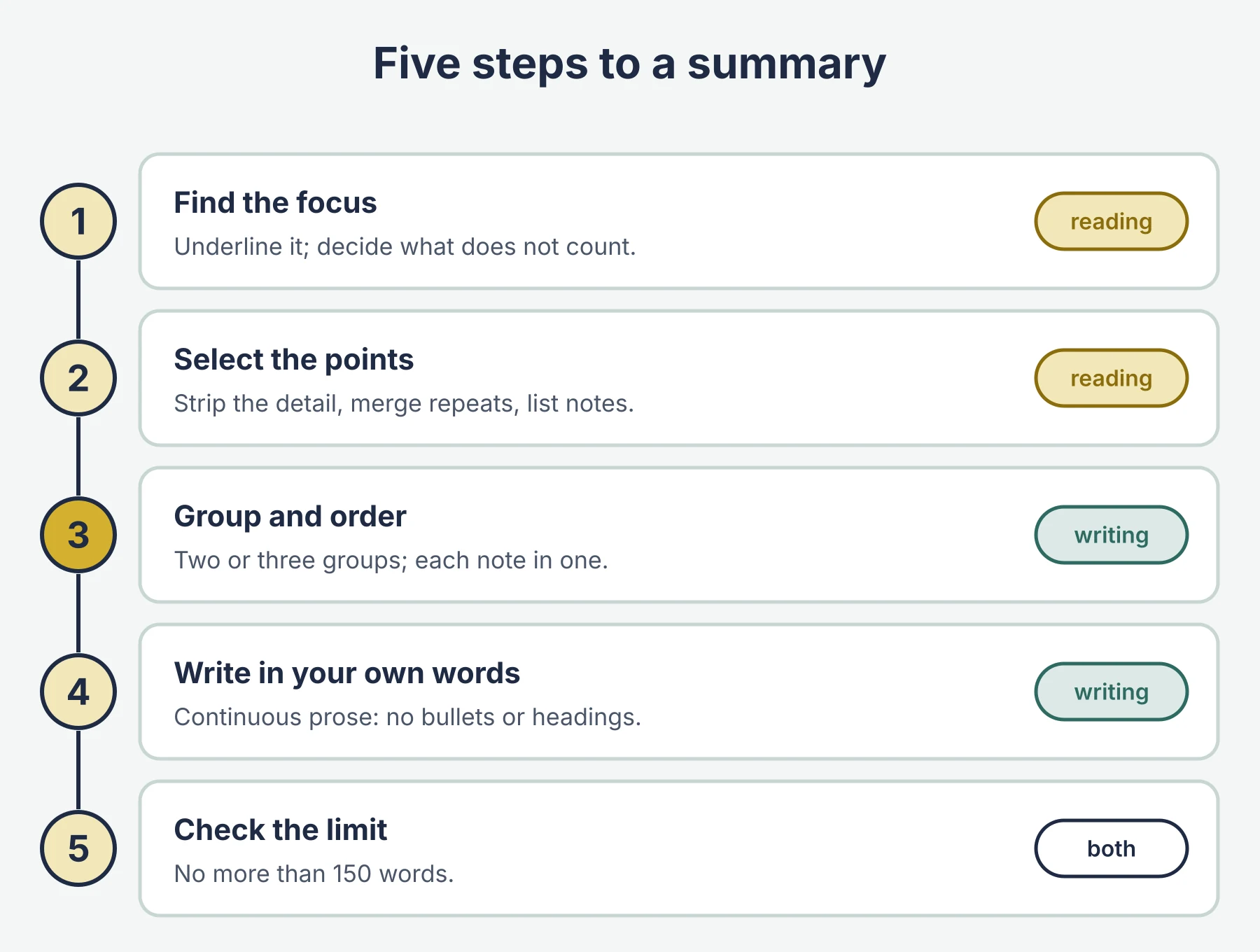
The question never asks you to summarise the whole text. It names a focus, for example the benefits of, the problems faced by, the reasons why, what X did to…. Underline it. Then decide what does not count: if the focus is benefits, drawbacks are excluded however interesting; if it is what volunteers did, what the government did is excluded.
Step 2: select the points
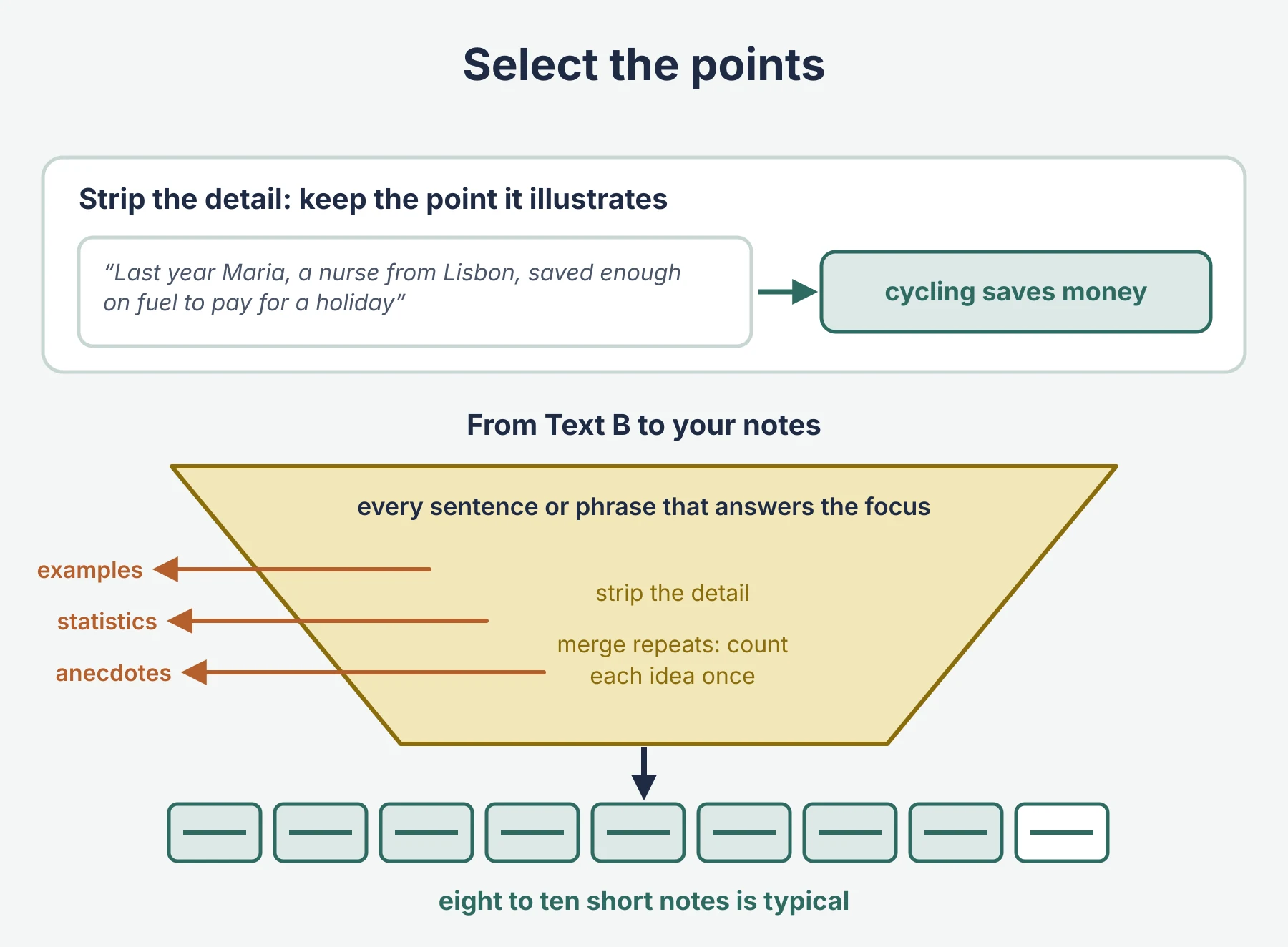
Read Text B once for its overall argument. On the second reading, mark each sentence or phrase that answers the focus. Then:
- Strip the detail. Examples, statistics and anecdotes usually illustrate a point; the point is what you keep. “Last year Maria, a nurse from Lisbon, saved enough on fuel to pay for a holiday” illustrates cycling saves money.
- Merge repeats. Writers restate key ideas; count each idea once.
- List in note form in the margin or on the planning page: eight to ten short notes is typical.
Step 3: group and order
A list of points in the order they appear produces a list-like summary. Grouping produces structure (W2). Common groupings: benefits to individuals / to society; causes / effects; short-term / long-term; what is done / why it works. Decide two or three groups and assign each note to one.
Step 4: write in your own words
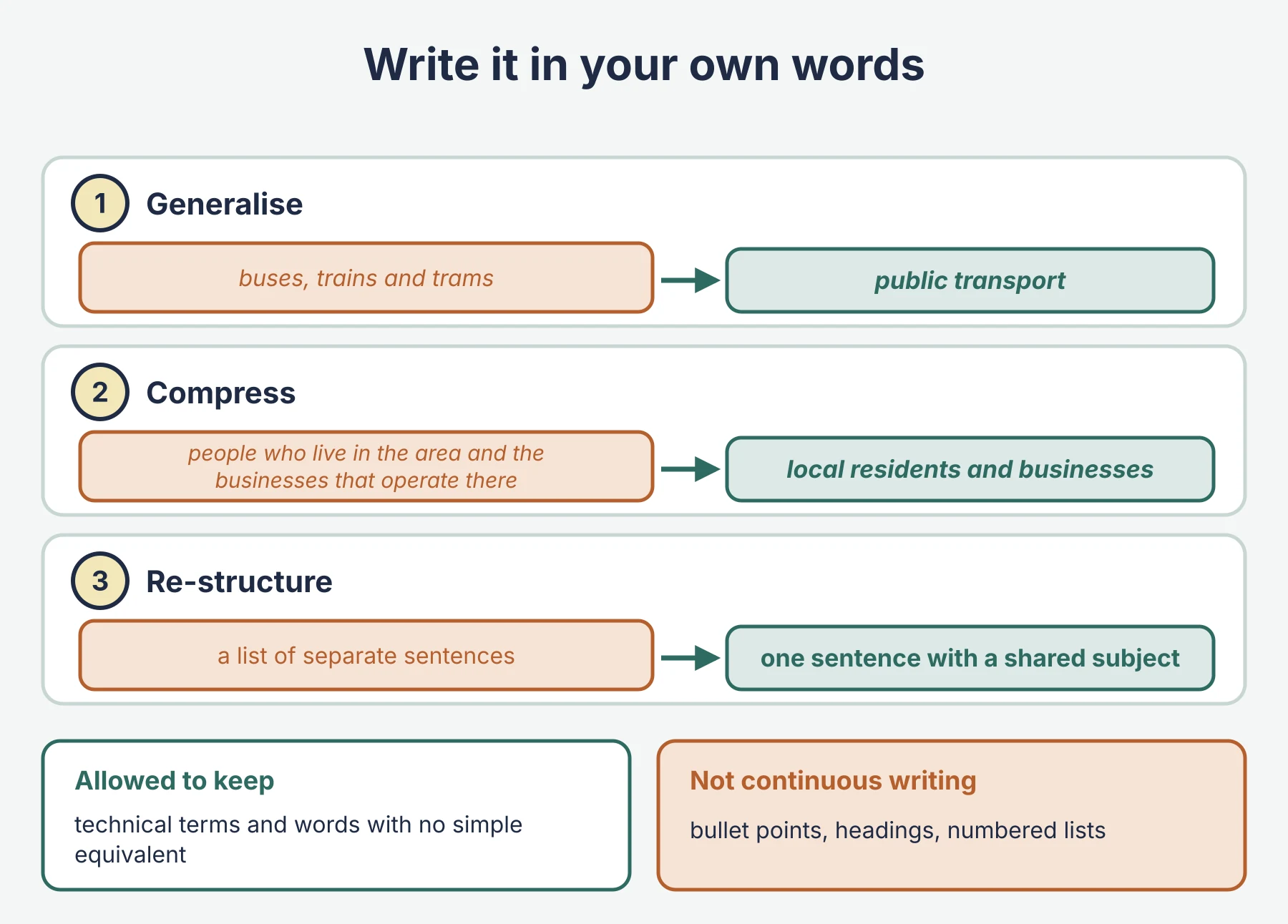
You may keep technical terms or words with no simple equivalent, but phrase the sentences yourself. Methods:
- Generalise: “buses, trains and trams” becomes “public transport”.
- Compress: “people who live in the area and the businesses that operate there” becomes “local residents and businesses”.
- Re-structure: turn a list of separate sentences into one sentence with a shared subject.
Write continuous prose. Bullet points, headings and numbered lists are not “continuous writing”.
Step 5: check the limit
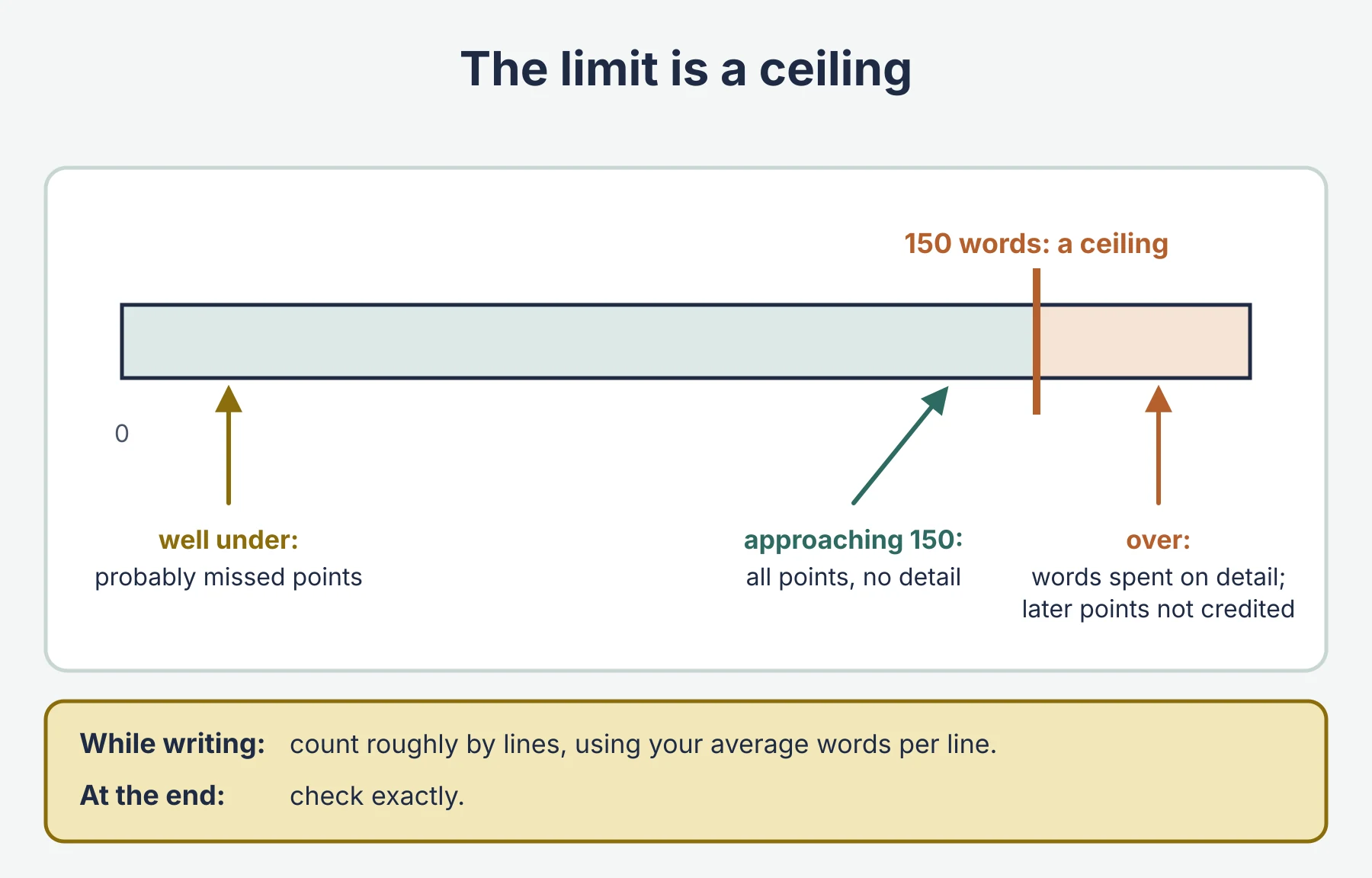
The limit is a ceiling: “no more than 150 words”. Count roughly by lines as you write (find your average words per line beforehand), then check exactly at the end. A summary well under the limit has probably missed points; one over it has spent words on detail.
Worked example
Shortened Text B (original, written for this guide):
Across many cities, schools are turning their concrete playgrounds into gardens, and the results are striking. Teachers report that children who spend breaktime among plants return to lessons calmer and better able to concentrate. One head teacher in a busy inner-city school said the number of playground arguments had fallen noticeably since the garden opened.
The gardens are also classrooms in their own right. Pupils measure plant growth in mathematics, study insects in science and write about the changing seasons. For children who struggle in a traditional classroom, practical work outdoors can be the first time they feel successful at school.
Not everyone is convinced. Some parents worry about mud, insects and allergies, and gardens need regular care during the long summer holiday. But supporters argue that the benefits reach beyond the school gate: a green space cools the surrounding streets on hot days, provides a home for birds and bees, and, when it is opened at weekends, gives local families somewhere to meet.
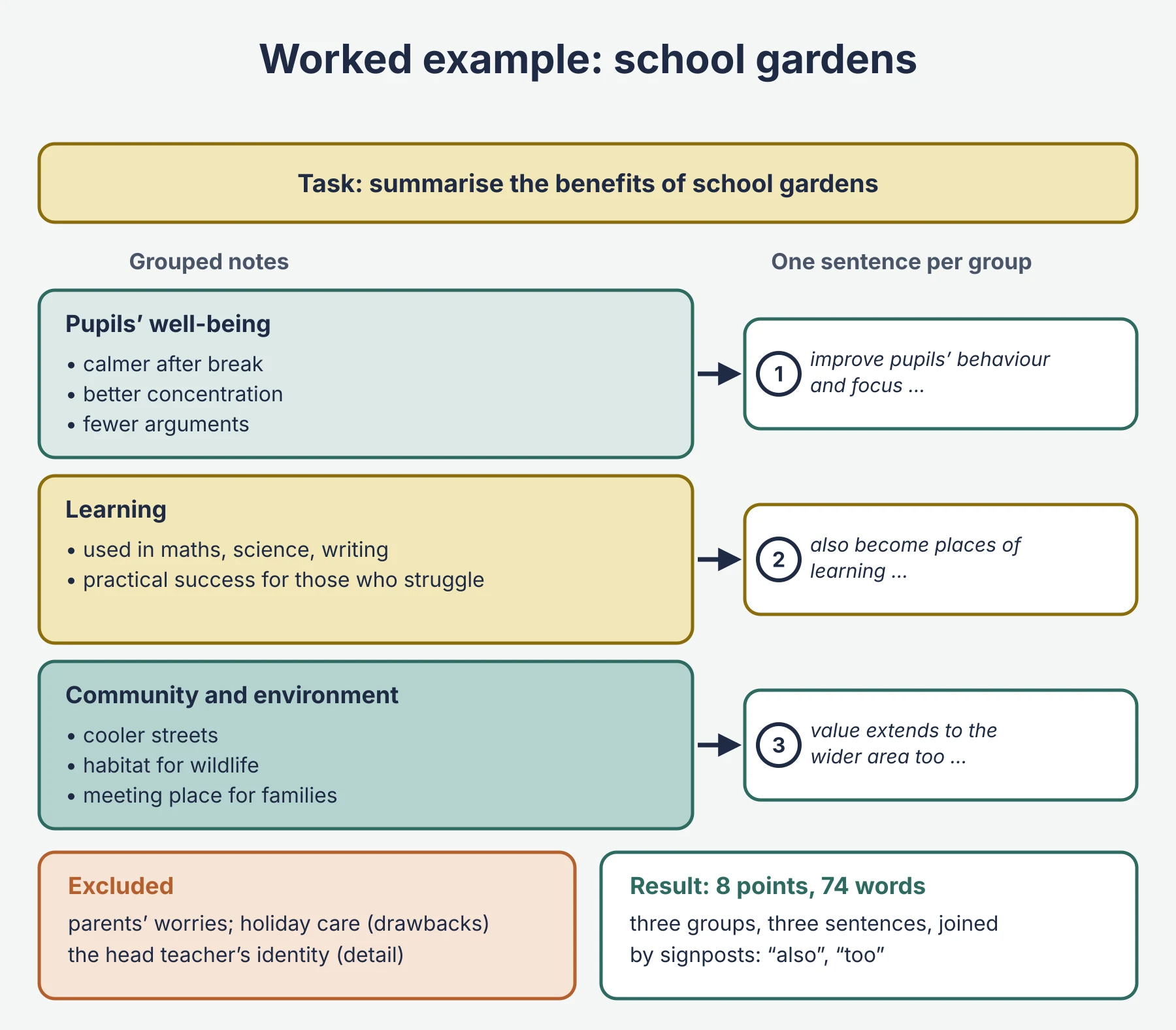
Task: Summarise the benefits of school gardens, as described in the text.
Plan (notes, grouped):
- Pupils’ well-being: calmer after break; better concentration; fewer arguments.
- Learning: used in maths, science and writing; practical success for those who struggle.
- Community and environment: cooler streets; habitat for wildlife; meeting place for families.
Excluded: parents’ worries; holiday care (drawbacks); the head teacher’s identity (detail).
Model summary (74 words, for a shortened text):
School gardens improve pupils’ behaviour and focus: children return from break calmer, concentrate better and argue less. The gardens also become places of learning, supporting several subjects through hands-on activities and giving pupils who find ordinary lessons difficult a chance to succeed. Their value extends to the wider area too, since green spaces lower the temperature of nearby streets, shelter wildlife and, when opened at weekends, offer local families a place to come together.
Commentary: all eight points are present (R1, R5); none of the drawbacks appears. Three groups give three sentences, joined by signposts (“also”, “too”), which is the deliberate structure W2 rewards. Phrasing is the candidate’s own (“lower the temperature of nearby streets” for “cools the surrounding streets”), with varied sentence forms (W3). A real Text B is about twice as long and would give more points, so a full answer would approach, but not exceed, 150 words.
When the focus has two parts
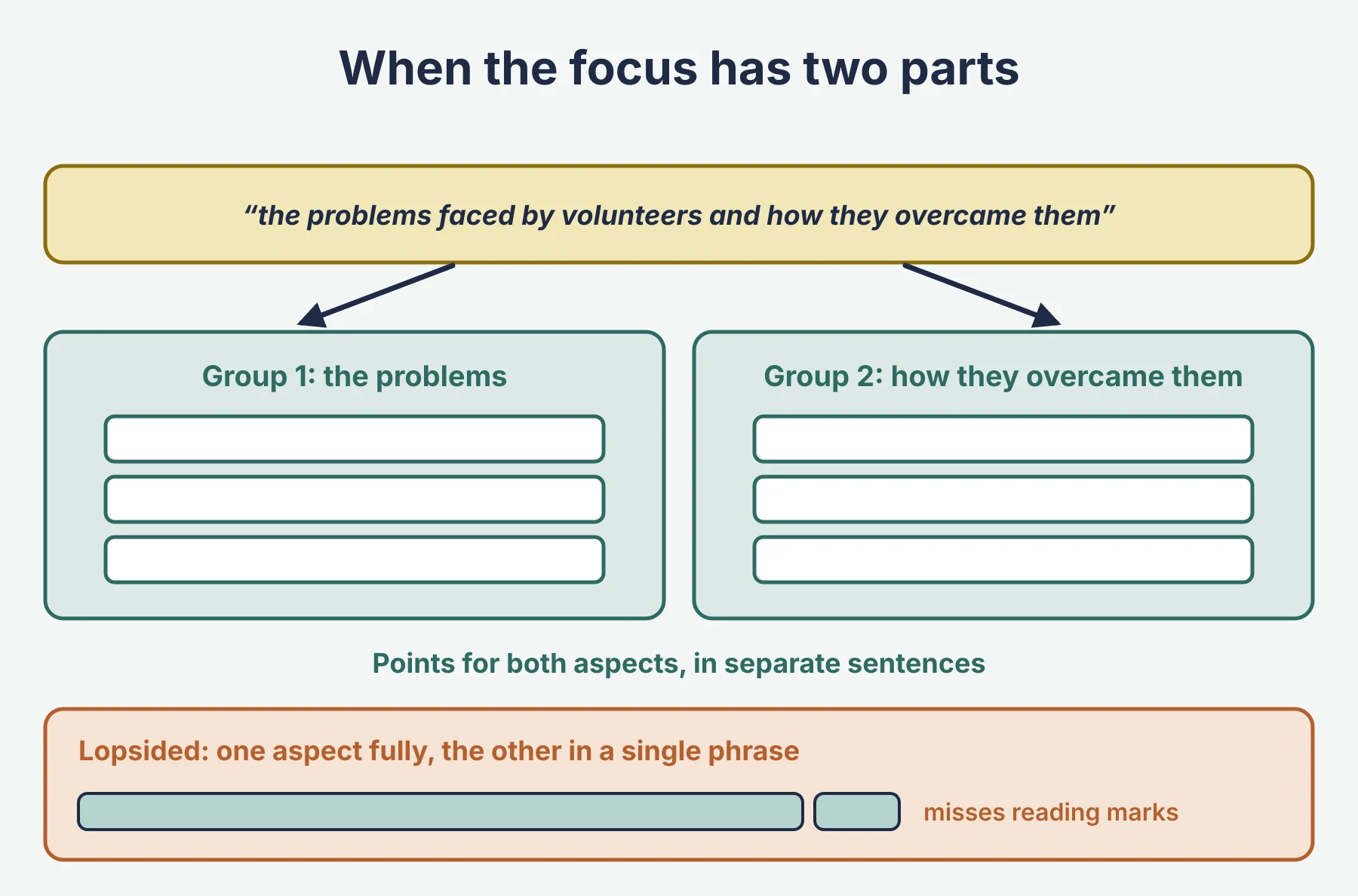
Some tasks combine two aspects, such as the problems faced by volunteers and how they overcame them. Treat each aspect as a group in your plan, check you have points for both, and keep them in separate sentences so the examiner can see that both have been answered. A summary that covers one aspect fully and the other in a single phrase usually misses reading marks it could have had.
Common mistakes
- Summarising the whole text instead of the focus.
- Keeping examples and figures that illustrate points.
- Copying sentences from Text B, which limits the writing marks.
- A list in sentence form: “Firstly… Secondly… Thirdly…” through every point, with no grouping.
- Adding opinion or comment: “This is a wonderful idea” is not in the text.
- Exceeding the limit: points made after the limit is reached are not credited.
Exam technique
- Plan before writing: points first, then groups, then prose.
- Aim for one sentence per group, sometimes two.
- Use linking words that show relationships (as a result, in addition, however), not just sequence.
- Question 3a is the heaviest question on the paper (20 marks): give it a fair share of Section B’s time, leaving room for the 5-mark Question 3b short response on the same text.
More resources on this topic
Related resources
-
Practice questions
Cambridge O Level English Language (1123): Question 3a Summary Task – Practice Questions
Original summary drills and a full 20-mark task on a new Text B-style article for 1123 Paper 1 Question 3a, with a point list, model answer and guidance.
English · Cambridge · O Level
Try questions -
Revision notes
Cambridge O Level English Language (1123): Question 3a Summary Task – Revision Notes
Condensed notes for the 1123 Paper 1 Question 3a summary: facts, the reading and writing halves, a five-step method, own-words tools, traps and a self-test.
English · Cambridge · O Level
Revise topic -
Study guides
Cambridge O Level English Language (1123): Question 3b Short Response
How to answer the 5-mark Question 3b short response on 1123 Paper 1: reading implicit meanings and attitudes in Text B, naming them precisely and proving them.
English · Cambridge · O Level
Read guide
Get free revision emails (optional)
Occasional emails with practice questions, worked explanations and links to free resources for the qualification and subjects you choose. No spam, and you can unsubscribe from any email. The free tools on this site never need an email.