
Revision Notes
Cambridge O Level English Language (1123): Question 2 Use of Language Task – Revision Notes
Condensed notes for 1123 Paper 1 Question 2: R4, meaning versus effect, connotation, a feature toolkit, effect verbs, banned phrases, traps and a self-test.
- Subject
- English
- Level
- O LEVELS
- Topic
- Paper 1 – Reading
- Author
- Marlbridge Academic Team
- Updated
- Reviewed by
- Ammar Bilal (what this means)
Aligned to Cambridge O Level English (1123), 2024-2026. Official specification .
Syllabus page (what it covers and how it is assessed): Cambridge O Level English Language.
Found an error? Report a correction.
Need help with this topic? Request a free trial class for O Level English Language (1123).
These notes cover Question 2, the Use of Language task, of 1123 Paper 1: “short answers worth a total of nine marks relating to the author’s use of language and the effect this has”, on Text A. For the paper overview see the Paper 1 Reading study guide; for the full method and a worked extract see the Question 2 Use of Language study guide.
Key facts
- 9 marks, short answers, sub-questions on Text A (the same narrative as Question 1).
- One objective: R4, “demonstrate understanding of how writers achieve effects and influence readers”.
- The syllabus asks candidates to “recognise and respond to linguistic devices, figurative language and imagery”.
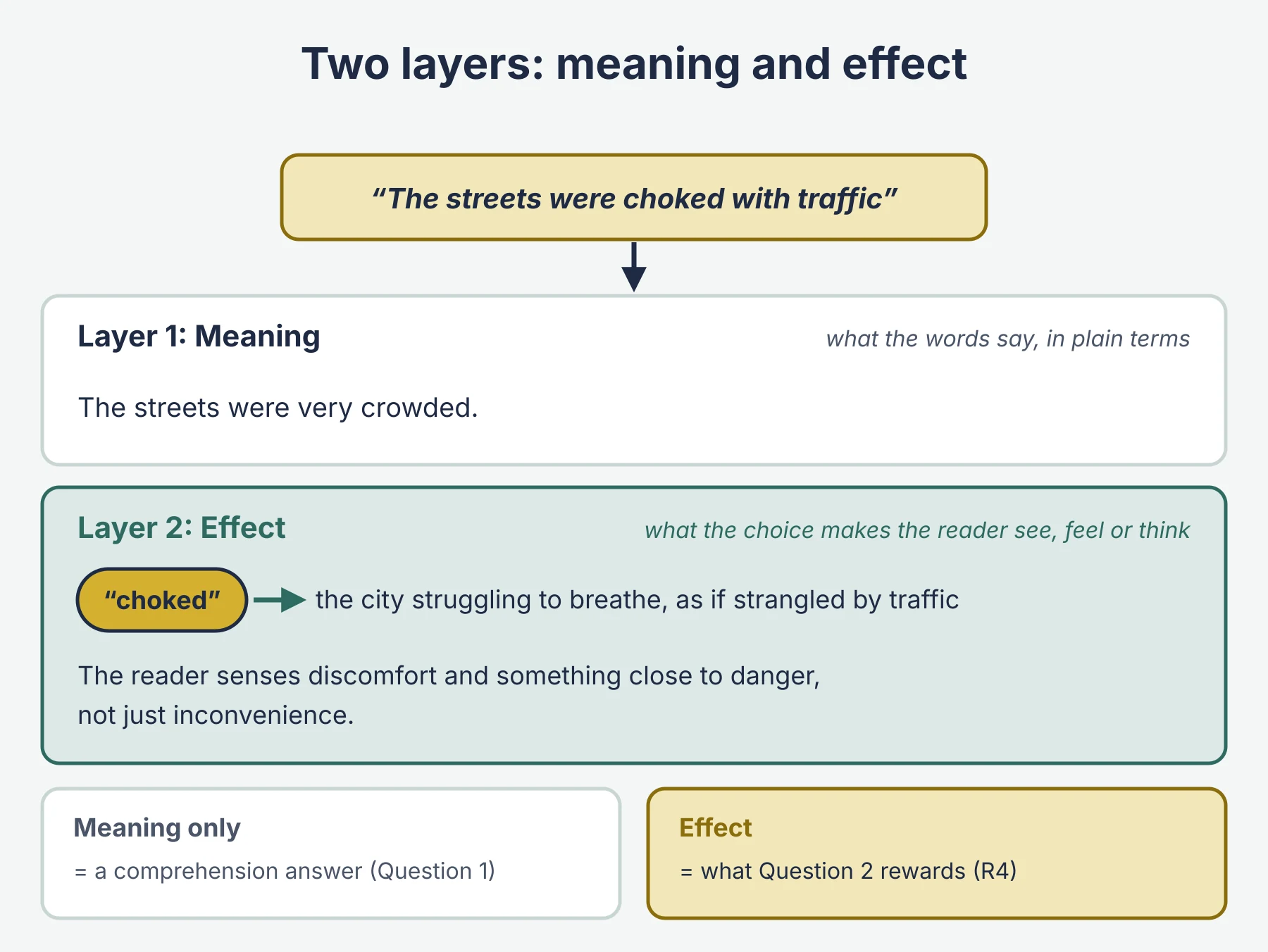
Meaning versus effect
| Layer | Question it answers | Example: “the wind clawed at the tent” |
|---|---|---|
| Meaning | What does it say? | The wind pulled hard at the tent. |
| Effect | What does the choice make us see, feel, think? | “Clawed” makes the wind an animal attacking; the campers seem under threat. |
Question 2 credits effect. Meaning alone is a Question 1 answer. In a two-mark answer, give the meaning in a few words and spend the rest of the answer on the effect: the second mark usually depends on what the choice suggests in this context.
Connotation
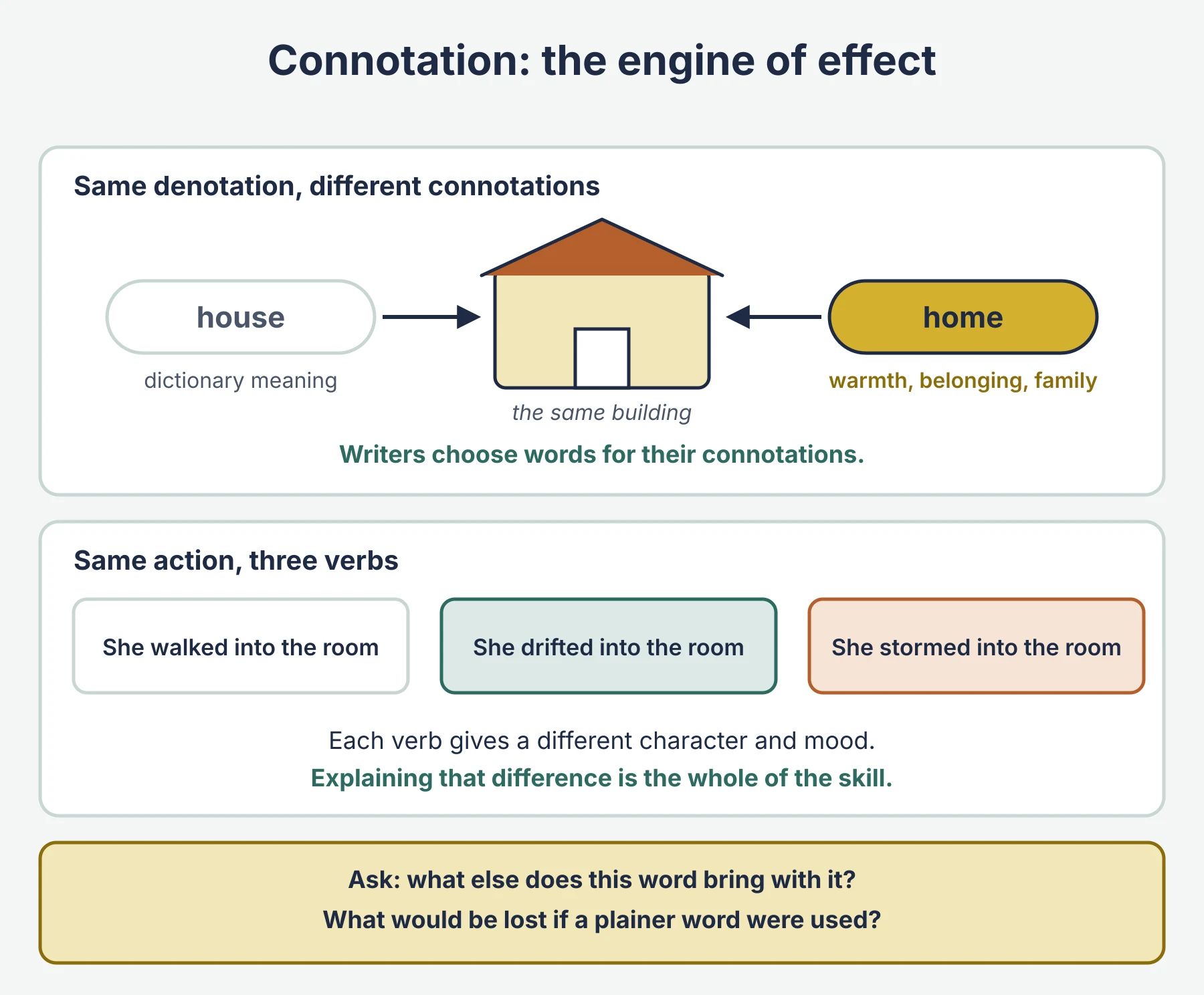
Denotation = dictionary meaning. Connotation = associations. Ask: what would be lost if a plainer word were used? walked / drifted / stormed: same action, different person and mood.
Feature toolkit
| Feature | Effect question |
|---|---|
| verb | what kind of action, what attitude or force? |
| adjective / adverb | what quality, what judgement? |
| simile | what does the comparison reveal? |
| metaphor | what does the fusion suggest? |
| personification | which human quality, and why give it? |
| sensory imagery | which sense, what atmosphere? |
| sound (alliteration, onomatopoeia) | what do we hear, what mood? |
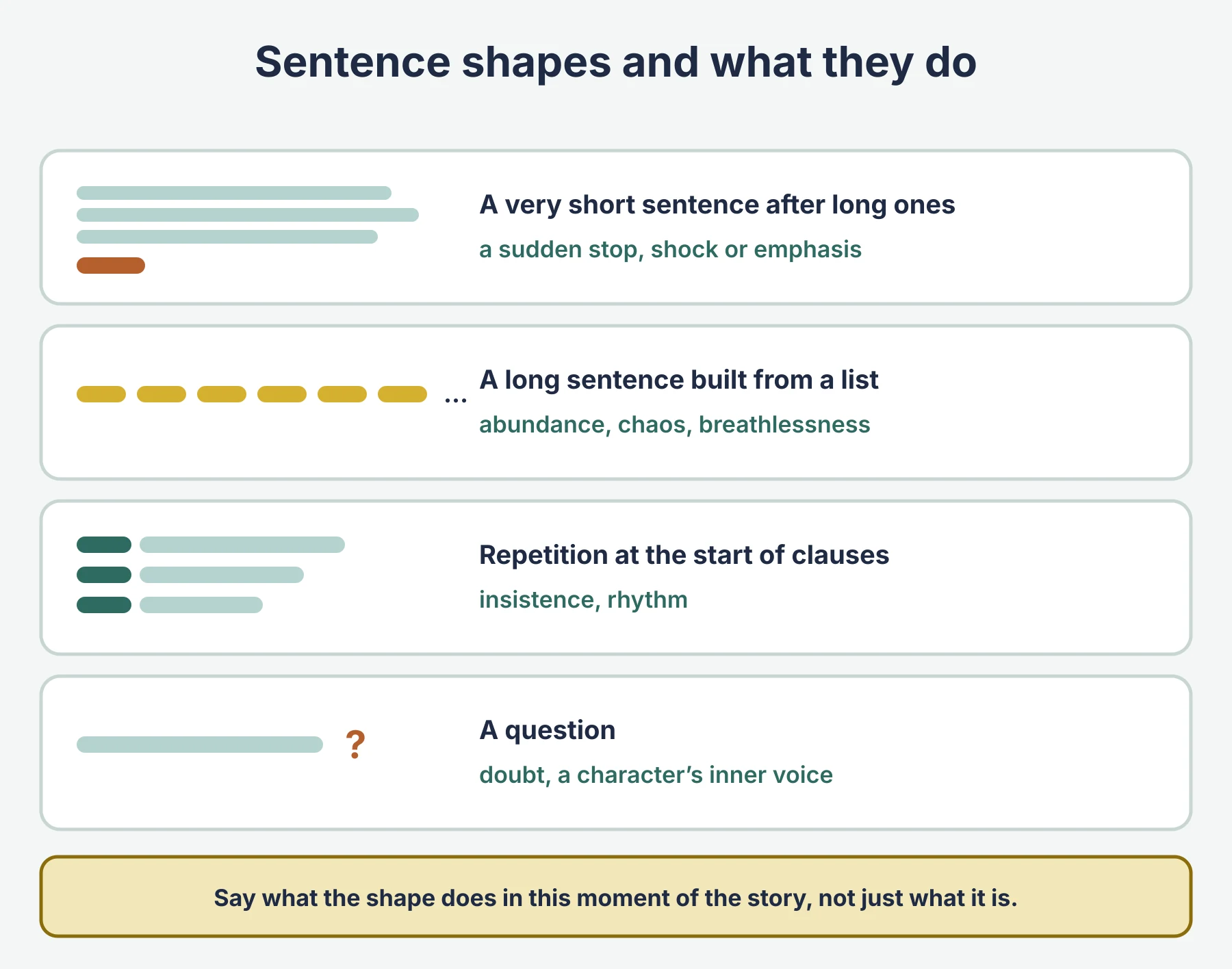
| short sentence / fragment | sudden, tense, emphatic? |
| long, listing sentence | overwhelming, busy, breathless? |
| repetition | what is stressed? |
| contrast | what does the gap reveal? |
The three-step answer
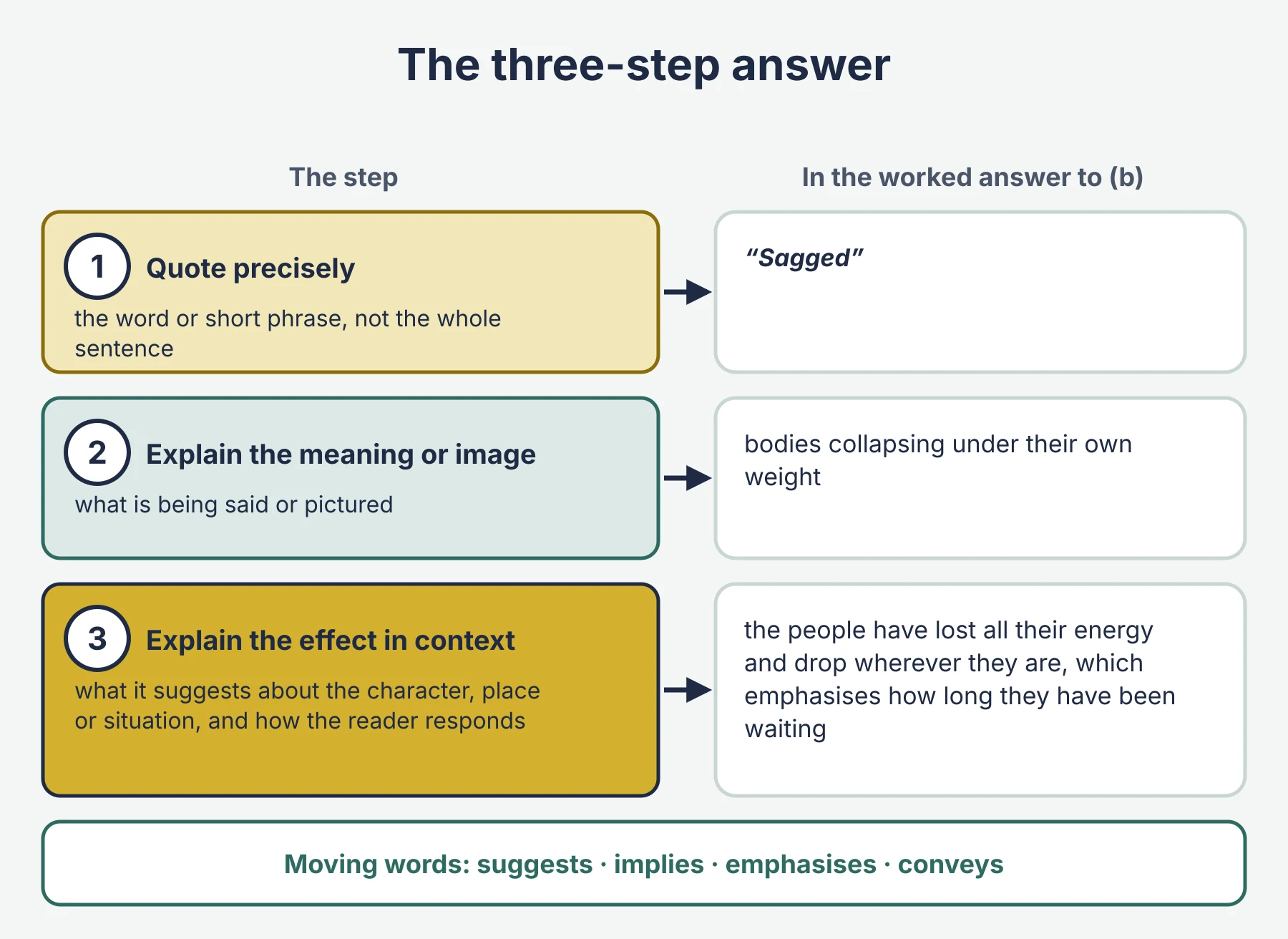
Quote (short) → explain (meaning or image) → effect in context (character, place, situation, reader).
Effect verbs
suggests · implies · conveys · emphasises · highlights · creates a sense of · makes the reader feel · reveals · hints at · reinforces
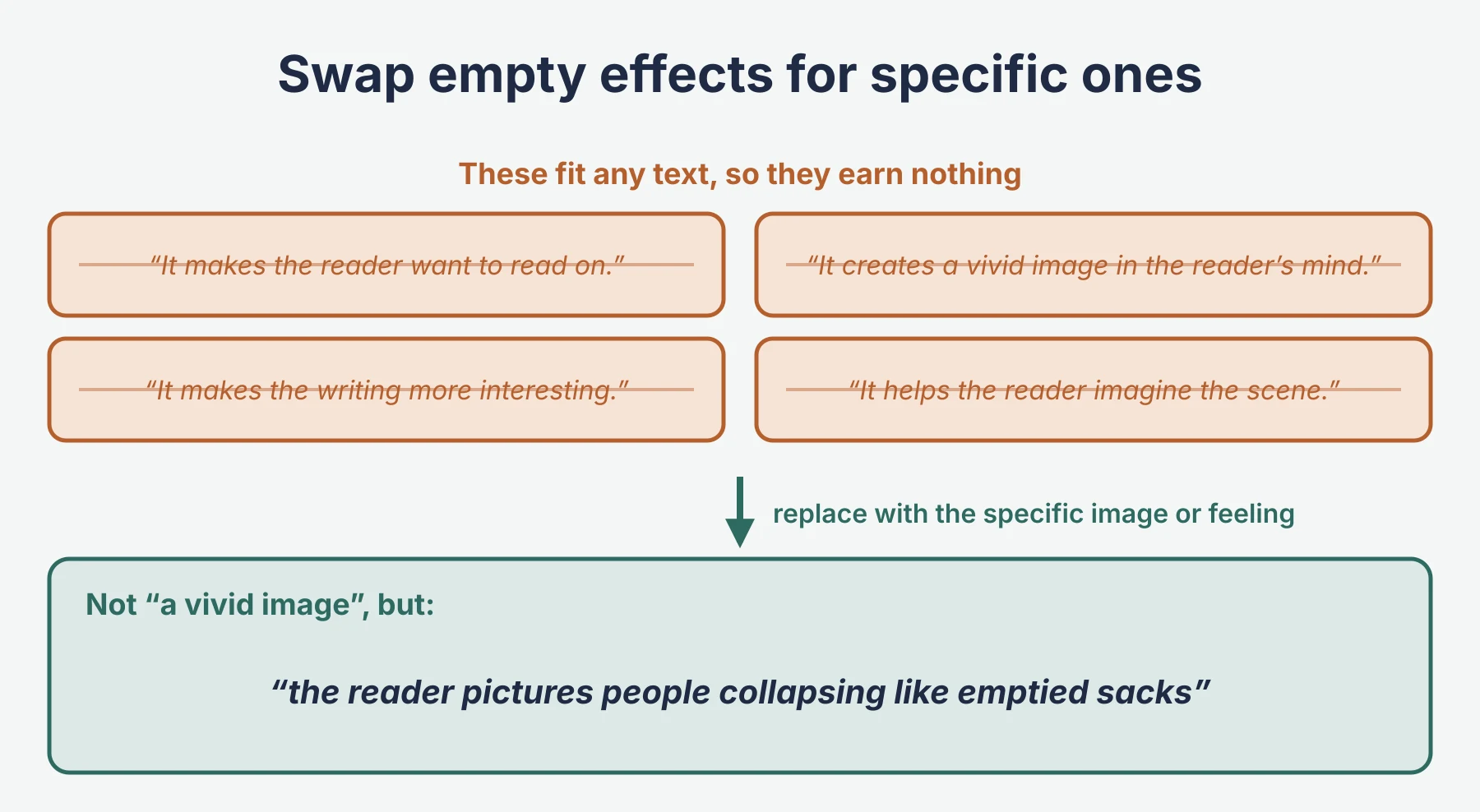
Banned phrases (they fit any text)
- “makes the reader want to read on”
- “creates a vivid image”
- “makes it more interesting”
- “helps the reader imagine”
Replace with the specific image or feeling.
Answer shapes by tariff (working rule)
| Marks | Shape |
|---|---|
| 1 | identify the word or phrase precisely |
| 2 | word or phrase + its effect, or meaning + effect |
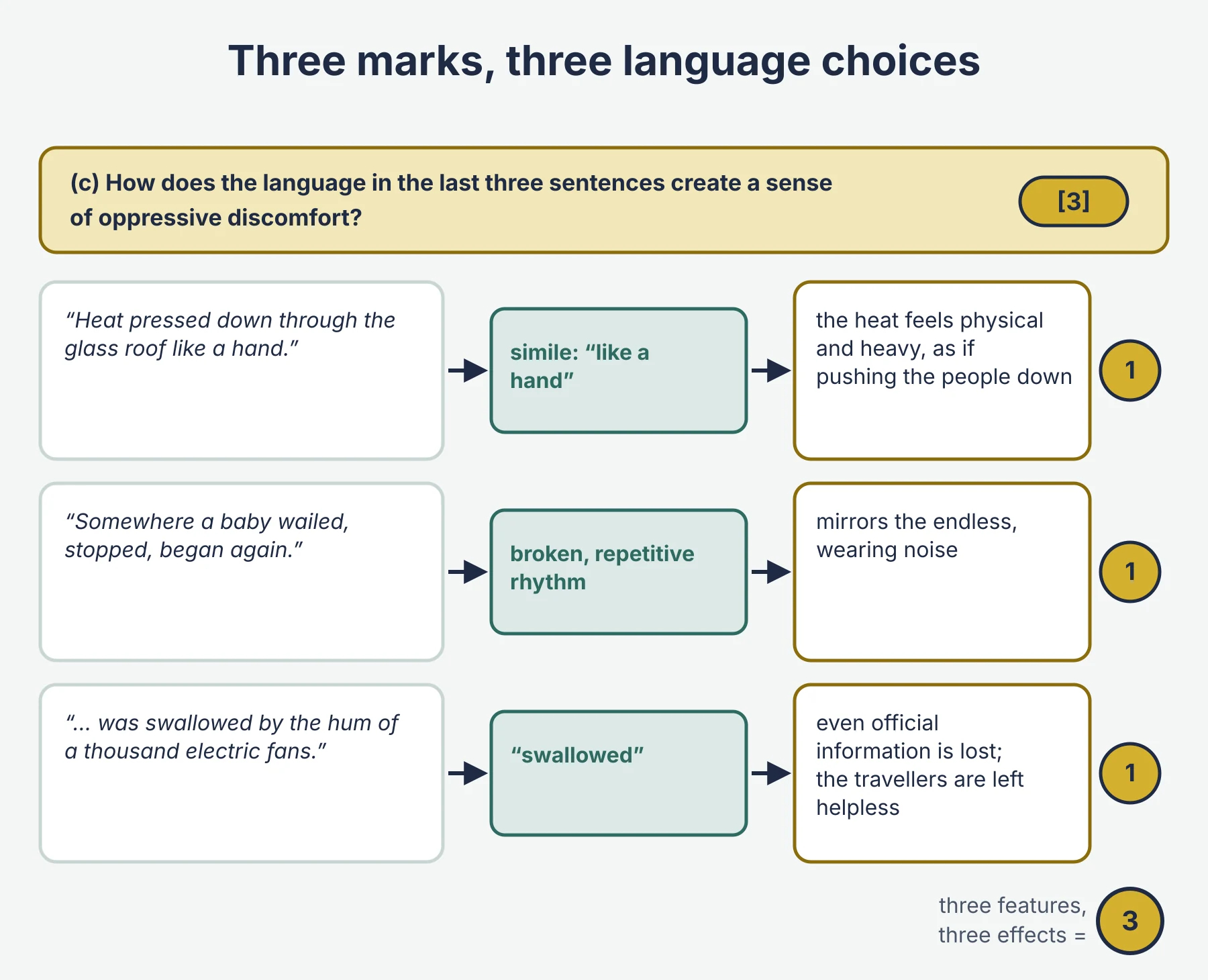
| 3 | three distinct choices with effects, or one choice developed in three clear steps |
Weak to strong
| Weak | Strong |
|---|---|
| “Shuddered” is a good word to describe the fridge. | “Shuddered” makes the fridge seem to give a last violent shiver, like a living thing dying, so the silence that follows feels sudden. |
| The simile makes it vivid. | Comparing the lake to “a sheet of tin” makes it seem flat, hard and lifeless, reflecting the narrator’s bleak mood. |
| The short sentence creates tension. | “Silence. Then a knock.” The one-word sentence holds the reader in the pause, so the knock lands as a shock. |
Sentence starters
- “The word … suggests that…”
- “By comparing … to …, the writer implies…”
- “This makes the reader picture / feel…”
- “The effect is to emphasise…”
- “In this context, it hints that the character…”
Exam traps
- Paraphrase with no effect.
- Naming a device and stopping.
- Quoting a whole sentence.
- Context-free effects (“red means danger”).
- Choosing words outside the paragraph the question names.
- One idea stretched across three marks.
- Leaving Question 2 the scraps of Section A’s time.
Self-test
- How many marks is Question 2 worth, and which objective does it test?
- What is the difference between meaning and effect?
- Define connotation.
- Give the effect of “stormed” in “She stormed into the room”.
- Why does “This is a metaphor” earn nothing on its own?
- What are the three steps of a language answer?
- Rewrite this empty comment: “The simile creates a vivid image.” (Text: “the lake lay like a sheet of tin”)
- What effect can a very short sentence have in a tense scene?
- Name two “banned” phrases.
- A three-mark question asks how a paragraph creates fear. How should the answer be organised?
- Which text does Question 2 use?
- What does the syllabus ask candidates to recognise and respond to?
Answers
- 9 marks; R4.
- Meaning is what the words say; effect is what the choice of words makes the reader see, feel or think.
- The associations a word carries beyond its dictionary meaning.
- It suggests anger and force: she enters loudly and aggressively, perhaps ready for an argument.
- It names the device but says nothing about what it does in this text.
- Quote briefly, explain the meaning or image, explain the effect in context.
- For example: “Comparing the lake to tin makes it seem flat, grey and lifeless, as if it were a hard, cold surface rather than water.”
- It creates suddenness or emphasis, mirroring shock or a held breath.
- Two of: “makes the reader want to read on”, “creates a vivid image”, “makes it more interesting”, “helps the reader imagine”.
- Three distinct language choices from the paragraph, each quoted and explained for how it creates fear.
- Text A, the narrative text also used for Question 1.
- “Linguistic devices, figurative language and imagery.”
More resources on this topic
Related resources
-
Study guides
Cambridge O Level English Language (1123): Question 3a Summary Task
Writing the 150-word 1123 Paper 1 Question 3a summary of Text B: finding the focus, selecting points, own words, grouping and linking, with a model.
English · Cambridge · O Level
Read guide -
Practice questions
Cambridge O Level English Language (1123): Question 3a Summary Task – Practice Questions
Original summary drills and a full 20-mark task on a new Text B-style article for 1123 Paper 1 Question 3a, with a point list, model answer and guidance.
English · Cambridge · O Level
Try questions -
Revision notes
Cambridge O Level English Language (1123): Question 3a Summary Task – Revision Notes
Condensed notes for the 1123 Paper 1 Question 3a summary: facts, the reading and writing halves, a five-step method, own-words tools, traps and a self-test.
English · Cambridge · O Level
Revise topic
Get free revision emails (optional)
Occasional emails with practice questions, worked explanations and links to free resources for the qualification and subjects you choose. No spam, and you can unsubscribe from any email. The free tools on this site never need an email.