
Study Guides
Cambridge O Level English Language (1123): Question 2 Use of Language Task
How to explain a writer's word choice, imagery and sentence effects for the 9-mark 1123 Paper 1 Question 2 on Text A, with annotated answers and common errors.
- Subject
- English
- Level
- O LEVELS
- Topic
- Paper 1 – Reading
- Author
- Marlbridge Academic Team
- Updated
- Reviewed by
- Ammar Bilal (what this means)
Aligned to Cambridge O Level English (1123), 2024-2026. Official specification .
Syllabus page (what it covers and how it is assessed): Cambridge O Level English Language.
Found an error? Report a correction.
Need help with this topic? Request a free trial class for O Level English Language (1123).
This guide covers Question 2, the Use of Language task, in Section A of Cambridge O Level English Language 1123 Paper 1 Reading. The syllabus says candidates “respond to a series of sub-questions based on Text A. These are short answers worth a total of nine marks relating to the author’s use of language and the effect this has.” It tests a single objective, R4: “demonstrate understanding of how writers achieve effects and influence readers”. For the paper as a whole, see the Paper 1 Reading study guide. This page is about the skill itself: saying precisely what a writer’s words do.
Meaning and effect
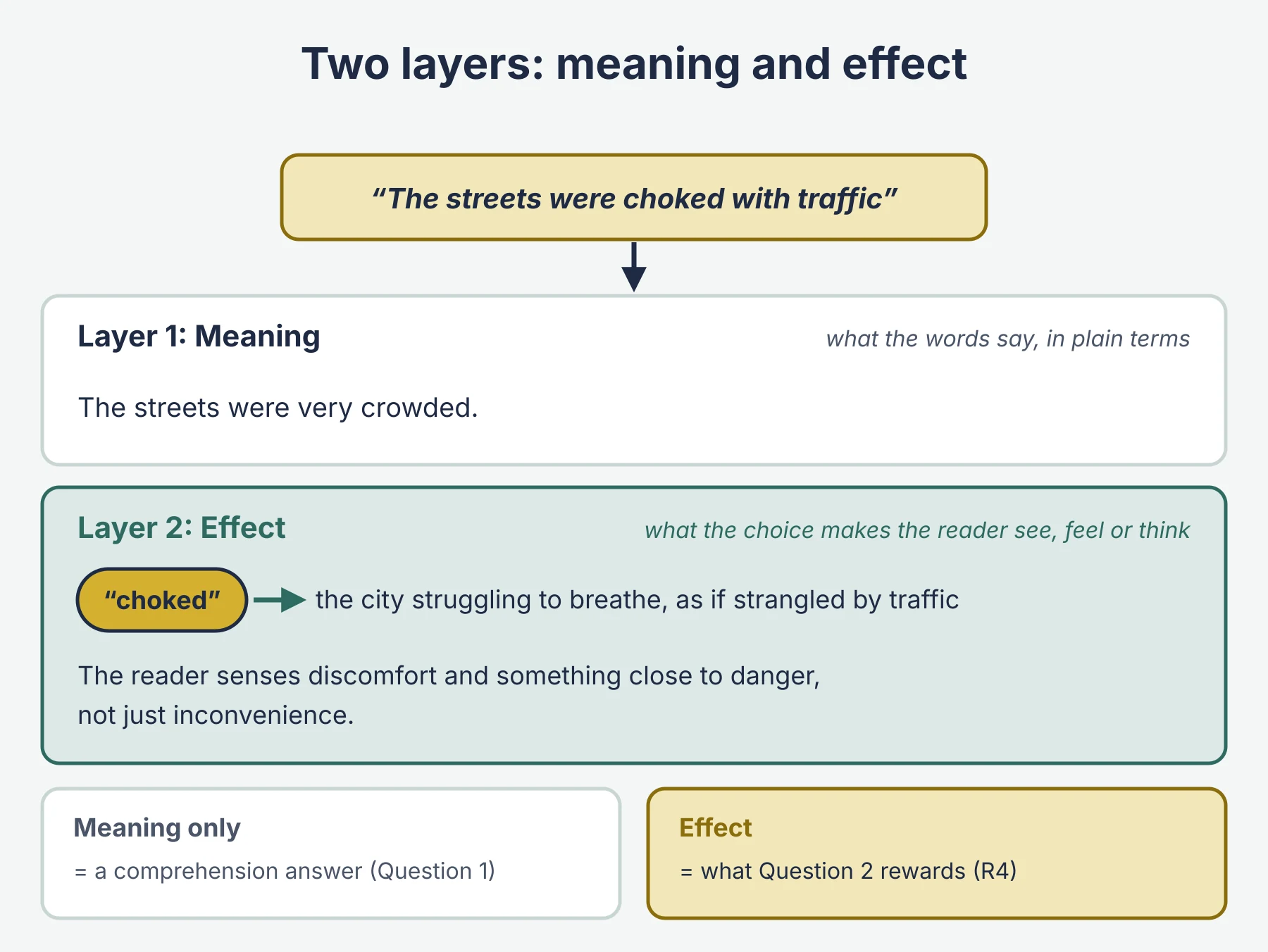
Every language answer has two layers.
- Meaning: what the words say, in plain terms. “The streets were choked with traffic” means the streets were very crowded.
- Effect: what the choice of words makes the reader see, feel or think, beyond the plain meaning. “Choked” suggests the city is struggling to breathe, as if the traffic were strangling it; the reader senses discomfort and something close to danger, not just inconvenience.
Question 2 rewards the second layer. An answer that only gives the meaning is answering a comprehension question, which belongs to Question 1.
Connotation: the engine of effect
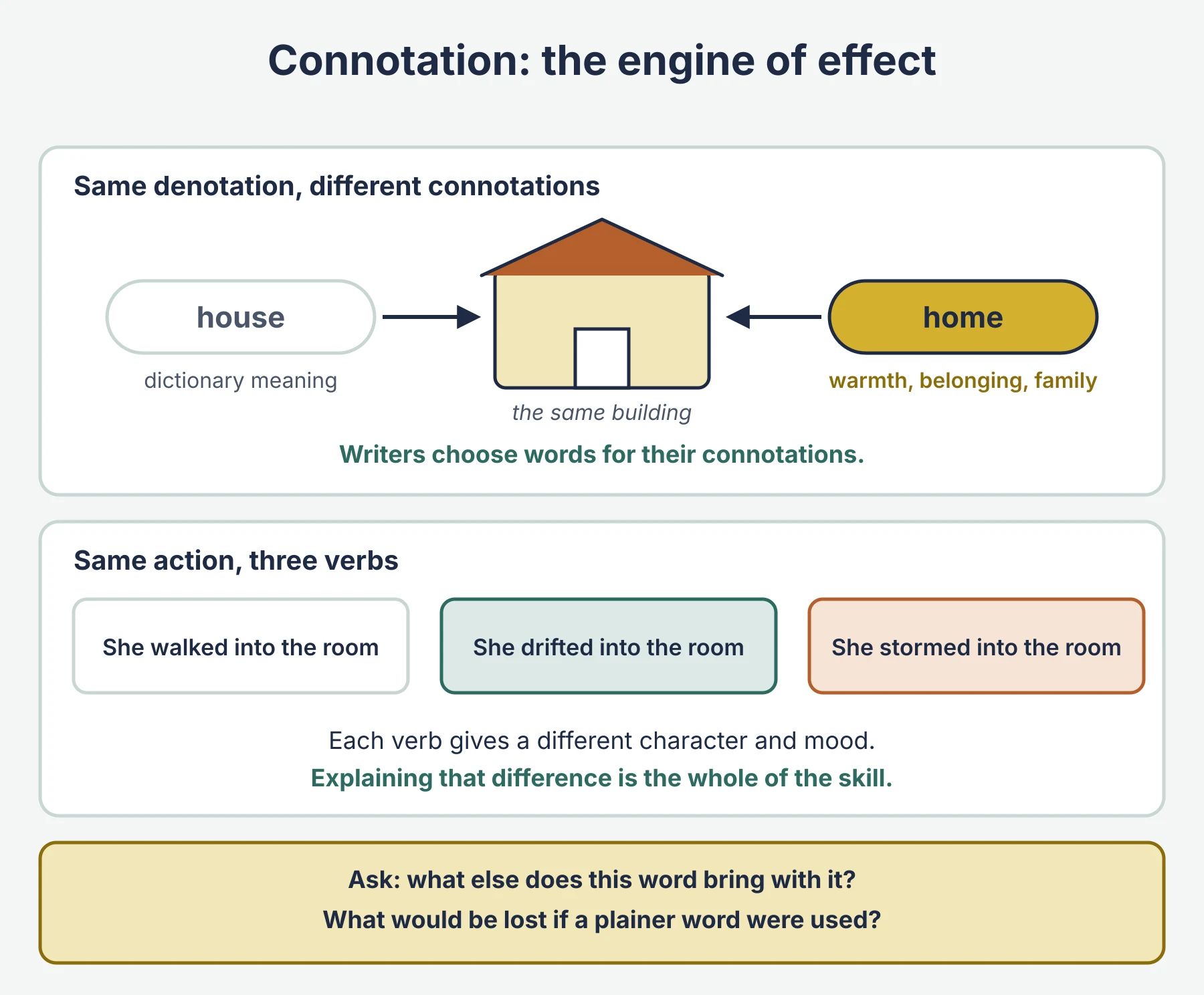
A word’s denotation is its dictionary meaning. Its connotations are the associations it carries. Home and house can denote the same building; home carries warmth, belonging and family. Writers choose words for their connotations. When you explain an effect, ask: what else does this word bring with it? What would be lost if a plainer word were used?
Compare: “She walked into the room”, “She drifted into the room”, “She stormed into the room”. The action is the same; each verb gives a different character and mood. Explaining that difference is the whole of the skill.
What to look for
The syllabus’s reading content asks you to “recognise and respond to linguistic devices, figurative language and imagery”. In a narrative Text A, that usually means:
| Feature | Example (original) | Ask |
|---|---|---|
| precise verbs | the wind clawed at the tent | what kind of action, what does it suggest? |
| adjectives and adverbs | a brittle silence | what quality does it give? |
| simile | the lake lay like a sheet of tin | what is compared, and what does that reveal? |
| metaphor | the classroom was a furnace | what does the fusion suggest? |
| personification | the house watched them leave | what human quality, and why? |
| sensory imagery | the sour smell of wet wool | which sense, what atmosphere? |
| sound | the hiss and spit of the fire | what does it make the reader hear? |
| sentence form | Silence. Then a knock. | what does length or rhythm do? |
| contrast | bright banners over empty seats | what does the gap reveal? |
Naming the feature is not required for credit and earns nothing on its own. Use the name when it helps you explain; never let it replace the explanation.
The three-step answer
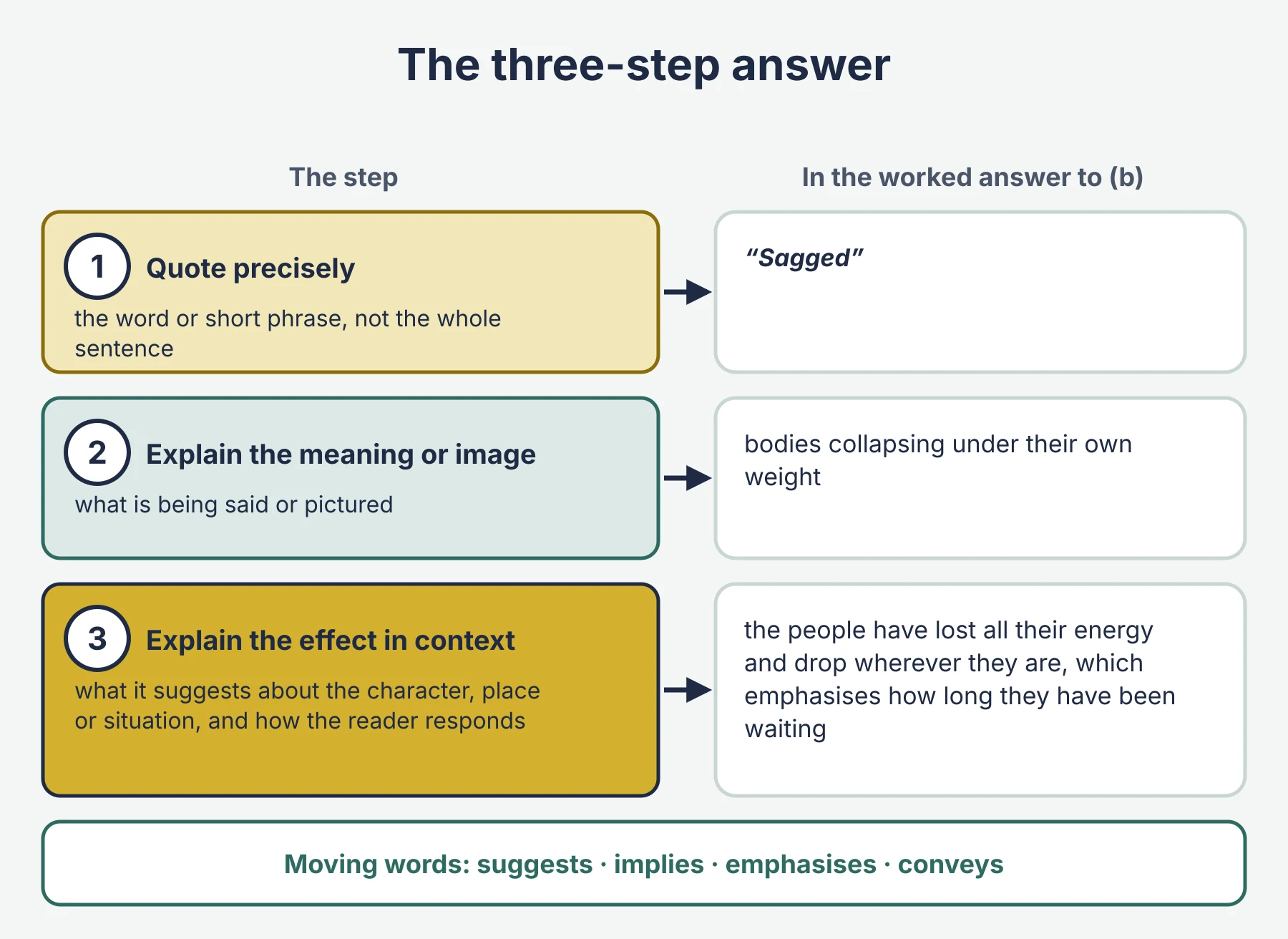
- Quote precisely: the word or short phrase, not the whole sentence.
- Explain the meaning or image: what is being said or pictured.
- Explain the effect in context: what it suggests about the character, place or situation, and how the reader responds.
Worked example
The extract is original, written for this guide.
By noon the station had given up. The departure board flickered and went blank, and the crowd that had been jostling on the platform since dawn sagged onto benches, suitcases, the bare concrete. Heat pressed down through the glass roof like a hand. Somewhere a baby wailed, stopped, began again. An announcer’s voice crackled over the speakers, apologised for something no one could hear, and was swallowed by the hum of a thousand electric fans.
(a) Explain what the writer suggests by saying that “the station had given up”. [2]
Answer: The station is personified as if it were a tired person who has stopped trying [1]. It suggests that nothing is working any more and that the whole place, not just the people, has been defeated by the heat and the delay [1].
(b) Identify the word in the second sentence which shows how tired the crowd had become, and explain its effect. [2]
Answer: “Sagged” [1]. It suggests bodies collapsing under their own weight, as if the people have lost all their energy and simply drop wherever they are, which emphasises how long they have been waiting [1].
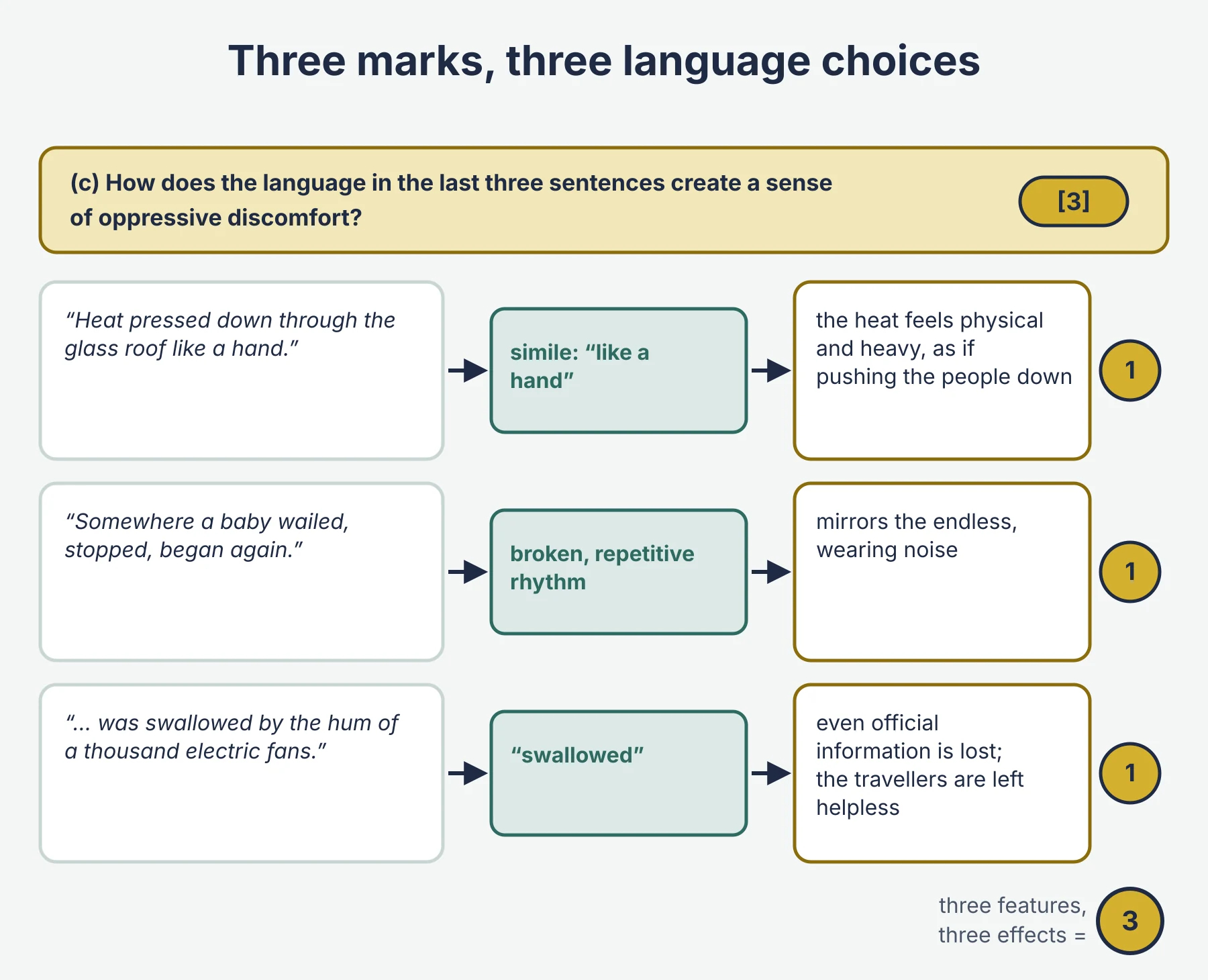
(c) Explain how the writer’s language in the last three sentences creates a sense of oppressive discomfort. [3]
Answer: The simile “like a hand” makes the heat feel physical and heavy, as if something were pushing the people down [1]. The baby that “wailed, stopped, began again” is shown through a broken, repetitive rhythm that mirrors the endless, wearing noise [1]. The announcer’s voice is “swallowed”, suggesting that even official information is lost in the heat and noise, which leaves the travellers helpless [1].
Commentary: each answer quotes briefly, explains, then connects to the situation. Part (c) selects three different features from the three sentences, each with its own effect, matching the three marks.
Writing about sentence structure
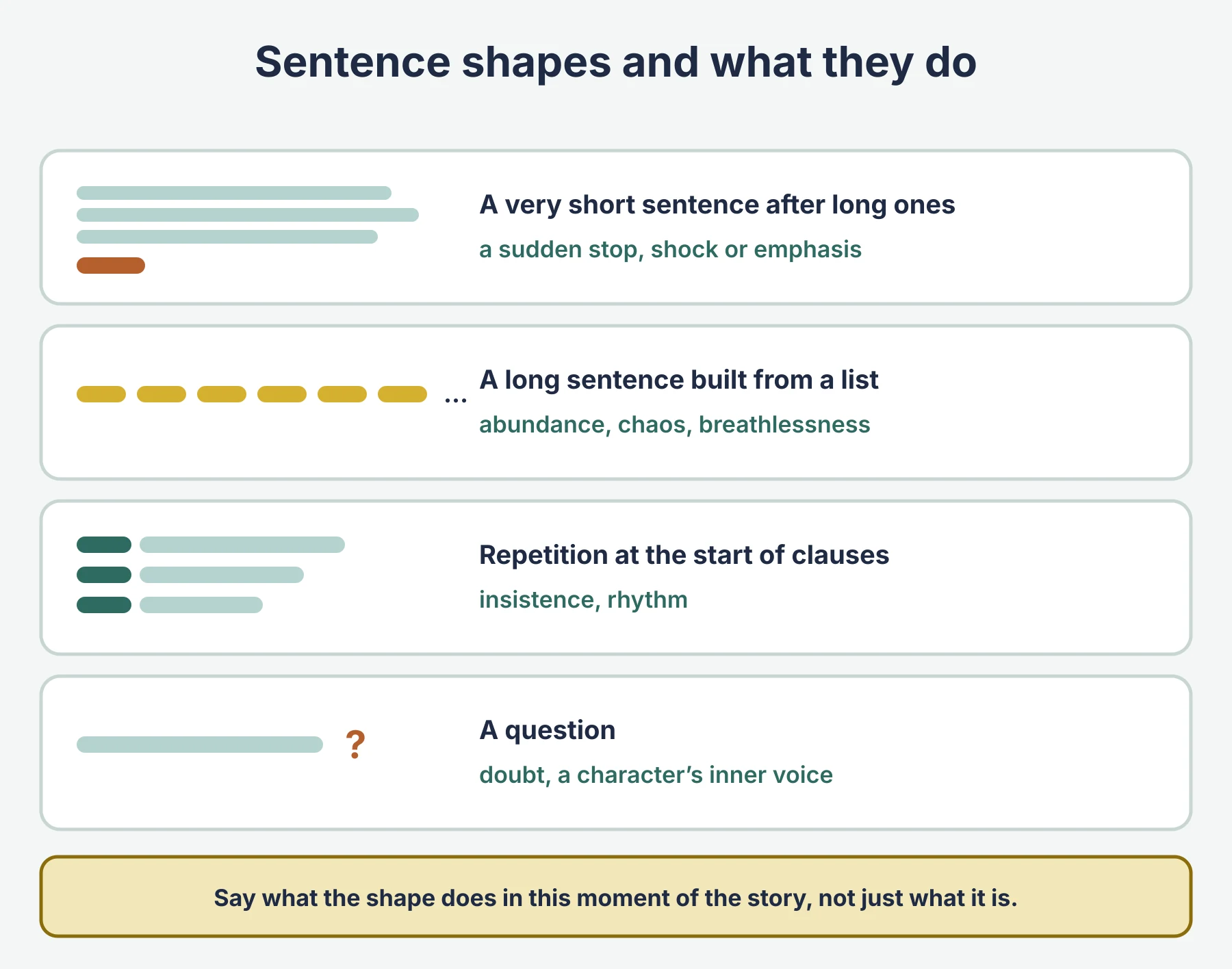
Sentence form is language too. Look for a very short sentence after long ones (a sudden stop, shock or emphasis), a long sentence built from a list (abundance, chaos, breathlessness), repetition at the start of clauses (insistence, rhythm), or a question (doubt, a character’s inner voice). As with words, say what the shape does in this moment of the story, not just what the shape is.
Avoid empty effects
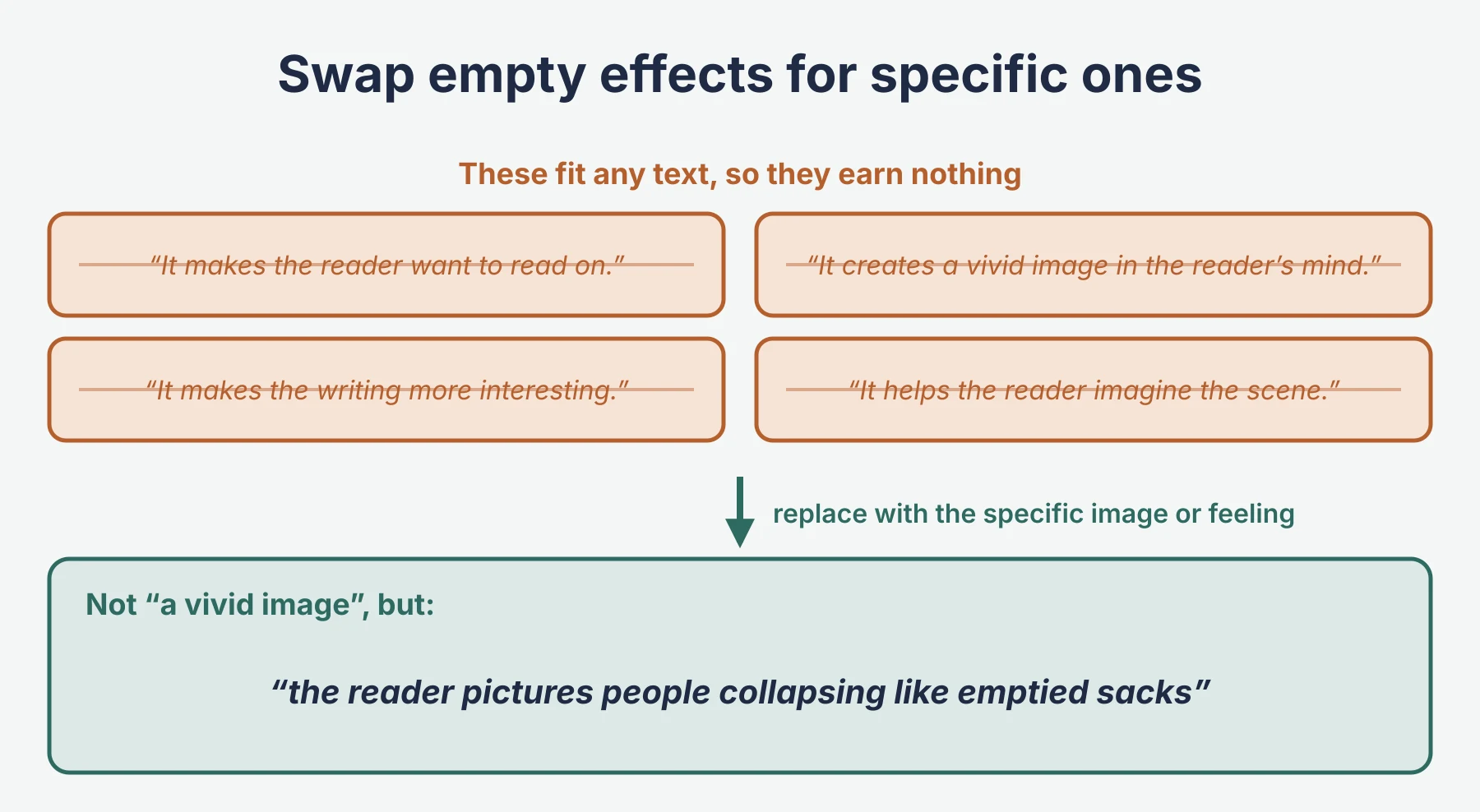
Some phrases appear in thousands of answers and earn nothing because they fit any text:
- “It makes the reader want to read on.”
- “It creates a vivid image in the reader’s mind.”
- “It makes the writing more interesting.”
- “It helps the reader imagine the scene.”
Replace each with the specific image or feeling: not “a vivid image”, but “the reader pictures people collapsing like emptied sacks”.
Common mistakes
- Meaning only: correct paraphrase with no comment on effect.
- Device spotting: “This is a simile” with nothing after it.
- Over-long quotation that hides which words you are discussing.
- Effects that ignore context: “red suggests danger” when the red is a child’s raincoat in a happy scene.
- One point for several marks: in a three-mark question, use three distinct choices or develop one choice in three clear steps.
- Wrong words chosen when asked to identify “a word” or “a phrase”: check the instruction and the paragraph named.
Exam technique
- Read the question’s line or paragraph reference and stay within it.
- If asked for “a word”, give one word; for “a phrase”, a few words.
- Use “suggests”, “implies”, “emphasises”, “conveys” to move from meaning to effect.
- Question 2 is 9 marks, about a third of Section A: give it time after Question 1, not the minutes left over.
More resources on this topic
Related resources
-
Practice questions
Cambridge O Level English Language (1123): Question 2 Use of Language Task – Practice Questions
Twelve original language questions on a new narrative extract for 1123 Paper 1 Question 2: word choice, imagery and sentence effects, with full answers.
English · Cambridge · O Level
Try questions -
Revision notes
Cambridge O Level English Language (1123): Question 2 Use of Language Task – Revision Notes
Condensed notes for 1123 Paper 1 Question 2: R4, meaning versus effect, connotation, a feature toolkit, effect verbs, banned phrases, traps and a self-test.
English · Cambridge · O Level
Revise topic -
Study guides
Cambridge O Level English Language (1123): Question 3a Summary Task
Writing the 150-word 1123 Paper 1 Question 3a summary of Text B: finding the focus, selecting points, own words, grouping and linking, with a model.
English · Cambridge · O Level
Read guide
Get free revision emails (optional)
Occasional emails with practice questions, worked explanations and links to free resources for the qualification and subjects you choose. No spam, and you can unsubscribe from any email. The free tools on this site never need an email.