
Revision Notes
Cambridge O Level English Language (1123): Question 1 Comprehension Task – Revision Notes
Condensed notes for 1123 Paper 1 Question 1: Text A facts, explicit versus implicit questions, wording decoder, own-words methods, traps and a self-test.
- Subject
- English
- Level
- O LEVELS
- Topic
- Paper 1 – Reading
- Author
- Marlbridge Academic Team
- Updated
- Reviewed by
- Ammar Bilal (what this means)
Aligned to Cambridge O Level English (1123), 2024-2026. Official specification .
Syllabus page (what it covers and how it is assessed): Cambridge O Level English Language.
Found an error? Report a correction.
Need help with this topic? Request a free trial class for O Level English Language (1123).
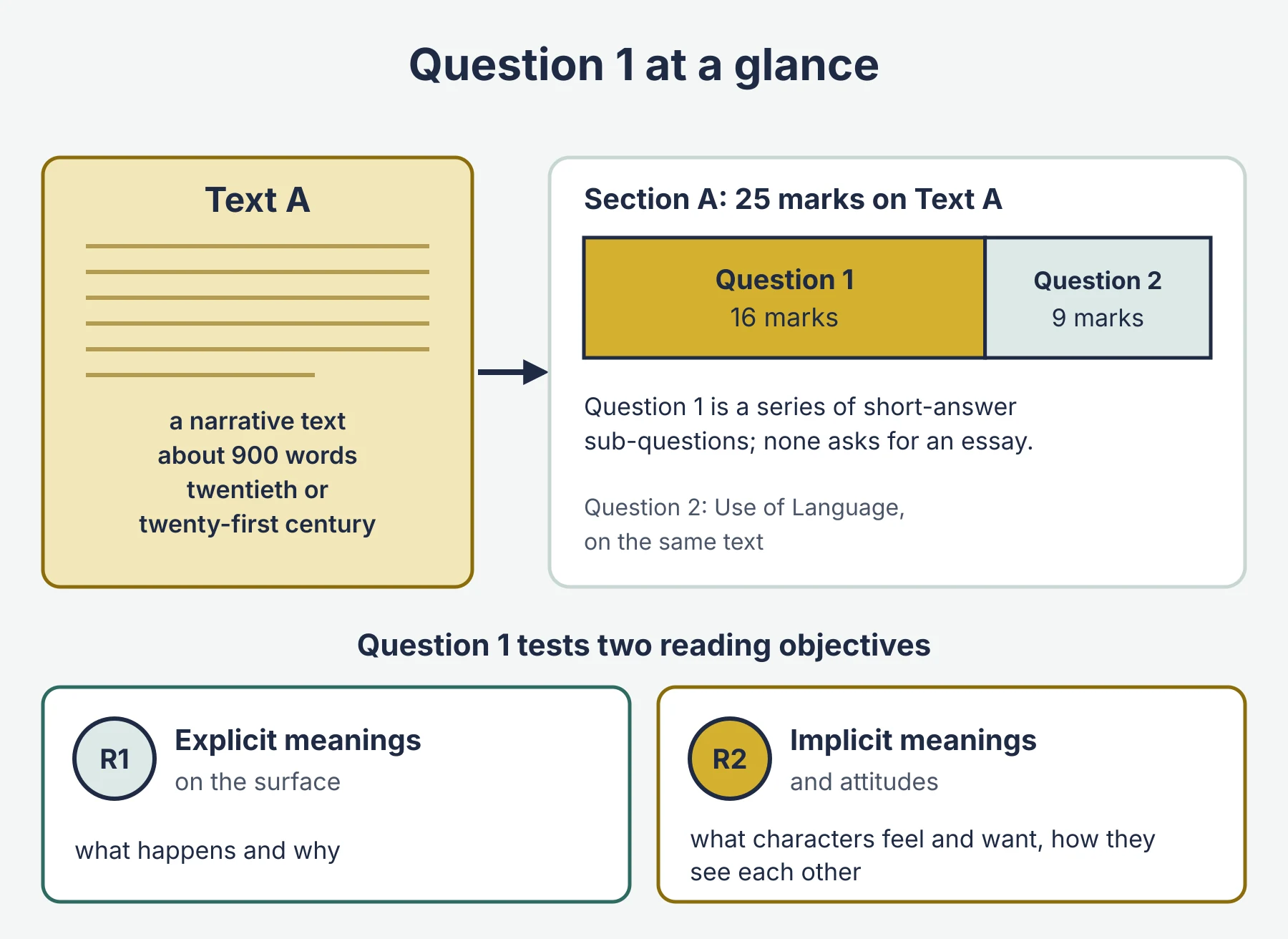
These notes cover Question 1, the Comprehension task, of 1123 Paper 1: “a series of sub-questions based on Text A, a narrative text”, with “short answers testing understanding of both explicit and implicit meanings”. For the whole paper see the Paper 1 Reading study guide; for the full method and a worked extract see the Question 1 Comprehension study guide.
Key facts
| Fact | Detail |
|---|---|
| Marks | 16, of Section A’s 25 |
| Objectives | R1 explicit meanings; R2 implicit meanings and attitudes |
| Text | Text A, narrative, about 900 words, twentieth or twenty-first century |
| Answers | short answers to a series of sub-questions |
| Same text as | Question 2 Use of Language (9 marks) |
| Paper | 2 hours, 50 marks; texts in a separate insert; no dictionaries |
Explicit versus implicit
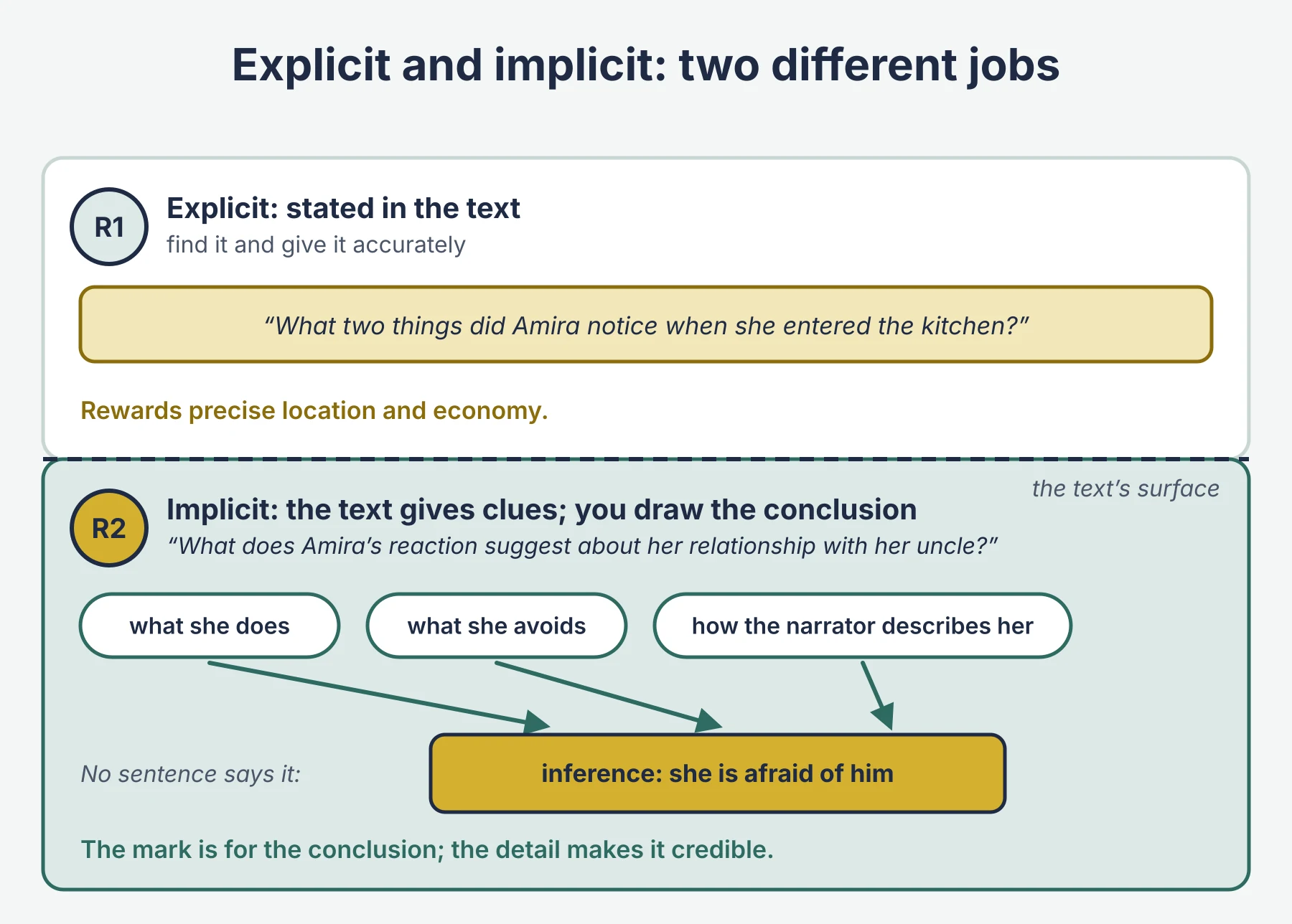
| Explicit (R1) | Implicit (R2) | |
|---|---|---|
| Where | stated in the text | suggested by the text |
| Your job | locate and state precisely | infer and anchor |
| Typical wording | “What…”, “Give…”, “Identify…” | “What does … suggest…”, “Why might…”, “What impression…” |
| Weak answer | copying too much | a guess with no link to the text |
Wording decoder
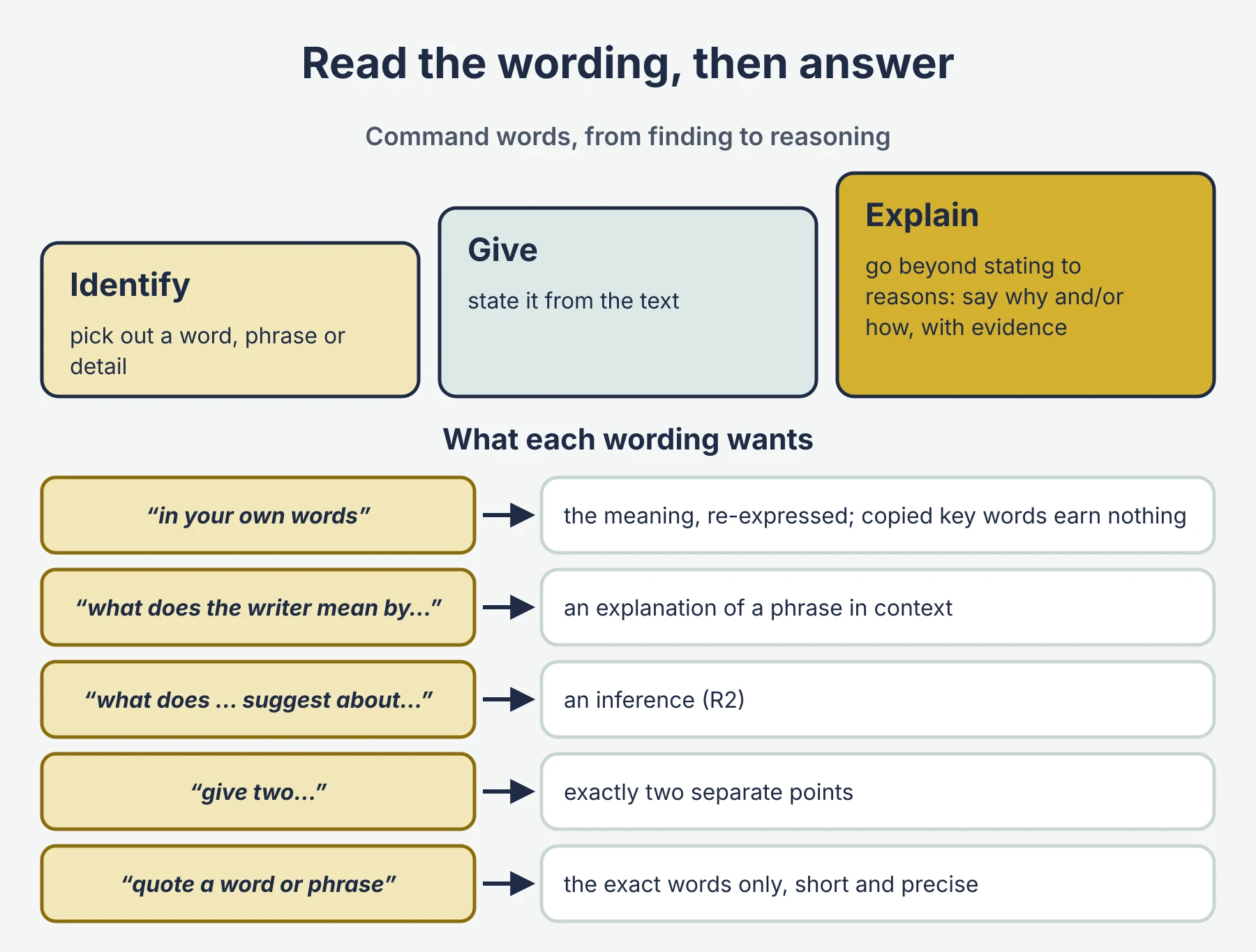
| Wording | Do this |
|---|---|
| in your own words | re-express the key words; do not copy them |
| what does the writer mean by | explain the phrase in context |
| what does … suggest about | name the inference and the detail behind it |
| give two | two separate, visible points |
| quote a word / phrase | exact words, short |
| explain why | a reason, linked with “because” or “so” |
Syllabus command words: Identify = name/select/recognise; Give = produce an answer from a given source; Explain = set out reasons, make relationships clear, support with evidence.
Marks to points (working rule)
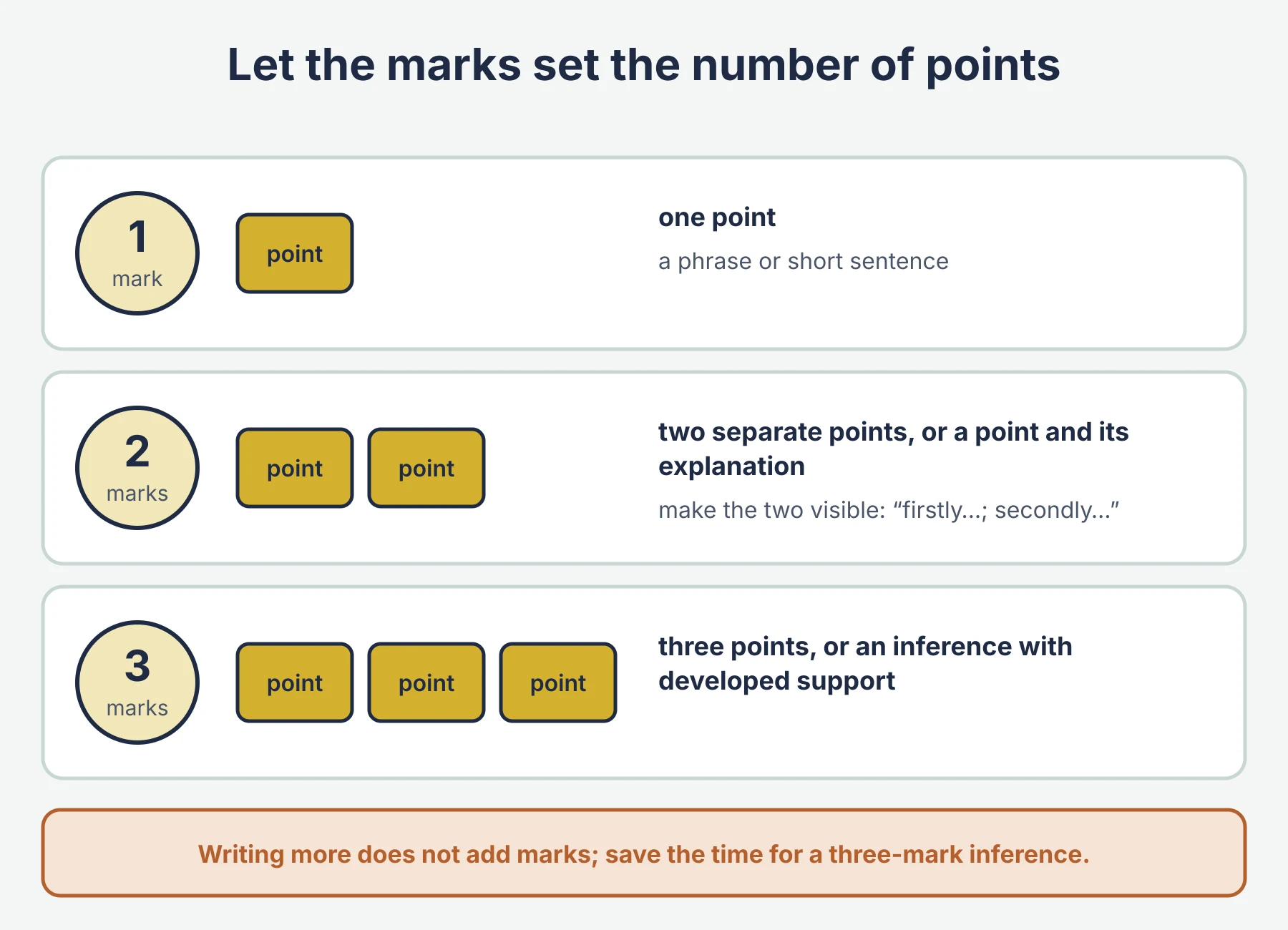
1 mark = one point · 2 marks = two points or point plus explanation · 3 marks = three points or a developed inference.
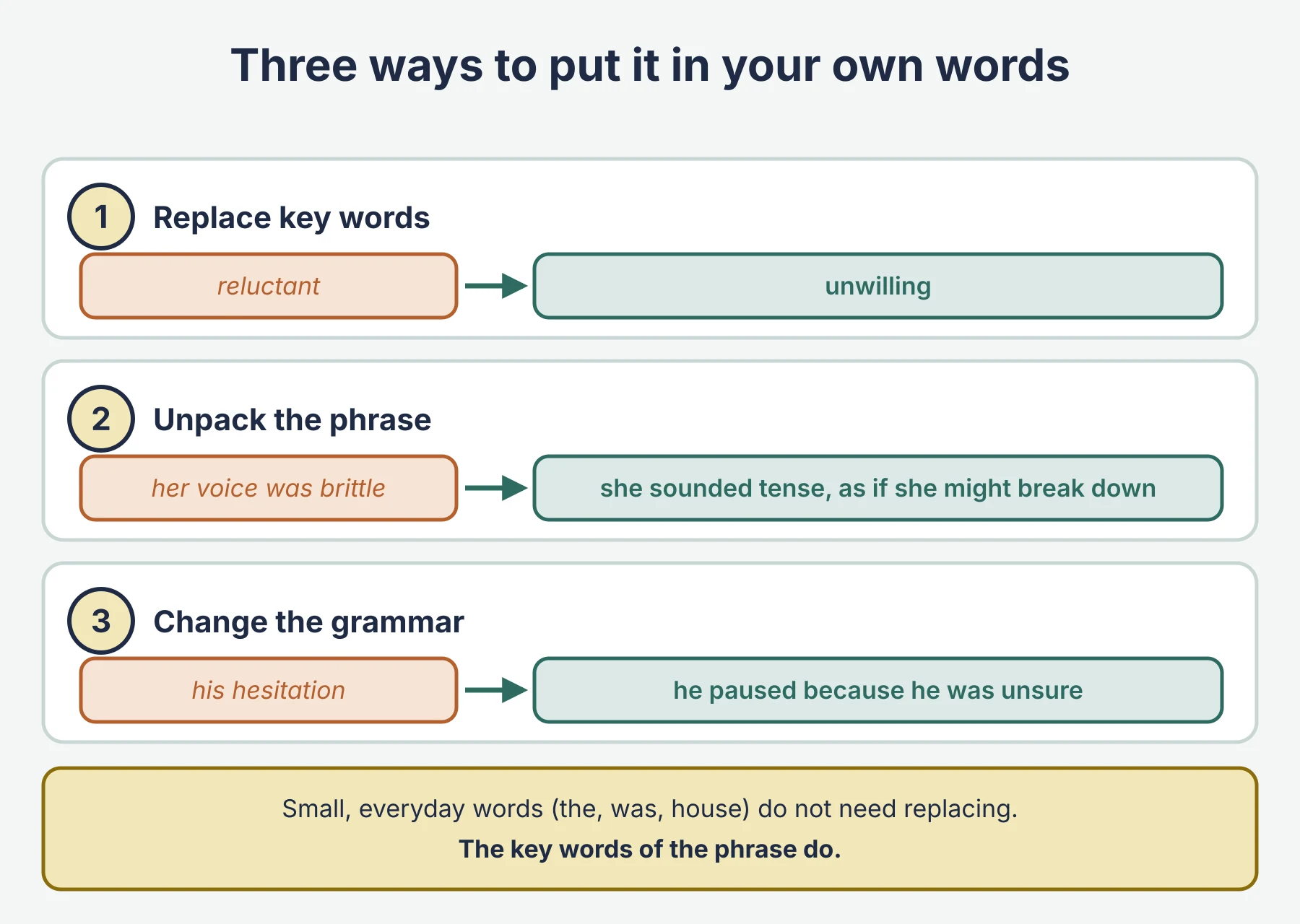
Own-words methods
- Synonym: reluctant → unwilling.
- Unpack: a brittle voice → she sounded tense, close to breaking down.
- Re-shape: his hesitation → he paused because he was unsure.
Keep simple words; change the key ones.
Inference: the two-part answer
Conclusion + anchor. She is anxious (conclusion) because she keeps checking the clock and cannot finish her sentence (anchor).
What narrative texts ask about
- motive: why a character acts;
- feeling: what a reaction shows;
- relationship: how two characters see each other;
- change: how a character’s view shifts across the extract;
- atmosphere: what the setting suggests about events.
Mini example (original)
Kofi folded the letter twice, very small, and pushed it to the bottom of his bag, under the football boots he no longer wore.
| Question | Type | Answer |
|---|---|---|
| Where did Kofi put the letter? | explicit (R1) | at the bottom of his bag, under his old football boots |
| What does the way he folds and hides the letter suggest? | implicit (R2) | he wants to keep it secret or forget it: he makes it “very small” and buries it out of sight |
| What does “he no longer wore” suggest about the boots? | implicit (R2) | he has given up football, so the boots are part of his past |
Timing within Section A
Section A is 25 marks: Question 1 has 16 and Question 2 has 9. Divide Section A’s time in roughly that ratio, so Question 1 takes a little under two-thirds of it. Read Text A once in full before starting either question; both depend on knowing the whole narrative.
Exam traps
- Inventing what the text does not support.
- Quoting when asked to explain; explaining when asked to quote.
- Lifting key words in “own words” questions.
- Two marks, one point.
- A named feeling with no textual anchor.
- Telling what happens when asked why.
- Spending so long on Question 1 that Question 2 is rushed.
Self-test
- How many marks is Question 1 worth, and which objectives does it test?
- How long is Text A, and what kind of text is it?
- What is the difference between an R1 and an R2 question?
- Define the command word “Explain” as the syllabus does.
- What two parts does a strong inference answer contain?
- Re-express in your own words: “He was reluctant to leave.”
- A two-mark question asks why a character stayed silent. What should the answer contain?
- Is “She is sad” a full answer to “What does her reaction suggest about her feelings?” [2 marks]?
- Which other question uses Text A?
- What should you do with the words “the” and “was” in an own-words answer?
- Name three things narrative comprehension questions often ask about.
- Why read the whole text before answering?
Answers
- 16 marks; R1 and R2.
- About 900 words; a narrative text from the twentieth or twenty-first century.
- R1 asks for what is stated (explicit); R2 asks for what is implied, including attitudes.
- “Set out purposes or reasons / make the relationships between things clear / say why and/or how and support with relevant evidence.”
- A clear conclusion and a detail from the text that supports it.
- For example: “He did not want to go.”
- Two separate reasons, or one reason and its explanation, drawn from the text.
- No: it names a feeling but gives no anchor; at most one mark.
- Question 2, the Use of Language task.
- Nothing: simple words can stay; only the key words need re-expressing.
- Any three of motive, feeling, relationship, change, atmosphere.
- Sub-questions follow the story, and implicit meanings often depend on later events.
More resources on this topic
Related resources
-
Study guides
Cambridge O Level English Language (1123): Question 2 Use of Language Task
How to explain a writer's word choice, imagery and sentence effects for the 9-mark 1123 Paper 1 Question 2 on Text A, with annotated answers and common errors.
English · Cambridge · O Level
Read guide -
Practice questions
Cambridge O Level English Language (1123): Question 2 Use of Language Task – Practice Questions
Twelve original language questions on a new narrative extract for 1123 Paper 1 Question 2: word choice, imagery and sentence effects, with full answers.
English · Cambridge · O Level
Try questions -
Revision notes
Cambridge O Level English Language (1123): Question 2 Use of Language Task – Revision Notes
Condensed notes for 1123 Paper 1 Question 2: R4, meaning versus effect, connotation, a feature toolkit, effect verbs, banned phrases, traps and a self-test.
English · Cambridge · O Level
Revise topic
Get free revision emails (optional)
Occasional emails with practice questions, worked explanations and links to free resources for the qualification and subjects you choose. No spam, and you can unsubscribe from any email. The free tools on this site never need an email.