
Study Guides
Cambridge O Level English Language (1123): Question 1 Comprehension Task
How to answer the 16-mark 1123 Paper 1 Question 1 comprehension sub-questions on Text A: explicit and implicit meaning, own words, evidence and mark-matching.
- Subject
- English
- Level
- O LEVELS
- Topic
- Paper 1 – Reading
- Author
- Marlbridge Academic Team
- Updated
- Reviewed by
- Ammar Bilal (what this means)
Aligned to Cambridge O Level English (1123), 2024-2026. Official specification .
Syllabus page (what it covers and how it is assessed): Cambridge O Level English Language.
Found an error? Report a correction.
Need help with this topic? Request a free trial class for O Level English Language (1123).
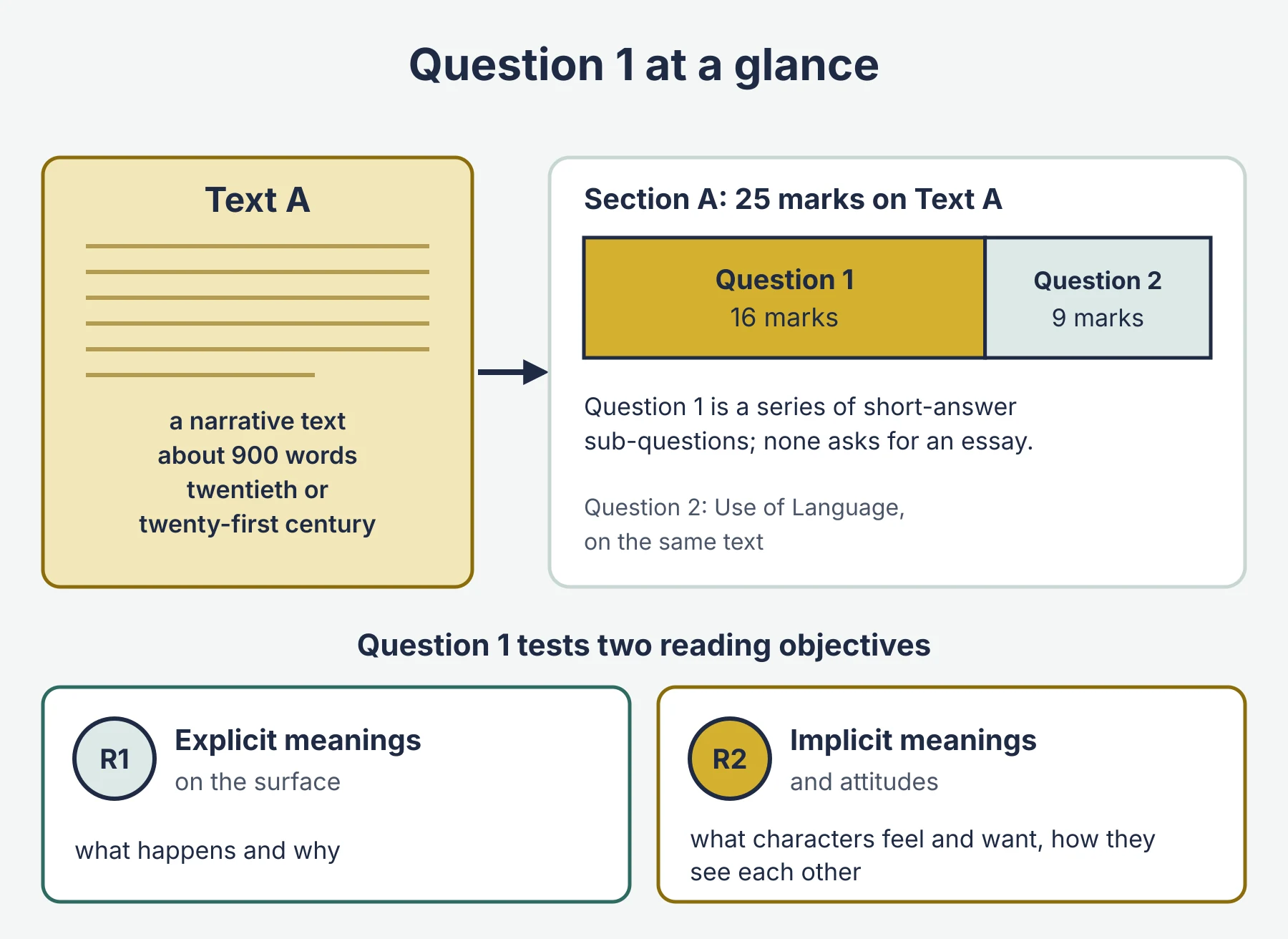
This guide covers Question 1, the Comprehension task, in Section A of Cambridge O Level English Language 1123 Paper 1 Reading. The syllabus says: “Candidates respond to a series of sub-questions based on Text A, a narrative text. These are short answers testing understanding of both explicit and implicit meanings.” It carries 16 marks and tests R1 (explicit meanings) and R2 (implicit meanings and attitudes). For the whole paper, including Question 2 and Section B, start with the Paper 1 Reading study guide. This page goes inside Question 1 only.
What you are working with
Text A is “approximately 900 words long” and comes from “either the twentieth or the twenty-first century”. It is a narrative: a story or an extract from one, with characters, a setting and events. That shapes the questions. You will be asked what happens and why, but also what characters feel, what they want, how they see each other, and what a detail tells you that the narrator never says outright. All of Question 1’s sub-questions are short answers; none asks for an essay.
Explicit and implicit: two different jobs
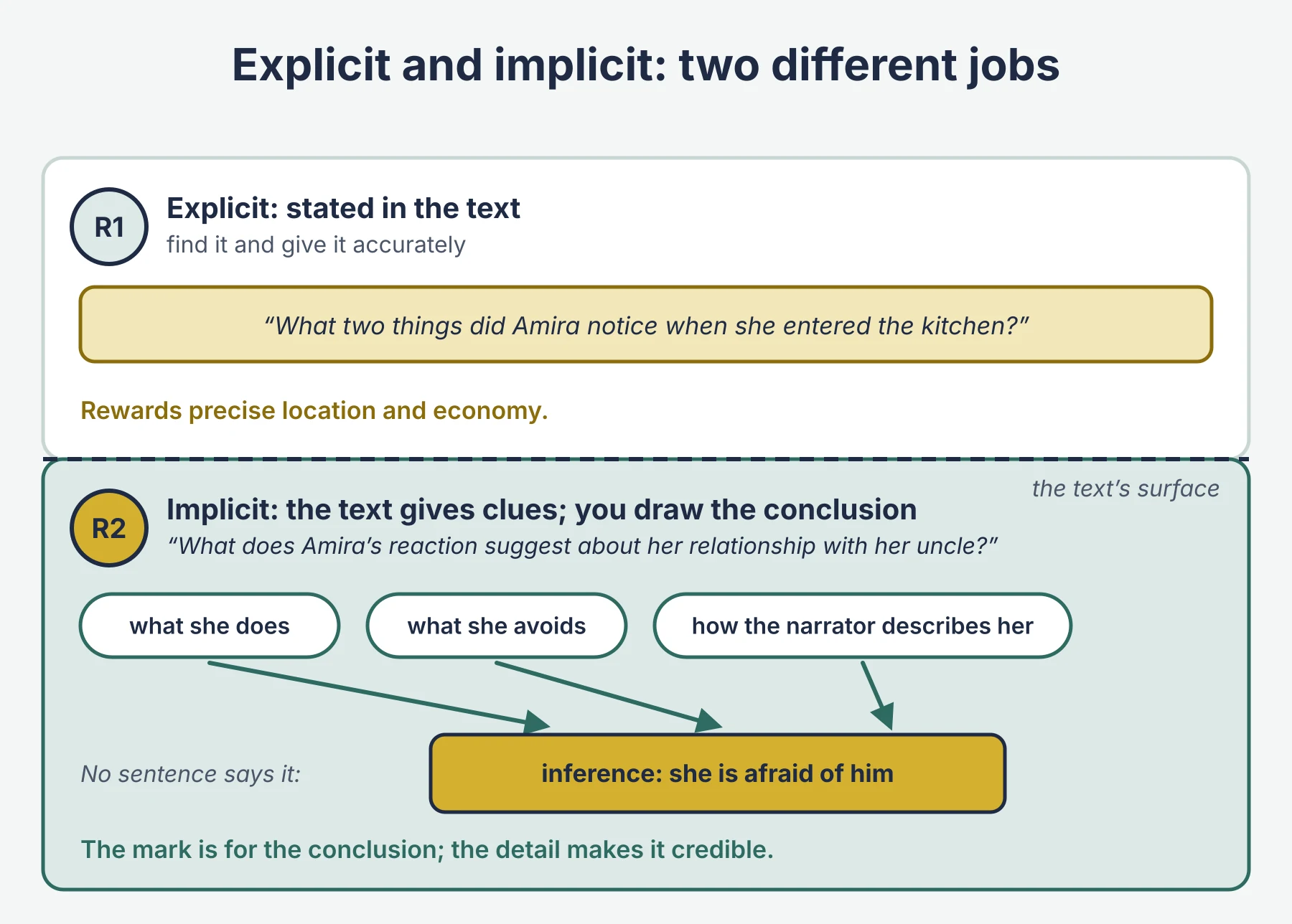
Explicit meaning (R1) is on the surface. The answer is stated in the text and your task is to find it and give it accurately. A question such as “What two things did Amira notice when she entered the kitchen?” is explicit.
Implicit meaning (R2) sits underneath. The text gives clues; you draw the conclusion. “What does Amira’s reaction suggest about her relationship with her uncle?” is implicit. No sentence will say “Amira was afraid of her uncle”; you infer it from what she does, what she avoids and how the narrator describes her.
Recognising which kind of question you face saves time and marks. Explicit questions reward precise location and economy. Implicit questions reward a clear inference anchored in a detail: the mark is for the conclusion, and the detail is what makes the conclusion credible.
How sub-questions are typically worded
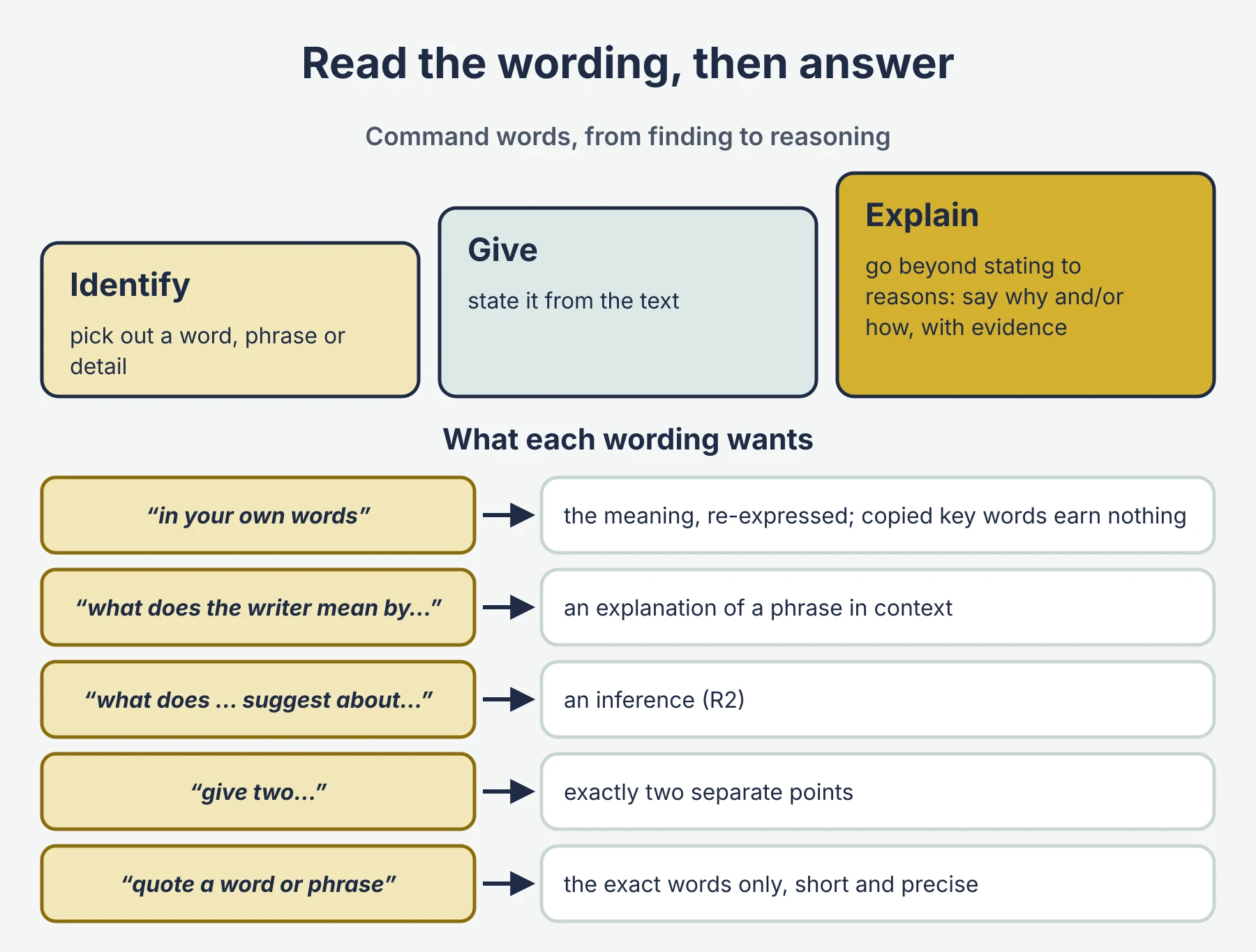
Different wordings point to different kinds of answer. The command words defined in the syllabus help:
- Identify (“name/select/recognise”): pick out a word, phrase or detail.
- Give (“produce an answer from a given source”): state it from the text.
- Explain (“set out purposes or reasons / make the relationships between things clear / say why and/or how and support with relevant evidence”): go beyond stating to reasons.
You will also meet phrasings such as “in your own words”, “what does the writer mean by…”, “what does … suggest about…” and “give two reasons why…”. Each tells you something:
| Wording | What it wants |
|---|---|
| “in your own words” | the meaning, re-expressed; copied key words earn nothing |
| “what does the writer mean by…” | an explanation of a phrase in context |
| “what does … suggest about…” | an inference (R2) |
| “give two…” | exactly two separate points |
| “quote a word or phrase” | the exact words only, short and precise |
Matching the answer to the marks
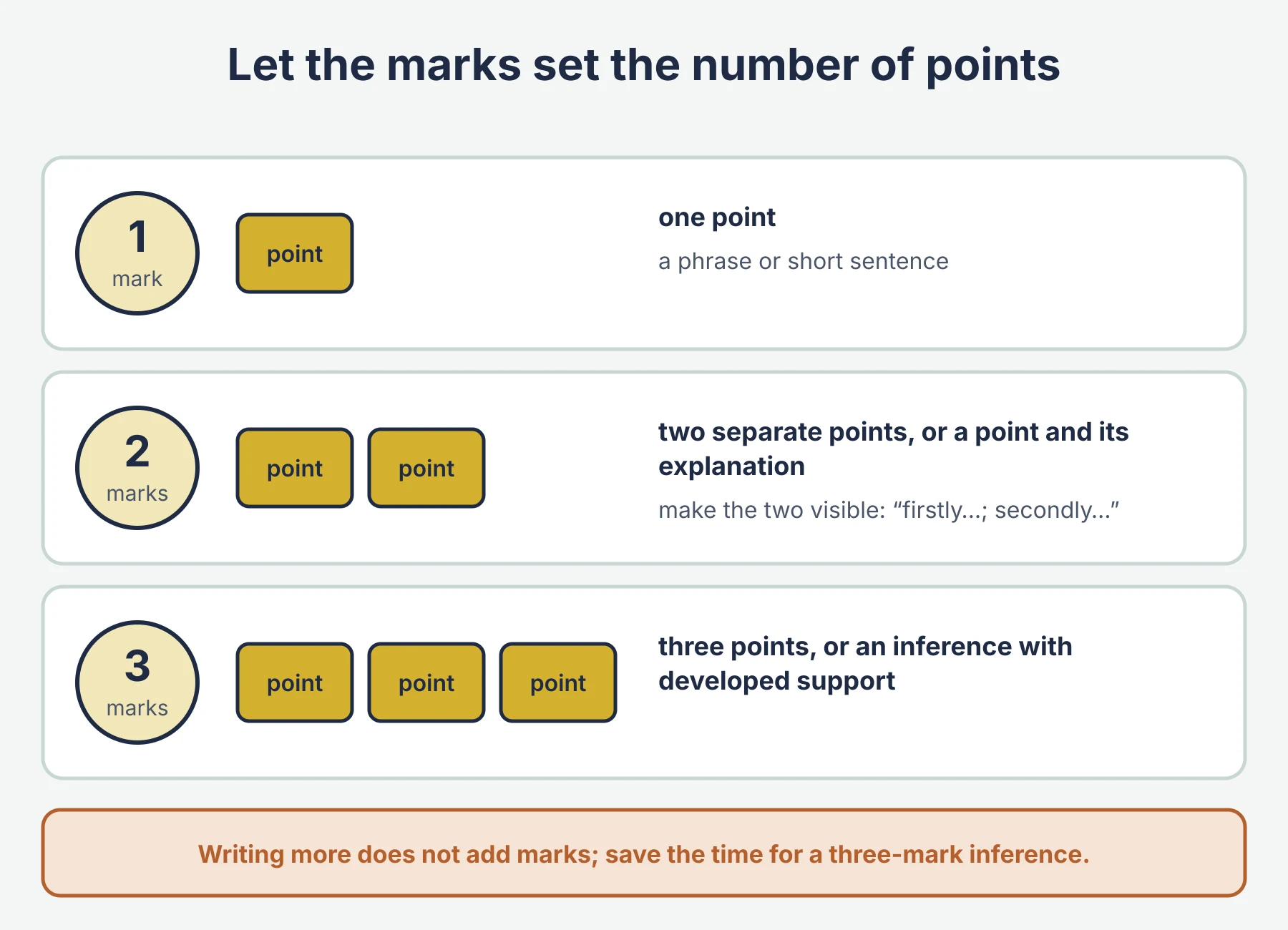
Each sub-question shows its marks. Use them as a guide to the number of distinct points:
- 1 mark: one point, a phrase or short sentence.
- 2 marks: two separate points, or a point and its explanation. Make the two visible: “firstly…; secondly…” or two short sentences.
- 3 marks: three points, or an inference with developed support.
Writing more does not add marks; a long answer to a one-mark question uses time that a three-mark inference needs.
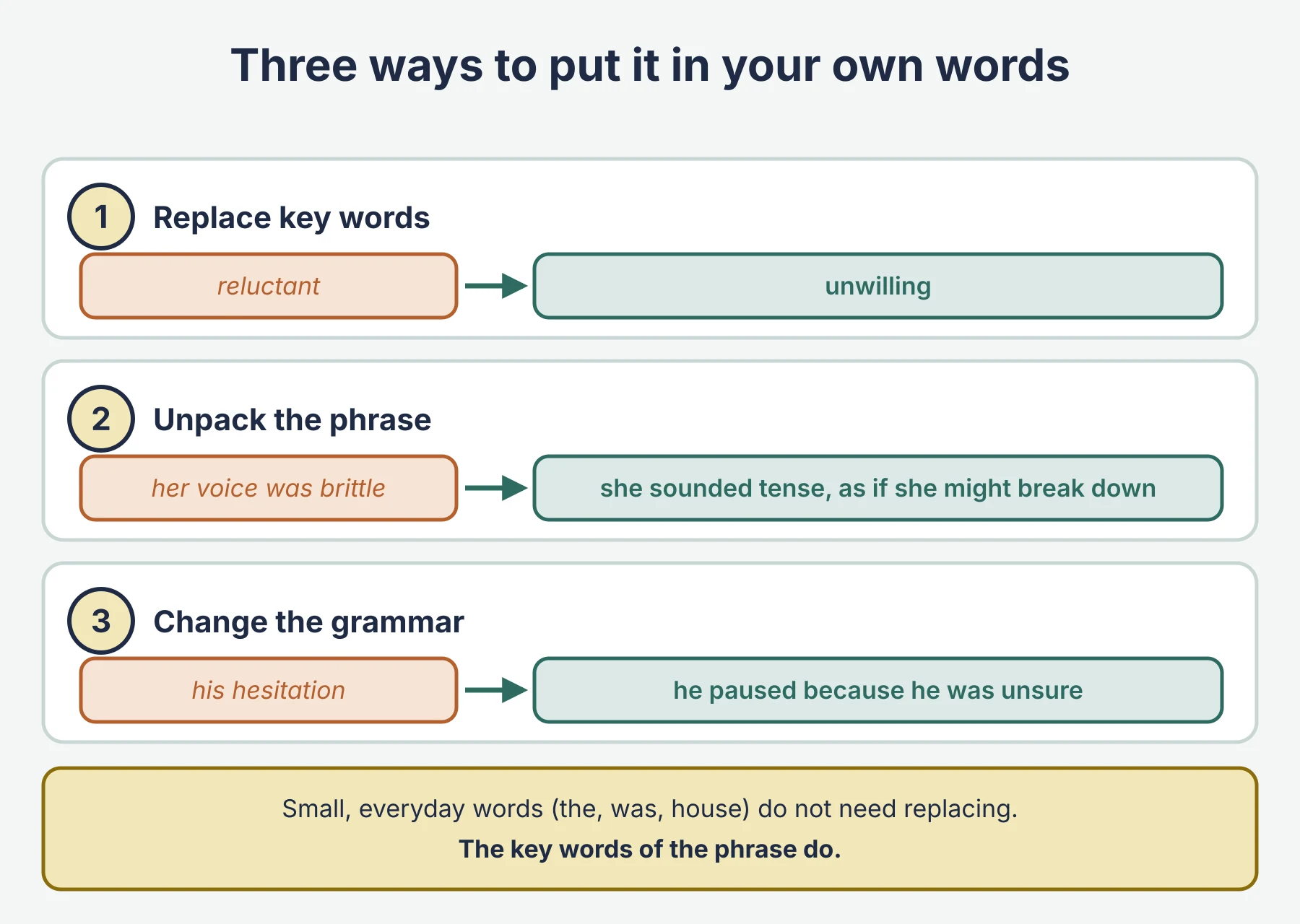
Answering “in your own words”
This instruction is checking that you understand the words, not that you can find them. Three methods:
- Replace key words with accurate equivalents: “reluctant” becomes “unwilling”.
- Unpack the phrase: “her voice was brittle” becomes “she sounded tense, as if she might break down”.
- Change the grammar: a noun phrase becomes a clause, “his hesitation” becomes “he paused because he was unsure”.
Small, everyday words (the, was, house) do not need replacing. The key words of the phrase do.
Worked example
The extract below is original, written for this guide in the style of a narrative Text A.
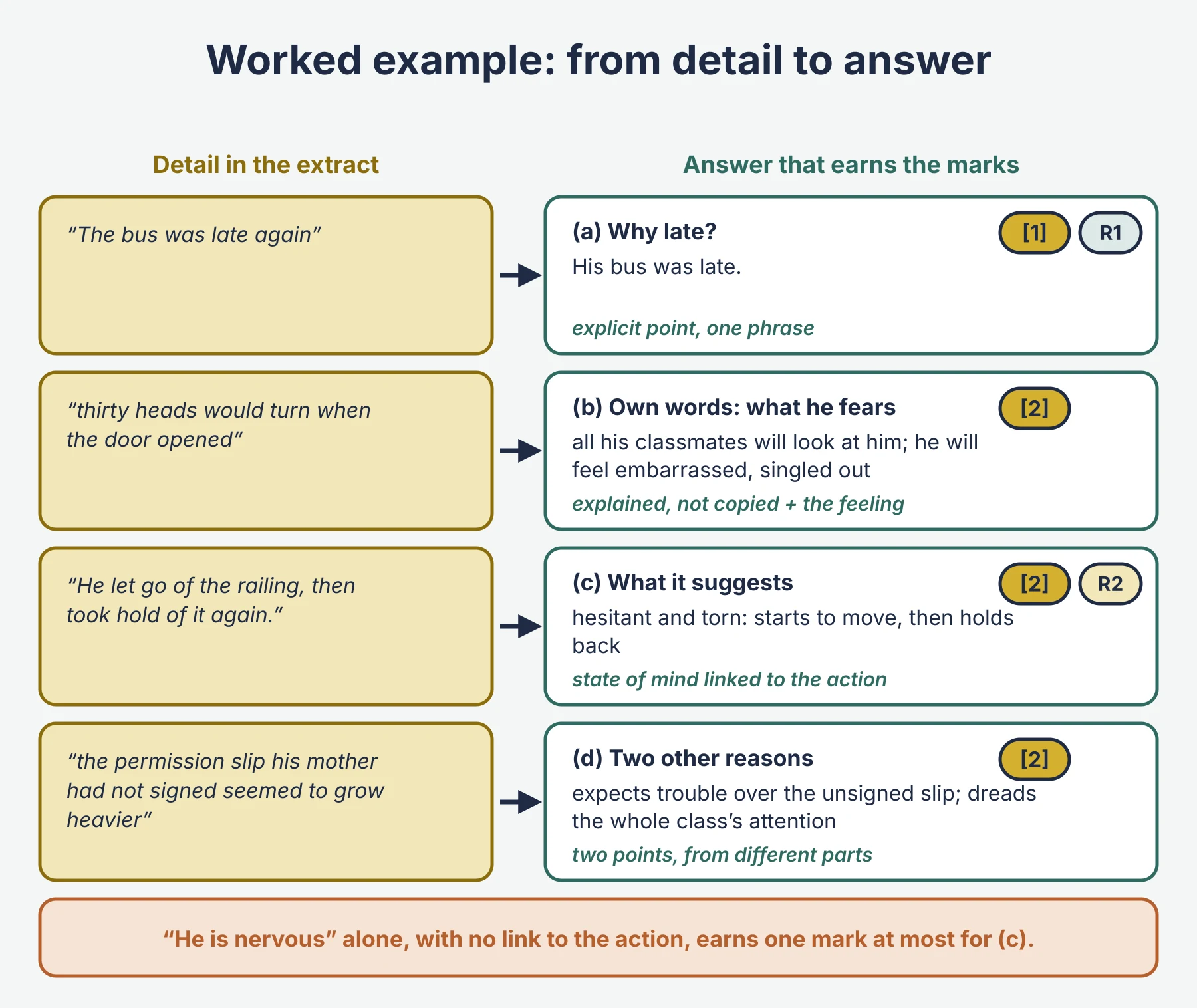
The bus was late again, and by the time Daniel reached the gates, the school was already silent. He stood for a moment with his hand on the cold railing, counting the windows of the first floor until he found the one that was his classroom. Mr Okafor would be writing the date on the board by now, in his slow, careful capitals. Daniel thought of the empty chair by the radiator and of the way thirty heads would turn when the door opened. He let go of the railing, then took hold of it again. In his bag, the permission slip his mother had not signed seemed to grow heavier with every minute.
(a) Why did Daniel arrive after school had started? [1]
Answer: His bus was late.
Commentary: an explicit point (R1), stated in the first sentence. One mark, one phrase.
(b) Explain in your own words what Daniel fears will happen when he enters the classroom. [2]
Answer: He is afraid that all his classmates will look at him at once, so he will feel embarrassed and singled out in front of everyone.
Commentary: “thirty heads would turn” is explained, not copied (all his classmates will look at him), and the second mark is for the feeling it produces (embarrassed, singled out).
(c) What does the sentence “He let go of the railing, then took hold of it again” suggest about Daniel’s state of mind? [2]
Answer: It suggests he is hesitant and torn: he starts to move towards the building but loses his courage and holds back.
Commentary: an inference (R2). The answer names the state of mind (hesitant, torn) and links it to the action (starts to move, holds back). “He is nervous” alone would earn one mark at most.
(d) Suggest two reasons, apart from being late, why Daniel might not want to go in. [2]
Answer: Firstly, he has a permission slip that his mother has not signed, so he expects to be in trouble. Secondly, he dreads the attention of the whole class turning towards him as he walks in.
Commentary: two separate points from different parts of the extract. The slip “seemed to grow heavier” is not about weight: the image shows his worry growing, which supports the first point.
Common mistakes
- Answering from imagination rather than from the text: “he hates school” is not supported here.
- Quoting a whole sentence when asked to explain, or explaining when asked to quote.
- Copying key words in an “own words” question.
- One point for two marks, or two points merged so the examiner cannot separate them.
- Inference with no anchor: a feeling named with no link to what the character does or says.
- Answering a different question: describing what happens when the question asks why.
Exam technique
- Read Text A through once before starting; Question 1 follows the story, so knowing its outline helps you place each answer.
- Sub-questions usually move through the text in order; use line or paragraph references in the question to find your place quickly.
- Underline the key instruction words (own words, suggest, two).
- Keep answers short and precise. Question 1 is 16 of Section A’s 25 marks; leave enough time for the 9-mark Question 2 on the same text.
More resources on this topic
Related resources
-
Practice questions
Cambridge O Level English Language (1123): Question 1 Comprehension Task – Practice Questions
Twelve original sub-questions on a new narrative extract in the style of 1123 Paper 1 Question 1, on explicit and implicit meaning, with full answers.
English · Cambridge · O Level
Try questions -
Revision notes
Cambridge O Level English Language (1123): Question 1 Comprehension Task – Revision Notes
Condensed notes for 1123 Paper 1 Question 1: Text A facts, explicit versus implicit questions, wording decoder, own-words methods, traps and a self-test.
English · Cambridge · O Level
Revise topic -
Study guides
Cambridge O Level English Language (1123): Question 2 Use of Language Task
How to explain a writer's word choice, imagery and sentence effects for the 9-mark 1123 Paper 1 Question 2 on Text A, with annotated answers and common errors.
English · Cambridge · O Level
Read guide
Get free revision emails (optional)
Occasional emails with practice questions, worked explanations and links to free resources for the qualification and subjects you choose. No spam, and you can unsubscribe from any email. The free tools on this site never need an email.