
Study Guides
Cambridge O Level Islamiyat (2058): The Period of Rule of the Rightly Guided Caliphs and Their Importance as Leaders
Study guide to the rules of Abu Bakr, Umar, Uthman and Ali, their difficulties and their lessons for government, for Cambridge O Level Islamiyat 2058 Paper 2.
- Subject
- Islamiyat
- Level
- O LEVELS
- Topic
- Paper 2
- Author
- Marlbridge Academic Team
- Updated
- Reviewed by
- Azam Siddique (what this means)
Aligned to Cambridge O Level Islamiyat (2058), 2026-2027. Official specification .
Syllabus page (what it covers and how it is assessed): Cambridge O Level Islamiyat.
Syllabus points this page covers
2058
- 2.3 The Period of Rule of the Rightly Guided Caliphs and Their Importance as Leaders
Found an error? Report a correction.
Need help with this topic? Request a free trial class for O Level Islamiyat (2058).
The period of rule of the Rightly Guided Caliphs is one of the two optional topics of Paper 2 in Cambridge O Level Islamiyat 2058. One or two 14-mark questions are set on it among Questions 3–5, normally with a knowledge part (a) worth 10 and an understanding part (b) worth 4. Examiners expect the main events of each rule and an understanding of why these four leaders are still treated as models of government.
What the syllabus covers
- the main events of the rules of the four caliphs;
- their policies in maintaining and expanding the state;
- their approaches to leading the community;
- their main achievements and the main difficulties they faced;
- their significance as examples of leadership;
- the importance of their rules as models for government today, and for relations with other states.
Their lives during the Prophet’s (pbuh) lifetime belong to Paper 1; this topic begins in 632.
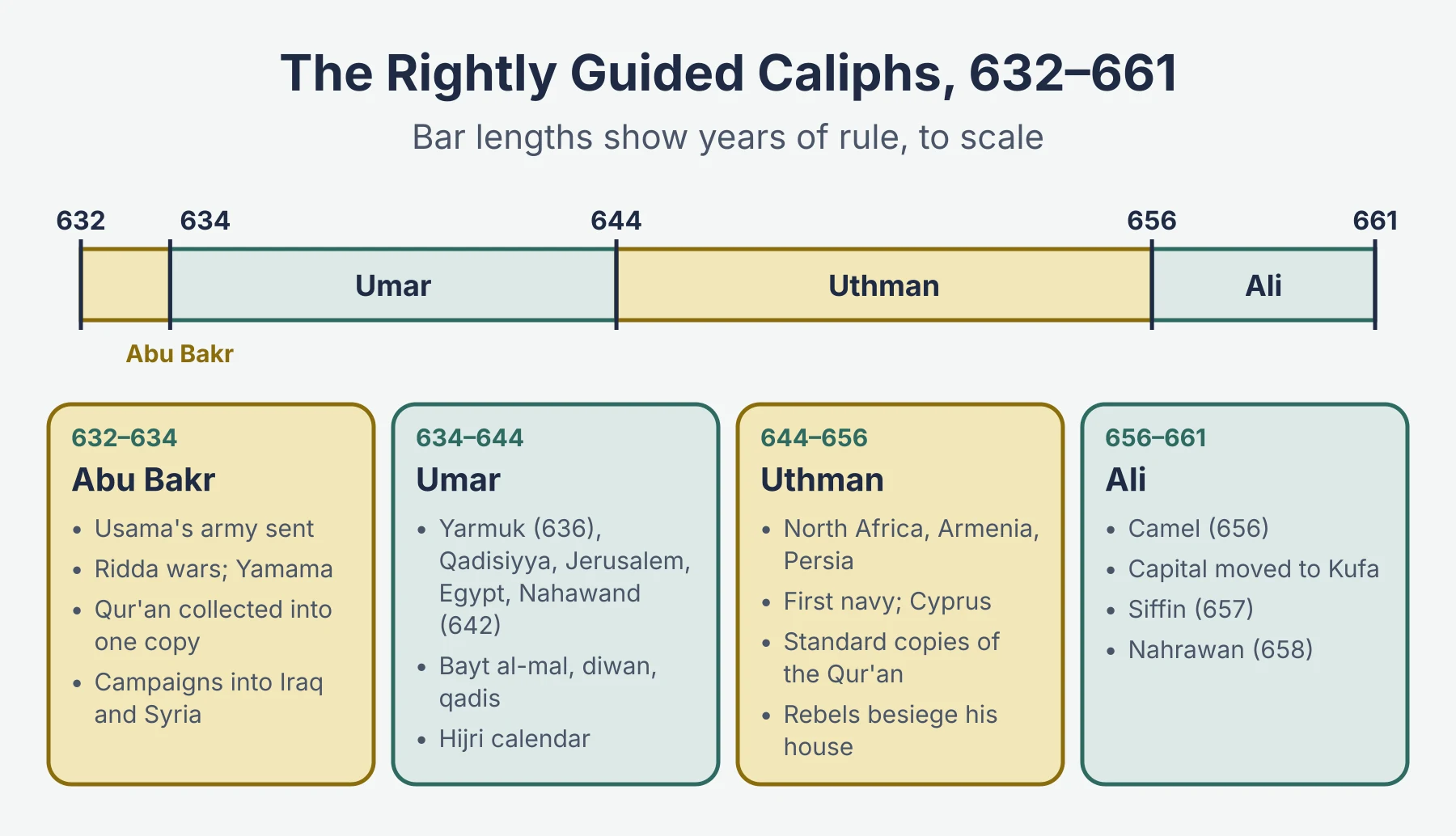
Abu Bakr (RA) (632–634): holding the community together
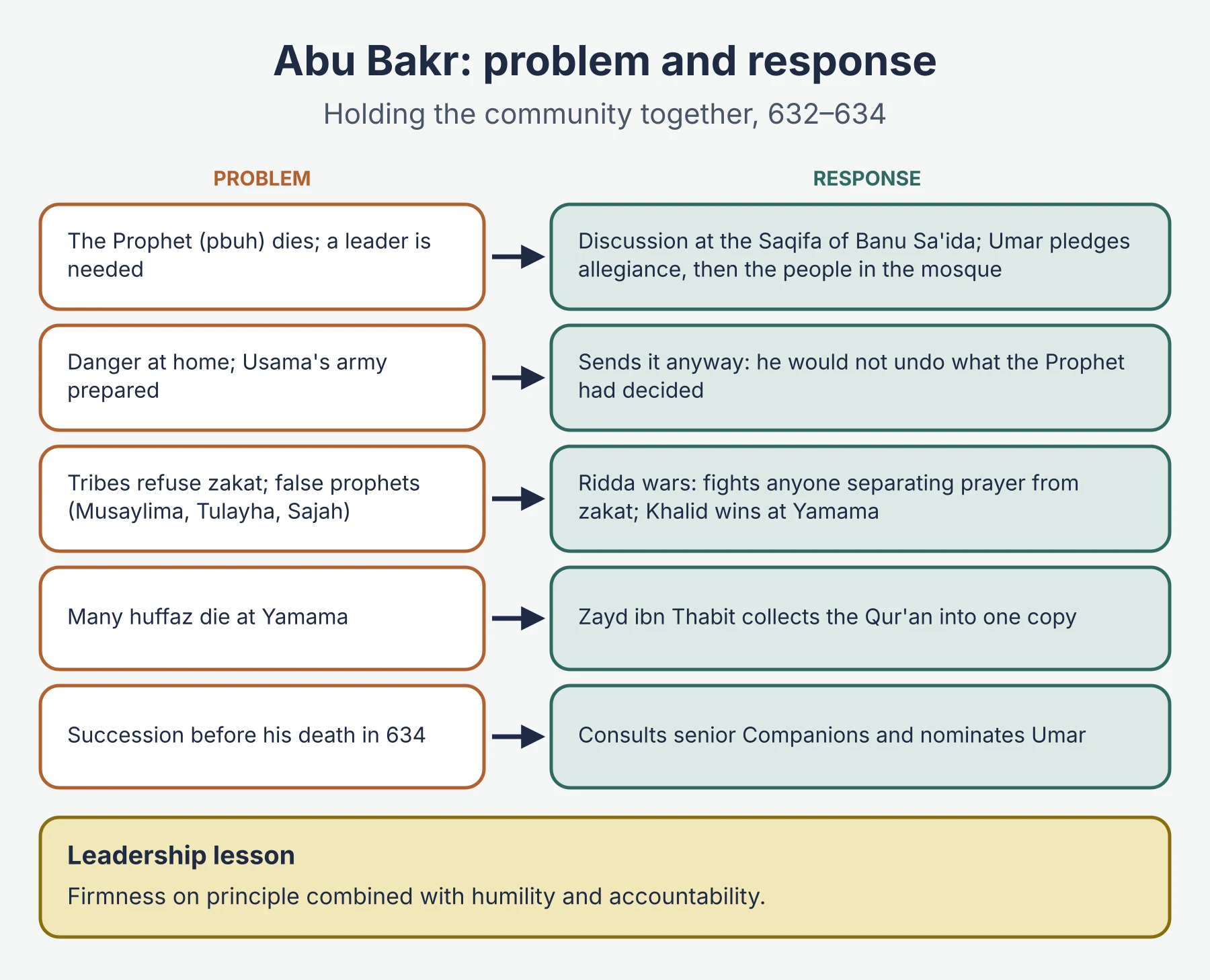
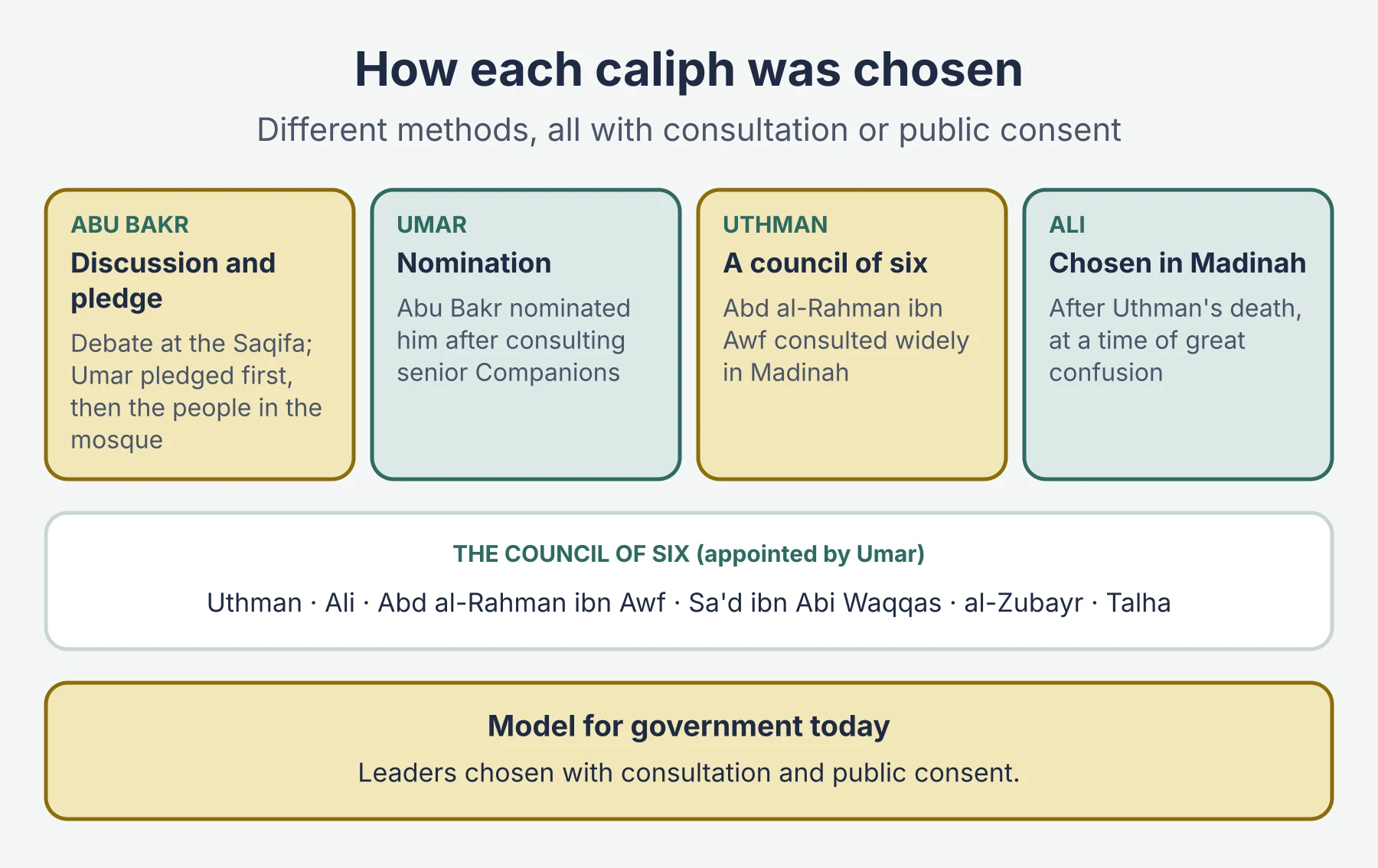
Becoming caliph. When the Prophet (pbuh) died, the Ansar gathered at the Saqifa of Banu Sa’ida to choose a leader. Abu Bakr (RA), Umar (RA) and Abu Ubayda (RA) went to them; after discussion, Umar (RA) pledged allegiance to Abu Bakr (RA) and the others followed, and the next day the people pledged in the mosque.
His first address. He said he had been given authority though he was not the best of them, asked them to help him if he did well and correct him if he did wrong, said that the weak among them would be strong with him until he secured their rights, and told them to obey him only as long as he obeyed God and His Messenger.
First decision: Usama’s army. The Prophet (pbuh) had prepared an army under young Usama ibn Zayd to go to the Syrian frontier. Despite the danger at home, Abu Bakr (RA) sent it, saying he would not undo what the Prophet had decided. Its safe return showed that the new state was still strong.
The Ridda wars. Many tribes refused to pay zakat, and false prophets such as Musaylima, Tulayha and Sajah claimed followers. Some Companions advised patience over zakat, but Abu Bakr insisted he would fight anyone who separated prayer from zakat. He sent armies to every region; Khalid ibn al-Walid defeated Tulayha and then Musaylima at Yamama.
The Qur’an. Because many huffaz died at Yamama, he had Zayd ibn Thabit (RA) collect the Qur’an into one copy.
Expansion. Khalid led campaigns into Iraq, then crossed the desert to join the armies in Syria.
Death. Before dying in 634, he consulted senior Companions and nominated Umar (RA). He was buried beside the Prophet (pbuh).
Leadership lesson: firmness on principle combined with humility and accountability.
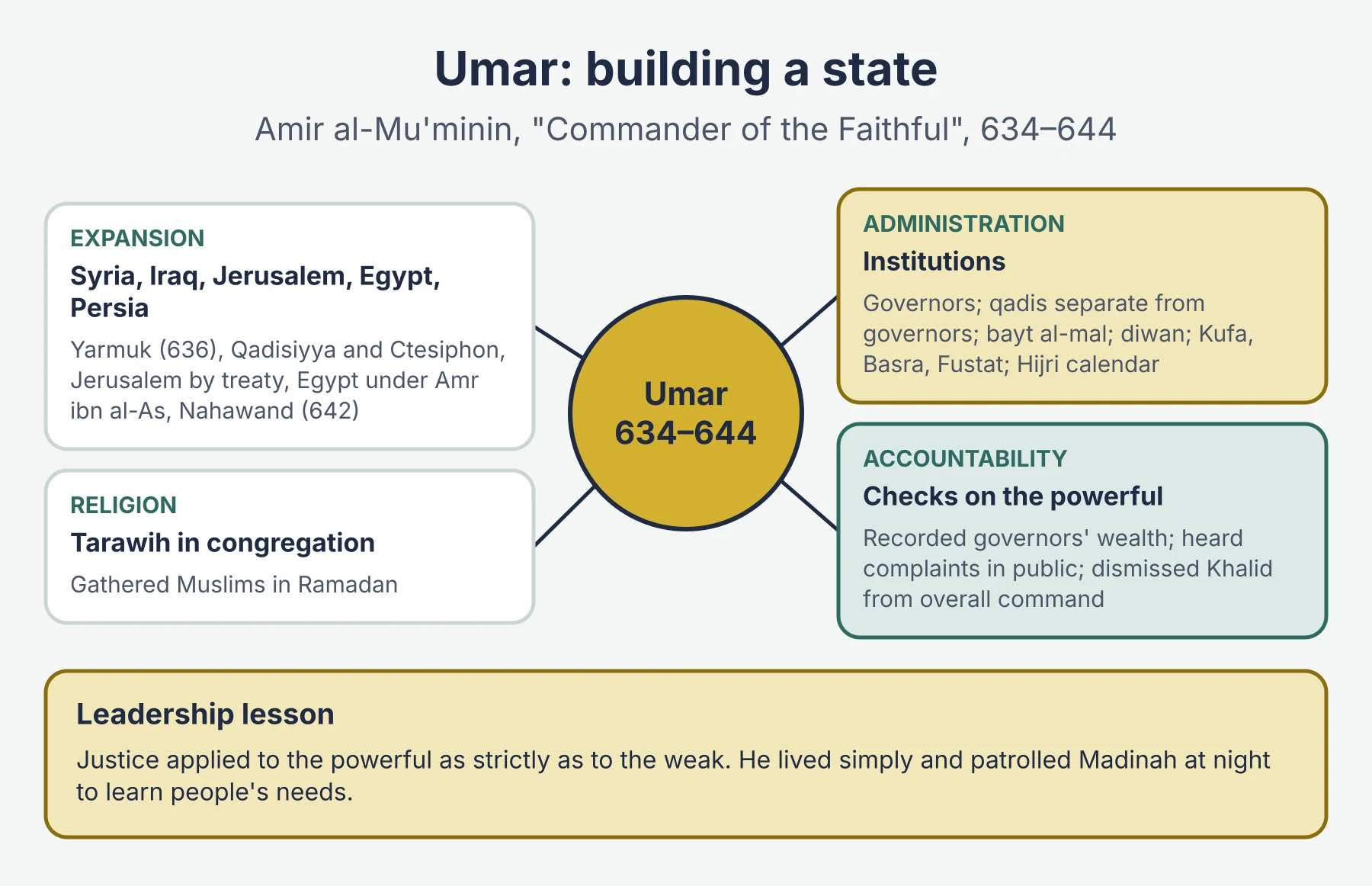
Umar (RA) (634–644): building a state
- Title and style. The first to be called Amir al-Mu’minin, “Commander of the Faithful”. He lived simply, patrolled Madina at night to learn people’s needs, and carried food to the poor himself.
- Expansion. Syria (victory at Yarmuk, 636), Iraq (Qadisiyya, and the capture of Ctesiphon), Jerusalem (taken by treaty; he travelled there in person), Egypt (under Amr ibn al-As), and Persia (Nahawand, 642).
- Administration. Provinces under governors; judges (qadis) separate from governors; the bayt al-mal (treasury) and the diwan (register of stipends); garrison towns at Kufa, Basra and Fustat; the Hijri calendar dating from the Hijra.
- Accountability. He recorded governors’ wealth when they took office and investigated any large increase; he heard complaints against officials in public, and he dismissed Khalid ibn al-Walid from overall command so that people would not think victories depended on one man.
- Religion. He gathered Muslims for tarawih in congregation in Ramadan.
- Death. He was stabbed by Abu Lu’lu’a while leading the dawn prayer in 644. Before dying he appointed a council of six: Uthman (RA), Ali (RA), Abd al-Rahman ibn Awf (RA), Sa’d ibn Abi Waqqas (RA), al-Zubayr and Talha (RA), to choose his successor.
Leadership lesson: justice applied to the powerful as strictly as to the weak.
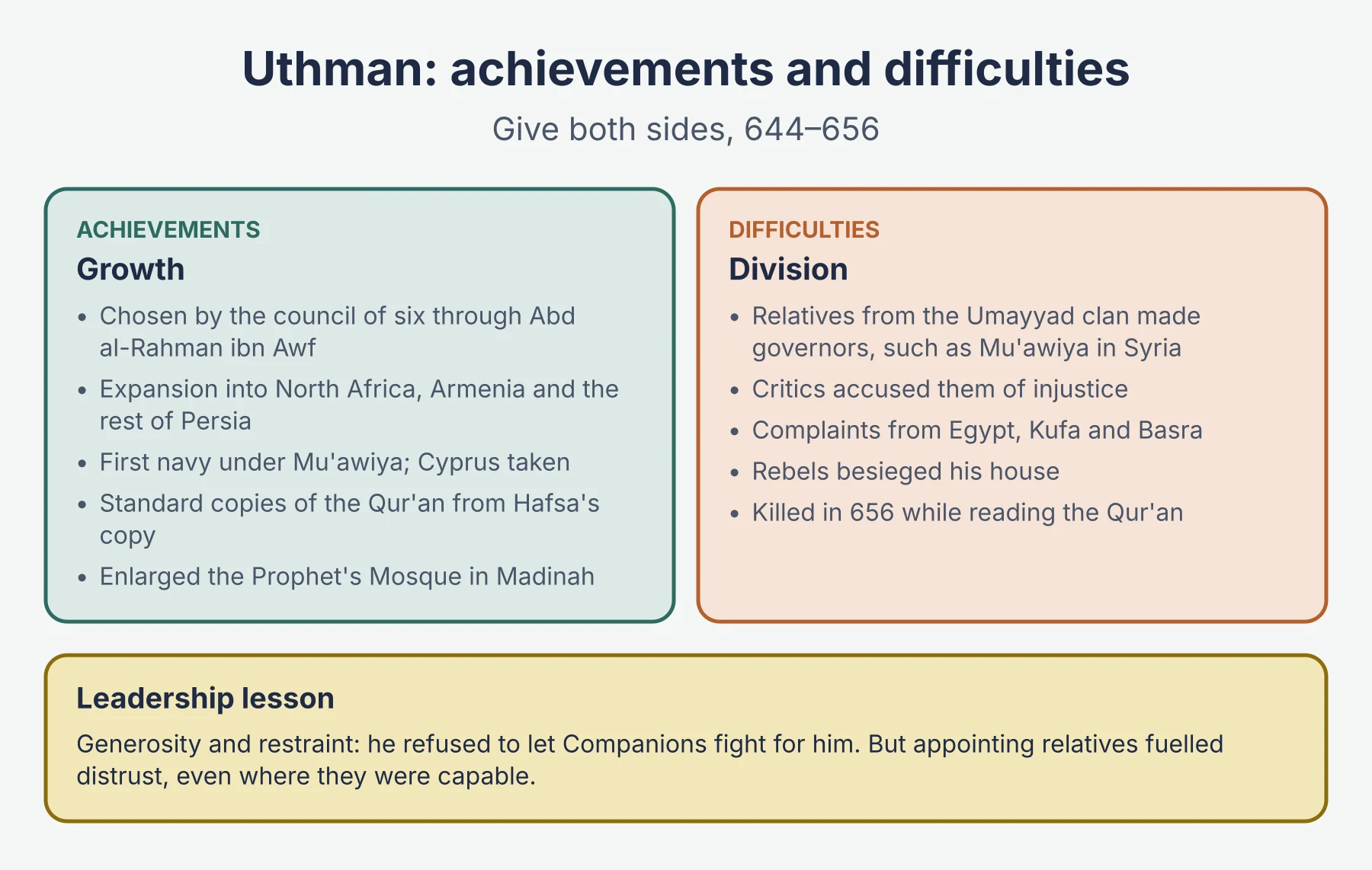
Uthman (RA) (644–656): growth and division
- Chosen by the council of six through Abd al-Rahman ibn Awf (RA), who consulted widely in Madina.
- Expansion continued into North Africa, Armenia and the remaining parts of Persia; under Mu’awiya, governor of Syria, the Muslims built their first navy and took Cyprus.
- The Qur’an. He had standard copies made from Hafsa’s (RA) copy and sent to the main cities, ending disputes over recitation.
- Building. He enlarged the Prophet (pbuh)’s Mosque in Madina.
- Difficulties. He appointed several relatives from the Umayyad clan as governors, such as Mu’awiya in Syria, and critics accused them of injustice. Groups from Egypt, Kufa and Basra came to Madina with complaints. Uthman (RA) answered them and promised reforms, but the rebels besieged his house.
- Martyrdom. He refused to let Companions fight to defend him, not wanting Muslim blood shed for his sake, and was killed in 656 while reading the Qur’an.
Leadership lesson: generosity and restraint; but also the danger of appointing relatives, which fuelled distrust even where they were capable.
Ali (RA) (656–661): leading through civil conflict
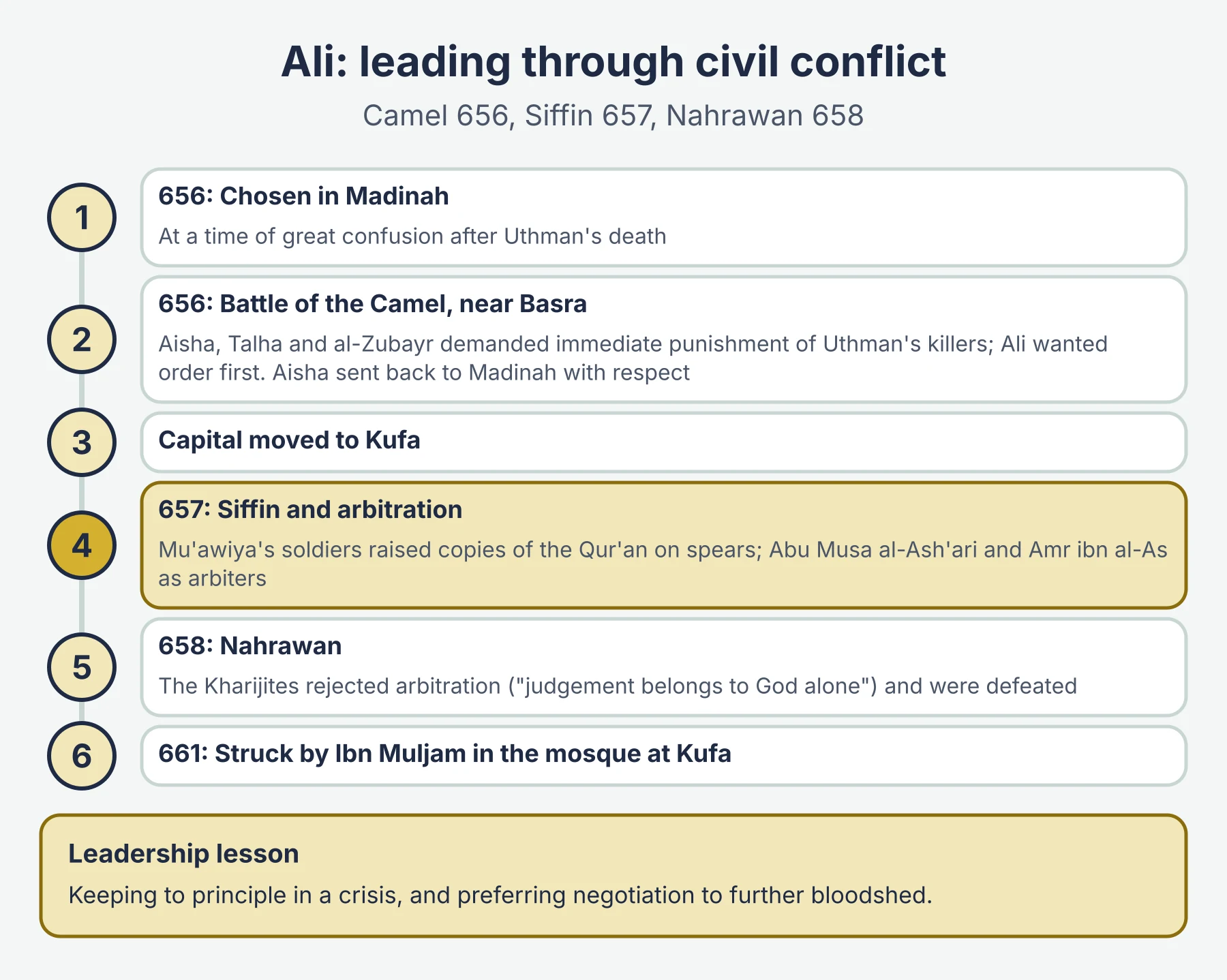
- Chosen in Madina after Uthman’s (RA) death, at a time of great confusion.
- The demand for justice. Aisha (RA), Talha (RA) and al-Zubayr demanded the immediate punishment of Uthman’s (RA) killers. Ali (RA) wanted to restore order first. The two sides met at the Battle of the Camel (656) near Basra; Talha (RA) and al-Zubayr were killed, and Ali (RA) sent Aisha (RA) back to Madina with respect.
- Kufa. He moved the capital to Kufa in Iraq.
- Siffin, 657. Mu’awiya refused to accept Ali (RA) until Uthman’s (RA) killers were punished. At Siffin, when Mu’awiya’s soldiers raised copies of the Qur’an on spears, Ali (RA) agreed to arbitration, with Abu Musa al-Ash’ari representing him and Amr ibn al-As representing Mu’awiya.
- The Kharijites. A group rejected arbitration, saying “judgement belongs to God alone”, and left his army. He defeated them at Nahrawan (658).
- Death. In 661 the Kharijite Ibn Muljam struck him in the mosque at Kufa.
- Character. Renowned for knowledge of the Qur’an, fair judgement, bravery and very simple living.
Leadership lesson: keeping to principle in a crisis, and preferring negotiation to further bloodshed.
Comparing approaches to leadership
| Issue | How the caliphs responded | Model for government today |
|---|---|---|
| Choosing a leader | Discussion at Saqifa; nomination after consultation; a council of six; pledge in Madina | Leaders chosen with consultation and public consent |
| Accountability | Abu Bakr’s (RA) first address; Umar’s (RA) checks on governors | Officials answerable for public money and conduct |
| Welfare | Umar’s (RA) diwan and stipends | State support for the poor, widows and elderly |
| Minorities | Umar’s (RA) guarantee to the Christians of Jerusalem | Protection of the rights and worship of all citizens |
| Rebellion and dissent | Abu Bakr (RA) against the Ridda; Uthman’s (RA) restraint; Ali (RA) against the Kharijites | Uphold the law while avoiding needless bloodshed |
| Other states | Treaties, terms offered before fighting, rules protecting civilians | International agreements and humane conduct in war |
Worked example
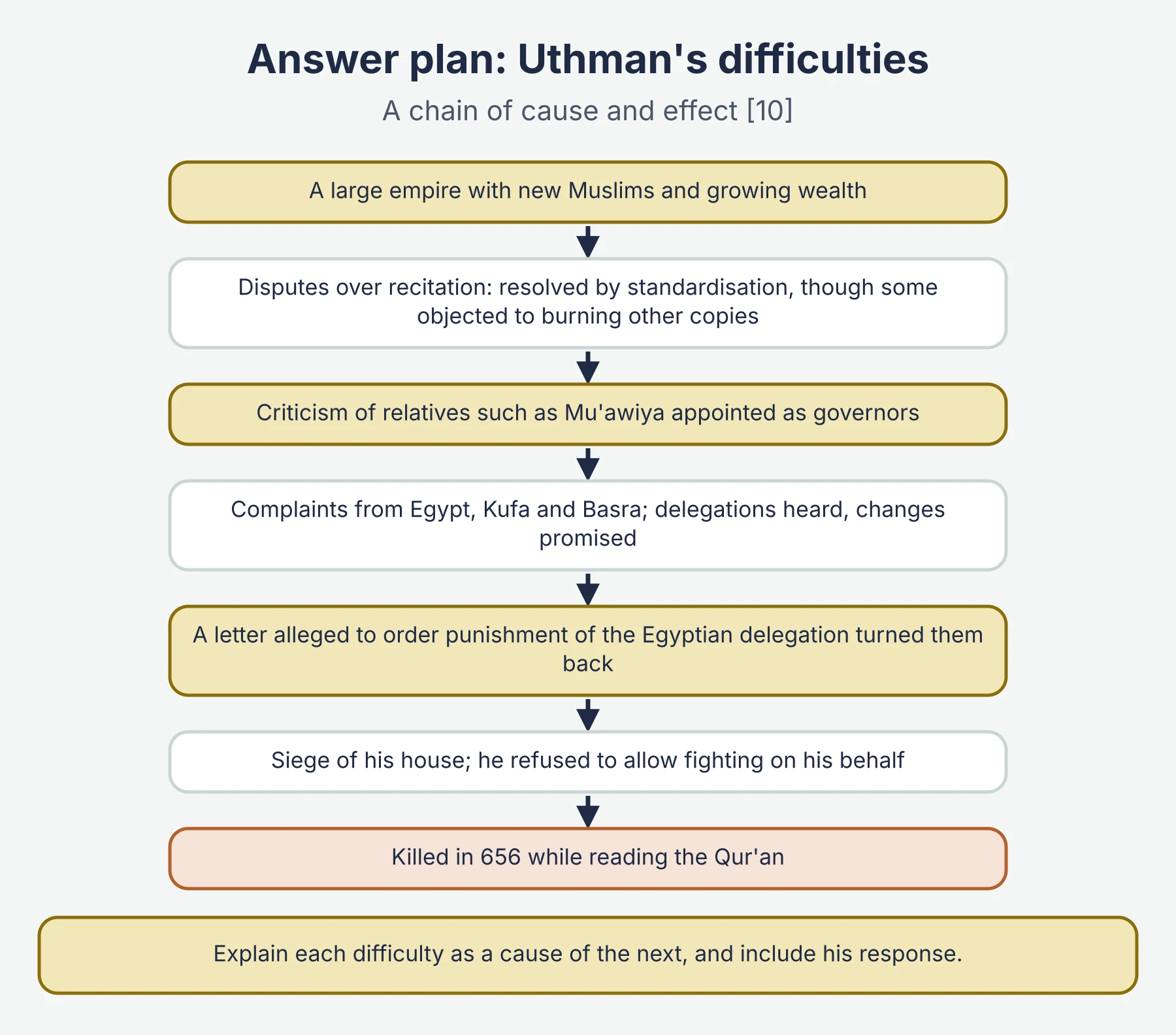
Question: Describe the main difficulties Uthman (RA) faced during his caliphate. [10]
Strong answer plan: a large empire with new Muslims and growing wealth → disputes over recitation of the Qur’an, which he resolved by standardisation, though some objected to the burning of other copies → criticism of appointing relatives such as Mu’awiya and others as governors → complaints from Egypt, Kufa and Basra → delegations came to Madina; he heard them and promised changes → a letter alleged to order the punishment of the Egyptian delegation turned them back towards Madina → siege of his house → refusal to allow fighting on his behalf → killed in 656 while reading the Qur’an.
Why it scores well: the difficulties are explained in a chain of cause and effect, and his response to each is included.
Common mistakes
- Writing the Prophet’s (pbuh) lifetime into a Paper 2 answer. Uthman’s (RA) purchase of the well of Ruma is Paper 1.
- Mixing up the battles under Ali (RA). Camel 656, Siffin 657, Nahrawan 658.
- One-sided answers on Uthman (RA) or Ali (RA). Give achievements and difficulties.
- Vague modern links. Name a specific modern practice, such as an anti-corruption inquiry or welfare payments.
Exam technique
- “Describe the main events”: narrate in order with dates, places and names.
- “What can leaders learn” or “How far are they models today”: choose a specific action, explain the principle, then give a present-day application.
- The topic is optional, so check how many questions are set on it before choosing.
Related pages
Source: Cambridge International, Cambridge O Level Islamiyat 2058 syllabus for examination in 2026 and 2027, Paper 2 Topic 3.
Related resources
-
Practice questions
Cambridge O Level Islamiyat (2058): The Period of Rule of the Rightly Guided Caliphs — Practice Questions
Twelve original questions on the rules of Abu Bakr, Umar, Uthman and Ali and their lessons for leaders, for Cambridge O Level Islamiyat 2058, with answers.
Islamiyat · Cambridge · O Level
Try questions -
Study guides
Cambridge O Level Islamiyat: Articles of Faith and Pillars of Islam, Subtopic 2.4 (2058)
Question-led study guide to Allah, angels, books, prophets, qadr, the Last Day, jihad and the Five Pillars for Cambridge O Level Islamiyat 2058 Paper 2.
Islamiyat · Cambridge · O Level
Read guide -
Revision notes
Cambridge O Level Islamiyat: Articles of Faith and Pillars of Islam — Revision Notes (2058)
Mind-map recall notes on the six beliefs, jihad and the Five Pillars, with Qur'an references and significance points, for Cambridge O Level Islamiyat 2058.
Islamiyat · Cambridge · O Level
Revise topic
Get free revision emails (optional)
Occasional emails with practice questions, worked explanations and links to free resources for the qualification and subjects you choose. No spam, and you can unsubscribe from any email. The free tools on this site never need an email.