
Study Guides
Edexcel International A Level Business: Business decisions and strategy (YBS11)
Study guide to every section of Unit 3 Business decisions and strategy in Pearson Edexcel International A Level Business, with worked examples.
- Subject
- Business
- Level
- A LEVEL
- Topic
- Business decisions and strategy
- Author
- Marlbridge Academic Team
- Updated
- Reviewed by
- Salman Ahmad (what this means)
Aligned to Pearson Edexcel A Level Business (YBS11), Issue 1, September 2017. Official specification .
Syllabus page (what it covers and how it is assessed): Pearson Edexcel A Level Business.
Syllabus points this page covers
YBS11 (A Level)
- 3 Business decisions and strategy (whole topic)
Found an error? Report a correction.
Need help with this topic? Request a free trial class for A Level Business (YBS11).
This guide follows the Pearson Edexcel International Advanced Subsidiary/Advanced Level in Business specification (YBS11), Issue 1, September 2017, and covers all of Unit 3, sections 3.3.1 to 3.3.6. The paper is source-based with quantitative skills; the ratios are not supplied, so learn them. Every business below is invented.
Links: revision notes, practice questions, Edexcel A Level Business hub, printable checklist, free diagnostics.
Map of the topic
| Section | Content | Below |
|---|---|---|
| 3.3.1 | objectives, strategy theories, SWOT, external influences | 1 |
| 3.3.2 | growth: organic, inorganic, problems | 2 |
| 3.3.3 | forecasting, investment appraisal, decision trees, CPA, contribution | 3 |
| 3.3.4 | culture, stakeholders, ethics | 4 |
| 3.3.5 | statements, ratios, human resources | 5 |
| 3.3.6 | change, contingency planning | 6 |
1 Business objectives and strategy
Corporate objectives. A mission statement or set of corporate aims says what the business exists to do. Corporate objectives turn it into measurable targets, such as a market share by a date. To appraise a mission statement, ask whether it is specific and acted on.
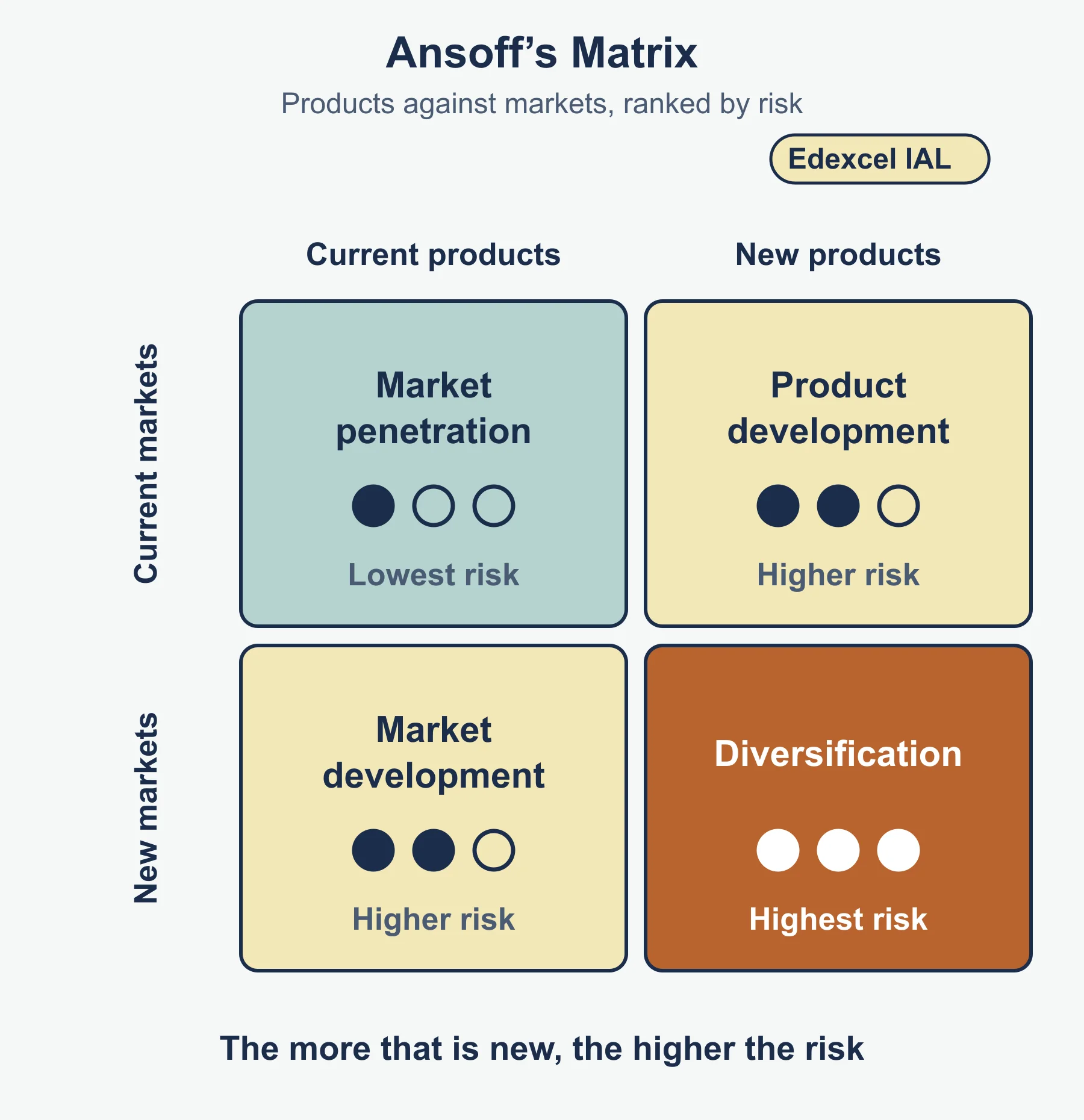
Ansoff’s Matrix links products and markets.
Market penetration sells current products to current customers (lowest risk). Product development brings new products to the current market. Market development takes current products to new markets. Diversification is new products in new markets (highest risk).
Porter’s Strategic Matrix compares the source of advantage (low cost or differentiation) with the scope of the market (broad or narrow). The outcomes are cost leadership, differentiation, cost focus and differentiation focus.
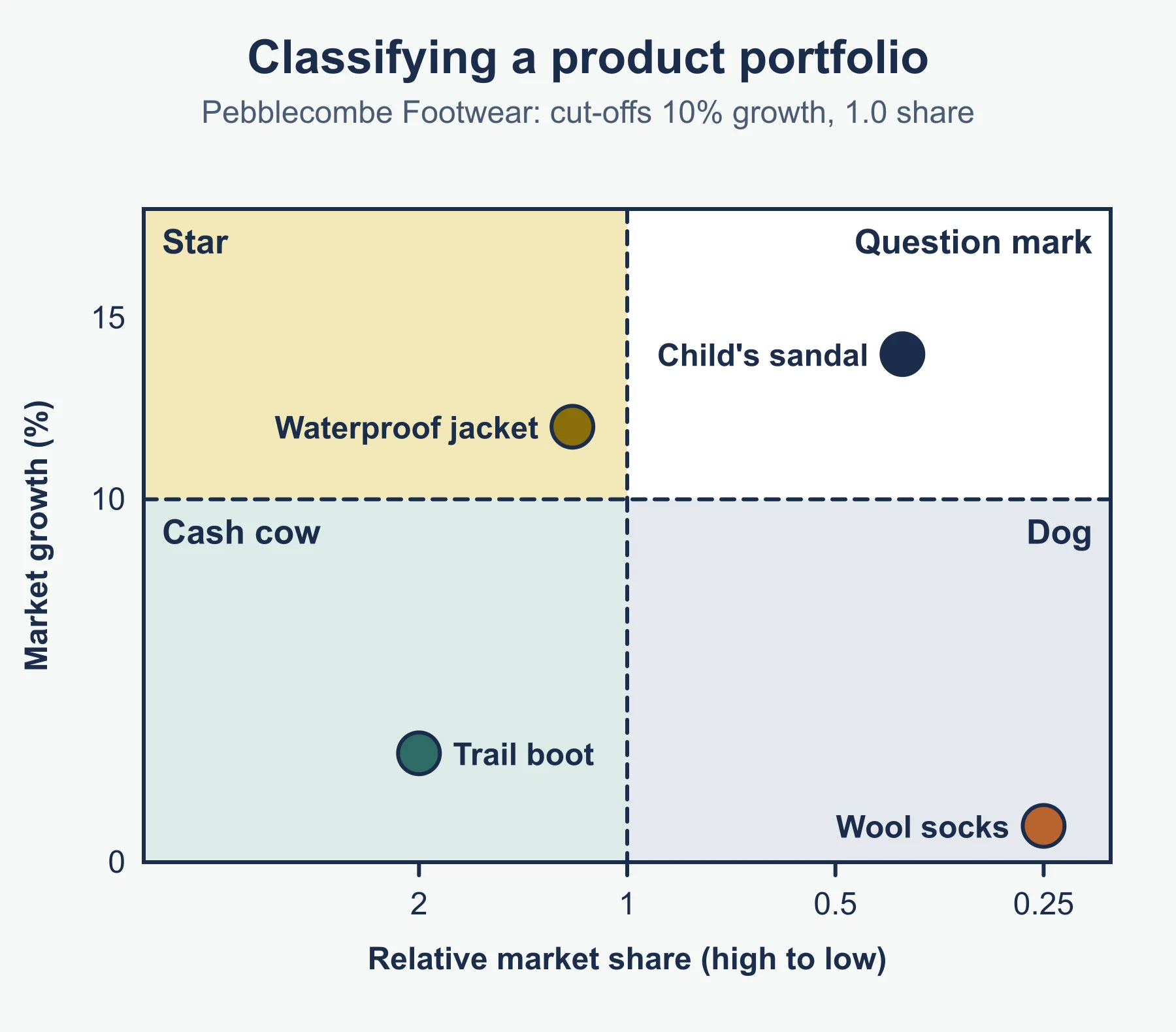
Portfolio analysis aims to judge the balance of a firm’s products so that cash from mature ones funds growth in promising ones. The Boston matrix (stars, cash cows, question marks, dogs) is the usual tool. Strategic decisions are long term and firm-wide (entering a market); tactical ones are shorter term (a price promotion). Both affect human, physical and financial resources.
SWOT separates internal considerations (strengths, weaknesses) from external ones (opportunities, threats).
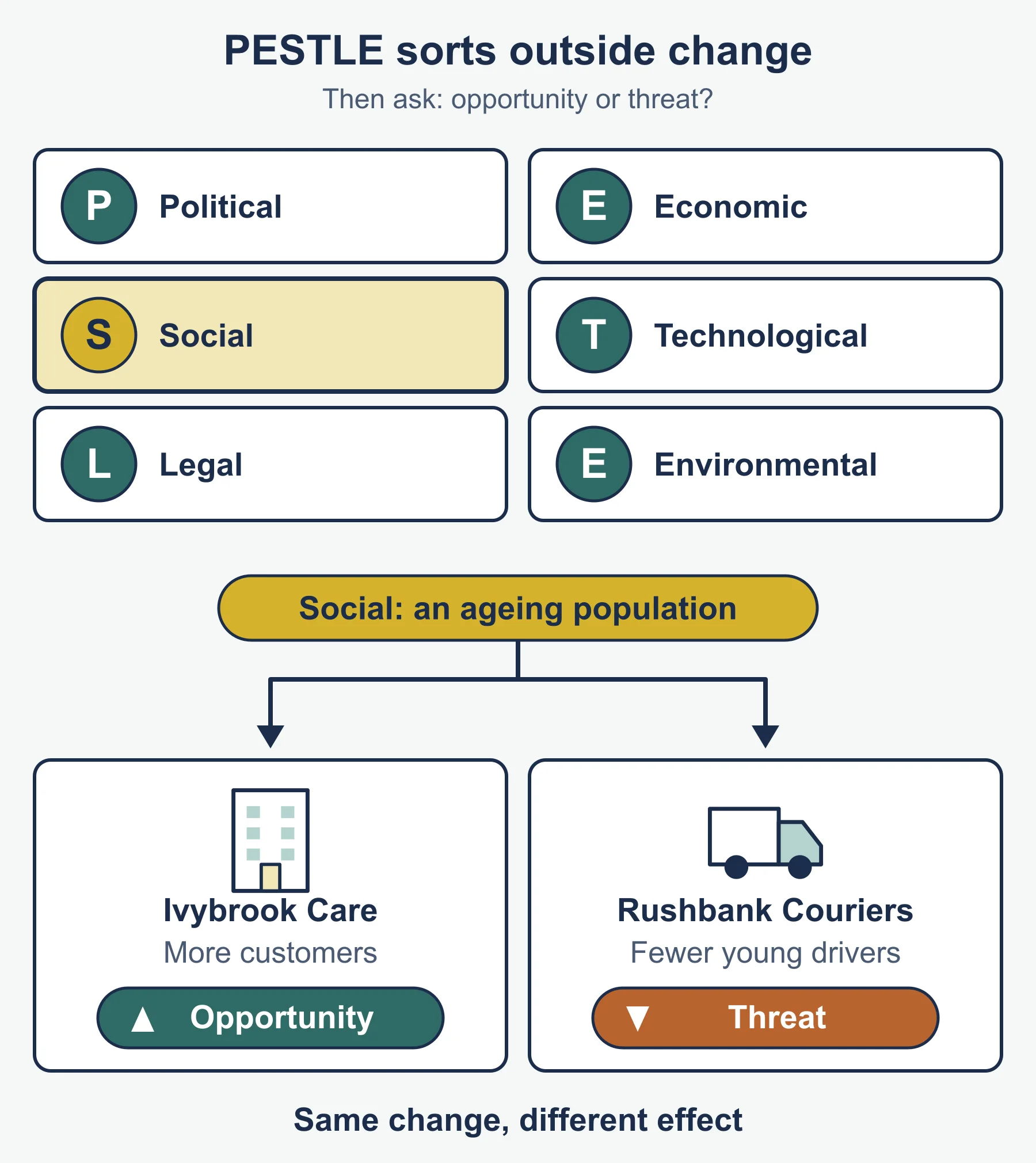
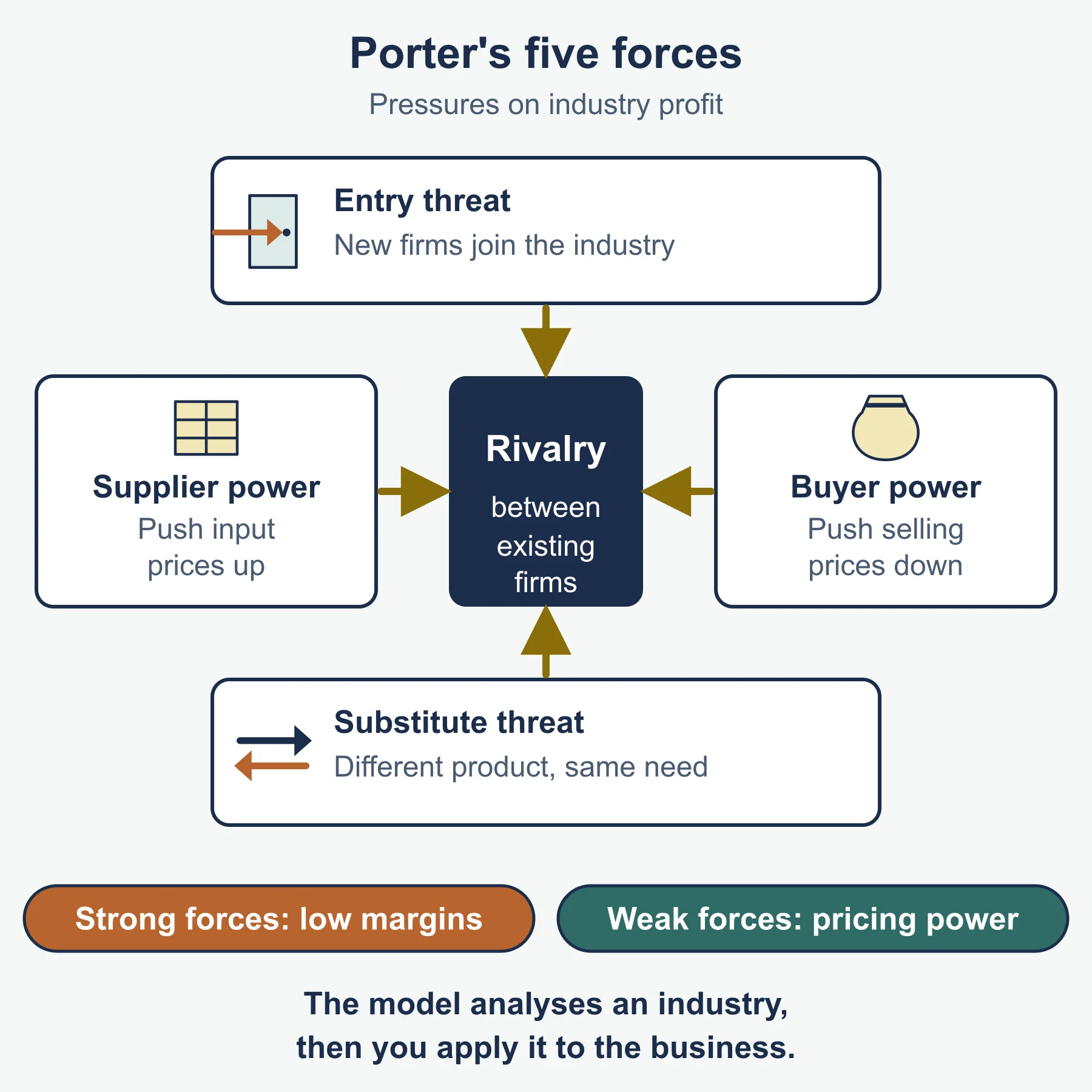
External influences. PESTLE sorts changes into political, economic, social, technological, legal and environmental. The competitive environment shifts as entrants, technology and customers change. Porter’s five forces are: competitive rivalry; the threat of new entrants; the threat of substitute products; buyers’ bargaining power; and suppliers’ bargaining power.
2 Business growth
Objectives of growth: internal economies of scale (such as bulk buying) and external economies (such as a skilled local labour pool); market power over customers and suppliers; market share and brand recognition; and profitability. Organic growth comes from the firm’s own resources. Inorganic growth comes from outside, by merger or takeover.
Organic methods: new products, new markets or regions, new outlets, online selling and extra capacity. Advantages: control and culture are kept, and growth is paced. Disadvantages: slow, limited by retained profit and borrowing.
Inorganic growth. A merger is two firms agreeing to combine. A takeover is one firm buying control of another, sometimes against its board. Reasons: instant scale, brands, new markets, removing a rival. Types:
- Horizontal integration: same stage, same industry (two coach operators).
- Vertical integration: forward (towards customers) or backward (towards suppliers).
- Conglomerate: unrelated industries, to spread risk.
Financial rewards: scale economies, share, diversified income. Financial risks: overpaying, higher gearing, integration costs. Inorganic advantages: speed, assets. Disadvantages: cost, culture clash, redundancies.
Tithby Coaches buying a rival on its routes is horizontal; heavy borrowing and unhappy drivers may cancel the gains.
Problems arising from growth. Diseconomies of scale push unit costs up through coordination problems, slow decisions and weaker motivation. Internal communication worsens as layers and sites grow, so messages are distorted or late. Overtrading is expanding sales faster than working capital can finance. Fosbury Cycles sees orders rise 80% and buys stock to match, but customers pay in 60 days and suppliers want payment in 30. Profitable on paper, it runs out of cash. Remedy: slower growth or extra finance.
3 Decision-making techniques
Quantitative sales forecasting
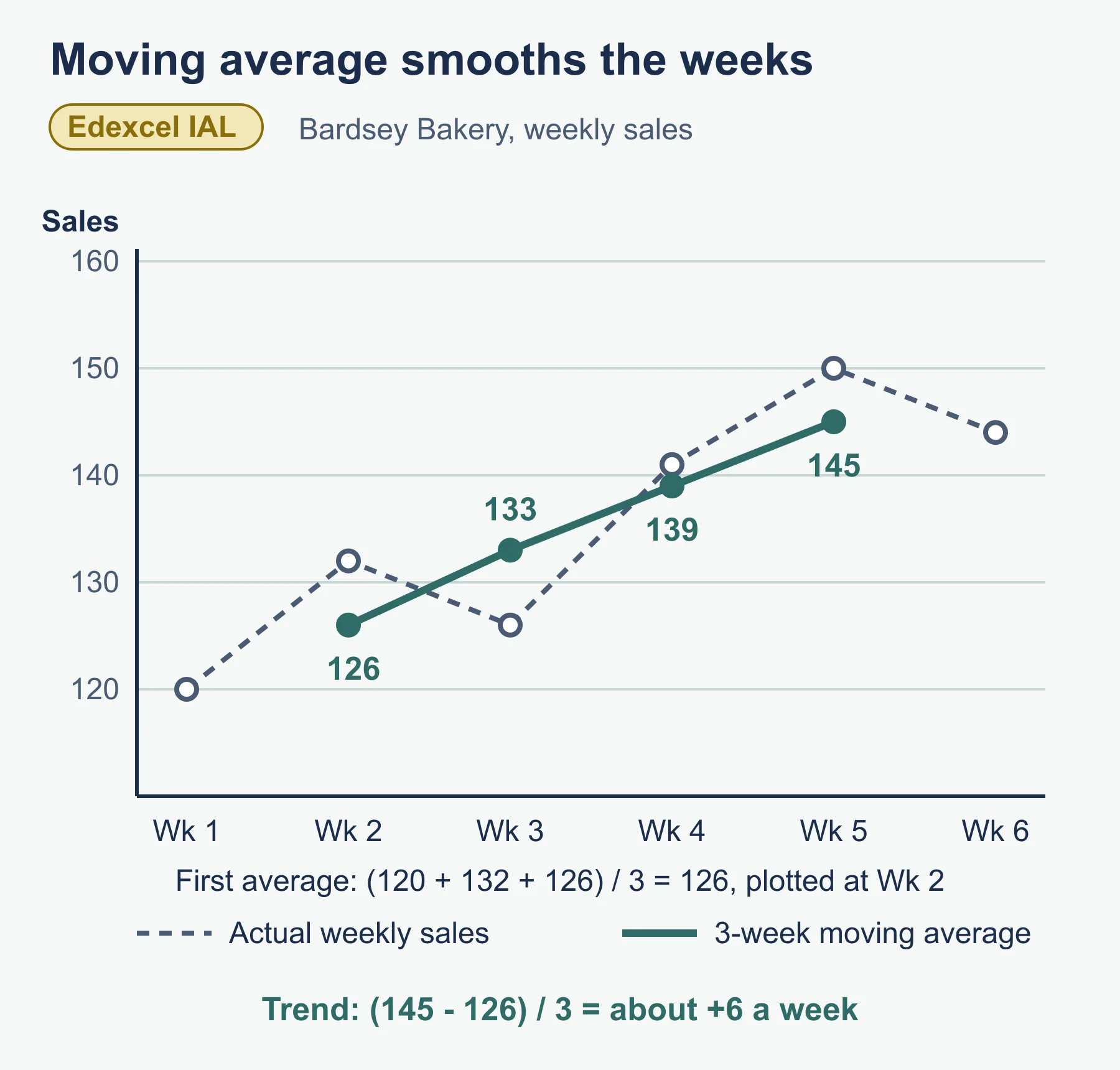
Moving averages smooth short-term variation to show the trend. Three-period example, weekly sales at Bardsey Bakery: 120, 132, 126, 141, 150, 144. Averages: (120+132+126)/3 = 126, then 133, 139, 145, each against the middle week. Trend: about +6 a week.
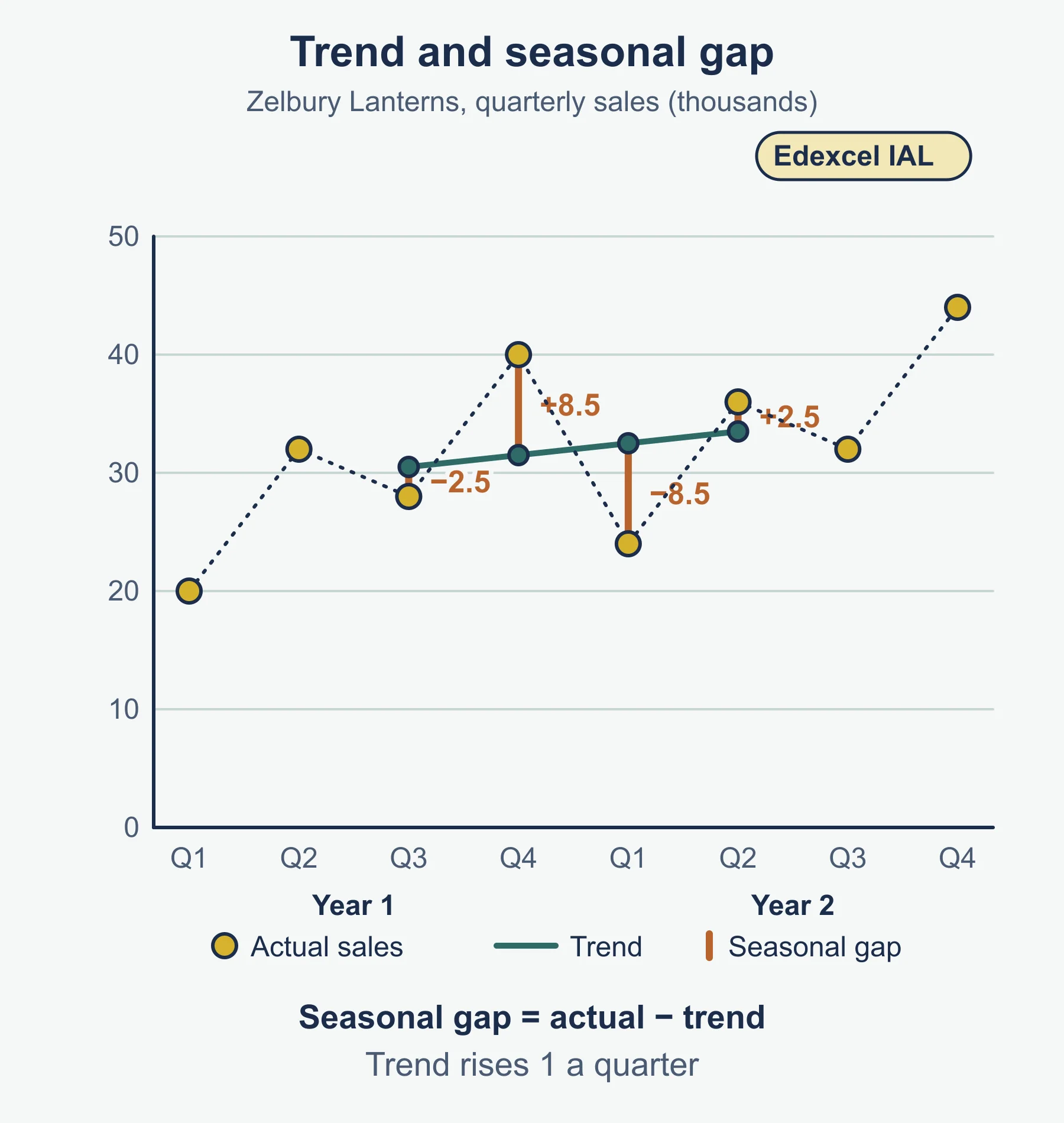
Four-quarter (centred) example, Zelbury Lanterns, sales in thousands: year 1 quarters 20, 32, 28, 40 and year 2 quarters 24, 36, 32, 44.
Four-quarter totals give averages 30, 31, 32, 33, 34; centring (averaging neighbours) gives trend values 30.5, 31.5, 32.5, 33.5 for Q3 Y1 to Q2 Y2. Seasonal variation (actual minus trend) is -2.5, +8.5, -8.5 and +2.5.
The trend rises by 1 a quarter; forecast = trend plus seasonal gap.
Scatter graphs and lines of best fit. Plot sales against another variable. If Pondmere Pottery’s line of best fit is sales = 40 + 5 x advertising spend (thousands), spend of 12 predicts sales of 100. Extrapolating beyond the data is less reliable.
Limitations: the past may not repeat, outliers distort, shocks are ignored, weak correlation forecasts poorly.
Investment appraisal
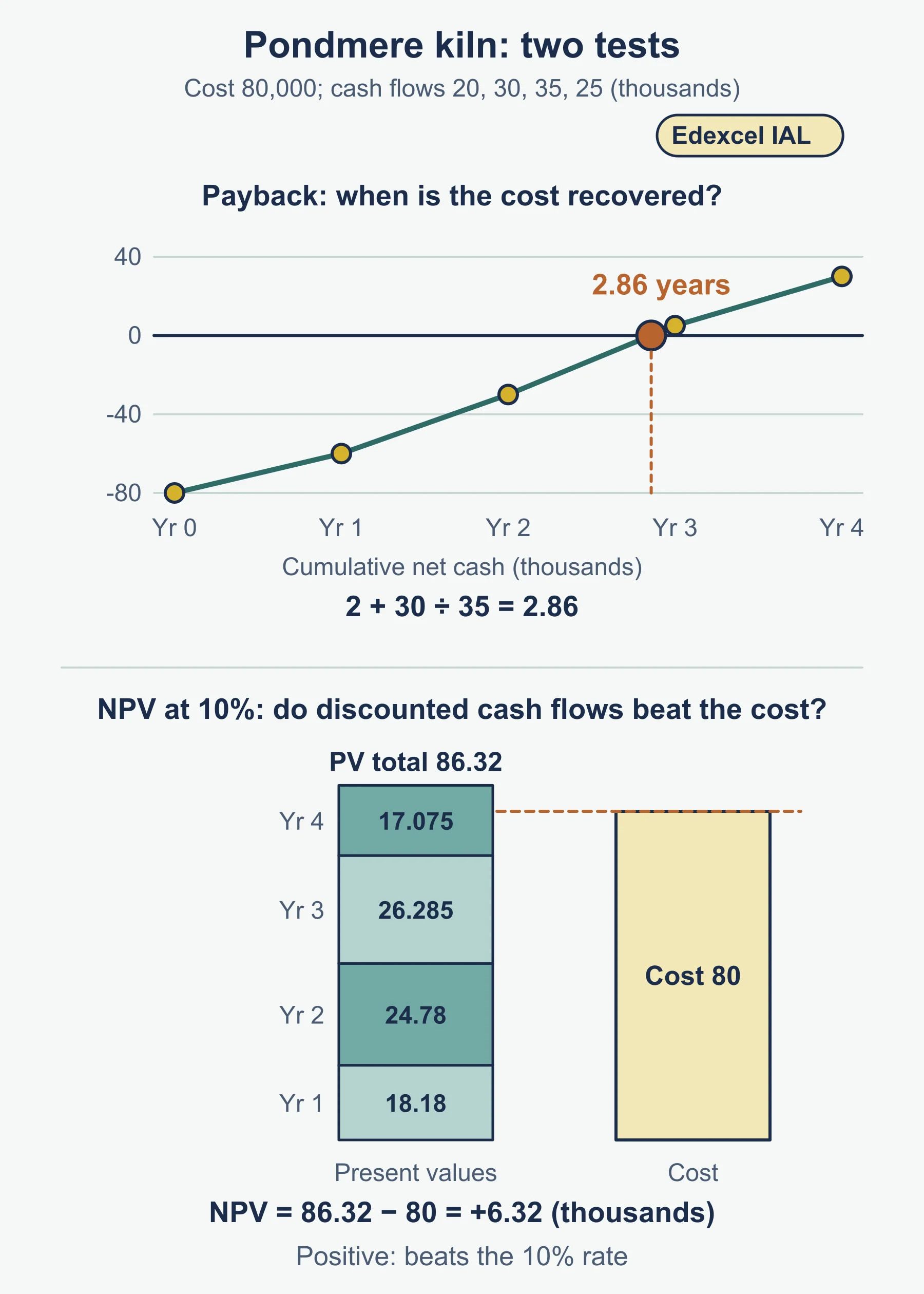
Pondmere Pottery considers a kiln costing 80,000 with net cash flows of 20,000, 30,000, 35,000 and 25,000 in years 1 to 4 (total 110,000).
- Simple payback: 50,000 is recovered after 2 years; 30,000 of year 3’s 35,000 remains. 2 + 30/35 = 2.86 years.
- Average (accounting) rate of return (standard form): average annual profit / initial investment x 100. Total net return 110,000 - 80,000 = 30,000; over 4 years that is 7,500. 7,500 / 80,000 x 100 = 9.4% (9.375).
- Net present value: multiply each year’s cash flow by its discount factor, total the results, then deduct the initial cost. At 10%, factors are 0.909, 0.826, 0.751, 0.683. Present values: 18,180 + 24,780 + 26,285 + 17,075 = 86,320. NPV = 86,320 - 80,000 = +6,320. A positive NPV shows the return beats the rate used for discounting.
Limitations: payback ignores cash after payback; ARR ignores timing; NPV does recognise that money received later is worth less, yet the answer hinges on the rate chosen. All rely on forecasts and ignore qualitative factors.
Decision trees
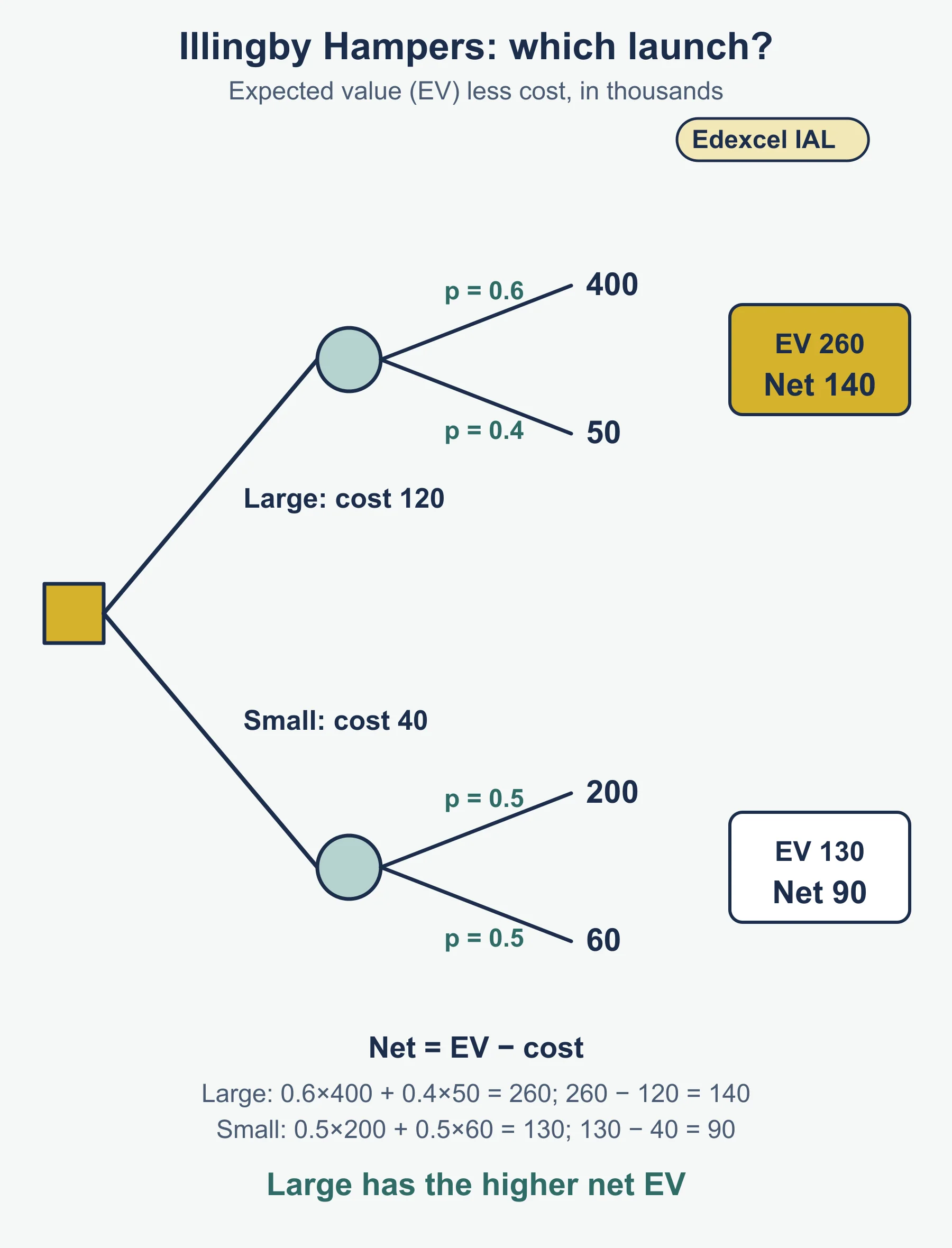
Squares are decisions, circles chance events. Multiply each outcome by its probability, add for expected value (EV), then subtract the option’s cost. Illingby Hampers (in thousands): a large launch costs 120, with a 0.6 chance of 400 and 0.4 chance of 50. EV = 240 + 20 = 260, net 140. A small launch costs 40, with 0.5 chance of 200 and 0.5 of 60. EV = 130, net 90. The large launch has the higher net EV. Limitations: probabilities are subjective, only money is counted and risk attitude is ignored.
Critical path analysis
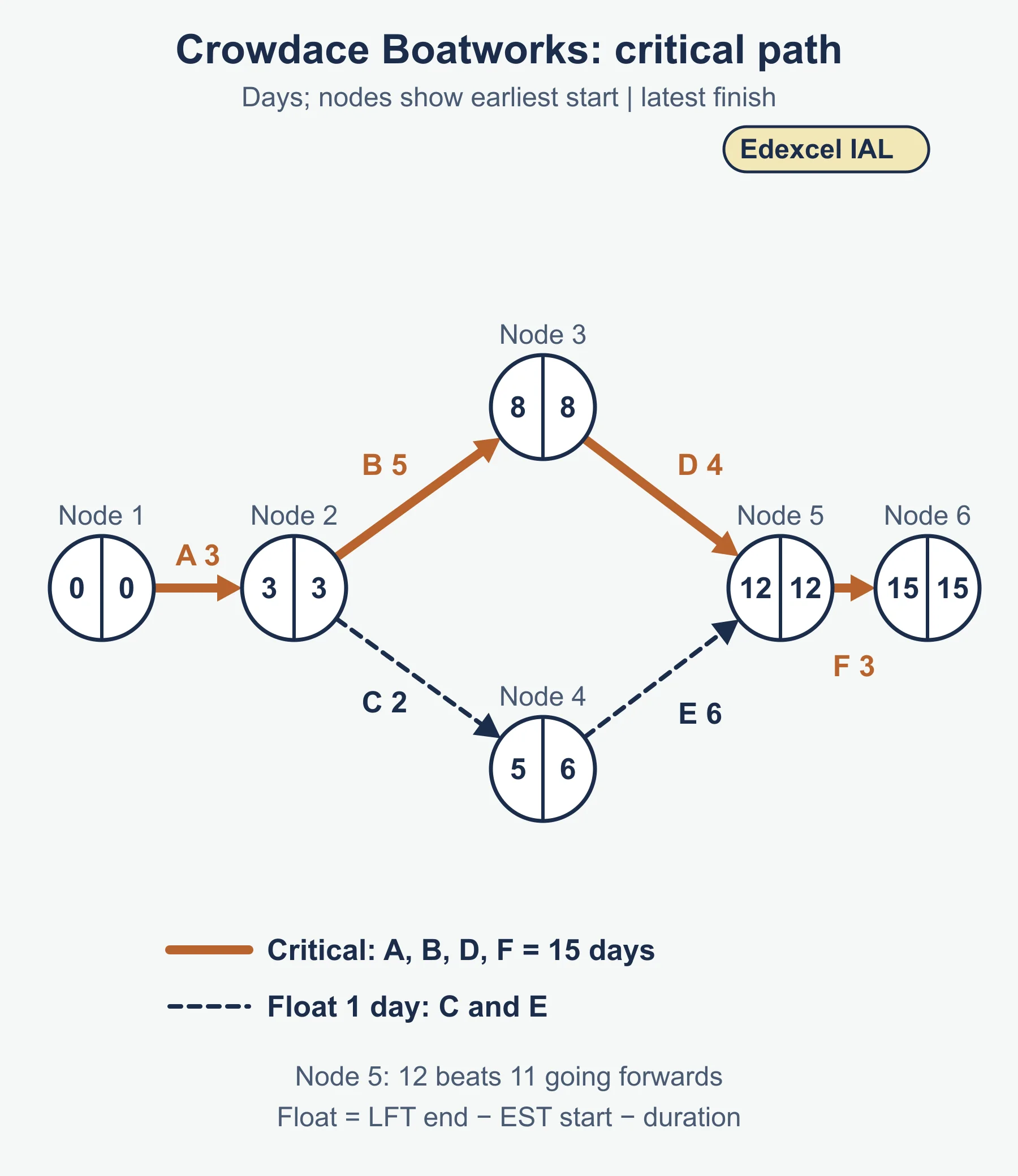
CPA shows the sequence and timing of project activities so managers can schedule resources and see which delays matter. Crowdace Boatworks fits out a boat. Activity A takes 3 days and starts the job. B takes 5 days and C takes 2, both following A. D takes 4 days following B. E takes 6 days following C. F takes 3 days and needs D and E finished.
Nodes: A is 1 to 2; B 2 to 3; C 2 to 4; D 3 to 5; E 4 to 5; F 5 to 6. Node values as (EST, LFT): 1 (0, 0); 2 (3, 3); 3 (8, 8); 4 (5, 6); 5 (12, 12); 6 (15, 15).
EST: go forwards, taking the larger value where paths join (node 5: 12 beats 11). LFT: go backwards, taking the smaller. Total float = LFT at end node - EST at start node - duration. C: 6 - 3 - 2 = 1. E: 12 - 5 - 6 = 1. Activities with zero float (A, B, D, F) form the critical path, 15 days. Limitations: durations are estimates.
Contribution
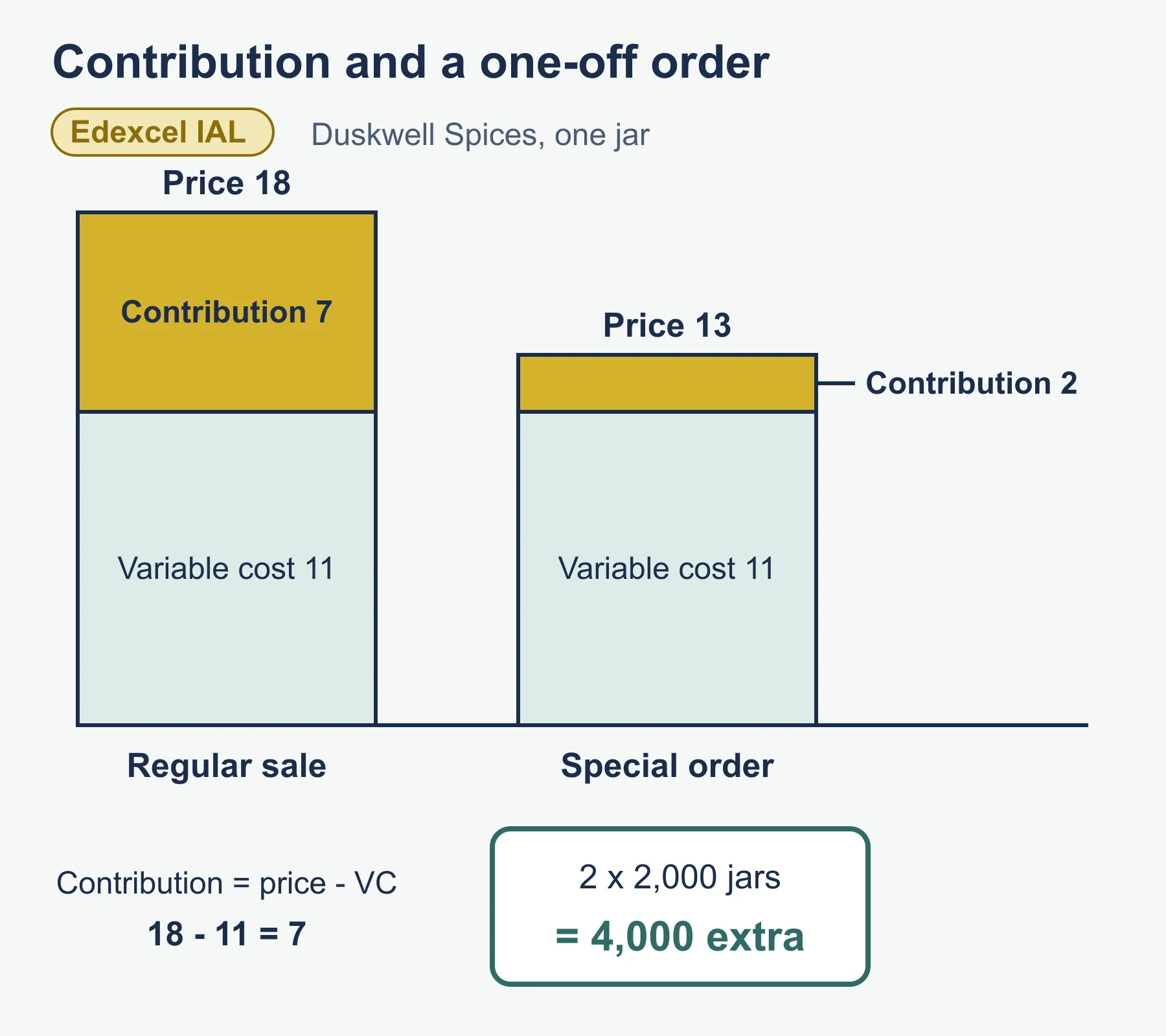
Contribution per unit = selling price - variable cost per unit. It is what each unit adds towards fixed costs and profit. Duskwell Spices sells a jar at 18, variable cost 11: contribution 7. A one-off order of 2,000 jars at 13 gives 2 x 2,000 = 4,000 extra, worth accepting if there is spare capacity and regular customers are not undercut. Contribution also helps choose between products, but fixed costs must still be covered.
4 Influences on business decisions
Corporate culture is shared values and ways of working. A strong culture is widely held and drives behaviour; a weak one is ignored. The four types are:
- Power: central control, quick decisions, typical of founder-led firms.
- Role: rules and defined jobs, stable but slow to adapt.
- Task: project teams, flexible and results focused.
- Person: the organisation serves individual experts.
Culture forms from founders’ values, history, leadership, structure and recruitment. Changing it is hard because habits are embedded and staff resist.
Stakeholder and shareholder models. Internal stakeholders (owners, managers, employees) and external ones (customers, suppliers, lenders, government, community) have different objectives: pay, repayment, quality. The stakeholder view says decisions should consider all of them. The shareholder view says the focus should be shareholder returns: share price and dividends. Conflict arises, for example, when cutting wages raises dividends.
Business ethics. Strategic decisions can trade profit against ethics, such as polluting production. Pay and rewards raise ethical questions: fairness, executive pay against average pay, and bonuses that reward short-term risk. Corporate social responsibility (CSR) means a business accepts responsibility for its social and environmental impact beyond legal minimums. It can improve brand but adds cost.
5 Assessing competitiveness
Financial statements. The statement of comprehensive income (profit and loss account) starts from revenue, deducts cost of sales to reach gross profit, deducts other operating expenses to reach operating profit, then deducts interest, leaving profit for the year. The statement of financial position (balance sheet) lists what the firm owns (non-current and current assets) and owes (current and non-current liabilities), giving net assets, which equal total equity (share capital plus retained profits). Shareholders watch profit; lenders gearing and liquidity; employees security; suppliers ability to pay.
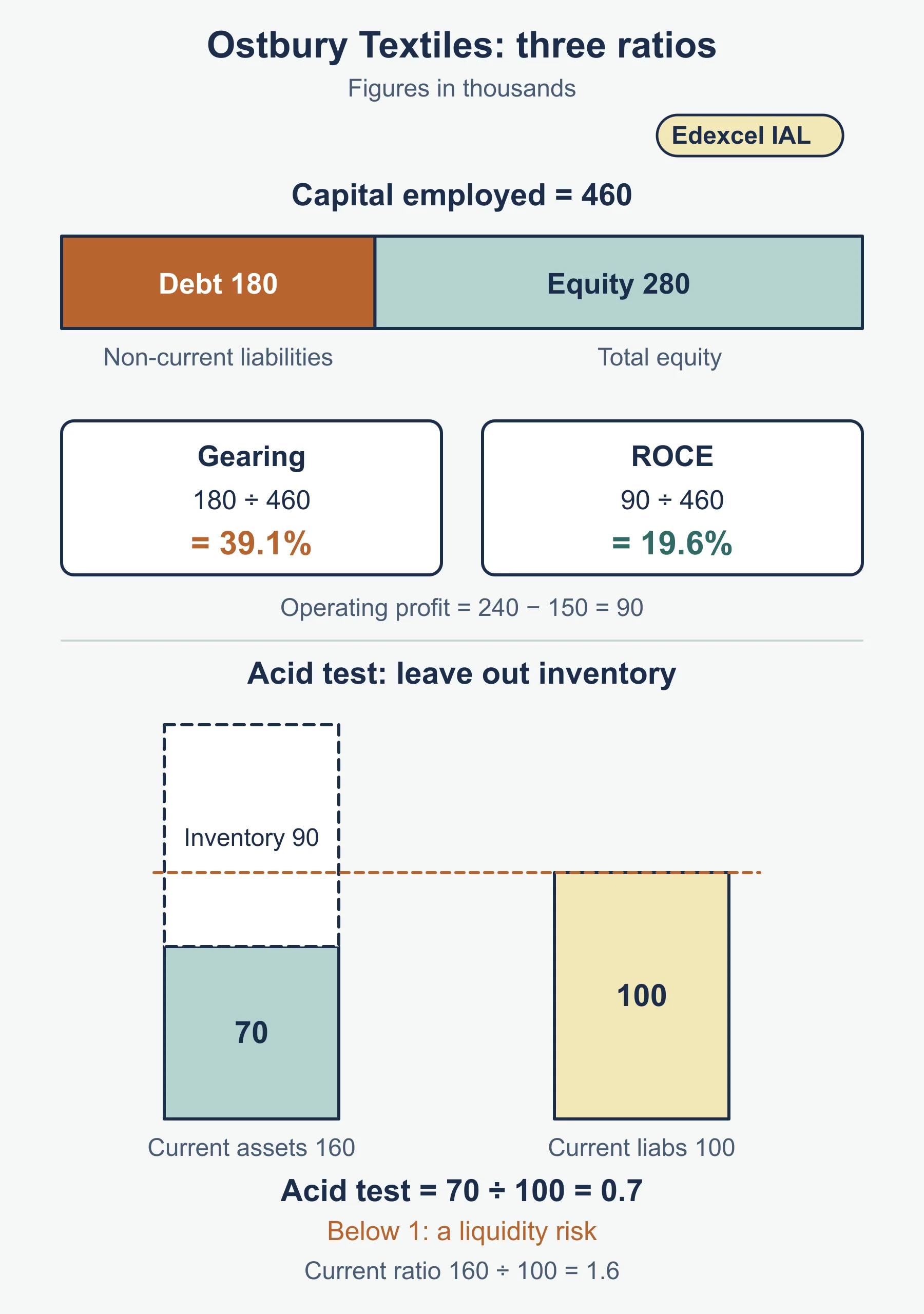
Ratios (as in Appendix 9 of the specification). Ostbury Textiles: revenue 600,000, cost of sales 360,000, other operating expenses 150,000, interest 18,000; current assets 160,000 (inventory 90,000), current liabilities 100,000, non-current liabilities 180,000, total equity 280,000.
- Gross profit margin = gross profit / revenue x 100 = 240,000 / 600,000 = 40%.
- Profit for the year margin = (profit for the year / revenue) x 100 = 72,000 / 600,000 = 12%.
- Current ratio = current assets / current liabilities = 1.6.
- Acid test ratio = (current assets - inventory) / current liabilities = 70,000 / 100,000 = 0.7.
- Gearing = non-current liabilities / capital employed x 100 = 180,000 / 460,000 = 39.1%.
- ROCE = operating profit / capital employed x 100 = 90,000 / 460,000 = 19.6%.
Capital employed = non-current liabilities + total equity = 460,000; operating profit = 240,000 - 150,000 = 90,000. An acid test of 0.7 suggests a liquidity risk. Limitations: historic data, differing accounting policies, no non-financial factors.
Human resources. Standard forms:
- Labour productivity = output / number of employees.
- Labour turnover (%) = leavers in the period / average employees x 100.
- Retention (%) = employees who stayed from the start / employees at the start x 100.
- Absenteeism (%) = days lost / possible working days x 100.
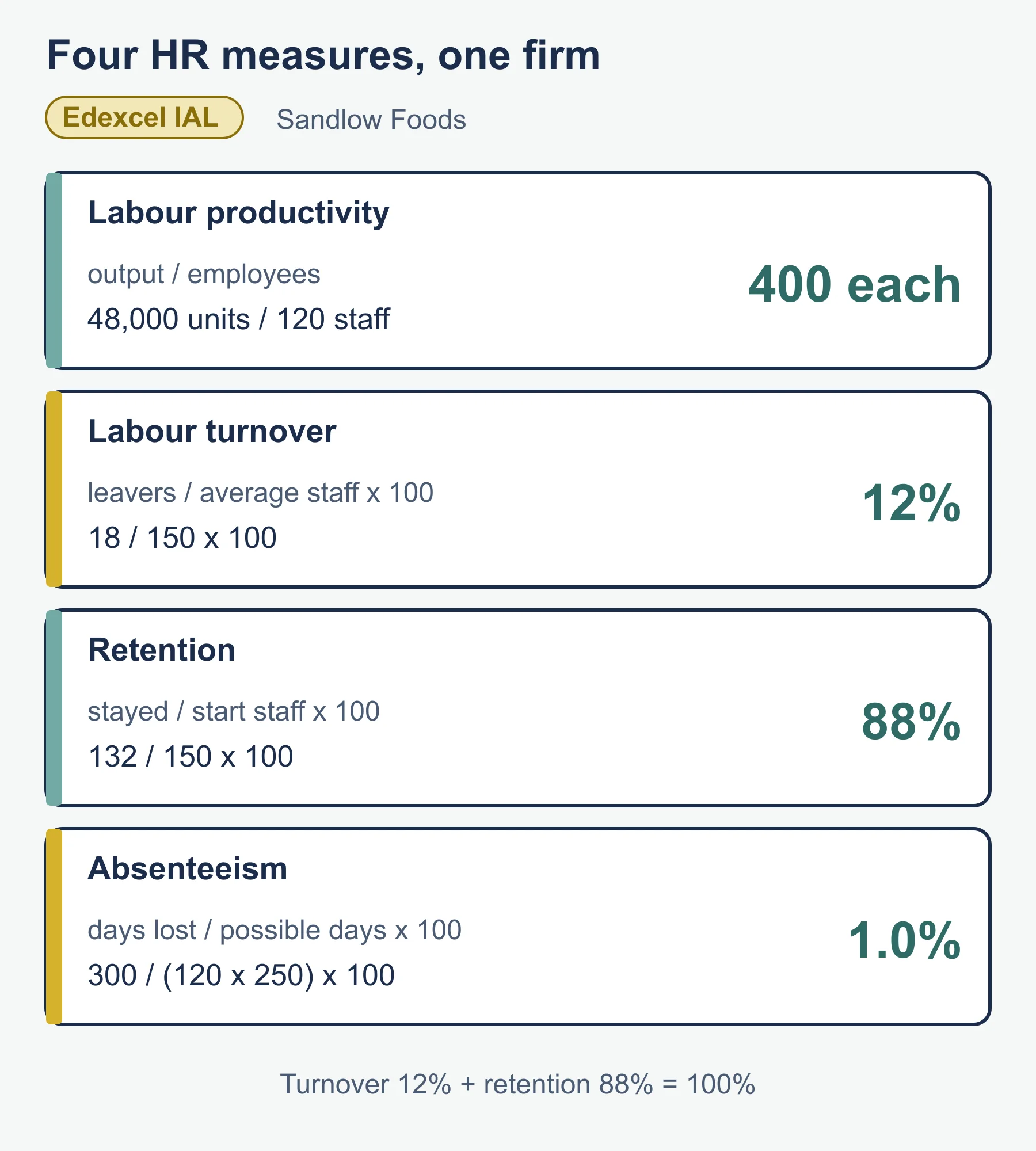
Sandlow Foods: 48,000 units from 120 staff is 400 each. 18 leavers from 150 staff is turnover of 12% and retention of 88%. 300 days lost from 120 x 250 possible days is 1.0% absence. Limitations: averages hide departmental differences.
Strategies: financial rewards (bonuses), employee share ownership, consultation (listening before deciding) and empowerment (giving staff authority).
6 Managing change
Key factors in change: organisational culture (a strong one can resist), size of organisation (larger firms are harder to move), time or speed (rapid change disrupts, slow change may be too late), managing resistance (communication, involvement, training) and transformative leadership, where leaders set an inspiring vision and change attitudes as well as structures.
Contingency planning. Risk assessment judges each risk by likelihood and impact. Key risks named in the specification are natural disasters, IT systems failure and loss of key staff. Mitigation includes a business continuity plan (backup sites and data, alternative suppliers) and succession planning (preparing people for key roles). Ullacombe Retail rates IT failure as moderate likelihood but severe impact, so it keeps off-site backups.
Frequently asked questions
What sections are in Unit 3 of Edexcel International A Level Business? Unit 3 of YBS11 has six sections, 3.3.1 to 3.3.6: business objectives and strategy, business growth, decision-making techniques, influences on business decisions, assessing competitiveness, and managing change.
What is Porter’s Strategic Matrix? It compares the source of competitive advantage (low cost or differentiation) with the scope of the market (broad or narrow). The four outcomes are cost leadership, differentiation, cost focus and differentiation focus.
What are the four types of corporate culture? Power culture has central control, role culture relies on rules and defined jobs, task culture uses flexible project teams, and person culture has the organisation serve individual experts.
What are the limitations of quantitative sales forecasting? The past may not repeat, outliers distort results, sudden shocks are ignored and weak correlation gives poor forecasts. Extrapolating a line of best fit far beyond the data is risky.
Official syllabus
Pearson Edexcel International Advanced Subsidiary/Advanced Level in Business (YBS11), Specification, Issue 1, September 2017, Unit 3, sections 3.3.1 to 3.3.6, published by Pearson Education Limited.
Get free revision emails (optional)
Occasional emails with practice questions, worked explanations and links to free resources for the qualification and subjects you choose. No spam, and you can unsubscribe from any email. The free tools on this site never need an email.
Related resources
-
Practice questions
Edexcel International A Level Business: Business decisions and strategy (YBS11) – Practice Questions
Original practice questions with worked answers for Unit 3 Business decisions and strategy in Edexcel International A Level Business.
Business · Pearson Edexcel · A Level
Try questions -
Revision notes
Edexcel International A Level Business: Business decisions and strategy (YBS11) – Revision Notes
Condensed revision notes for Unit 3 Business decisions and strategy in Edexcel International A Level Business: formulas, models and a self-test.
Business · Pearson Edexcel · A Level
Revise topic -
Exam preparation
Edexcel International A Level Business: Source-Booklet Technique Across Four Units
How Edexcel IAL Business (YBS11) exam structure changes from the AS units to the A2 units, why source booklets drive every answer, and a 20-mark essay routine.
Business · Pearson Edexcel · A Level
Read guide
Related articles
-
teaching
A Level tuition in Dubai: Cambridge or Pearson Edexcel International A Level?
Schools in Dubai and Abu Dhabi teach either Cambridge International AS & A Level or Pearson Edexcel International A Level. How the two are structured, why it matters for tuition, and how online classes from Lahore work.
9 October 2026
-
curriculum guides
Choosing subjects at IGCSE and A Level
How subject choices at 14 and 16 affect university options later, and how to keep pathways open without overloading a timetable.
28 July 2026
Studying this with a teacher
Working through Business A LEVEL?
This page is free and stays free. If you would rather be taught it, Marlbridge runs Business classes one-to-one and in small groups of up to 15, online in your own time zone. The first trial class is free. WhatsApp replies within an hour (8am–11pm Pakistan time, every day); email the same day.
Pearson Edexcel Business teachers at Marlbridge

