
Study Guides
Edexcel International A Level Business: Planning a business and raising finance (YBS11)
Study guide to business plans, internal and external finance, forms of business and liability for Edexcel International A Level Business, section 2.3.1.
- Subject
- Business
- Level
- AS LEVEL
- Topic
- Managing business activities
- Author
- Marlbridge Academic Team
- Updated
- Reviewed by
- Salman Ahmad (what this means)
Aligned to Pearson Edexcel A Level Business (YBS11), Issue 1, September 2017. Official specification .
Syllabus page (what it covers and how it is assessed): Pearson Edexcel A Level Business.
Syllabus points this page covers
YBS11 (AS Level)
- 2.3.1 Planning a business and raising finance
Found an error? Report a correction.
Need help with this topic? Request a free trial class for A Level Business (YBS11).
This guide covers section 2.3.1, Planning a business and raising finance, of Unit 2 (Managing business activities) in the Pearson Edexcel International Advanced Subsidiary/Advanced Level in Business (YBS11) specification, Issue 1, September 2017. It follows the five headings the specification lists: planning, internal finance, external finance, forms of business and liability. Amounts are in dollars. For the unit overview see the Managing business activities study guide; the other 2.3.1 pages are the revision notes and the practice questions. Earlier unit-level pages: revision notes and practice. Course hub: Edexcel A Level Business. Checklist: printable checklist. To locate your weak spots first, take the free diagnostics.
What 2.3.1 asks you to know
| Heading | You must be able to |
|---|---|
| 1 Planning | Describe the content of a business plan; explain its relevance and uses |
| 2 Internal finance | Owner’s capital (personal savings), retained profit, sale of assets |
| 3 External finance | Sources: business angels, banks, family and friends, crowd funding, other businesses, peer-to-peer funding. Methods: grants, leasing, loans, overdrafts, share capital, trade credit, venture capital. Judge suitability for different circumstances |
| 4 Forms of business | Sole trader, partnership, private limited company (Ltd); franchising, social enterprise, lifestyle businesses, online businesses; growth to a public limited company (plc) and stock market flotation |
| 5 Liability | Implications of limited and unlimited liability, with advantages and disadvantages; finance appropriate for each |
The specification lists “sources” and “methods” of external finance separately. A source is who provides the money; a method is the form the money takes. One source can supply several methods: a bank can provide a loan or an overdraft.
1 Planning
Content of a business plan (1a)
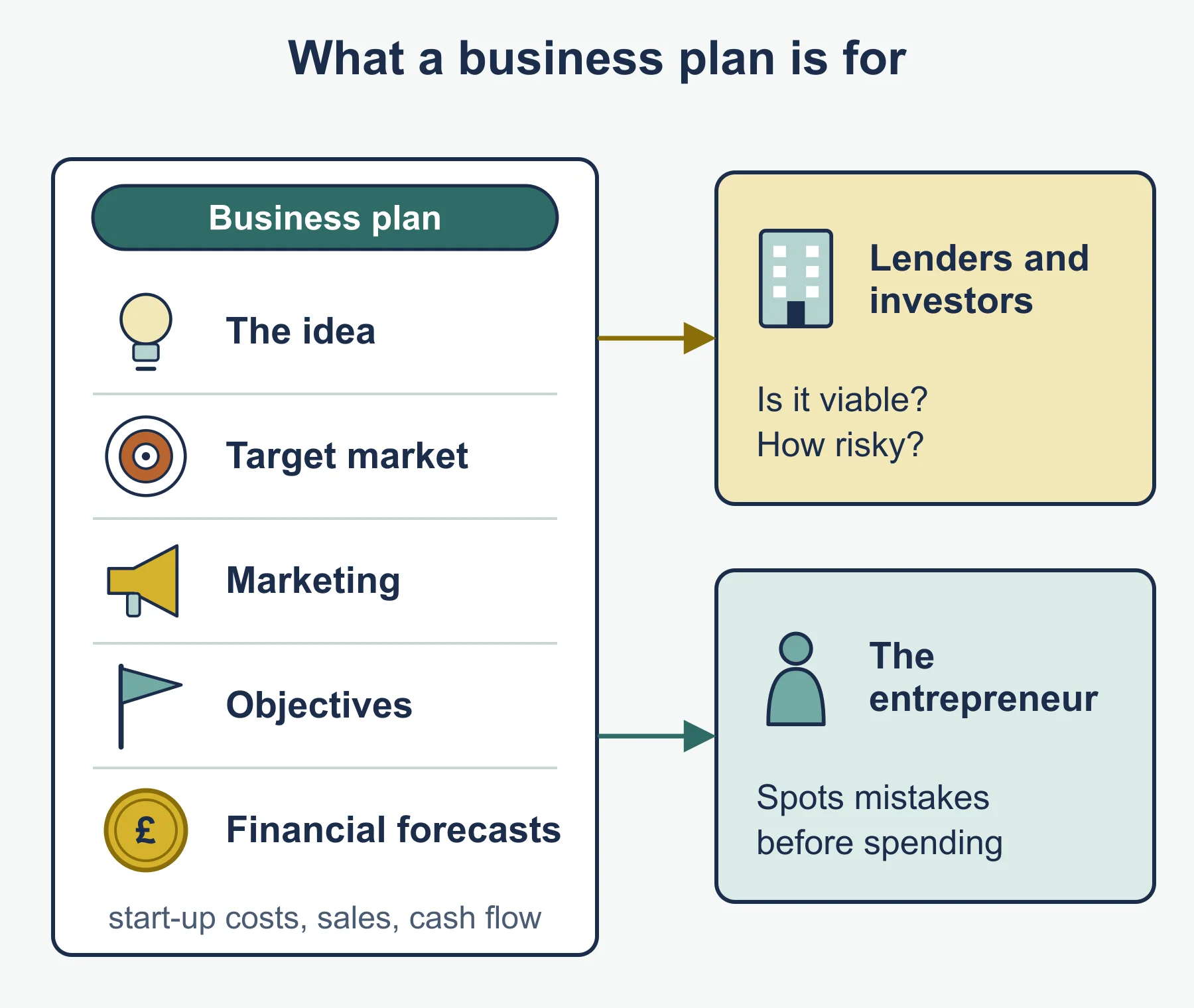
A business plan is a written document stating the venture’s intended activities and the way they will be funded. Typical content:
- Business idea and aims: the product or service, its customers and the objectives.
- Market research: size of the market, target customers, competitors.
- Marketing plan: price, promotion, place, product.
- Operations: location, equipment, suppliers, staffing.
- Owners and managers: experience and roles.
- Financial information: start-up costs, sales forecasts, cash-flow forecast, expected profit, break-even and how much finance is needed.
Relevance and uses (1b)
The plan has two audiences. Inside the business it forces the owner to test the idea, set targets and later compare actual results with the plan. Outside, it is the document that lenders and investors read before they decide whether to provide finance. A plan also reduces risk by exposing weak assumptions before money is spent. Its limits: forecasts are estimates, the market may change, and a plan can give false comfort if the research behind it is poor.
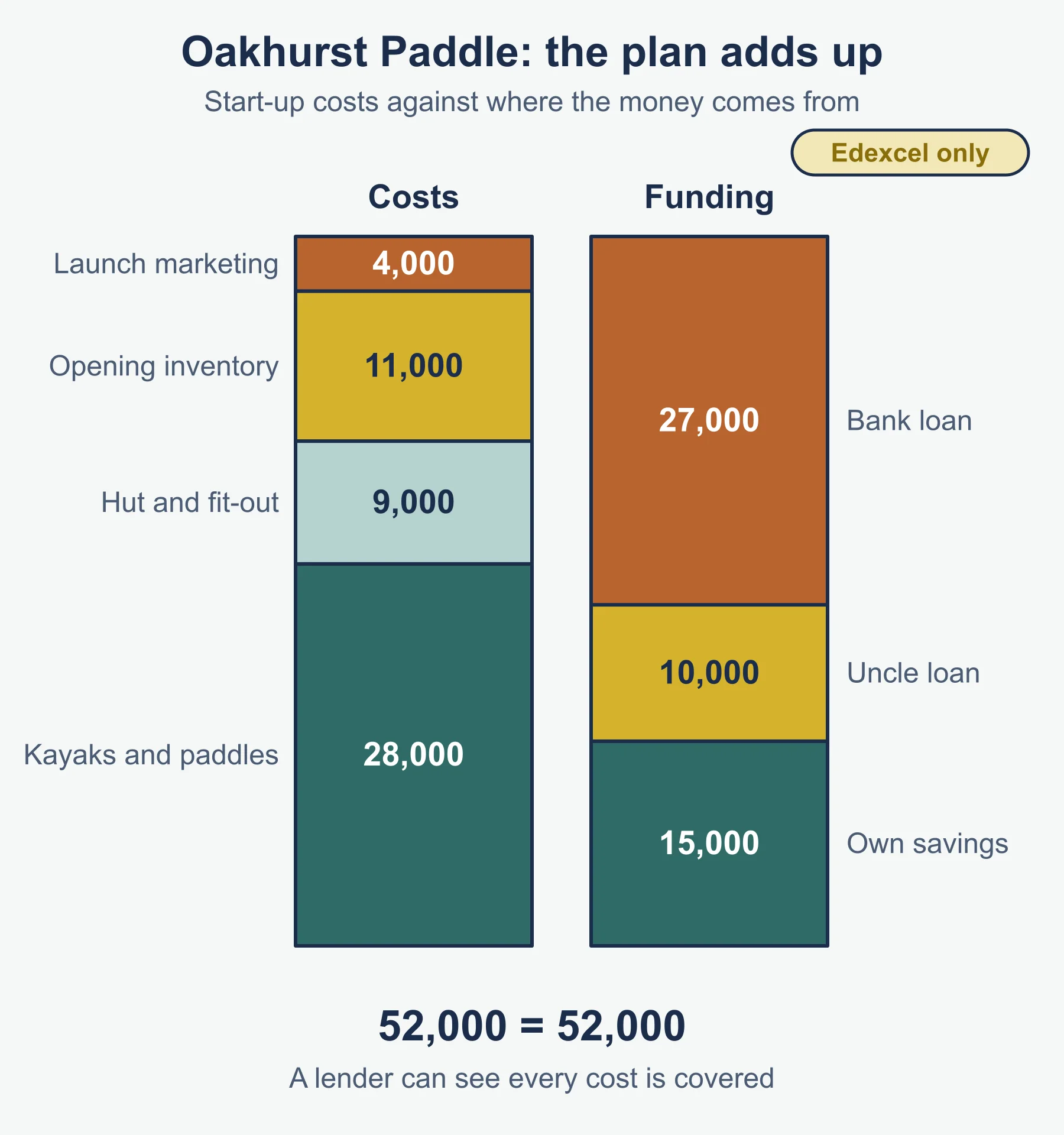
Worked example: Oakhurst Paddle. Maya plans a kayak-hire business and costs the start-up in her plan.
| Item | Cost |
|---|---|
| Kayaks and paddles | 28,000 |
| Hut deposit and fit-out | 9,000 |
| Opening inventory (life jackets, spares) | 11,000 |
| Launch marketing | 4,000 |
| Total finance needed | 52,000 |
Her funding section shows where the 52,000 will come from: personal savings 15,000, a loan from her uncle 10,000 and a bank loan 27,000, which is also 52,000. A lender can see that the plan covers every cost and that the owner is putting in her own money.
2 Internal finance
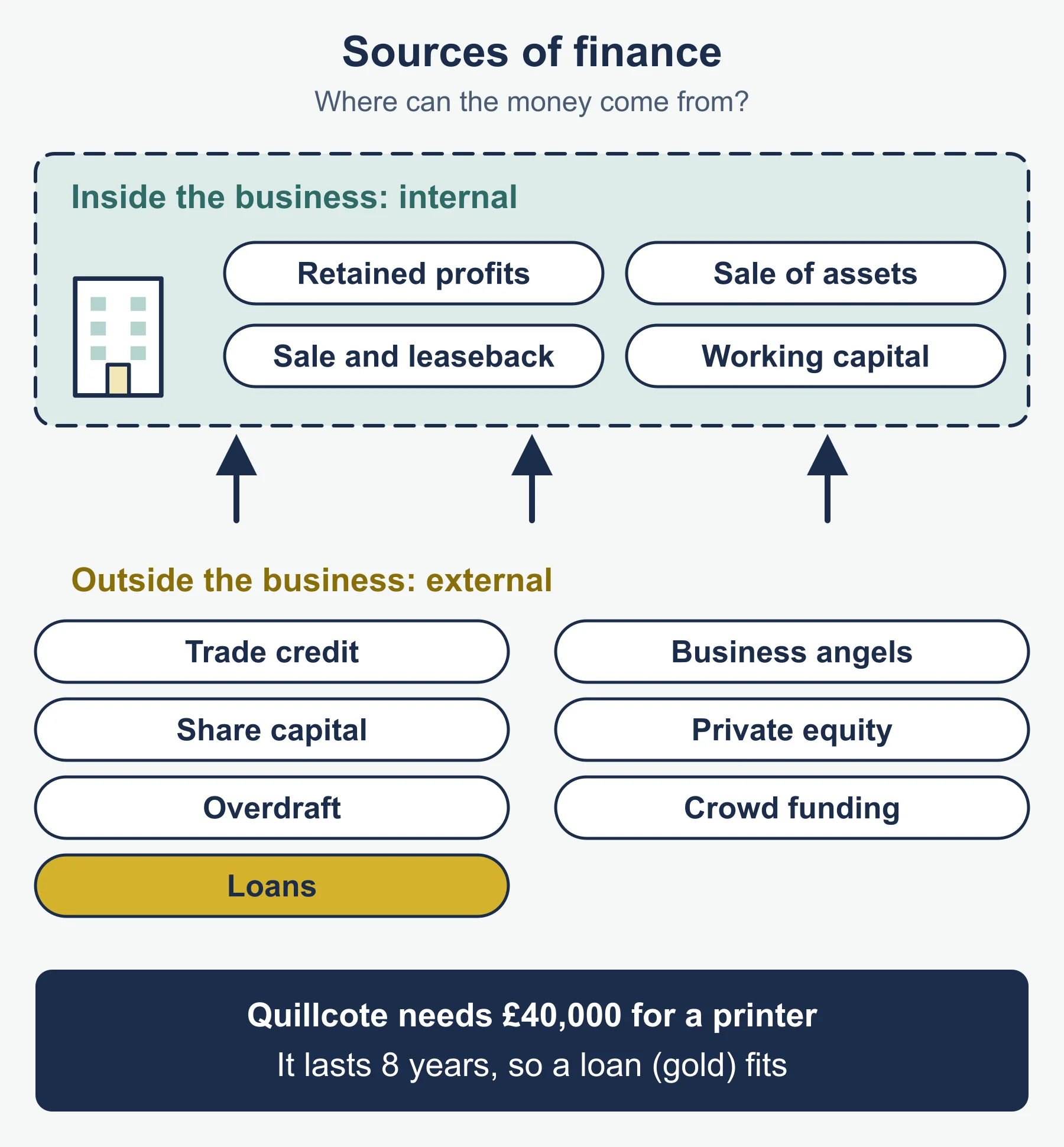
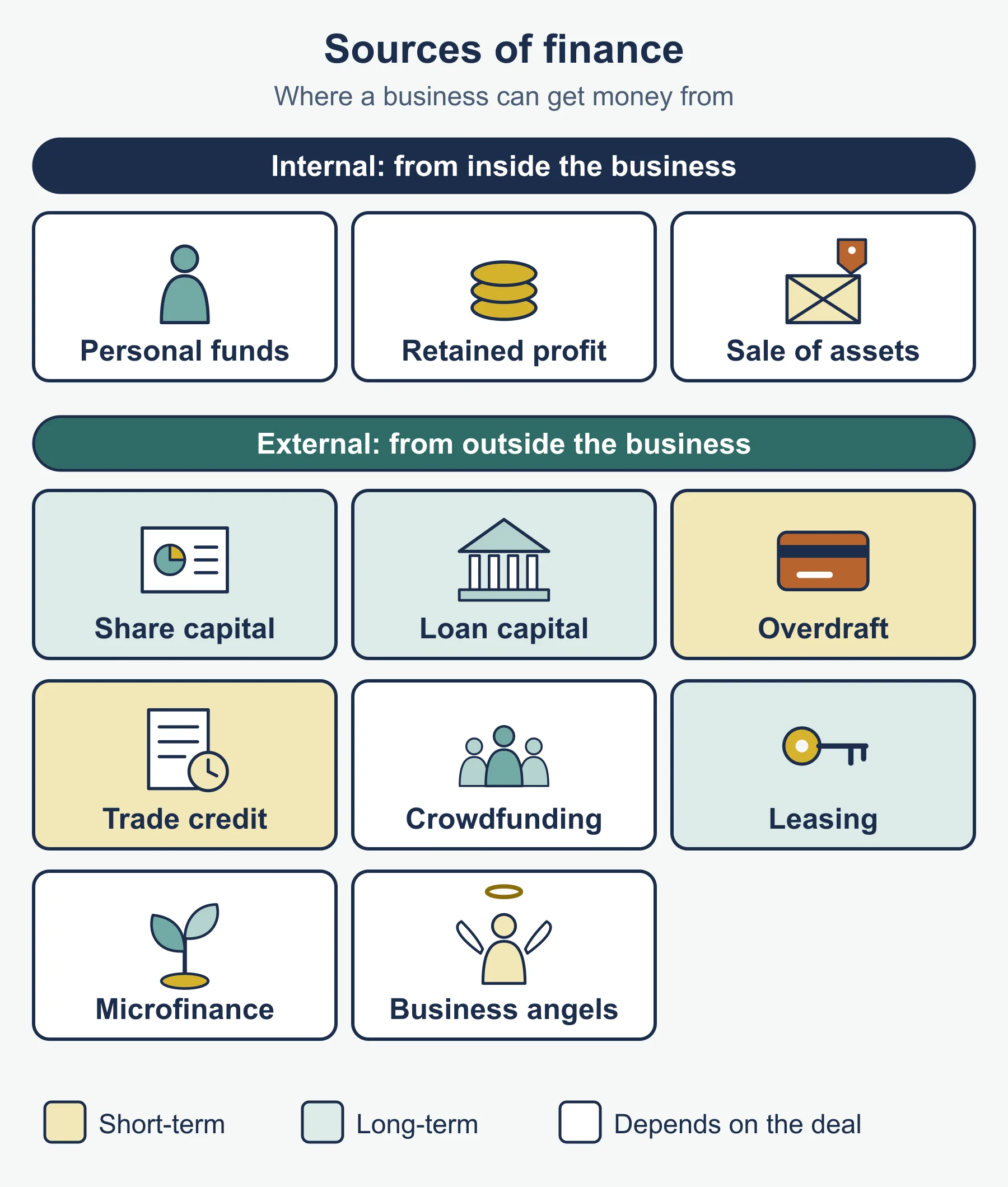
Internal finance comes from within the business or its owner.
- Owner’s capital: personal savings (2a). Quick, no interest, no outside control. Limited by what the owner has, and personal money is at risk.
- Retained profit (2b). Profit kept in the business rather than paid out. It carries no interest and no outside control, but a new or loss-making business has none, and growth funded this way is slow.
- Sale of assets (2c). Selling equipment, vehicles or property raises cash without borrowing. If the asset is still needed, the business may have to rent it back, and it may sell below its book value.
Internal finance suits small, low-risk needs and owners who want full control. It is rarely enough for rapid expansion.
3 External finance
External finance comes from outside the business.
Sources (3a)
- Family and friends. Cheap and flexible, often on informal terms. Risk to relationships, and informal agreements can cause disputes.
- Banks. The main provider of loans and overdrafts. Reliable for businesses with a sound plan and security, but they charge interest and may refuse high-risk start-ups.
- Peer-to-peer funding. Individuals lend to businesses through an online platform. Can be quicker or cheaper than a bank for some borrowers, but rates depend on the credit assessment and the borrower must still repay.
- Business angels. Wealthy individuals who invest their own money, often taking a share of ownership and offering advice. Suit early-stage businesses with growth potential. The owner gives up some control and profit.
- Crowd funding. Many people each contribute a small amount, usually online, sometimes in return for a reward or a share. It tests demand and builds a customer base, but fails if the target is not reached and needs a convincing campaign.
- Other businesses. A supplier, customer or partner company may lend or invest, for example because it benefits from the venture.
Methods (3b)
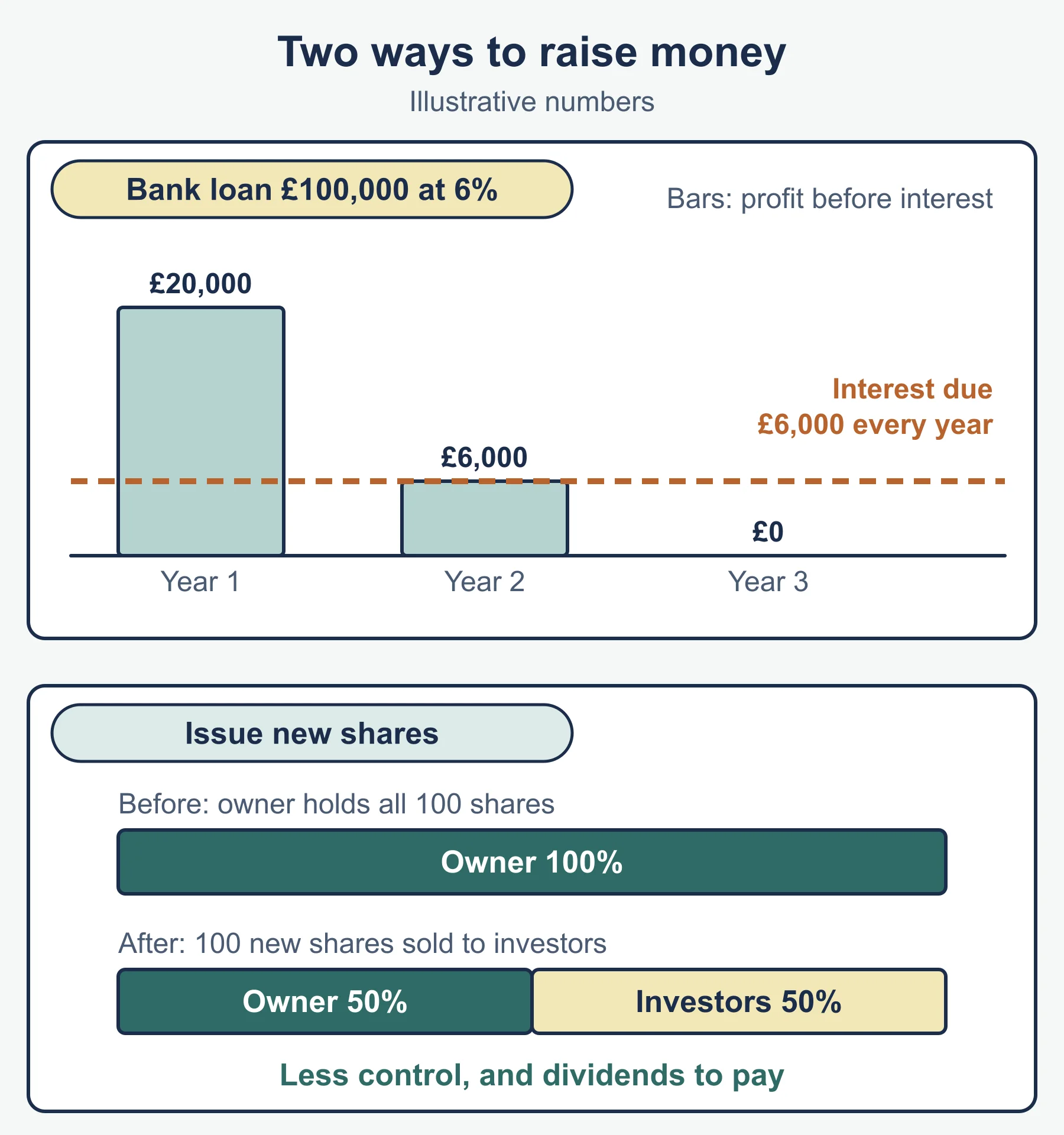
- Loans. A set amount paid back, plus interest, across an agreed term. Suit long-term purchases, but repayments must be met whatever happens to sales.
- Share capital. Money raised by selling shares in a company. No repayment and no interest, but ownership and control are shared and dividends may be expected.
- Venture capital. Investment, usually in shares, by a specialist firm in a business with high growth potential and higher risk. It brings money and expertise but the firm usually wants a significant say and an eventual exit.
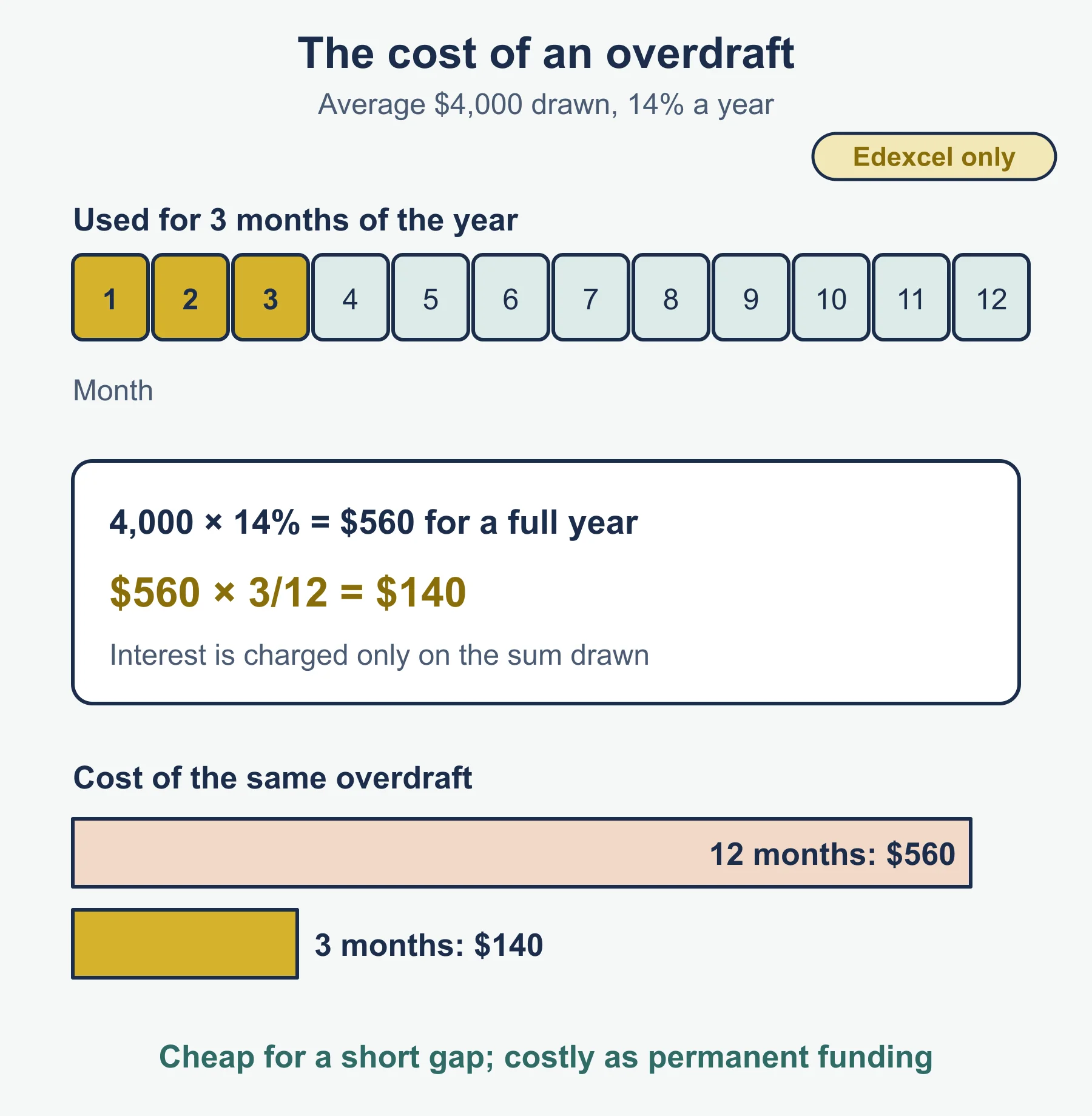
- Overdrafts. Permission to spend more than the bank balance up to a limit. Flexible, with interest charged just on the sum drawn, but rates are high and the bank can usually ask for repayment. Suited to short-term cash gaps, not to buying long-term assets.
- Leasing. Using an asset in return for regular payments, without owning it. It avoids a large outlay and may include servicing, but total payments are often higher than buying and the business does not own the asset.
- Trade credit. Receiving goods now and paying the supplier later. It is effectively free if paid on time, but the supplier may offer a discount for prompt payment and may stop supplying if late.
- Grants. Money from a government or other body, often for a stated purpose, that need not be repaid. Conditions apply and competition for funding can be strong.
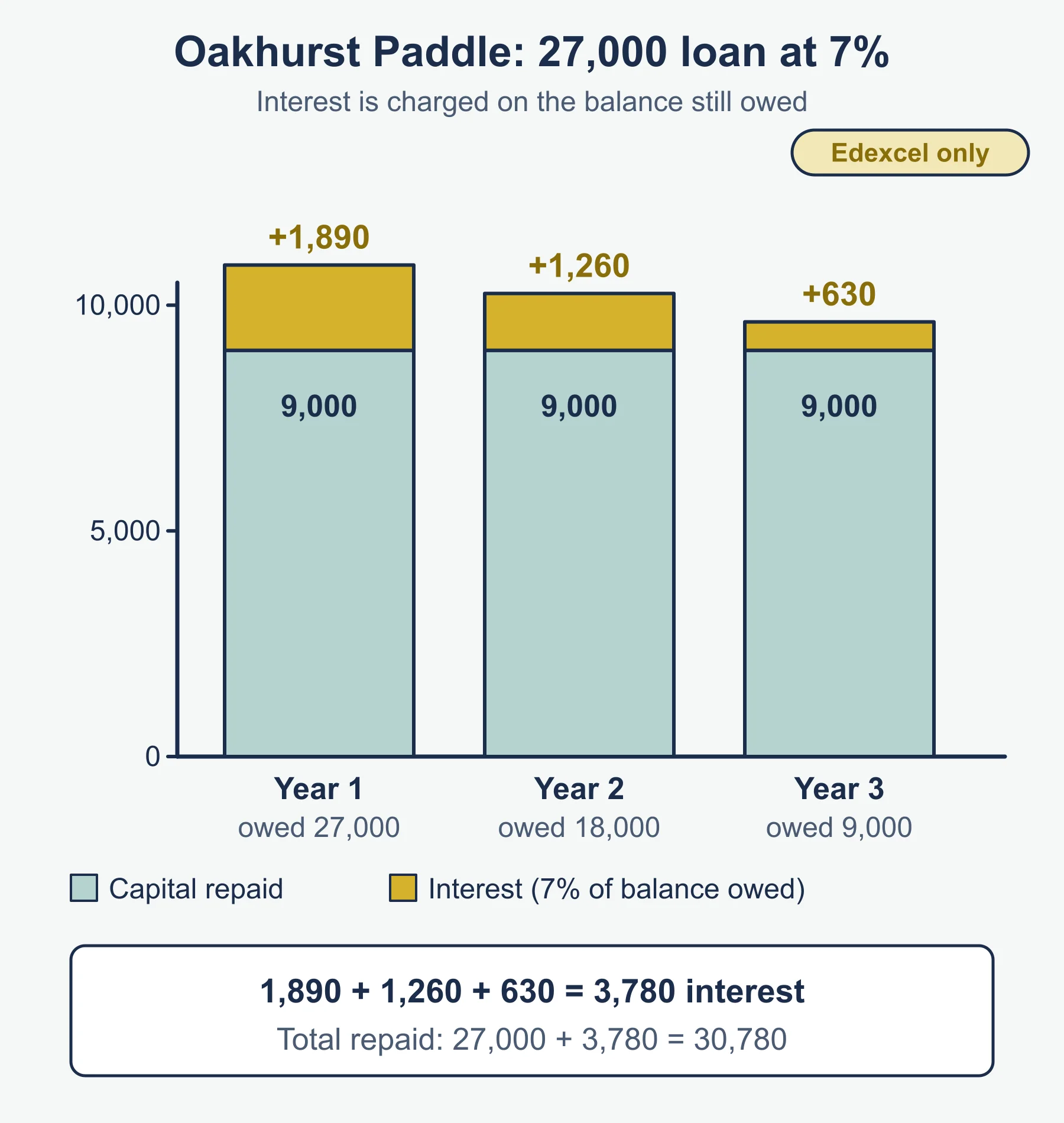
Worked example: a loan. Oakhurst Paddle’s 27,000 bank loan carries 7% interest a year on the outstanding balance. The loan is repaid in three equal capital instalments of 9,000 at the end of each year.
- Year 1 interest: 27,000 × 0.07 = 1,890
- Year 2 interest: 18,000 × 0.07 = 1,260
- Year 3 interest: 9,000 × 0.07 = 630
- Total interest: 3,780, so the business repays 30,780 in all.
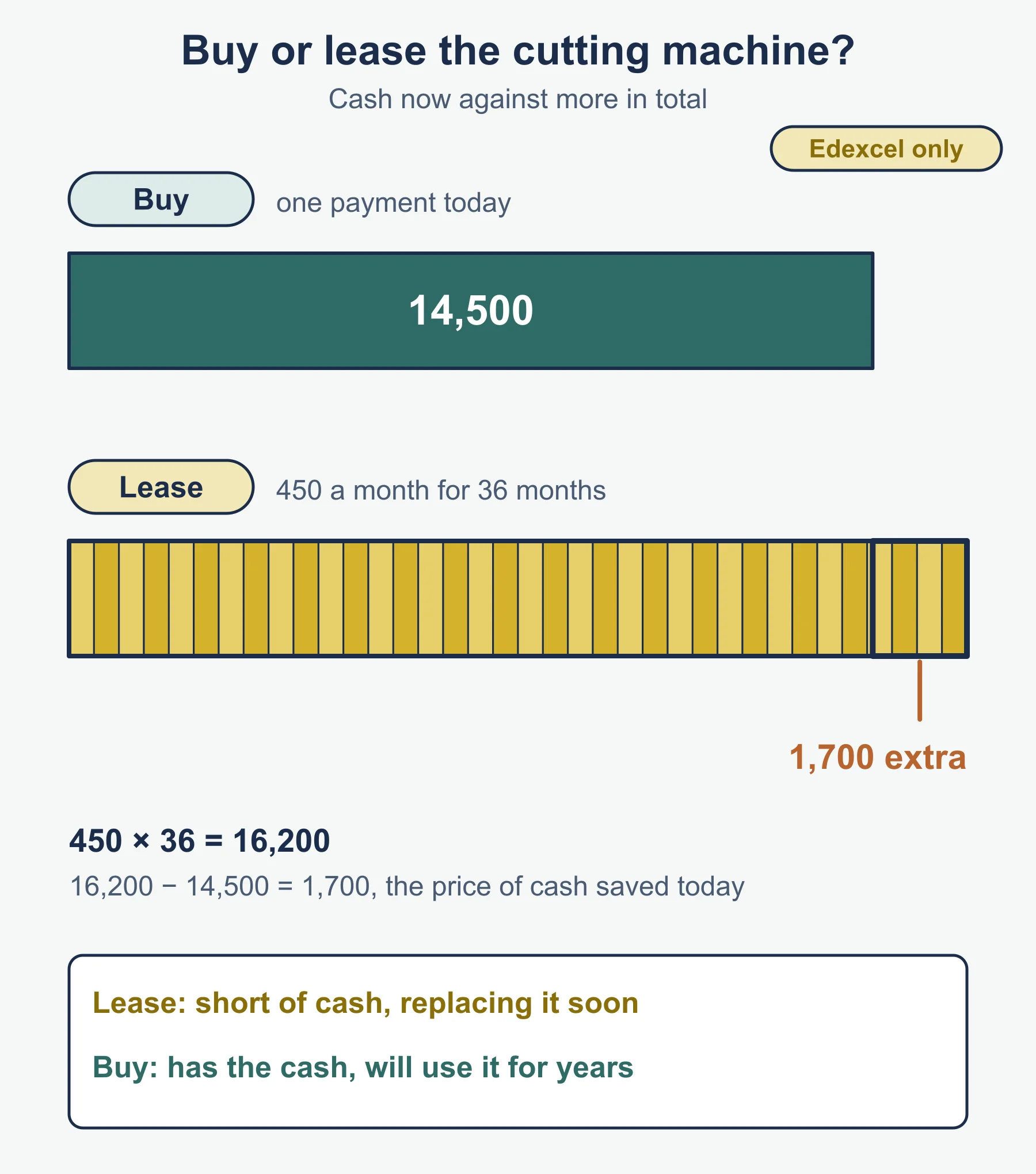
Worked example: leasing against buying. A cutting machine costs 14,500 to buy. The leasing company asks 450 a month for 36 months: 450 × 36 = 16,200, which is 1,700 more. The extra 1,700 buys the cash saved today. Leasing is more suitable for a business short of cash that expects to replace the machine soon; buying suits a business with cash that will use the machine for years.
Worked example: an overdraft. An average overdraft of 4,000 for three months at 14% a year costs 4,000 × 0.14 × 3/12 = 140. This is cheap for a short gap; it would be costly as permanent funding.
Judging suitability
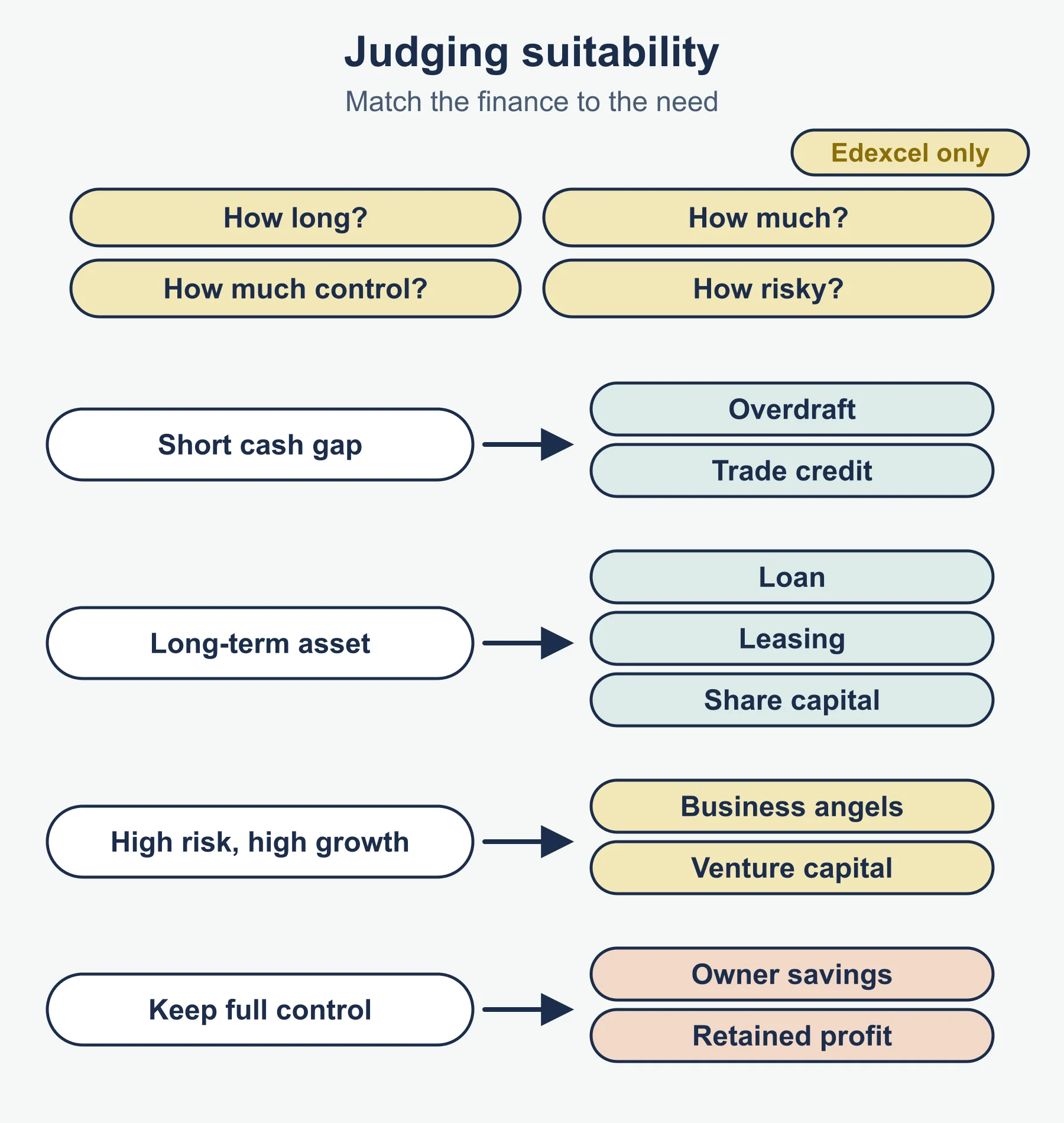
Match the finance to four things: how long the money is needed, how much is needed, how much control the owner will give up, and the risk of the business. Short-term gaps suit an overdraft or trade credit. Long-term assets suit loans, leasing or share capital. High-risk, high-growth businesses are more likely to attract business angels or venture capital than banks.
4 Forms of business
Sole trader, partnership and private limited company (4a)
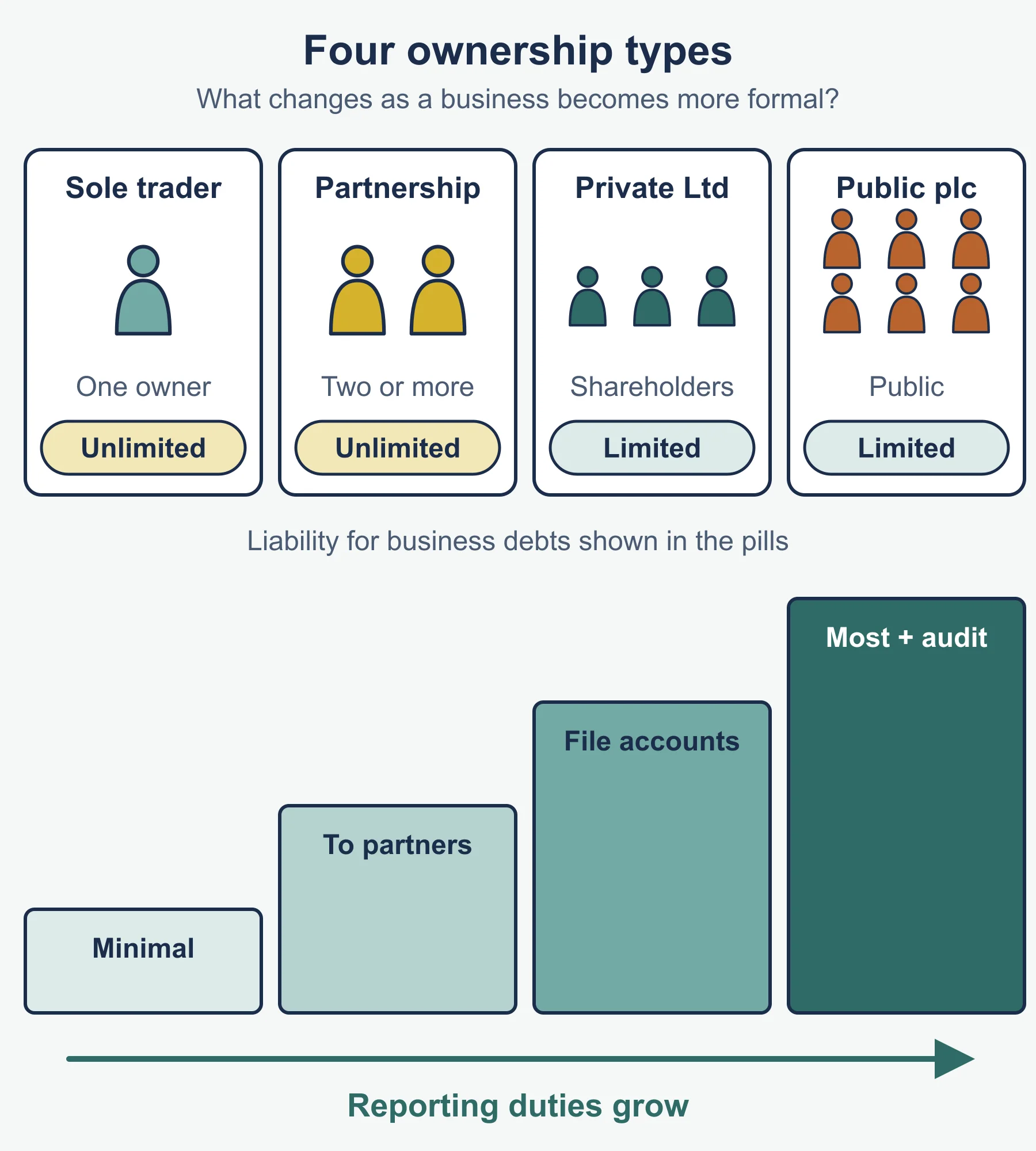
- Sole trader. One owner. Simple to set up, the owner keeps all profit and control, and has few reporting duties. The owner has unlimited liability and finds it hard to raise large sums.
- Partnership. Two or more owners who share the profit, the work and the skills. More capital is available than for a sole trader. Partners generally have unlimited liability, disagreements can arise, and profit is shared.
- Private limited company (Ltd). A separate legal entity owned by shareholders. Shares cannot be offered to the general public. Shareholders have limited liability, and the company can raise capital by issuing shares to chosen investors. More administration and disclosure of information are needed.
Franchising, social enterprise, lifestyle and online businesses (4b)
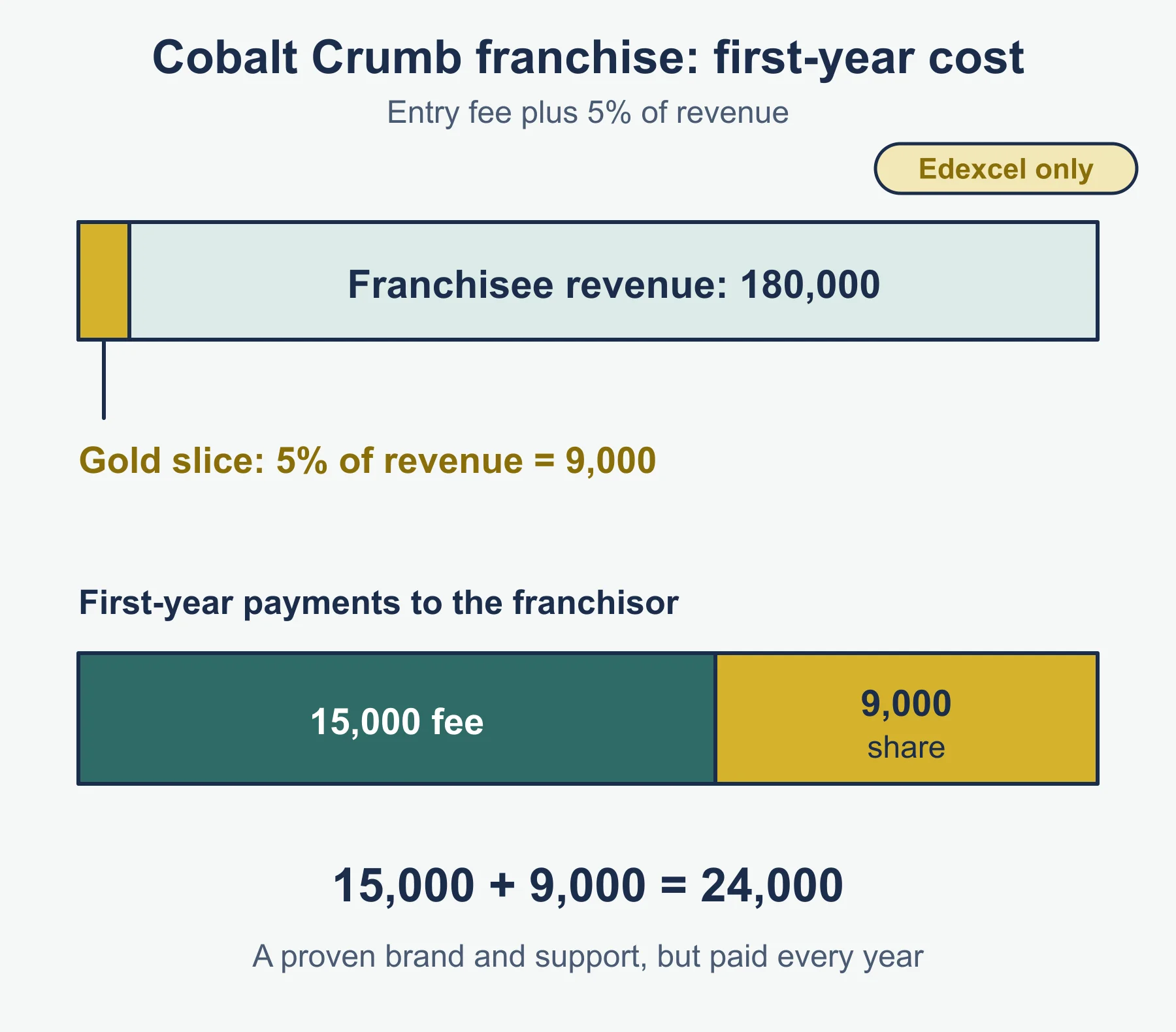
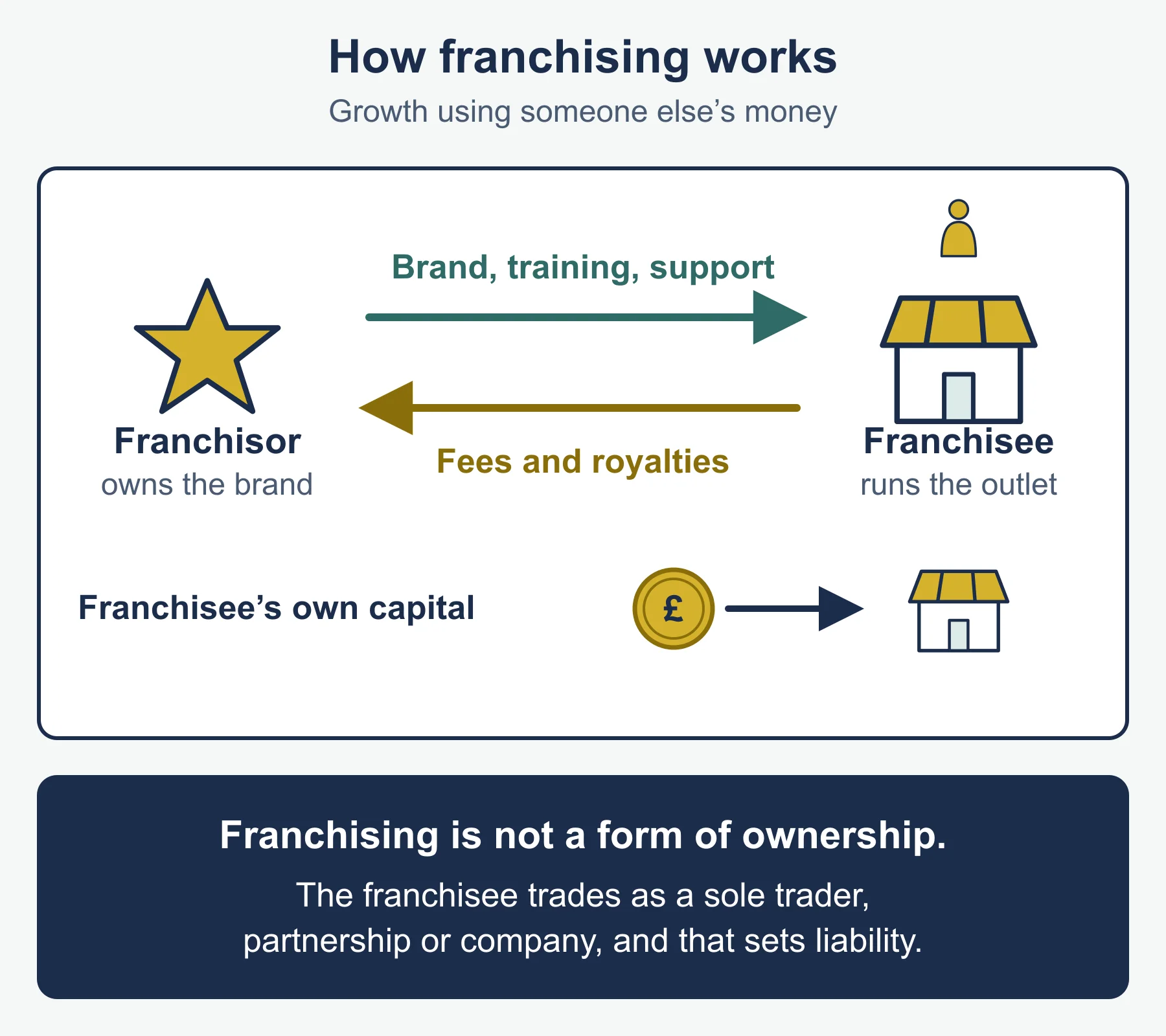
- Franchising. A franchisee pays a fee, often plus a share of revenue, to use a franchisor’s brand and system. Cobalt Crumb, a bakery franchise, charges a 15,000 entry fee and 5% of revenue. On revenue of 180,000 the franchisee pays 9,000 that year, so 24,000 in the first year. The franchisee gets a proven brand and support but pays continuing costs and has less freedom.
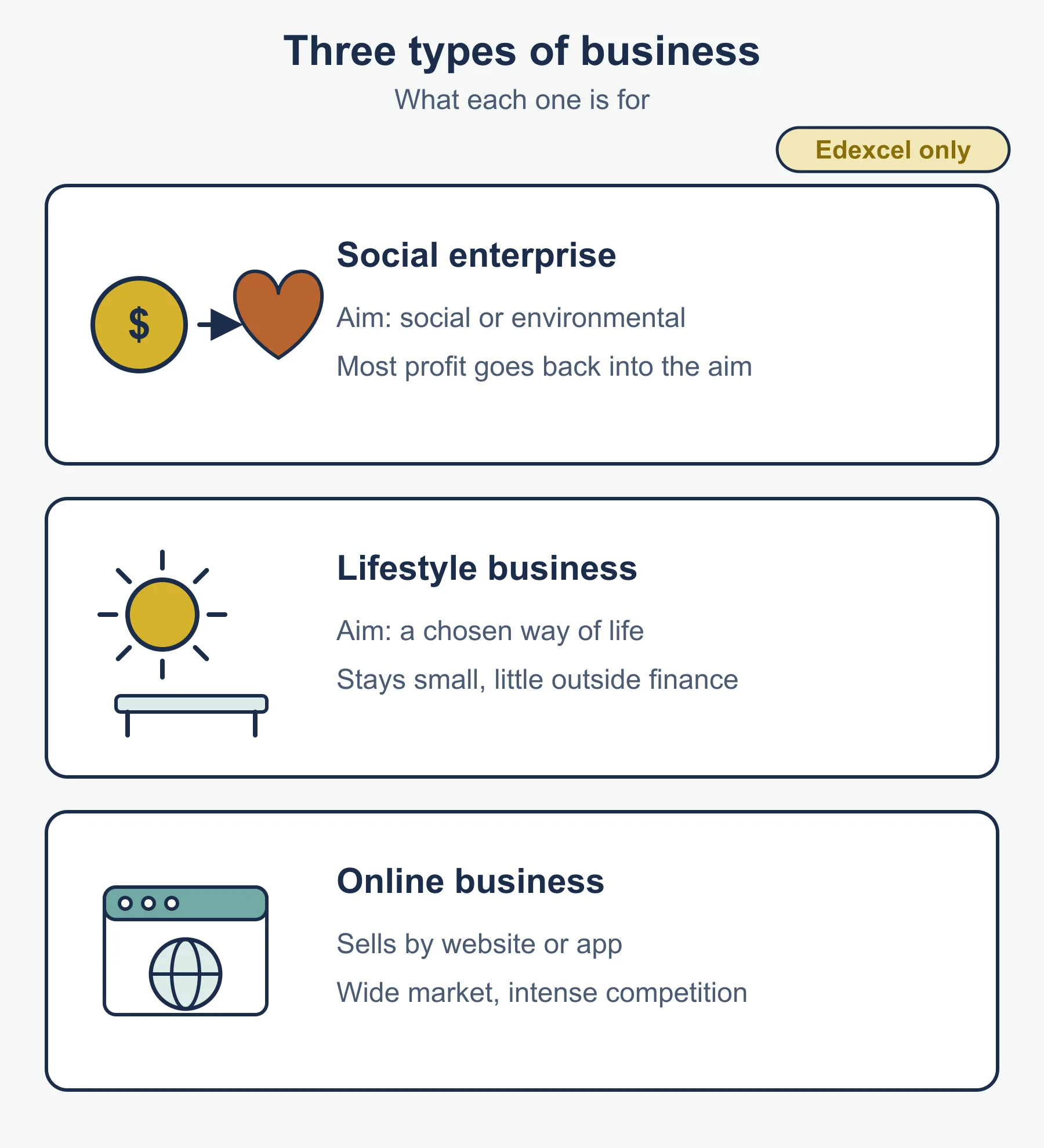
- Social enterprise. A business that trades to meet social or environmental aims and reinvests most of its profit in them rather than maximising owners’ returns. It may find some finance, such as grants, easier to attract, but profit is not the sole aim.
- Lifestyle business. Run to give the owner a chosen way of life and income rather than to grow as large as possible. It usually needs little outside finance and tends to stay small.
- Online business. Sells mainly or only through a website or app. Start-up costs can be low and the market wide, but competition is intense and the business depends on technology and delivery.
Growth to a plc and flotation (4c)
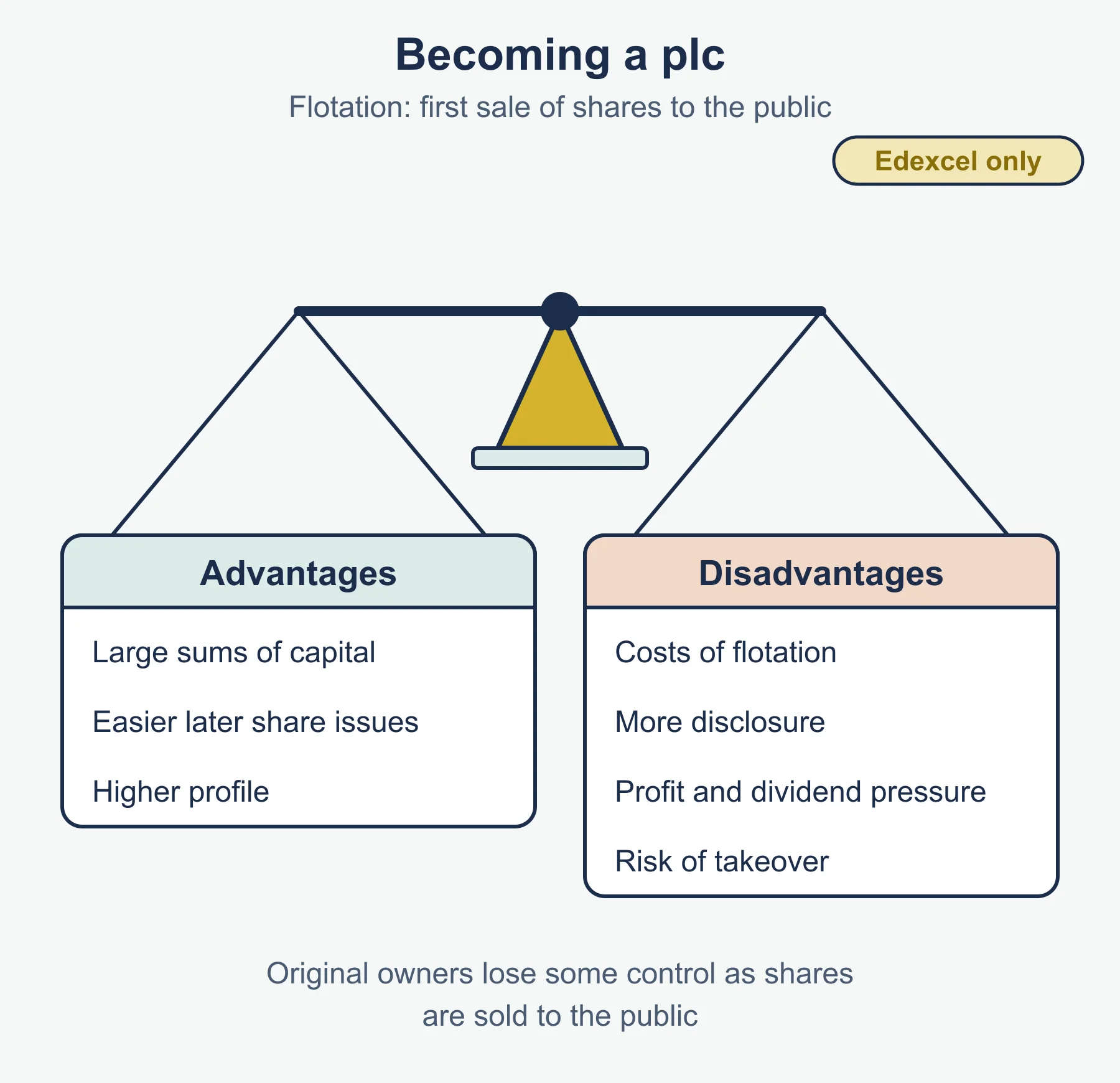
A public limited company (plc) can offer its shares to the public. Stock market flotation is the process of selling shares to the public for the first time and getting them listed. Advantages: large sums of capital, easier future share issues and higher profile. Disadvantages: costs of flotation, more disclosure, the pressure of shareholders expecting profits and dividends, and a risk of takeover as original owners lose control.
5 Liability
Limited and unlimited liability (5a)
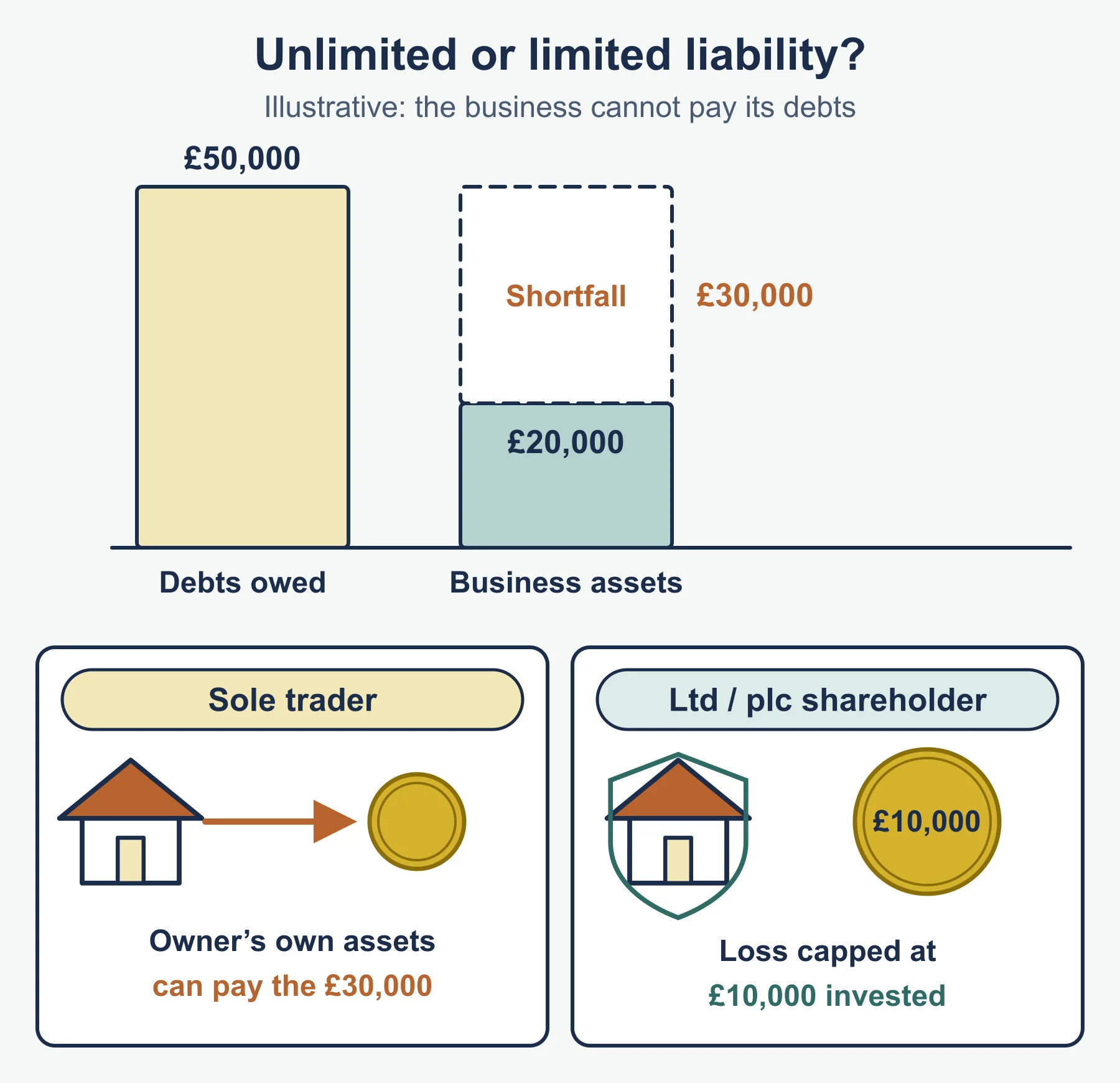
Unlimited liability means the owner is personally responsible for all the business’s debts, so personal assets can be at risk. Limited liability means a shareholder’s loss is limited to the amount invested in shares.
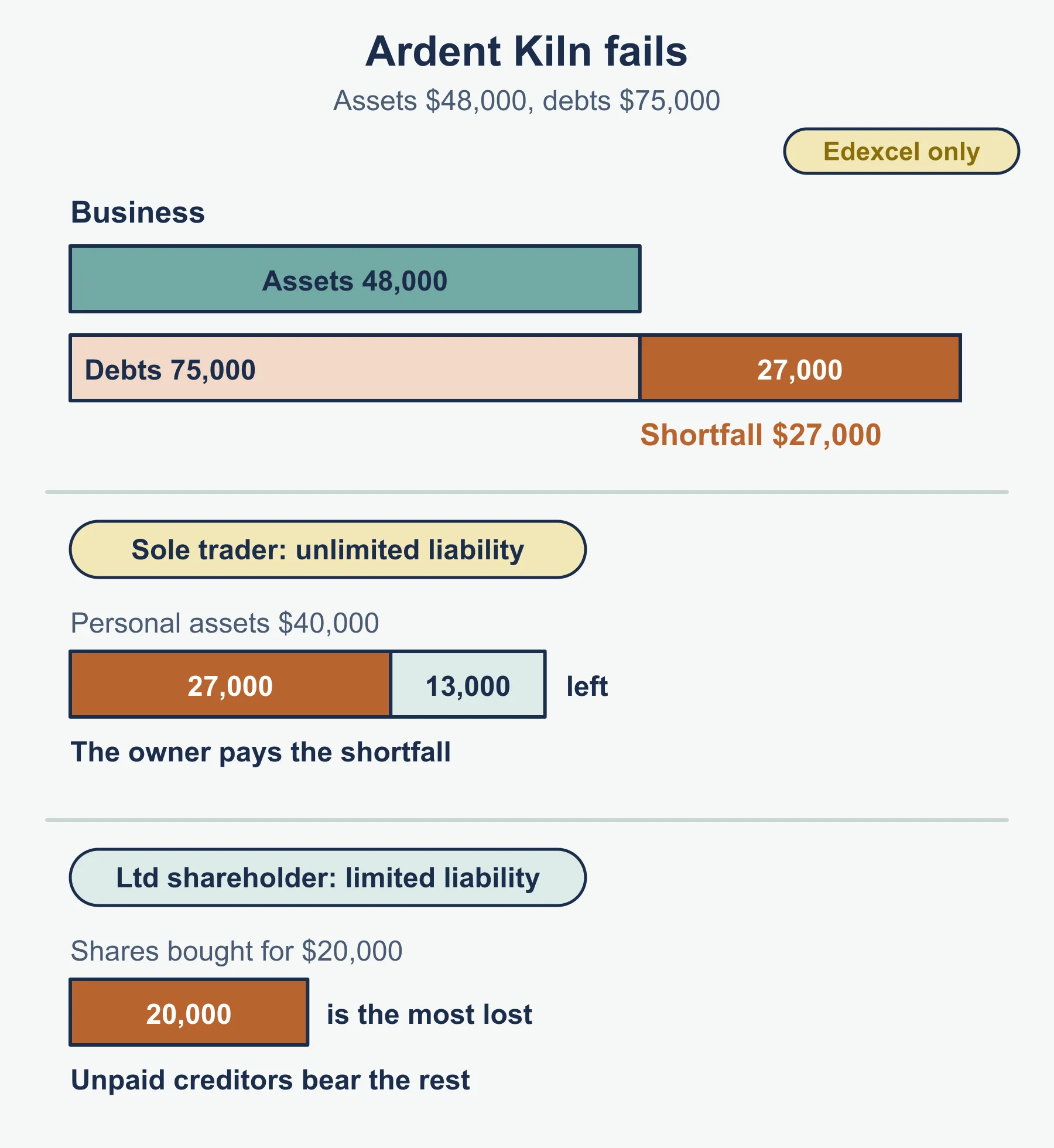
Worked example: Ardent Kiln. A business has assets of 48,000 and debts of 75,000, a shortfall of 27,000.
- If run by a sole trader with personal assets of 40,000, the 27,000 can fall on the owner, who is left with 13,000.
- If run as a Ltd in which a shareholder paid 20,000 for shares, that shareholder’s loss is limited to 20,000, and the unpaid creditors bear the rest.
Advantages of limited liability: it protects personal assets and makes investors readier to put money in. Disadvantages: more paperwork and published information, and lenders may ask for personal guarantees from small company owners. Describe the legal position in general terms only.
Finance appropriate to each (5b)
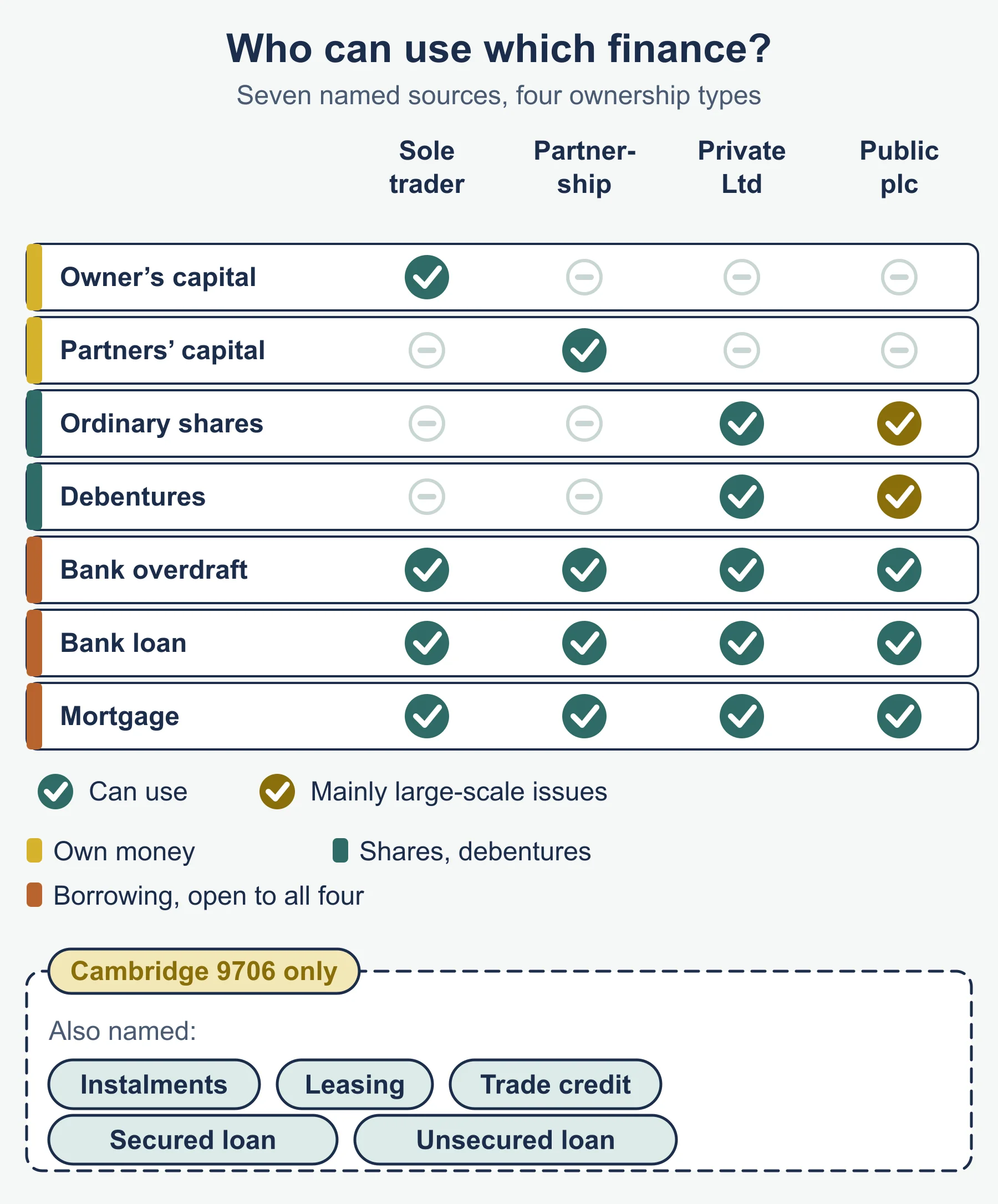
Unlimited-liability businesses rely on personal savings, retained profit, loans and family and friends, and may find outside shareholders unavailable. Limited-liability companies can also issue shares, attract business angels and venture capital, and a plc can float on the stock market.
Common errors
- Listing sources without matching them to the case.
- Saying retained profit is “extra money” rather than profit kept back from owners.
- Treating leasing as owning the asset.
- Calling a sole trader’s liability limited, or saying a Ltd can sell shares to the public.
- Saying a grant must be repaid.
Frequently asked questions
What does a business plan contain? A business plan typically covers the business idea and aims, market research, a marketing plan, operations, the owners and managers, and financial information such as start-up costs, sales and cash-flow forecasts, break-even and the finance needed.
What is the difference between leasing and buying an asset? Leasing lets a business use an asset in return for regular payments without owning it, avoiding a large outlay. Total payments are often higher than buying, and the business does not own the asset.
What is a social enterprise? A social enterprise trades to meet social or environmental aims and reinvests most of its profit in them rather than maximising returns for its owners.
Can a private limited company sell shares to the public? No. A private limited company’s shares cannot be offered to the general public; only a public limited company (plc) can do this, for example through a stock market flotation.
Official syllabus
Pearson Edexcel International Advanced Subsidiary/Advanced Level in Business specification, Issue 1, September 2017, Pearson Education Limited: Unit 2, section 2.3.1.
Get free revision emails (optional)
Occasional emails with practice questions, worked explanations and links to free resources for the qualification and subjects you choose. No spam, and you can unsubscribe from any email. The free tools on this site never need an email.
Related resources
-
Practice questions
Edexcel International A Level Business: Planning a business and raising finance (YBS11) – Practice Questions
Twelve original questions with worked answers on business plans, finance, forms of business and liability for Edexcel International A Level Business.
Business · Pearson Edexcel · AS Level
Try questions -
Revision notes
Edexcel International A Level Business: Planning a business and raising finance (YBS11) – Revision Notes
Recall notes on business plans, finance sources and methods, forms of business and liability for Edexcel International A Level Business, section 2.3.1.
Business · Pearson Edexcel · AS Level
Revise topic -
Study guides
Edexcel International A Level Business: Financial planning and Managing finance (YBS11)
Full study guide to Financial planning (2.3.2) and Managing finance (2.3.3) in Edexcel International A Level Business Unit 2, with worked examples.
Business · Pearson Edexcel · AS Level
Read guide
Related articles
-
teaching
A Level tuition in Dubai: Cambridge or Pearson Edexcel International A Level?
Schools in Dubai and Abu Dhabi teach either Cambridge International AS & A Level or Pearson Edexcel International A Level. How the two are structured, why it matters for tuition, and how online classes from Lahore work.
9 October 2026
-
curriculum guides
Choosing subjects at IGCSE and A Level
How subject choices at 14 and 16 affect university options later, and how to keep pathways open without overloading a timetable.
28 July 2026
Studying this with a teacher
Working through Business AS LEVEL?
This page is free and stays free. If you would rather be taught it, Marlbridge runs Business classes one-to-one and in small groups of up to 15, online in your own time zone. The first trial class is free. WhatsApp replies within an hour (8am–11pm Pakistan time, every day); email the same day.
Pearson Edexcel Business teachers at Marlbridge

