
Revision Notes
Pearson Edexcel IGCSE English Language (4EA1): Assignment B Imaginative Writing – Revision Notes
Checklist notes for 4EA1 Component 3 Assignment B coursework: task rules, purposes, AO4 and AO5 level wording, a drafting routine, traps and a self-test.
- Subject
- English
- Level
- IGCSE
- Topic
- Component 3 – Poetry and Prose Texts and Imaginative Writing (Non-Examined Assessment)
- Author
- Marlbridge Academic Team
- Updated
- Reviewed by
- Ammar Bilal (what this means)
Aligned to Pearson Edexcel IGCSE English (4EA1), For first teaching 2016 (Issue 7, August 2025). Official specification .
Syllabus page (what it covers and how it is assessed): Pearson Edexcel IGCSE English Language.
Found an error? Report a correction.
Need help with this topic? Request a free trial class for IGCSE English Language (4EA1).
Condensed notes for the coursework writing piece in Pearson Edexcel International GCSE English Language A (4EA1). For the full method and a worked redraft, use the Assignment B Imaginative Writing study guide.
Requirements checklist
| Requirement | Detail |
|---|---|
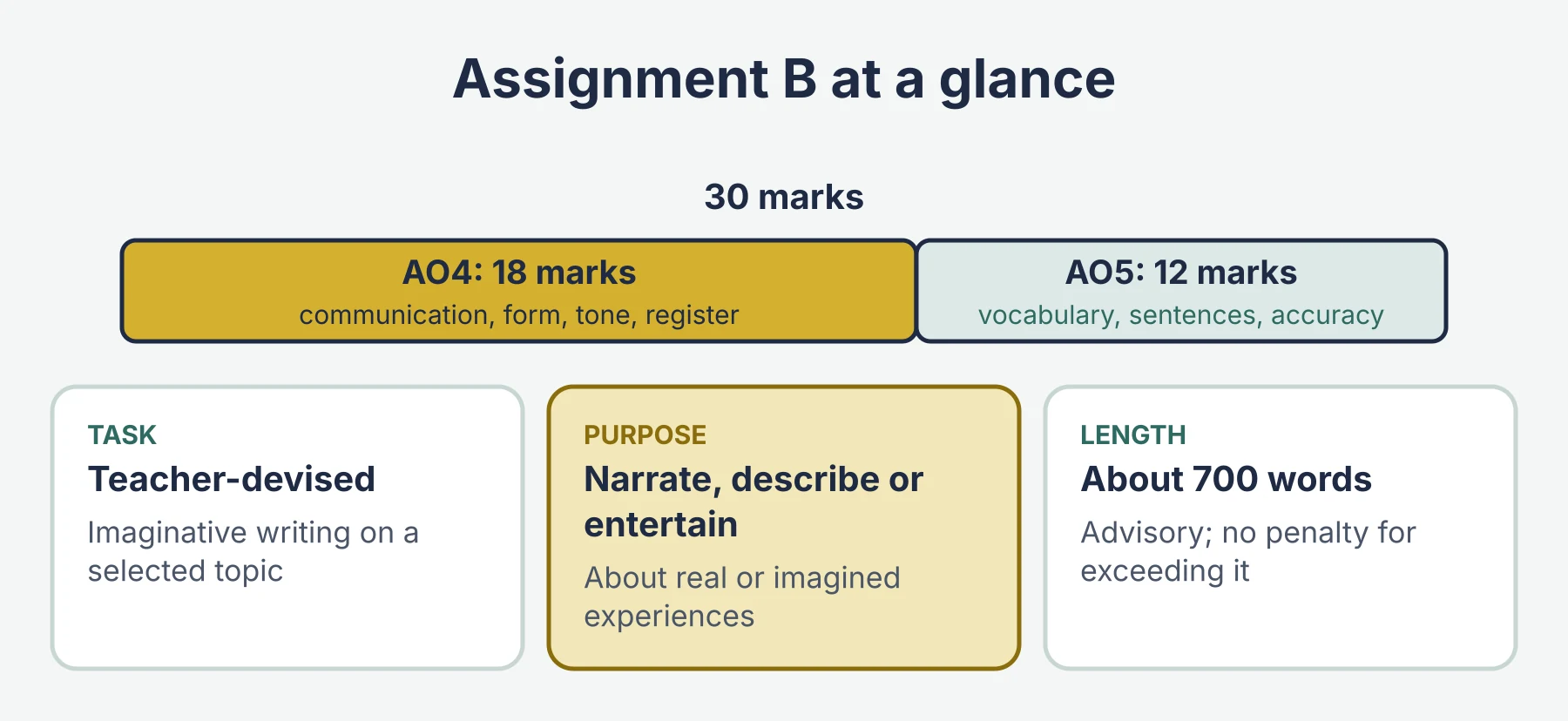
| Task | A piece of imaginative writing on a selected topic, devised by the teacher |
| Purpose | Narrate, describe or entertain |
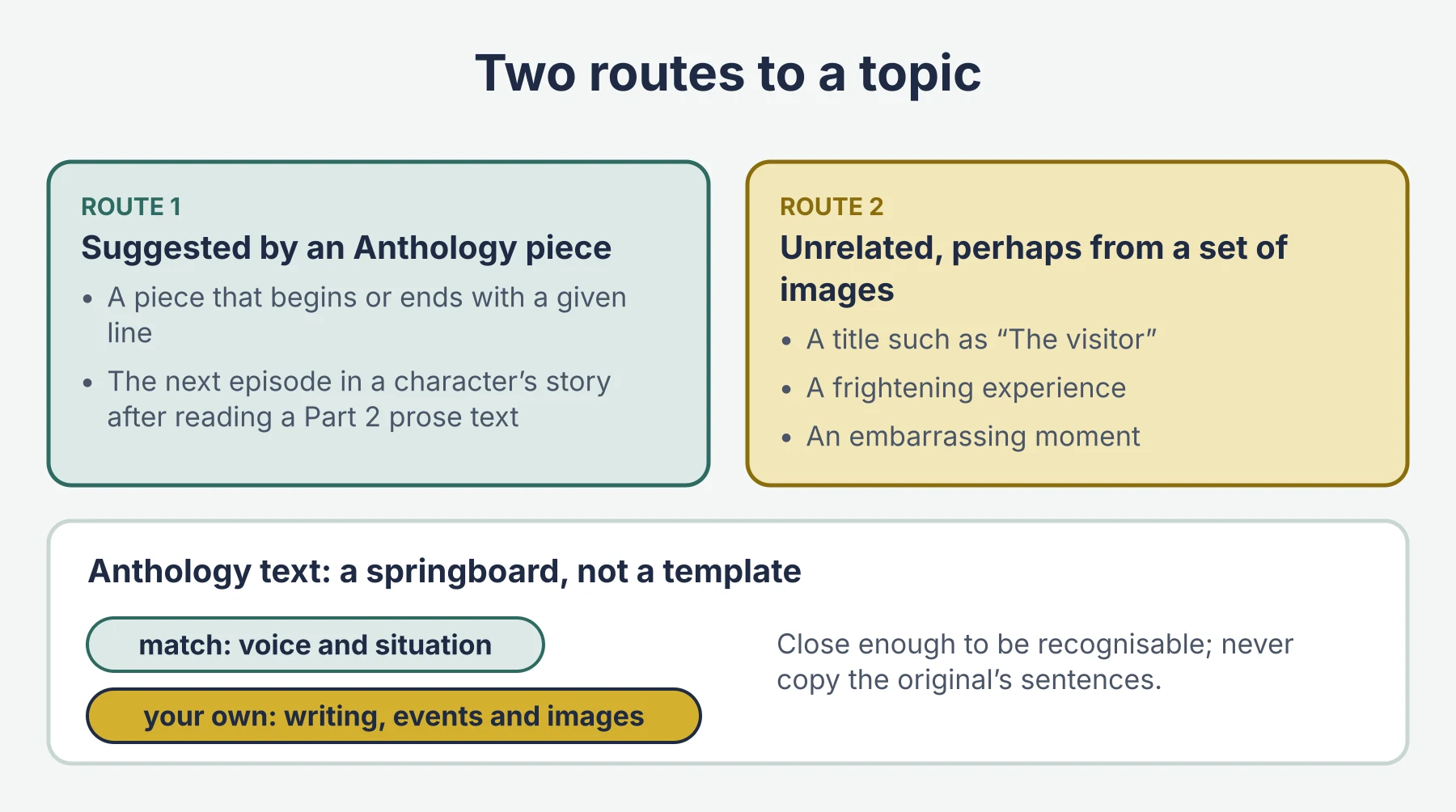
| Topic source | Suggested by an Anthology piece, or unrelated (perhaps from images) |
| Content | Real or imagined experiences |
| Length | About 700 words (advisory; no penalty for exceeding it) |
| Marks | 30: AO4 18, AO5 12 |
| Feedback | General suggestions at draft stage; you make all corrections |
| After marking | No rewriting |
Task types to expect
| Type | Example shape |
|---|---|
| Given opening line | Begin with a line taken from an Anthology text |
| Given closing line | End with specified words |
| Continuation | The next episode in a character’s story |
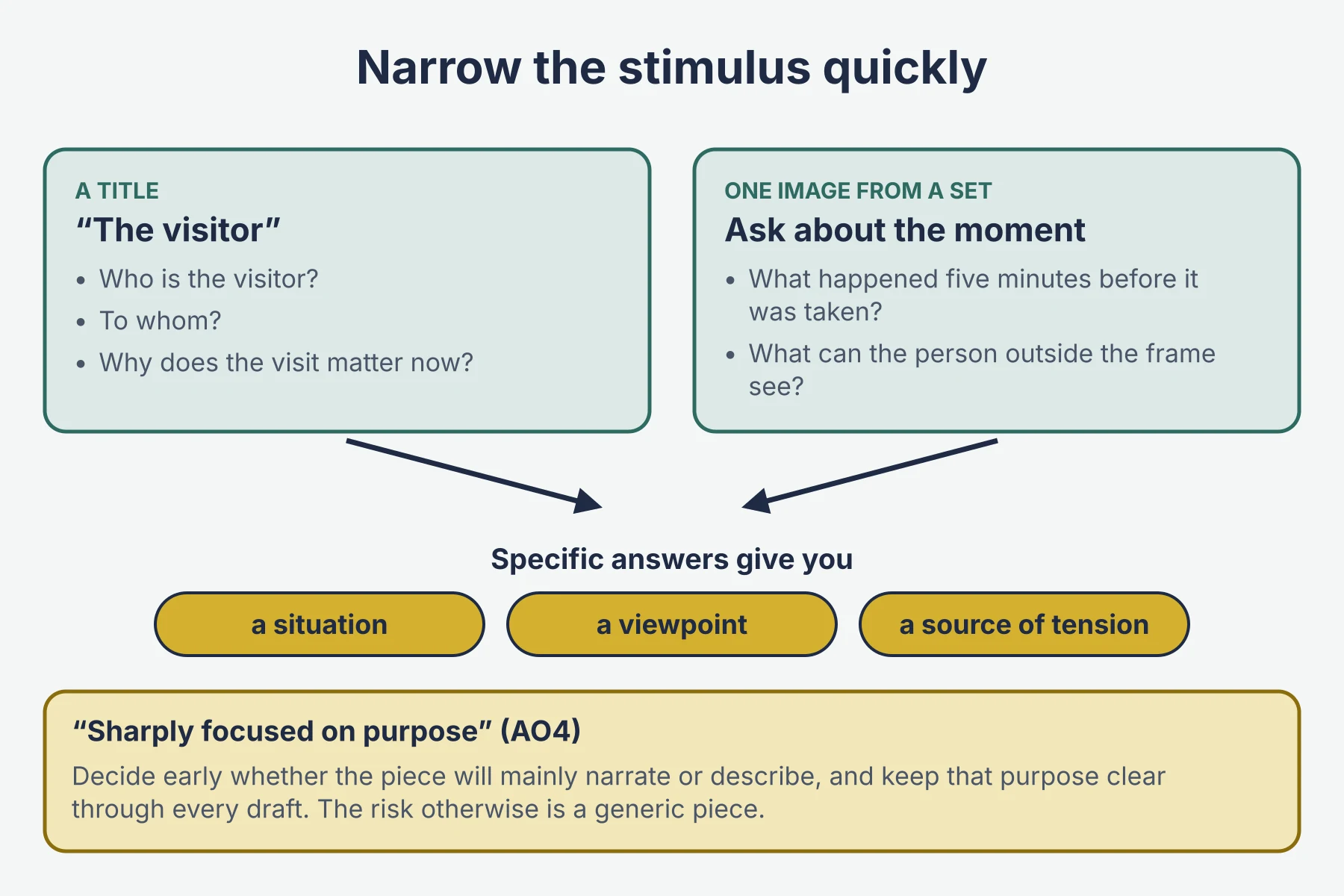
| Title | A short title such as “The visitor” |
| Experience | A frightening or embarrassing moment, real or imagined |
| Image-based | A response to one of a set of pictures |
Level wording to aim for
| AO | Level | Key phrases from the grid |
|---|---|---|
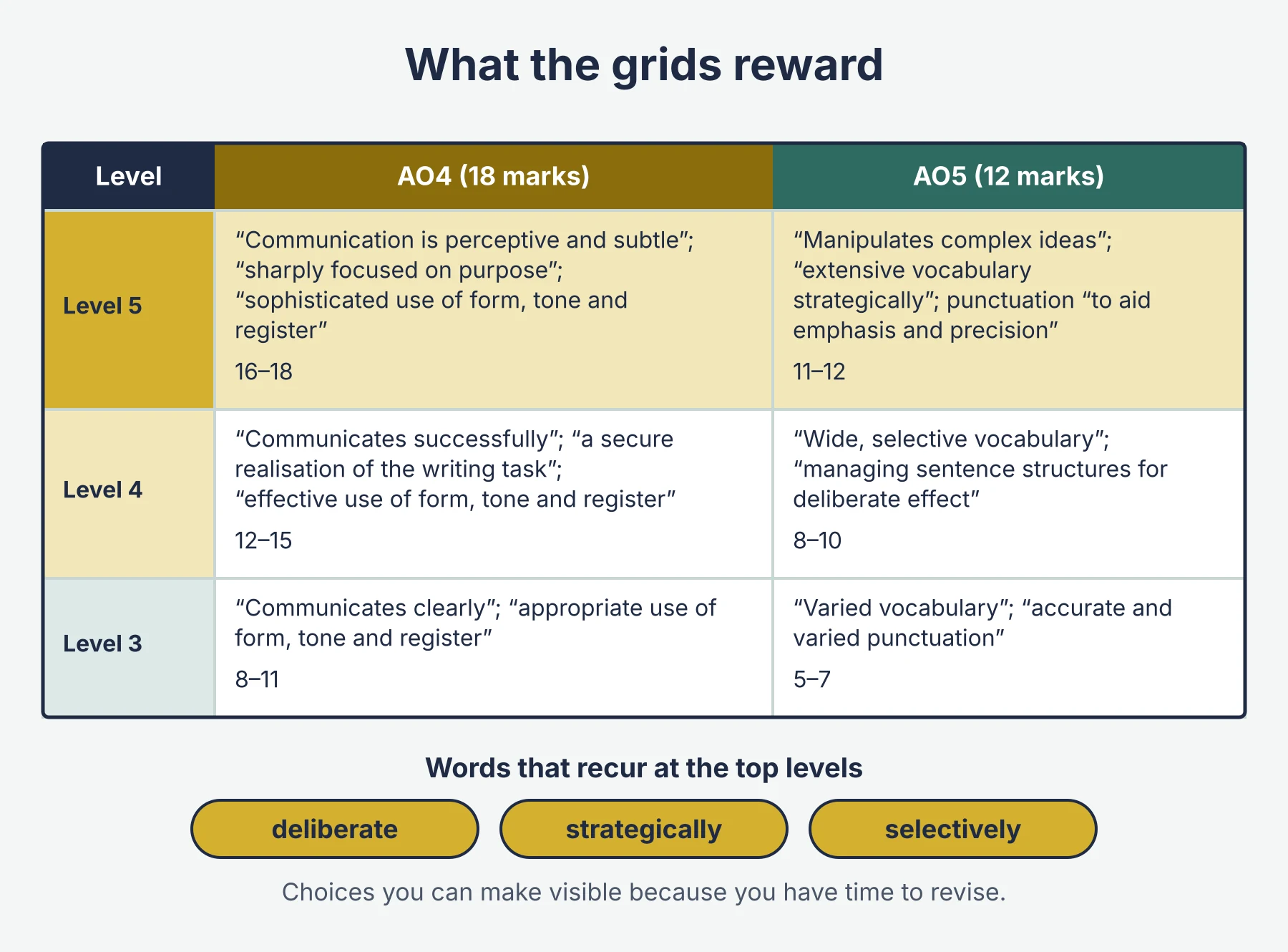
| AO4 | 4 (12–15) | “Communicates successfully”; “secure realisation of the writing task”; “effective use of form, tone and register” |
| AO4 | 5 (16–18) | “Perceptive and subtle”; “sharply focused on purpose”; “sophisticated use of form, tone and register” |
| AO5 | 4 (8–10) | “Wide, selective vocabulary”; sentence structures managed “for deliberate effect” |
| AO5 | 5 (11–12) | “Manipulates complex ideas”; “extensive vocabulary strategically”; punctuation “to aid emphasis and precision” |
Shaping 700 words
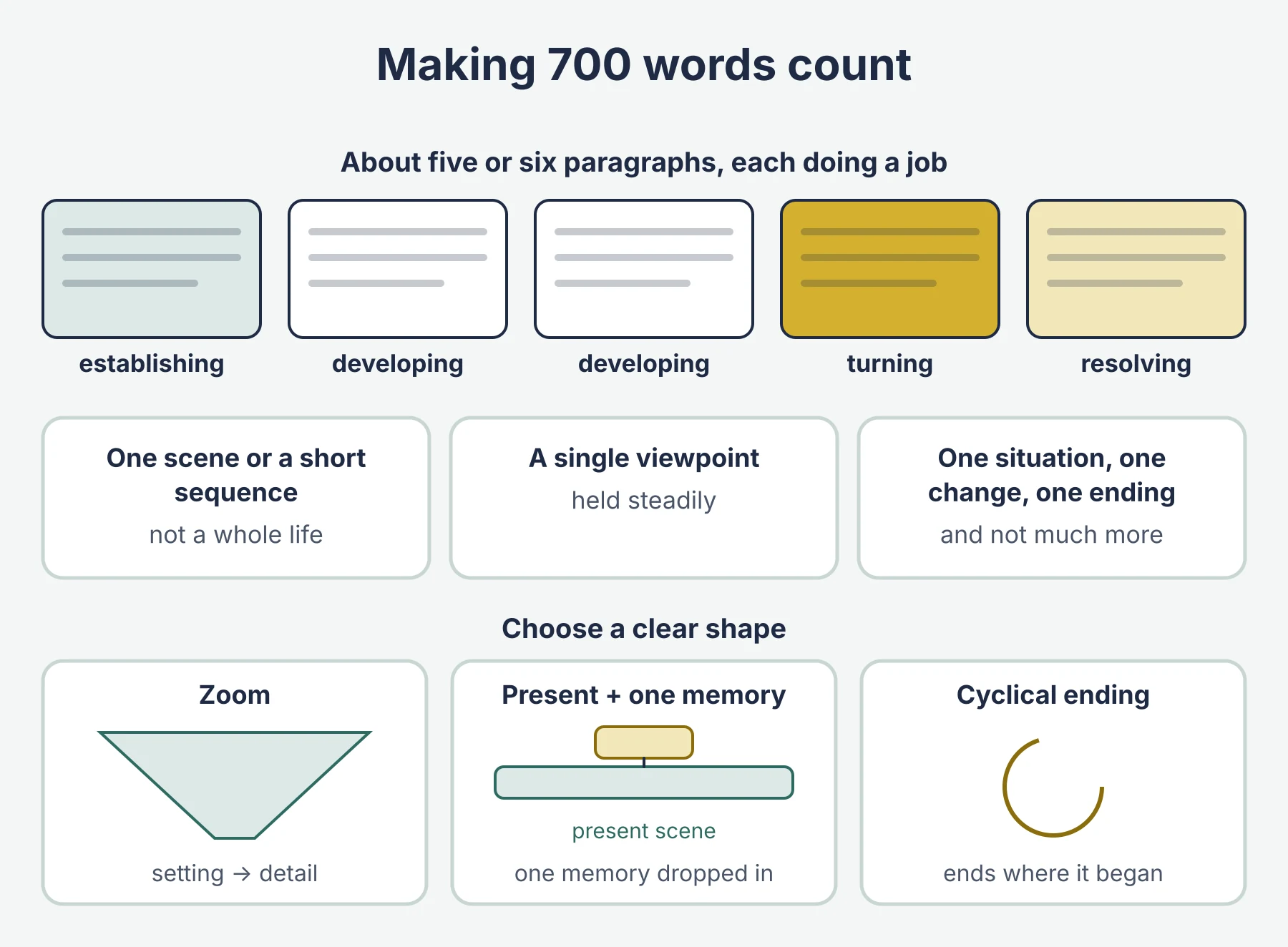
- One situation, one change, one deliberate ending.
- Five or six paragraphs, each with a job.
- One viewpoint and one tense, unless a shift is deliberate.
- A shape: zoom, time shift, cyclical, delayed revelation.
Six-pass drafting routine
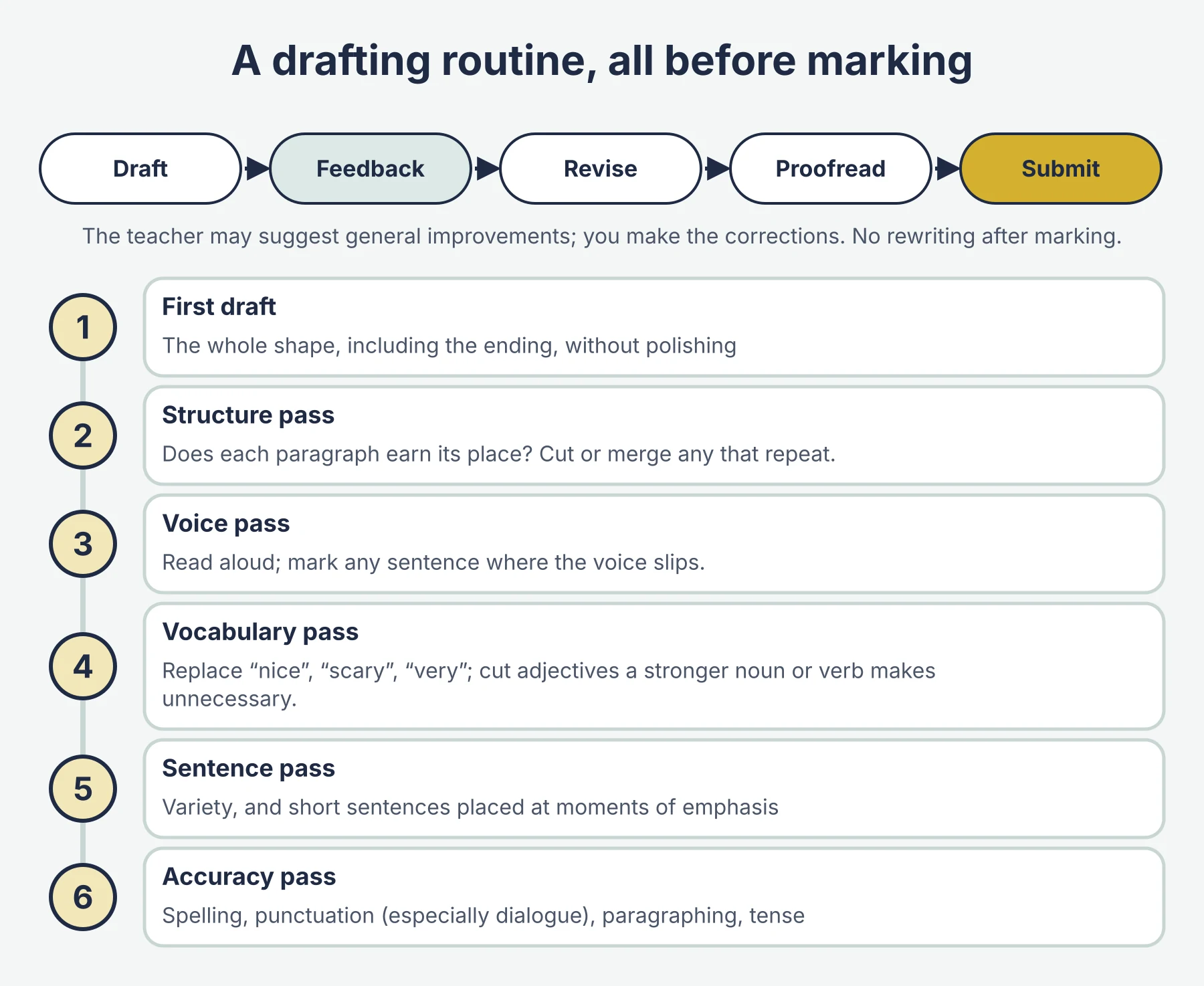
- Whole draft with ending.
- Structure: cut or merge repetitive paragraphs.
- Voice: read aloud; fix slips.
- Vocabulary: precise nouns and verbs; remove filler adjectives and “very”.
- Sentences: vary length; place short sentences at key moments.
- Accuracy: dialogue punctuation, spelling, paragraphing, tense.
Continuations: rules of thumb
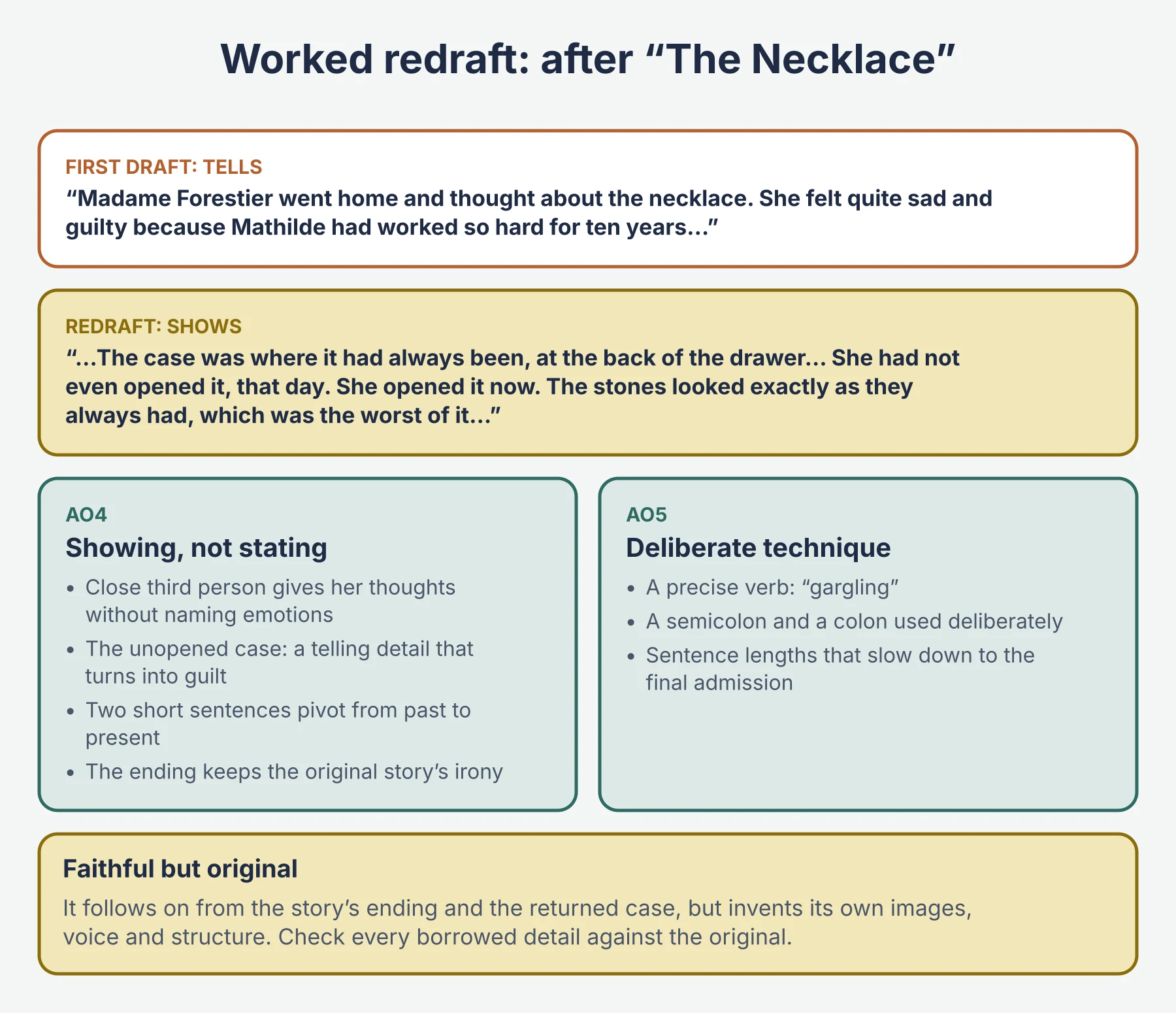
- Match the original’s situation and voice, not its sentences.
- Check every borrowed detail against the text.
- Add something new: a viewpoint, a later moment, a hidden thought.
- Keep the purpose imaginative: no commentary on the original.
One sentence through three drafts
Draft 1: “The kitchen was very messy and it smelled bad and I was upset.”
Draft 2: “The kitchen was a mess of unwashed pans, and the smell of burnt milk made me feel sick.”
Draft 3: “Burnt milk had welded itself to the pan; I stood in the doorway and could not make myself go in.”
Draft 2 replaces vague words with specific detail. Draft 3 chooses one precise image (“welded”), uses a semicolon to link cause and reaction, and shows the narrator’s feeling through an action instead of naming it. That progression, from general to specific to strategic, is exactly what the AO4 and AO5 grids describe between the middle and top levels.
Key terms
| Term | Meaning |
|---|---|
| Non-examined assessment | Coursework set and marked in the centre, moderated by Pearson |
| Teacher-devised | Task set by your teacher to allow access to AO4 and AO5 |
| Close third person | Third-person narration tied to one character’s thoughts |
| Telling detail | A specific detail that implies more than it states |
| Continuation | New writing that follows on from an existing text |
| Authentication | Signed confirmation that the work is your own |
| Moderation | Pearson’s check of a sample of the centre’s marking |
Exam-room habits that still matter
Even without an exam, the qualities AO5 rewards are the same: accurate sentence boundaries, varied punctuation used correctly, and paragraphing that marks shifts in time, place or speaker. Because you have time, errors that would be understandable under exam pressure are harder to excuse.
Traps
- Writing an argument or article: the purpose must be to narrate, describe or entertain.
- Copying sentences from an Anthology text.
- Over-plotting; too many characters.
- Treating length as quality.
- Running out of drafting time and submitting a first draft.
- Expecting your teacher to correct errors for you.
- Using AI or online text: work must be your own.
Self-test
- What are the three permitted purposes for Assignment B?
- Who devises the Assignment B task?
- What is the advisory word count?
- How are the 30 marks split?
- Give two ways the topic may be suggested.
- Can you write about a real experience?
- What wording describes AO4 at Level 5?
- What may your teacher do with a draft?
- Can you rewrite after marking?
- Give two rules of thumb for a continuation.
- Name the six drafting passes.
- Why are AO5 errors harder to excuse in coursework?
Answers: 1. Narrate, describe or entertain. 2. The teacher. 3. About 700 words. 4. AO4 18, AO5 12. 5. By an Anthology piece (an opening or closing line, a continuation) or by an unrelated title or set of images. 6. Yes; real or imagined experiences are allowed. 7. “Perceptive and subtle”; “sharply focused on purpose”; “sophisticated use of form, tone and register”. 8. Suggest general improvements; you make the corrections. 9. No. 10. Any two: match situation and voice; check borrowed details; add something new; keep the purpose imaginative. 11. Whole draft, structure, voice, vocabulary, sentences, accuracy. 12. You have time to draft and proofread, so the finished work should be controlled and accurate.
Related pages
Related resources
-
Revision notes
Edexcel IGCSE English Language: Non-fiction Texts and Transactional Writing — Revision Notes
Condensed recall notes on reading non-fiction, language analysis, comparison and transactional writing for Edexcel International GCSE English Language 4EA1.
English · Pearson Edexcel · IGCSE
Revise topic -
Practice questions
Pearson Edexcel IGCSE English Language: Component 3 Non-Examined Assessment — Practice Questions (4EA1)
Original Component 3 coursework tasks for Edexcel IGCSE English Language A (4EA1): three-text Anthology essays and imaginative writing, with AO mark guidance.
English · Pearson Edexcel · IGCSE
Try questions -
Revision notes
Pearson Edexcel IGCSE English Language: Component 3 Non-Examined Assessment — Revision Notes
Condensed notes on Edexcel IGCSE English Language A (4EA1) Component 3: Assignment A's three-text essay, Assignment B's imaginative writing, AOs and levels.
English · Pearson Edexcel · IGCSE
Revise topic
Get free revision emails (optional)
Occasional emails with practice questions, worked explanations and links to free resources for the qualification and subjects you choose. No spam, and you can unsubscribe from any email. The free tools on this site never need an email.