
Study Guides
Pearson Edexcel IGCSE English Language (4EA1): Assignment B Imaginative Writing
Crafting the 700-word 4EA1 Component 3 Assignment B coursework piece: task types, AO4 and AO5 levels, drafting within the rules and a worked redraft.
- Subject
- English
- Level
- IGCSE
- Topic
- Component 3 – Poetry and Prose Texts and Imaginative Writing (Non-Examined Assessment)
- Author
- Marlbridge Academic Team
- Updated
- Reviewed by
- Ammar Bilal (what this means)
Aligned to Pearson Edexcel IGCSE English (4EA1), For first teaching 2016 (Issue 7, August 2025). Official specification .
Syllabus page (what it covers and how it is assessed): Pearson Edexcel IGCSE English Language.
Found an error? Report a correction.
Need help with this topic? Request a free trial class for IGCSE English Language (4EA1).
Assignment B is the writing half of the coursework route in Pearson Edexcel International GCSE English Language A (4EA1). Unlike the exam alternative, you have time to plan, draft and refine, so the standard of control expected in the finished piece is high. This guide covers the kinds of task your teacher may set, what the assessment grids reward, and how to use the drafting process well within the rules. The Component 3 overview explains how the component fits the qualification.
What the specification requires
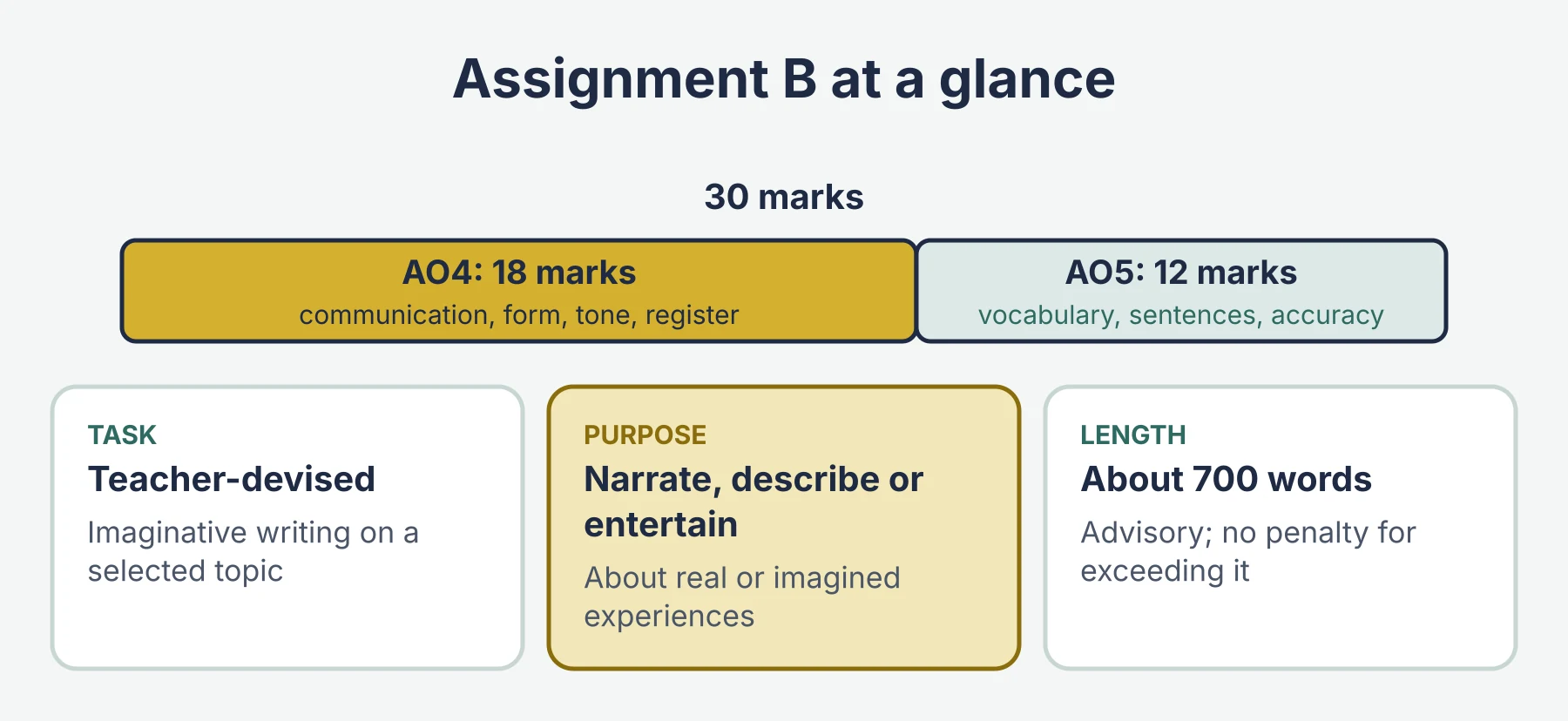
- A piece of imaginative writing based on a selected topic.
- A teacher-devised assignment that allows access to AO4 (18 marks) and AO5 (12 marks): 30 marks in total.
- The purpose should be to narrate, describe or entertain.
- An advisory length of about 700 words; there is no penalty for exceeding it.
- You may write about real or imagined experiences.
Kinds of task
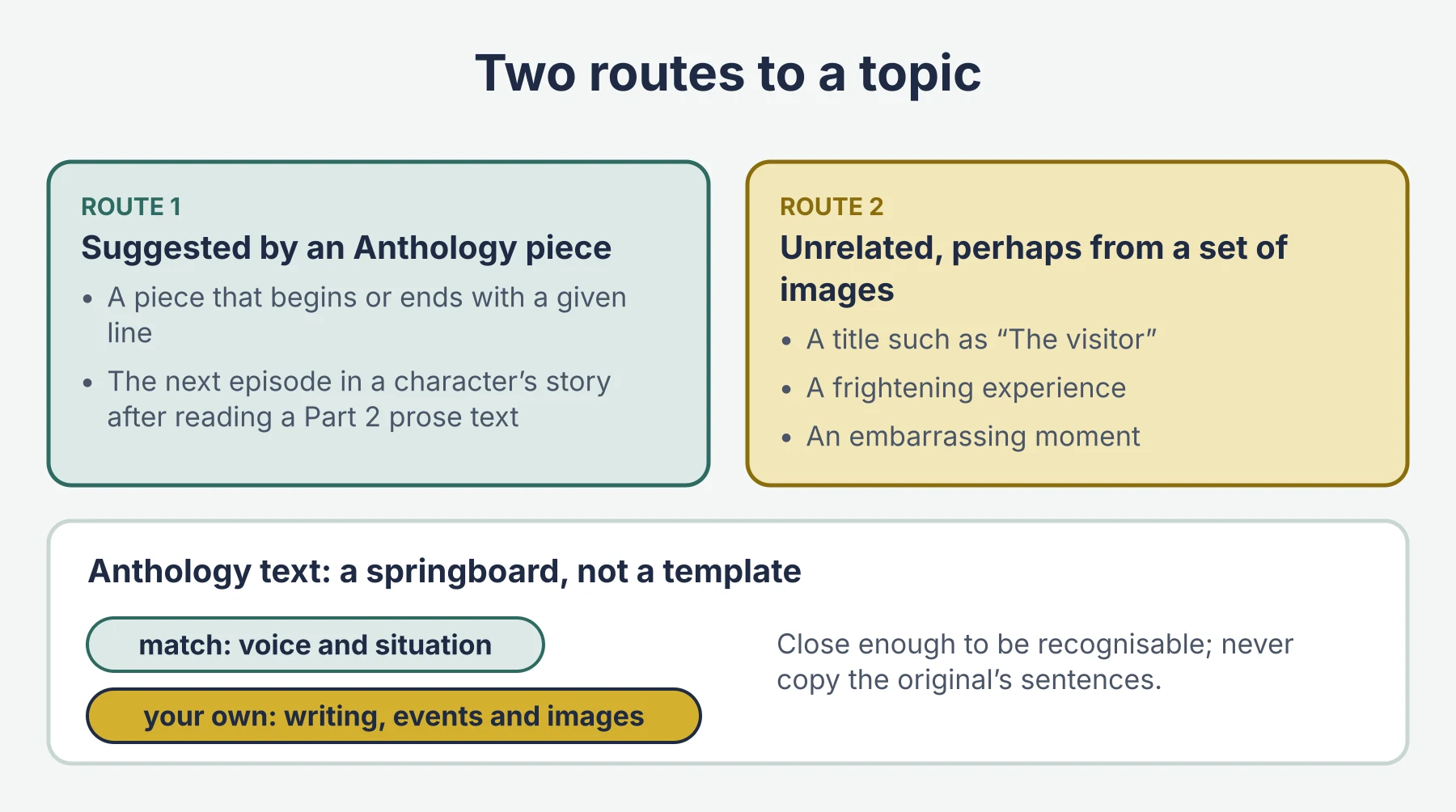
The specification gives two routes for setting the topic:
| Route | Examples of the type the specification gives |
|---|---|
| Suggested by an Anthology piece | A piece that begins or ends with a given line; the next episode in a character’s story after reading a Part 2 prose text |
| Unrelated, perhaps from a set of images | A title such as “The visitor”; a frightening experience; an embarrassing moment |
If your task is linked to an Anthology text, use it as a springboard, not a template. A continuation should match the original’s voice and situation closely enough to be recognisable, but the writing, events and images must be your own.
What the grids reward
| Level | AO4 (18) key wording | AO5 (12) key wording |
|---|---|---|
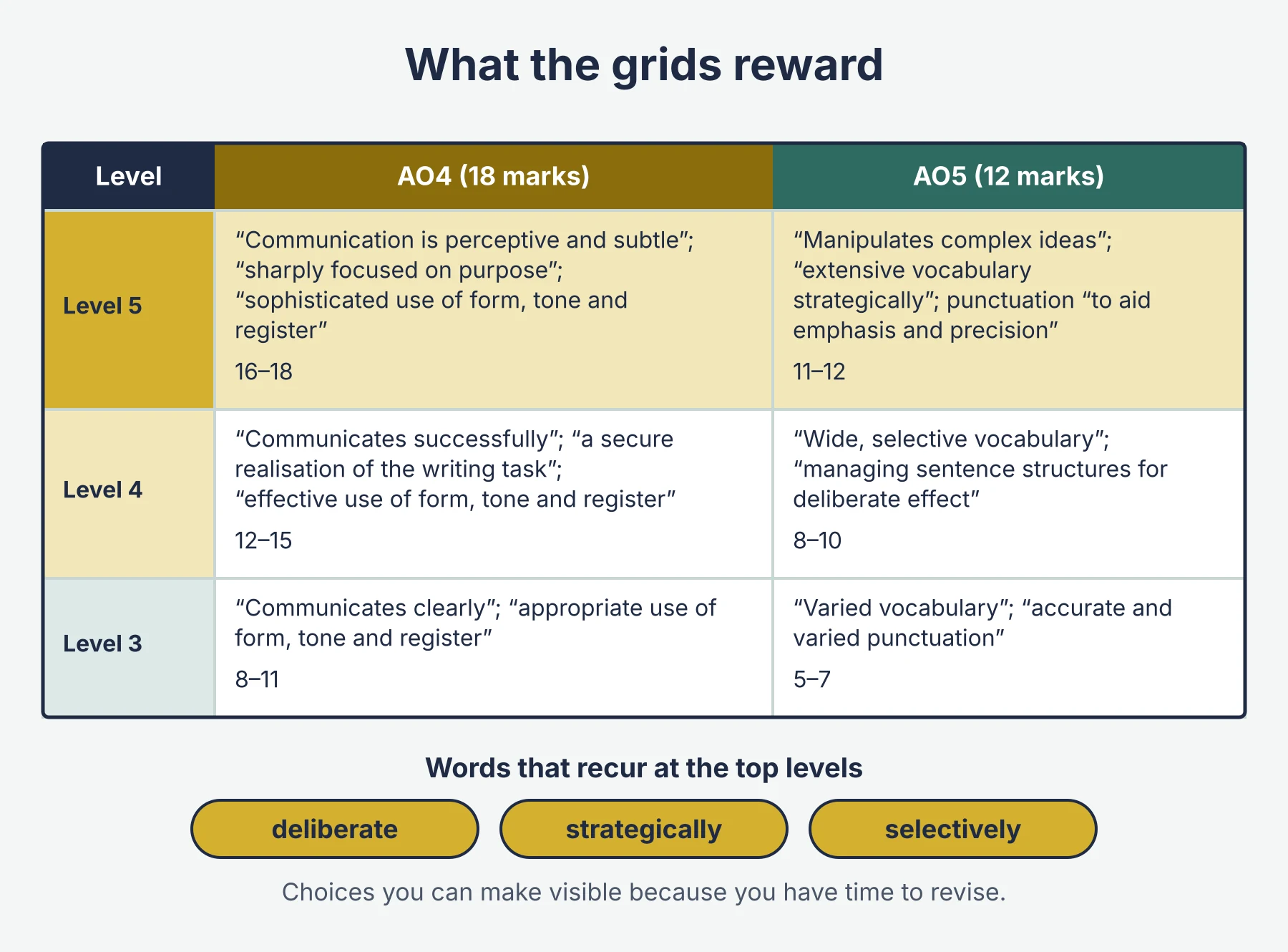
| Level 3 | “Communicates clearly”; “appropriate use of form, tone and register” (8–11) | “Varied vocabulary”; “accurate and varied punctuation” (5–7) |
| Level 4 | “Communicates successfully”; “a secure realisation of the writing task”; “effective use of form, tone and register” (12–15) | “Wide, selective vocabulary”; “managing sentence structures for deliberate effect” (8–10) |
| Level 5 | “Communication is perceptive and subtle”; “sharply focused on purpose”; “sophisticated use of form, tone and register” (16–18) | “Manipulates complex ideas”; “extensive vocabulary strategically”; punctuation used “to aid emphasis and precision” (11–12) |
The words deliberate, strategically and selectively recur at the top levels. They describe choices you can make visible because you have time to revise.
Making 700 words count
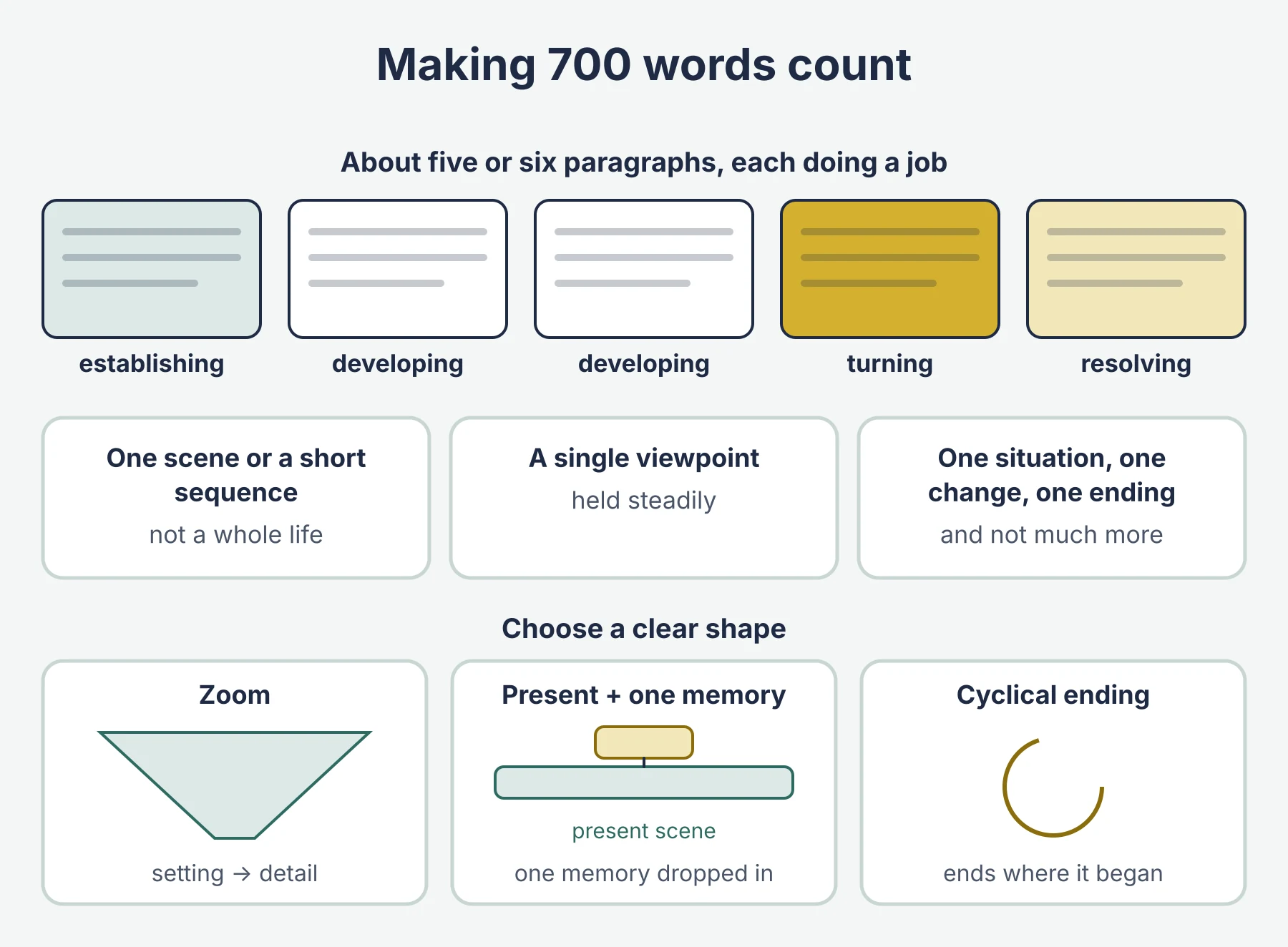
Seven hundred words is roughly five or six paragraphs. That is enough for one situation, one change and one well-crafted ending, and not much more.
- One scene or a short sequence rather than a whole life.
- A single viewpoint, held steadily.
- A clear shape: for example a zoom from setting to detail, a present scene with one memory, or a cyclical ending.
- Every paragraph doing a job: establishing, developing, turning, resolving.
Using images or a title as a stimulus
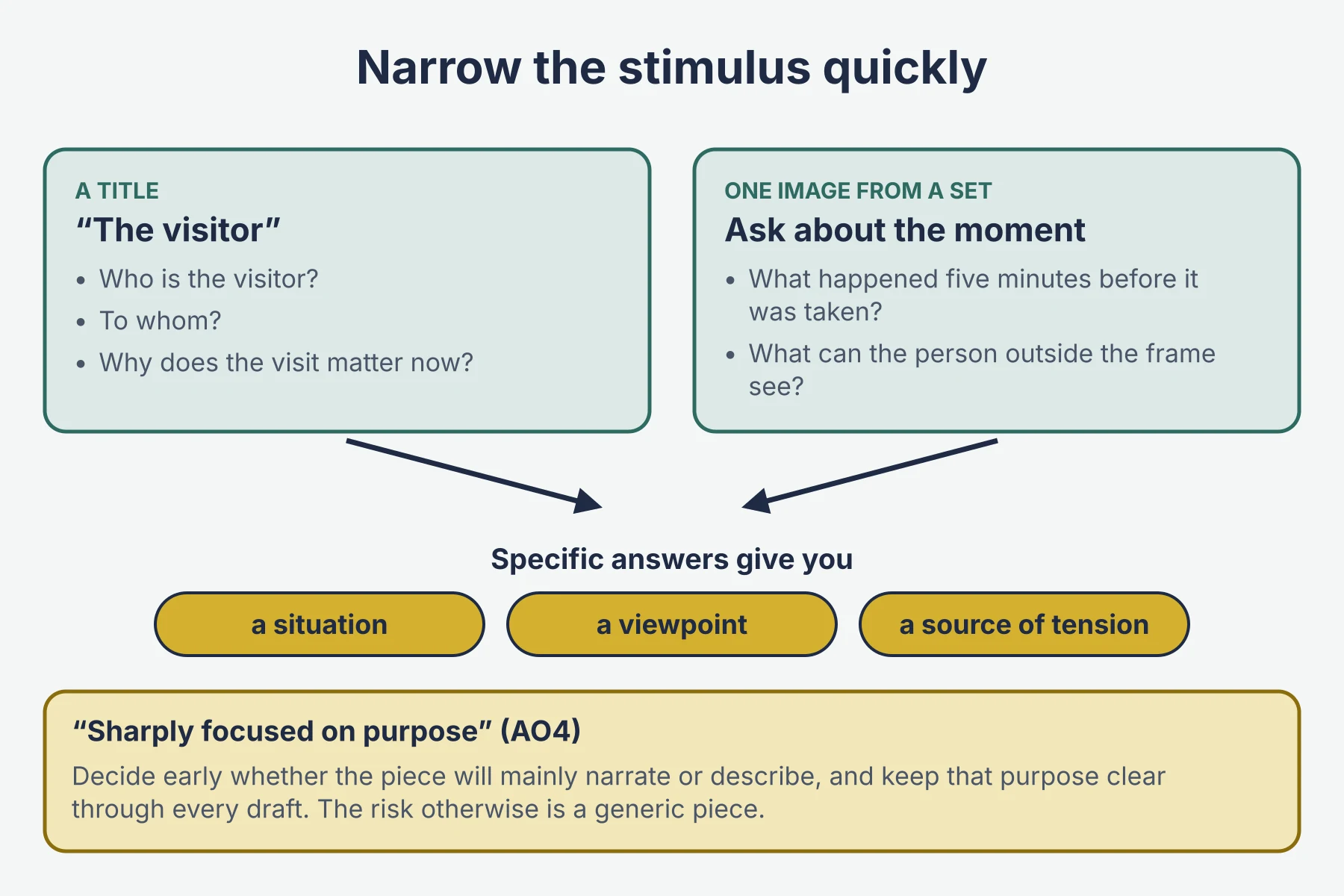
When the task is unrelated to the Anthology, perhaps prompted by a set of images or a title such as “The visitor”, the risk is a generic piece. Narrow the stimulus quickly: who is the visitor, to whom, and why does the visit matter now? Choose one image from a set and ask what happened five minutes before it was taken, or what the person outside the frame can see. Specific answers to these questions give you a situation, a viewpoint and a source of tension, which is what AO4’s “sharply focused on purpose” requires. Decide early whether the piece will mainly narrate or describe, and keep that purpose clear through every draft.
Working within the coursework rules
- You must work independently and sign the authentication sheet; your teacher signs it too.
- Your teacher may suggest general improvements at a draft stage; you must make the corrections and update the work yourself.
- The work must not be rewritten after it has been marked.
- Acknowledge sources. Teachers are told to be alert to work derived from the internet or AI.
- The finished piece shows your name, the completion date, the mark and a brief teacher comment.
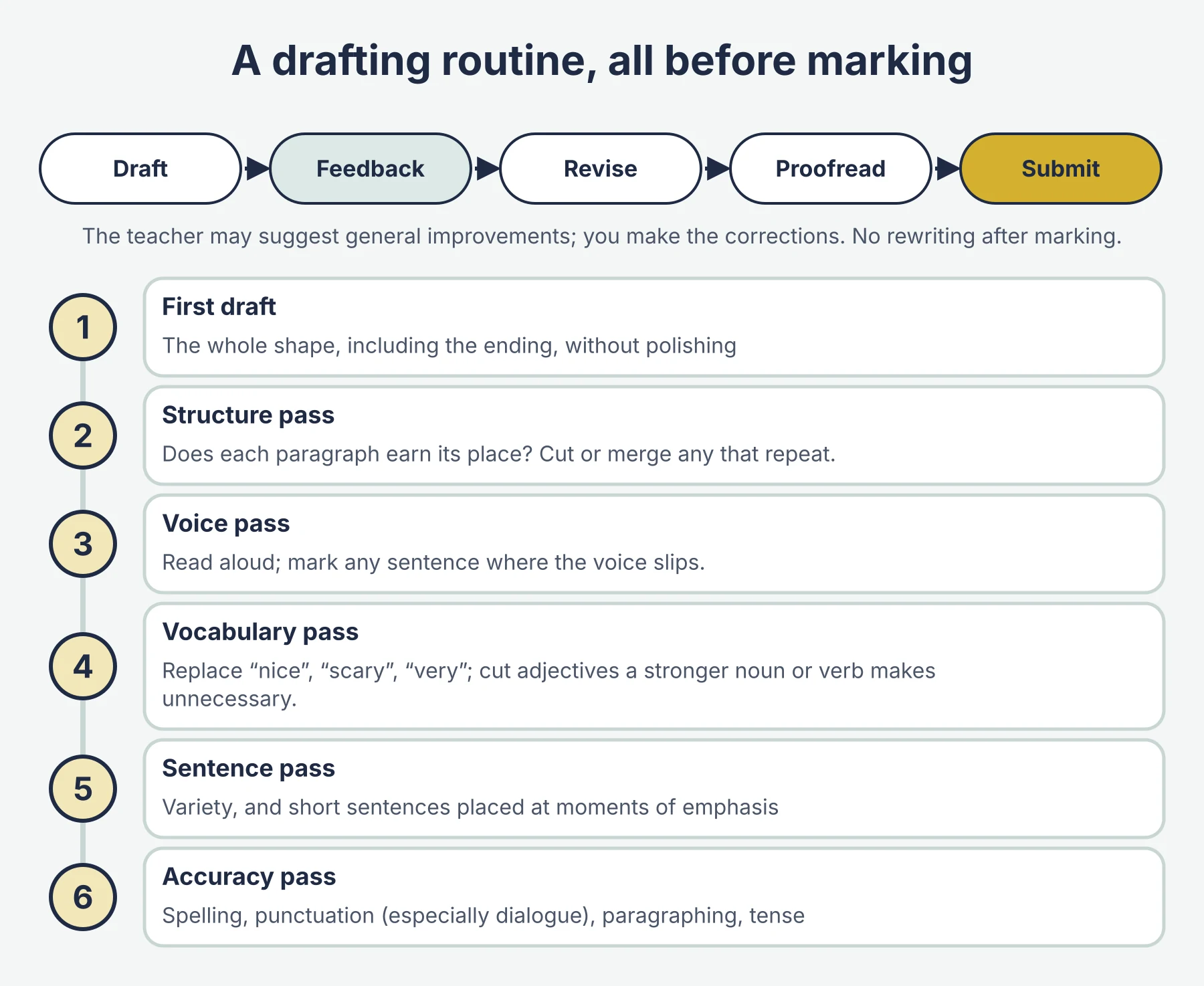
Plan your drafting so that the improvements happen before marking: draft, receive general feedback, revise, proofread, submit.
A drafting routine
- First draft: get the whole shape down, including the ending, without polishing.
- Structure pass: does each paragraph earn its place? Cut or merge any that repeat.
- Voice pass: read aloud; mark any sentence where the voice slips.
- Vocabulary pass: replace vague words (“nice”, “scary”, “very”) with precise ones; delete adjectives that a stronger noun or verb makes unnecessary.
- Sentence pass: check variety and the placement of short sentences at moments of emphasis.
- Accuracy pass: spelling, punctuation (especially dialogue), paragraphing, tense.
Worked redraft
Task (original, Anthology-linked): After reading “The Necklace”, write the scene in which Madame Forestier returns home after her final conversation with Mathilde. Your purpose is to narrate.
First-draft paragraph:
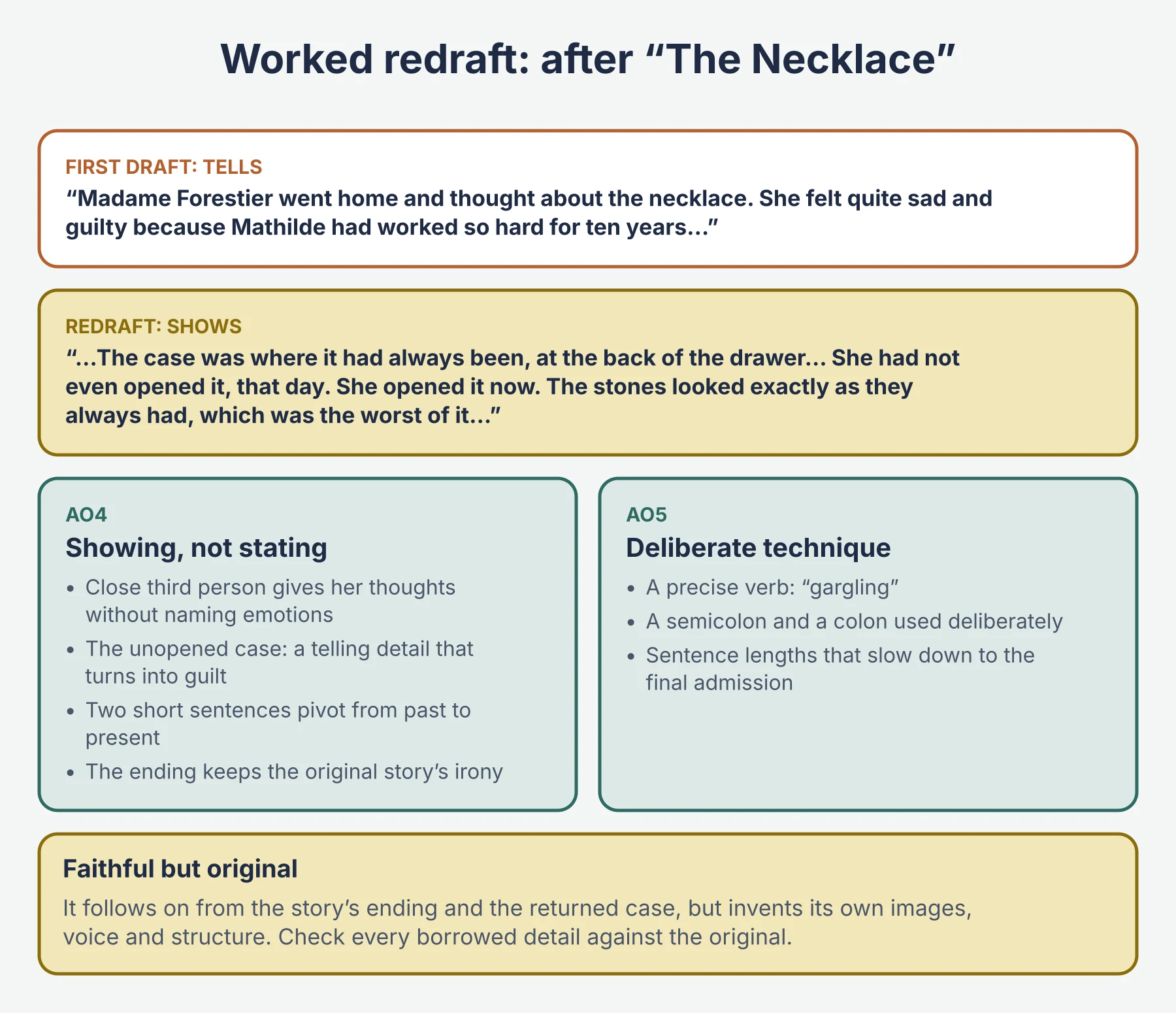
Madame Forestier went home and thought about the necklace. She felt quite sad and guilty because Mathilde had worked so hard for ten years. It was a long time ago but she still remembered the ball. She looked out of the window and it was raining.
Redrafted paragraph:
The rain had found its way into the gutters again; she could hear it gargling somewhere above the window. The case was where it had always been, at the back of the drawer, black leather worn pale at the corners. She had not even opened it, that day. She opened it now. The stones looked exactly as they always had, which was the worst of it: ten years of someone else’s life, lying quietly on velvet, and she had never noticed the difference.
What changed, and why it scores higher:
- AO4: close third person gives access to her thoughts without stating emotions; the unopened case is a telling detail that turns into guilt; the short sentences “She had not even opened it, that day. She opened it now.” pivot the paragraph from past to present, and the final sentence keeps the original story’s irony.
- AO5: a precise verb (“gargling”), a semicolon and a colon used deliberately, and varied sentence lengths that slow down to the final admission.
- Faithful but original: the scene follows on from the Anthology story’s ending and its detail of the returned case, while inventing its own images, voice and structure.
If you write a continuation, check every detail you borrow against the original text so that nothing contradicts it.
Common mistakes
- Writing an essay or argument: the purpose must be to narrate, describe or entertain.
- Copying the Anthology text’s sentences in a continuation.
- Too much plot for 700 words.
- Assuming time to draft means length: extra words do not raise the mark; control does.
- Leaving accuracy to the end and running out of drafting time.
- Ignoring the teacher’s general feedback or, at the other extreme, expecting the teacher to correct the work.
Where to go next
- Assignment B Imaginative Writing revision notes
- Assignment B Imaginative Writing practice questions
- Assignment A Poetry and Prose Texts study guide
- Section B Imaginative Writing study guide, the exam equivalent in Component 2
Official specification
Pearson Edexcel International GCSE in English Language (Specification A) 4EA1, Issue 7 (August 2025), Component 3 — qualifications.pearson.com.
Related resources
-
Revision notes
Edexcel IGCSE English Language: Non-fiction Texts and Transactional Writing — Revision Notes
Condensed recall notes on reading non-fiction, language analysis, comparison and transactional writing for Edexcel International GCSE English Language 4EA1.
English · Pearson Edexcel · IGCSE
Revise topic -
Practice questions
Pearson Edexcel IGCSE English Language (4EA1): Assignment B Imaginative Writing – Practice Questions
Original redrafting drills and full 30-mark coursework-style tasks for 4EA1 Component 3 Assignment B imaginative writing, with AO4 and AO5 marking guidance.
English · Pearson Edexcel · IGCSE
Try questions -
Revision notes
Pearson Edexcel IGCSE English Language (4EA1): Assignment B Imaginative Writing – Revision Notes
Checklist notes for 4EA1 Component 3 Assignment B coursework: task rules, purposes, AO4 and AO5 level wording, a drafting routine, traps and a self-test.
English · Pearson Edexcel · IGCSE
Revise topic
Get free revision emails (optional)
Occasional emails with practice questions, worked explanations and links to free resources for the qualification and subjects you choose. No spam, and you can unsubscribe from any email. The free tools on this site never need an email.