
Revision Notes
Pearson Edexcel IGCSE English Language (4EA1): Assignment A Poetry and Prose Texts – Revision Notes
Checklist notes for the 4EA1 Component 3 Assignment A three-text essay: rules, focus choice, AO1 and AO2 level wording, essay structures, traps and a self-test.
- Subject
- English
- Level
- IGCSE
- Topic
- Component 3 – Poetry and Prose Texts and Imaginative Writing (Non-Examined Assessment)
- Author
- Marlbridge Academic Team
- Updated
- Reviewed by
- Ammar Bilal (what this means)
Aligned to Pearson Edexcel IGCSE English (4EA1), For first teaching 2016 (Issue 7, August 2025). Official specification .
Syllabus page (what it covers and how it is assessed): Pearson Edexcel IGCSE English Language.
Found an error? Report a correction.
Need help with this topic? Request a free trial class for IGCSE English Language (4EA1).
Condensed notes for the coursework reading essay in Pearson Edexcel International GCSE English Language A (4EA1). For the full method and a worked plan, use the Assignment A Poetry and Prose Texts study guide.
Requirements checklist
| Requirement | Detail |
|---|---|
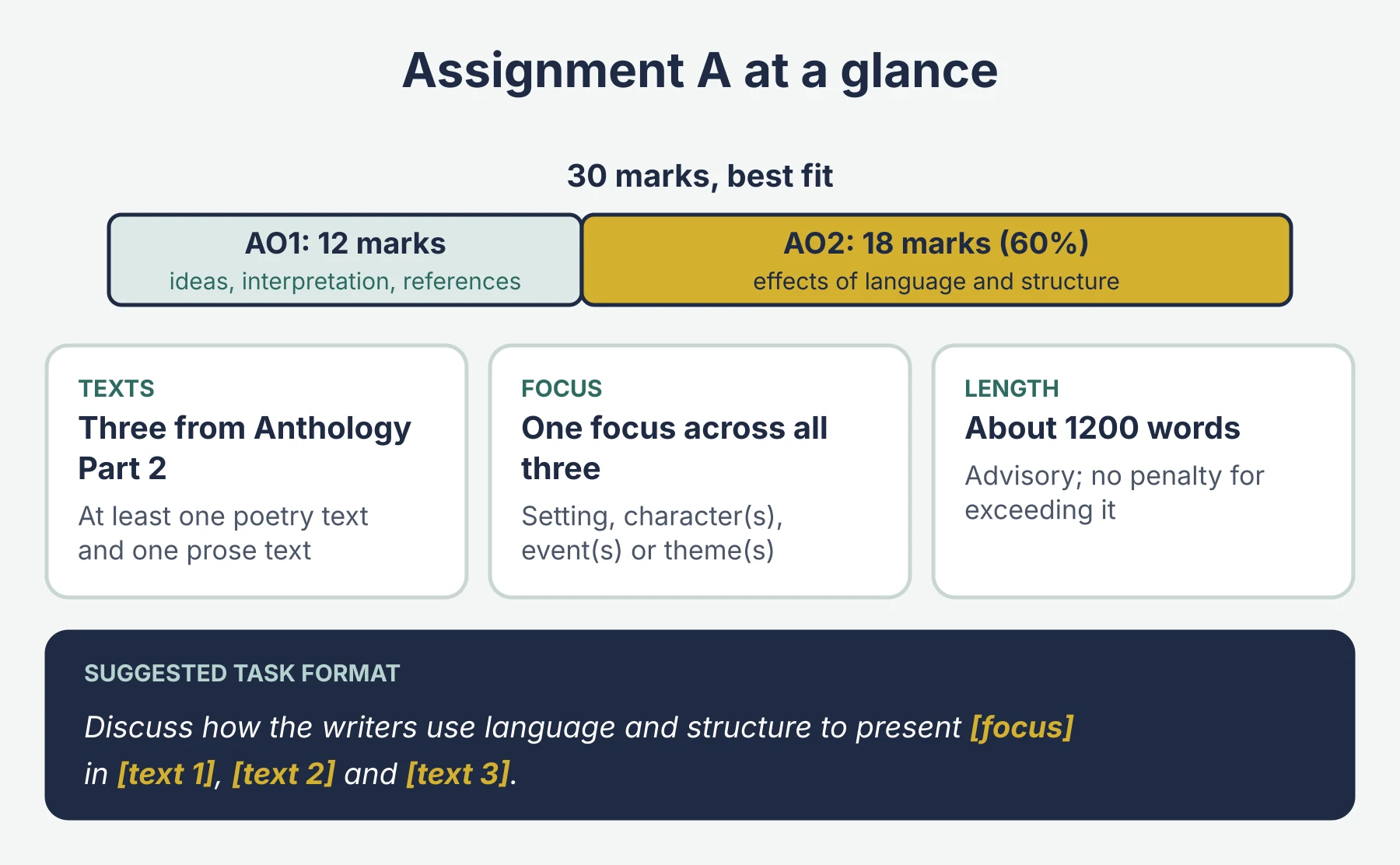
| Texts | Three from Anthology Part 2 |
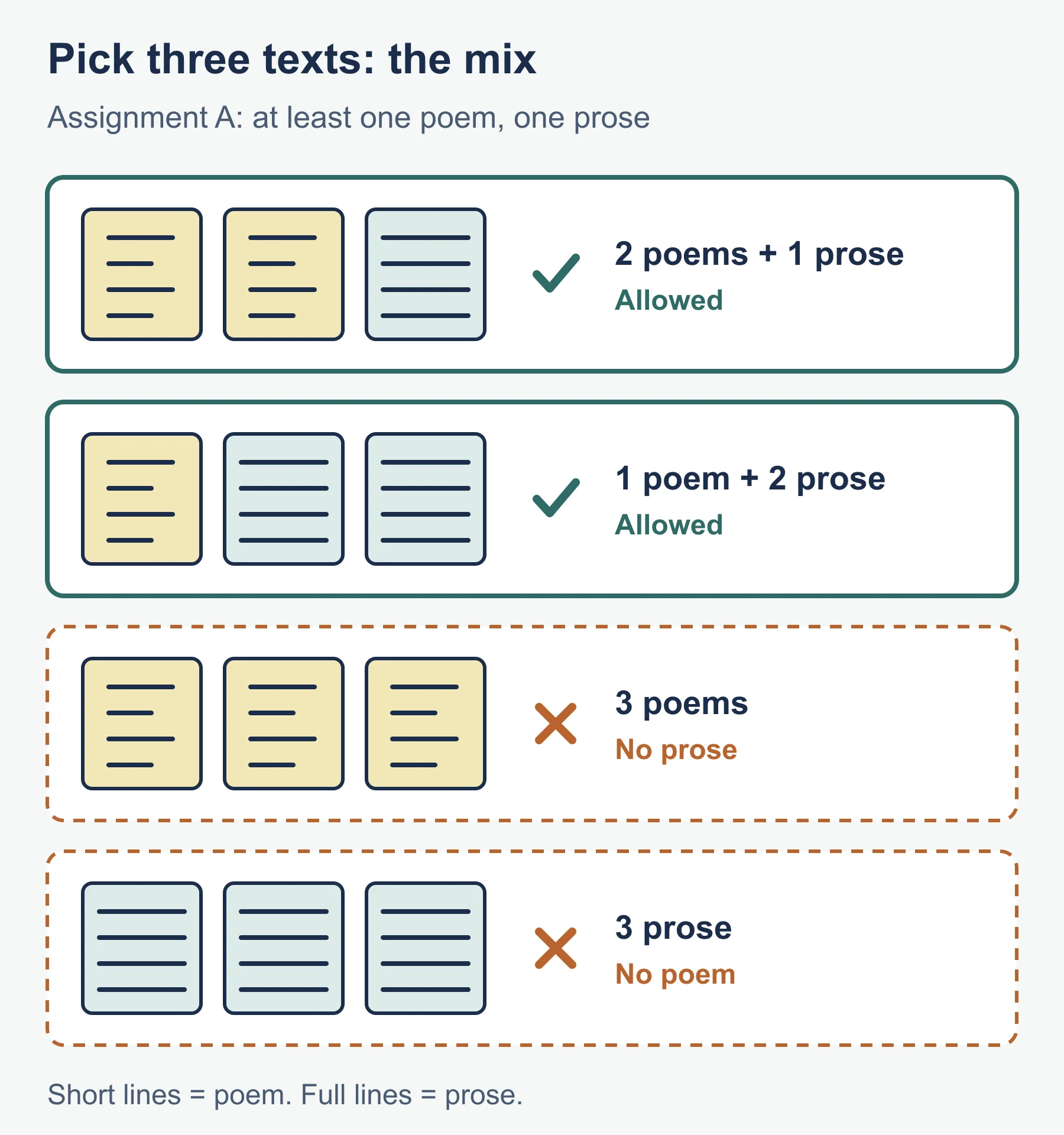
| Mix | At least one poetry text and one prose text |
| Focus | Chosen by you or your teacher; for example setting, character(s), event(s), theme(s) |
| Length | About 1200 words (advisory; no penalty for exceeding it) |
| Marks | 30: AO1 12, AO2 18 |
| Assessment | Internally assessed, externally moderated |
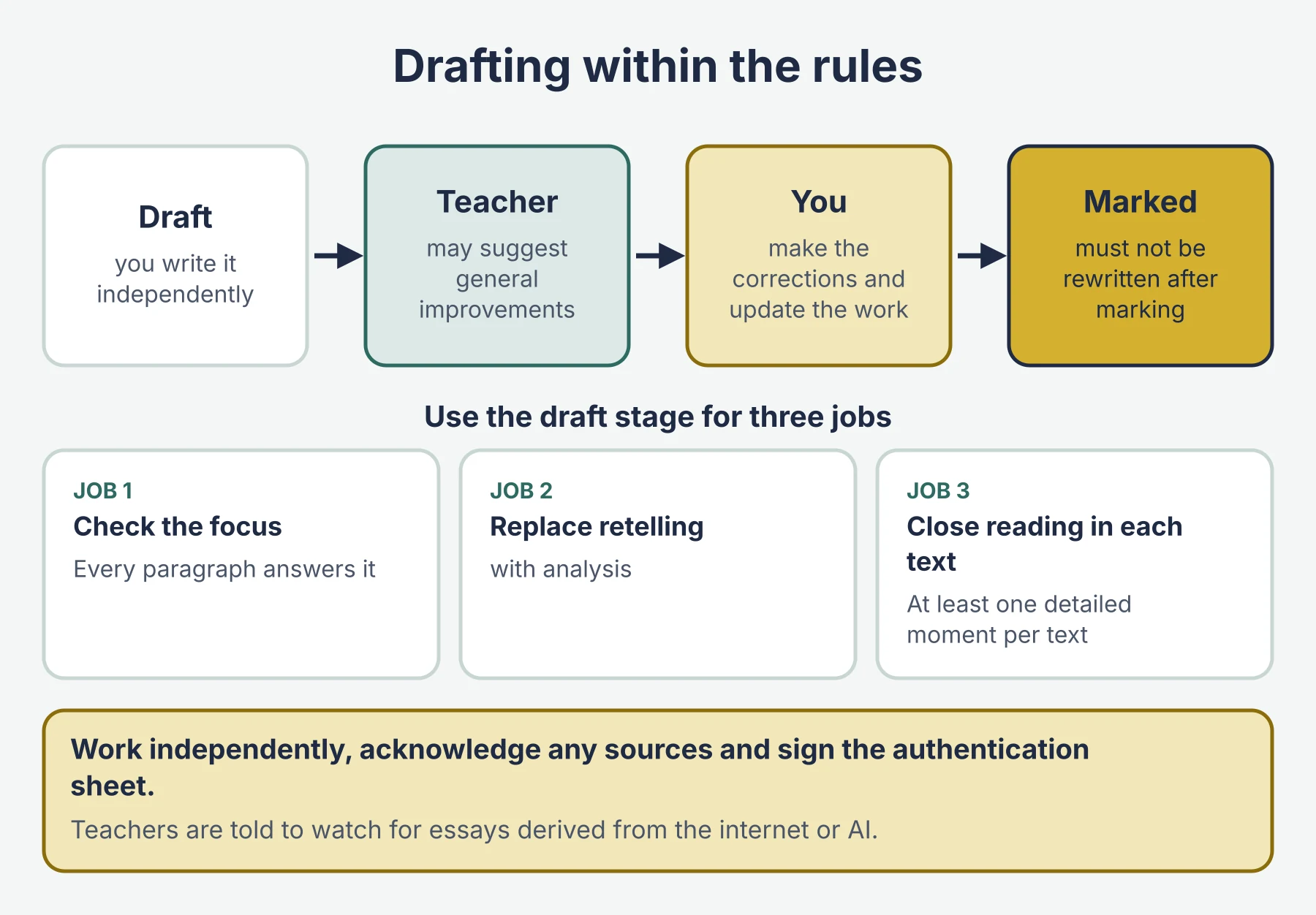
| Feedback | General suggestions at draft stage only; you make the corrections |
| After marking | No rewriting |
Part 2 texts by form
| Poetry | Prose |
|---|---|
| “Disabled” | “The Story of an Hour” |
| “Out, Out–” | “The Necklace” |
| “An Unknown Girl” | “Significant Cigarettes” |
| “The Bright Lights of Sarajevo” | “Whistle and I’ll Come to You” |
| “Still I Rise” | “Night” |
Testing a focus
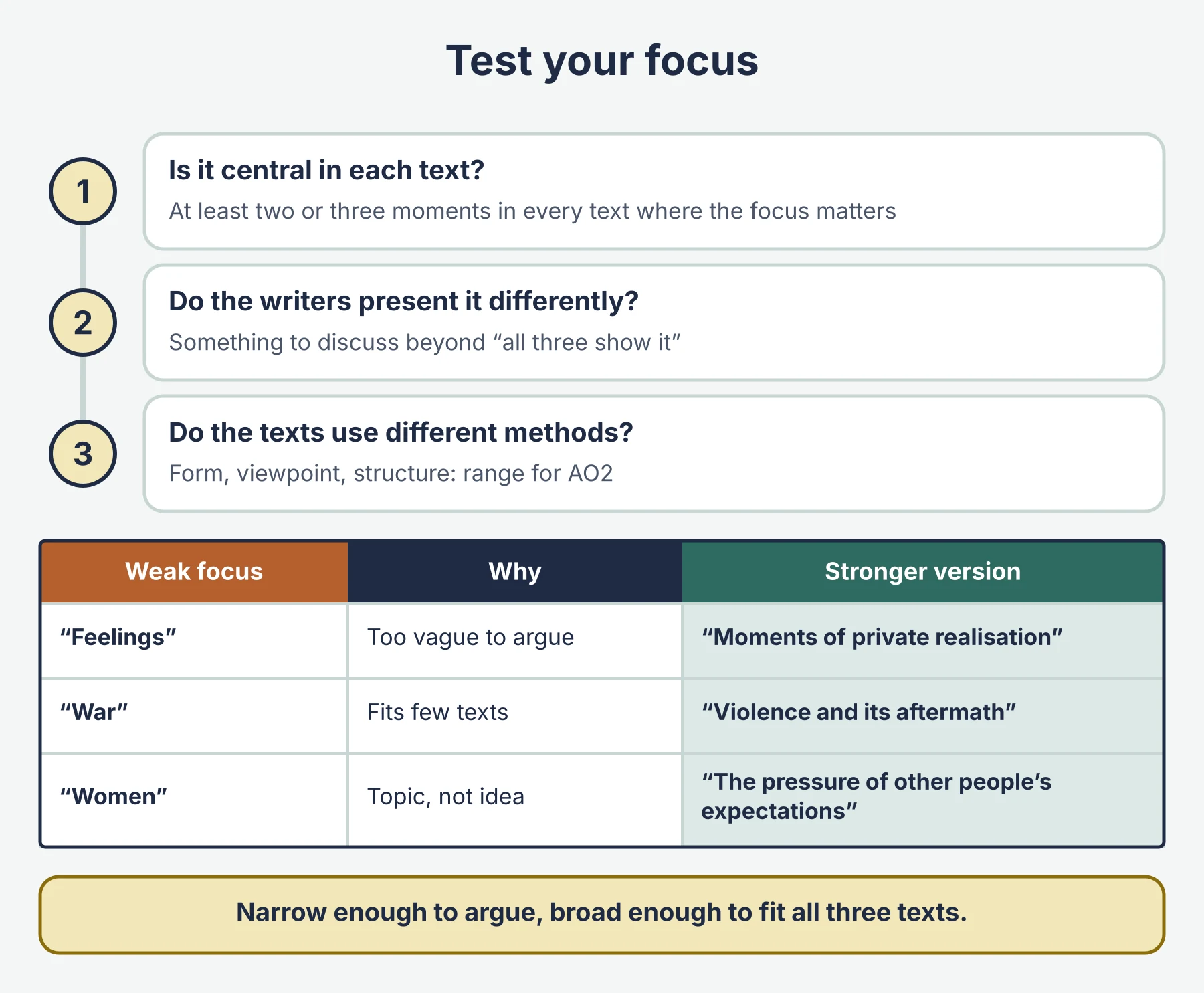
- Central to all three texts?
- Presented differently by each writer?
- Shaped by different methods, giving AO2 range?
If the answer to any is no, change a text or narrow the focus.
Level wording to aim for
| AO | Level | Key phrases from the grid |
|---|---|---|
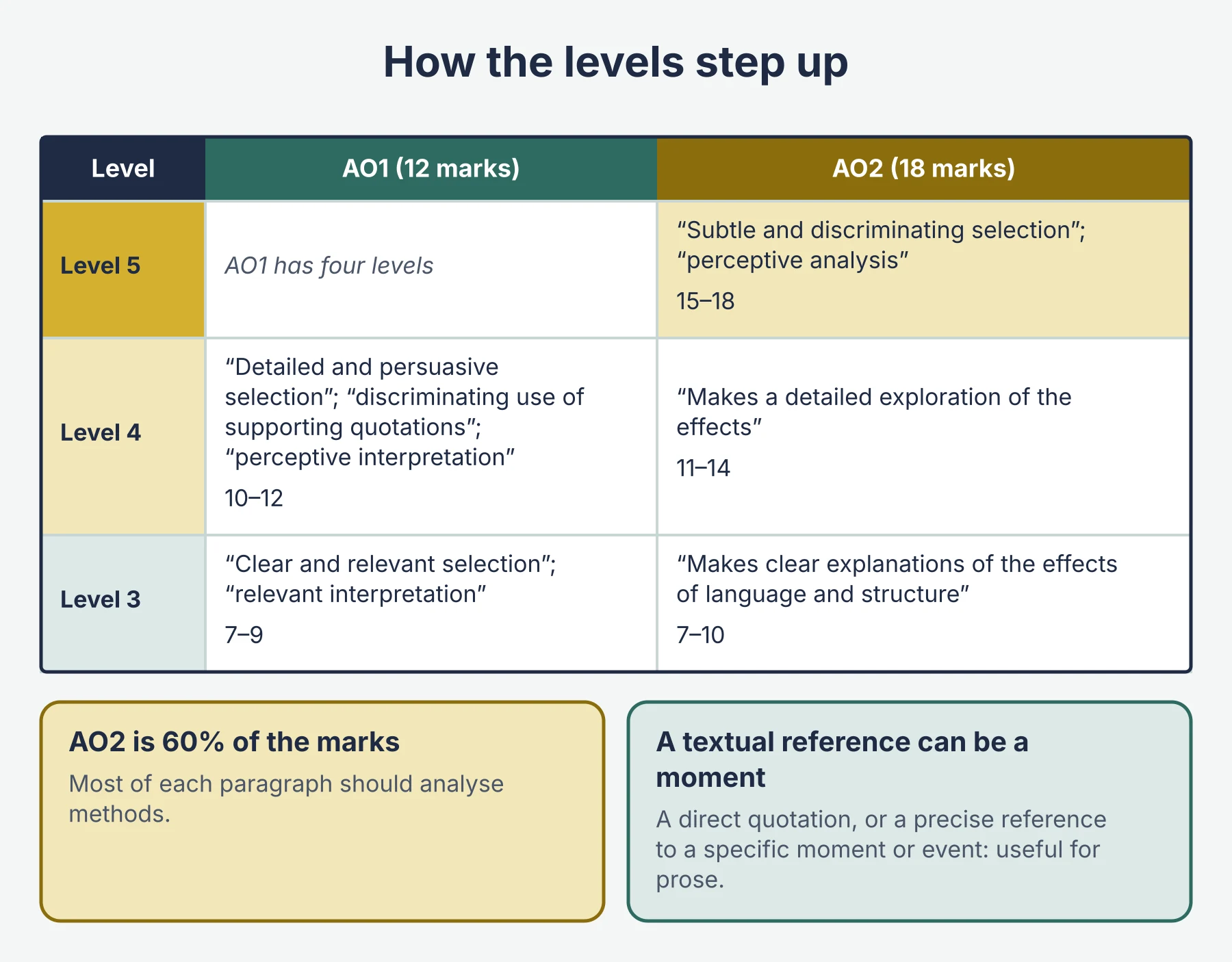
| AO1 | 3 (7–9) | “Clear and relevant selection”; “relevant interpretation” |
| AO1 | 4 (10–12) | “Detailed and persuasive selection”; “discriminating use of supporting quotations”; “perceptive interpretation” |
| AO2 | 3 (7–10) | “Clear explanations of the effects of language and structure” |
| AO2 | 4 (11–14) | “Thorough and confident selection”; “detailed exploration” |
| AO2 | 5 (15–18) | “Subtle and discriminating selection”; “perceptive analysis” |
Marks are awarded on a best fit basis across the whole essay.
Two essay structures
| Structure | How | Best for |
|---|---|---|
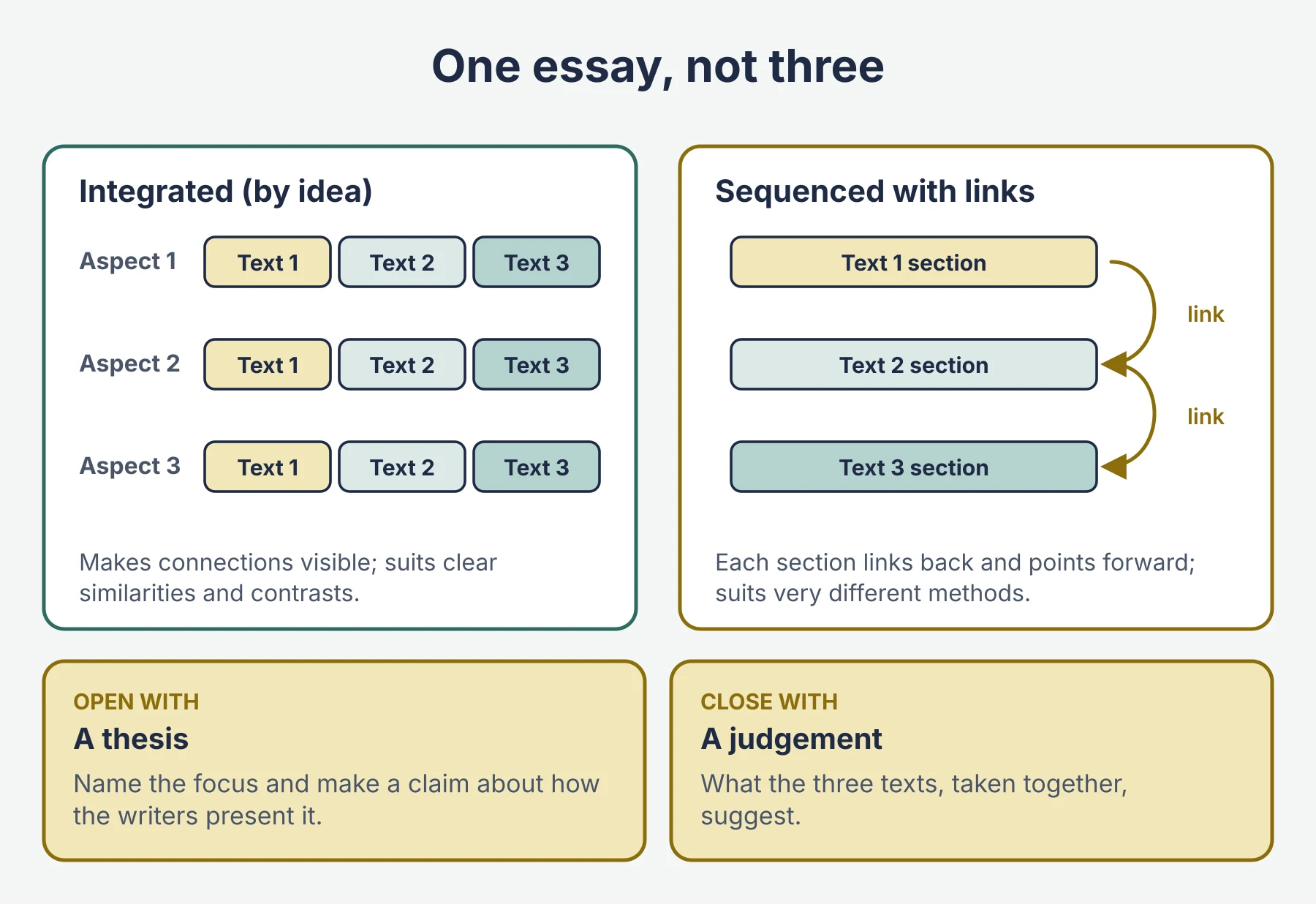
| Integrated | Each paragraph on one aspect of the focus, discussing two or three texts | Trios with clear similarities and contrasts |
| Sequenced with links | A section per text, each opening with a link to the last | Trios with very different methods |
Paragraph recipe
- Point about the focus (not about plot).
- Textual reference: a short quotation or a precise moment.
- Method: language, form or structure.
- Effect on the reader.
- Idea or perspective the writer conveys.
- Link to another text or back to the thesis.
Lifting a sentence: Level 3 to Level 5
Level 3 (clear explanation): “Frost uses personification when the saw ‘snarled’, which makes it sound dangerous.”
Level 4 (detailed exploration): “Frost personifies the saw as an animal that ‘snarled’, so it seems to have a will of its own, and this prepares the reader for the moment it seems to leap at the boy.”
Level 5 (perceptive analysis, connected): “Frost gives the saw an animal’s voice while giving the adults almost none, so the machine seems more alive than the people around the boy; Chopin reverses this pattern, filling Louise’s silent room with the voices of spring outside, so in both texts what is not human speaks loudest at the moment of crisis.”
Each step adds a reason, then a connection to another text.
Draft-stage checklist
- Thesis names all three texts and makes a claim.
- Each paragraph opens with a point about the focus.
- Every text has at least one close-reading moment.
- Structure (openings, turns, endings) is analysed, not just language.
- No paragraph is mostly plot.
- Quotations are short and embedded in your sentences.
- Conclusion makes a judgement, not a summary.
Key terms
| Term | Meaning |
|---|---|
| Focus | The aspect (theme, setting, character, event) the essay examines |
| Thesis | Your overall answer to the task, stated early |
| Textual reference | A quotation or a reference to a specific moment or event |
| Perspective | A writer’s viewpoint or attitude |
| Best fit | Marking that balances strengths and weaknesses to choose a level |
| Moderation | External check of a centre’s marking by Pearson |
| Authentication | Signed confirmation that the work is your own |
Traps
- Three poems: invalid mix.
- A focus that fits only one text well.
- Three separate essays joined by “also”.
- Retelling plots or paraphrasing poems.
- Long quotations with short comments.
- Leaving structure out of AO2.
- Assuming you can revise after marking.
- Using online essays or AI text: work must be your own, and sources acknowledged.
Self-test
- How many texts must Assignment A discuss, and what mix is required?
- What is the advisory word count, and is going over penalised?
- How are the 30 marks split between AOs?
- Give two examples of a focus suggested by the specification.
- Complete the suggested task format: “Discuss how the writers use language and structure to present…”
- What counts as a textual reference?
- What phrase describes AO2 at Level 5?
- What may your teacher do at the draft stage?
- What is forbidden after marking?
- What is “best fit” marking?
- Name two advantages of an integrated essay structure.
- Which AO carries more marks, and what does that mean for each paragraph?
Answers: 1. Three; at least one poetry text and one prose text. 2. About 1200 words; no penalty for exceeding it. 3. AO1 12, AO2 18. 4. Any two: setting, character(s), event(s), theme(s). 5. “…[focus] in [text 1], [text 2] and [text 3].” 6. A direct quotation or a reference to a specific moment or event. 7. “Subtle and discriminating selection” and “perceptive analysis”. 8. Suggest general improvements; you must make any corrections. 9. Rewriting the work. 10. Choosing the level that best matches the essay overall, balancing strengths and weaknesses. 11. Connections are visible throughout; methods are compared directly; the essay builds one argument. 12. AO2 (18); most of each paragraph should analyse language and structure.
Related pages
Related resources
-
Revision notes
Edexcel IGCSE English Language: Non-fiction Texts and Transactional Writing — Revision Notes
Condensed recall notes on reading non-fiction, language analysis, comparison and transactional writing for Edexcel International GCSE English Language 4EA1.
English · Pearson Edexcel · IGCSE
Revise topic -
Study guides
Pearson Edexcel IGCSE English Language (4EA1): Assignment B Imaginative Writing
Crafting the 700-word 4EA1 Component 3 Assignment B coursework piece: task types, AO4 and AO5 levels, drafting within the rules and a worked redraft.
English · Pearson Edexcel · IGCSE
Read guide -
Practice questions
Pearson Edexcel IGCSE English Language (4EA1): Assignment B Imaginative Writing – Practice Questions
Original redrafting drills and full 30-mark coursework-style tasks for 4EA1 Component 3 Assignment B imaginative writing, with AO4 and AO5 marking guidance.
English · Pearson Edexcel · IGCSE
Try questions
Get free revision emails (optional)
Occasional emails with practice questions, worked explanations and links to free resources for the qualification and subjects you choose. No spam, and you can unsubscribe from any email. The free tools on this site never need an email.