
Study Guides
Pearson Edexcel IGCSE English Language (4EA1): Assignment A Poetry and Prose Texts
Planning and drafting the three-text 4EA1 Component 3 Assignment A essay: choosing a focus, AO1 and AO2 levels, and a worked plan with a model paragraph.
- Subject
- English
- Level
- IGCSE
- Topic
- Component 3 – Poetry and Prose Texts and Imaginative Writing (Non-Examined Assessment)
- Author
- Marlbridge Academic Team
- Updated
- Reviewed by
- Ammar Bilal (what this means)
Aligned to Pearson Edexcel IGCSE English (4EA1), For first teaching 2016 (Issue 7, August 2025). Official specification .
Syllabus page (what it covers and how it is assessed): Pearson Edexcel IGCSE English Language.
Found an error? Report a correction.
Need help with this topic? Request a free trial class for IGCSE English Language (4EA1).
Assignment A is the reading half of the coursework route in Pearson Edexcel International GCSE English Language A (4EA1). Instead of a 45-minute exam essay on one text, you write a considered essay of about 1200 words on three Anthology Part 2 texts. This guide covers the decisions that shape a strong assignment: choosing the trio and focus, building a line of argument across three texts, and using the drafting stage within the rules. The Component 3 overview explains how the component fits the qualification.
What the specification requires
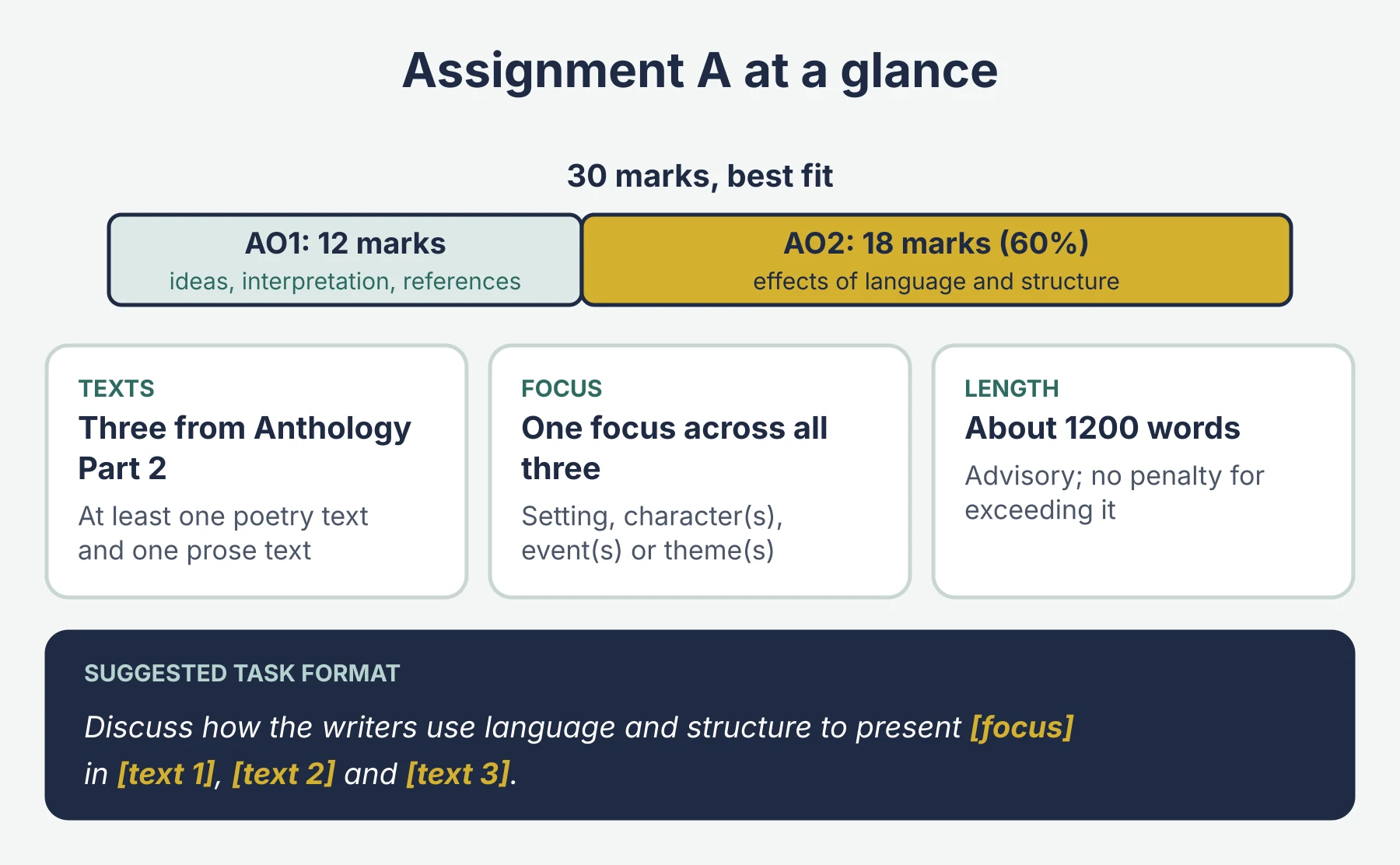
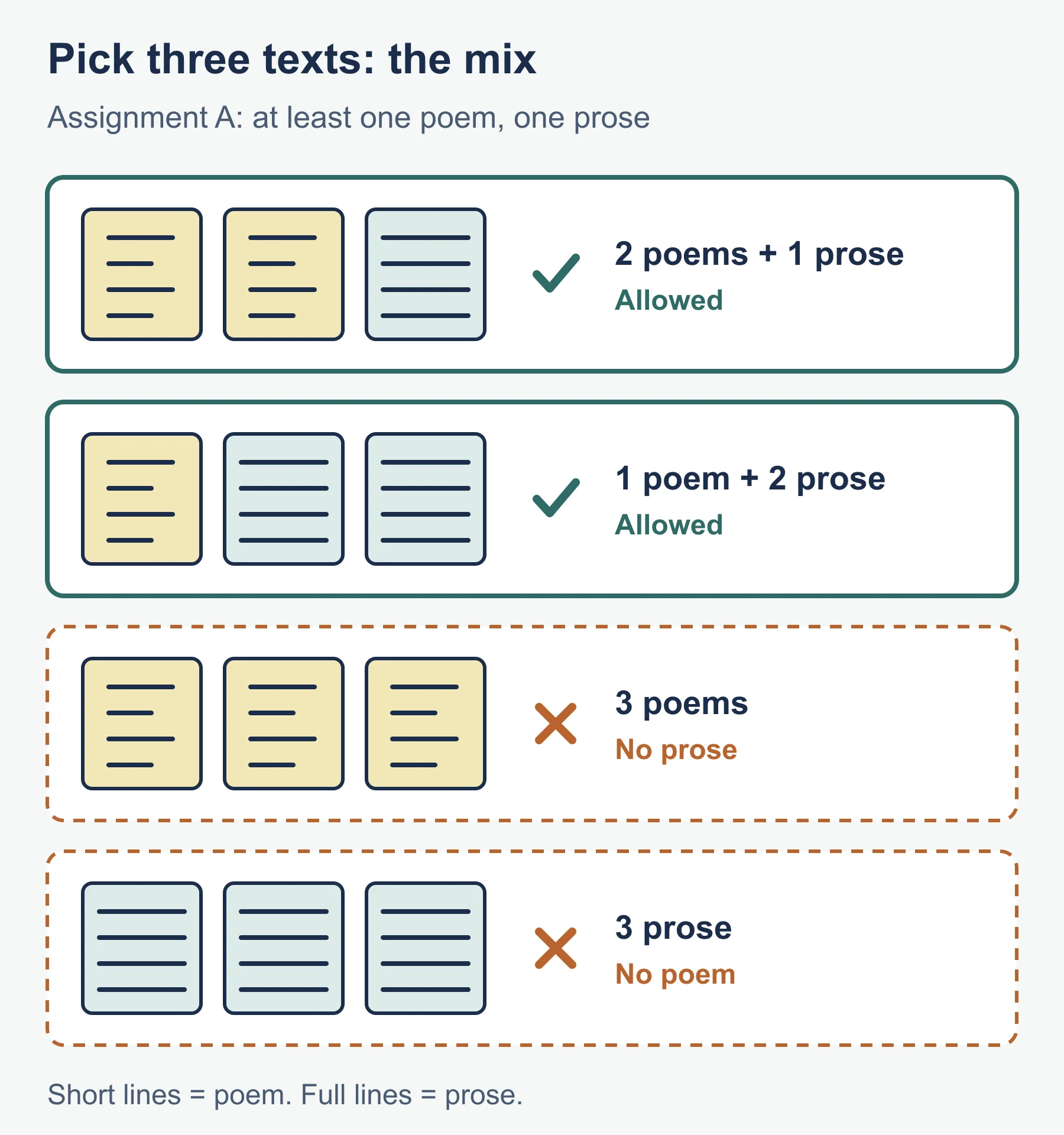
- Three texts from Part 2 of the Anthology, with at least one poetry text and one prose text.
- A focus for the assignment; the specification suggests setting, character(s), event(s) or theme(s).
- A task that allows access to AO1 (12 marks) and AO2 (18 marks): 30 marks in total.
- An advisory length of about 1200 words; there is no penalty for exceeding it.
- The suggested task format: Discuss how the writers use language and structure to present [focus] in [text 1], [text 2] and [text 3]. The response should discuss the writers’ ideas and perspectives about the focus, how they use language and structure to achieve their effects, and include textual references.
The task may be devised by your teacher or self-generated, and students in a class may write on the same texts.
Choosing a trio and a focus
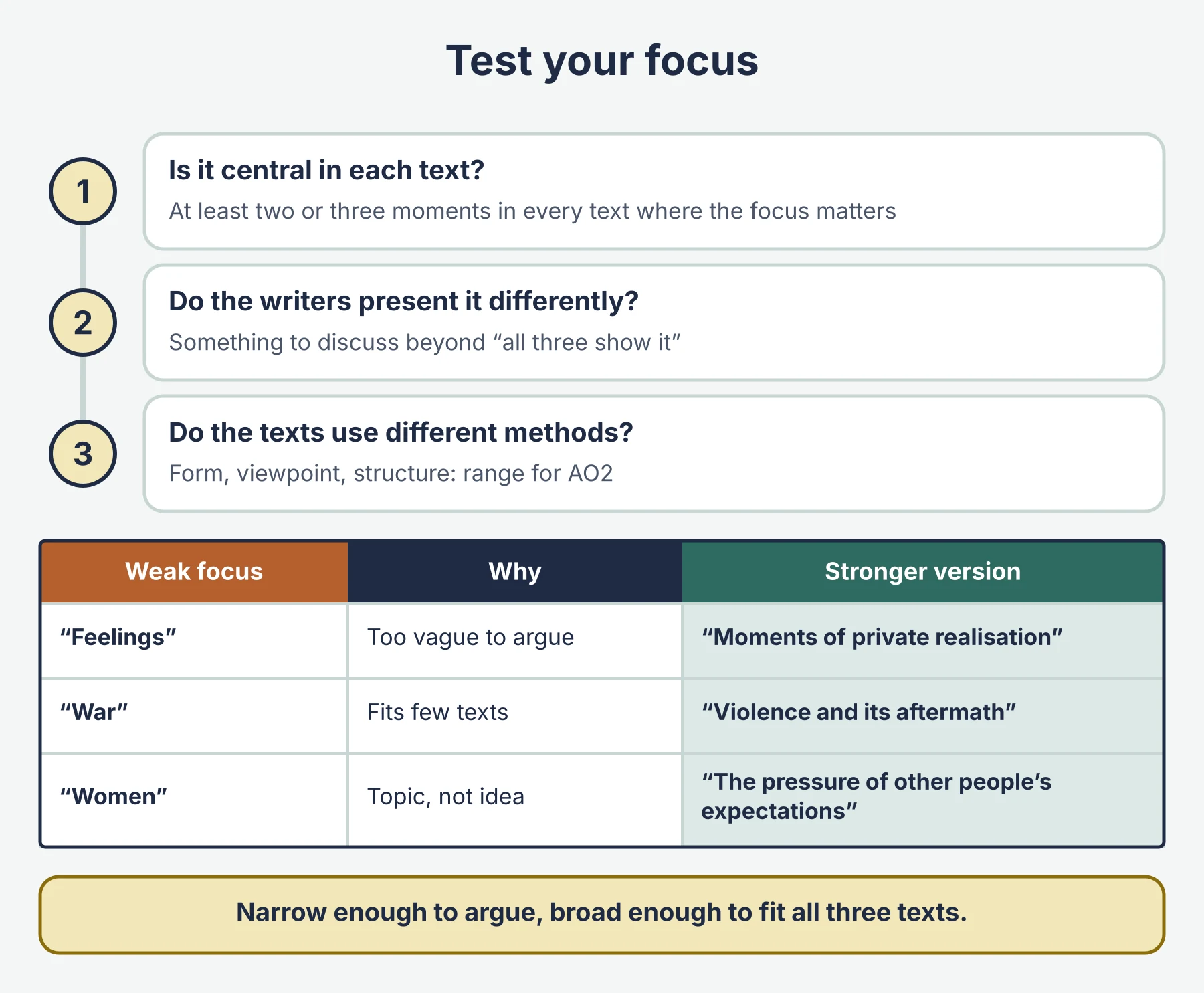
The best focus is narrow enough to argue and broad enough to fit all three texts. Test it with three questions:
- Does each text have at least two or three moments where the focus is central?
- Do the writers present it differently, so there is something to discuss beyond “all three show it”?
- Do the texts use different methods (form, viewpoint, structure), giving AO2 range?
| Weak focus | Why | Stronger version |
|---|---|---|
| “Feelings” | Too vague to argue | “Moments of private realisation” |
| “War” | Fits few texts | “Violence and its aftermath” |
| “Women” | Topic, not idea | “The pressure of other people’s expectations” |
How the marks work
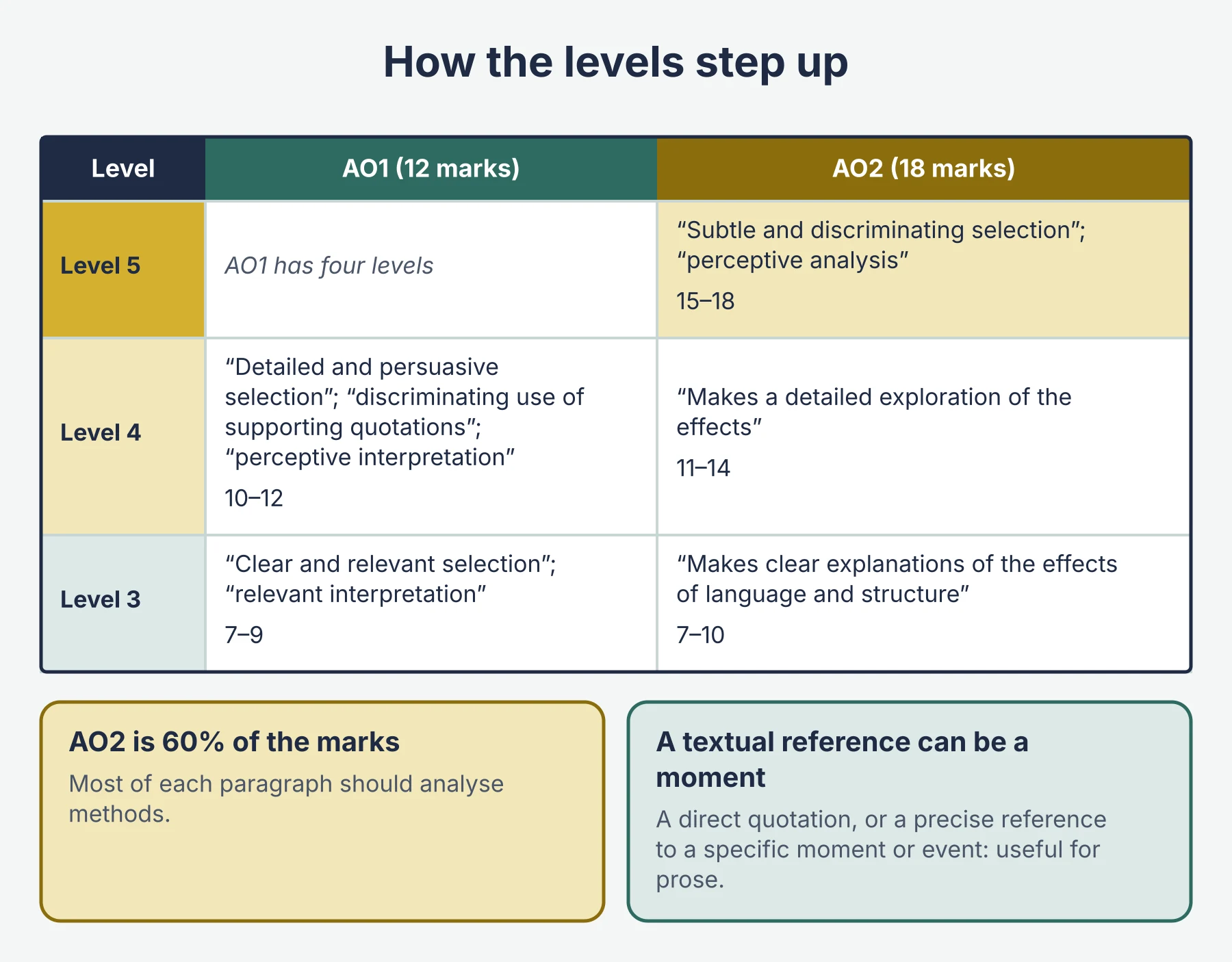
The specification marks the assignment on a best fit basis. Key wording from the assessment grids:
| Level | AO1 (12) | AO2 (18) |
|---|---|---|
| Level 3 | “Clear and relevant selection”; “relevant interpretation” (7–9) | “Makes clear explanations of the effects of language and structure” (7–10) |
| Level 4 | “Detailed and persuasive selection”; “discriminating use of supporting quotations”; “perceptive interpretation” (10–12) | “Makes a detailed exploration of the effects” (11–14) |
| Level 5 | — (AO1 has four levels) | “Subtle and discriminating selection”; “perceptive analysis” (15–18) |
Two practical consequences:
- AO2 is 60% of the marks, so most of each paragraph should analyse methods.
- The specification counts a textual reference as either a direct quotation or a reference to a specific moment or event. For prose, a precise reference to a moment can be as useful as a quotation.
Building a line of argument
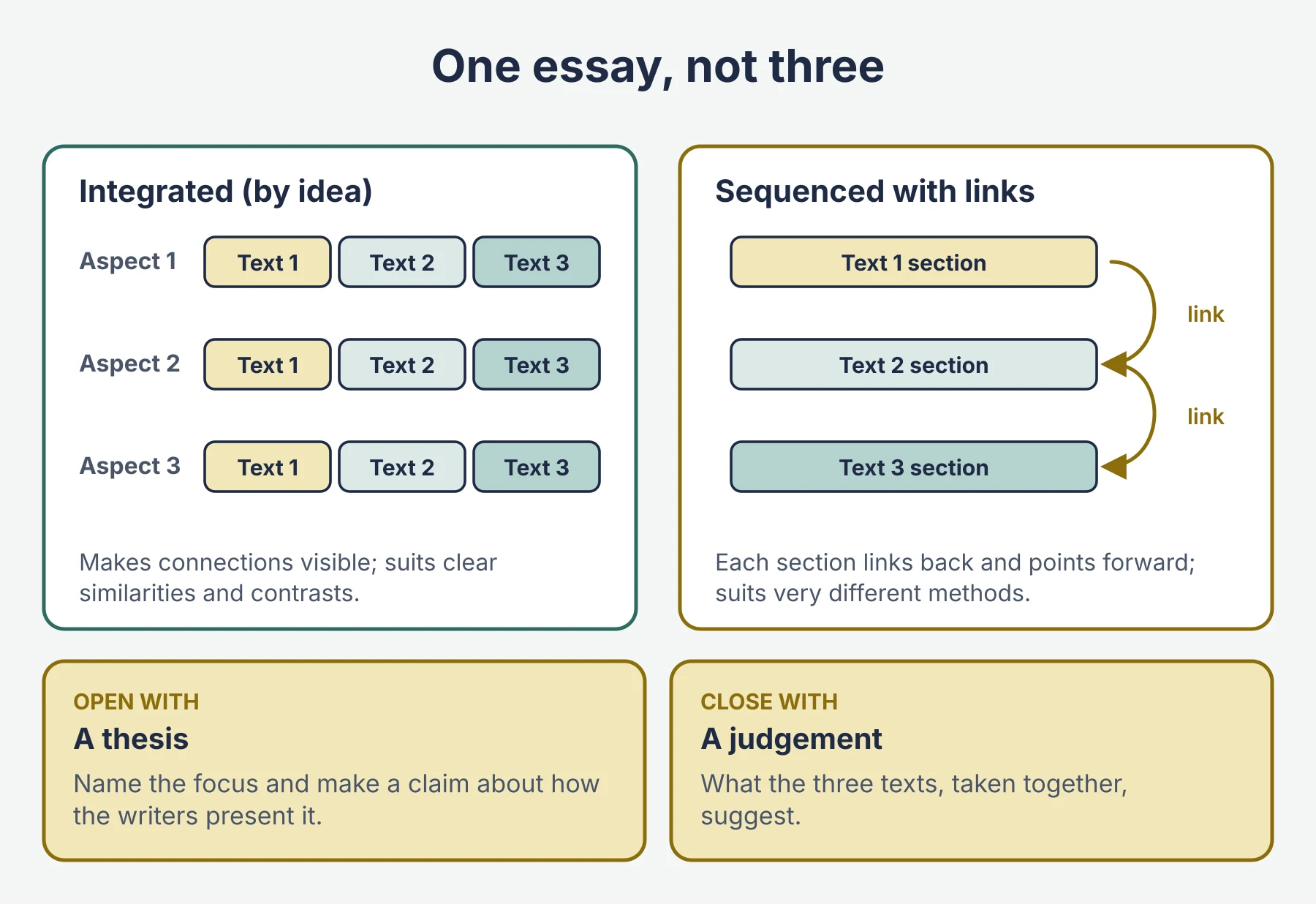
A strong Assignment A is one essay, not three. Two structures work:
Integrated (by idea): each paragraph takes one aspect of the focus and discusses two or three texts within it. This makes connections visible and suits trios with clear similarities and contrasts.
Sequenced with links: a section on each text, but each section opens by linking back to the previous one and closes by pointing forward. This suits trios where the methods are very different.
Either way, open with a thesis that names the focus and a claim about how the writers present it, and close with a judgement about what the three texts, taken together, suggest.
Worked example
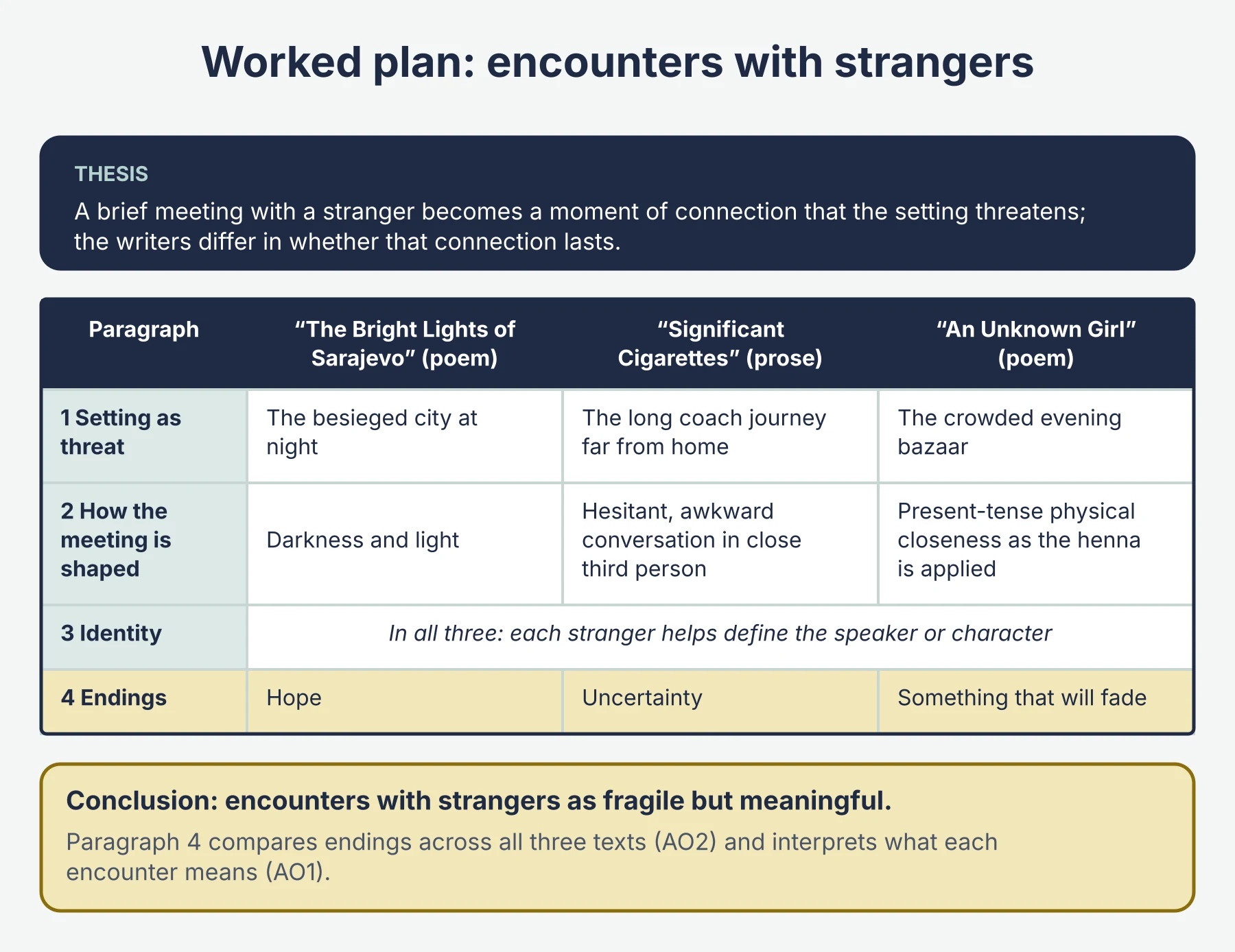
Trio: “The Bright Lights of Sarajevo” (poem), “Significant Cigarettes” (prose), “An Unknown Girl” (poem). Focus: encounters with strangers.
Task: Discuss how the writers use language and structure to present encounters with strangers in “The Bright Lights of Sarajevo”, “Significant Cigarettes” and “An Unknown Girl”.
Plan:
Thesis:  In all three texts a brief meeting with a stranger becomes a moment of
         connection that the setting threatens; the writers differ in whether
         that connection lasts.
Para 1:  Setting as threat - the besieged city at night; the long coach journey
         far from home; the crowded evening bazaar
Para 2:  How the meeting is shaped - darkness and light (Harrison); hesitant,
         awkward conversation in close third person (Tremain); present-tense
         physical closeness as the henna is applied (Alvi)
Para 3:  Identity - each stranger helps define the speaker or character
Para 4:  Endings - hope (Harrison); uncertainty (Tremain); something that will
         fade (Alvi)
Conclusion: encounters with strangers as fragile but meaningful
Model paragraph (paragraph 4):
The writers end their encounters very differently, and these endings shape how the reader values the meeting. Harrison closes on the possibility of love surviving in the dark, so the stranger becomes a source of hope in a city defined by danger. Tremain leaves Lev’s acquaintance unresolved; the story stops before the reader knows what the meeting will mean, which mirrors the uncertainty of arriving in a new country. Alvi’s speaker knows the henna pattern will fade, so the encounter with the unknown girl is presented as beautiful because it is temporary: the short lines and present tense hold the moment still, as if the speaker is trying to keep what she already knows she will lose.
What earns credit: a comparative point on structure (endings) across all three texts (AO2), an interpretation of what the encounter means in each (AO1), and analysis of form in the Alvi example (line length, tense).
Drafting within the rules
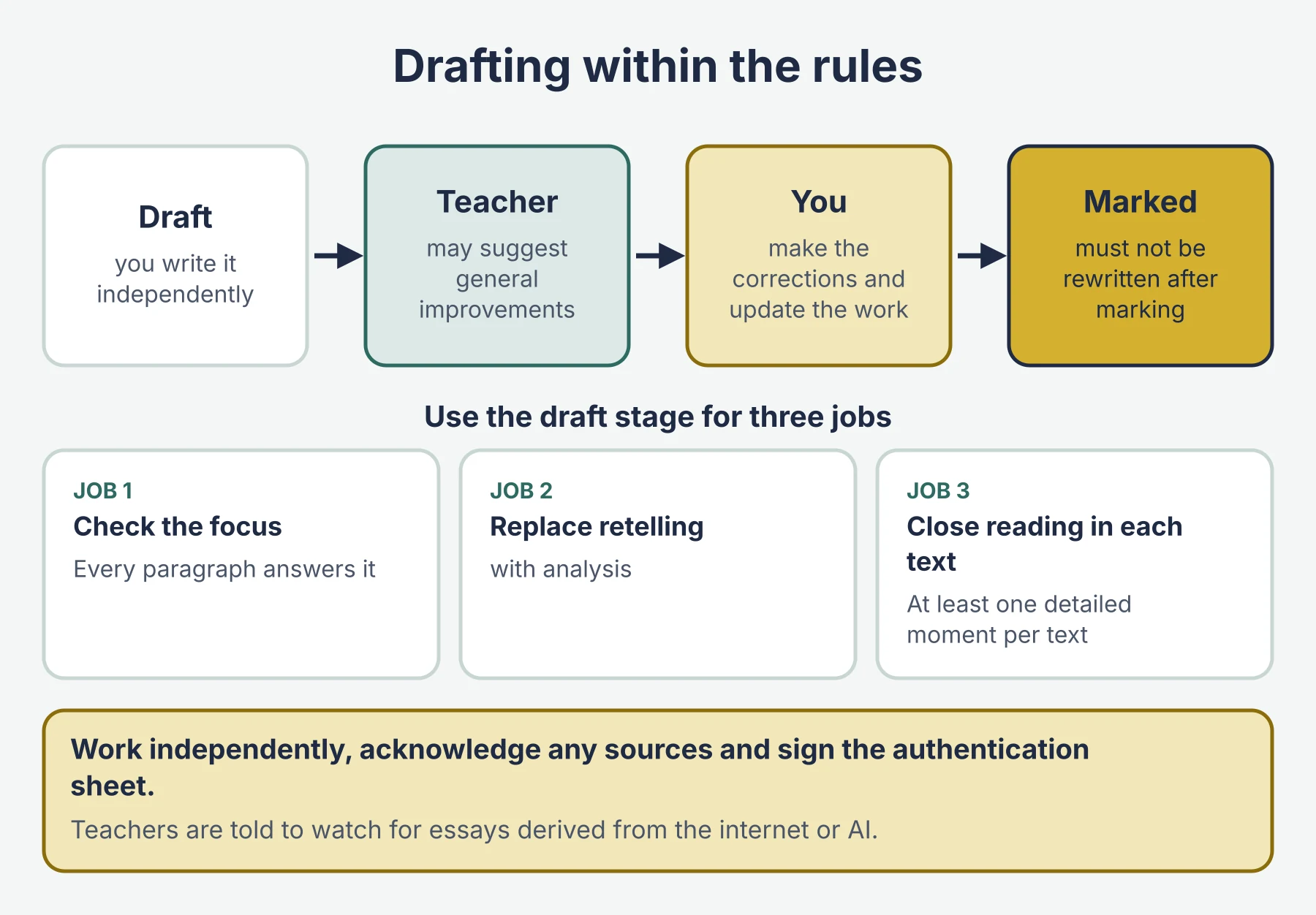
- Your teacher may suggest general improvements at the draft stage, but you must make the corrections and update the work.
- Work must not be rewritten after it has been marked.
- You must work independently, acknowledge any sources, and sign the authentication sheet; teachers are told to watch for essays derived from the internet or AI.
Use the draft stage for three jobs: check that every paragraph answers the focus, replace any retelling with analysis, and make sure each text has at least one detailed, close-reading moment.
Common mistakes
- Three poems, or only two texts. At least one poem and one prose text are required.
- A focus that fits one text well and two others badly.
- Three mini-essays with no connections.
- Retelling stories in place of analysis.
- Quotation dumping: long quotations with little comment.
- Ignoring structure: openings, turning points and endings are often the richest AO2 material.
- Context-heavy introductions: AO1 and AO2 are assessed, not historical background.
Command words in the task
| Wording | What to do |
|---|---|
| Discuss how the writers use language and structure | Analyse methods in all three texts |
| Present [focus] | Keep every paragraph on the chosen focus |
| Ideas and perspectives | Show what each writer seems to think or suggest (AO1) |
| Include textual references | Short quotations or precise references to moments |
Where to go next
- Assignment A Poetry and Prose Texts revision notes
- Assignment A Poetry and Prose Texts practice questions
- Assignment B Imaginative Writing study guide
- Component 3 revision notes
Official specification
Pearson Edexcel International GCSE in English Language (Specification A) 4EA1, Issue 7 (August 2025), Component 3 — qualifications.pearson.com.
Related resources
-
Revision notes
Edexcel IGCSE English Language: Non-fiction Texts and Transactional Writing — Revision Notes
Condensed recall notes on reading non-fiction, language analysis, comparison and transactional writing for Edexcel International GCSE English Language 4EA1.
English · Pearson Edexcel · IGCSE
Revise topic -
Practice questions
Pearson Edexcel IGCSE English Language (4EA1): Assignment A Poetry and Prose Texts – Practice Questions
Original task-setting, planning and paragraph-improvement questions plus full 30-mark three-text tasks for 4EA1 Component 3 Assignment A, with marking guidance.
English · Pearson Edexcel · IGCSE
Try questions -
Revision notes
Pearson Edexcel IGCSE English Language (4EA1): Assignment A Poetry and Prose Texts – Revision Notes
Checklist notes for the 4EA1 Component 3 Assignment A three-text essay: rules, focus choice, AO1 and AO2 level wording, essay structures, traps and a self-test.
English · Pearson Edexcel · IGCSE
Revise topic
Get free revision emails (optional)
Occasional emails with practice questions, worked explanations and links to free resources for the qualification and subjects you choose. No spam, and you can unsubscribe from any email. The free tools on this site never need an email.