
Study Guides
Pearson Edexcel IGCSE English Language (4EA1): Section B Imaginative Writing
Narrative and descriptive craft for the 30-mark imaginative writing task in 4EA1 Paper 2 Section B: AO4, AO5, structure, voice and an annotated model opening.
- Subject
- English
- Level
- IGCSE
- Topic
- Component 2 – Poetry and Prose Texts and Imaginative Writing
- Author
- Marlbridge Academic Team
- Updated
- Reviewed by
- Ammar Bilal (what this means)
Aligned to Pearson Edexcel IGCSE English (4EA1), For first teaching 2016 (Issue 7, August 2025). Official specification .
Syllabus page (what it covers and how it is assessed): Pearson Edexcel IGCSE English Language.
Found an error? Report a correction.
Need help with this topic? Request a free trial class for IGCSE English Language (4EA1).
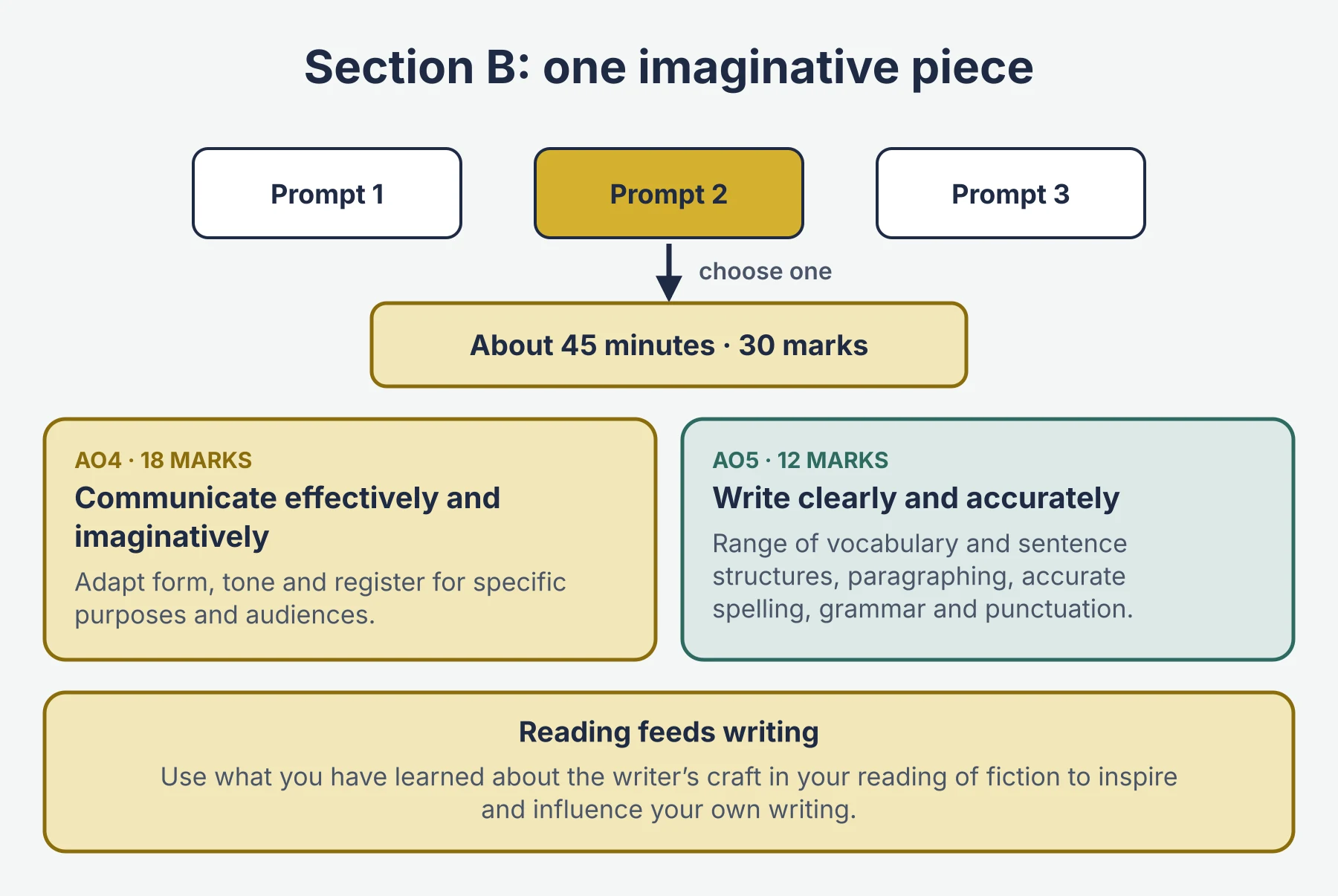
Section B of Component 2 asks for one piece of imaginative writing under exam conditions. You choose from three prompts and have about 45 minutes. This guide explains how the writing is assessed, the structural and stylistic choices that lift a response, and how to plan quickly. For the paper as a whole, see the Component 2 overview.
What Section B covers
| Detail | Section B: Imaginative Writing |
|---|---|
| Task | One imaginative writing task, based on one of three given prompts |
| Marks | 30: AO4 18, AO5 12 |
| Advised time | About 45 minutes |
AO4: communicate effectively and imaginatively, adapting form, tone and register of writing for specific purposes and audiences. AO5: write clearly, using a range of vocabulary and sentence structures, with appropriate paragraphing and accurate spelling, grammar and punctuation.
The specification links this section to your reading: students should use what they have learned about the writer’s craft in their reading of fiction to inspire and influence their own imaginative writing, and develop creative writing techniques, planning and proofreading skills.
Choosing your prompt
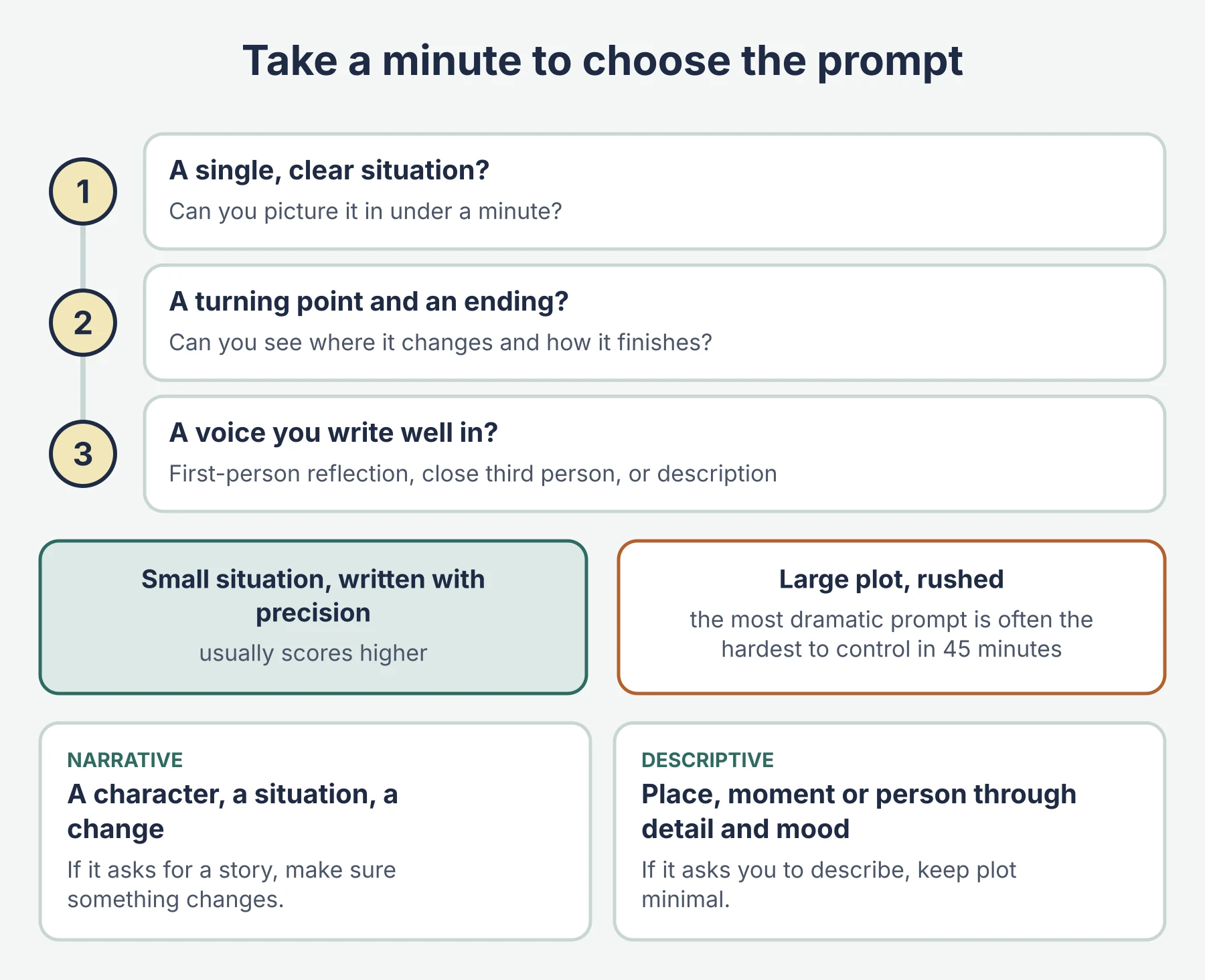
You have three options, so take a minute to choose well:
- Can you picture a single, clear situation for it in under a minute?
- Can you see a turning point and an ending?
- Does it suit a voice you write well in: first-person reflection, close third person, or description?
The prompt that sounds most dramatic is often the hardest to control in 45 minutes. A small situation written with precision usually scores higher than a large plot rushed.
Narrative and descriptive writing
Narrative writing tells a story: a character, a situation, a change. Descriptive writing builds a place, moment or person through detail and mood, with little plot. Many strong responses blend the two: a descriptive opening, a small event, a changed ending. If a prompt asks you to describe, keep plot minimal; if it asks for a story, make sure something changes.
Structure: shapes that work in 45 minutes
| Shape | How it works | Why it helps |
|---|---|---|
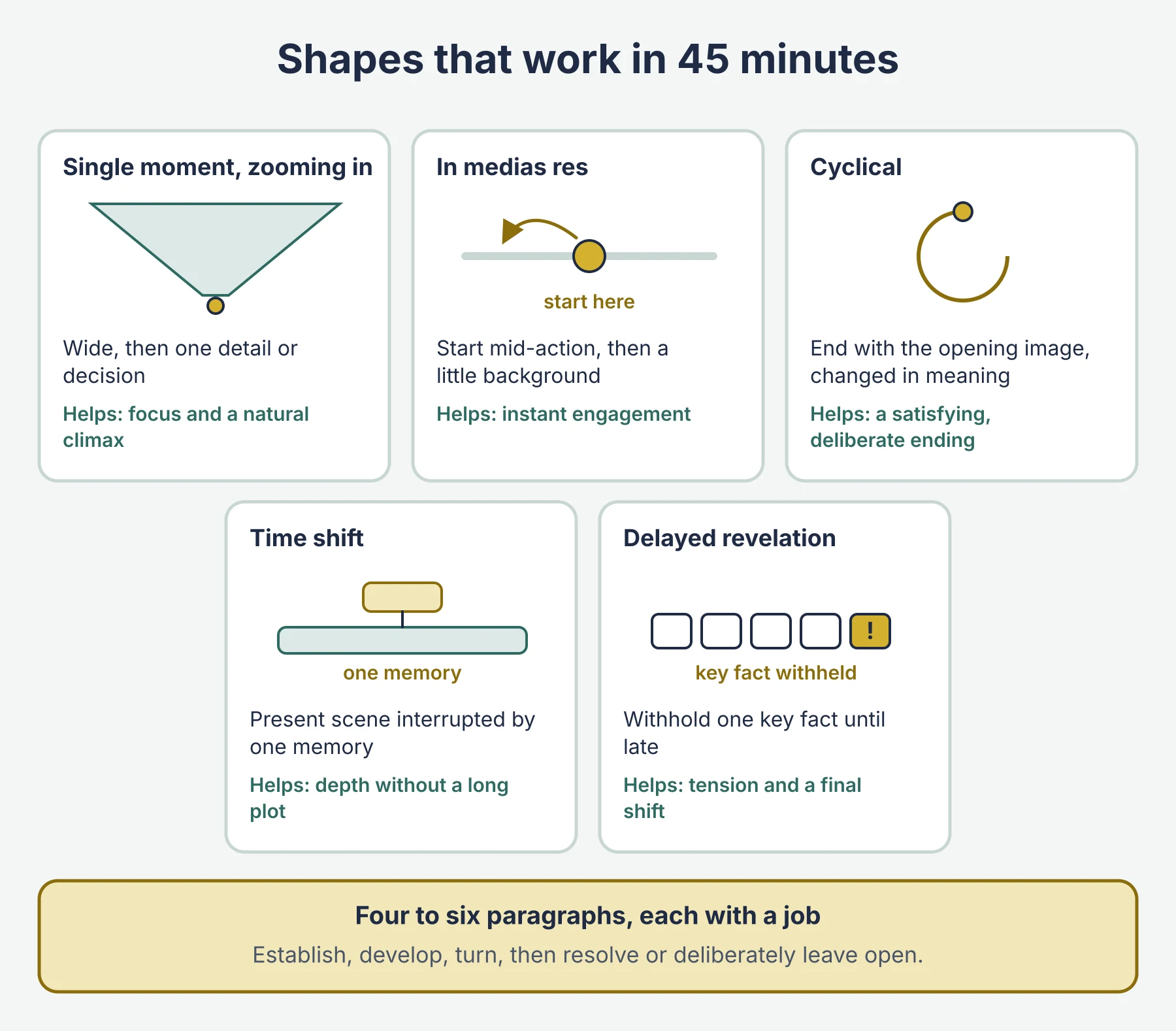
| Single moment, zooming in | Begin wide (a street, a room), narrow to one detail or decision | Gives focus and a natural climax |
| In medias res | Start in the middle of action, then fill in a little background | Instant engagement |
| Cyclical | End with the opening image, changed in meaning | A satisfying, deliberate ending |
| Time shift | Present scene interrupted by one memory | Adds depth without a long plot |
| Delayed revelation | Withhold one key fact until late | Creates tension and a final shift |
Whatever shape you choose, aim for four to six paragraphs, each with a clear job: establish, develop, turn, resolve or deliberately leave open.
Voice, viewpoint and tense
- First person gives intimacy and lets you show thoughts directly.
- Close third person keeps one character’s perspective but allows a little distance.
- Tense: past tense is the default; present tense creates immediacy. Choose one and keep it, unless a shift (for example into a memory) is deliberate and clear.
Characterisation and setting
- Show, do not tell. Instead of “she was nervous”, show her folding a ticket into smaller and smaller squares.
- One telling detail is worth more than a list of adjectives.
- Setting can reflect mood (pathetic fallacy), but avoid weather clichés unless you twist them.
- Dialogue should be brief and purposeful; it must reveal character or move the story. Punctuate it correctly and start a new paragraph for each new speaker.
Worked example
Prompt (original): Write a story that begins with a phone ringing in an empty house.
Plan (four minutes):
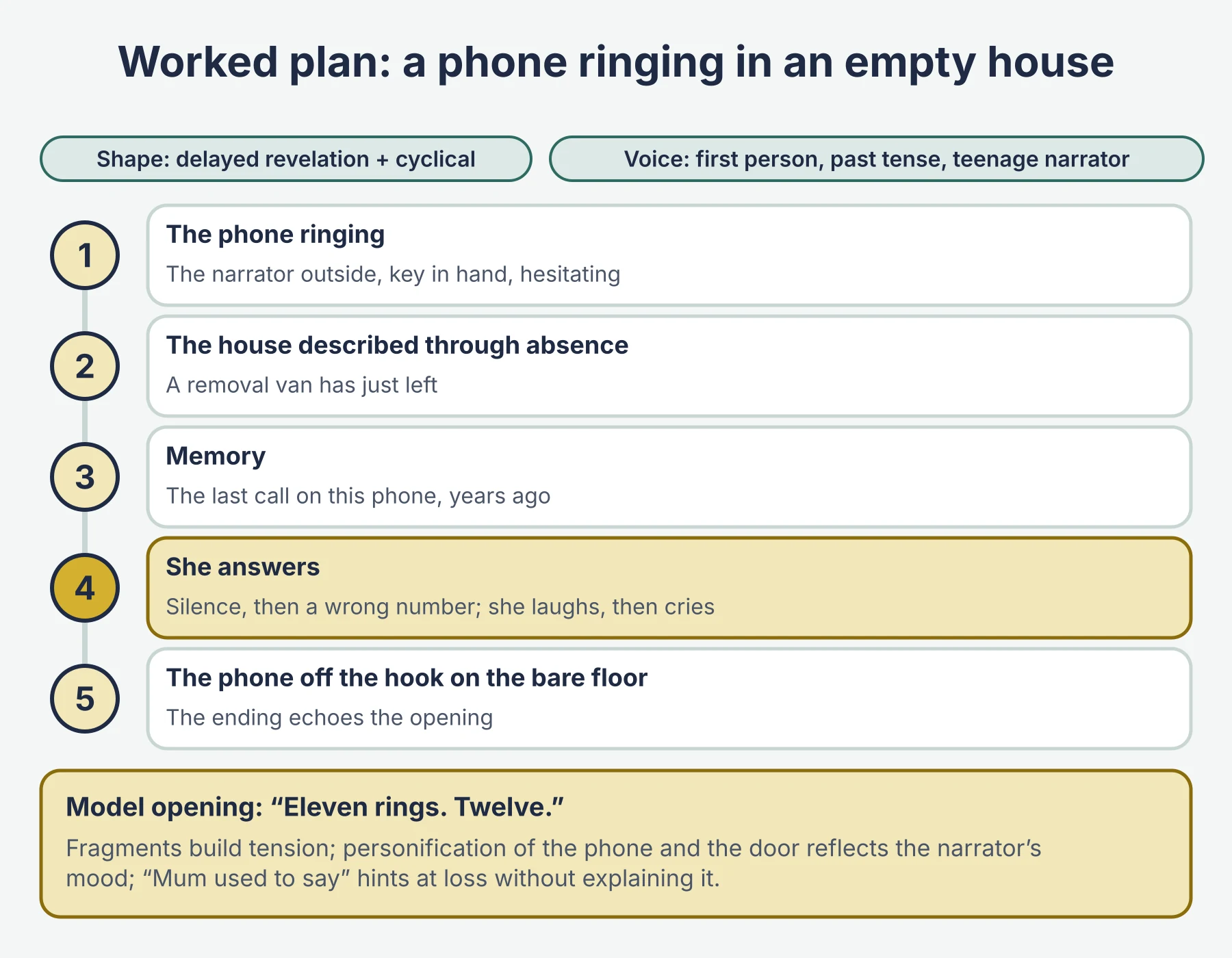
Shape:     delayed revelation + cyclical
Voice:     first person, past tense, a teenage narrator
Para 1:    the phone ringing; the narrator outside, key in hand, hesitating
Para 2:    the house described through absence - a removal van has just left
Para 3:    memory: the last call on this phone, years ago
Para 4:    she answers; silence, then a wrong number; she laughs, then cries
Para 5:    she leaves the phone off the hook on the bare floor; ending echoes opening
Model opening:
The phone was still ringing when I reached the gate. Nobody rings a landline any more, Mum used to say, and yet there it was, shrill and stubborn, filling a house that had been emptied that morning down to the last lampshade. I stood with the key in my hand. Eleven rings. Twelve. The front door had always stuck in winter; now it opened at the first push, as if the house had given up arguing.
What earns credit:
- AO4: a clear voice from the first line; a hint of loss (“Mum used to say”, the emptied house) without explanation, so the reader is drawn in; personification of the phone and the door that reflects the narrator’s mood.
- AO5: varied sentence lengths, including fragments (“Eleven rings. Twelve.”) used for tension; a semicolon balancing past and present; precise vocabulary (“shrill”, “stubborn”).
Improving a weak paragraph
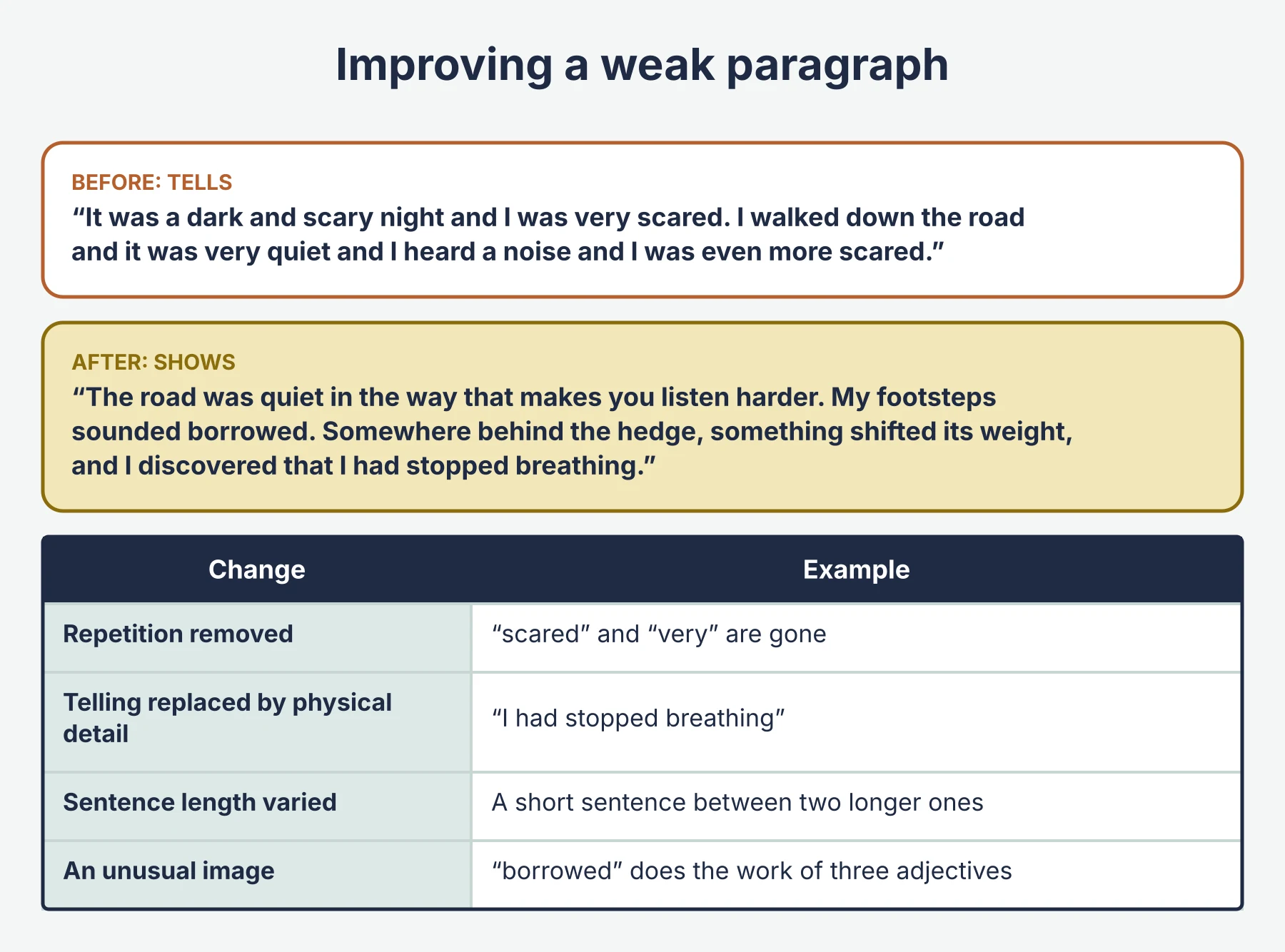
Before: It was a dark and scary night and I was very scared. I walked down the road and it was very quiet and I heard a noise and I was even more scared.
After: The road was quiet in the way that makes you listen harder. My footsteps sounded borrowed. Somewhere behind the hedge, something shifted its weight, and I discovered that I had stopped breathing.
The revision removes repetition (“scared”, “very”), replaces telling with physical detail, varies sentence length and uses an unusual image (“borrowed”) that does the work of three adjectives.
Slowing down the key moment
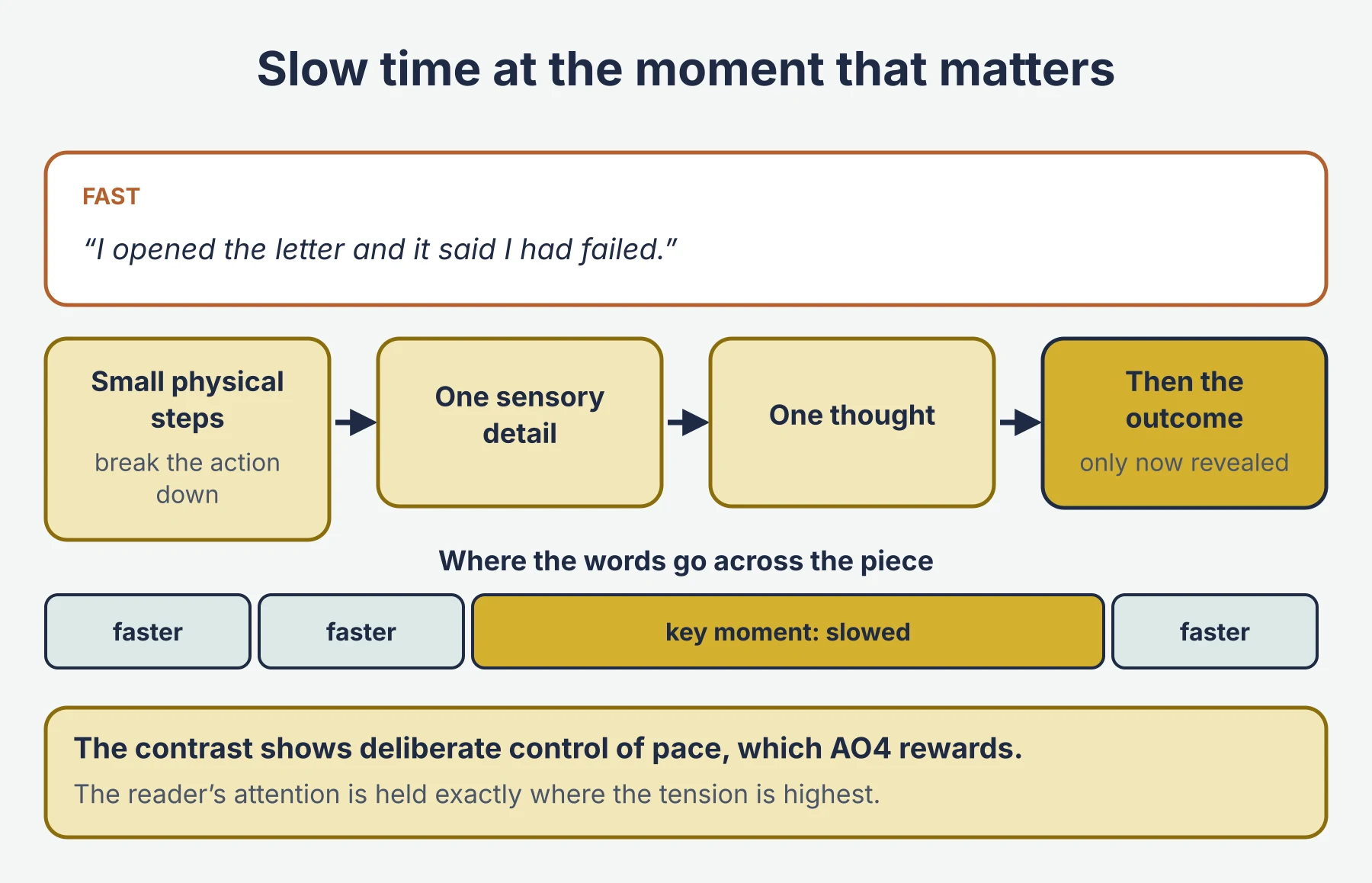
Most pieces have one moment that matters most: a door opening, a decision, a discovery. Strong writers slow time there. Instead of “I opened the letter and it said I had failed”, break the action into small physical steps, add one sensory detail and one thought, and only then reveal the outcome. The reader’s attention is held exactly where the tension is highest, and the contrast with faster paragraphs elsewhere shows deliberate control of pace, which AO4 rewards.
AO5: technical control under time pressure
- Vary sentence openings: not every sentence should start with “I” or “The”.
- Use a range of punctuation accurately: dashes, semicolons, colons, and correctly punctuated dialogue.
- Paragraph for changes of time, place, speaker or focus.
- Keep tense consistent.
- Leave three minutes to proofread; correct neatly.
Common mistakes
- Over-plotting: car chases, explosions and twists crammed into four paragraphs.
- No ending: the story stops because time ran out.
- Telling emotions instead of showing them.
- Dialogue-heavy pieces with little description or development.
- Adjective lists in place of precise vocabulary.
- Tense drift between past and present without purpose.
- Ignoring the prompt in favour of a prepared story that fits it only loosely.
Exam technique
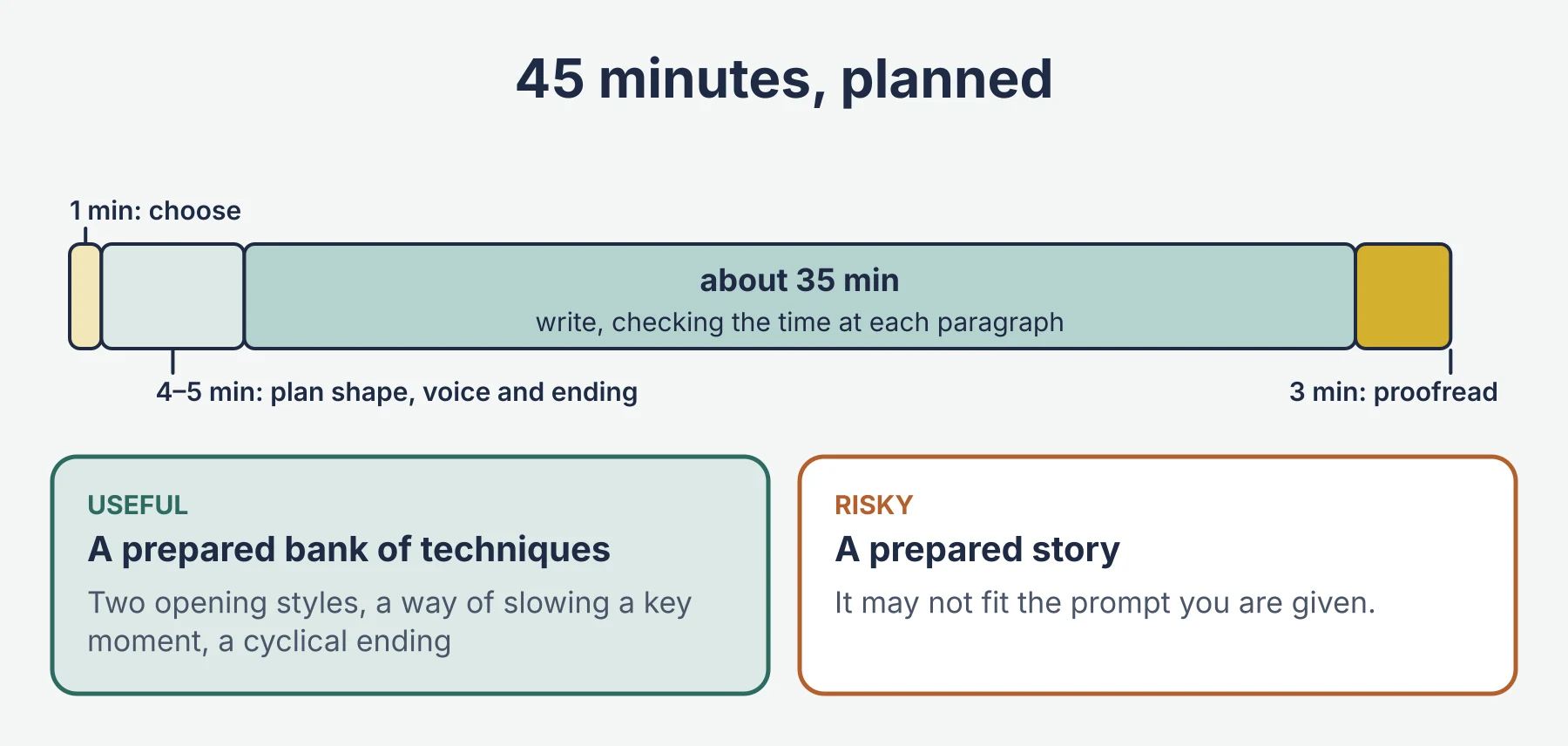
- One minute to choose the prompt.
- Four or five minutes to plan shape, voice and ending.
- About 35 minutes writing, checking the time at each paragraph.
- Three minutes proofreading.
A prepared bank of techniques (two opening styles, a way of slowing a key moment, a cyclical ending) is useful; a prepared story is risky, because it may not fit the prompt you are given.
Where to go next
- Section B Imaginative Writing revision notes
- Section B Imaginative Writing practice questions
- Section A Poetry and Prose Texts study guide
Official specification
Pearson Edexcel International GCSE in English Language (Specification A) 4EA1, Issue 7 (August 2025), Component 2 — qualifications.pearson.com.
Related resources
-
Revision notes
Edexcel IGCSE English Language: Non-fiction Texts and Transactional Writing — Revision Notes
Condensed recall notes on reading non-fiction, language analysis, comparison and transactional writing for Edexcel International GCSE English Language 4EA1.
English · Pearson Edexcel · IGCSE
Revise topic -
Practice questions
Pearson Edexcel IGCSE English Language (4EA1): Section B Imaginative Writing – Practice Questions
Original imaginative writing practice for 4EA1 Paper 2 Section B: short craft drills and three-prompt timed tasks with AO4 and AO5 marking guidance.
English · Pearson Edexcel · IGCSE
Try questions -
Revision notes
Pearson Edexcel IGCSE English Language (4EA1): Section B Imaginative Writing – Revision Notes
Quick-recall notes for 4EA1 Paper 2 imaginative writing: AO4 and AO5, structure shapes, voice, show-not-tell, dialogue rules, traps and a self-test.
English · Pearson Edexcel · IGCSE
Revise topic
Get free revision emails (optional)
Occasional emails with practice questions, worked explanations and links to free resources for the qualification and subjects you choose. No spam, and you can unsubscribe from any email. The free tools on this site never need an email.