
Study Guides
Pearson Edexcel IGCSE English Language (4EA1): Section A Poetry and Prose Texts
How to write the 30-mark Anthology Part 2 essay in 4EA1 Paper 2 Section A: AO1 and AO2, reading poems and stories, a worked plan and model paragraphs.
- Subject
- English
- Level
- IGCSE
- Topic
- Component 2 – Poetry and Prose Texts and Imaginative Writing
- Author
- Marlbridge Academic Team
- Updated
- Reviewed by
- Ammar Bilal (what this means)
Aligned to Pearson Edexcel IGCSE English (4EA1), For first teaching 2016 (Issue 7, August 2025). Official specification .
Syllabus page (what it covers and how it is assessed): Pearson Edexcel IGCSE English Language.
Found an error? Report a correction.
Need help with this topic? Request a free trial class for IGCSE English Language (4EA1).
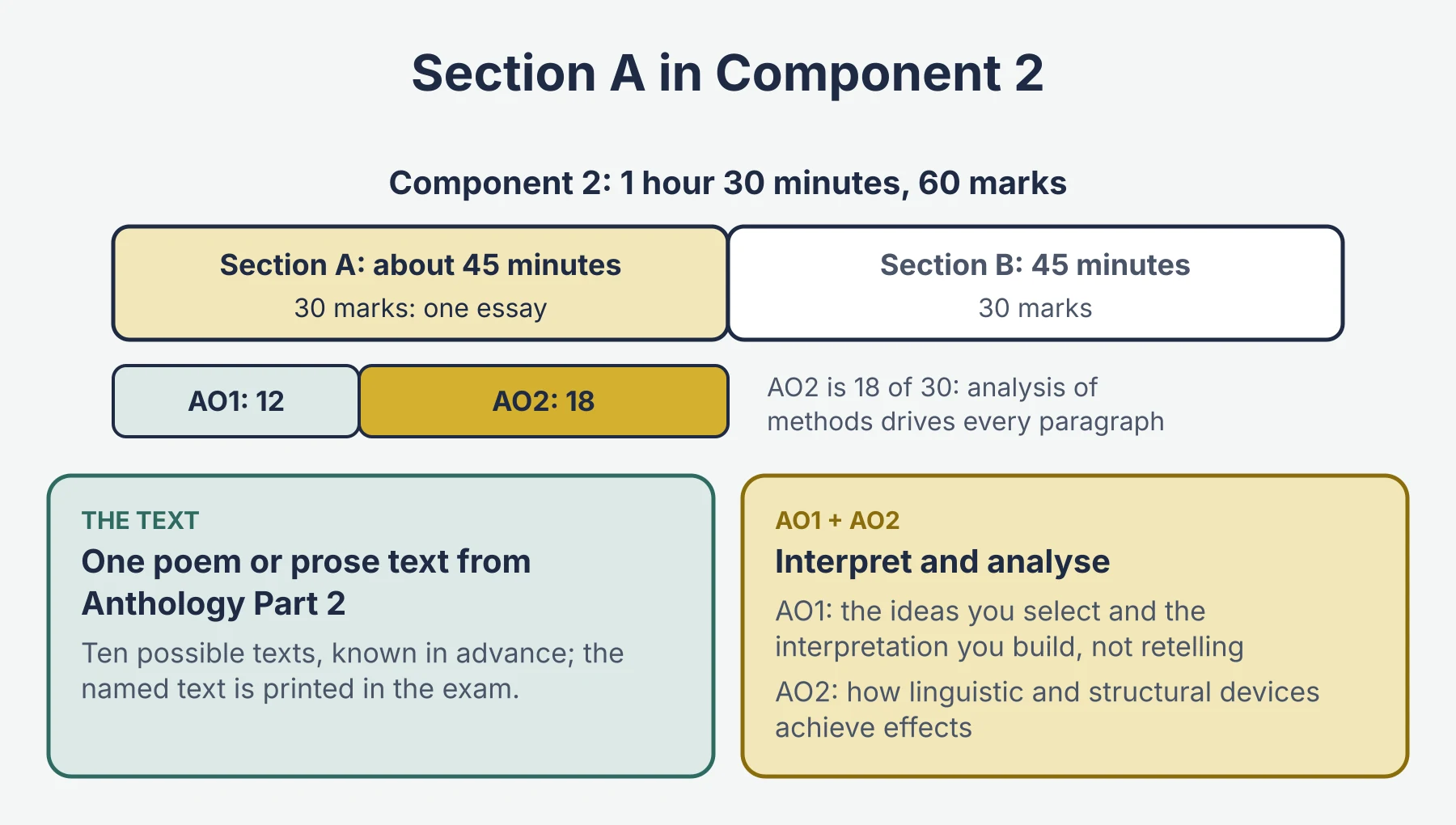
Section A of Component 2 is a single essay on one poem or prose text from Part 2 of the Pearson Edexcel International GCSE English Anthology. You know the ten possible texts in advance, and the named text is printed in the exam. This guide explains how the essay is assessed, how to prepare each text, and how to turn a question into a 45-minute answer. For the paper as a whole, see the Component 2 overview.
What Section A covers
| Detail | Section A: Poetry and Prose Texts |
|---|---|
| Task | One essay question on a poetry or prose text from Anthology Part 2 |
| Text | Made available in the examination |
| Marks | 30: AO1 12, AO2 18 |
| Advised time | About 45 minutes |
| Paper | Component 2 is 1 hour 30 minutes and 60 marks in total |
AO1: read and understand a variety of texts, selecting and interpreting information, ideas and perspectives. AO2: understand and analyse how writers use linguistic and structural devices to achieve their effects.
AO2 is worth 18 of the 30 marks, so analysis of the writer’s methods should drive every paragraph. AO1 is shown through the ideas you select and the interpretation you build, not through retelling.
The ten Part 2 texts
| Poetry | Prose |
|---|---|
| “Disabled”, Wilfred Owen | “The Story of an Hour”, Kate Chopin |
| “Out, Out–”, Robert Frost | “The Necklace”, Guy de Maupassant |
| “An Unknown Girl”, Moniza Alvi | “Significant Cigarettes” (from The Road Home), Rose Tremain |
| “The Bright Lights of Sarajevo”, Tony Harrison | “Whistle and I’ll Come to You” (from The Woman in Black), Susan Hill |
| “Still I Rise”, Maya Angelou | “Night”, Alice Munro |
The anthology is fixed by specification issue; check the current list with your teacher before revising.
Preparing each text
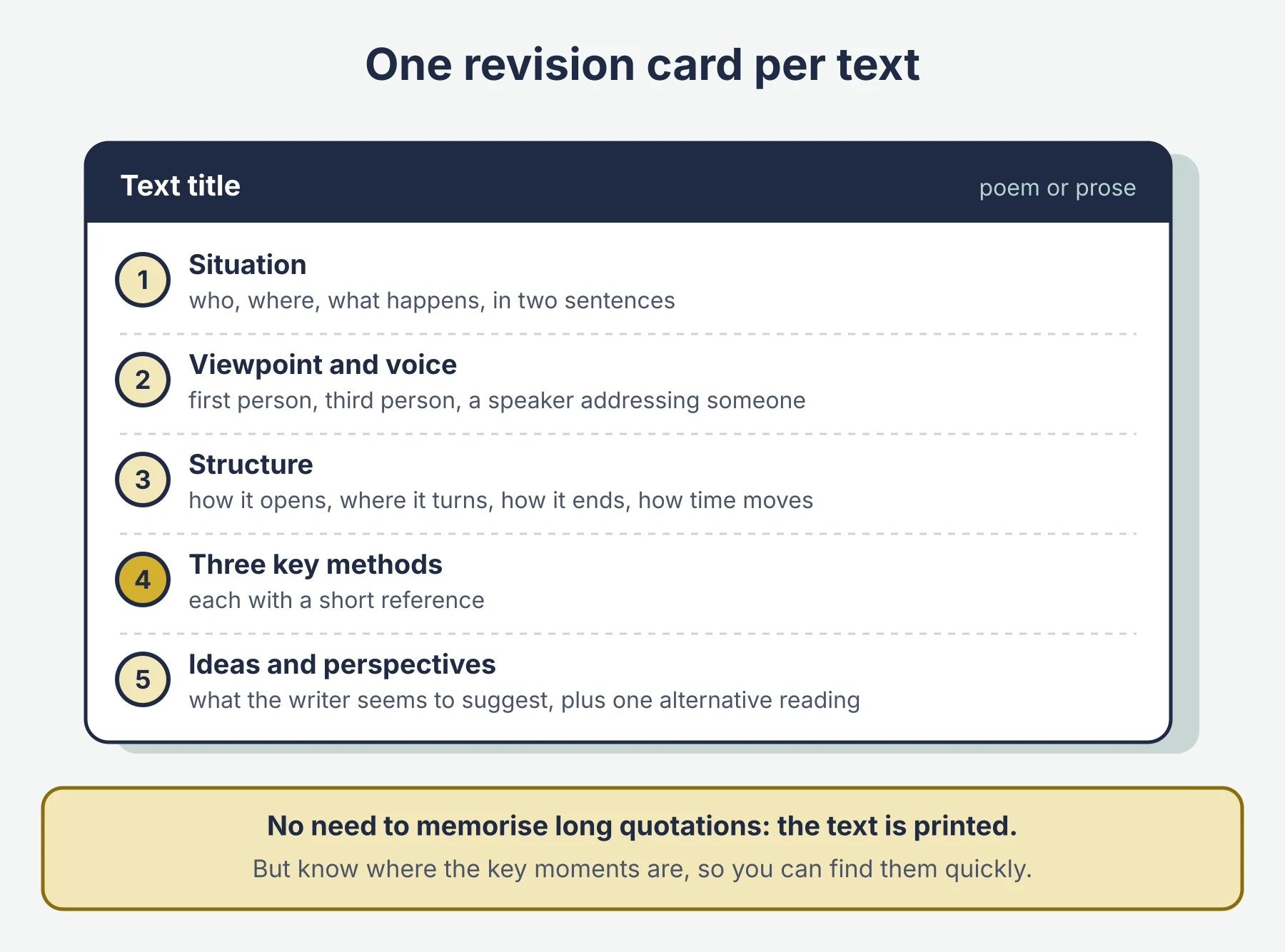
Build one revision card per text with five headings:
- Situation: who, where, what happens, in two sentences.
- Viewpoint and voice: first person, third person, a speaker addressing someone.
- Structure: how the text opens, where it turns, how it ends, how time moves.
- Three key methods with a short reference for each.
- Ideas and perspectives: what the writer seems to suggest, and one alternative reading.
Because the text is printed in the exam, you do not need to memorise long quotations. You do need to know where the key moments are, so you can find them quickly.
Reading a poem for AO2
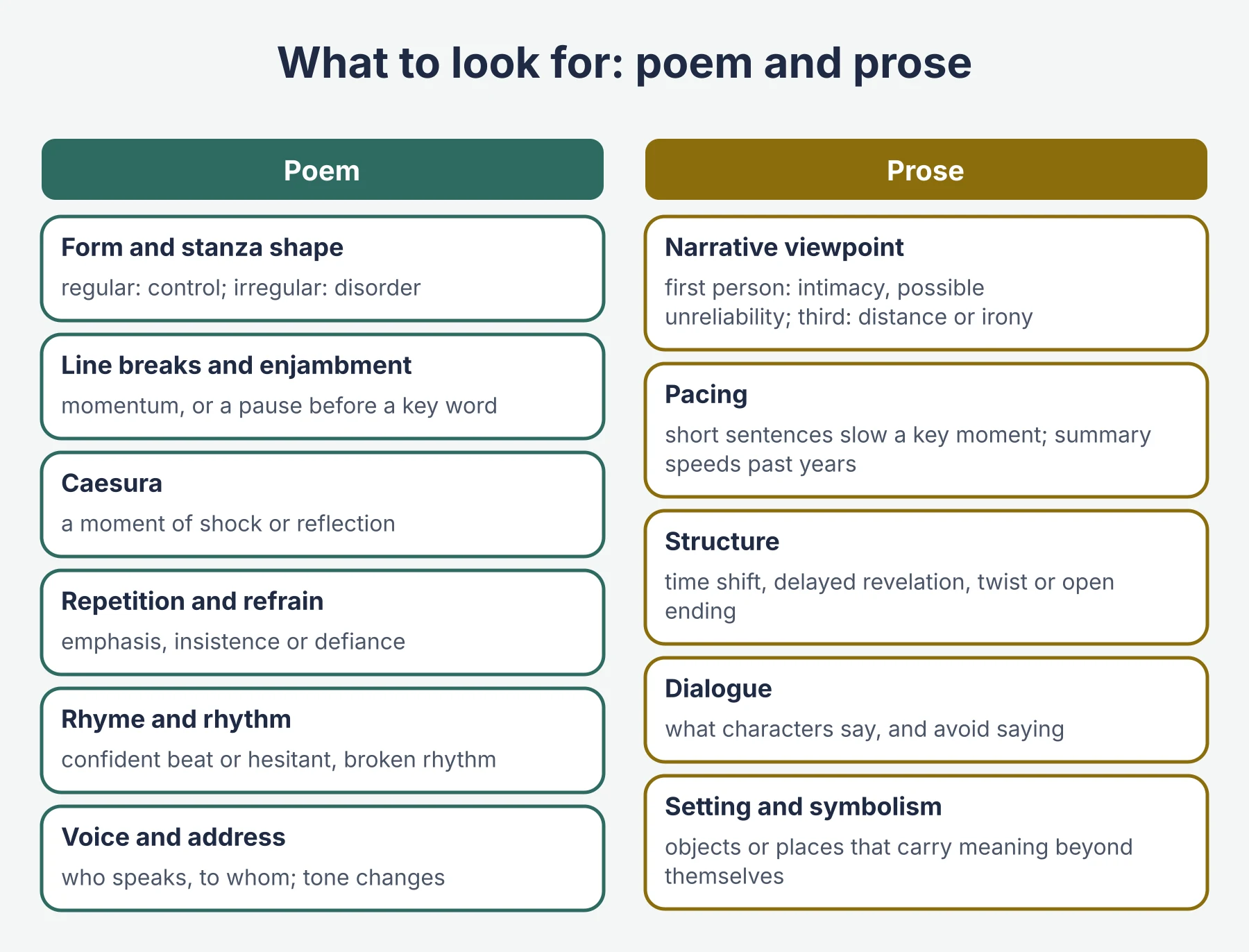
- Form and stanza shape: regular stanzas suggest control; irregular ones can mirror disorder.
- Line breaks and enjambment: a sentence running over a line can create momentum or a pause before a key word.
- Caesura: a mid-line break, often a moment of shock or reflection.
- Repetition and refrain: emphasis, insistence or defiance.
- Rhyme and rhythm: a regular beat can sound confident; broken rhythm can sound hesitant.
- Voice and address: who speaks, and to whom; how the tone changes.
Reading a prose text for AO2
- Narrative viewpoint: a first-person narrator gives intimacy and possible unreliability; third person gives distance or irony.
- Pacing: short sentences and close detail slow a key moment; summary speeds past years.
- Structure: a time shift, a delayed revelation, a twist ending, an open ending.
- Dialogue: what characters say, and what they avoid saying.
- Setting and symbolism: objects or places that carry meaning beyond themselves.
Worked example: a prose question
Question (original): Explore how the writer presents the consequences of pride in “The Necklace”. In your answer you should consider the writer’s use of language and structure.
Plan (five minutes):
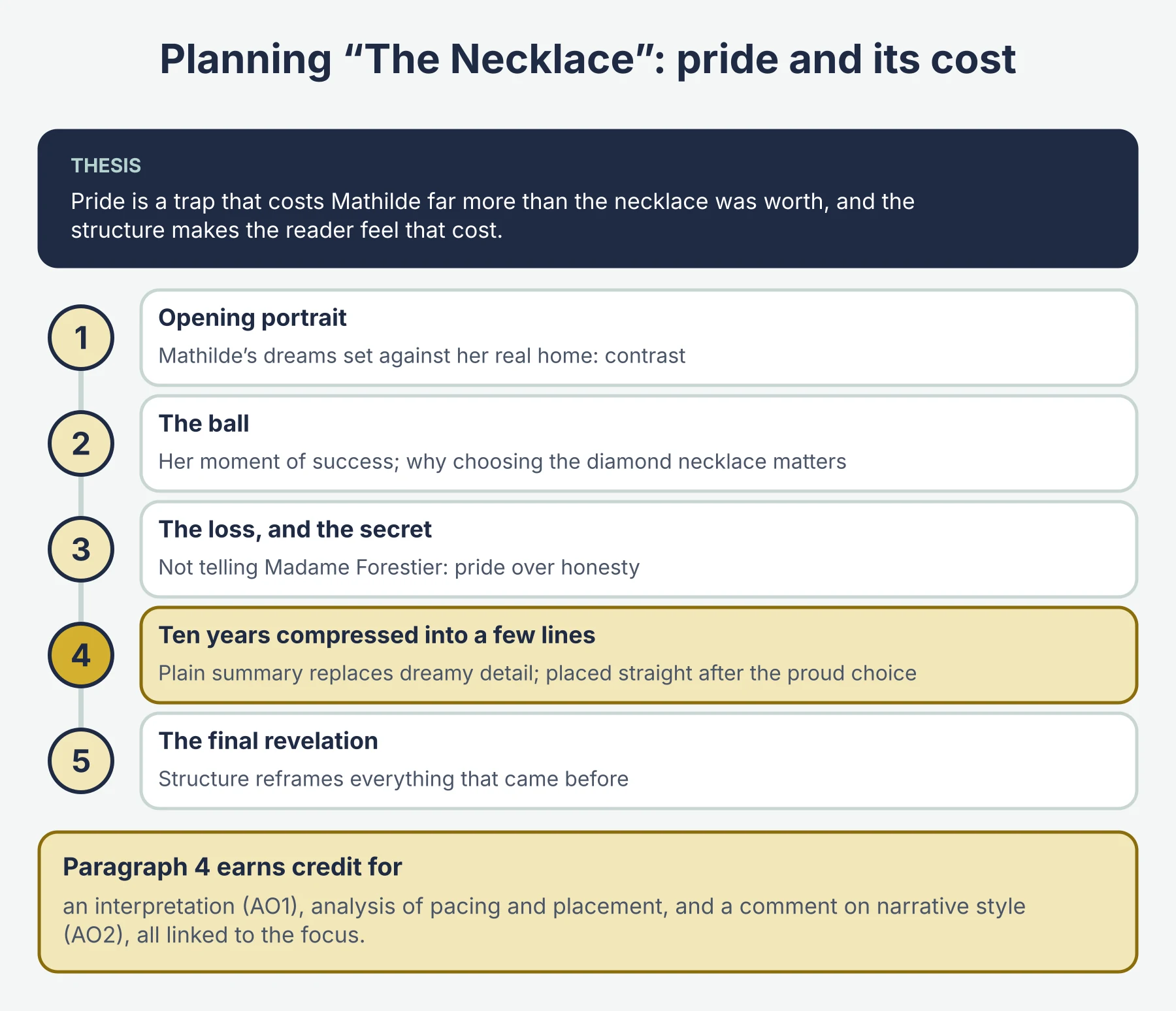
Thesis:   Maupassant presents pride as a trap that costs Mathilde far more than
          the necklace was worth, and the structure makes the reader feel that cost.
Para 1:   Opening portrait - Mathilde's dreams set against her real home (contrast)
Para 2:   The ball - her moment of success; why choosing the diamond necklace matters
Para 3:   The loss and the decision not to tell Madame Forestier - pride over honesty
Para 4:   Ten years compressed into a few lines; the change in her appearance
Para 5:   The final revelation - structure reframes everything that came before
Model paragraph (paragraph 4):
Maupassant compresses ten years of hardship into a short passage of summary, so the reader feels the sudden weight of time that Mathilde’s pride has cost her. The narration lists her labour and the household economies plainly, without the dreamy detail that described her wishes at the start, and this shift in style mirrors her loss of illusions. By placing this summary immediately after the decision to replace the necklace secretly, the writer makes the consequence feel like a direct result of that one proud choice, preparing the reader for the irony of the ending.
What earns credit: an interpretation (AO1), structural analysis of pacing and placement, and a comment on narrative style (AO2), all linked to the focus of the question.
Worked example: a poetry paragraph
Question (original): Explore how Owen presents loss in “Disabled”.
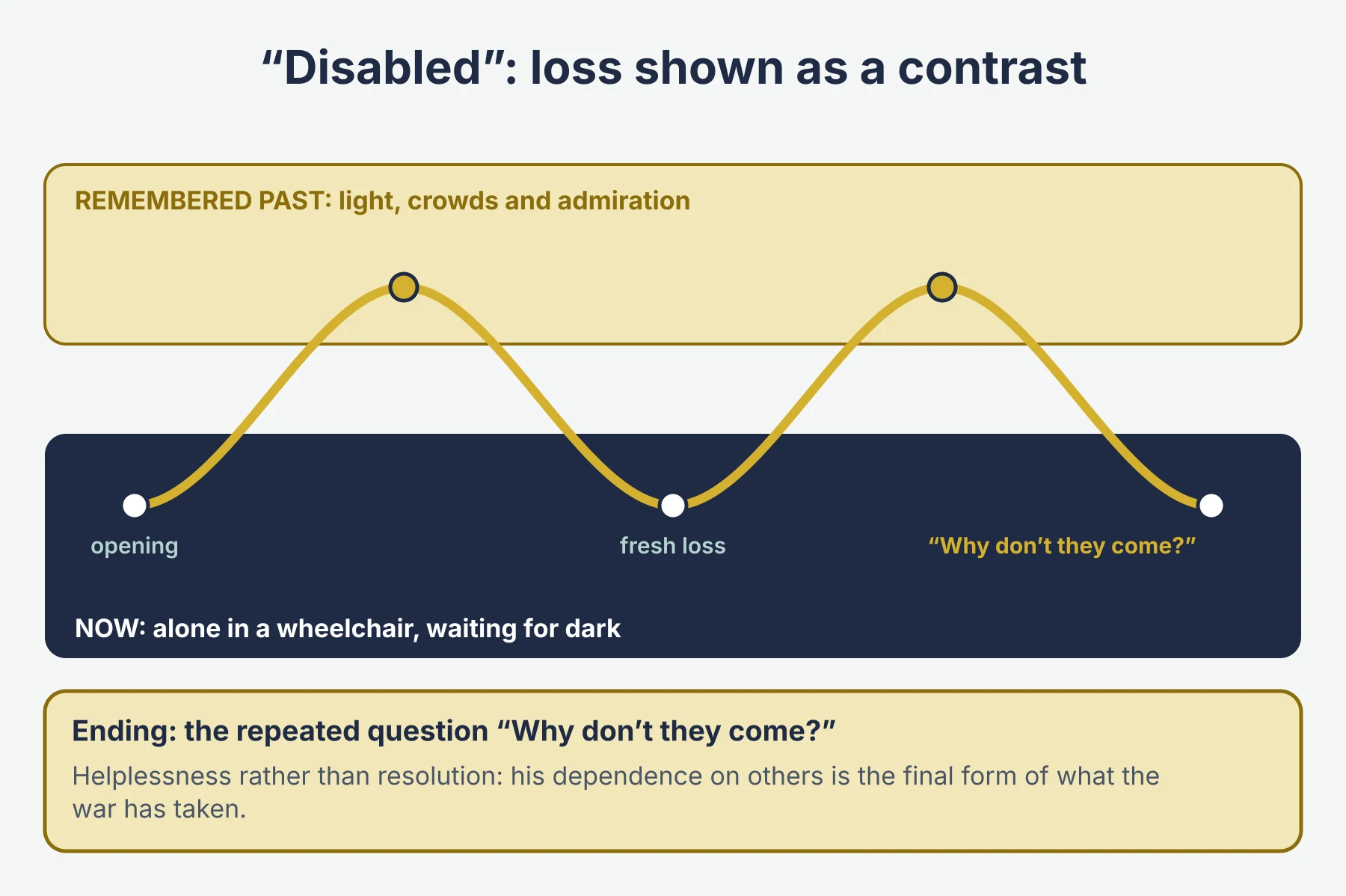
Owen structures the poem around a movement between the man’s bleak situation now and remembered scenes of his past, so loss is shown as a contrast rather than simply stated. The opening places him alone in a wheelchair, waiting for dark, while the memories are full of light, crowds and admiration; each return to the present therefore feels like a fresh loss. The poem closes with the repeated question “Why don’t they come?”, which ends on helplessness rather than resolution: the reader is left with the man’s dependence on others, the final form of what the war has taken.
Building the essay
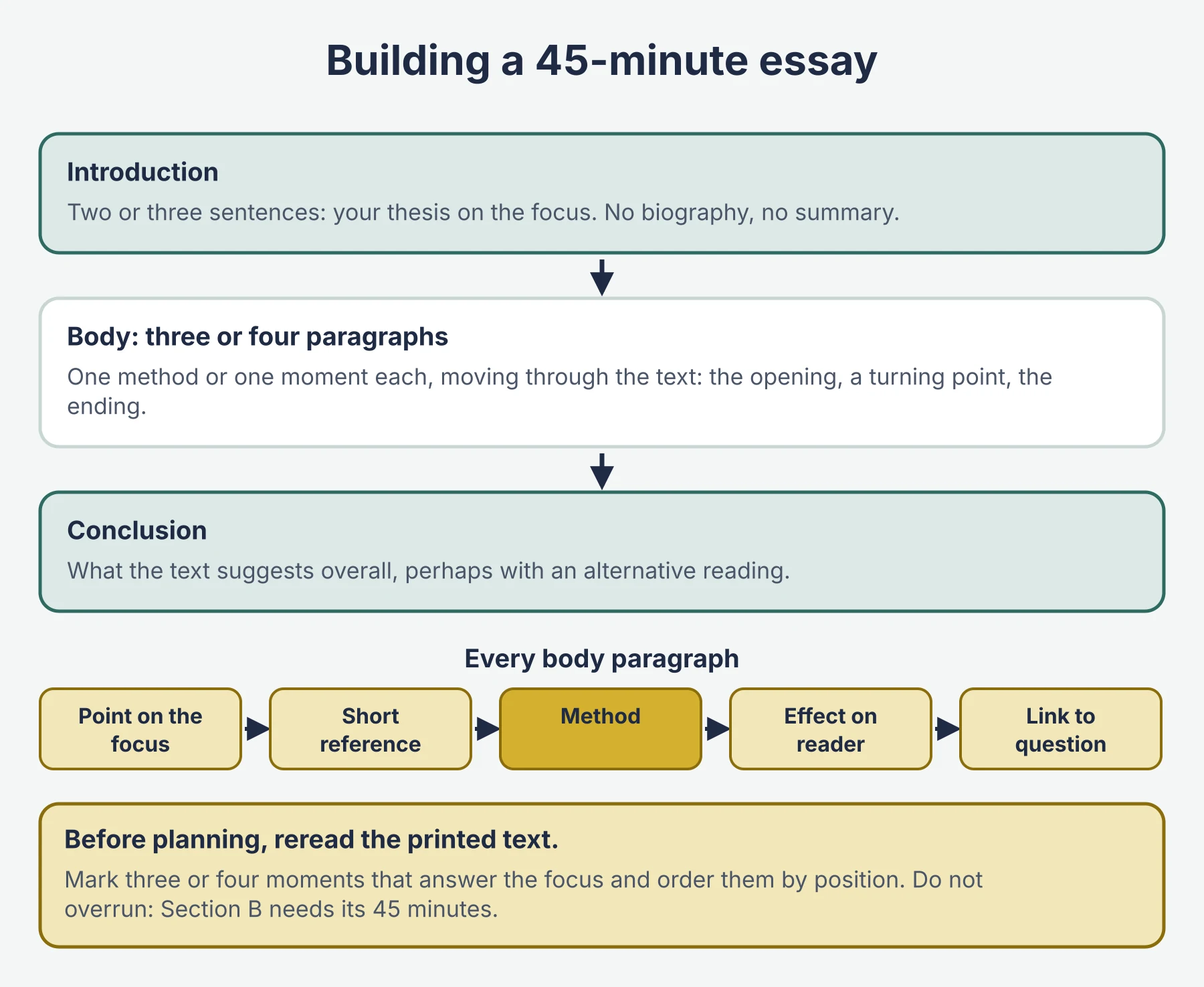
- Introduction: two or three sentences giving your thesis on the focus. No biography, no summary.
- Body: three or four paragraphs, each on one method or one moment, moving through the text so that you cover the opening, a turning point and the ending.
- Every paragraph: point on the focus, short reference, analysis of the method, effect on the reader, link back to the question.
- Conclusion: a sentence or two on what the text suggests overall, perhaps with an alternative reading.
Common mistakes
- Retelling the story or paraphrasing the poem. Retelling demonstrates basic understanding only.
- Feature-spotting without explaining effect.
- Ignoring structure, especially endings, which often carry the writer’s main point.
- Writing about the whole text with equal weight, so nothing is analysed in depth.
- Drifting from the focus named in the question into a general essay.
- Overrunning: Section B is worth the same 30 marks and needs its 45 minutes.
Exam technique and command words
| Command | What it asks |
|---|---|
| Explore how the writer presents… | Analyse methods and their effects on the named focus, not just describe content |
| Consider the writer’s use of language and structure | Cover both; structure is not optional |
| Support your answer with references | Short quotations or precise references to moments |
Read the printed text again before planning, even if you know it well. Mark three or four moments that answer the focus, then order them by position in the text so your essay tracks its structure.
Where to go next
- Section A Poetry and Prose Texts revision notes
- Section A Poetry and Prose Texts practice questions
- Section B Imaginative Writing study guide
Official specification
Pearson Edexcel International GCSE in English Language (Specification A) 4EA1, Issue 7 (August 2025), Component 2 — qualifications.pearson.com.
Related resources
-
Revision notes
Edexcel IGCSE English Language: Non-fiction Texts and Transactional Writing — Revision Notes
Condensed recall notes on reading non-fiction, language analysis, comparison and transactional writing for Edexcel International GCSE English Language 4EA1.
English · Pearson Edexcel · IGCSE
Revise topic -
Practice questions
Pearson Edexcel IGCSE English Language (4EA1): Section A Poetry and Prose Texts – Practice Questions
Short AO2 skills questions on an original poem and story, plus 30-mark Anthology Part 2 essay tasks with indicative content, for 4EA1 Paper 2 Section A.
English · Pearson Edexcel · IGCSE
Try questions -
Revision notes
Pearson Edexcel IGCSE English Language (4EA1): Section A Poetry and Prose Texts – Revision Notes
Quick-recall notes for 4EA1 Paper 2 Section A: the ten Anthology Part 2 texts, AO1 and AO2, poetry and prose terms, essay shape, traps and a self-test.
English · Pearson Edexcel · IGCSE
Revise topic
Get free revision emails (optional)
Occasional emails with practice questions, worked explanations and links to free resources for the qualification and subjects you choose. No spam, and you can unsubscribe from any email. The free tools on this site never need an email.