
Revision Notes
Pearson Edexcel IGCSE English Language (4EA1): Section A Poetry and Prose Texts – Revision Notes
Quick-recall notes for 4EA1 Paper 2 Section A: the ten Anthology Part 2 texts, AO1 and AO2, poetry and prose terms, essay shape, traps and a self-test.
- Subject
- English
- Level
- IGCSE
- Topic
- Component 2 – Poetry and Prose Texts and Imaginative Writing
- Author
- Marlbridge Academic Team
- Updated
- Reviewed by
- Ammar Bilal (what this means)
Aligned to Pearson Edexcel IGCSE English (4EA1), For first teaching 2016 (Issue 7, August 2025). Official specification .
Syllabus page (what it covers and how it is assessed): Pearson Edexcel IGCSE English Language.
Found an error? Report a correction.
Need help with this topic? Request a free trial class for IGCSE English Language (4EA1).
Condensed notes for the reading essay in Component 2 of Pearson Edexcel International GCSE English Language A (4EA1). For explanations and worked paragraphs, use the Section A Poetry and Prose Texts study guide.
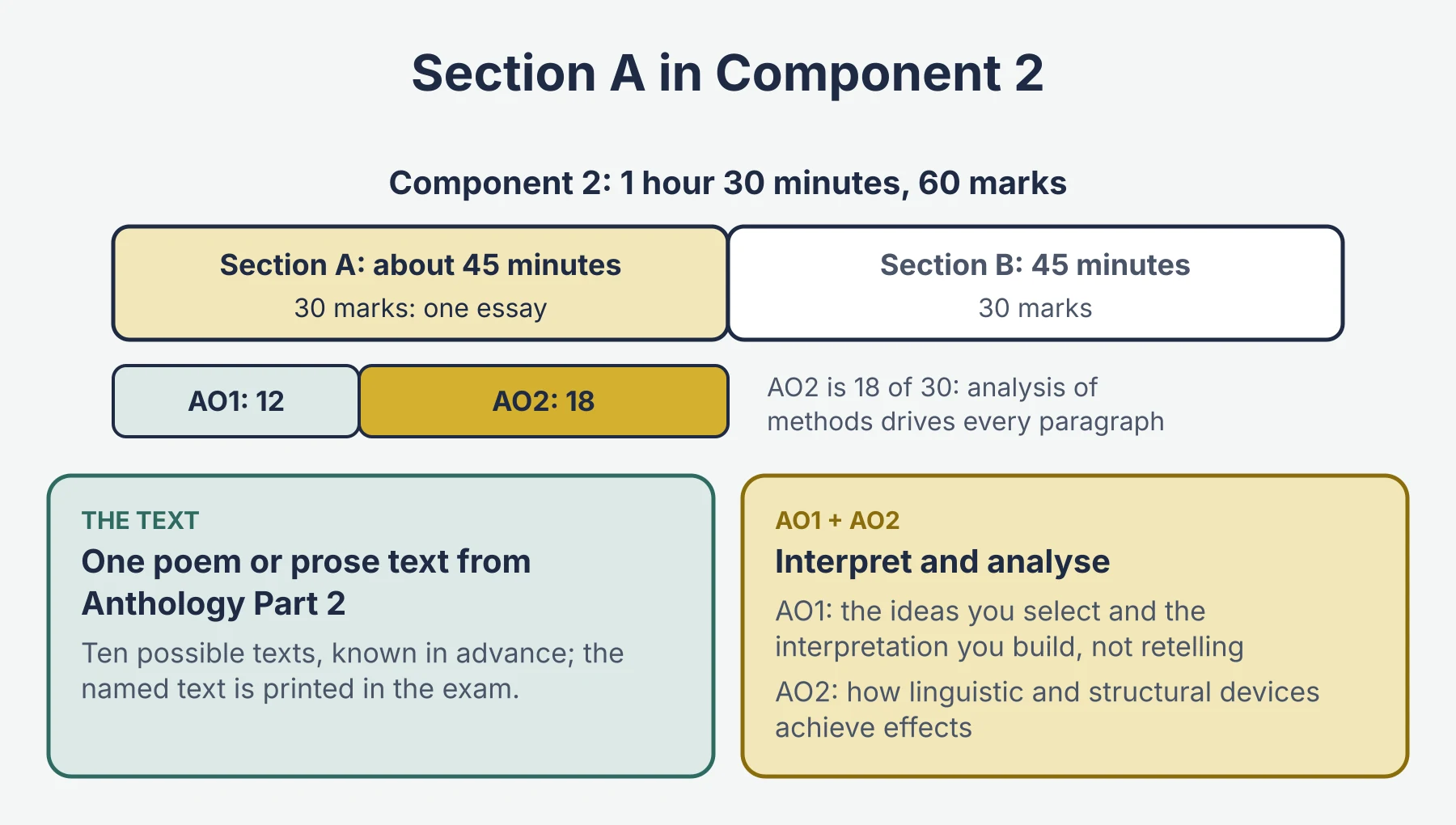
The task in one box
| Detail | Section A |
|---|---|
| Task | One essay on one Part 2 poem or prose text, named in the question |
| Text provided? | Yes, made available in the examination |
| Marks | 30: AO1 12, AO2 18 |
| Advised time | About 45 minutes |
Text revision grid
| Text | Situation in brief | Methods worth revising |
|---|---|---|
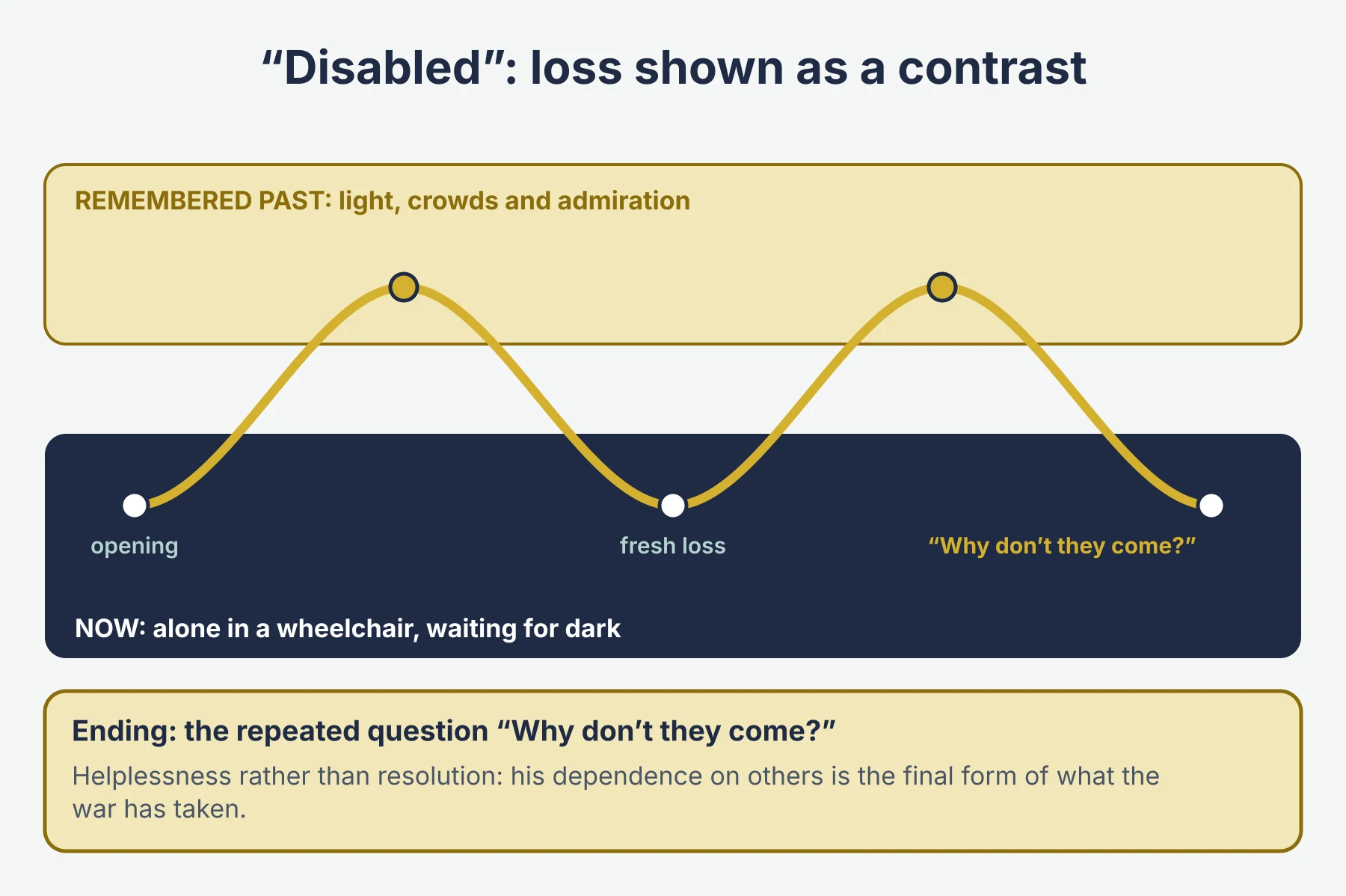
| “Disabled” (Owen) | A young soldier, badly wounded in the war, sits in a wheelchair remembering his life before | Contrast of past and present; light and dark imagery; closing repeated question |
| “Out, Out–” (Frost) | A boy on a farm is fatally injured by a buzz saw | Personification of the saw; calm narrative voice; abrupt ending |
| “An Unknown Girl” (Alvi) | A speaker visiting an Indian bazaar has henna applied by a girl she does not know | Short lines; present tense; imagery of the henna; identity and belonging |
| “The Bright Lights of Sarajevo” (Harrison) | Young people meet and court in a city under wartime siege | Contrast of darkness and light; hope amid danger |
| “Still I Rise” (Angelou) | A speaker defies those who would oppress her | Refrain; rhetorical questions; similes; direct address |
| “The Story of an Hour” (Chopin) | A wife told of her husband’s death feels unexpected freedom | Open-window imagery; repetition of “free”; ironic final sentence |
| “The Necklace” (Maupassant) | A woman borrows a necklace, loses it and spends ten years repaying a replacement | Contrast of dreams and reality; time compression; twist ending |
| “Significant Cigarettes” (Tremain) | Lev, a migrant travelling to London, meets a fellow passenger | Close third-person viewpoint; cigarettes as a motif; memory of home |
| “Whistle and I’ll Come to You” (Hill) | A narrator staying at an isolated house on the marshes, with only a dog for company, is drawn into danger | First-person retrospective narration; Gothic setting; sound and suspense |
| “Night” (Munro) | A narrator recalls sleepless nights in her youth and a conversation with her father | Retrospective adult voice; night setting; restrained dialogue |
AO1 and AO2 in practice
| Objective | Shown by | Not shown by |
|---|---|---|
| AO1 (12) | Selecting apt moments; interpreting ideas and perspectives; a clear line of argument | Retelling the plot |
| AO2 (18) | Explaining how specific choices of language and structure create effects | Naming devices with no effect |
Key terms
| Term | Meaning |
|---|---|
| Enjambment | A sentence running on past the end of a line |
| Caesura | A pause within a line, usually marked by punctuation |
| Refrain | A repeated line or phrase |
| Volta | A turn in a poem’s argument or mood |
| Personification | Giving human qualities to a thing or idea |
| Narrative viewpoint | The position from which a story is told |
| Retrospective narration | Telling events from a later point in time |
| Pathetic fallacy | Setting or weather reflecting feeling |
| Irony | A gap between what is said or expected and what is true |
| Twist ending | A final revelation that changes the meaning of what came before |
| Motif | A repeated image or object that carries meaning |
| Time compression | Covering a long period in a short passage |
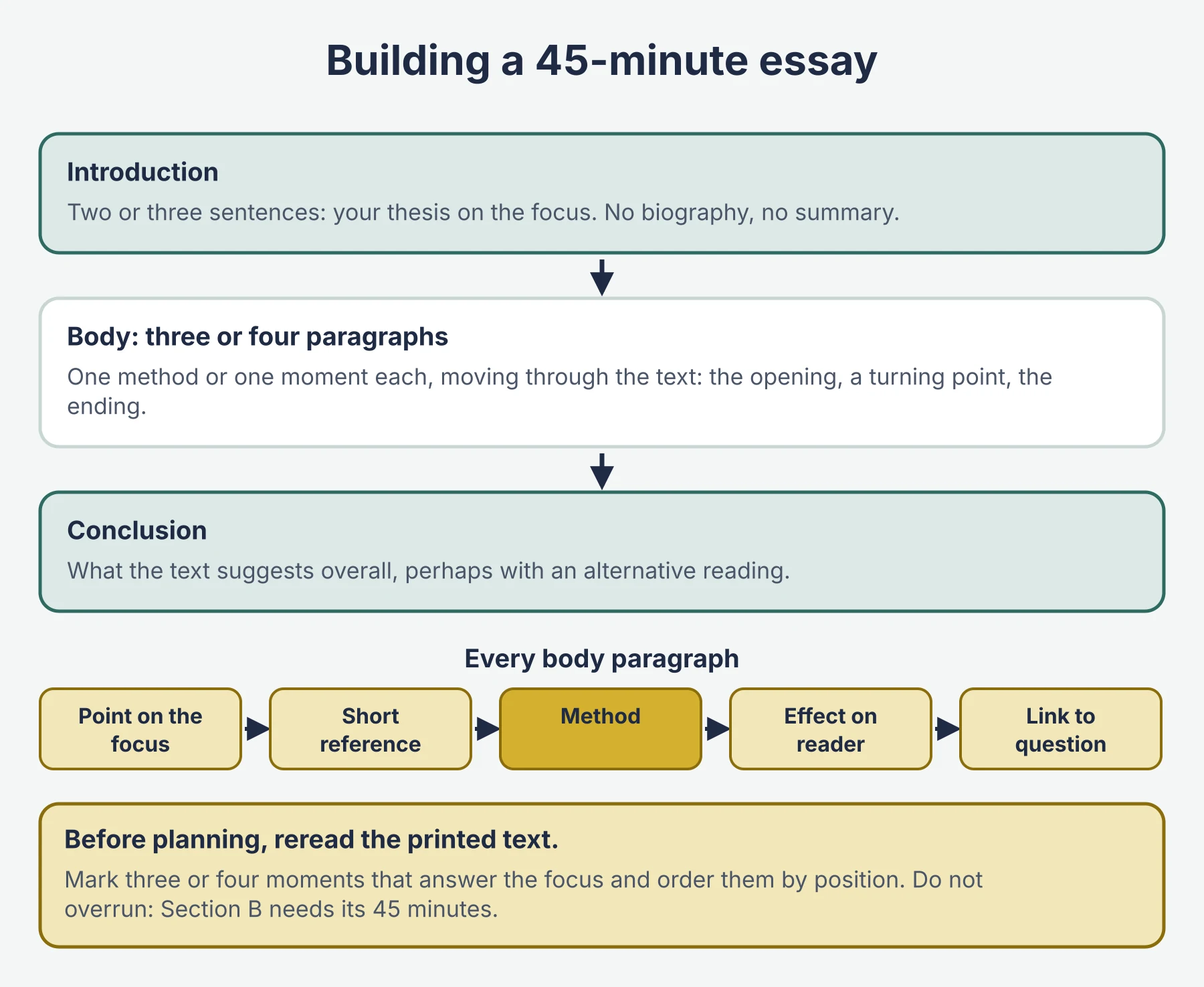
Essay shape
- Thesis: two sentences answering the focus.
- Three or four paragraphs, each on one moment or method, in the order they appear in the text.
- Each paragraph: point, short reference, method, effect, link to the focus.
- Conclusion: what the writer suggests overall; an alternative reading if you have one.
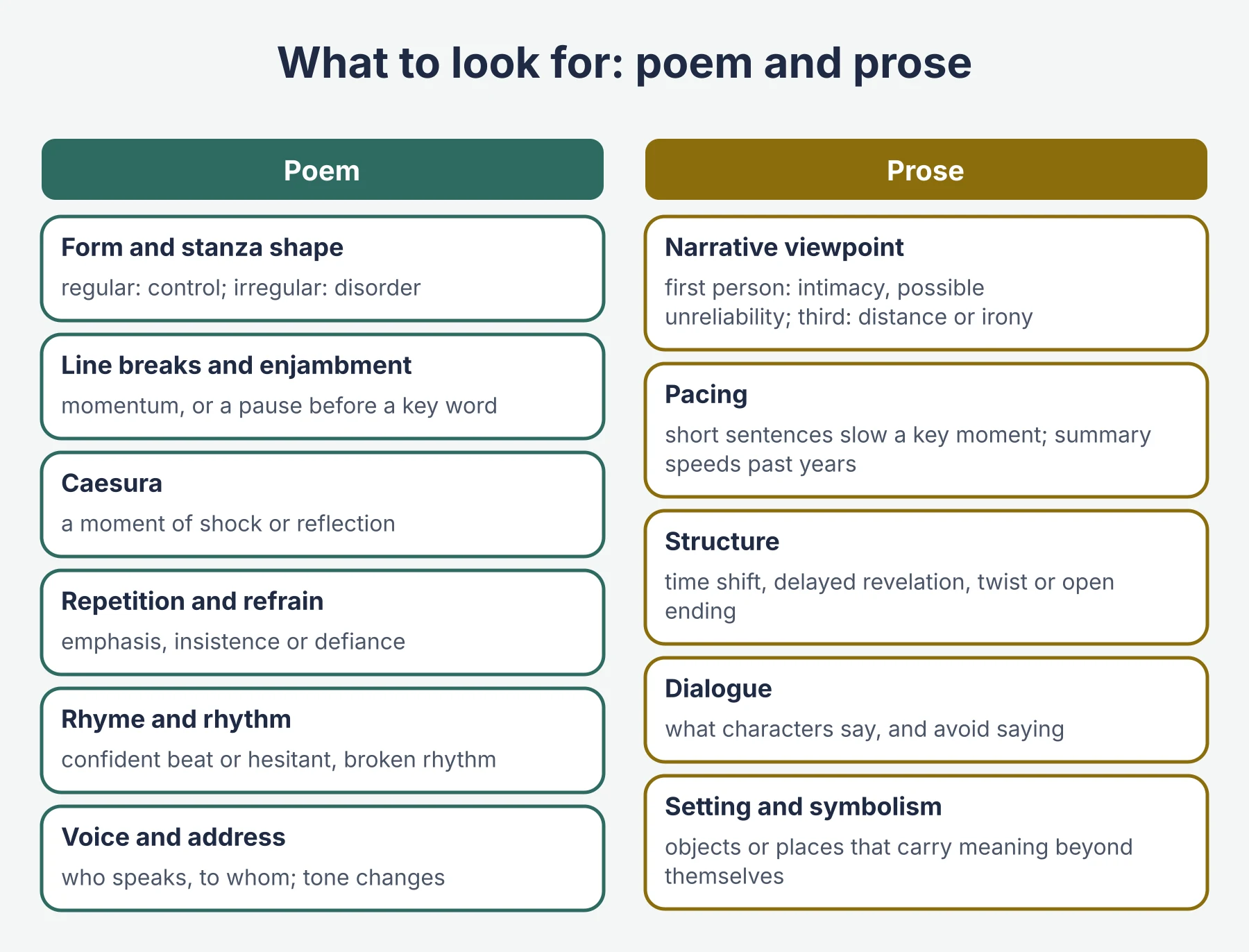
Poetry versus prose: what to look for
| Poetry | Prose |
|---|---|
| Stanza shape and line length | Paragraphing and sentence length |
| Line breaks and enjambment | Pacing: scene versus summary |
| Rhyme, rhythm, refrain | Dialogue and silence |
| Voice and addressee | Narrator and viewpoint |
| Final line or stanza | Ending: twist, open or closed |
Exam traps
- Summarising: retelling shows only basic understanding and leaves AO2 almost untouched.
- Feature lists without effects.
- Forgetting structure, especially the ending.
- Writing about context or the poet’s life at length: Section A assesses AO1 and AO2 only.
- Quoting long lines: choose a few words and analyse them closely.
- Spending more than 45 minutes and leaving Section B short.
Self-test
- How many marks is Section A worth, and how are they split between AOs?
- Will you have the text in the exam?
- Name the five poems in Anthology Part 2.
- Name the five prose texts.
- Which AO carries more marks, and what does that mean for your paragraphs?
- What is the difference between enjambment and caesura?
- Give two structural features to analyse in a prose text.
- What is a twist ending? Name a Part 2 text that uses one.
- Why is retelling the plot weak?
- Is context assessed in this section?
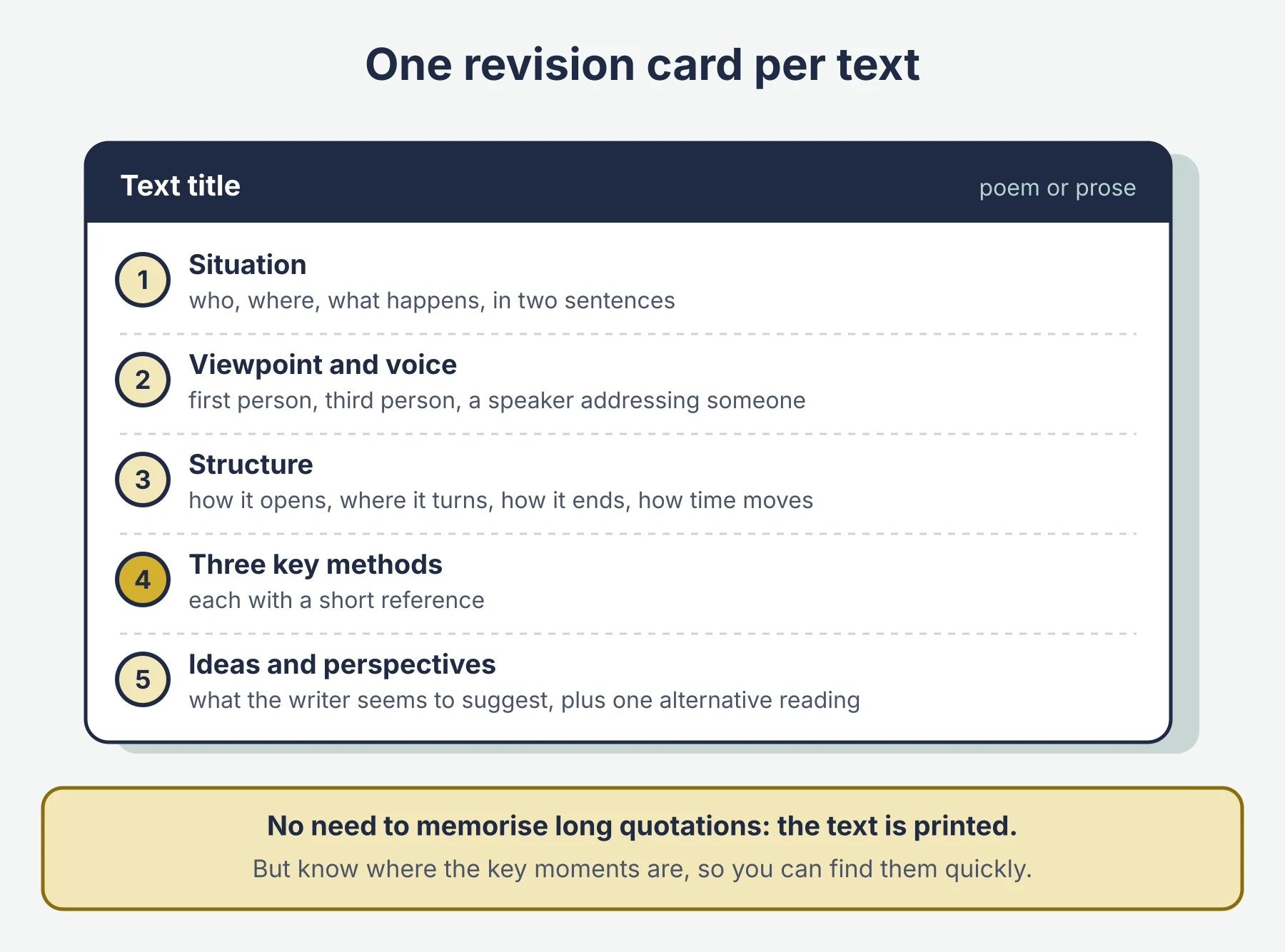
- What five headings could a revision card for each text use?
- How should you order your body paragraphs?
Answers: 1. 30 marks: AO1 12, AO2 18. 2. Yes, it is made available in the examination. 3. “Disabled”, “Out, Out–”, “An Unknown Girl”, “The Bright Lights of Sarajevo”, “Still I Rise”. 4. “The Story of an Hour”, “The Necklace”, “Significant Cigarettes”, “Whistle and I’ll Come to You”, “Night”. 5. AO2 (18); every paragraph should analyse language or structure. 6. Enjambment runs a sentence over a line break; caesura is a pause within a line. 7. Any two: viewpoint, pacing, time shifts, dialogue, the ending, delayed revelation. 8. A final revelation that changes the meaning of the story; “The Necklace” (or “The Story of an Hour”). 9. It shows only basic understanding and earns little AO2 credit. 10. No; only AO1 and AO2 are assessed. 11. Situation, viewpoint and voice, structure, key methods, ideas and perspectives. 12. In the order the moments appear in the text, so the essay tracks the structure.
Related pages
Related resources
-
Revision notes
Edexcel IGCSE English Language: Non-fiction Texts and Transactional Writing — Revision Notes
Condensed recall notes on reading non-fiction, language analysis, comparison and transactional writing for Edexcel International GCSE English Language 4EA1.
English · Pearson Edexcel · IGCSE
Revise topic -
Study guides
Pearson Edexcel IGCSE English Language (4EA1): Section B Imaginative Writing
Narrative and descriptive craft for the 30-mark imaginative writing task in 4EA1 Paper 2 Section B: AO4, AO5, structure, voice and an annotated model opening.
English · Pearson Edexcel · IGCSE
Read guide -
Practice questions
Pearson Edexcel IGCSE English Language (4EA1): Section B Imaginative Writing – Practice Questions
Original imaginative writing practice for 4EA1 Paper 2 Section B: short craft drills and three-prompt timed tasks with AO4 and AO5 marking guidance.
English · Pearson Edexcel · IGCSE
Try questions
Get free revision emails (optional)
Occasional emails with practice questions, worked explanations and links to free resources for the qualification and subjects you choose. No spam, and you can unsubscribe from any email. The free tools on this site never need an email.