
Revision Notes
Pearson Edexcel IGCSE English Language (4EA1): Section B Imaginative Writing – Revision Notes
Quick-recall notes for 4EA1 Paper 2 imaginative writing: AO4 and AO5, structure shapes, voice, show-not-tell, dialogue rules, traps and a self-test.
- Subject
- English
- Level
- IGCSE
- Topic
- Component 2 – Poetry and Prose Texts and Imaginative Writing
- Author
- Marlbridge Academic Team
- Updated
- Reviewed by
- Ammar Bilal (what this means)
Aligned to Pearson Edexcel IGCSE English (4EA1), For first teaching 2016 (Issue 7, August 2025). Official specification .
Syllabus page (what it covers and how it is assessed): Pearson Edexcel IGCSE English Language.
Found an error? Report a correction.
Need help with this topic? Request a free trial class for IGCSE English Language (4EA1).
Condensed notes for the writing section of Component 2 in Pearson Edexcel International GCSE English Language A (4EA1). For full explanations and a model opening, use the Section B Imaginative Writing study guide.
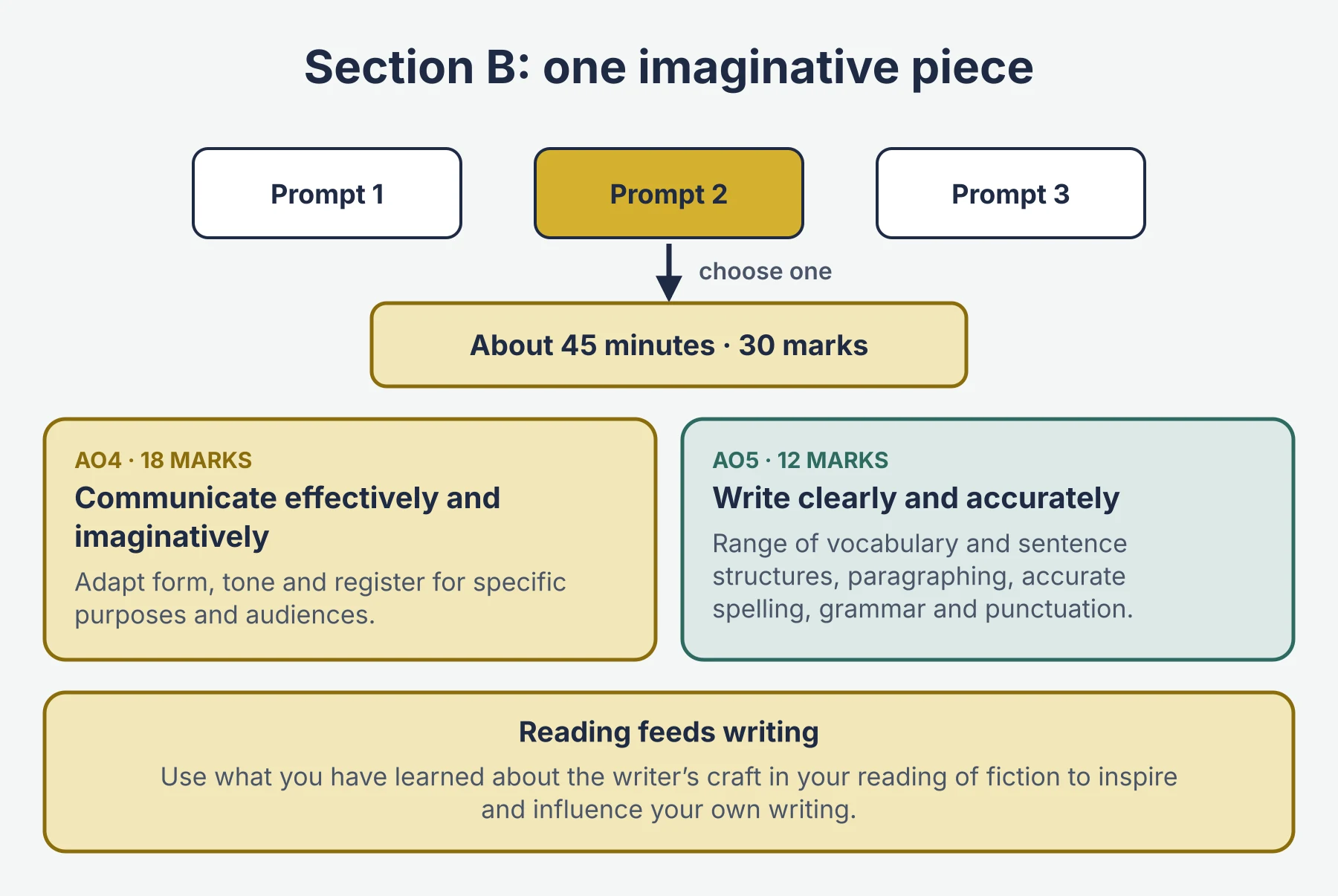
The task in one box
| Detail | Section B |
|---|---|
| Task | One imaginative writing task from a choice of three prompts |
| Marks | 30: AO4 18, AO5 12 |
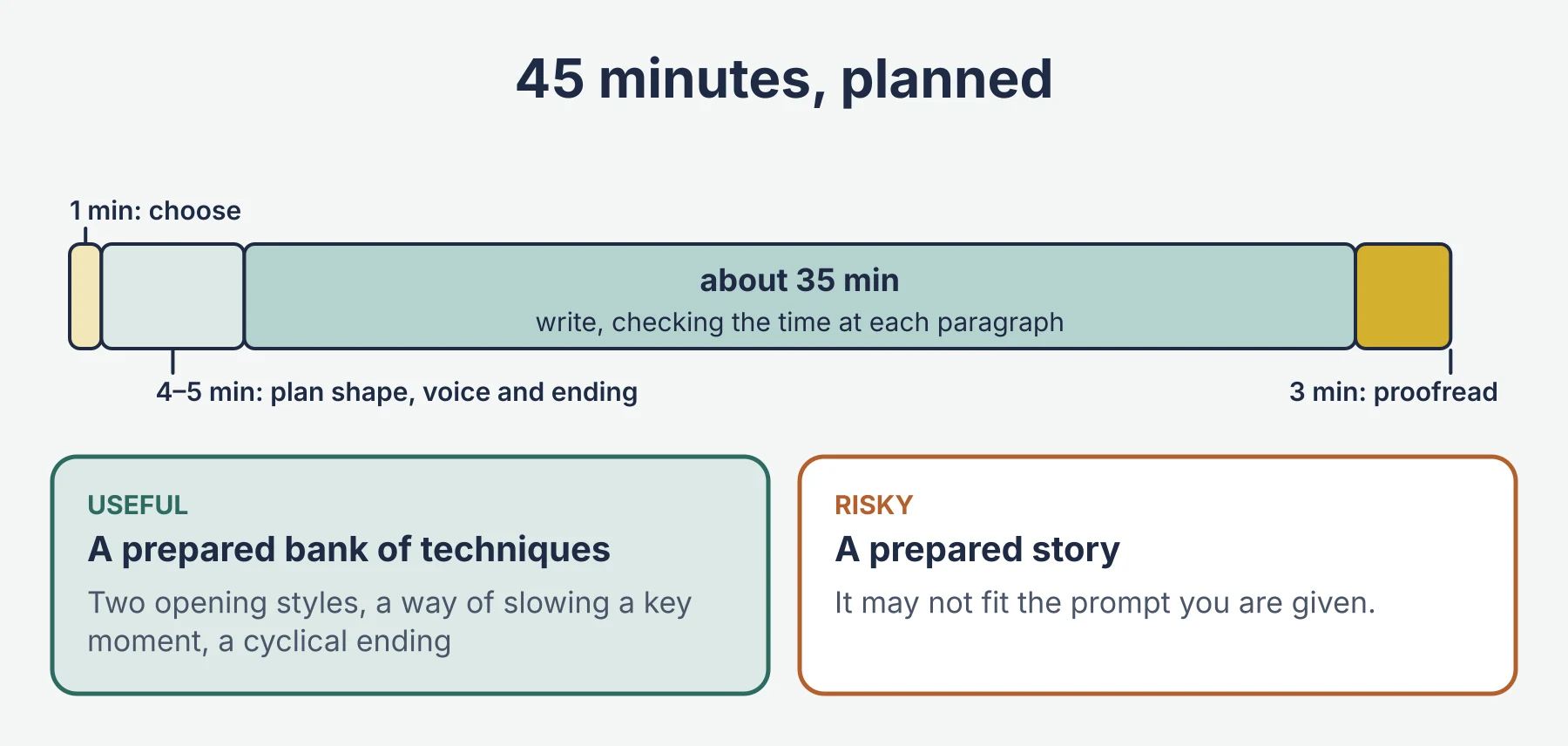
| Advised time | About 45 minutes |
| Link to reading | Use the craft you studied in fiction to shape your own writing |
What each AO rewards
| AO | Rewards | Typical loss |
|---|---|---|
| AO4 (18) | A clear purpose, a controlled voice, deliberate structure, form, tone and register suited to the task and reader | Rambling plot, no ending, inconsistent voice |
| AO5 (12) | Range of vocabulary and sentence structures, paragraphing, accurate spelling, grammar and punctuation | Repetition, comma splices, tense drift, unpunctuated dialogue |
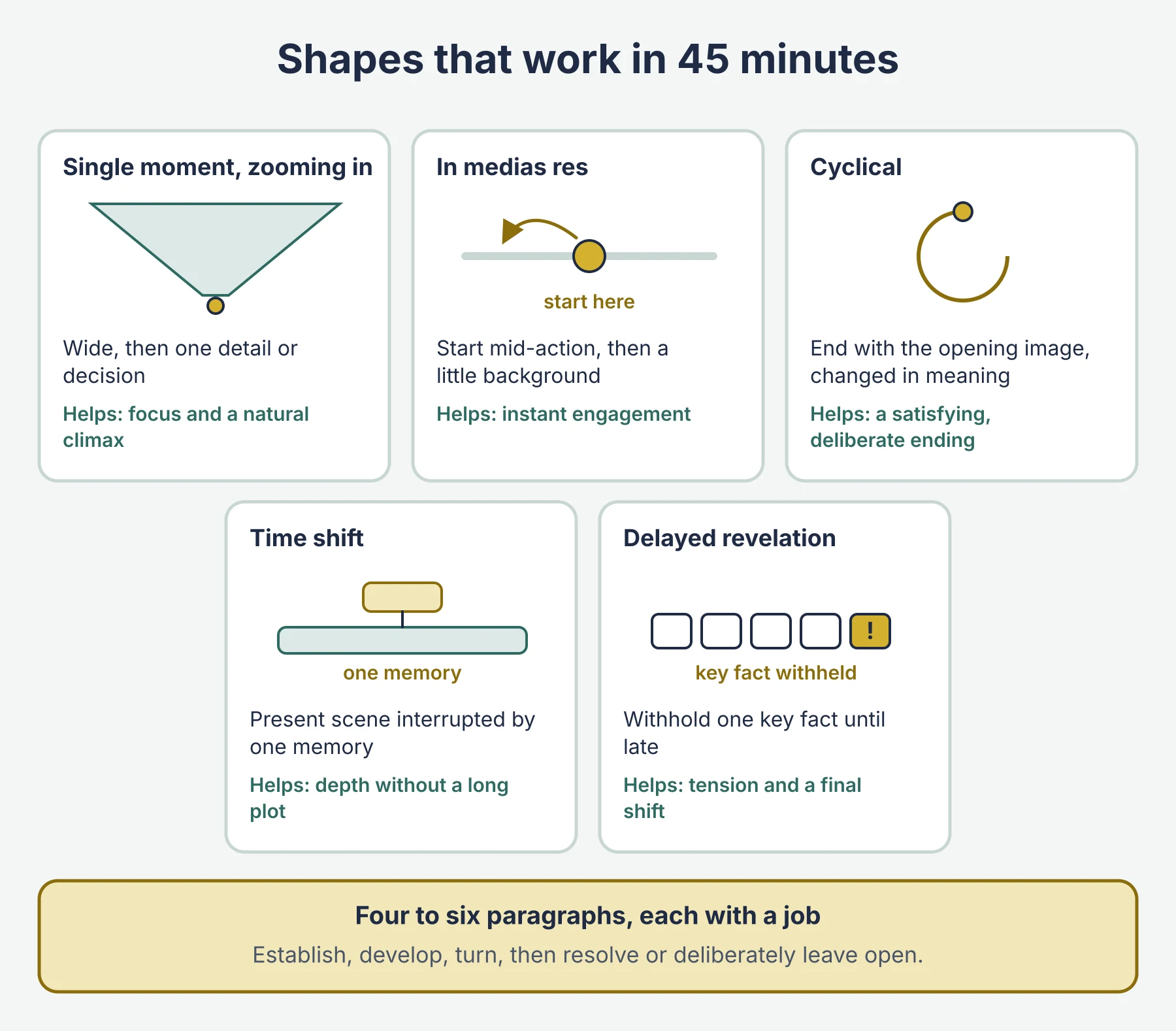
Five structure shapes
- Zoom: wide setting to one small detail.
- In medias res: start mid-action.
- Cyclical: final image echoes the first.
- Time shift: present scene plus one memory.
- Delayed revelation: hold back one fact until near the end.
Aim for four to six paragraphs: establish, develop, turn, resolve (or deliberately leave open).
Voice and tense choices
| Choice | Effect | Watch out for |
|---|---|---|
| First person | Intimacy; direct access to thoughts | Every sentence starting “I” |
| Close third person | One viewpoint with some distance | Slipping into other characters’ heads |
| Past tense | Natural storytelling; reflection | Accidental switches to present |
| Present tense | Immediacy and tension | Sustaining it for the whole piece |
Techniques to have ready
| Technique | Example of use |
|---|---|
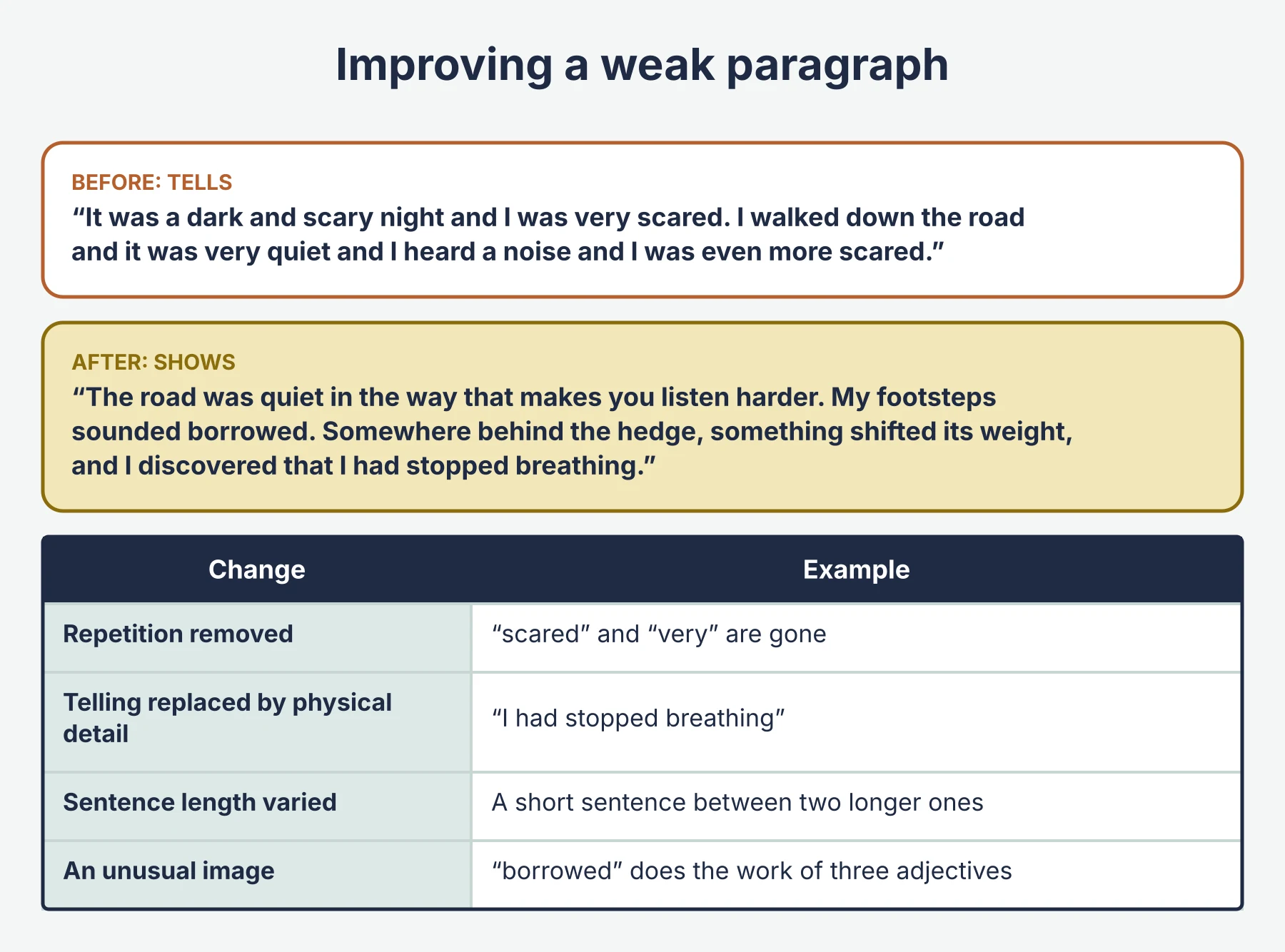
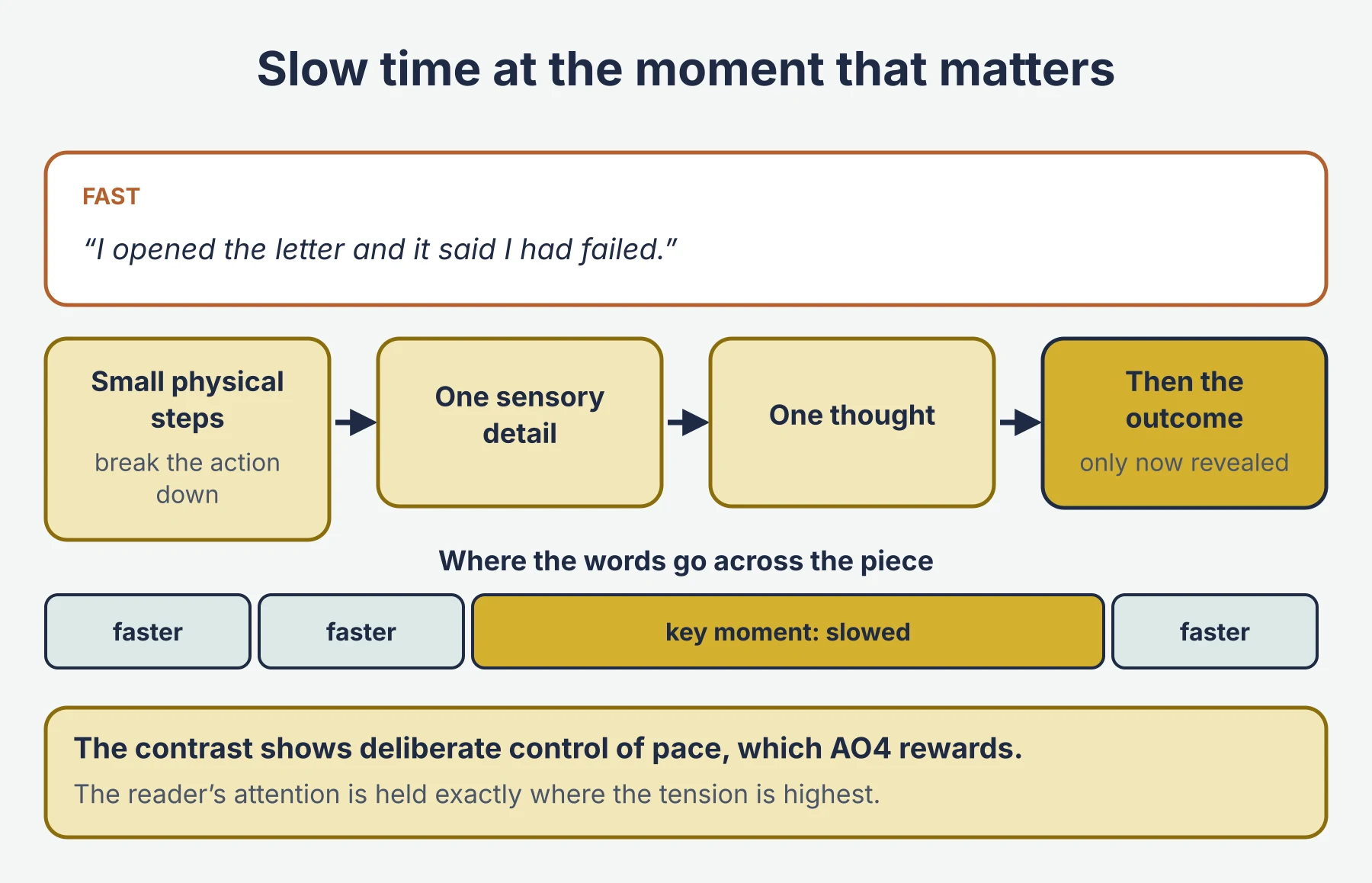
| Show, not tell | Hands twisting a ticket instead of “she was nervous” |
| Telling detail | One precise object that suggests a whole life |
| Sensory description | Sound and smell, not only sight |
| Short sentence for impact | After a long, building sentence |
| Fragment | “Nothing. Then a knock.” for tension |
| Pathetic fallacy | Setting reflecting mood, used sparingly |
| Foreshadowing | An early detail that gains meaning later |
| Dialogue | Brief lines that reveal character or move the plot |
Openings and endings to practise
| Opening type | Example |
|---|---|
| Dialogue | “Don’t open it,” she said, but I already had. |
| Single striking detail | The clock in the hall had stopped at ten past four. |
| Setting with mood | Fog had erased the far side of the river. |
| Ending type | Effect |
|---|---|
| Cyclical image | Completes the shape; shows change |
| Open question or image | Leaves the reader thinking |
| Quiet reflection | Shows what the narrator has learned |
| Final short sentence | Lands the emotional point |
Avoid “and then I woke up”: it cancels everything the reader has invested in.
Dialogue rules
- Speech marks around the words spoken; punctuation inside the closing mark.
- New paragraph for each new speaker.
- A comma, not a full stop, before a speech tag: “I’m late,” she said.
- Keep it short; let action and description carry most of the story.
Key terms
| Term | Meaning |
|---|---|
| Narrative | Writing that tells a story with a change |
| Descriptive | Writing that builds a scene, mood or person through detail |
| In medias res | Starting in the middle of events |
| Cyclical structure | An ending that returns to the opening |
| Foreshadowing | A hint of what will happen later |
| Pathetic fallacy | Setting or weather reflecting feelings |
| Register | The level of formality of the language |
| Tone | The mood or attitude the writing conveys |
| Fragment | A deliberate incomplete sentence for effect |
Planning in four minutes
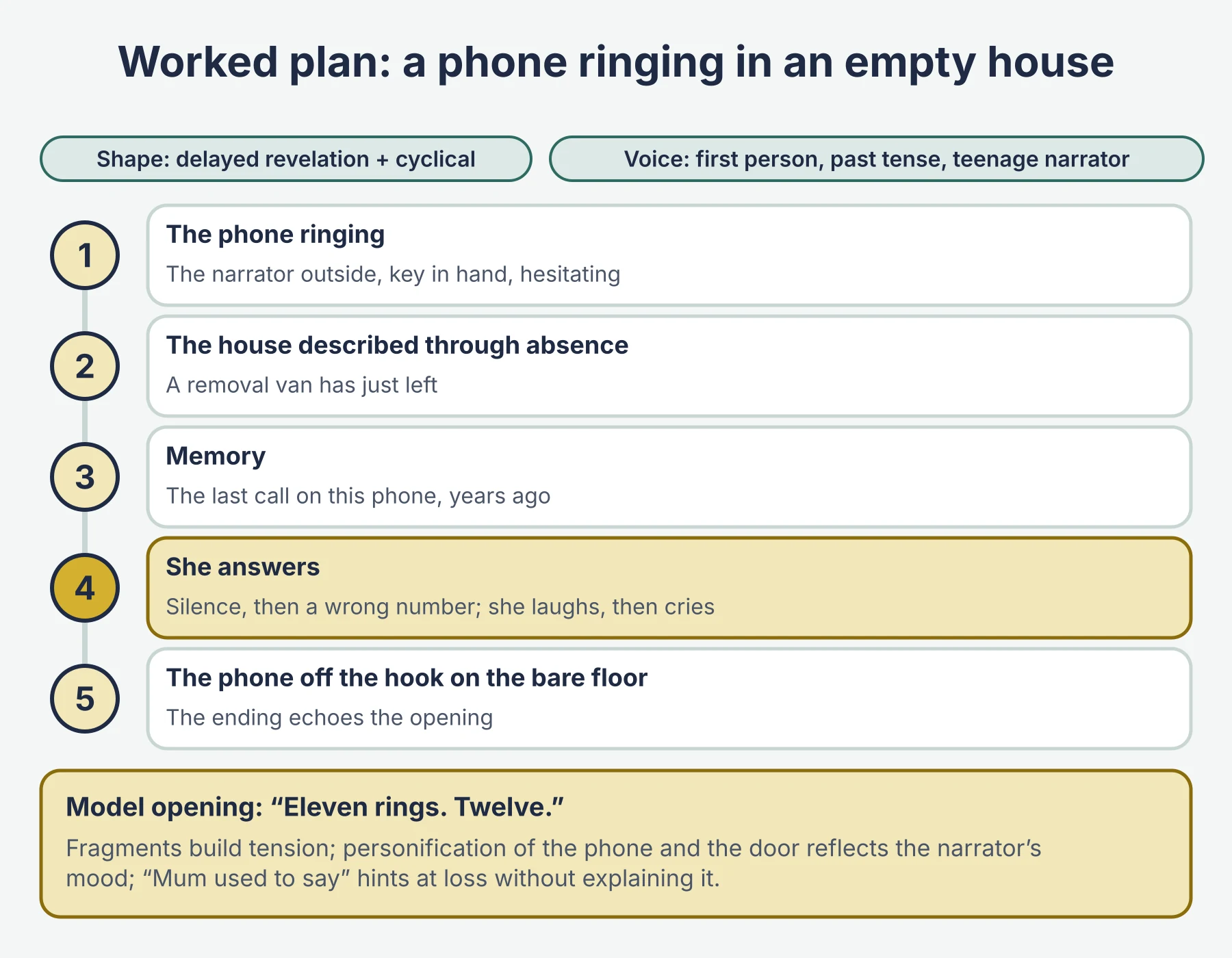
Prompt:     (underline key words)
Shape:      zoom / cyclical / time shift / delayed revelation
Voice:      first or third; past or present
Paragraphs: 1 establish  2 develop  3 turn  4 resolve or leave open
Ending:     final image or line, decided now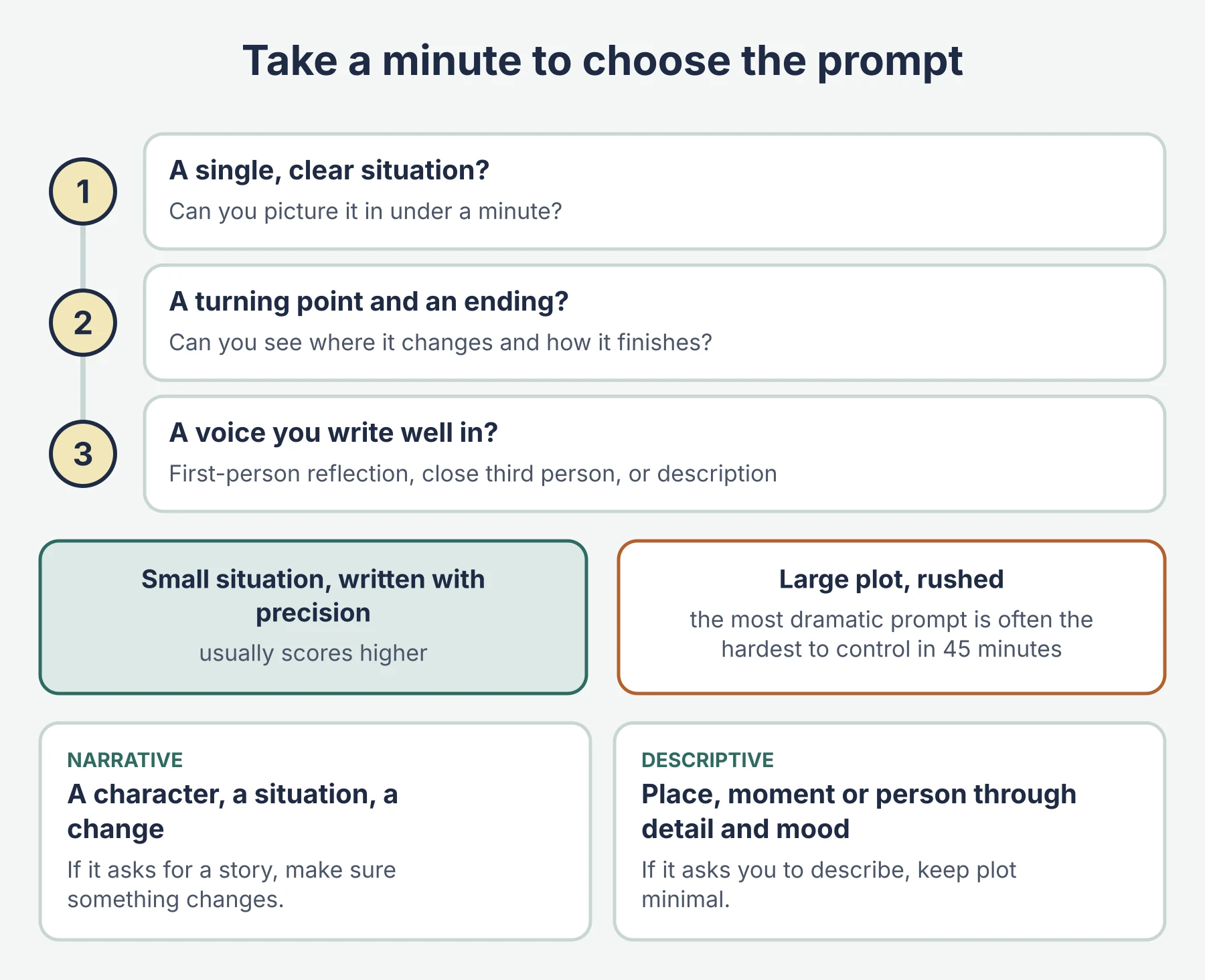
Exam traps
- Picking the most dramatic prompt rather than the one you can control.
- Over-plotting in 45 minutes.
- Writing a pre-learned story that only loosely fits the prompt.
- Ending abruptly because of poor timing.
- Using five adjectives where one precise word would do.
- Forgetting AO5: twelve marks depend on accuracy and range.
Self-test
- How many marks are AO4 and AO5 worth in Section B?
- How many prompts do you choose from?
- How long should you spend on Section B?
- What is the difference between narrative and descriptive writing?
- Name three structure shapes suited to a 45-minute piece.
- What does “show, not tell” mean?
- Give two rules for punctuating dialogue.
- What is the risk of using a pre-learned story?
- What is the effect of a short sentence after a long one?
- What should you decide before you begin writing?
- What is tense drift, and which AO does it affect?
- How can your Section A reading help your Section B writing?
Answers: 1. AO4 18, AO5 12. 2. Three. 3. About 45 minutes. 4. Narrative tells a story in which something changes; descriptive builds a scene or mood with little plot. 5. Any three: zoom, in medias res, cyclical, time shift, delayed revelation. 6. Revealing feelings or character through actions, details and speech rather than stating them. 7. Any two: punctuation inside the speech marks; new paragraph for each new speaker; a comma before the speech tag. 8. It may not fit the prompt, which weakens AO4. 9. It creates emphasis, shock or a pause. 10. The shape, the voice and the ending. 11. Switching between past and present tense without purpose; it affects AO5 and can weaken AO4. 12. Techniques analysed in the anthology texts can be used deliberately in your own writing.
Related pages
Related resources
-
Revision notes
Edexcel IGCSE English Language: Non-fiction Texts and Transactional Writing — Revision Notes
Condensed recall notes on reading non-fiction, language analysis, comparison and transactional writing for Edexcel International GCSE English Language 4EA1.
English · Pearson Edexcel · IGCSE
Revise topic -
Practice questions
Pearson Edexcel IGCSE English Language: Poetry and Prose Texts and Imaginative Writing — Practice Questions (4EA1)
Original practice with a model plan and worked commentary for anthology analysis and imaginative writing, for Edexcel IGCSE English Language A 4EA1 Paper 2.
English · Pearson Edexcel · IGCSE
Try questions -
Revision notes
Pearson Edexcel IGCSE English Language: Poetry and Prose Texts and Imaginative Writing — Revision Notes
Condensed notes on anthology poetry and prose analysis and imaginative writing craft for Pearson Edexcel International GCSE English Language A 4EA1 Component 2.
English · Pearson Edexcel · IGCSE
Revise topic
Get free revision emails (optional)
Occasional emails with practice questions, worked explanations and links to free resources for the qualification and subjects you choose. No spam, and you can unsubscribe from any email. The free tools on this site never need an email.