
Revision Notes
Pearson Edexcel International GCSE Physics (4PH1): Cosmology – Revision Notes
Recall notes for Edexcel 4PH1 sub-topic 8d: Big Bang history, the Doppler effect, red-shift equation, red-shift and distance, and CMB, with a self-test.
- Subject
- Physics
- Level
- IGCSE
- Topic
- Astrophysics
- Author
- Marlbridge Academic Team
- Updated
- Reviewed by
- Hassan (what this means)
Aligned to Pearson Edexcel IGCSE Physics (4PH1), Issue 4. Official specification .
Syllabus page (what it covers and how it is assessed): Pearson Edexcel IGCSE Physics.
Syllabus points this page covers
4PH1
- 8d Cosmology
Found an error? Report a correction.
Need help with this topic? Request a free trial class for IGCSE Physics (4PH1).
Condensed notes for sub-topic 8(d) Cosmology (statements 8.13P to 8.18P) of Pearson Edexcel International GCSE Physics (4PH1). The whole sub-topic is Physics-only, assessed on Paper 2P. Full explanations and worked examples are in the Cosmology study guide.
Past evolution of the universe
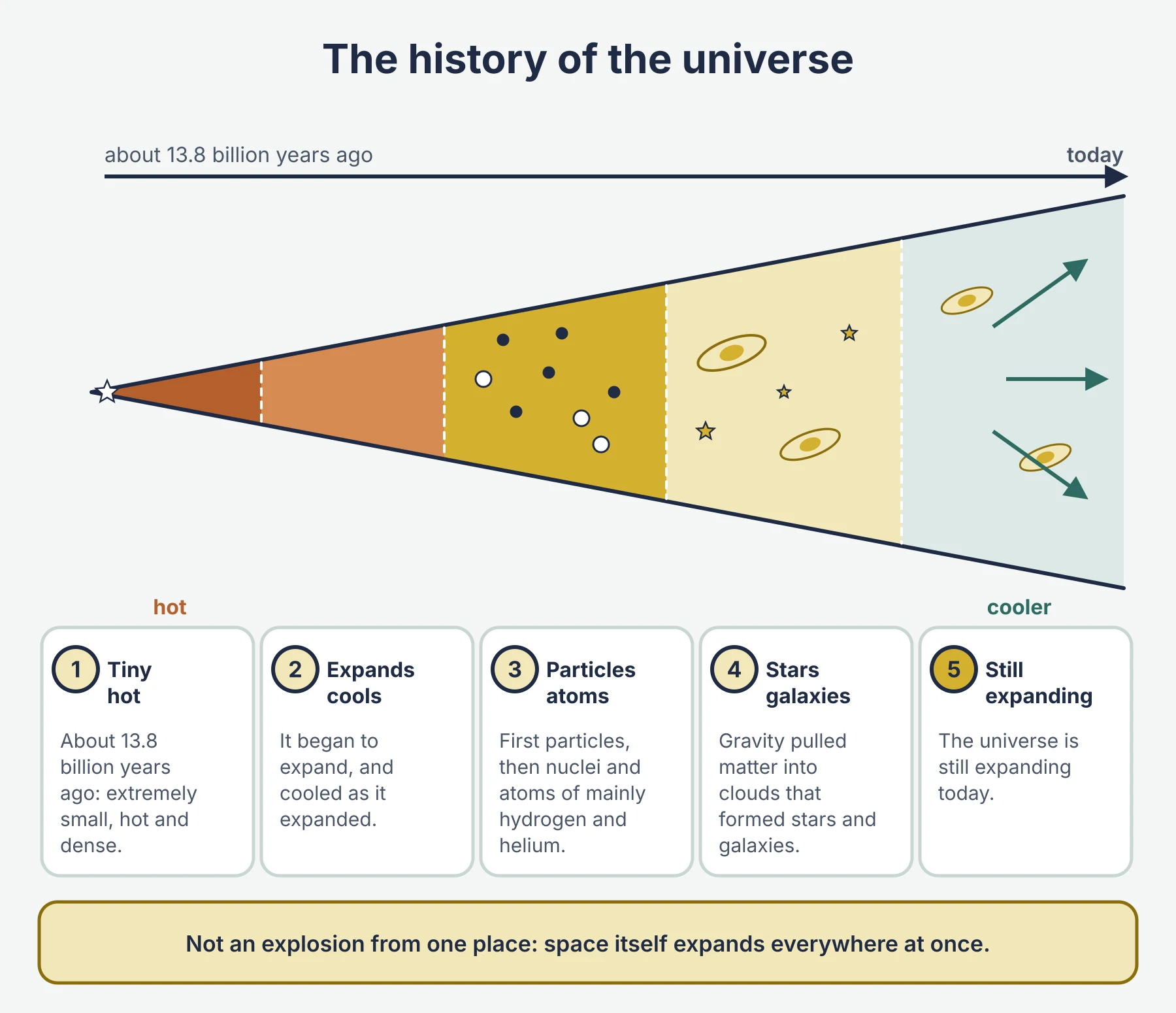
- About 13.8 billion years ago: extremely small, hot, dense state.
- Expanded and cooled.
- Particles → light nuclei and atoms (mainly hydrogen, helium) → stars and galaxies formed by gravity.
- Still expanding now.
- Space itself expands; the Big Bang was not an explosion from one point in space.
Doppler effect
| Source | Observed wavelength | Observed frequency | Light |
|---|---|---|---|
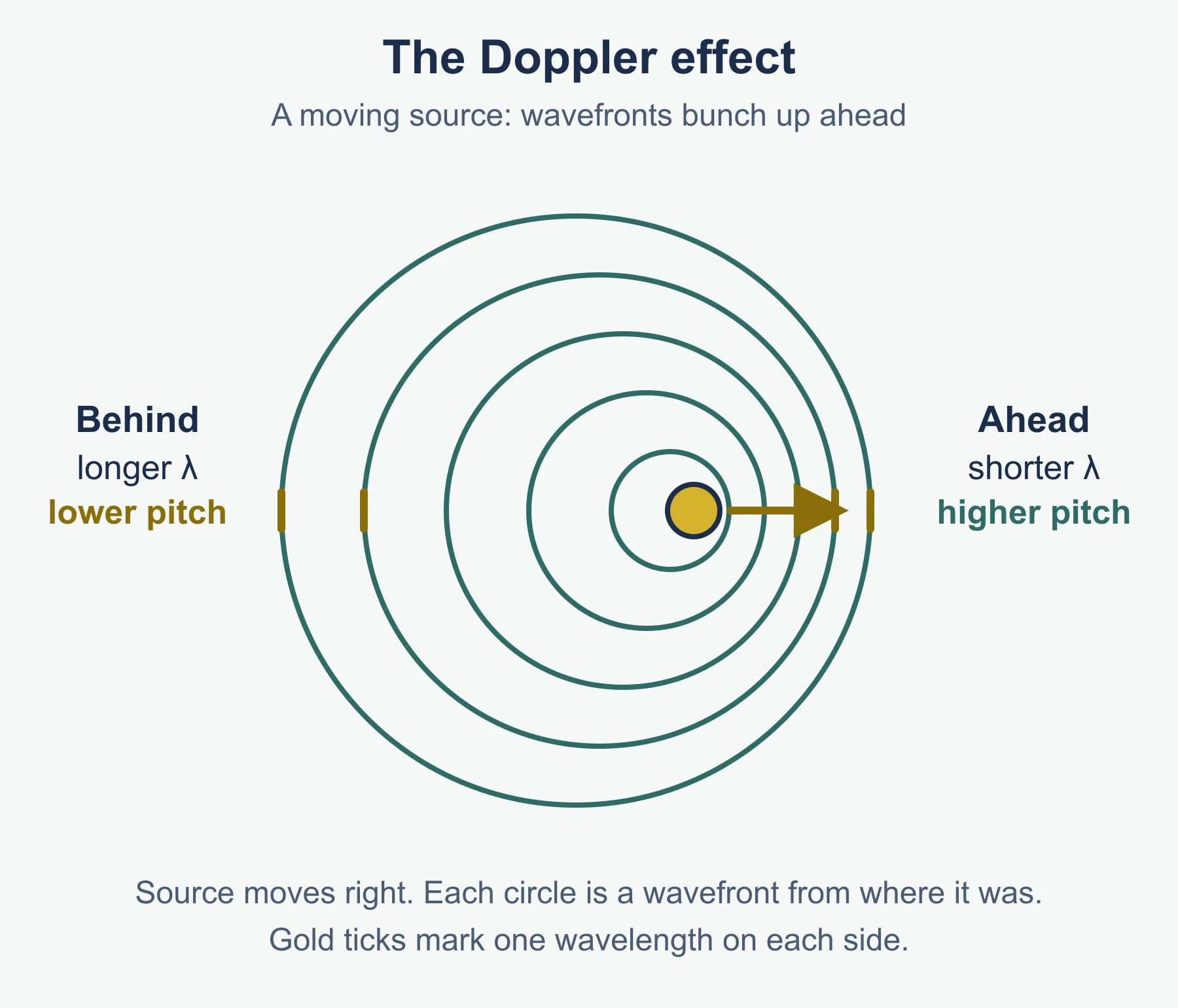
| Moving towards observer | Shorter | Higher | Blue-shift |
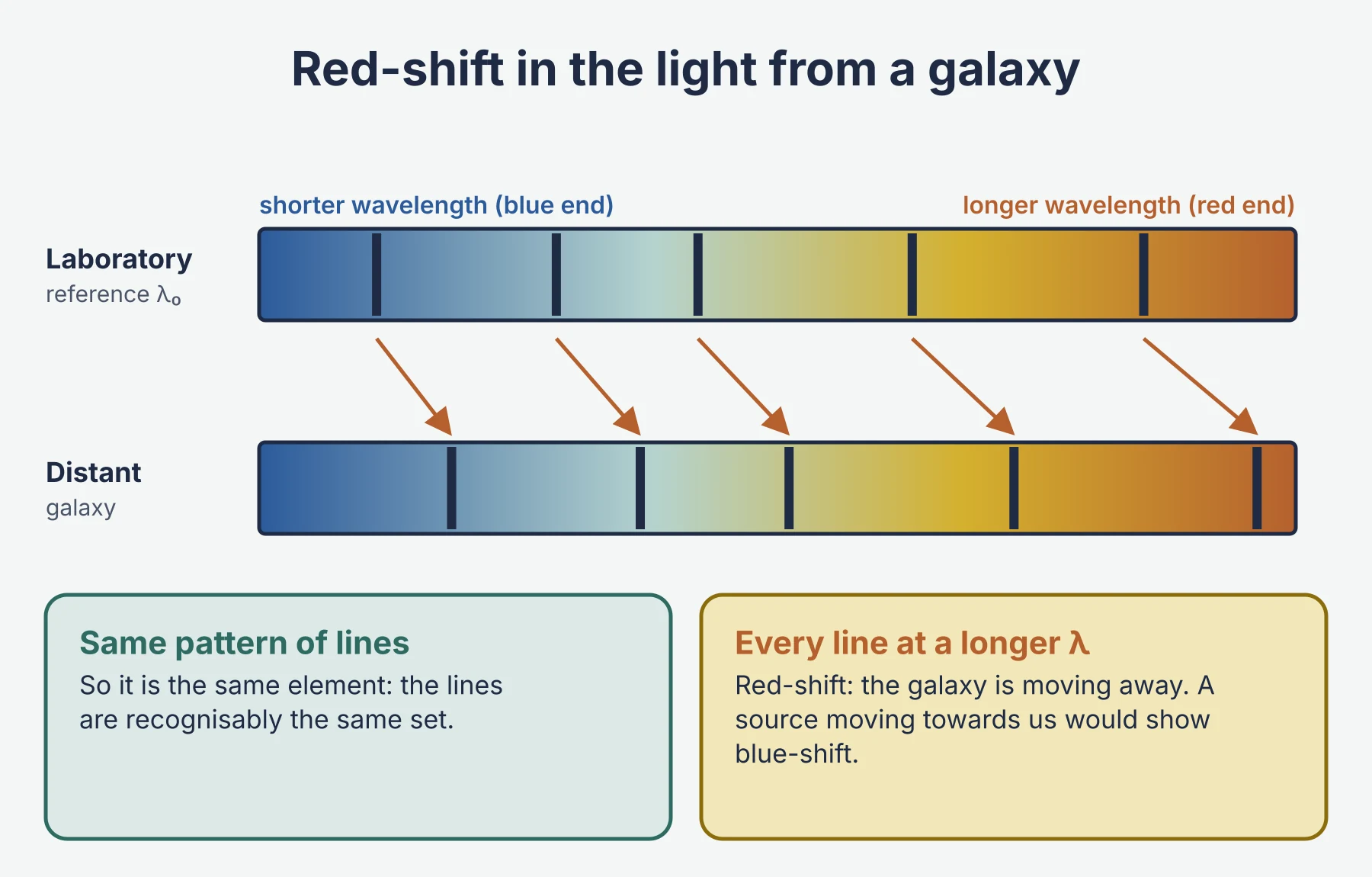
| Moving away from observer | Longer | Lower | Red-shift |
- Sound example: a siren’s pitch rises as it approaches, falls as it leaves.
- Spectral lines from galaxies keep their pattern but move to longer wavelengths.
Red-shift equation
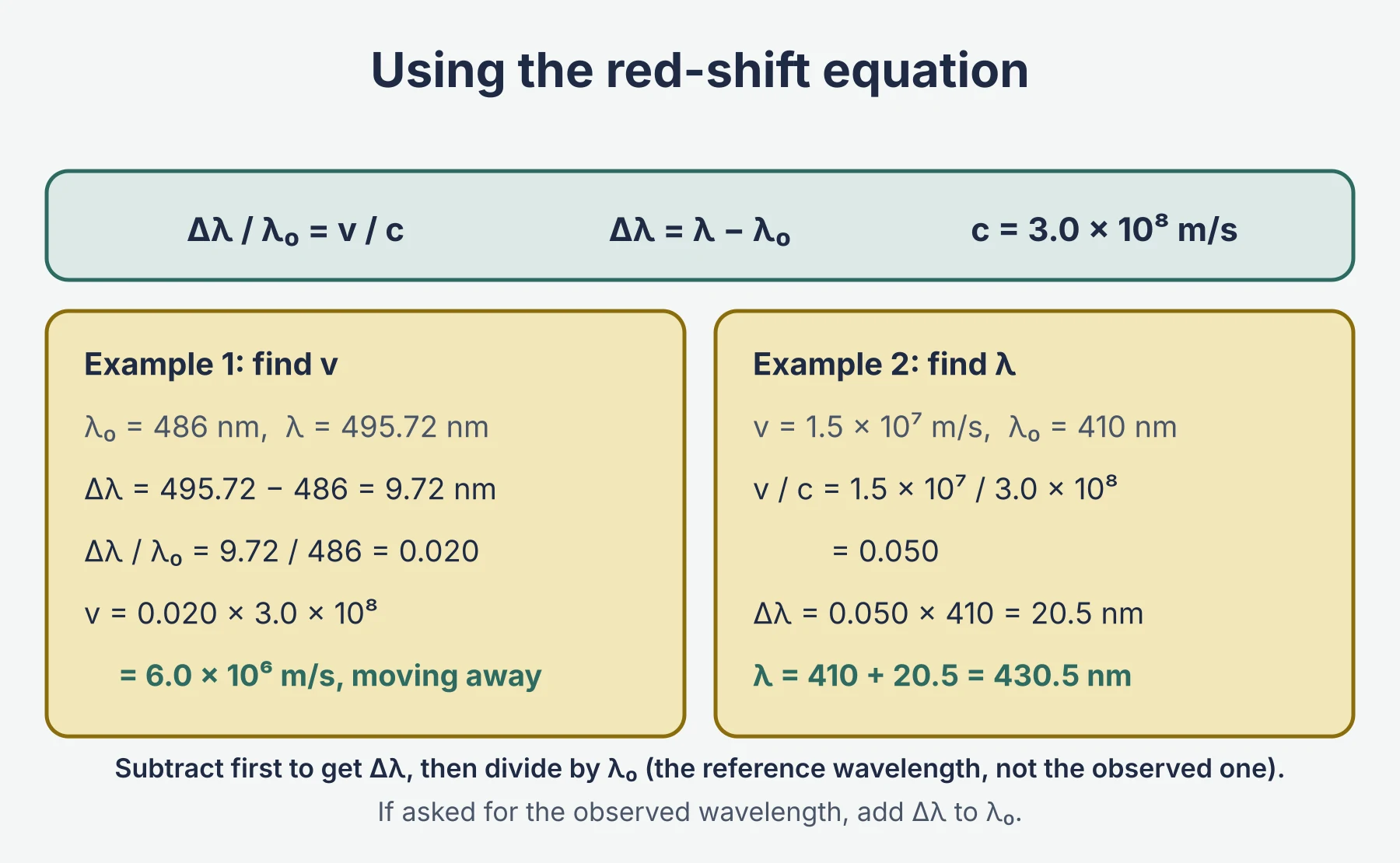
Δλ / λ₀ = v / c Δλ = λ − λ₀- λ = observed wavelength; λ₀ = reference (laboratory) wavelength.
- c = 3.0 × 10⁸ m/s.
- Wavelengths in the same unit as each other; v in m/s.
- v = c × Δλ / λ₀. Observed wavelength = λ₀ + Δλ.
Quick example (illustrative): λ₀ = 500 nm, λ = 512 nm → Δλ / λ₀ = 12 / 500 = 0.024 → v = 0.024 × 3.0 × 10⁸ = 7.2 × 10⁶ m/s away from us.
Second example (illustrative): v = 1.5 × 10⁷ m/s, λ₀ = 410 nm → v / c = 0.050 → Δλ = 20.5 nm → observed λ = 430.5 nm.
Red-shift and distance
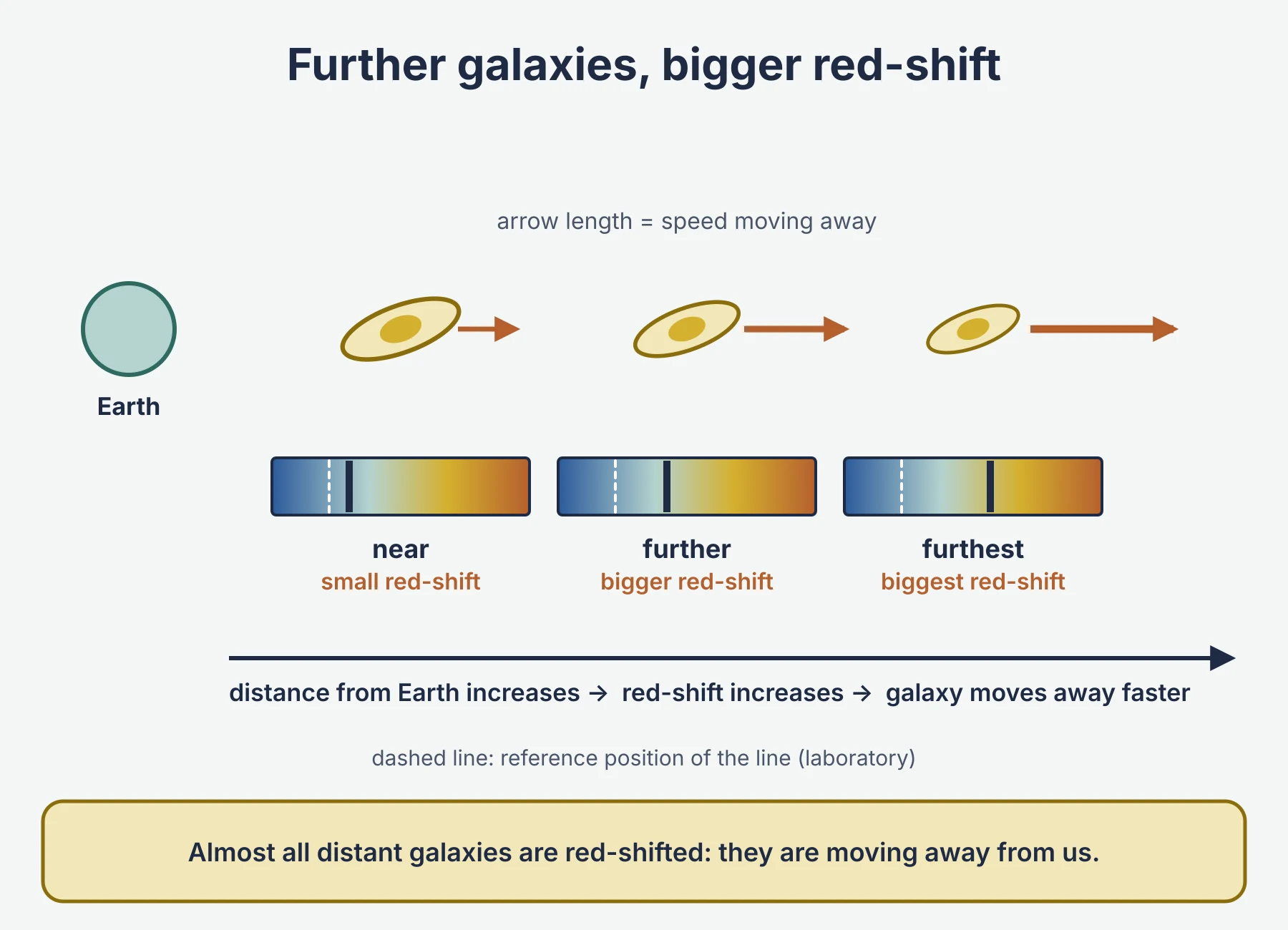
- Almost all distant galaxies are red-shifted → moving away.
- Greater distance → greater red-shift → faster recession.
Evidence for expansion
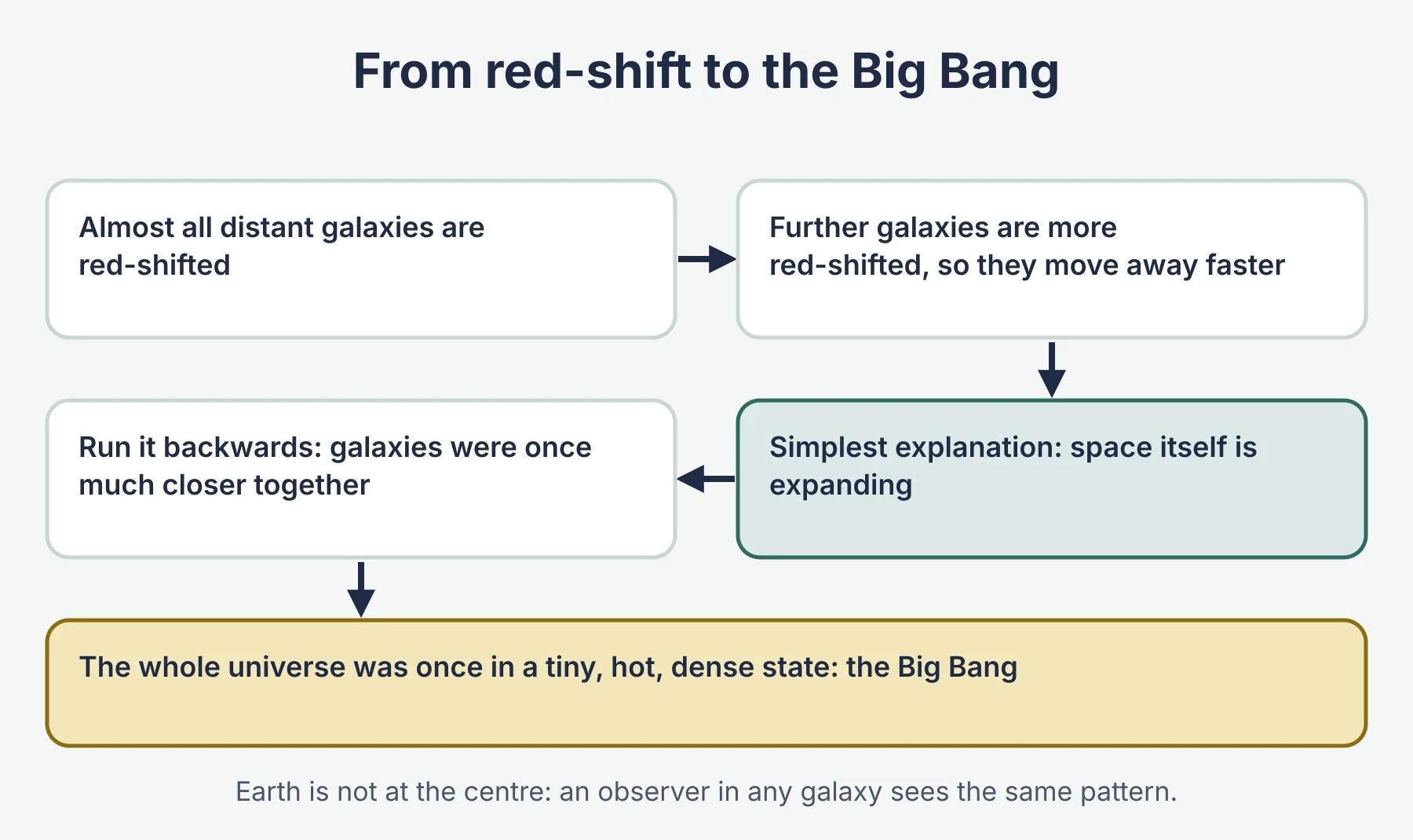
- All distant galaxies red-shifted → all moving away.
- More distant → faster.
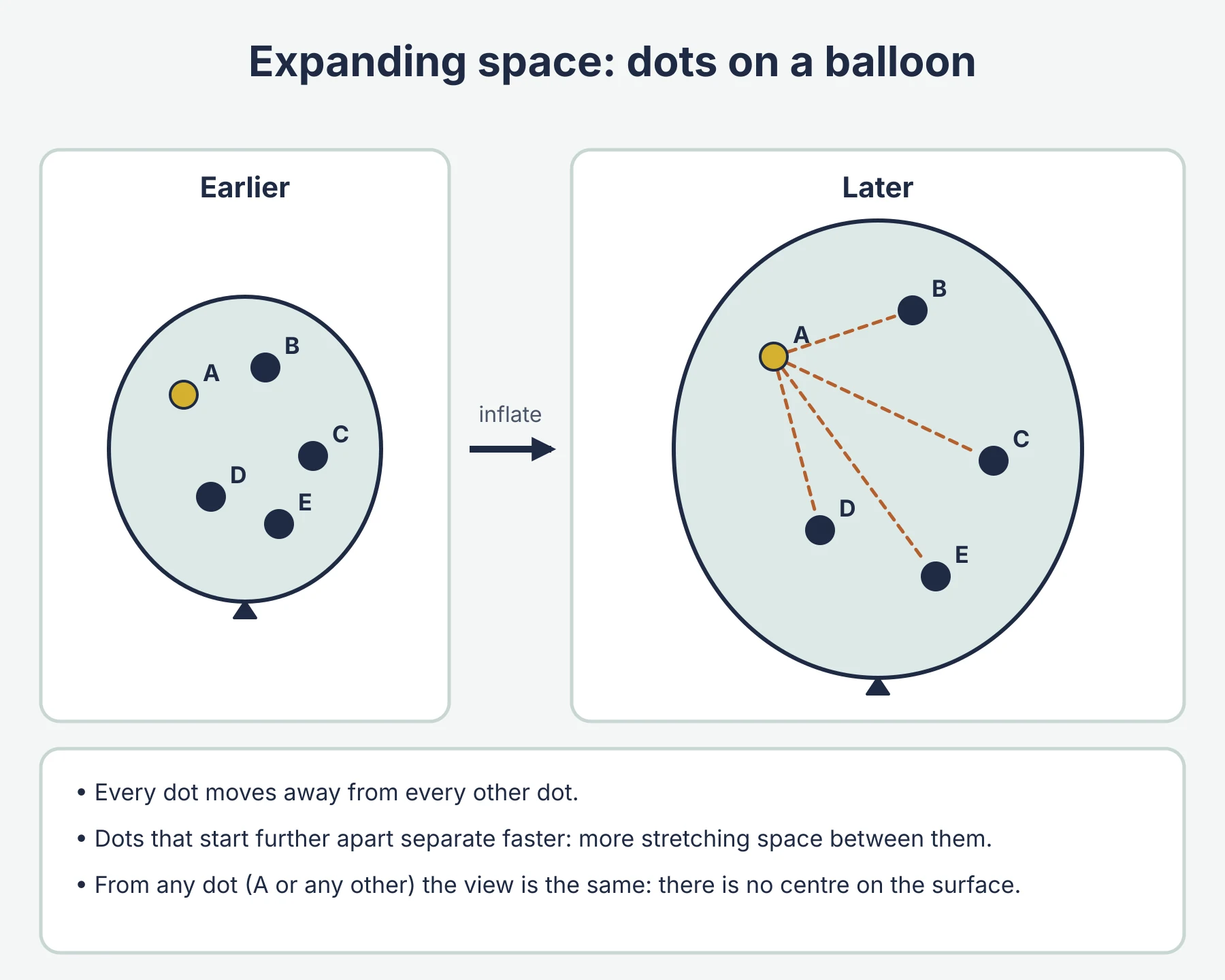
- So space itself is expanding (balloon model).
- Every observer sees the same pattern → no centre; Earth is not special.
- Run backwards → everything once together in a hot, dense state → Big Bang.
Cosmic microwave background (CMB)
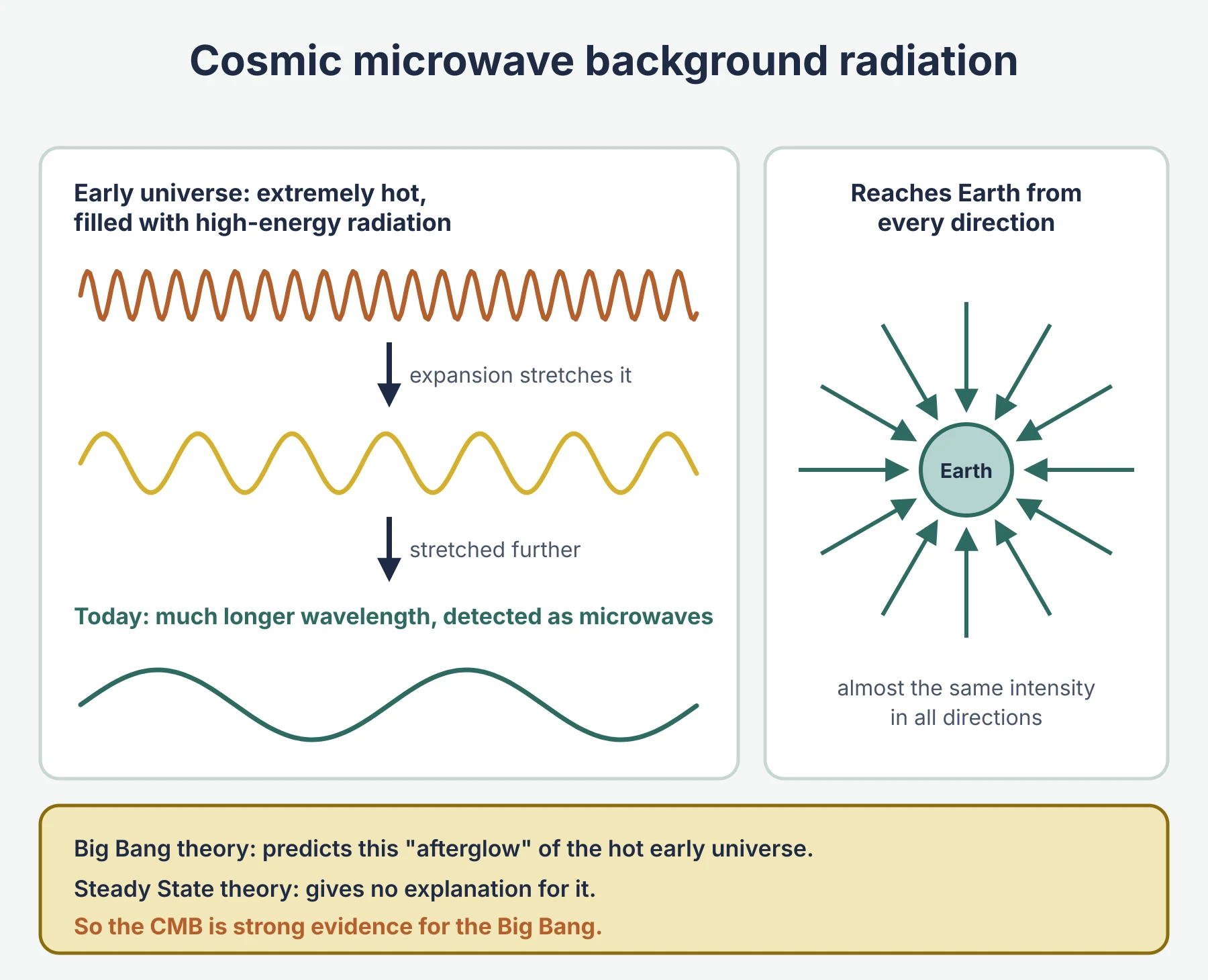
- Microwave radiation from every direction, almost uniform.
- Remnant of the radiation from the hot early universe, stretched to microwave wavelengths as space expanded.
- Predicted by the Big Bang theory; the Steady State theory cannot explain it.
Key terms
| Term | Meaning |
|---|---|
| Big Bang theory | The universe began in an extremely hot, dense state and has been expanding and cooling since |
| Doppler effect | Change in observed frequency and wavelength due to relative motion of source and observer |
| Red-shift | Increase in observed wavelength of light from a receding source |
| Reference wavelength | Wavelength of a spectral line from a stationary laboratory source |
| CMB radiation | Microwave radiation reaching us from all directions, left over from the early universe |
| Expanding universe | Space itself stretching, so galaxies move apart |
Exam traps
- Red-shift does not mean the galaxy looks red.
- λ₀ (not λ) goes in the denominator.
- Forgetting to add Δλ to λ₀ when asked for the observed wavelength.
- Receding source: frequency lower, wavelength longer. Do not mix them.
- Red-shift does not put Earth at the centre.
- CMB answers need the observation and what it shows.
- “The Big Bang was an explosion in space”: no, space itself expands.
Self-test
- Describe the state of the universe at the start, according to the Big Bang theory.
- What has happened to the temperature of the universe as it expanded?
- A source of waves moves away from an observer. What happens to the observed wavelength and frequency?
- What is red-shift?
- Write the red-shift equation in words.
- A line has λ₀ = 600 nm. A galaxy moves away at 4.5 × 10⁶ m/s. Calculate the observed wavelength.
- A line with λ₀ = 400 nm is observed at 404 nm. Calculate the galaxy’s speed.
- How does red-shift change with the distance of a galaxy?
- Why does red-shift not mean Earth is at the centre of the universe?
- What is the CMB, and from which directions does it come?
- How does the Big Bang theory explain the CMB?
- A nearby galaxy shows a line at 499.5 nm whose reference wavelength is 500 nm. What does this tell you?
Answers
- Extremely small, hot and dense.
- It has decreased: the universe cooled as it expanded.
- The wavelength increases and the frequency decreases.
- The increase in wavelength (shift towards the red end of the spectrum) of light from a source moving away.
- Change in wavelength ÷ reference wavelength = velocity of the galaxy ÷ speed of light.
- Δλ = 600 × (4.5 × 10⁶ / 3.0 × 10⁸) = 9.0 nm; observed wavelength = 609 nm.
- Δλ / λ₀ = 4 / 400 = 0.01; v = 0.01 × 3.0 × 10⁸ = 3.0 × 10⁶ m/s.
- More distant galaxies show greater red-shift.
- Space is expanding everywhere, so an observer in any galaxy would see all other galaxies moving away in the same pattern.
- Microwave radiation detected from every direction, almost uniformly.
- It is radiation left over from the hot, dense early universe, stretched to microwave wavelengths as the universe expanded and cooled.
- The wavelength is shorter (blue-shift), so this galaxy is moving towards us, at 3.0 × 10⁵ m/s.
Frequently asked questions
Is cosmology on Paper 1P? No. Every statement in sub-topic 8(d) has a “P” reference, so cosmology is assessed only on Paper 2P.
Do I need the Hubble constant for 4PH1? No. The specification asks you to describe how red-shift changes with distance, not to use a constant linking speed and distance.
Practise next with the Cosmology practice questions.
Related resources
-
Study guides
Pearson Edexcel International GCSE Physics (4PH1): Motion in the universe
Galaxies and the Milky Way, why g varies, gravity and orbits, comet, moon and planet orbits compared, and v = 2πr/T, for Edexcel 4PH1 sub-topic 8b.
Physics · Pearson Edexcel · IGCSE
Read guide -
Practice questions
Pearson Edexcel International GCSE Physics (4PH1): Motion in the universe – Practice Questions
Original questions with mark-scheme answers on galaxies, gravitational field strength, orbits, comets and orbital speed calculations, for Edexcel 4PH1 8b.
Physics · Pearson Edexcel · IGCSE
Try questions -
Revision notes
Pearson Edexcel International GCSE Physics (4PH1): Motion in the universe – Revision Notes
Recall notes for Edexcel 4PH1 sub-topic 8b: galaxies, why g varies, gravity and orbits, comet and planet orbits compared, and v = 2πr/T, with a self-test.
Physics · Pearson Edexcel · IGCSE
Revise topic
Related articles
Get free revision emails (optional)
Occasional emails with practice questions, worked explanations and links to free resources for the qualification and subjects you choose. No spam, and you can unsubscribe from any email. The free tools on this site never need an email.