
Study Guides
Pearson Edexcel International GCSE Physics (4PH1): Motion in the universe
Galaxies and the Milky Way, why g varies, gravity and orbits, comet, moon and planet orbits compared, and v = 2πr/T, for Edexcel 4PH1 sub-topic 8b.
- Subject
- Physics
- Level
- IGCSE
- Topic
- Astrophysics
- Author
- Marlbridge Academic Team
- Updated
- Reviewed by
- Hassan (what this means)
Aligned to Pearson Edexcel IGCSE Physics (4PH1), Issue 4. Official specification .
Syllabus page (what it covers and how it is assessed): Pearson Edexcel IGCSE Physics.
Syllabus points this page covers
4PH1
- 8b Motion in the universe
Found an error? Report a correction.
Need help with this topic? Request a free trial class for IGCSE Physics (4PH1).
This guide covers sub-topic 8(b) Motion in the universe of the Pearson Edexcel International GCSE in Physics (4PH1), Issue 4 specification: statements 8.2 to 8.6. All five are core content, examinable on both papers. A shorter summary of the whole topic is in the Astrophysics study guide, and the unit conversions used below are practised in Units in astrophysics.
What the specification asks for
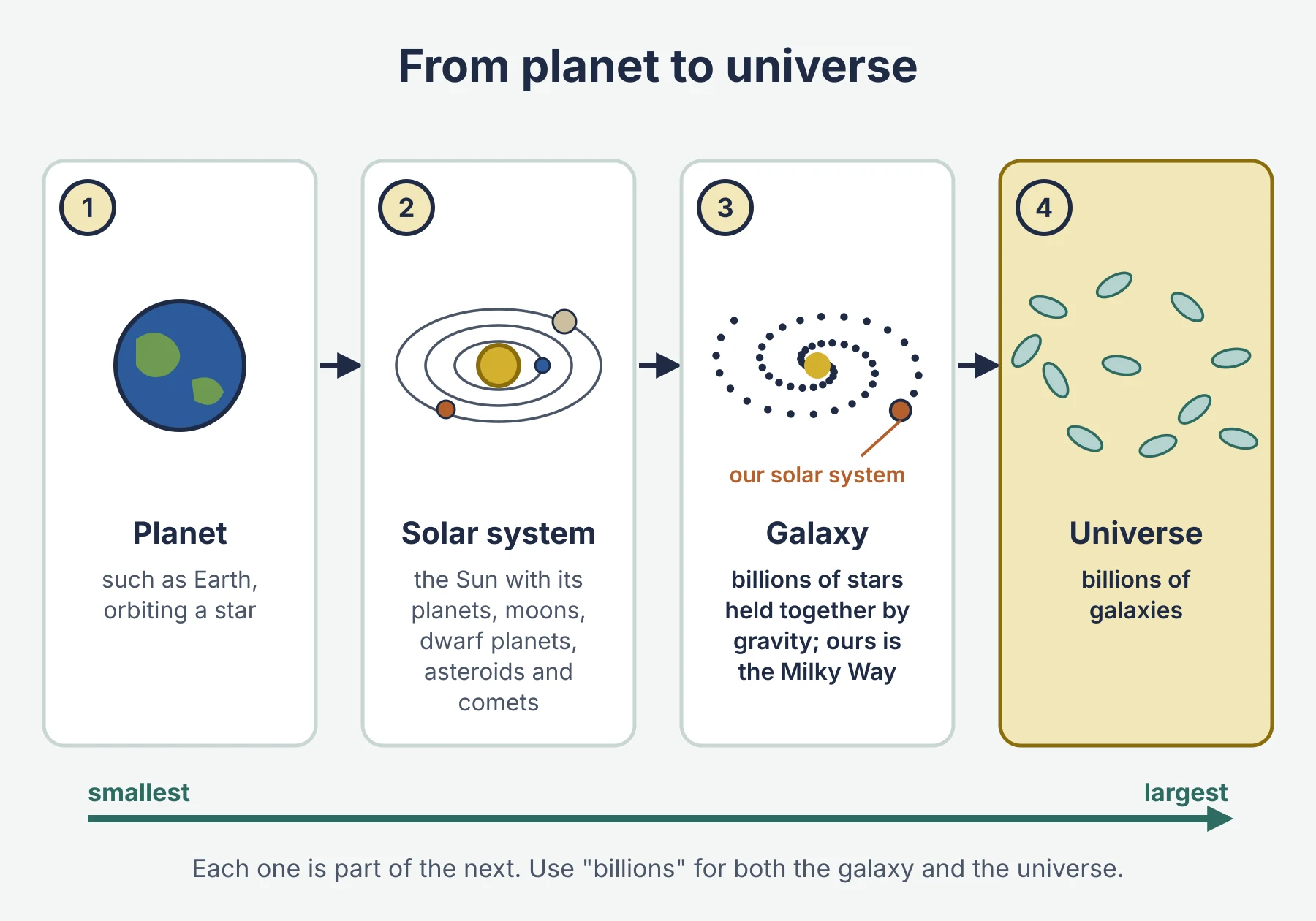
- 8.2 know that the universe is a large collection of billions of galaxies; a galaxy is a large collection of billions of stars; our solar system is in the Milky Way galaxy
- 8.3 understand why gravitational field strength, g, varies and know that it is different on other planets and the Moon from that on the Earth
- 8.4 explain that gravitational force causes moons to orbit planets, planets to orbit the Sun, artificial satellites to orbit the Earth, and comets to orbit the Sun
- 8.5 describe the differences in the orbits of comets, moons and planets
- 8.6 use orbital speed = (2 × π × orbital radius) / time period, v = 2πr / T
The scale of the universe (8.2)
Put the structures in order of size, smallest first:
- Planet, such as Earth, orbiting a star.
- Solar system: our Sun with its planets, moons, dwarf planets, asteroids and comets.
- Galaxy: a collection of billions of stars, held together by gravity. Our solar system is one small part of the Milky Way galaxy.
- Universe: a collection of billions of galaxies.
The words “billions” in both statements are deliberate: an answer that says a galaxy is “a group of stars” or the universe is “lots of galaxies” may not earn full credit.
Why g varies (8.3)
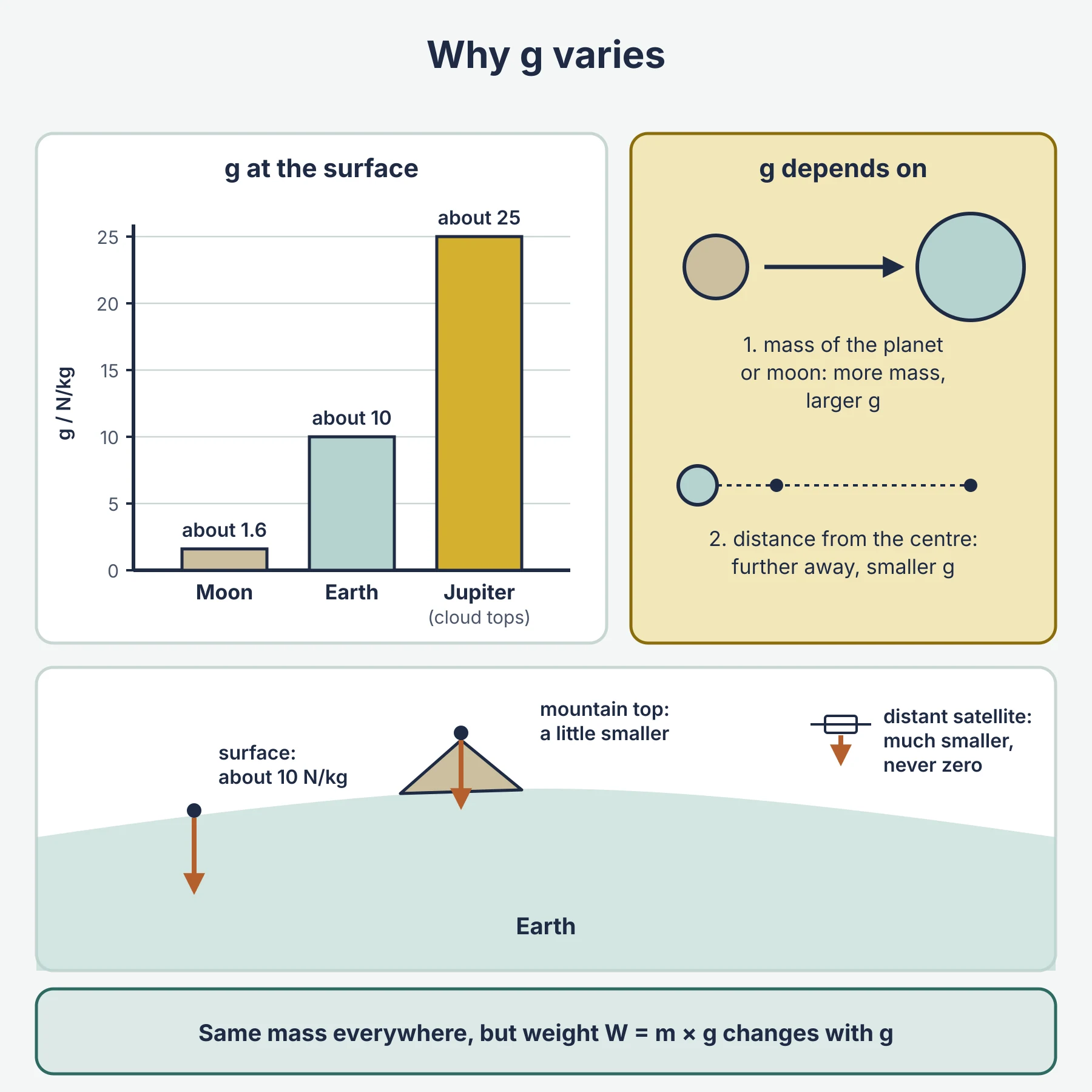
Gravitational field strength g is the gravitational force on each kilogram of mass, in N/kg. Every object with mass attracts every other. The strength of the field at a planet’s surface depends on two things:
- the mass of the planet or moon: more mass, stronger field, larger g
- the distance from its centre: further away, weaker field, smaller g
The Moon has much less mass than Earth, so g on its surface is much smaller: about 1.6 N/kg compared with about 10 N/kg on Earth. Jupiter has far more mass than Earth, and g at its cloud tops is about 25 N/kg, even though its radius is much larger. g also falls with height above Earth: it is a little smaller at the top of a mountain and much smaller at the height of a distant satellite. It is never zero, which is why satellites stay in orbit rather than drifting away.
So the same object has the same mass everywhere, but its weight (W = m × g) is different on each planet and on the Moon.
Gravity causes orbits (8.4)
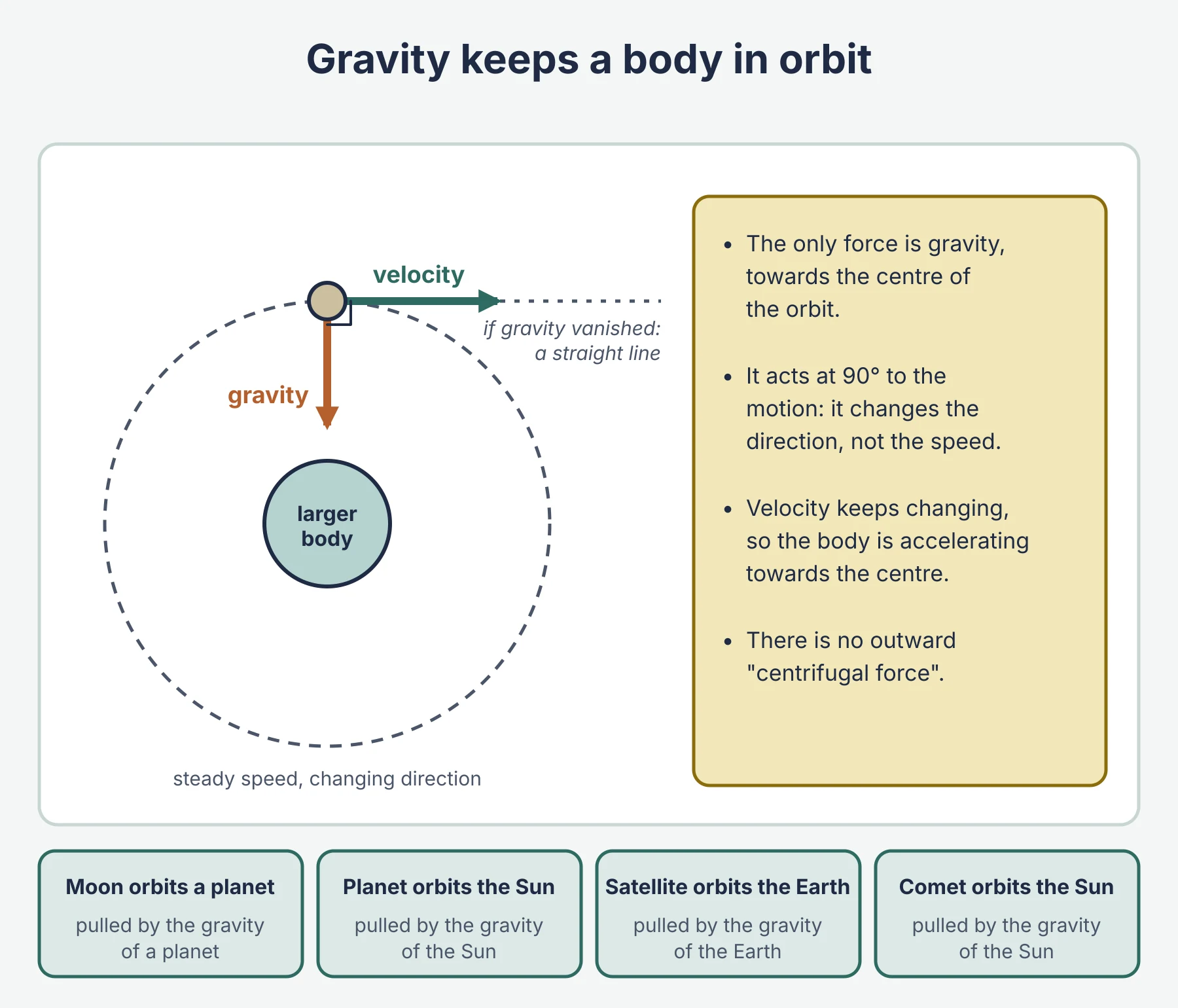
An object moving in space with no force on it would travel in a straight line at constant speed. To move in a circle, there must be a force towards the centre of the circle. In every orbit, that force is gravitational attraction towards the larger body:
| Orbiting body | Orbits | Force provided by |
|---|---|---|
| Moon | A planet (for example, Earth’s Moon) | Gravity of the planet |
| Planet | The Sun | Gravity of the Sun |
| Artificial satellite | The Earth | Gravity of the Earth |
| Comet | The Sun | Gravity of the Sun |
In a circular orbit, gravity acts at right angles to the motion. It changes the direction of the velocity continually but not the speed. Because velocity is changing, the orbiting body is accelerating towards the centre, even at a steady speed. If gravity suddenly disappeared, the body would fly off in a straight line along the direction it was moving at that instant.
Comparing orbits (8.5)
| Feature | Planets | Moons | Comets |
|---|---|---|---|
| Orbit around | The Sun | A planet | The Sun |
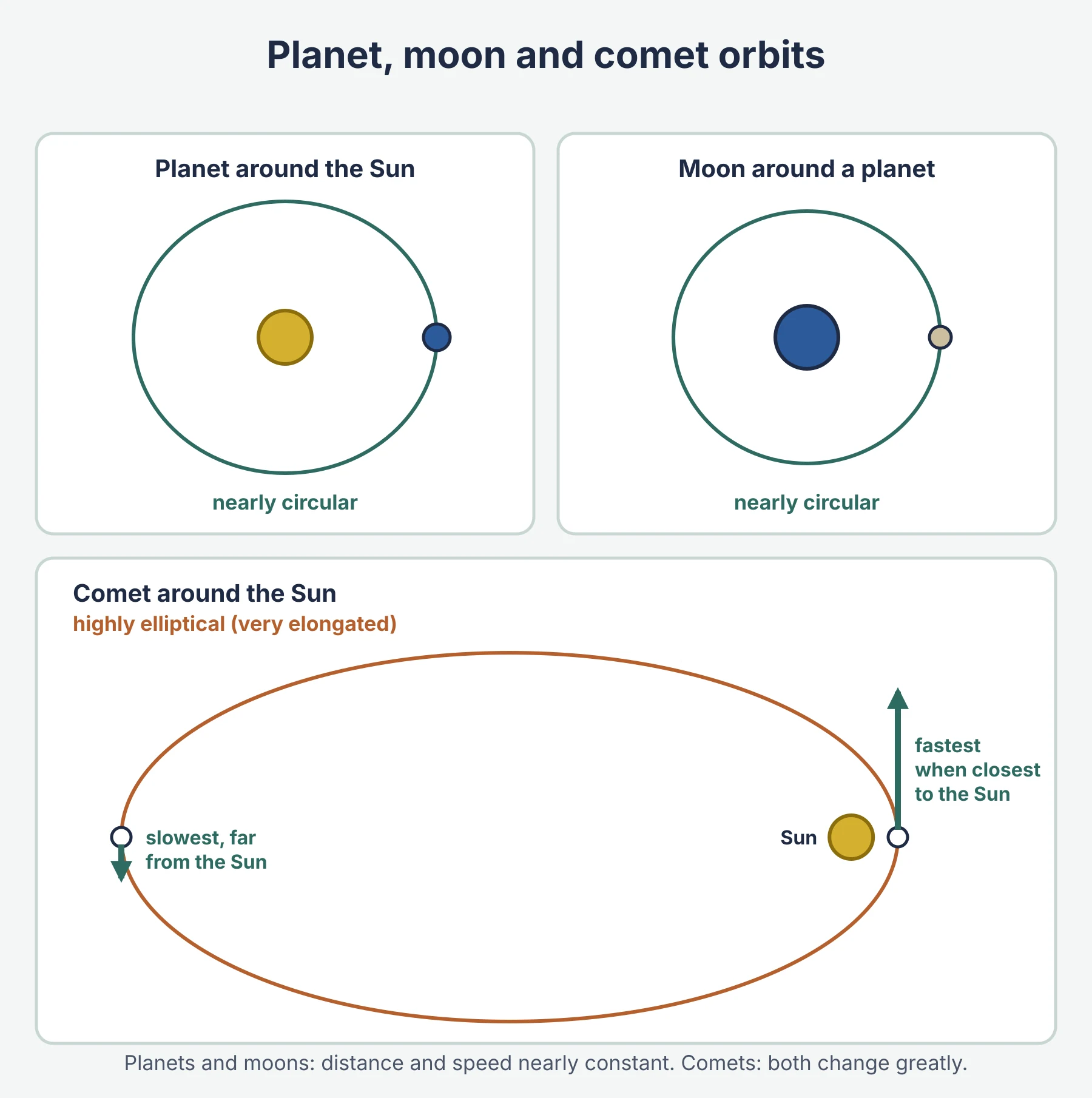
| Shape | Nearly circular (slightly elliptical) | Nearly circular | Highly elliptical (very elongated) |
| Speed | Nearly constant | Nearly constant | Changes greatly: fastest near the Sun, slowest far away |
| Distance from what they orbit | Nearly constant | Nearly constant | Varies enormously, from close to the Sun to far beyond the outer planets |
| Time period | From months to many years | Days to months for most | Can be very long |
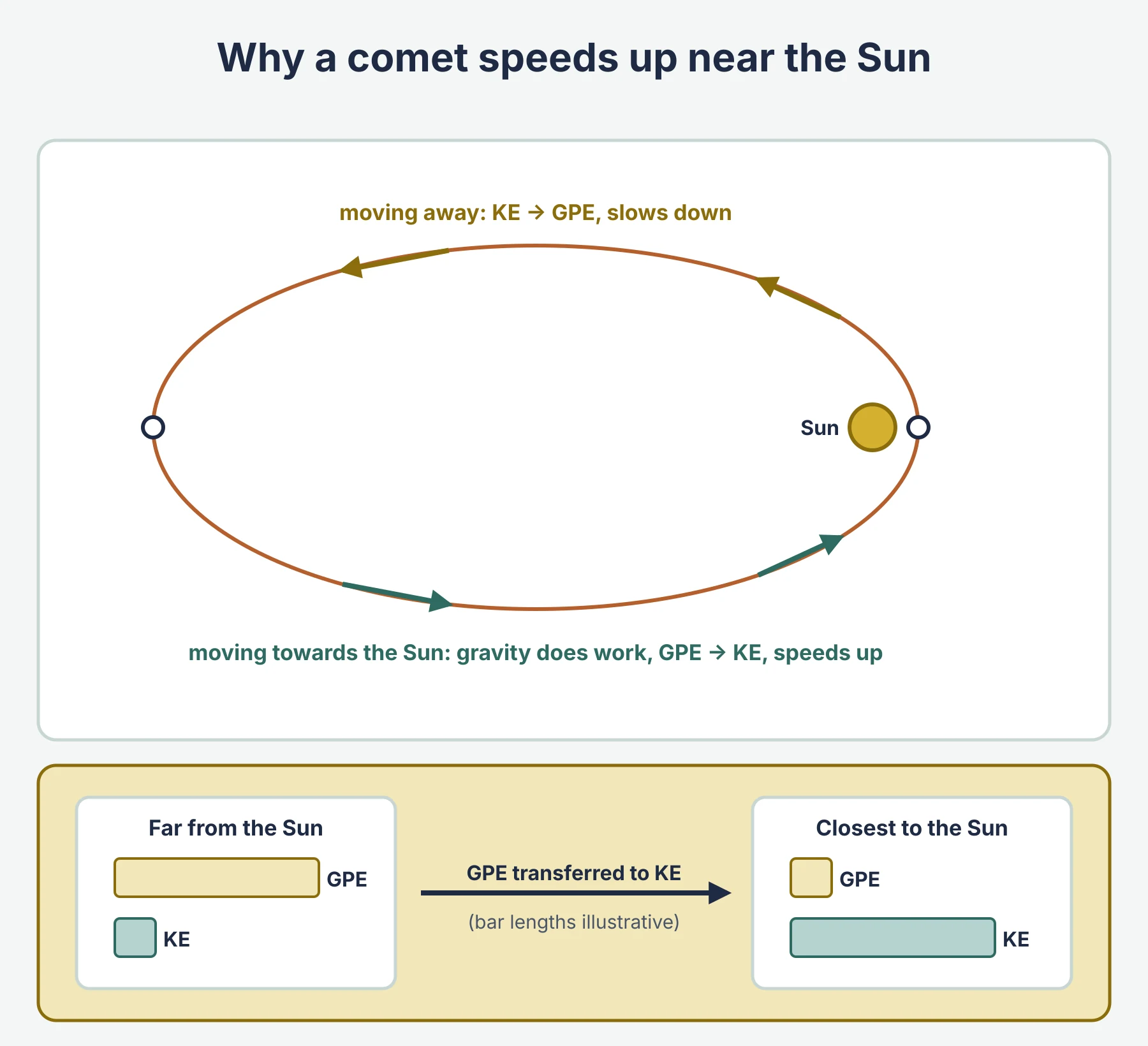
Explaining the comet’s changing speed earns credit: as the comet falls towards the Sun, gravity does work on it, so gravitational potential energy is transferred to kinetic energy and it speeds up; moving away, kinetic energy is transferred back and it slows down.
A further pattern follows from 8.3: the further a planet is from the Sun, the weaker the Sun’s gravitational field there, so the planet moves more slowly and, with a longer path to travel, takes much longer to complete an orbit.
Orbital speed (8.6)
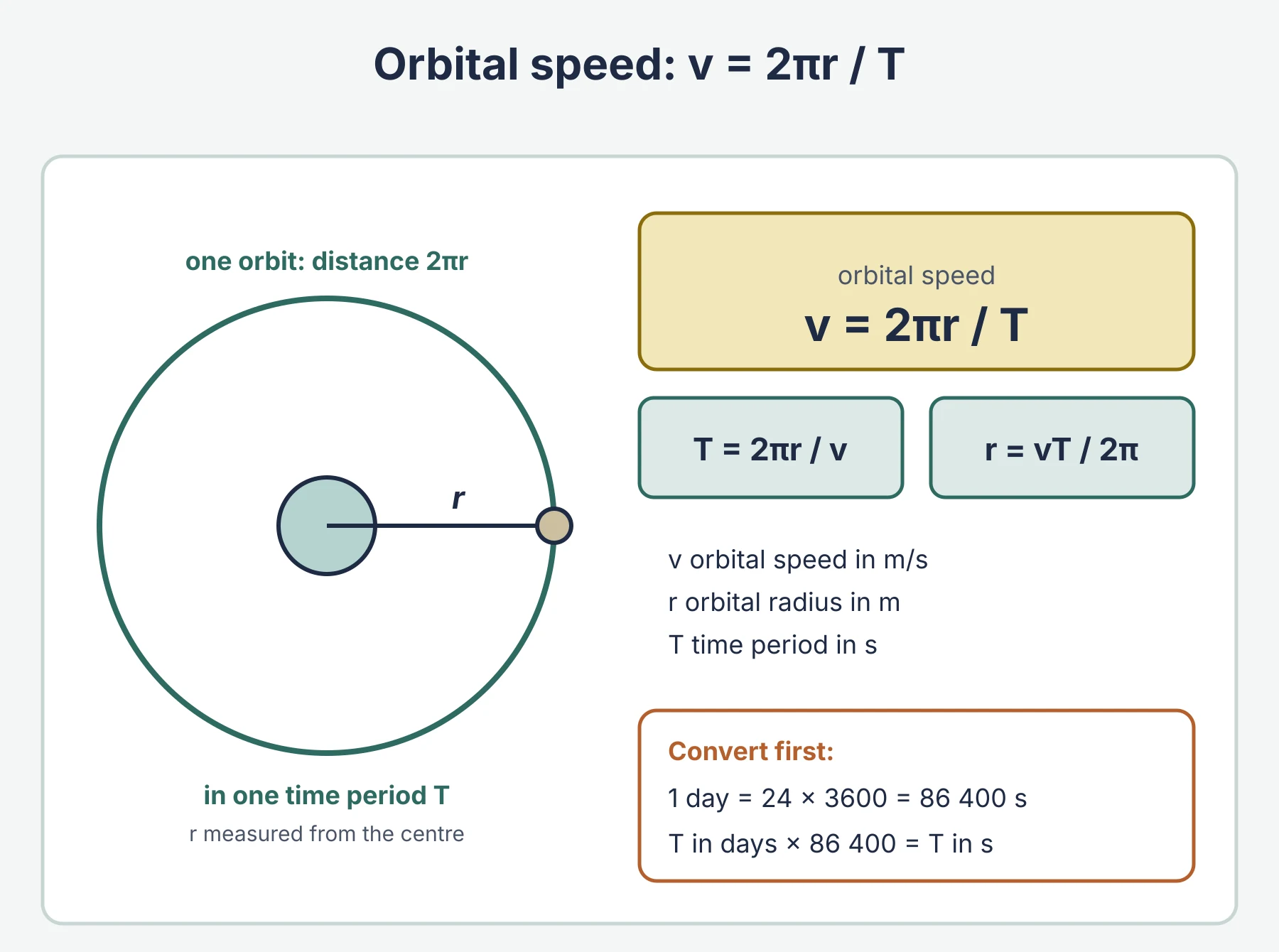
In one orbit the body travels the circumference of a circle, 2πr, in one time period T, so:
v = 2πr / T- r is the orbital radius in m, measured from the centre of the body being orbited.
- T is the time period in s.
- v is in m/s.
Rearranged: T = 2πr / v and r = vT / 2π.
Worked examples
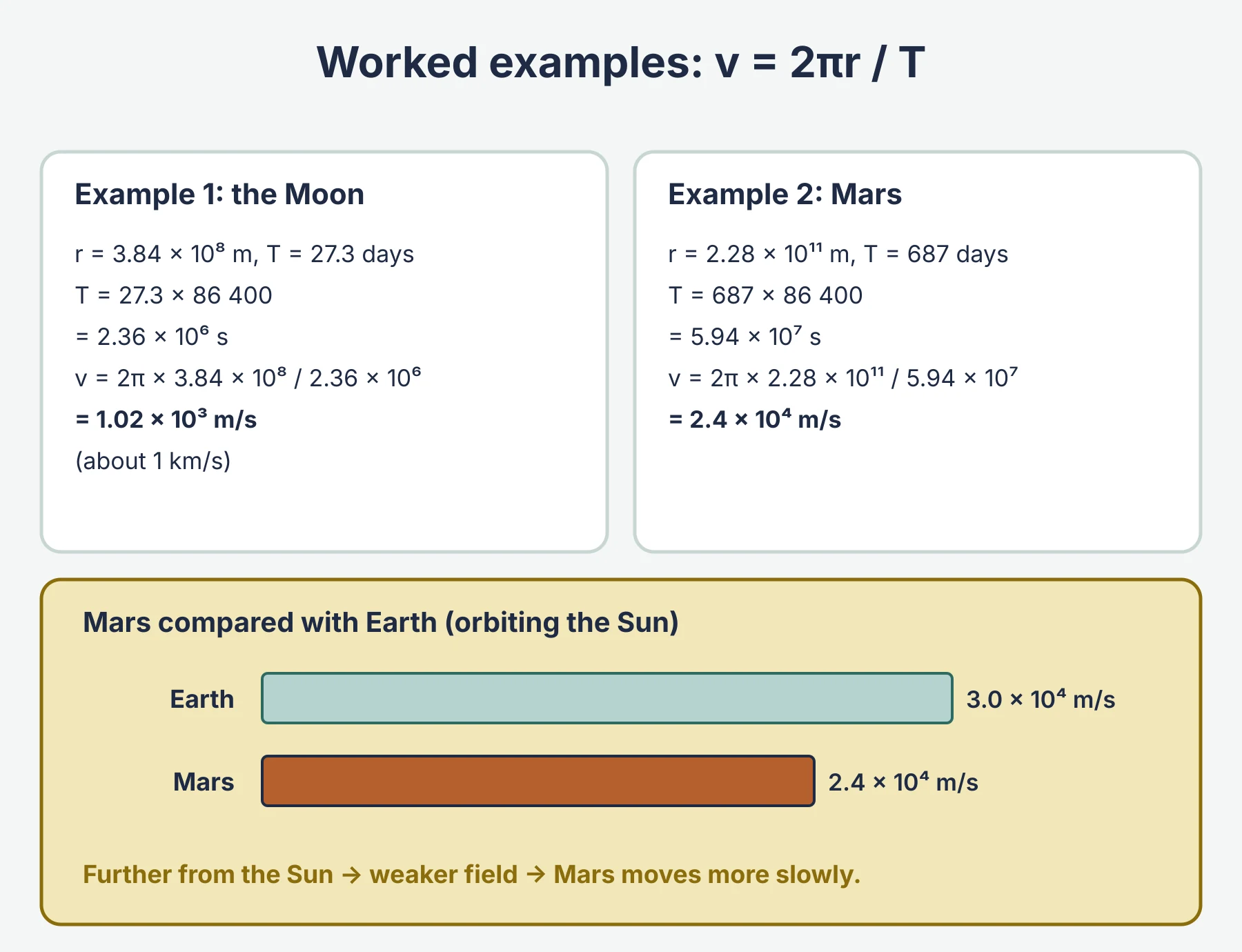
Example 1. The Moon orbits Earth at r = 3.84 × 10⁸ m with T = 27.3 days. Calculate its orbital speed.
T = 27.3 × 86 400 = 2.36 × 10⁶ s
v = 2π × 3.84 × 10⁸ / 2.36 × 10⁶ = 1.02 × 10³ m/s (about 1 km/s)
Example 2. Mars orbits the Sun at r = 2.28 × 10¹¹ m with T = 687 days. Calculate its orbital speed, and compare it with Earth’s (3.0 × 10⁴ m/s).
T = 687 × 86 400 = 5.94 × 10⁷ s
v = 2π × 2.28 × 10¹¹ / 5.94 × 10⁷ = 2.4 × 10⁴ m/s
Mars is further from the Sun and moves more slowly than Earth, as expected from the weaker gravitational field at its distance.
Example 3 (explain, 3 marks). Explain why a comet’s speed is greatest when it is closest to the Sun.
Model answer: the comet’s orbit is highly elliptical, so its distance from the Sun changes [1]. As it moves towards the Sun, the Sun’s gravitational force speeds it up: gravitational potential energy is transferred to kinetic energy [1]. Its kinetic energy, and so its speed, is therefore greatest at the closest point [1].
Common mistakes
- Putting the solar system and the galaxy in the wrong order of size.
- Saying g is “the same everywhere” or “zero in space”.
- Explaining an orbit with “centrifugal force pushing outwards”. The only force is gravity, inwards.
- Saying a body in a circular orbit is not accelerating because its speed is constant.
- Describing comet orbits as “oval” without saying they are far more elongated than planet orbits.
- Forgetting to convert days into seconds before using v = 2πr / T.
Exam technique
- Explain (8.4): name the force (gravity), its direction (towards the centre) and its effect (changes direction, keeps the body in orbit).
- Describe the differences (8.5): make direct comparisons (“comet orbits are much more elliptical than planet orbits”), not separate lists.
- Calculate (8.6): write the equation, convert to m and s, substitute, give units.
- State (8.2): use the exact relationships: billions of stars in a galaxy, billions of galaxies in the universe.
More resources on this topic
- Motion in the universe revision notes with a self-test
- Motion in the universe practice questions with full answers
- Stellar evolution study guide, the next sub-topic
Written against the Pearson Edexcel International GCSE in Physics (4PH1) specification, Issue 4. Always check the current specification for your examination year.
Related resources
-
Practice questions
Pearson Edexcel International GCSE Physics (4PH1): Motion in the universe – Practice Questions
Original questions with mark-scheme answers on galaxies, gravitational field strength, orbits, comets and orbital speed calculations, for Edexcel 4PH1 8b.
Physics · Pearson Edexcel · IGCSE
Try questions -
Revision notes
Pearson Edexcel International GCSE Physics (4PH1): Motion in the universe – Revision Notes
Recall notes for Edexcel 4PH1 sub-topic 8b: galaxies, why g varies, gravity and orbits, comet and planet orbits compared, and v = 2πr/T, with a self-test.
Physics · Pearson Edexcel · IGCSE
Revise topic -
Study guides
Pearson Edexcel International GCSE Physics (4PH1): Stellar evolution
Star colour and temperature, life cycles of Sun-like and massive stars, absolute magnitude and drawing the HR diagram, for Edexcel 4PH1 sub-topic 8c.
Physics · Pearson Edexcel · IGCSE
Read guide
Related articles
Get free revision emails (optional)
Occasional emails with practice questions, worked explanations and links to free resources for the qualification and subjects you choose. No spam, and you can unsubscribe from any email. The free tools on this site never need an email.