
Study Guides
Pearson Edexcel International GCSE Physics (4PH1): Units in astrophysics
Using kg, m, m/s, m/s², N, s and N/kg in weight, orbital speed and red-shift calculations, with conversions, for Edexcel IGCSE Physics 4PH1 sub-topic 8a.
- Subject
- Physics
- Level
- IGCSE
- Topic
- Astrophysics
- Author
- Marlbridge Academic Team
- Updated
- Reviewed by
- Hassan (what this means)
Aligned to Pearson Edexcel IGCSE Physics (4PH1), Issue 4. Official specification .
Syllabus page (what it covers and how it is assessed): Pearson Edexcel IGCSE Physics.
Syllabus points this page covers
4PH1
- 8a Units
Found an error? Report a correction.
Need help with this topic? Request a free trial class for IGCSE Physics (4PH1).
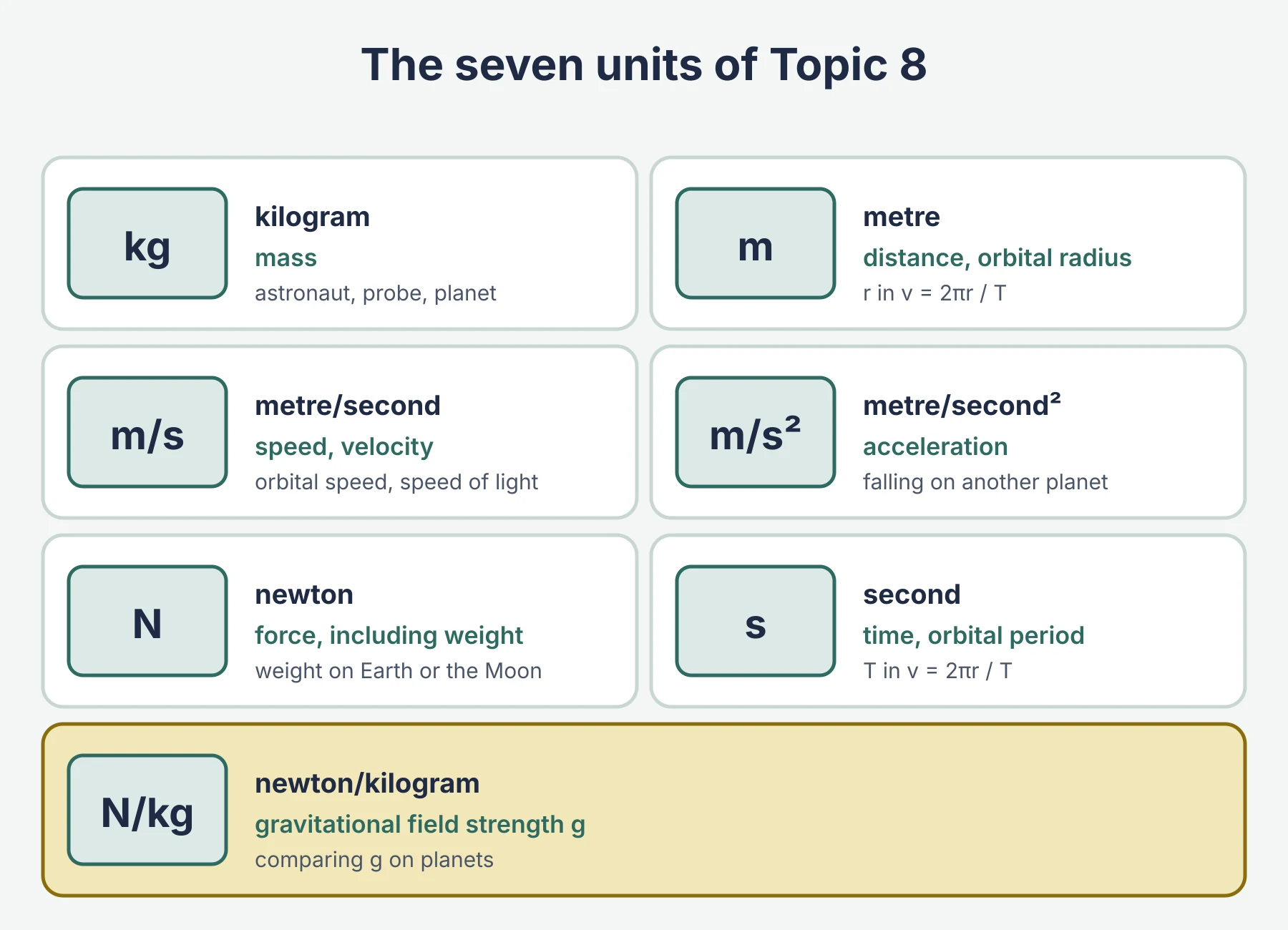
This guide covers sub-topic 8(a) Units of the Pearson Edexcel International GCSE in Physics (4PH1), Issue 4 specification. Its single statement, 8.1, reads: use the following units: kilogram (kg), metre (m), metre/second (m/s), metre/second² (m/s²), newton (N), second (s), newton/kilogram (N/kg). It is core content. Astrophysics questions use very large distances and very long times, so the main skill is converting given values into these units before substituting. The ideas behind the calculations are explained in the Motion in the universe study guide and the topic overview, Astrophysics.
What each unit measures in Topic 8
| Unit | Symbol | Quantity | Where it appears |
|---|---|---|---|
| kilogram | kg | Mass | Mass of an astronaut, probe or planet |
| metre | m | Distance; orbital radius | v = 2πr / T; distances to galaxies |
| metre/second | m/s | Speed, velocity | Orbital speed; galaxy velocity; speed of light |
| metre/second² | m/s² | Acceleration | Acceleration of a falling object on another planet |
| newton | N | Force, including weight | Weight on Earth, the Moon or another planet |
| second | s | Time; orbital period | T in v = 2πr / T |
| newton/kilogram | N/kg | Gravitational field strength g | Comparing g on planets and the Moon |
Mass, weight and gravitational field strength
Mass and weight are different quantities with different units, and astrophysics questions test the difference directly.
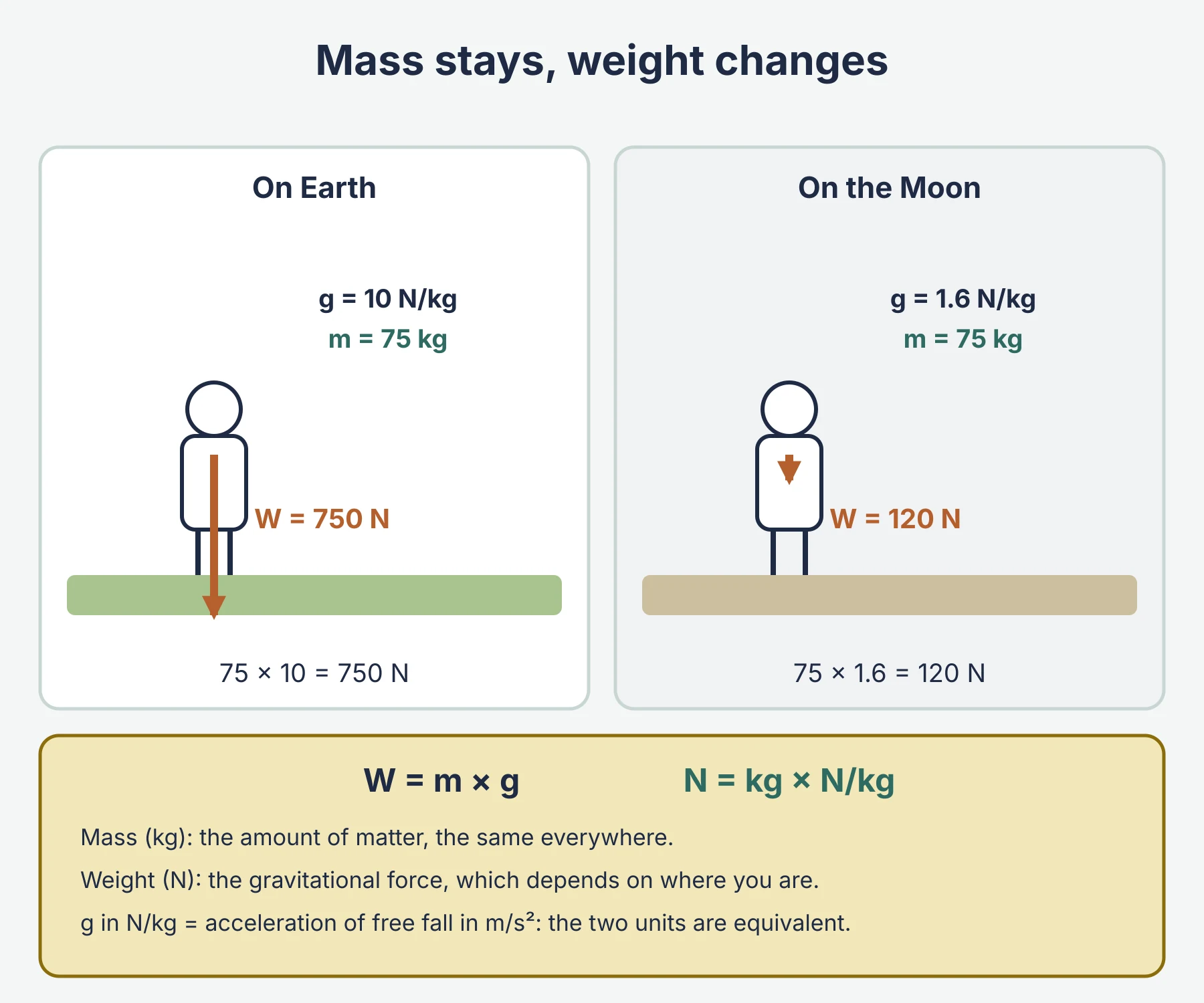
- Mass (kg) is the amount of matter in an object. It is the same everywhere.
- Weight (N) is the gravitational force on the object. It depends on where the object is.
- Gravitational field strength g (N/kg) is the force on each kilogram of mass.
weight = mass × gravitational field strength
W = m × g      (N = kg × N/kg)
Statement 8.3 says that g varies, and is different on other planets and the Moon from its value on Earth. On the Moon, g is about 1.6 N/kg; on Earth, close to 10 N/kg. A question will always give you the value it wants you to use.
The units N/kg and m/s² are equivalent: one newton is the force that gives 1 kg an acceleration of 1 m/s². So a planet’s g, in N/kg, is also the acceleration, in m/s², of an object falling freely near its surface, ignoring air resistance.
Orbital speed: metres and seconds
The orbital speed equation from statement 8.6 is:
orbital speed = (2 × π × orbital radius) / time period
v = 2πr / T
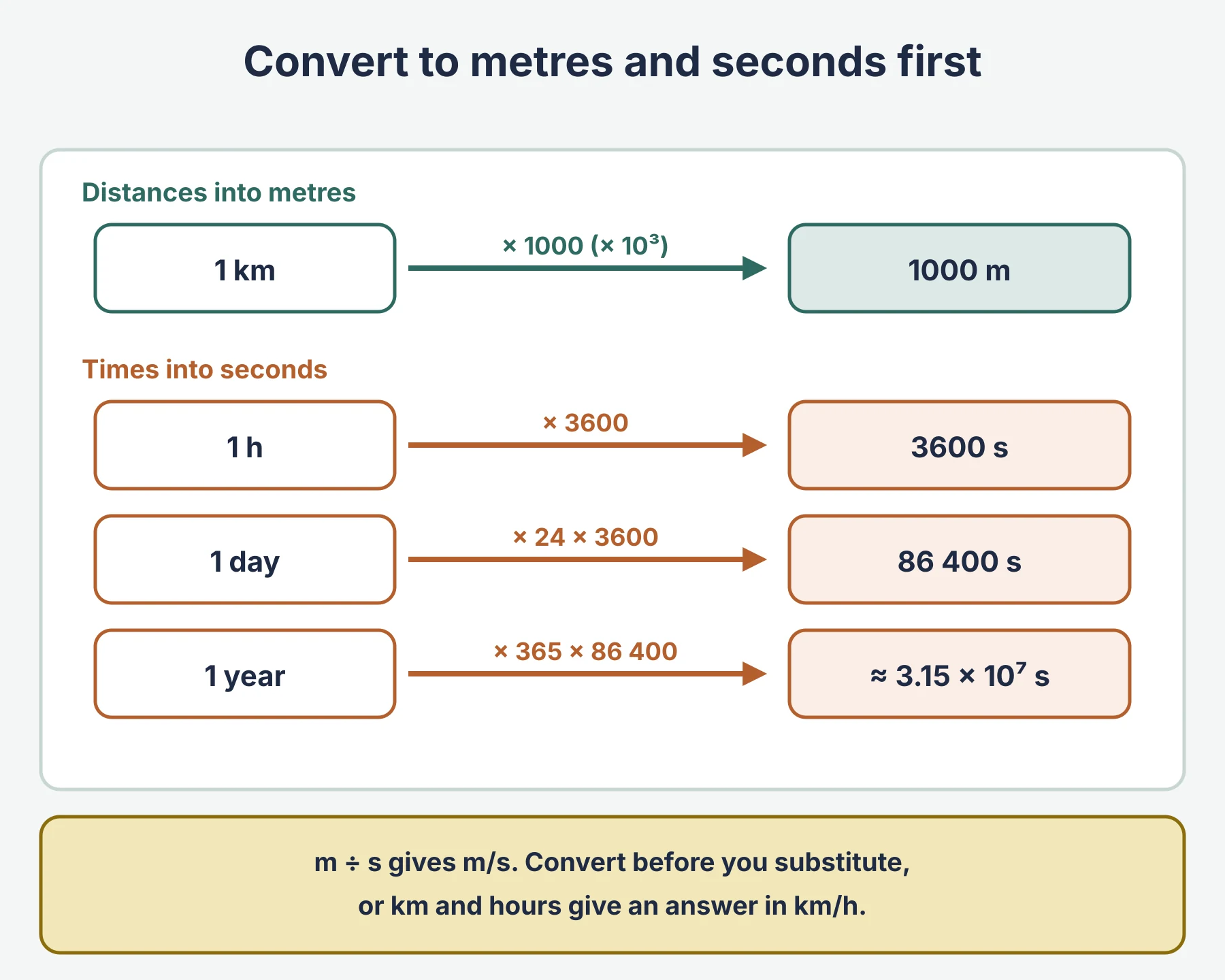
For v to come out in m/s, r must be in metres and T in seconds. Questions often give r in kilometres and T in hours, days or years, so convert first:
1 km   = 1000 m           (× 10³)
1 h    = 3600 s
1 day  = 24 × 3600 = 86 400 s
1 year ≈ 365 × 86 400 ≈ 3.15 × 10⁷ s
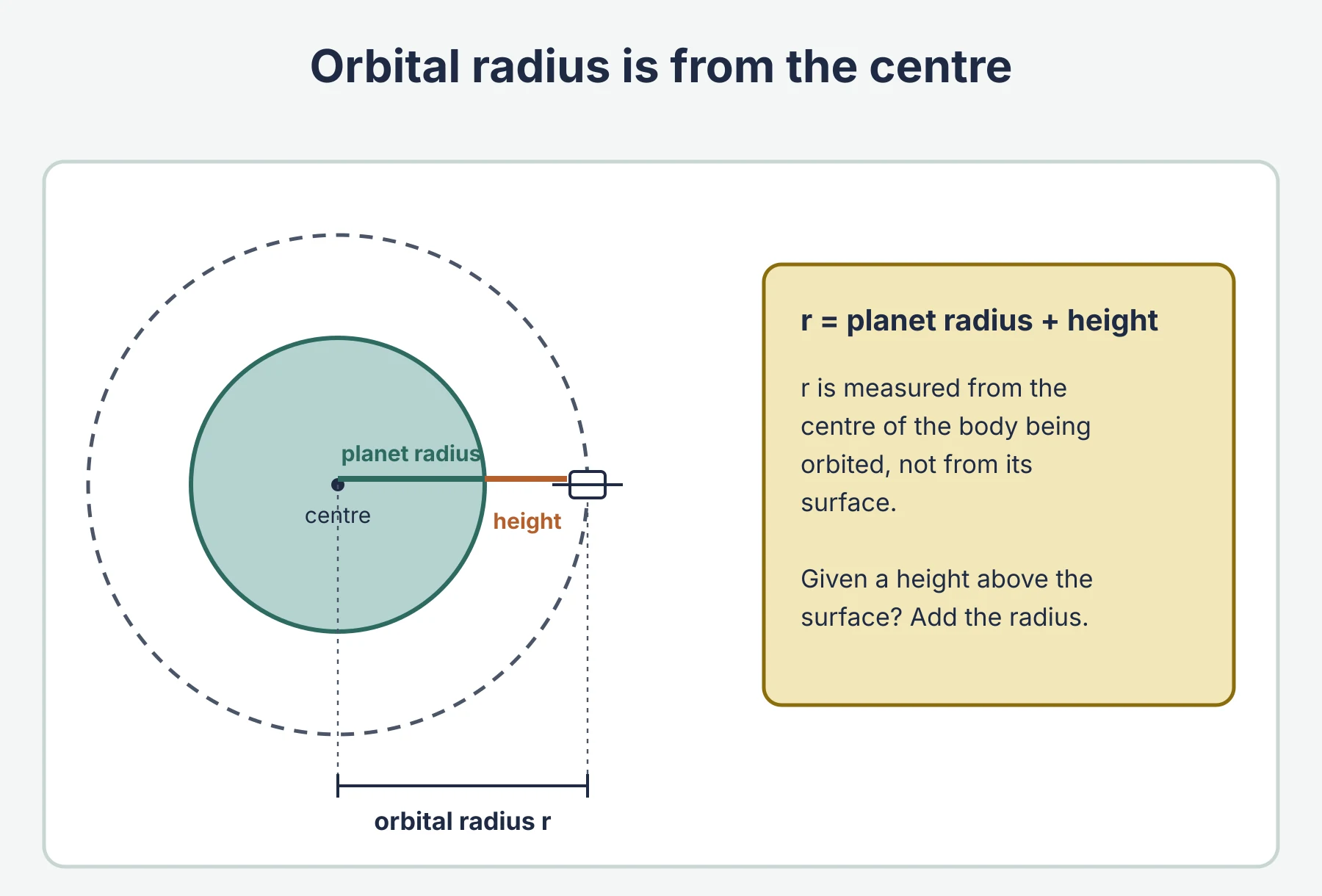
The orbital radius is measured from the centre of the body being orbited. If a question gives a satellite’s height above the surface, add the planet’s radius to get r.
Speeds in astrophysics
The red-shift equation (statement 8.16P) compares two speeds:
change in wavelength / reference wavelength = velocity of a galaxy / speed of light
Δλ / λ₀ = v / c
Both sides are ratios with no unit. The two wavelengths only need to be in the same unit as each other (often nanometres), and v comes out in the unit used for c. With c = 3.0 × 10⁸ m/s, v is in m/s.
Standard form
Astrophysical numbers are huge, so use standard form throughout. For example, Earth’s orbital radius is about 150 000 000 000 m, written 1.5 × 10¹¹ m. Enter standard form on a calculator with the ×10ˣ key, not by typing “× 10 ^” with extra brackets you might forget.
Checking an answer with its units
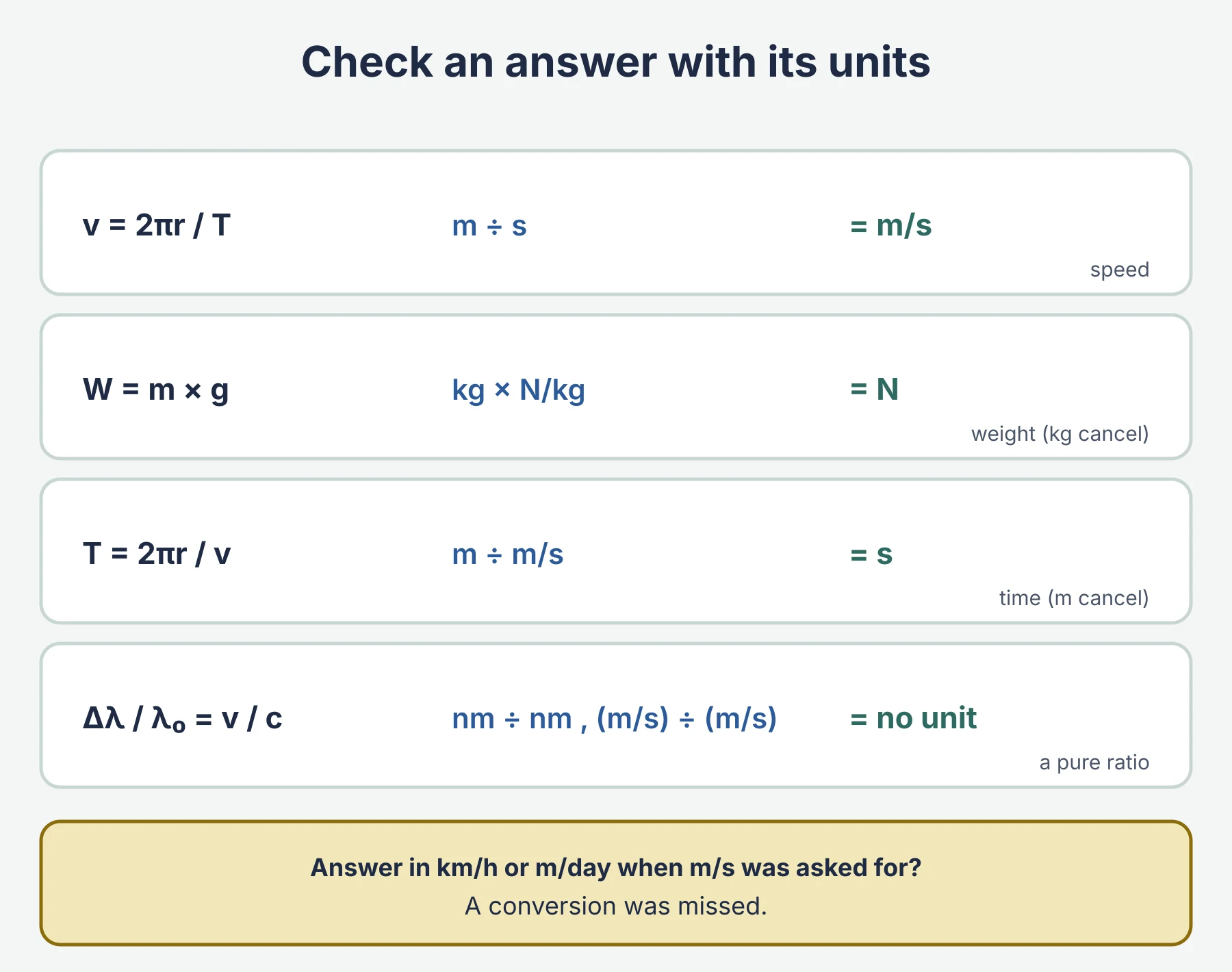
Units can be treated like algebra to check that an equation has been used correctly:
- v = 2πr / T: 2π has no unit, so the unit of v is m ÷ s = m/s. If your working gives km/h or m/day, a conversion has been missed.
- W = m × g: kg × N/kg = N. The kilograms cancel, leaving newtons.
- T = 2πr / v: m ÷ (m/s) = s. The metres cancel, leaving seconds.
- Δλ / λ₀ = v / c: nm ÷ nm and (m/s) ÷ (m/s) both cancel, leaving a pure number.
If the units of your answer do not match the quantity asked for, look for the step where a unit was not converted.
Worked examples
Example 1 (weight on the Moon). An astronaut has a mass of 75 kg. Take g = 10 N/kg on Earth and 1.6 N/kg on the Moon.
weight on Earth = 75 × 10  = 750 N
weight on Moon  = 75 × 1.6 = 120 N
mass on Moon    = 75 kg (unchanged)
Example 2 (km and hours). A navigation satellite orbits at a radius of 26 600 km with a period of 12 h. Calculate its orbital speed.
r = 26 600 km = 2.66 × 10⁷ m
T = 12 × 3600 = 43 200 s
v = 2π × 2.66 × 10⁷ / 43 200 = 3.9 × 10³ m/s (2 s.f.)
Example 3 (days). Earth orbits the Sun at r = 1.5 × 10¹¹ m in 365 days.
T = 365 × 86 400 = 3.15 × 10⁷ s
v = 2π × 1.5 × 10¹¹ / 3.15 × 10⁷ = 3.0 × 10⁴ m/s
Example 4 (rearranging). The Moon’s orbital radius is 3.8 × 10⁵ km and its orbital speed is 1.0 km/s. Find the period in seconds and in days.
T = 2πr / v
r = 3.8 × 10⁸ m, v = 1000 m/s
T = 2π × 3.8 × 10⁸ / 1000 = 2.4 × 10⁶ s
in days: 2.4 × 10⁶ / 86 400 ≈ 28 days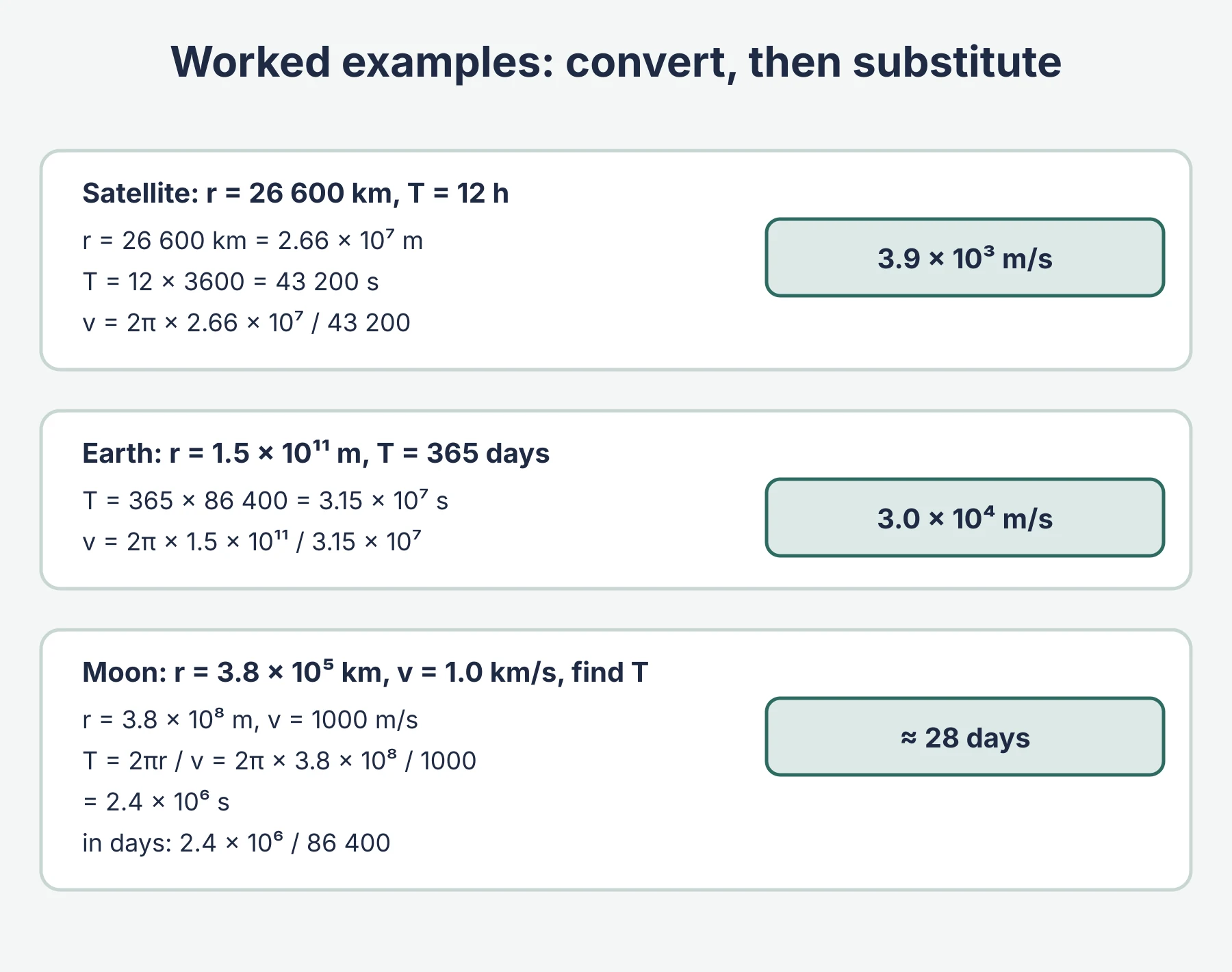
Common mistakes
- Giving weight in kilograms, or mass in newtons.
- Saying an astronaut’s mass changes on the Moon.
- Substituting kilometres and hours straight into v = 2πr / T; the answer is then in km/h, not m/s, and usually marked wrong.
- Using the height above the surface as the orbital radius.
- Typing 1.5 × 10¹¹ incorrectly into the calculator: check by estimating the order of magnitude.
- Writing N/kg for an acceleration in a question that asks for m/s²: they are equivalent, but use the unit the question asks for.
Exam technique
- Calculate: write each conversion as a separate line so a correct method earns credit even if the final number slips.
- State the unit: when asked “give the unit”, N/kg for g, N for weight, m/s for orbital speed.
- Estimate: round to one significant figure first, such as 2π ≈ 6, to check an answer’s order of magnitude.
- Show that: give your final value to at least one more significant figure than the value shown in the question.
More resources on this topic
- Units in astrophysics revision notes with conversions and a self-test
- Units in astrophysics practice questions with worked answers
- Cosmology study guide for red-shift calculations
Written against the Pearson Edexcel International GCSE in Physics (4PH1) specification, Issue 4. Always check the current specification for your examination year.
Related resources
-
Practice questions
Pearson Edexcel International GCSE Physics (4PH1): Units in astrophysics – Practice Questions
Original questions with worked answers on mass and weight, g in N/kg and m/s², and unit conversions for orbital speed and red-shift, for Edexcel 4PH1 8a.
Physics · Pearson Edexcel · IGCSE
Try questions -
Revision notes
Pearson Edexcel International GCSE Physics (4PH1): Units in astrophysics – Revision Notes
Recall notes for Edexcel 4PH1 sub-topic 8a: mass, weight and g, N/kg and m/s², conversions for orbital speed and red-shift units, with a self-test.
Physics · Pearson Edexcel · IGCSE
Revise topic -
Study guides
Astrophysics
Orbits and gravity, stellar evolution, the HR diagram and red-shift evidence for the Big Bang: Topic 8 of Edexcel International GCSE Physics (4PH1).
Physics · Pearson Edexcel · IGCSE
Read guide
Related articles
Get free revision emails (optional)
Occasional emails with practice questions, worked explanations and links to free resources for the qualification and subjects you choose. No spam, and you can unsubscribe from any email. The free tools on this site never need an email.