
Revision Notes
Pearson Edexcel International GCSE Physics (4PH1): Units in astrophysics – Revision Notes
Recall notes for Edexcel 4PH1 sub-topic 8a: mass, weight and g, N/kg and m/s², conversions for orbital speed and red-shift units, with a self-test.
- Subject
- Physics
- Level
- IGCSE
- Topic
- Astrophysics
- Author
- Marlbridge Academic Team
- Updated
- Reviewed by
- Hassan (what this means)
Aligned to Pearson Edexcel IGCSE Physics (4PH1), Issue 4. Official specification .
Syllabus page (what it covers and how it is assessed): Pearson Edexcel IGCSE Physics.
Syllabus points this page covers
4PH1
- 8a Units
Found an error? Report a correction.
Need help with this topic? Request a free trial class for IGCSE Physics (4PH1).
Condensed notes for sub-topic 8(a) Units of Pearson Edexcel International GCSE Physics (4PH1). Statement 8.1: use kilogram (kg), metre (m), metre/second (m/s), metre/second² (m/s²), newton (N), second (s) and newton/kilogram (N/kg). Core content. Worked examples are in the Units in astrophysics study guide.
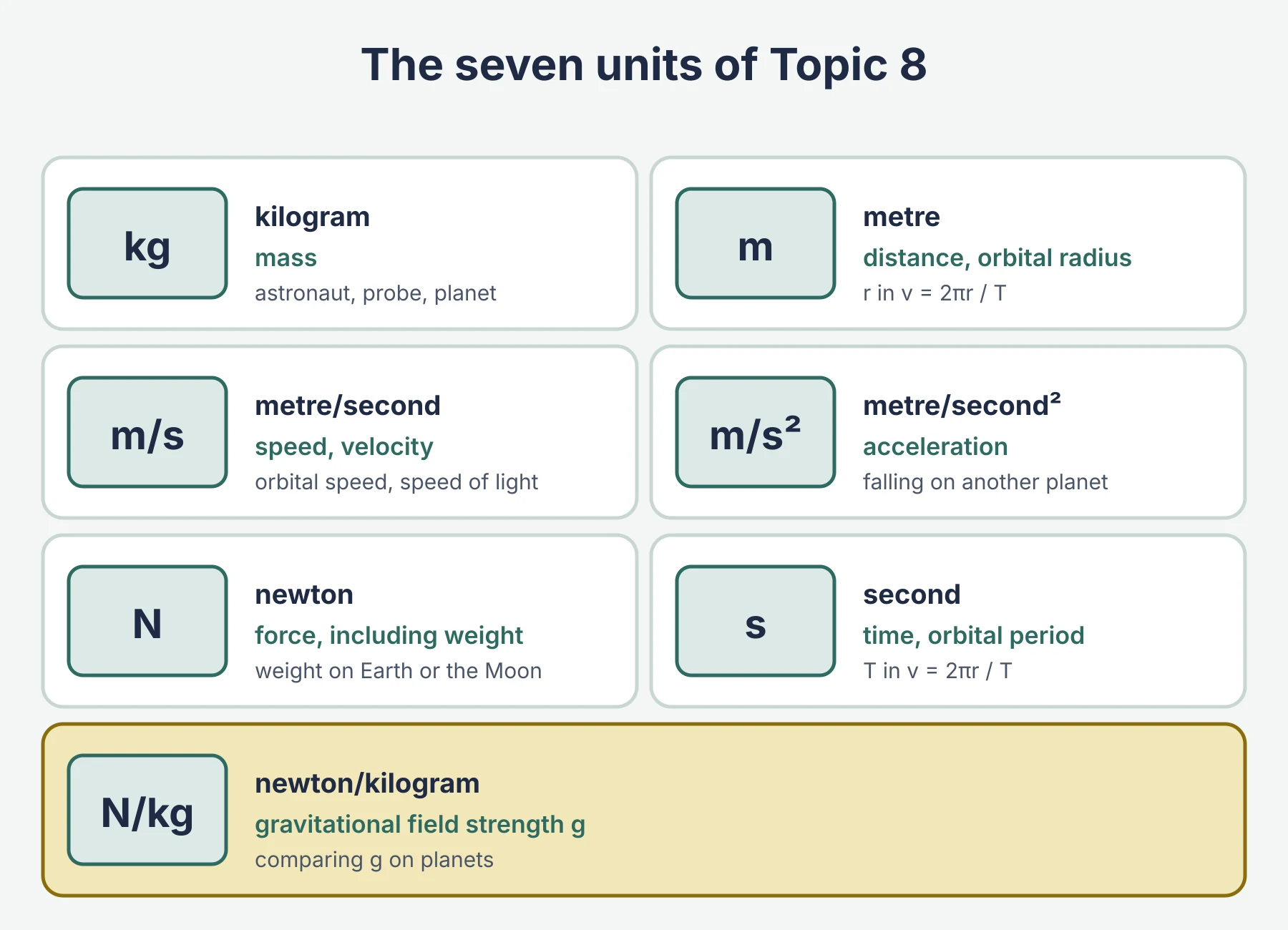
The seven units
| Unit | Quantity |
|---|---|
| kg | Mass |
| m | Distance, orbital radius |
| m/s | Speed: orbital speed, galaxy velocity, speed of light |
| m/s² | Acceleration |
| N | Force, including weight |
| s | Time, orbital period |
| N/kg | Gravitational field strength g |
Mass, weight and g
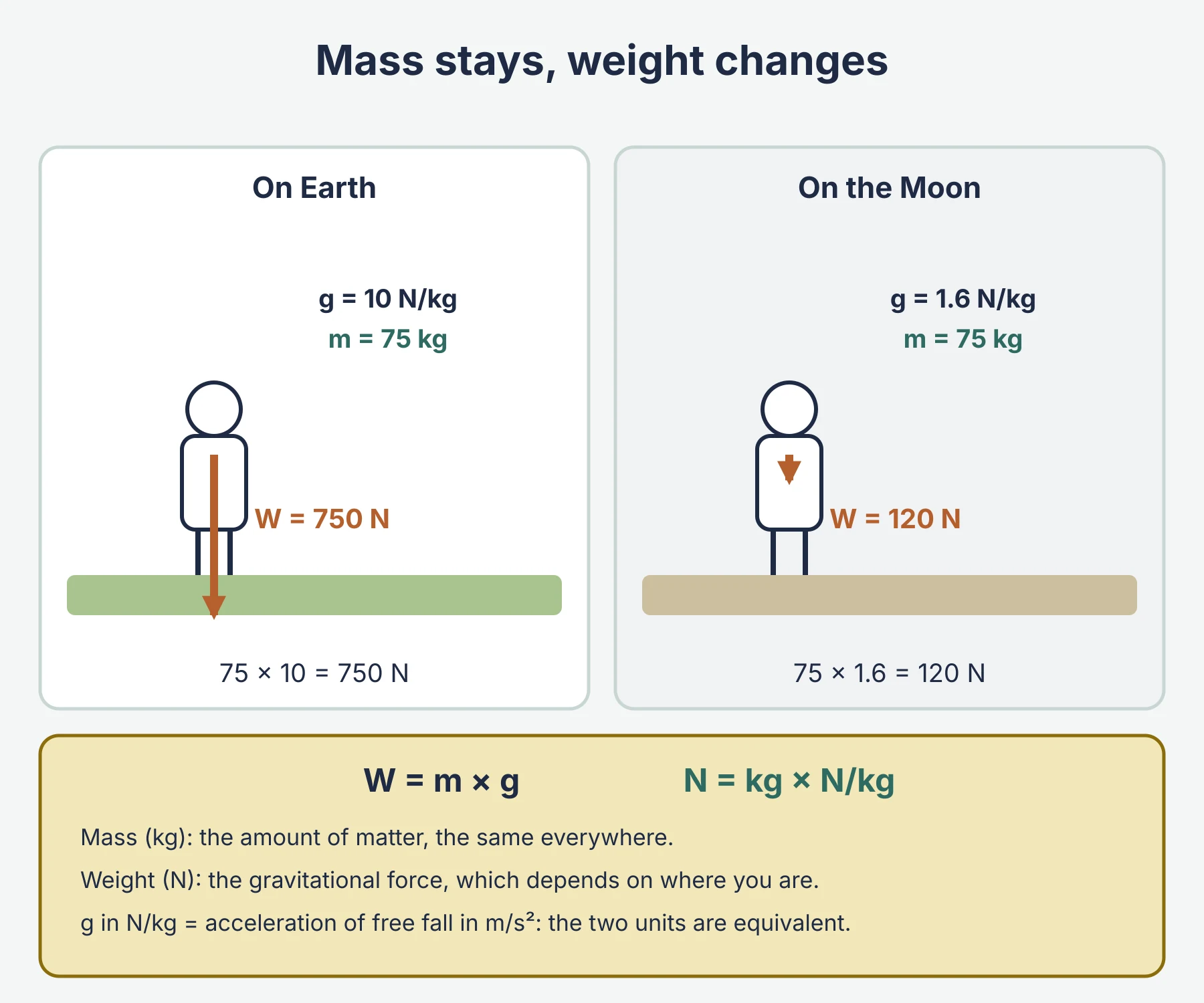
- Mass (kg): same everywhere.
- Weight (N): gravitational force; changes with location.
- W = m × g: N = kg × N/kg.
- g differs on the Moon and other planets (statement 8.3). Typical values: Earth close to 10 N/kg; Moon about 1.6 N/kg. Use the value the question gives.
- 1 N/kg = 1 m/s². g on a planet = acceleration of a freely falling object there (no air resistance).
Orbital speed units
v = 2πr / T
r in m, T in s → v in m/s
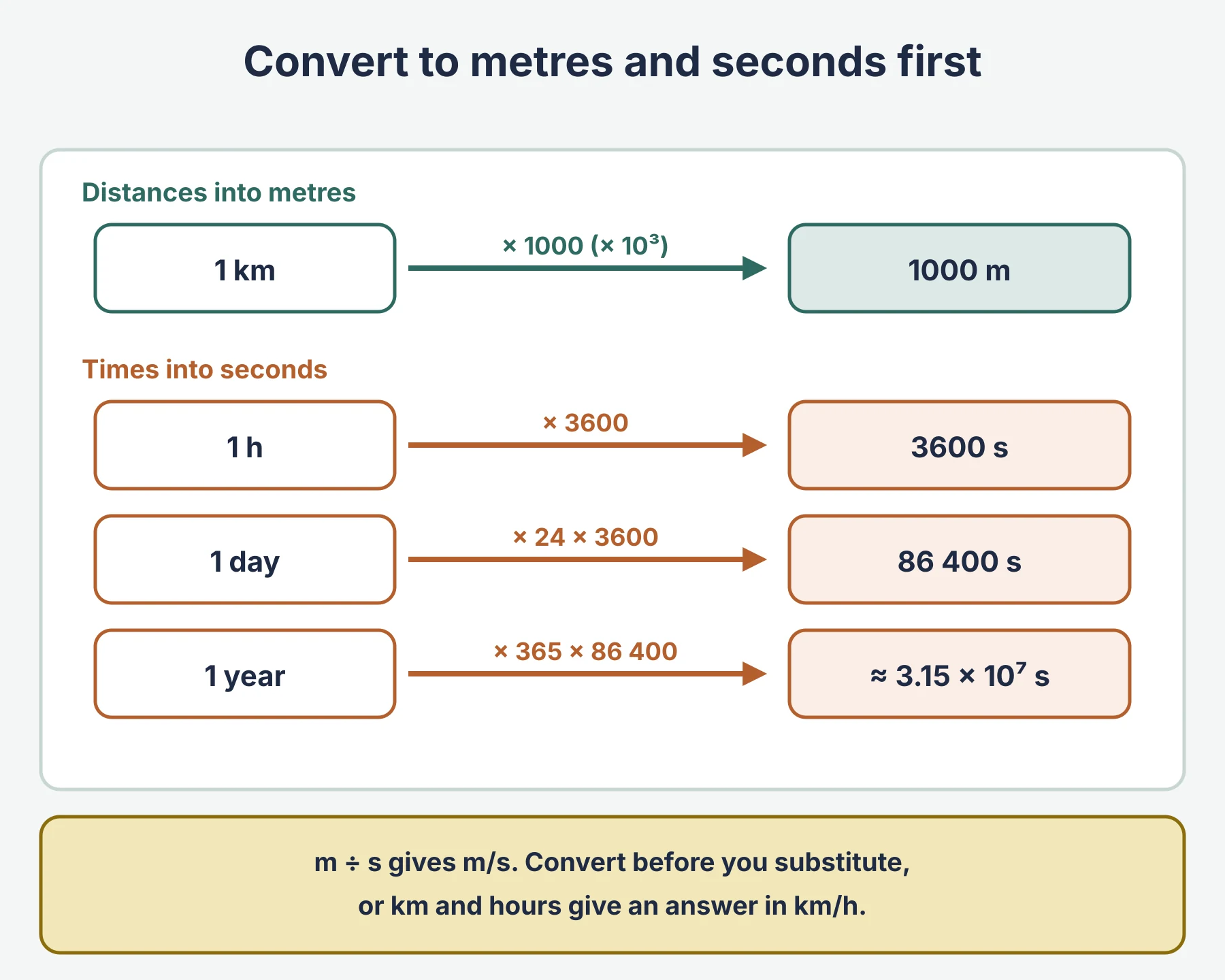
Conversions
1 km  = 1000 m
1 h   = 3600 s
1 day = 86 400 s
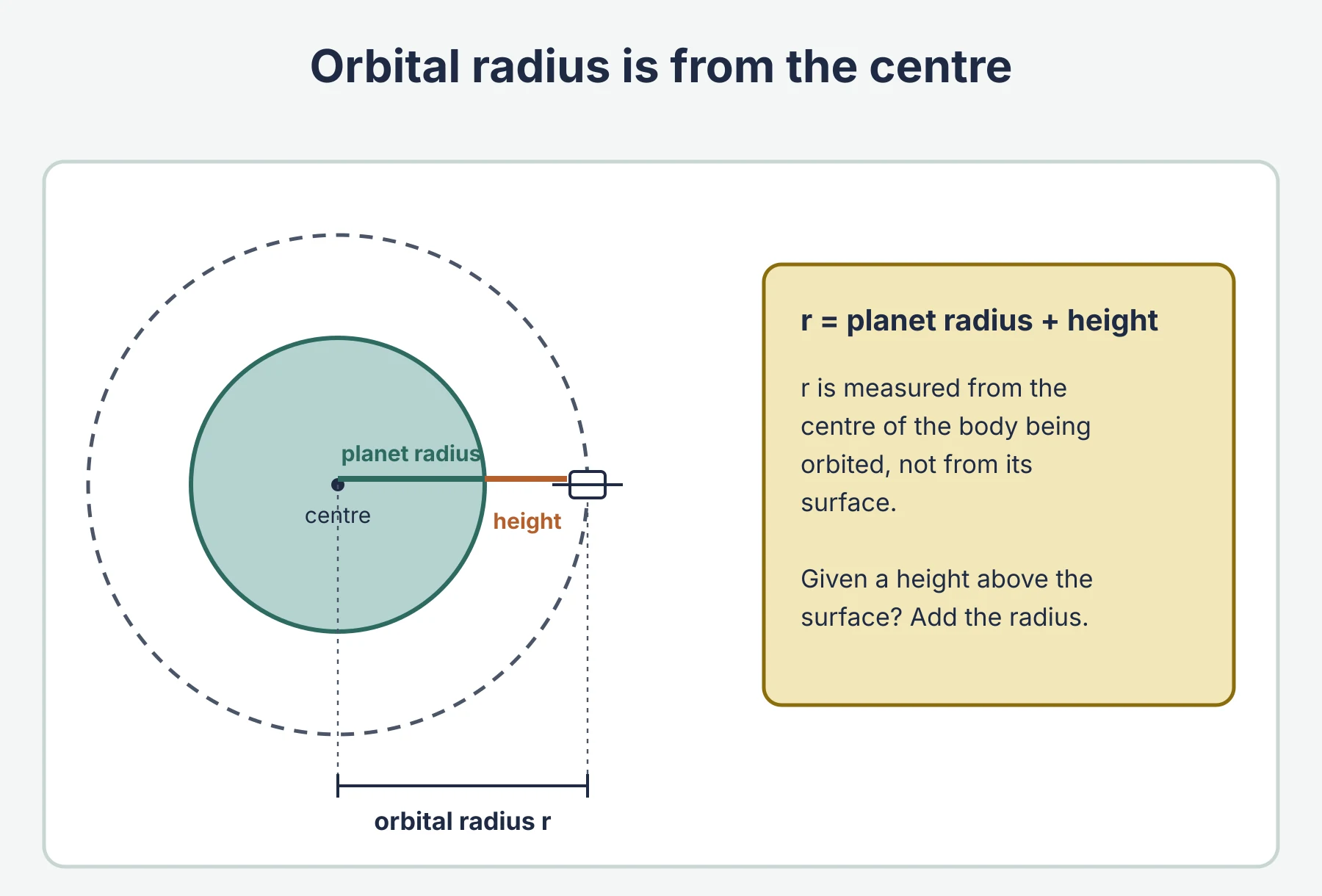
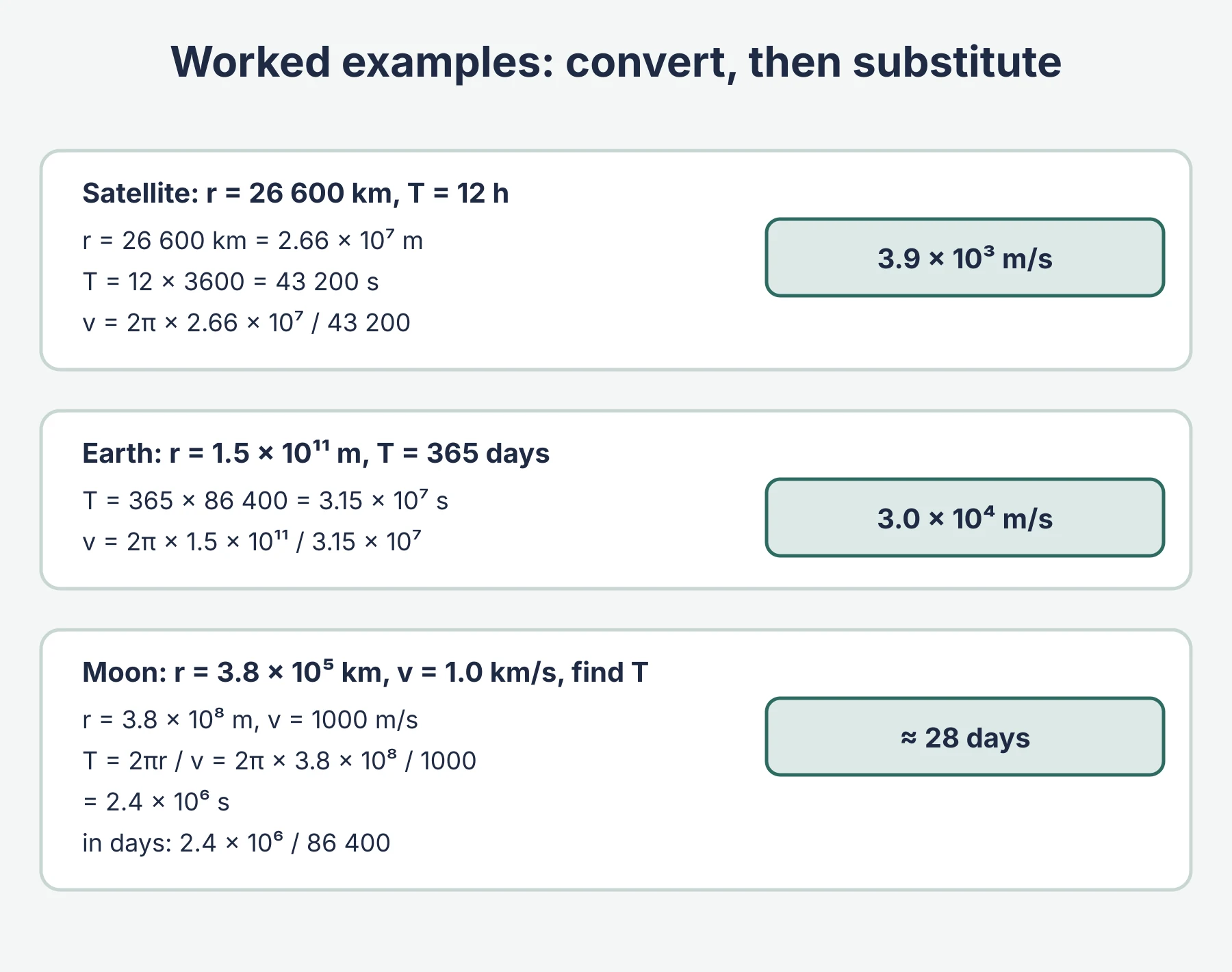
1 year ≈ 3.15 × 10⁷ s- Orbital radius is measured from the centre of the body orbited: r = planet radius + height above the surface.
- Rearranged: T = 2πr / v and r = vT / 2π.
Red-shift units
Δλ / λ₀ = v / c- Both ratios are unitless.
- Δλ and λ₀ must be in the same unit as each other (nm is fine).
- With c = 3.0 × 10⁸ m/s, v comes out in m/s.
- Δλ = observed wavelength − reference wavelength.
Unit checks
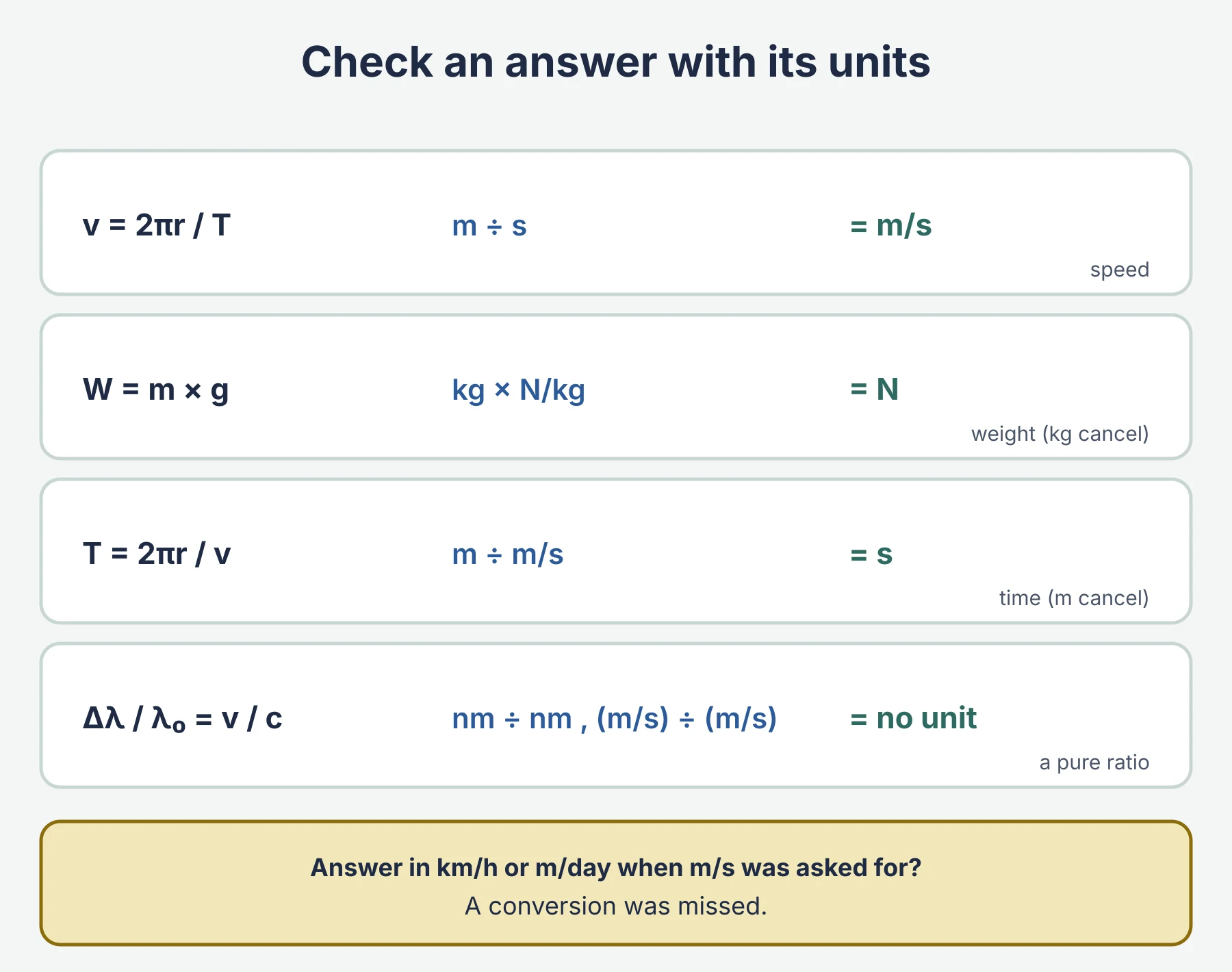
- v = 2πr / T → m ÷ s = m/s.
- W = m × g → kg × N/kg = N.
- T = 2πr / v → m ÷ (m/s) = s.
- If the unit that comes out is wrong, a conversion was missed.
Standard form and estimates
- Earth’s orbital radius ≈ 1.5 × 10¹¹ m; speed of light 3.0 × 10⁸ m/s.
- Use the calculator’s ×10ˣ key.
- Check: 2π ≈ 6; does the answer have a sensible power of ten?
Quick worked example
Illustrative figures. A 900 kg rover on Mars, where g = 3.7 N/kg.
- Mass on Mars: 900 kg.
- Weight on Mars: 900 × 3.7 = 3330 N ≈ 3300 N (2 s.f.).
- If dropped from rest (no air), its speed increases by 3.7 m/s every second.
Key terms
| Term | Meaning |
|---|---|
| Mass | Amount of matter in an object, in kg |
| Weight | Gravitational force on an object, in N |
| Gravitational field strength | Force per kilogram, in N/kg |
| Orbital radius | Distance from the centre of the orbited body to the orbiting object, in m |
| Time period | Time for one complete orbit, in s |
| Orbital speed | Speed of an orbiting object, in m/s |
| Reference wavelength | Wavelength of a spectral line from a stationary source |
Exam traps
- Weight in kg, or mass in N.
- “Mass is smaller on the Moon”: no, only weight is.
- Using km and hours in v = 2πr / T and calling the result m/s.
- Forgetting to add the planet’s radius to a satellite’s height.
- Using the observed wavelength as λ₀ in the red-shift ratio.
- Leaving answers unrounded: give 2 or 3 significant figures, matching the data.
Self-test
- State the units of mass, weight and gravitational field strength.
- Show that 1 N/kg is the same as 1 m/s².
- A 60 kg student stands on the Moon (g = 1.6 N/kg). Find her weight.
- A lander weighs 3000 N on Earth (g = 10 N/kg). Find its mass.
- Convert 3.6 × 10⁴ km into metres.
- Convert 5.0 days into seconds.
- A satellite orbits 600 km above a planet of radius 6400 km. What is r in metres?
- Which units must r and T be in to give v in m/s?
- In Δλ / λ₀ = v / c, what unit does the left-hand side have?
- An object dropped near the surface of a planet accelerates at 8.9 m/s². What is g there, in N/kg?
- A moon has r = 2.0 × 10⁸ m and T = 4.0 × 10⁵ s. Calculate v.
- Why is a speed of 3.0 × 10⁸ km/s wrong for light?
Answers
- Mass: kg; weight: N; gravitational field strength: N/kg.
- 1 N is the force that gives 1 kg an acceleration of 1 m/s², so 1 N/kg = 1 (kg m/s²)/kg = 1 m/s².
- W = 60 × 1.6 = 96 N.
- m = W / g = 3000 / 10 = 300 kg.
- 3.6 × 10⁴ × 1000 = 3.6 × 10⁷ m.
- 5.0 × 86 400 = 432 000 s = 4.32 × 10⁵ s.
- 6400 + 600 = 7000 km = 7.0 × 10⁶ m.
- r in metres and T in seconds.
- None: it is a ratio of two wavelengths.
- 8.9 N/kg.
- v = 2π × 2.0 × 10⁸ / 4.0 × 10⁵ = 3.1 × 10³ m/s (about 3140 m/s).
- The speed of light is 3.0 × 10⁸ m/s; 3.0 × 10⁸ km/s is 1000 times too large.
Frequently asked questions
Are any Topic 8 unit statements Physics-only? No. Statement 8.1 is core, although the units are also used in the Physics-only cosmology calculations.
Why is N/kg used for g rather than m/s²? Both are correct and equivalent; the specification lists both units. N/kg fits weight calculations, and m/s² fits acceleration.
Practise with the Units in astrophysics practice questions.
Related resources
-
Study guides
Astrophysics
Orbits and gravity, stellar evolution, the HR diagram and red-shift evidence for the Big Bang: Topic 8 of Edexcel International GCSE Physics (4PH1).
Physics · Pearson Edexcel · IGCSE
Read guide -
Practice questions
Edexcel IGCSE Physics: Astrophysics — Practice Questions
Original exam-style practice questions with full worked answers on the solar system, orbits, stellar life cycles, red shift and the Big Bang.
Physics · Pearson Edexcel · IGCSE
Try questions -
Revision notes
Edexcel IGCSE Physics: Astrophysics — Revision Notes
Condensed recall notes on the solar system, orbits, stellar life cycles, redshift and the Big Bang for Edexcel International GCSE Physics 4PH1.
Physics · Pearson Edexcel · IGCSE
Revise topic
Related articles
Get free revision emails (optional)
Occasional emails with practice questions, worked explanations and links to free resources for the qualification and subjects you choose. No spam, and you can unsubscribe from any email. The free tools on this site never need an email.