
Revision Notes
Pearson Edexcel International GCSE Physics (4PH1): Units for electricity – Revision Notes
Recall notes on A, C, J, Ω, s, V and W for Edexcel International GCSE Physics 4PH1 Topic 2: unit links, prefixes, conversions, exam traps and a self-test.
- Subject
- Physics
- Level
- IGCSE
- Topic
- Electricity
- Author
- Marlbridge Academic Team
- Updated
- Reviewed by
- Hassan (what this means)
Aligned to Pearson Edexcel IGCSE Physics (4PH1), Issue 4. Official specification .
Syllabus page (what it covers and how it is assessed): Pearson Edexcel IGCSE Physics.
Syllabus points this page covers
4PH1
- 2a Units
Found an error? Report a correction.
Need help with this topic? Request a free trial class for IGCSE Physics (4PH1).
Condensed notes on sub-topic 2(a) Units (statement 2.1) of Pearson Edexcel International GCSE Physics (4PH1), Issue 4. For full explanations and worked examples, use the Units for electricity study guide.
The list
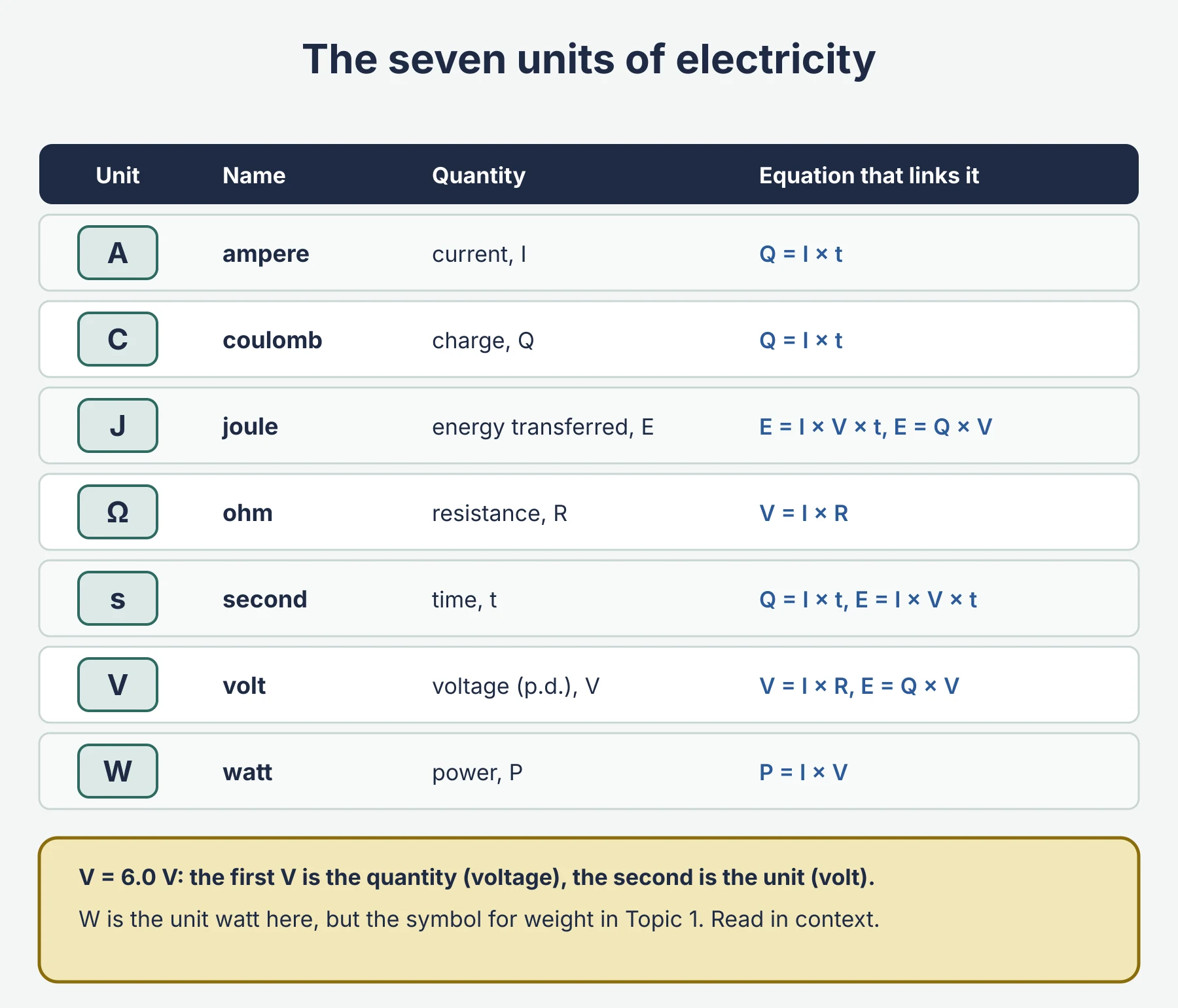
Statement 2.1: ampere (A), coulomb (C), joule (J), ohm (Ω), second (s), volt (V), watt (W).
Key units table
| Unit | Quantity (symbol) | Defined through | Same as |
|---|---|---|---|
| ampere, A | current (I) | Q = I × t | C/s |
| coulomb, C | charge (Q) | Q = I × t | A s |
| joule, J | energy transferred (E) | E = Q × V | C × V, or W × s |
| ohm, Ω | resistance (R) | V = I × R | V/A |
| second, s | time (t) | base unit | |
| volt, V | voltage (V) | E = Q × V | J/C |
| watt, W | power (P) | P = I × V | J/s, or A × V |
Must-know statements
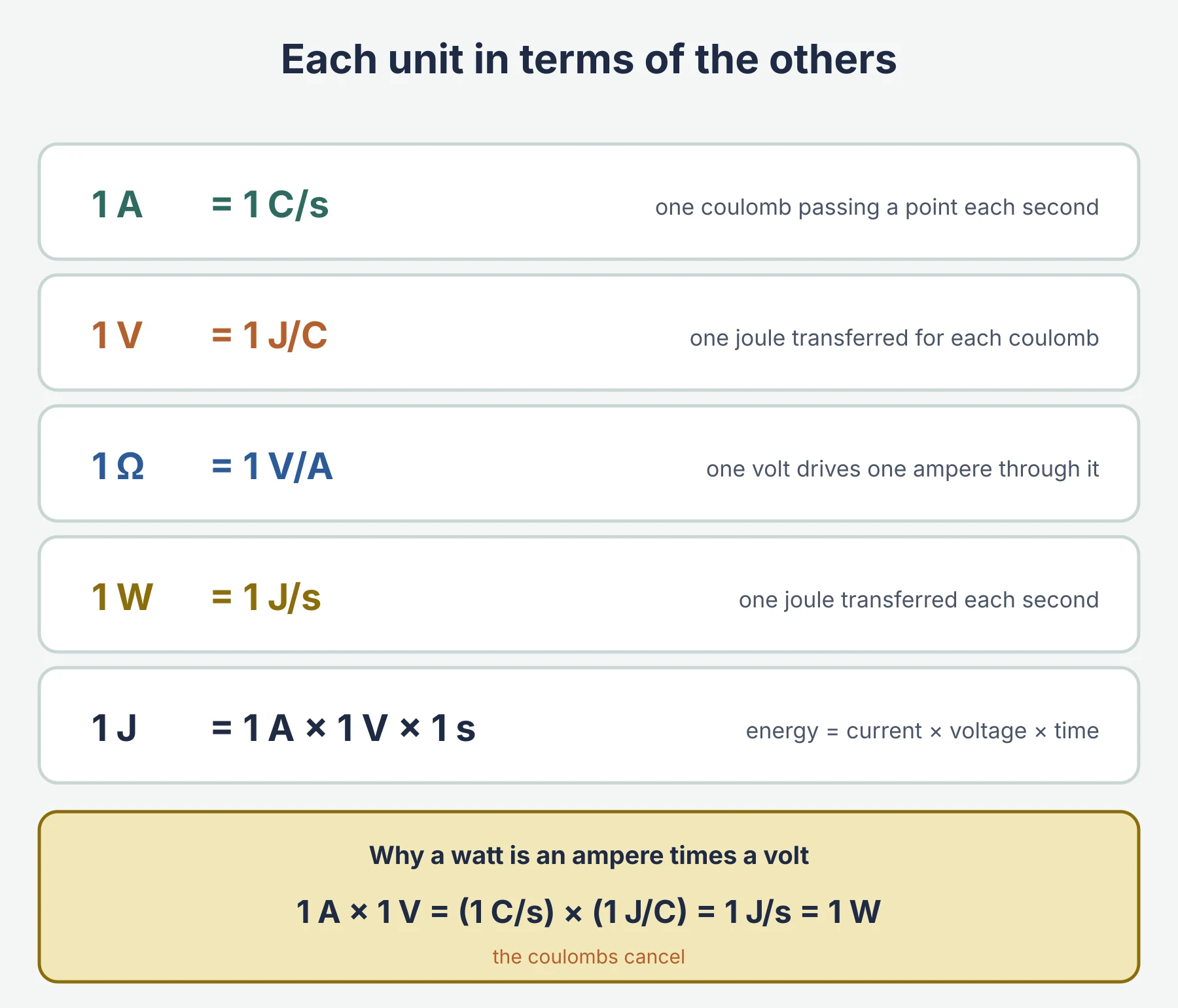
- Current is the rate of flow of charge: 1 A = 1 C/s.
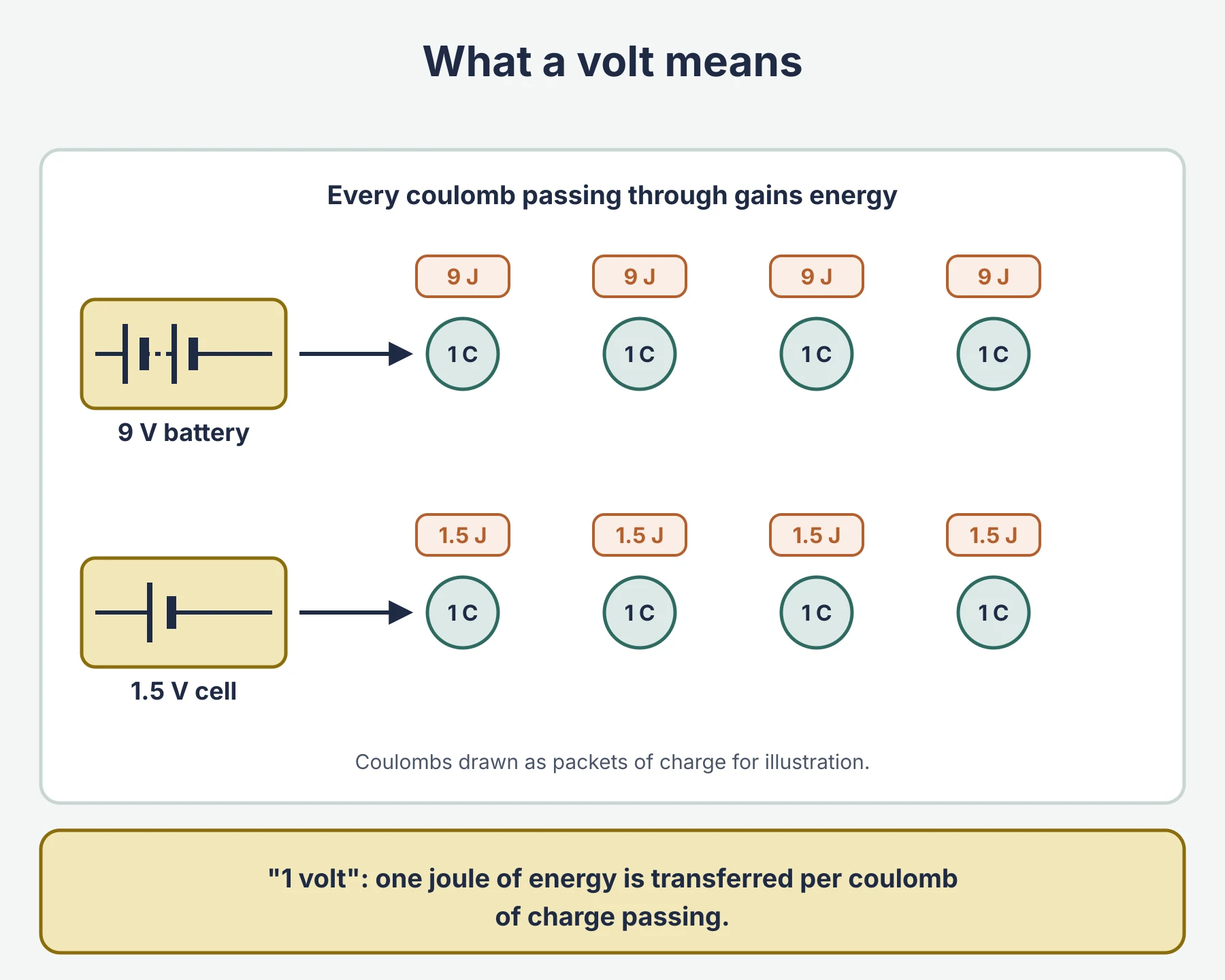
- The volt is a joule per coulomb: 1 V = 1 J/C (statement 2.20).
- 1 W = 1 J/s, and 1 W = 1 A × 1 V.
- 1 Ω = 1 V/A: a 1 Ω resistor needs 1 V to drive 1 A through it.
Prefixes and conversions
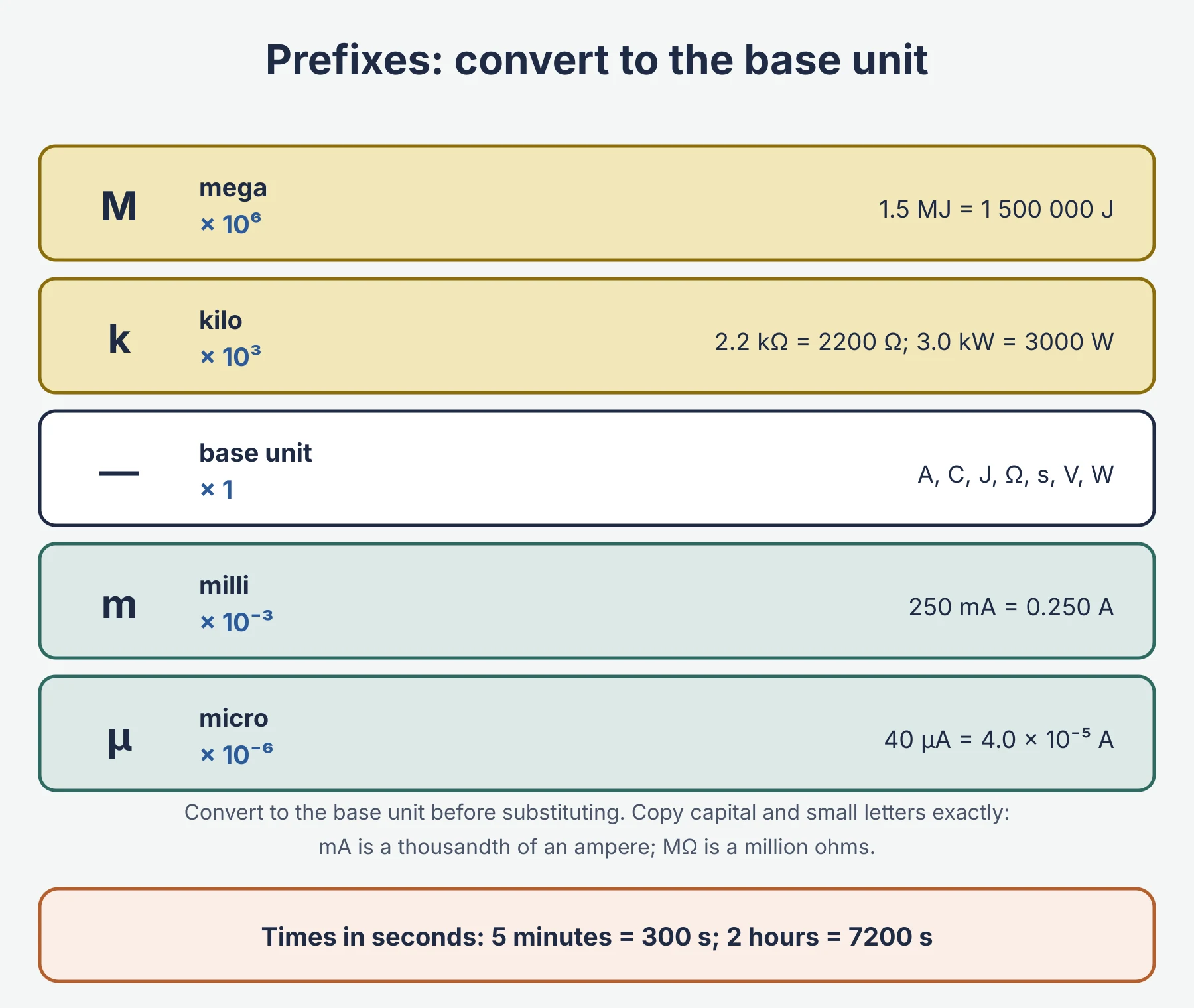
| Given | Convert | Example |
|---|---|---|
| mA | ÷ 1000 to A | 350 mA = 0.35 A |
| μA | ÷ 1 000 000 to A | 50 μA = 5.0 × 10⁻⁵ A |
| kΩ | × 1000 to Ω | 4.7 kΩ = 4700 Ω |
| MΩ | × 1 000 000 to Ω | 2.0 MΩ = 2.0 × 10⁶ Ω |
| kW | × 1000 to W | 2.5 kW = 2500 W |
| kJ | × 1000 to J | 18 kJ = 18 000 J |
| MJ | × 1 000 000 to J | 0.60 MJ = 600 000 J |
| minutes | × 60 to s | 4 min = 240 s |
| hours | × 3600 to s | 3 h = 10 800 s |
Unit checks
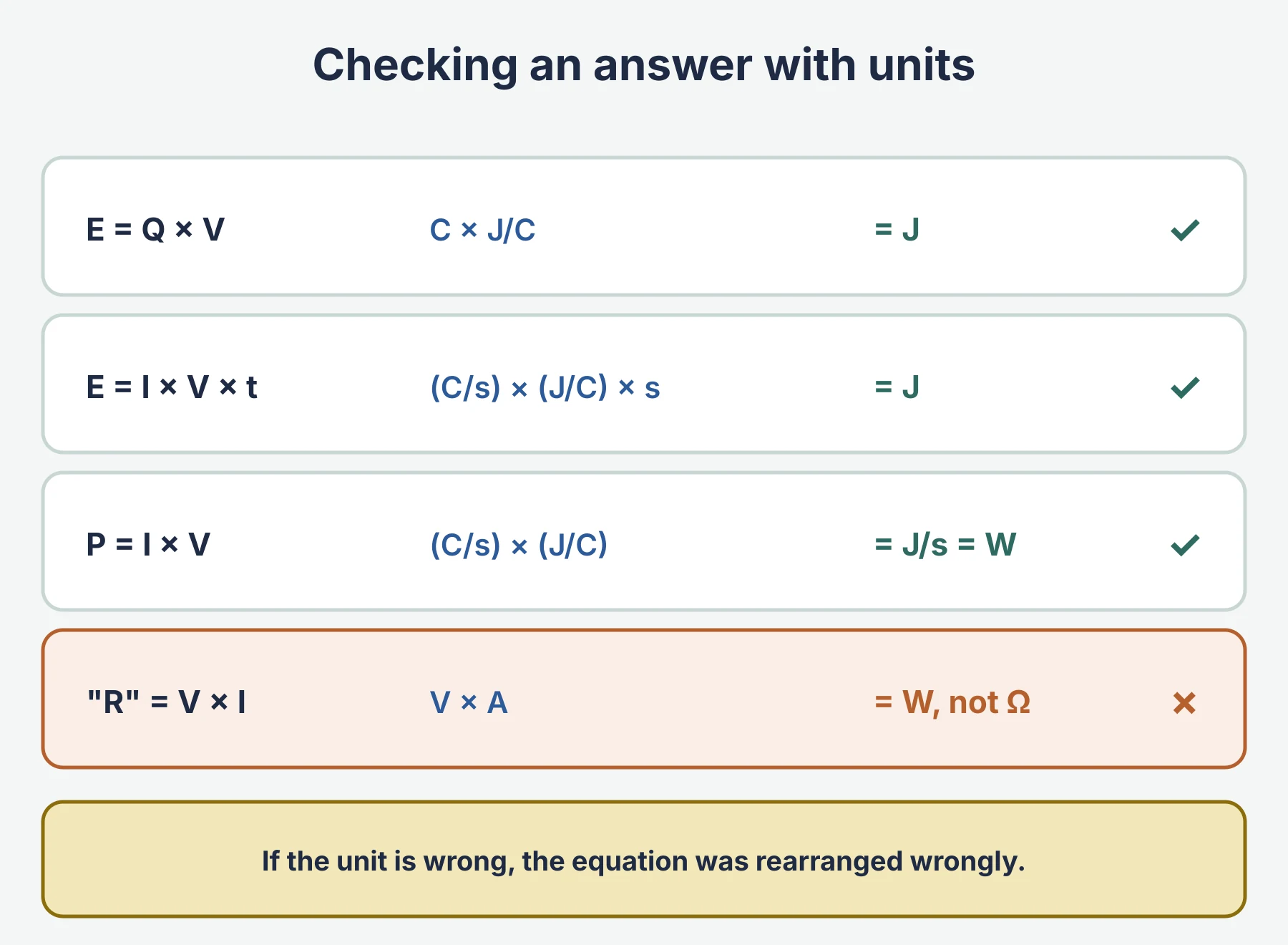
E = Q × V        C × J/C           = J
E = I × V × t    C/s × J/C × s     = J
P = I × V        C/s × J/C         = J/s = W
R = V / I        V / A             = Ω
If an answer’s unit does not match the quantity, the rearrangement is wrong.
One circuit, every unit
A 1.5 V cell drives 0.30 A through a resistor for 4.0 minutes (240 s).
charge      Q = I × t = 0.30 × 240   = 72 C
energy      E = Q × V = 72 × 1.5     = 108 J  (≈ 110 J)
power       P = I × V = 0.30 × 1.5   = 0.45 W
resistance  R = V / I = 1.5 / 0.30   = 5.0 Ω
check       E = P × t = 0.45 × 240   = 108 J
Each line gives a different unit from the same three data values. The final check uses 1 W = 1 J/s.
Symbols that double up
- V is the symbol for the quantity voltage and for the unit volt.
- W is the unit watt here, but the symbol for weight in Topic 1.
- In “E = I × V × t”, E means energy (in J), not a unit.
Exam traps
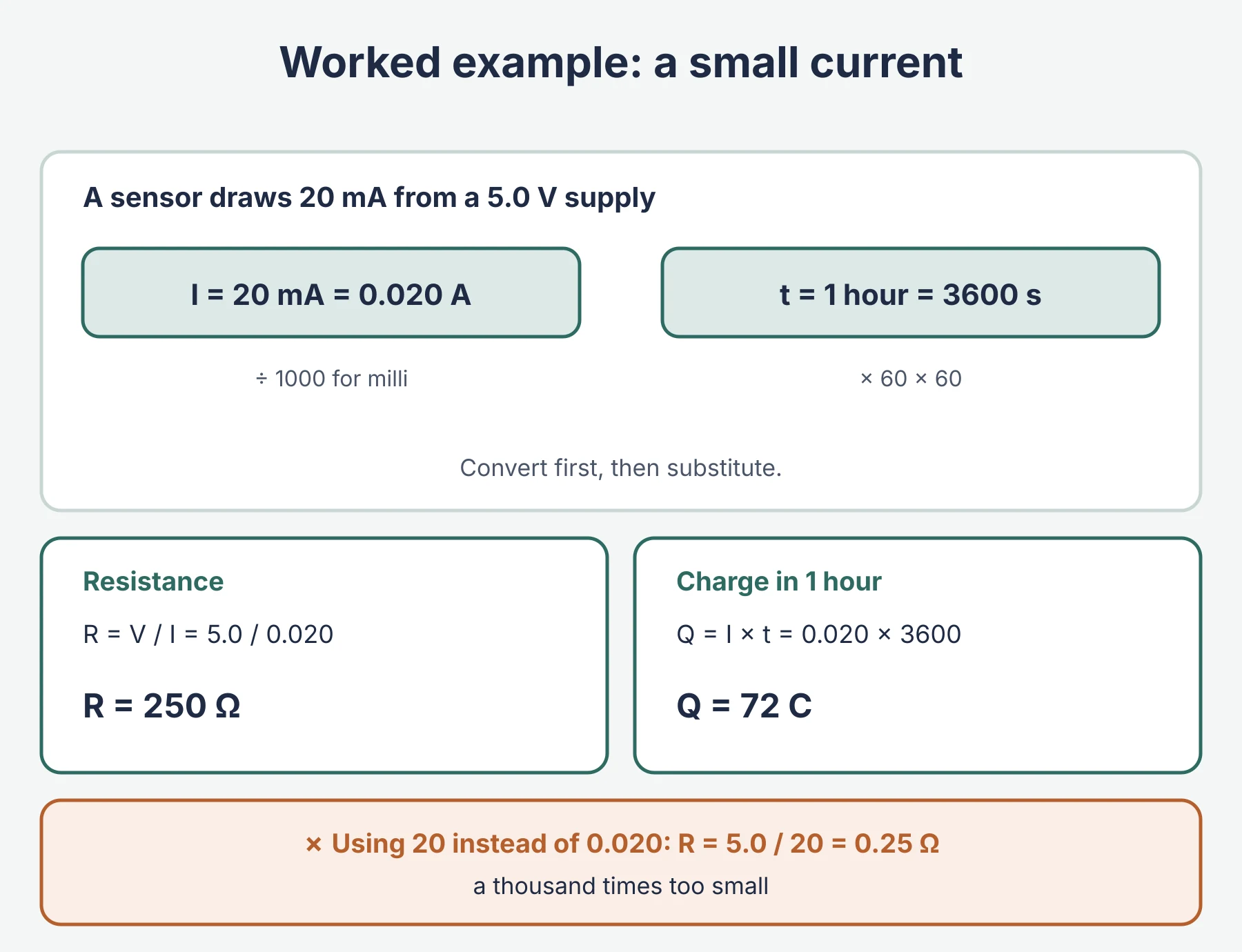
- Substituting 250 for 250 mA. Always convert to A.
- Leaving time in minutes in Q = I × t or E = I × V × t.
- Answering in W when the question asks for kW, or in J when it asks for kJ.
- Saying “a volt is a joule” or “a volt is a coulomb”. It is a joule per coulomb.
- Describing current as “the amount of charge”. It is the charge flowing per second.
- Writing kw, Kw or mj. Use kW and MJ: case matters.
- Rounding too early; keep the calculator value until the final answer.
Self-test
- State the unit of charge.
- Express the ampere in terms of the coulomb and the second.
- State what is meant by 1 volt.
- Express the watt in terms of the joule and the second.
- Convert 750 mA to amperes and 3.3 kΩ to ohms.
- A current of 0.40 A flows for 2.0 minutes. Calculate the charge that passes.
- A resistor has 6.0 V across it and 30 mA through it. Calculate its resistance.
- A 12 V battery passes 50 C of charge. Calculate the energy transferred.
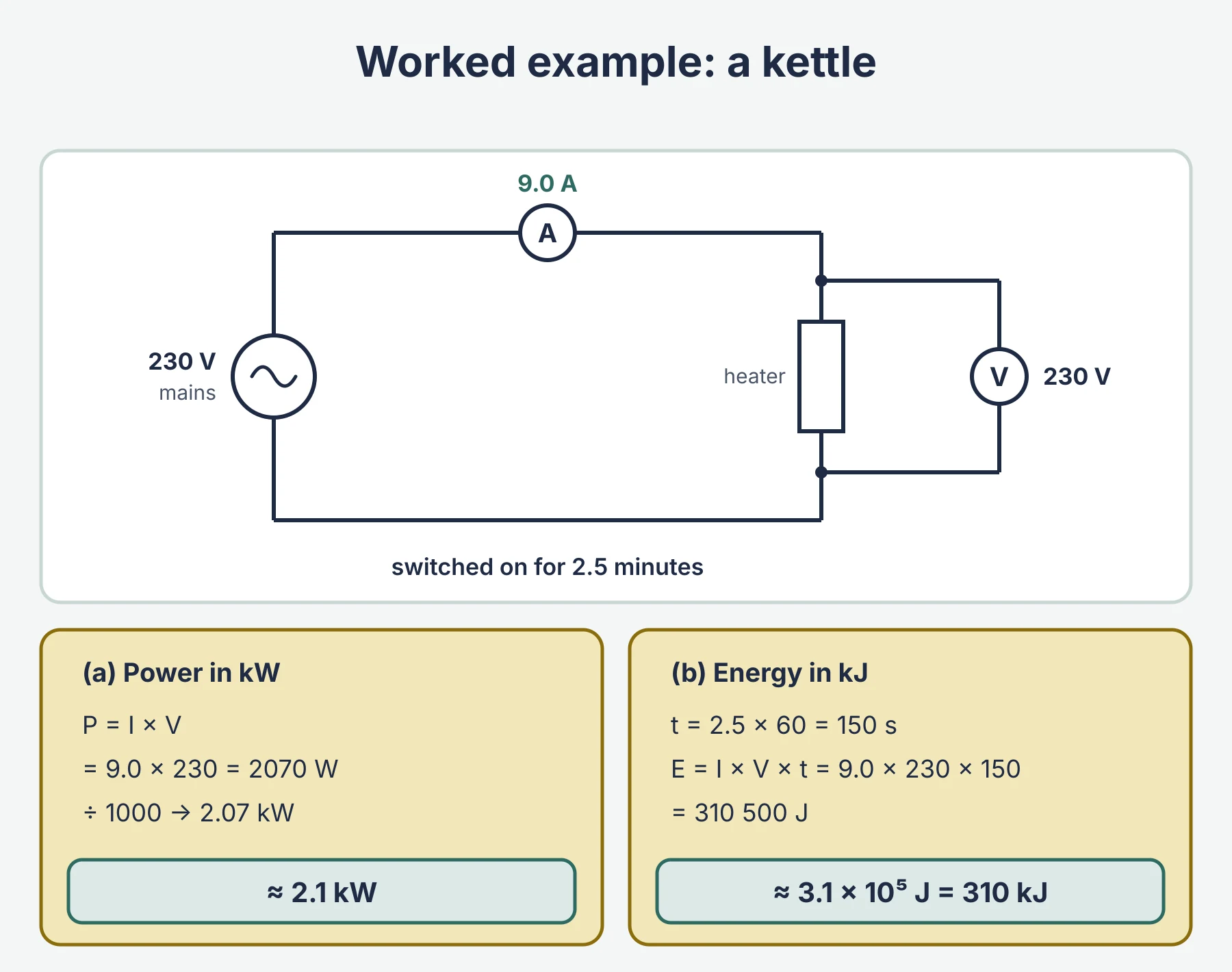
- A heater draws 8.0 A from 230 V. Calculate its power in kW.
- Show that A × V is equivalent to J/s.
- A student calculates resistance using R = I × V and gets an answer in W. What has gone wrong?
- A 2.0 kW heater is switched on for 30 minutes. Calculate the energy transferred in MJ.
Answers
- Coulomb (C).
- 1 A = 1 C/s.
- One joule of energy is transferred for each coulomb of charge that passes (1 V = 1 J/C).
- 1 W = 1 J/s.
- 0.75 A; 3300 Ω.
- Q = I × t = 0.40 × 120 = 48 C.
- R = V ÷ I = 6.0 ÷ 0.030 = 200 Ω.
- E = Q × V = 50 × 12 = 600 J.
- P = I × V = 8.0 × 230 = 1840 W = 1.84 kW, about 1.8 kW.
- A × V = (C/s) × (J/C) = J/s.
- Multiplying current by voltage gives power, not resistance; the correct rearrangement of V = I × R is R = V ÷ I, which gives ohms.
- 2.0 kW = 2000 W, 30 minutes = 1800 s; since 1 W = 1 J/s, energy = 2000 × 1800 = 3 600 000 J = 3.6 MJ.
Related resources
-
Study guides
Electricity
Mains electricity safety, series and parallel circuits, resistance, and electrostatic charge, for Pearson Edexcel International GCSE Physics 4PH1.
Physics · Pearson Edexcel · IGCSE
Read guide -
Practice questions
Edexcel IGCSE Physics: Electricity — Practice Questions
Original practice questions with answers on mains safety, circuits, resistance, I-V graphs and static charge for Edexcel International GCSE Physics 4PH1.
Physics · Pearson Edexcel · IGCSE
Try questions -
Revision notes
Edexcel IGCSE Physics: Electricity — Revision Notes
Condensed recall notes on mains safety, series and parallel circuits, resistance and electrostatic charge for Edexcel International GCSE Physics 4PH1.
Physics · Pearson Edexcel · IGCSE
Revise topic
Related articles
Get free revision emails (optional)
Occasional emails with practice questions, worked explanations and links to free resources for the qualification and subjects you choose. No spam, and you can unsubscribe from any email. The free tools on this site never need an email.