
Study Guides
Pearson Edexcel International GCSE Physics (4PH1): Units for electricity
The ampere, coulomb, joule, ohm, second, volt and watt in Edexcel International GCSE Physics 4PH1 Topic 2: meanings, links, prefixes and unit checks.
- Subject
- Physics
- Level
- IGCSE
- Topic
- Electricity
- Author
- Marlbridge Academic Team
- Updated
- Reviewed by
- Hassan (what this means)
Aligned to Pearson Edexcel IGCSE Physics (4PH1), Issue 4. Official specification .
Syllabus page (what it covers and how it is assessed): Pearson Edexcel IGCSE Physics.
Syllabus points this page covers
4PH1
- 2a Units
Found an error? Report a correction.
Need help with this topic? Request a free trial class for IGCSE Physics (4PH1).
This guide covers sub-topic 2(a) Units of Topic 2, Electricity, in the Pearson Edexcel International GCSE in Physics (4PH1), Issue 4. Statement 2.1 asks you to use the following units: ampere (A), coulomb (C), joule (J), ohm (Ω), second (s), volt (V) and watt (W). It has no “P”, so it is assessed on both papers. For the circuit physics that uses these units, see the Electricity study guide.
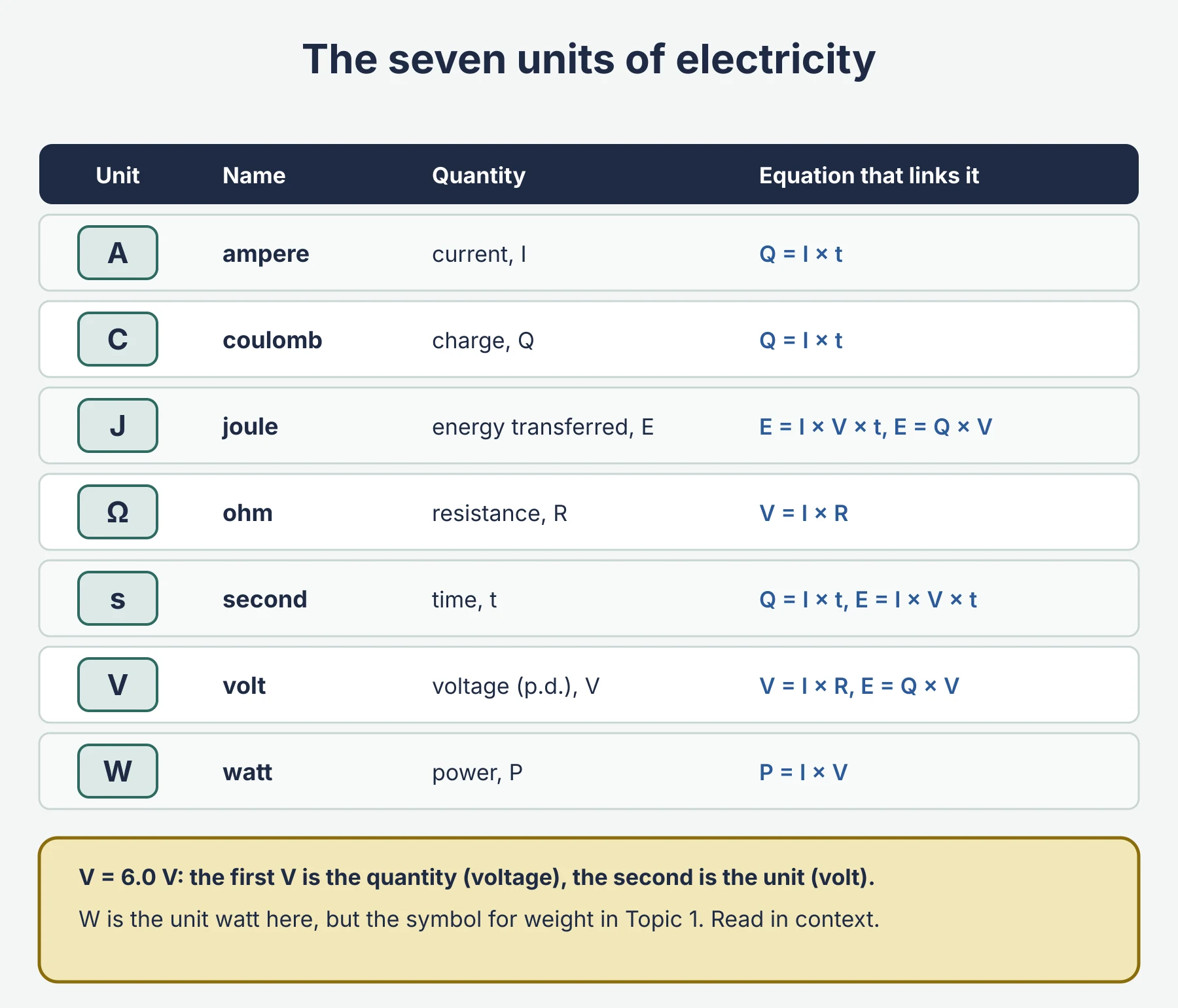
The seven units
| Unit | Symbol | Quantity | Equation that links it |
|---|---|---|---|
| ampere | A | current, I | Q = I × t |
| coulomb | C | charge, Q | Q = I × t |
| joule | J | energy transferred, E | E = I × V × t, E = Q × V |
| ohm | Ω | resistance, R | V = I × R |
| second | s | time, t | Q = I × t, E = I × V × t |
| volt | V | voltage (potential difference), V | V = I × R, E = Q × V |
| watt | W | power, P | P = I × V |
Notice that V is both the symbol for the quantity voltage and the symbol for its unit, the volt. In “V = 6.0 V” the first V is the quantity and the second is the unit. Similarly W is the unit watt, but in Topic 1 W is used as the symbol for weight. Read each equation in context.
What each unit means
The coulomb is the unit of charge. Electric current in a metal wire is a flow of electrons, each carrying a tiny negative charge, so a coulomb is the charge of a very large number of electrons.
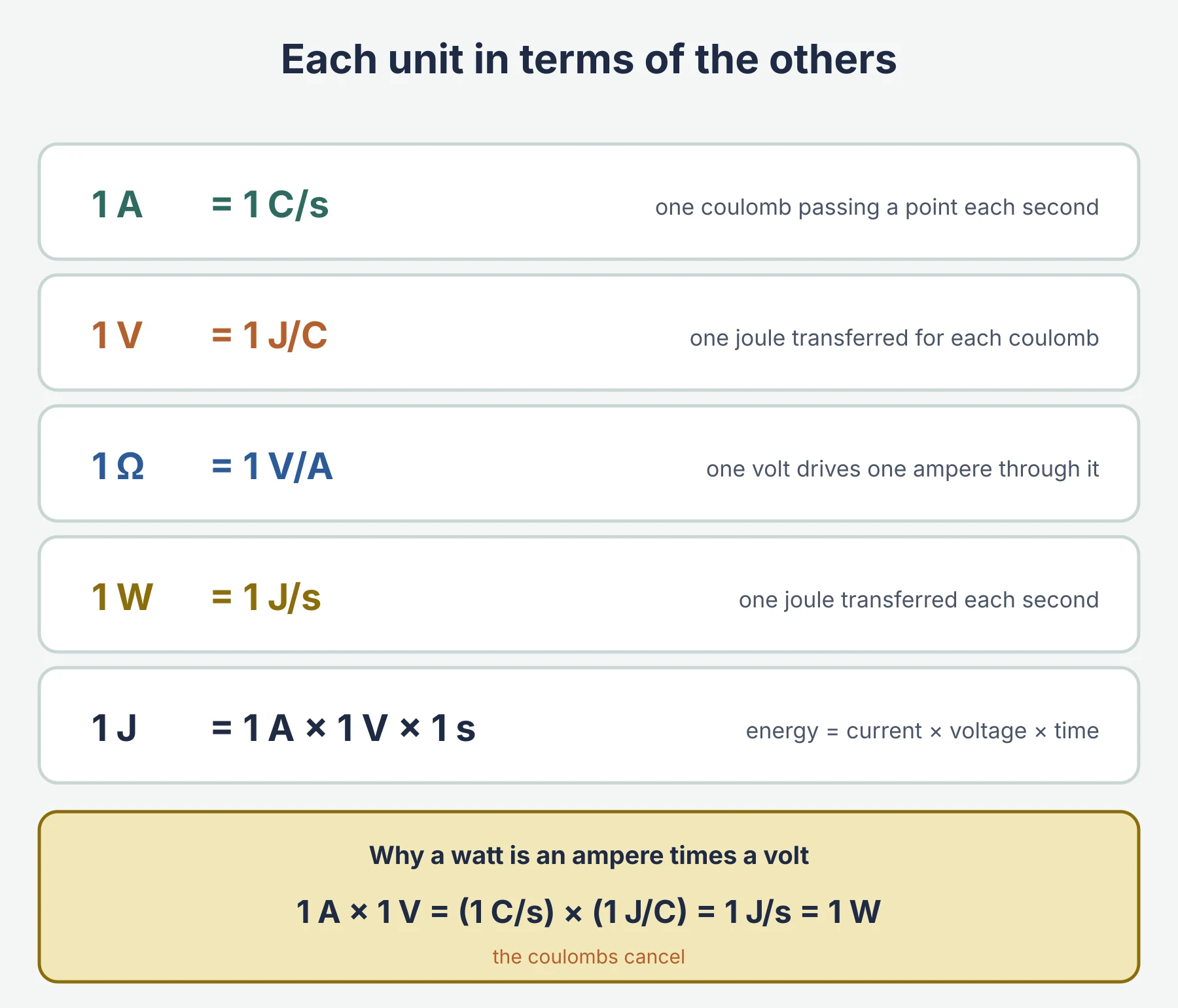
The ampere is the unit of current, the rate of flow of charge. From Q = I × t:
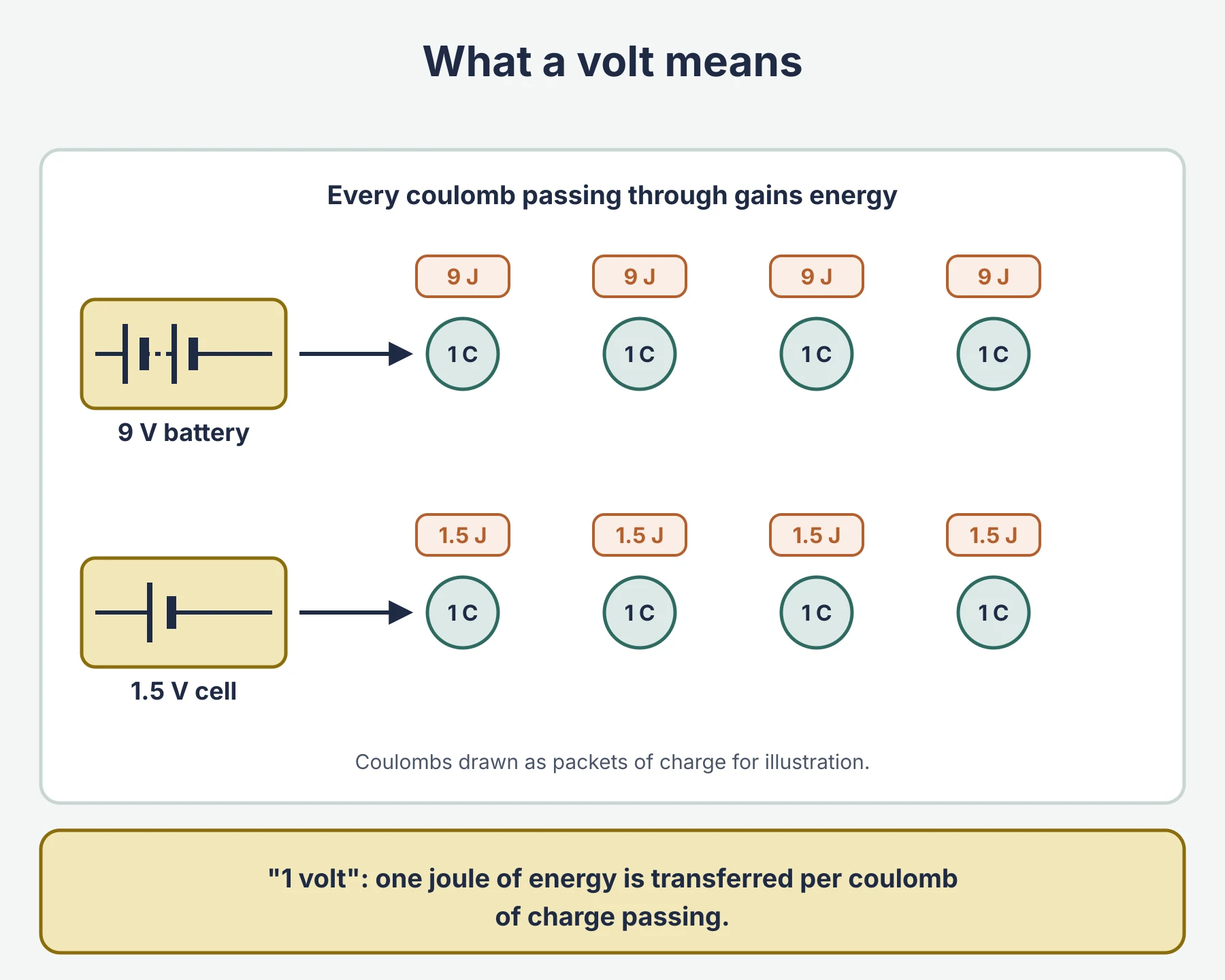
1 A = 1 C/s (one coulomb passing a point each second)The volt is the unit of voltage, the energy transferred per unit charge. Statement 2.20 says you must know that the volt is a joule per coulomb:
1 V = 1 J/C (one joule transferred for each coulomb that passes)A 9 V battery gives 9 J to every coulomb that passes through it; a 1.5 V cell gives 1.5 J.
The ohm is the unit of resistance. From V = I × R, R = V ÷ I:
1 Ω = 1 V/A (one volt is needed to drive one ampere through it)The watt is the unit of power, the rate of energy transfer:
1 W = 1 J/sFrom P = I × V, the watt is also an ampere multiplied by a volt: 1 A × 1 V = (1 C/s) × (1 J/C) = 1 J/s = 1 W.
The joule is the unit of energy. In circuits, energy transferred = current × voltage × time, so 1 J = 1 A × 1 V × 1 s.
Prefixes you will meet
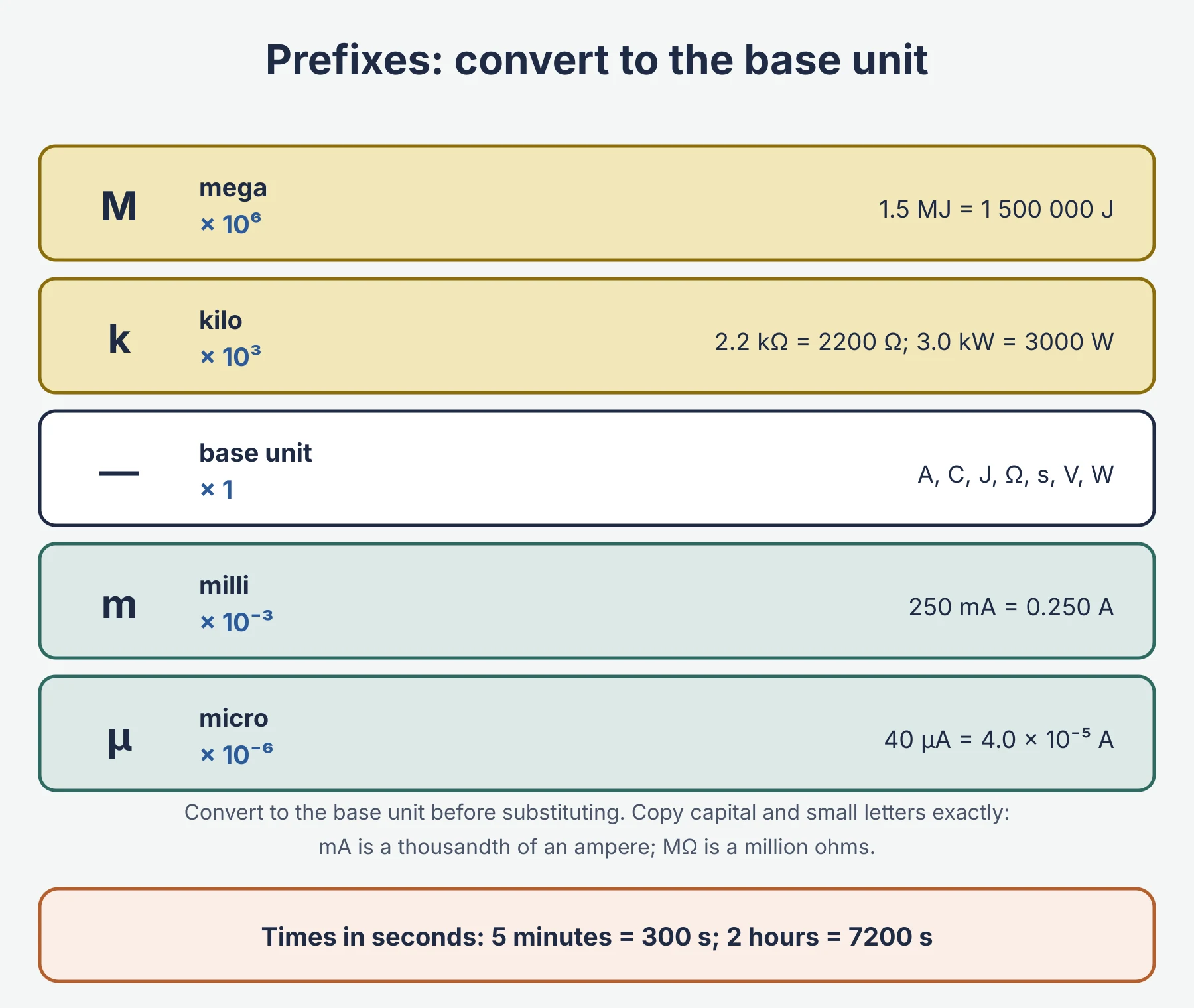
Electrical data often uses prefixes. Convert to the base unit before substituting.
| Prefix | Symbol | Multiplier | Example |
|---|---|---|---|
| milli | m | × 10⁻³ | 250 mA = 0.250 A |
| micro | μ | × 10⁻⁶ | 40 μA = 4.0 × 10⁻⁵ A |
| kilo | k | × 10³ | 2.2 kΩ = 2200 Ω; 3.0 kW = 3000 W |
| mega | M | × 10⁶ | 1.5 MJ = 1 500 000 J |
Times given in minutes or hours must be converted to seconds: 5 minutes = 300 s; 2 hours = 7200 s.
Take care with capital and small letters. “mA” (milliampere) is a thousandth of an ampere; “MΩ” (megohm) is a million ohms. Writing “Ma” or “ma” is ambiguous, so copy the case exactly.
Worked example 1: a kettle
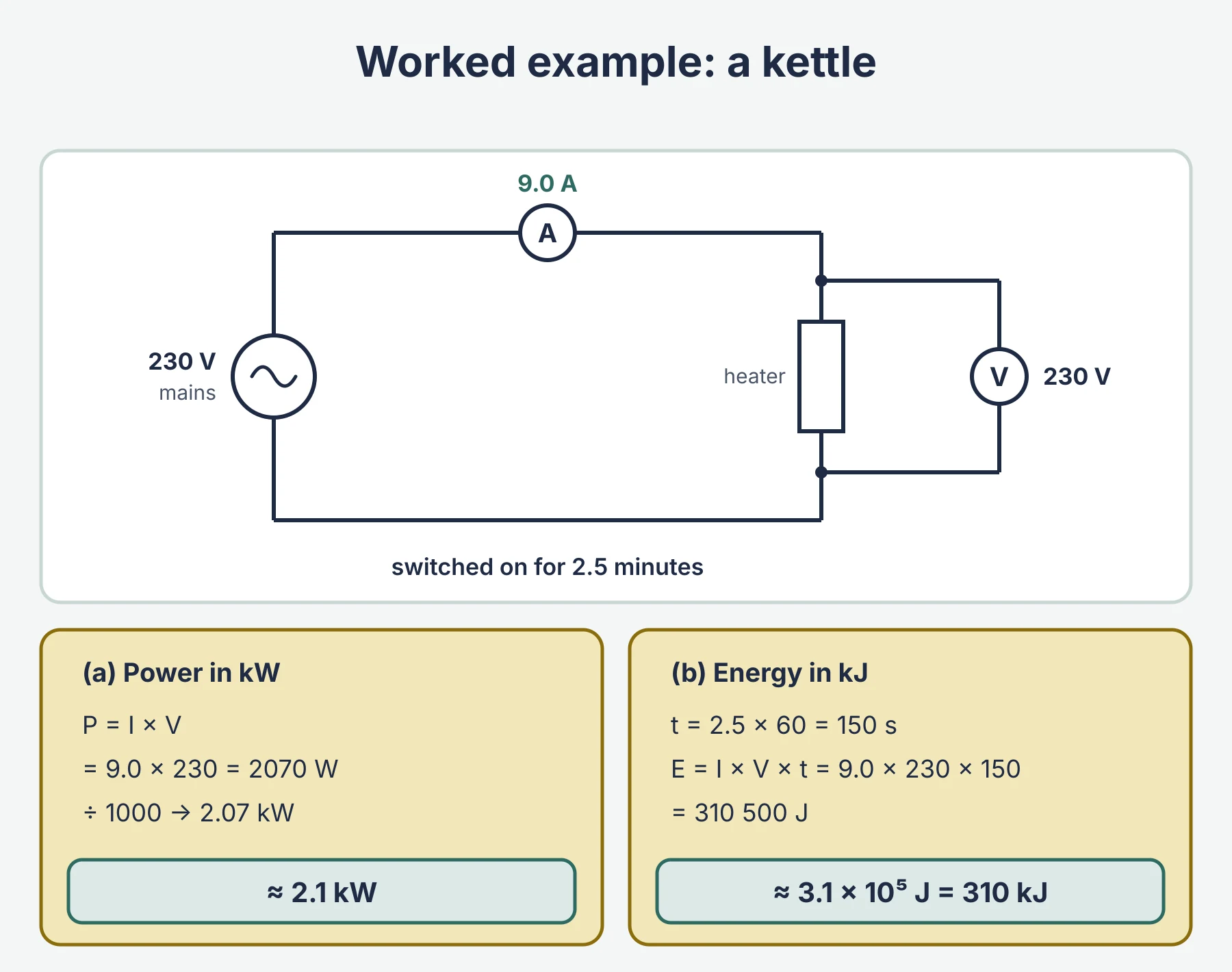
A kettle connected to 230 V mains takes a current of 9.0 A and is switched on for 2.5 minutes. Calculate (a) its power in kW and (b) the energy it transfers in kJ.
(a) P = I × V = 9.0 × 230 = 2070 W = 2.07 kW ≈ 2.1 kW
(b) t = 2.5 × 60 = 150 s
    E = I × V × t = 9.0 × 230 × 150 = 310 500 J ≈ 310 kJ
Commentary. The time is converted to seconds first. Converting the power to kW is a separate step at the end; dividing by 1000 is easy to forget when the question asks for kW. To two significant figures (matching 9.0 A) the energy is 3.1 × 10⁵ J, which is 310 kJ.
Worked example 2: a small current
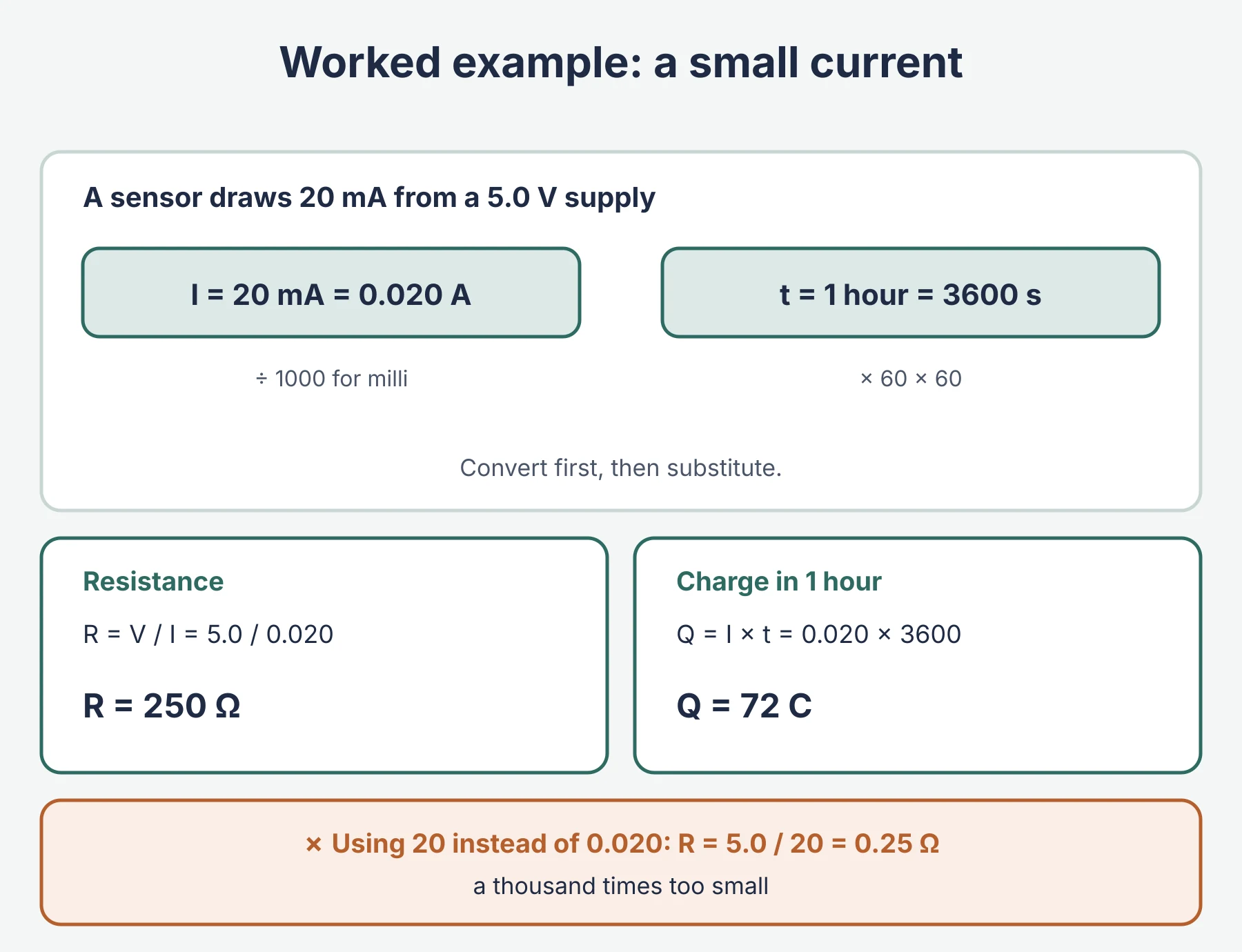
A sensor draws 20 mA from a 5.0 V supply. Calculate its resistance and the charge that flows in 1 hour.
I = 20 mA = 0.020 A
R = V / I = 5.0 / 0.020 = 250 Ω
t = 1 hour = 3600 s
Q = I × t = 0.020 × 3600 = 72 C
Using 20 instead of 0.020 would give R = 0.25 Ω, a thousand times too small.
Checking with units
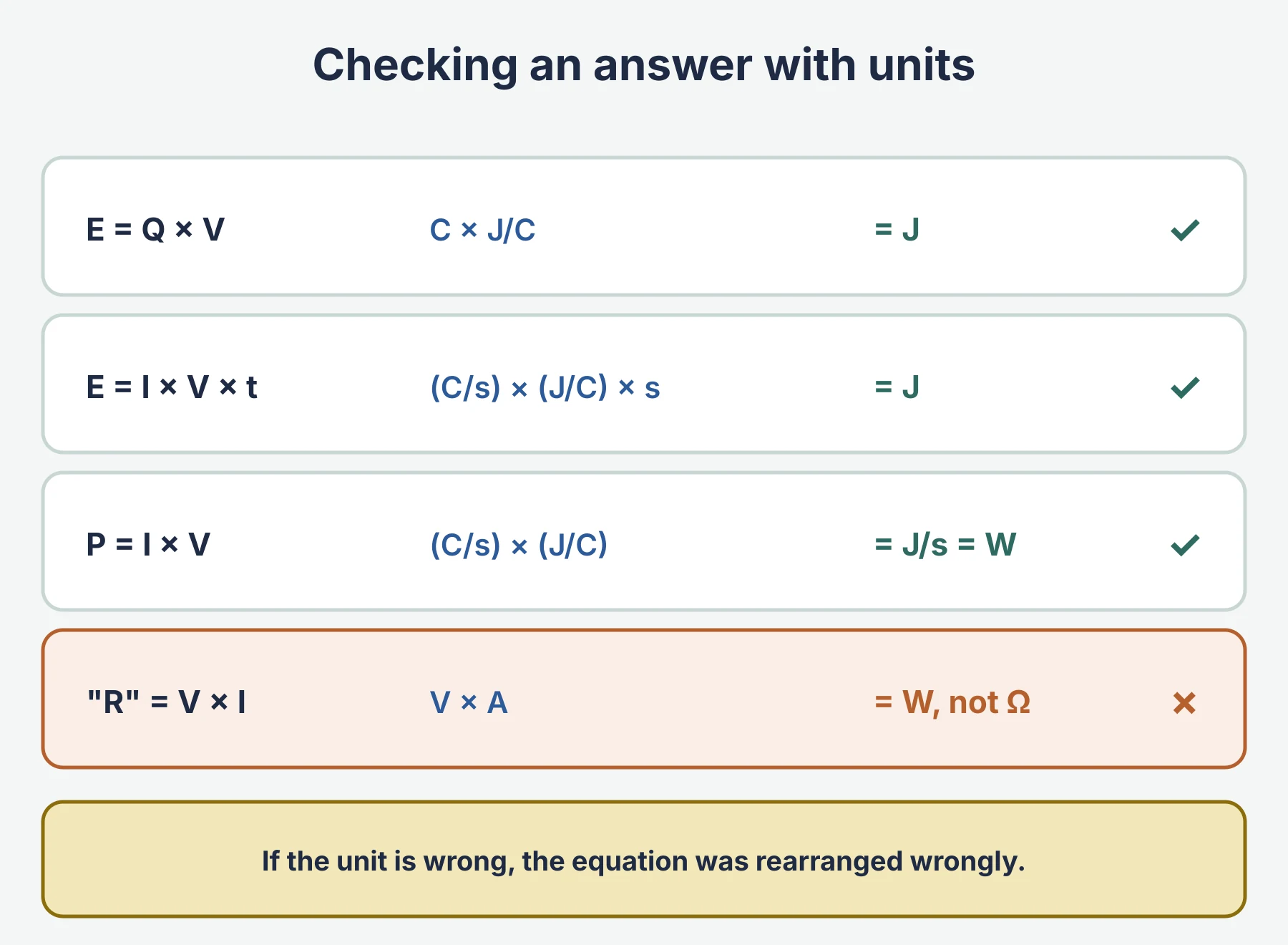
Because the units are linked, you can check an answer by working through its units.
- E = Q × V: C × J/C = J. Correct.
- E = I × V × t: (C/s) × (J/C) × s = J. Correct.
- P = I × V: (C/s) × (J/C) = J/s = W. Correct.
- If you calculate a “resistance” as V × I, the unit is W, not Ω, so the equation has been rearranged wrongly.
Common mistakes
- Using mA, kΩ, kW or minutes in an equation without converting.
- Confusing coulombs (charge) with amperes (rate of flow of charge).
- Giving power in J or energy in W. A watt is a joule per second.
- Writing the symbol for ohm as “O” or “0”, which can be misread. Write Ω, or the word “ohm”.
- Mixing up the quantity V (voltage) with the unit V (volt) when rearranging, especially in E = Q × V.
Exam technique with command words
- State the unit: give the name or symbol, for example “coulomb” or “C”. If asked for a unit “in terms of other units”, give a combination such as J/C.
- Calculate: write the equation, convert data, substitute, give the answer with a unit and to a sensible number of significant figures.
- Show that: work to at least one more significant figure than the printed value and include each conversion.
- Give or state the meaning of “1 volt”: “one joule of energy is transferred per coulomb of charge passing”.
- Units for electricity revision notes
- Units for electricity practice questions
- Using these units in context: Mains electricity study guide and Energy and voltage in circuits study guide
Written against the Pearson Edexcel International GCSE in Physics (4PH1) specification, Issue 4. Always check the current specification for your examination year.
Related resources
-
Practice questions
Pearson Edexcel International GCSE Physics (4PH1): Units for electricity – Practice Questions
Original practice questions with full answers on using A, C, J, Ω, s, V and W, prefixes and unit checks for Edexcel International GCSE Physics 4PH1 Topic 2.
Physics · Pearson Edexcel · IGCSE
Try questions -
Revision notes
Pearson Edexcel International GCSE Physics (4PH1): Units for electricity – Revision Notes
Recall notes on A, C, J, Ω, s, V and W for Edexcel International GCSE Physics 4PH1 Topic 2: unit links, prefixes, conversions, exam traps and a self-test.
Physics · Pearson Edexcel · IGCSE
Revise topic -
Study guides
Electricity
Mains electricity safety, series and parallel circuits, resistance, and electrostatic charge, for Pearson Edexcel International GCSE Physics 4PH1.
Physics · Pearson Edexcel · IGCSE
Read guide
Related articles
Get free revision emails (optional)
Occasional emails with practice questions, worked explanations and links to free resources for the qualification and subjects you choose. No spam, and you can unsubscribe from any email. The free tools on this site never need an email.