
Study Guides
Pearson Edexcel International GCSE Physics (4PH1): Mains electricity
Insulation, earthing, fuses, circuit breakers, electrical heating, P = IV, E = IVt and a.c. versus d.c. for Edexcel International GCSE Physics 4PH1, 2b.
- Subject
- Physics
- Level
- IGCSE
- Topic
- Electricity
- Author
- Marlbridge Academic Team
- Updated
- Reviewed by
- Hassan (what this means)
Aligned to Pearson Edexcel IGCSE Physics (4PH1), Issue 4. Official specification .
Syllabus page (what it covers and how it is assessed): Pearson Edexcel IGCSE Physics.
Syllabus points this page covers
4PH1
- 2b Mains electricity
Found an error? Report a correction.
Need help with this topic? Request a free trial class for IGCSE Physics (4PH1).
This guide goes deep on sub-topic 2(b) Mains electricity, statements 2.2 to 2.6 of the Pearson Edexcel International GCSE in Physics (4PH1), Issue 4. None of the statements carries a “P”, so all can be assessed on both papers. For the whole of Topic 2 in overview, see the Electricity study guide.
What the specification asks
- 2.2 understand how insulation, double insulation, earthing, fuses and circuit breakers protect the device or user in a range of domestic appliances
- 2.3 understand why a current in a resistor results in the electrical transfer of energy and an increase in temperature, and how this can be used in a variety of domestic contexts
- 2.4 know and use power = current × voltage (P = I × V) and apply it to the selection of appropriate fuses
- 2.5 use energy transferred = current × voltage × time (E = I × V × t)
- 2.6 know the difference between mains electricity being alternating current (a.c.) and direct current (d.c.) being supplied by a cell or battery
How appliances are connected
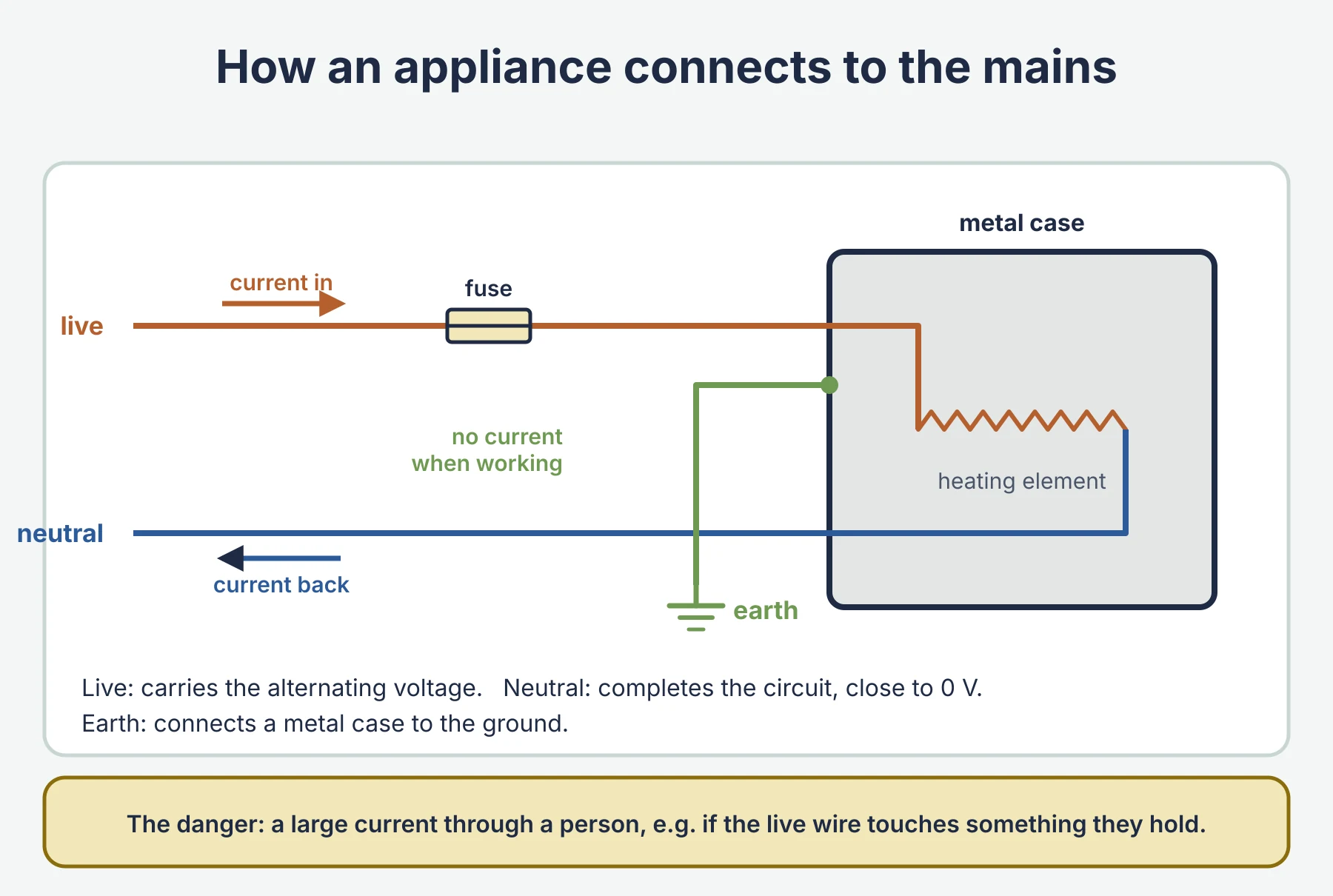
An appliance is connected to the mains through a cable. The live wire carries the alternating voltage; the neutral wire completes the circuit and stays close to zero volts. Many appliances with a metal case also have an earth wire, which connects the case to the ground. In a working appliance, current flows in through the live wire and back through the neutral; the earth wire carries no current.
The danger from mains electricity is a large current passing through a person, for example if the live wire touches something the person holds. Each safety feature in 2.2 deals with this in a different way.
The five safety features
Insulation. Each wire is covered in plastic, an electrical insulator, so the live wire cannot touch the user, another wire or the case. Cracked or worn insulation exposes the conductor and is a serious hazard.
Double insulation. The appliance has a casing made of an insulating material, such as plastic, as well as insulated wires, so no metal part that a user can touch could become live. A double-insulated appliance, such as many hairdryers and food mixers, does not need an earth wire. It carries a symbol of a square inside a square.
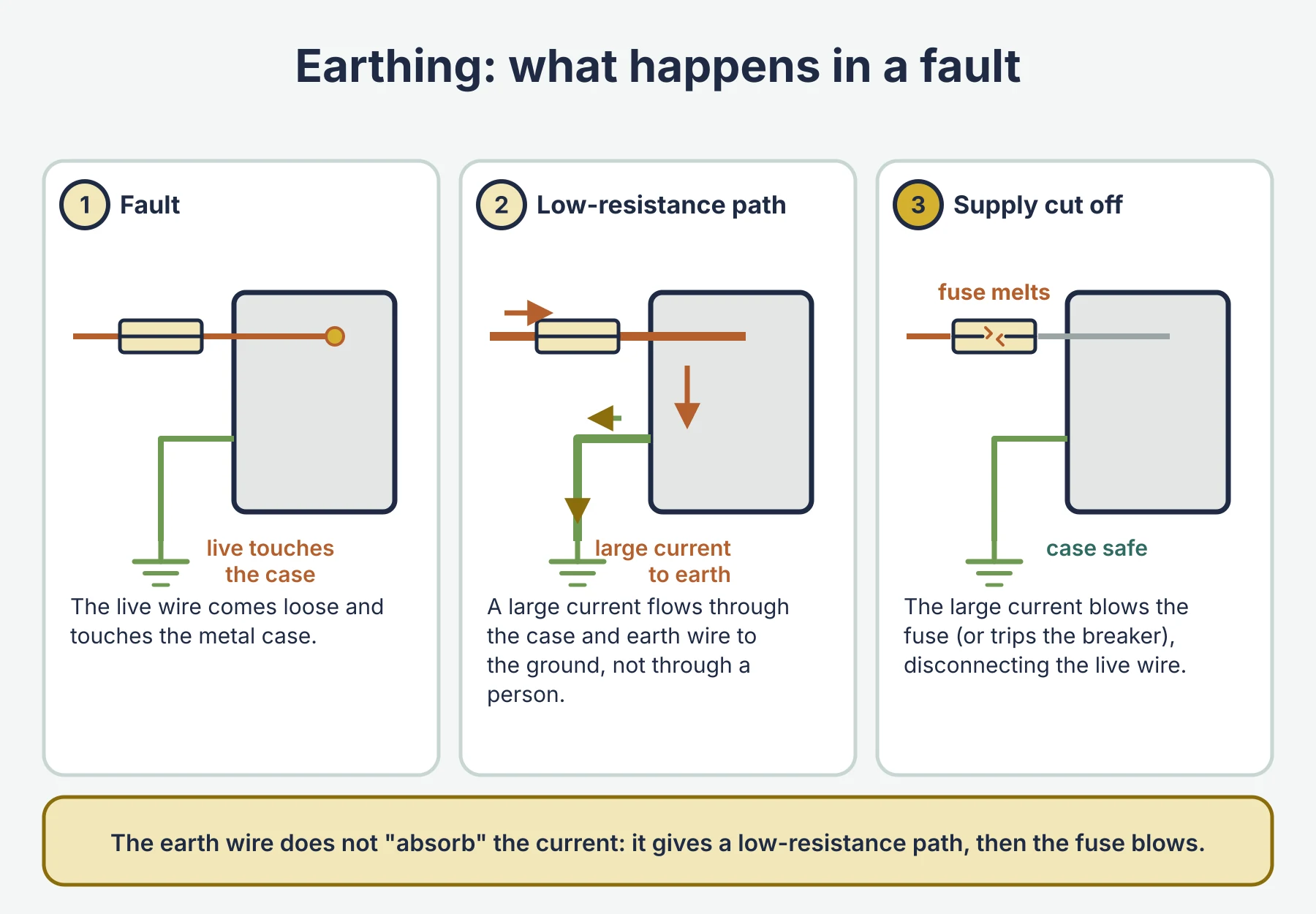
Earthing. A metal case is connected to the earth wire. If a fault lets the live wire touch the case, a large current flows from the live wire through the case and down the low-resistance earth wire to the ground, rather than through a person touching the case. This large current also blows the fuse or trips the circuit breaker, disconnecting the supply.
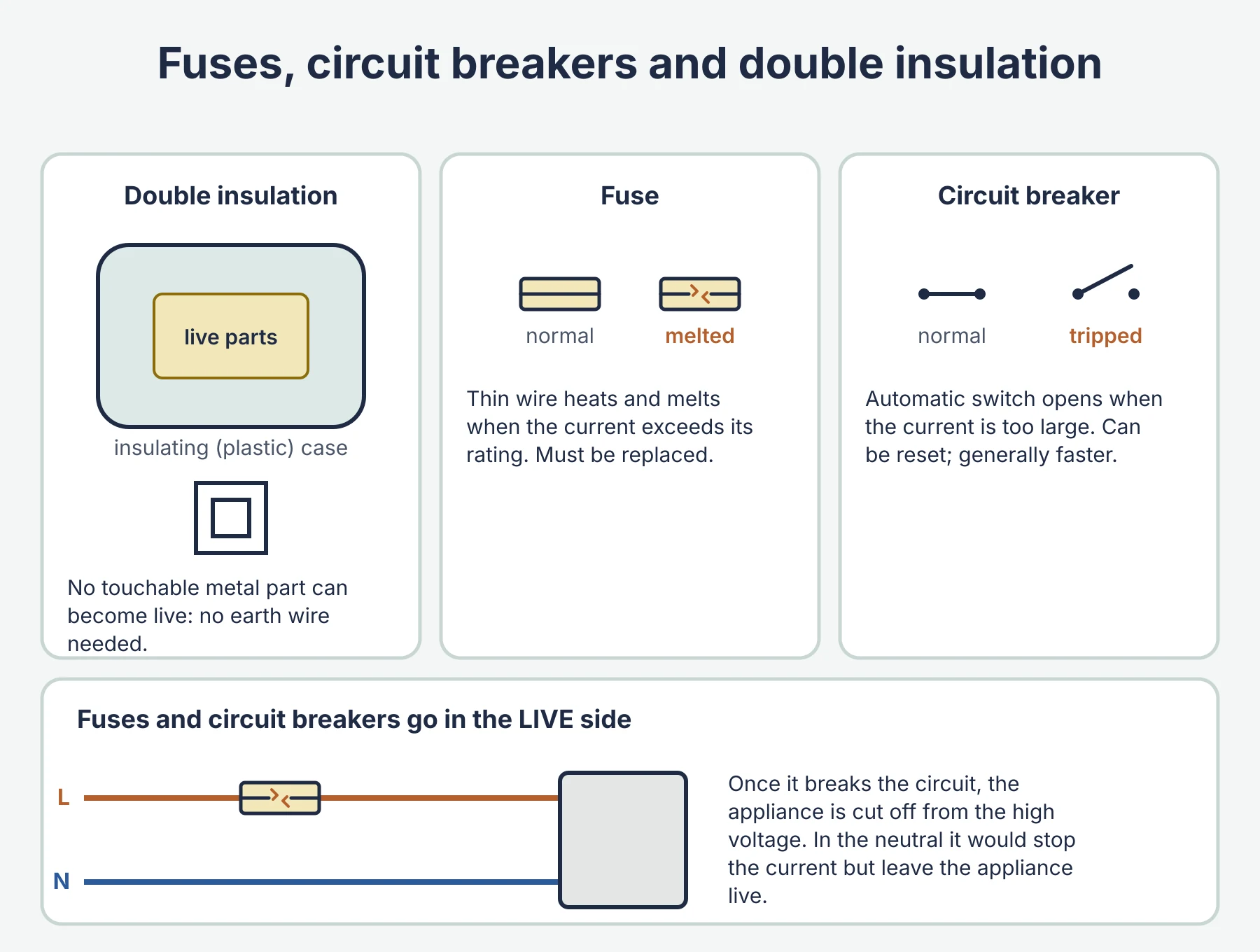
Fuses. A fuse is a short, thin piece of wire in a holder, placed in the live side of the circuit. If the current becomes larger than the fuse rating, the fuse wire heats up and melts, breaking the circuit. This stops the current before the cable overheats and possibly starts a fire. A blown fuse must be replaced.
Circuit breakers. A circuit breaker is an automatic switch in the live side of the circuit. When the current exceeds a set value, it opens (trips) and breaks the circuit. Unlike a fuse it can be reset once the fault is fixed, and it generally acts faster than a fuse.
Fuses and circuit breakers belong in the live side so that, once they break the circuit, the appliance is disconnected from the high voltage. A fuse in the neutral would stop the current but leave the appliance connected to the live wire.
| Feature | Protects | How |
|---|---|---|
| insulation | user | prevents contact with conductors |
| double insulation | user | no touchable metal part can become live |
| earthing | user | fault current flows to earth, then fuse blows |
| fuse | appliance and wiring (and user, with earthing) | melts when current exceeds rating |
| circuit breaker | appliance and wiring (and user, with earthing) | switch trips when current is too large; can be reset |
Why a current heats a resistor (2.3)
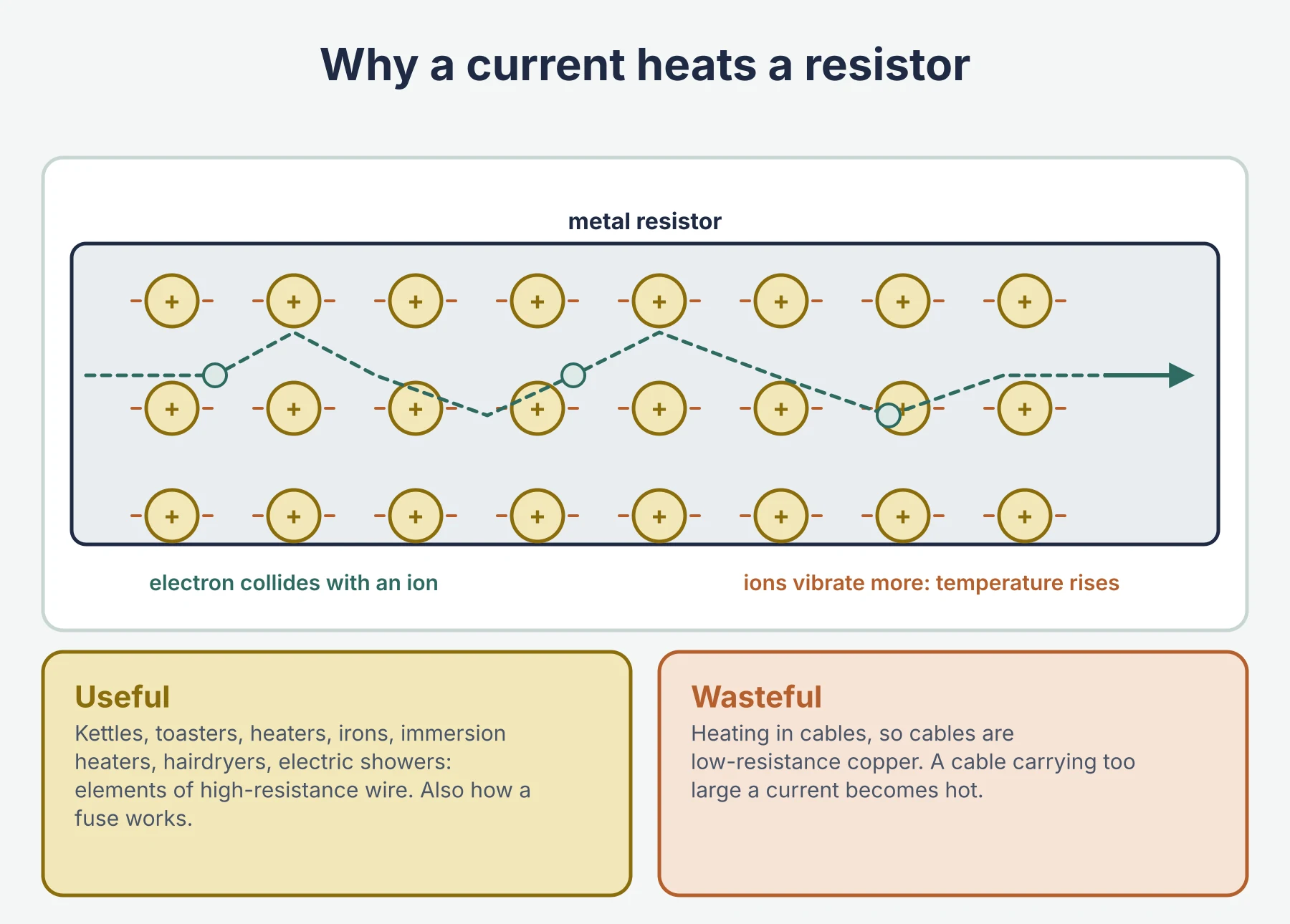
In a metal, current is a flow of electrons. As the electrons move through a resistor they collide with the vibrating ions of the metal and transfer energy to them. The ions vibrate more, so the temperature of the resistor rises. Electrical energy is transferred to thermal energy, and the resistor heats its surroundings.
This is useful in kettles, toasters, electric heaters, irons, immersion heaters, hairdryers and electric showers, which use a heating element of high-resistance wire. It is also why a fuse works. The same heating is wasteful in cables, which is why cables are made from low-resistance copper and why a cable carrying too large a current becomes hot.
Power and fuse selection (2.4)
power = current × voltage
P = I × V
To choose a fuse:
- Calculate the normal operating current using I = P ÷ V.
- Choose the fuse with the smallest rating above that current.
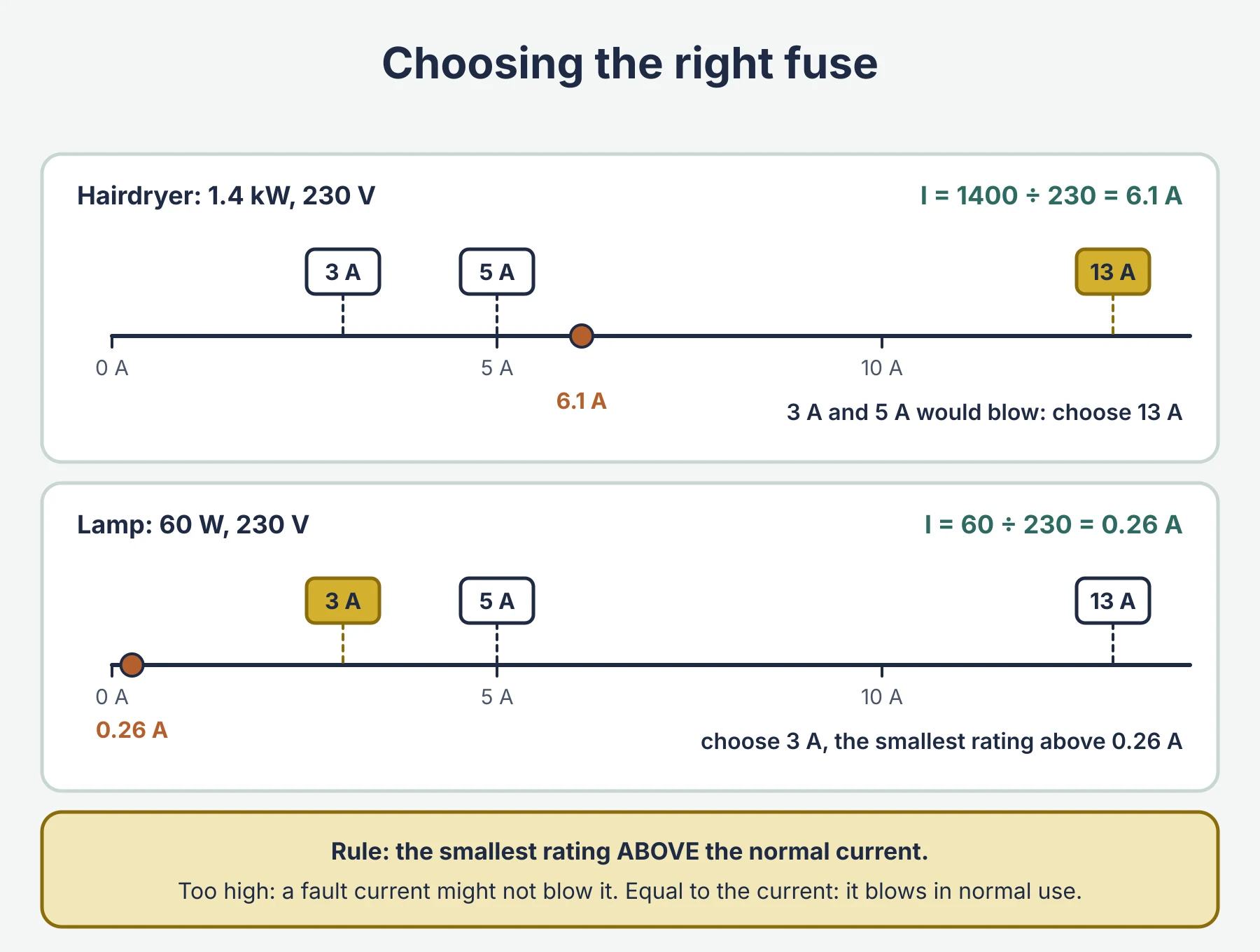
Worked example 1. A hairdryer is rated 1.4 kW, 230 V. Fuses of 3 A, 5 A and 13 A are available.
I = P / V = 1400 / 230 = 6.1 A
3 A and 5 A would blow in normal use; choose 13 A.
Worked example 2. A lamp is rated 60 W, 230 V.
I = 60 / 230 = 0.26 A
choose 3 A, the smallest rating above 0.26 A
A 13 A fuse would also let the lamp work, but a fault current of, say, 10 A would not blow it, and the thin lamp cable could overheat. A fuse rated equal to the normal current is also wrong: it would blow in normal use.
Energy transferred (2.5)
energy transferred = current × voltage × time
E = I × V × t
with E in J, I in A, V in V and t in s.
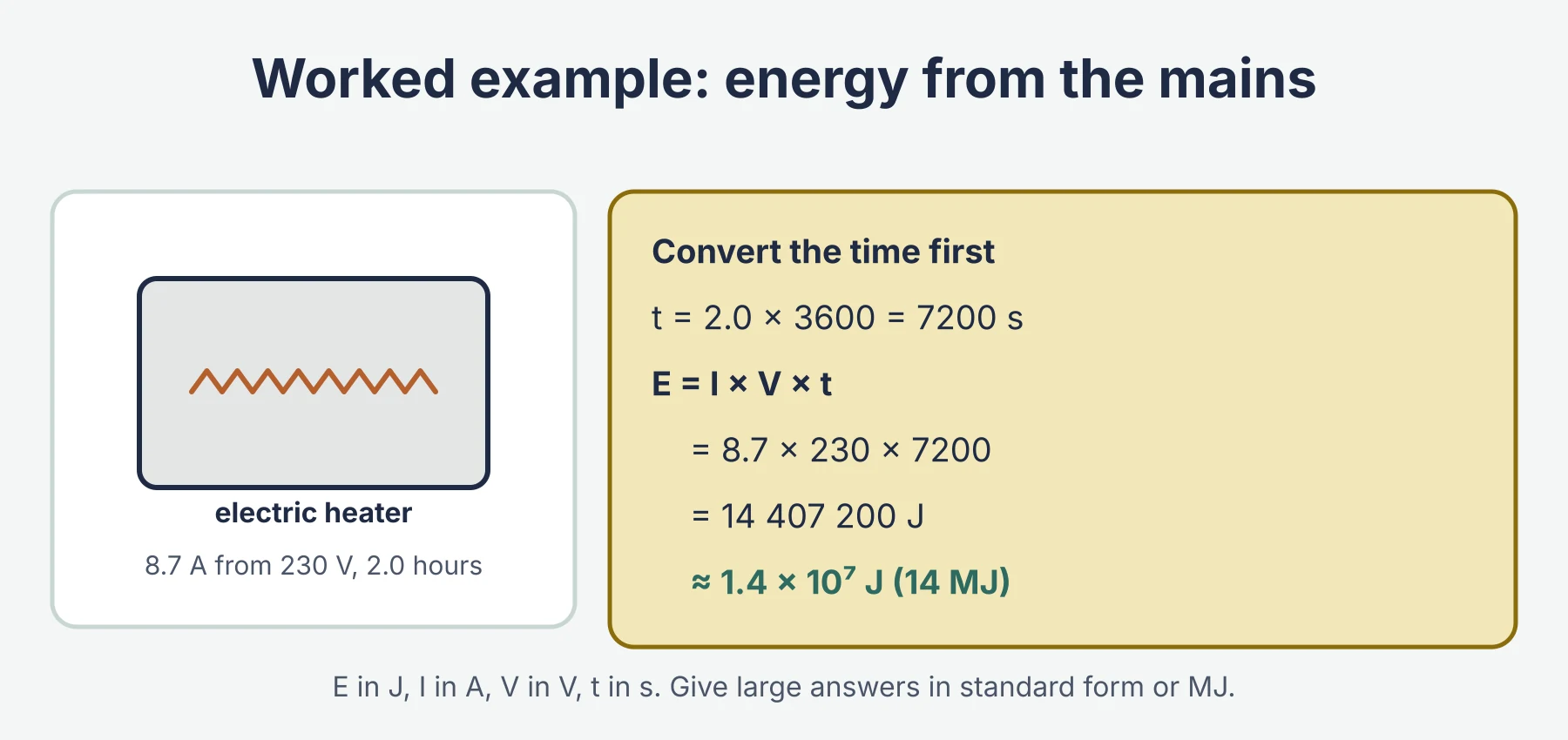
Worked example 3. An electric heater takes 8.7 A from the 230 V mains for 2.0 hours.
t = 2.0 × 3600 = 7200 s
E = 8.7 × 230 × 7200 = 14 407 200 J ≈ 1.4 × 10⁷ J
Commentary. Convert the time first. The large answer is best given in standard form, or as 14 MJ.
a.c. and d.c. (2.6)
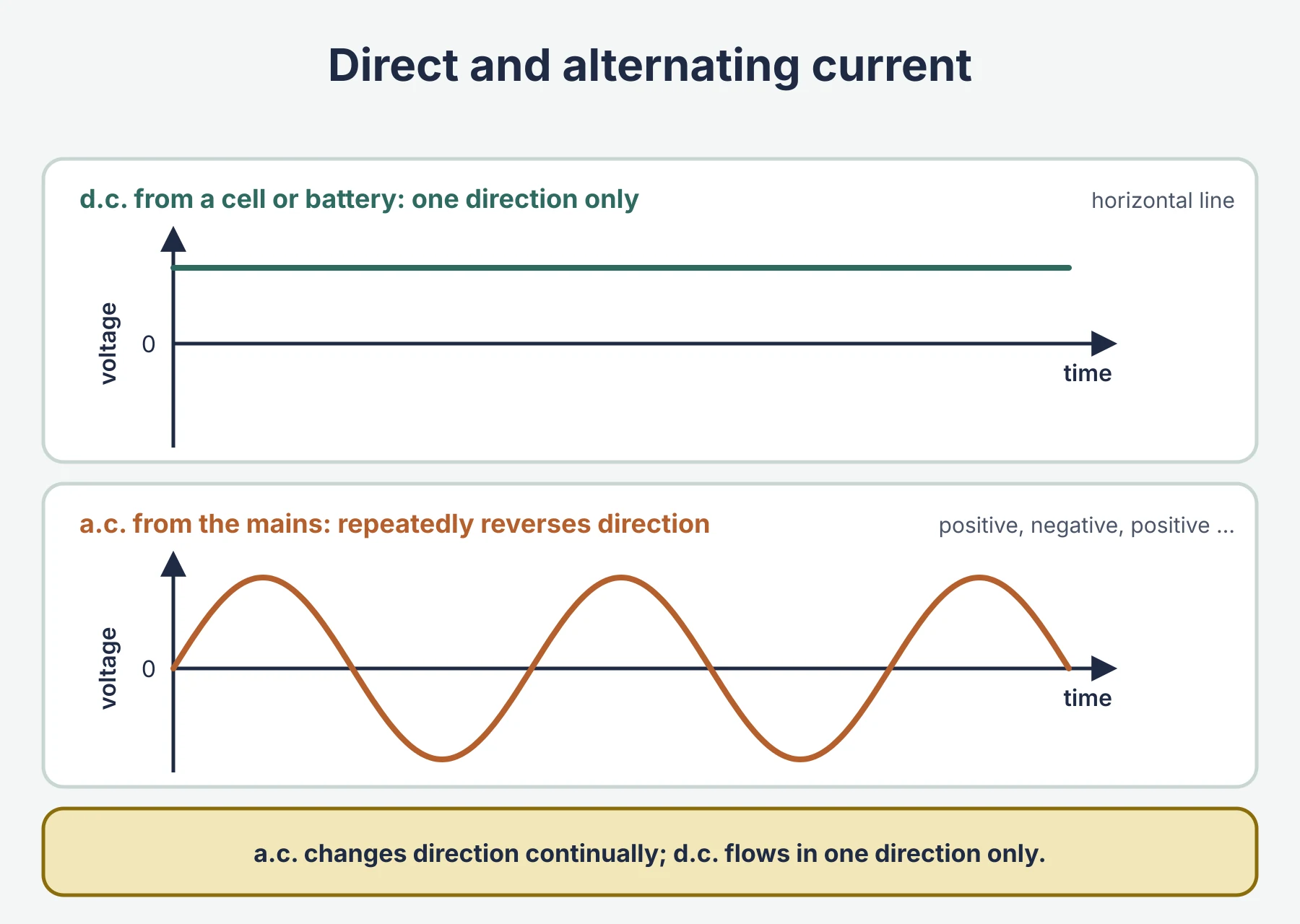
Direct current (d.c.) flows in one direction only. Cells and batteries supply d.c.; a graph of their voltage against time is a horizontal line.
Alternating current (a.c.) repeatedly reverses direction. Mains electricity is a.c.; a graph of voltage against time is a wave that goes positive, then negative, then positive again.
When you know the difference, give both halves: “a.c. changes direction continually; d.c. flows in one direction only.”
Common mistakes
- Saying a fuse “stops the current getting too high”. It breaks the circuit (by melting) when the current exceeds its rating.
- Saying the earth wire “absorbs” the current or makes the case safe on its own. The earth wire provides a low-resistance path, and the large current then blows the fuse.
- Choosing a fuse equal to, or far above, the operating current.
- Forgetting to convert kW to W or minutes to seconds.
- Explaining heating as “electrons rubbing”, rather than collisions of electrons with ions that make the ions vibrate more.
Exam technique with command words
- Explain how a feature protects the user: name the fault, what flows where, and the result (“the fuse melts, breaking the circuit and disconnecting the live wire”).
- Calculate then justify a fuse choice: give the current and the reason for the rating chosen.
- Describe a.c. and d.c.: one clear statement about direction for each.
- Suggest why an appliance is double insulated: link the plastic case to there being no metal part that could become live.
- Mains electricity revision notes
- Mains electricity practice questions
- Units and conversions: Units for electricity study guide
Written against the Pearson Edexcel International GCSE in Physics (4PH1) specification, Issue 4. Always check the current specification for your examination year.
Related resources
-
Practice questions
Pearson Edexcel International GCSE Physics (4PH1): Mains electricity – Practice Questions
Original practice questions with full answers on earthing, fuses, circuit breakers, electrical heating, P = IV, E = IVt and a.c. for Edexcel IGCSE Physics 4PH1.
Physics · Pearson Edexcel · IGCSE
Try questions -
Revision notes
Pearson Edexcel International GCSE Physics (4PH1): Mains electricity – Revision Notes
Recall notes on mains safety, electrical heating, fuse choice with P = IV, E = IVt and a.c. versus d.c., with a self-test, for Edexcel IGCSE Physics 4PH1.
Physics · Pearson Edexcel · IGCSE
Revise topic -
Study guides
Pearson Edexcel International GCSE Physics (4PH1): Units for electricity
The ampere, coulomb, joule, ohm, second, volt and watt in Edexcel International GCSE Physics 4PH1 Topic 2: meanings, links, prefixes and unit checks.
Physics · Pearson Edexcel · IGCSE
Read guide
Related articles
Get free revision emails (optional)
Occasional emails with practice questions, worked explanations and links to free resources for the qualification and subjects you choose. No spam, and you can unsubscribe from any email. The free tools on this site never need an email.