
Revision Notes
Pearson Edexcel International GCSE Physics (4PH1): Mains electricity – Revision Notes
Recall notes on mains safety, electrical heating, fuse choice with P = IV, E = IVt and a.c. versus d.c., with a self-test, for Edexcel IGCSE Physics 4PH1.
- Subject
- Physics
- Level
- IGCSE
- Topic
- Electricity
- Author
- Marlbridge Academic Team
- Updated
- Reviewed by
- Hassan (what this means)
Aligned to Pearson Edexcel IGCSE Physics (4PH1), Issue 4. Official specification .
Syllabus page (what it covers and how it is assessed): Pearson Edexcel IGCSE Physics.
Syllabus points this page covers
4PH1
- 2b Mains electricity
Found an error? Report a correction.
Need help with this topic? Request a free trial class for IGCSE Physics (4PH1).
Condensed notes on sub-topic 2(b) Mains electricity (statements 2.2 to 2.6) of Pearson Edexcel International GCSE Physics (4PH1), Issue 4. For full explanations and worked examples, use the Mains electricity study guide.
Equations
P = I × V                  (know and use; also I = P / V for fuses)
E = I × V × t              (use; t in seconds)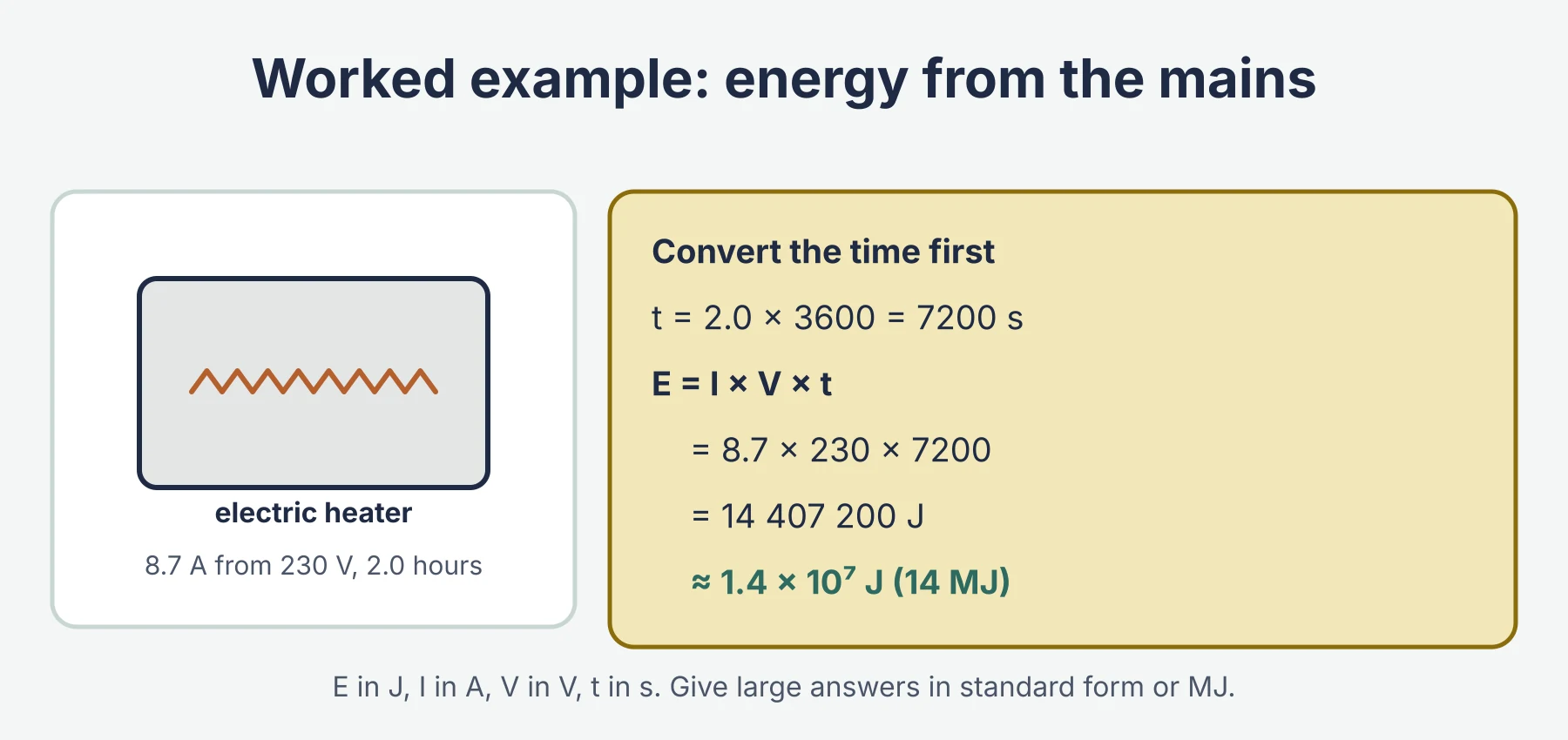
Key terms
| Term | Meaning |
|---|---|
| live wire | carries the alternating mains voltage |
| neutral wire | completes the circuit; close to 0 V |
| earth wire | connects a metal case to the ground; no current in normal use |
| insulation | plastic covering on wires preventing contact with conductors |
| double insulation | insulating case as well as insulated wires; no earth wire needed |
| fuse | thin wire in the live side that melts if current exceeds its rating |
| fuse rating | the current above which the fuse melts |
| circuit breaker | automatic switch in the live side that trips on excess current; resettable |
| a.c. | alternating current: repeatedly reverses direction (mains) |
| d.c. | direct current: one direction only (cells, batteries) |
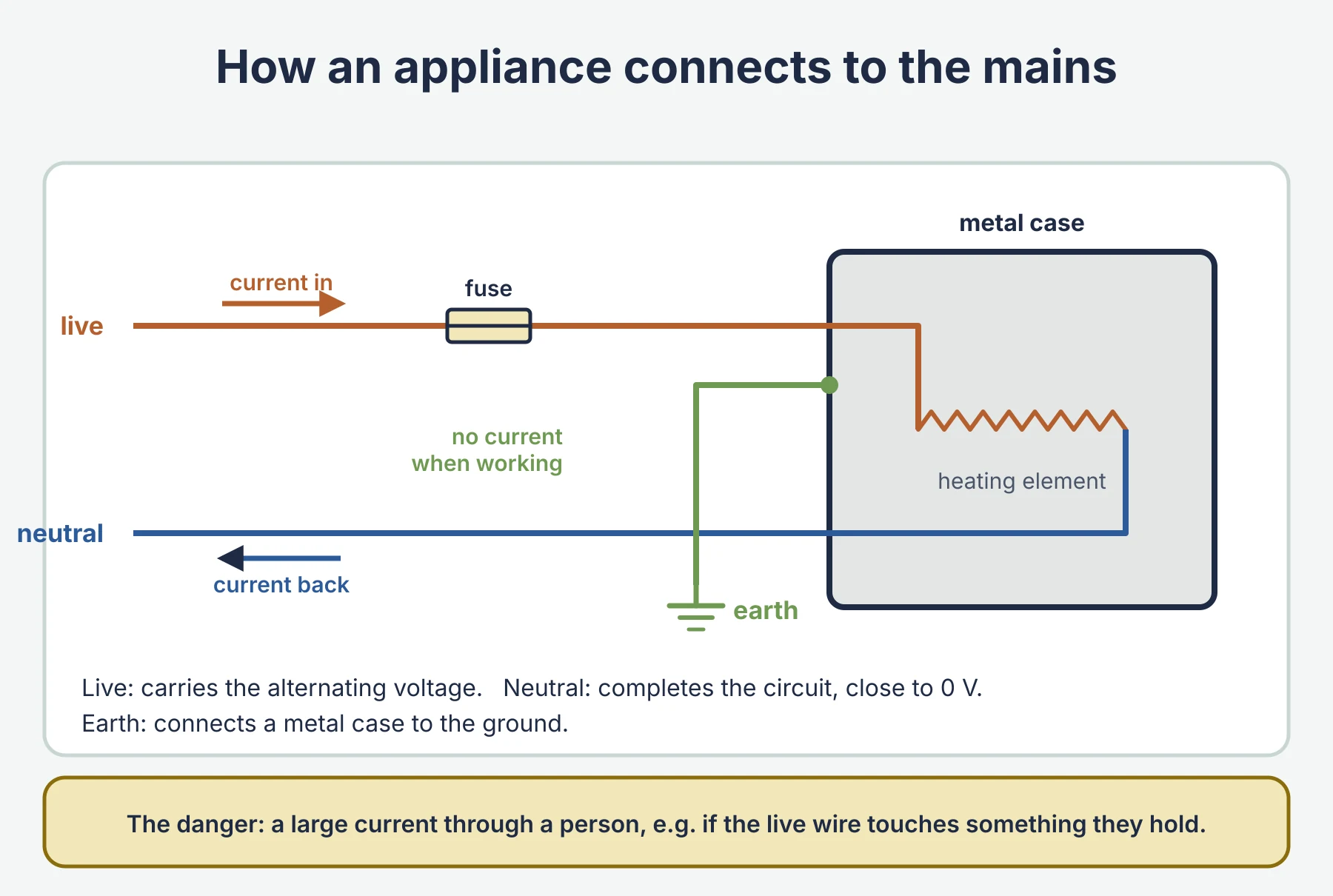
Safety features: fault, then result
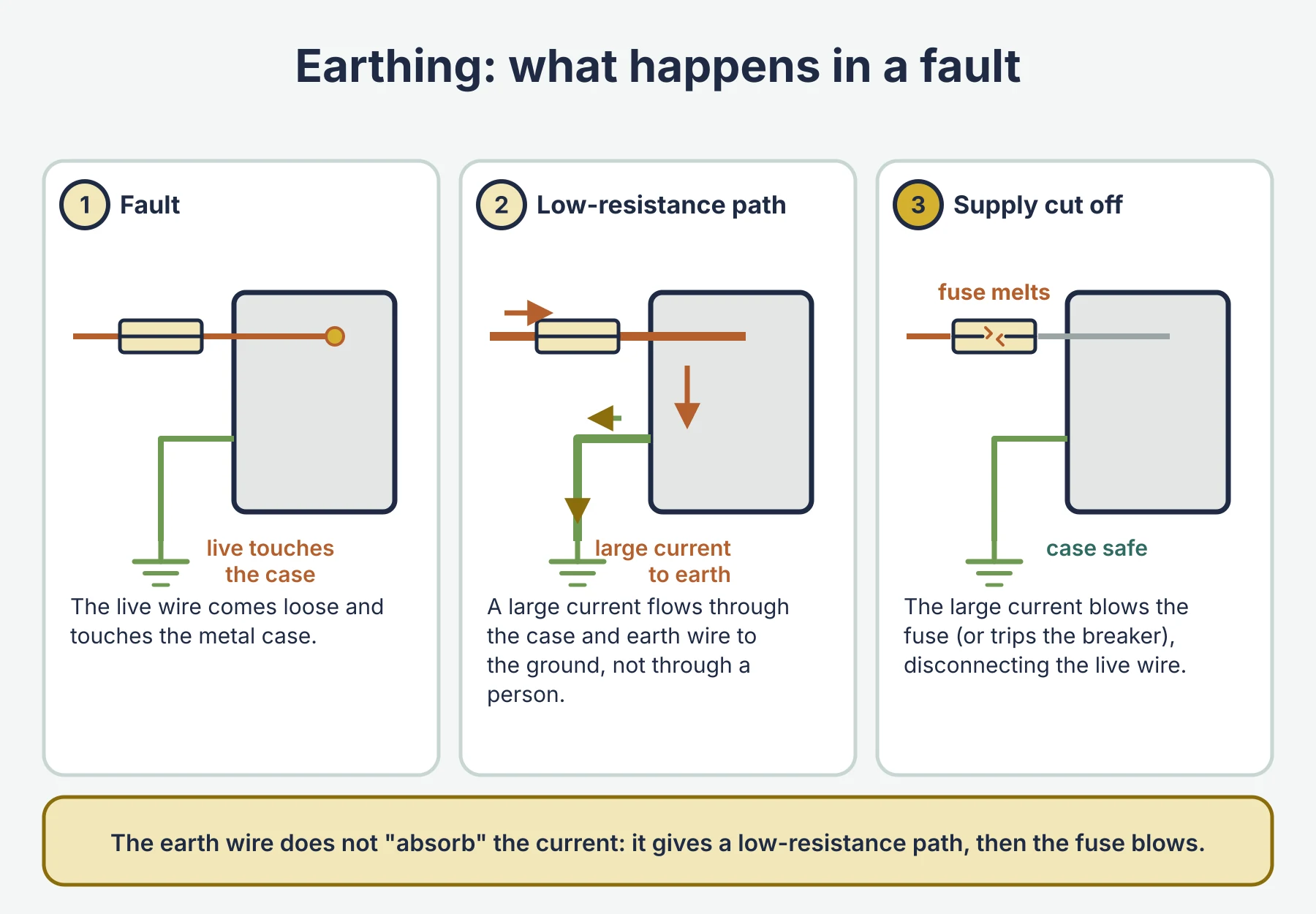
- Earthed metal case, live wire touches case: large current flows through the low-resistance earth wire → fuse melts or breaker trips → live disconnected → case not live, user safe.
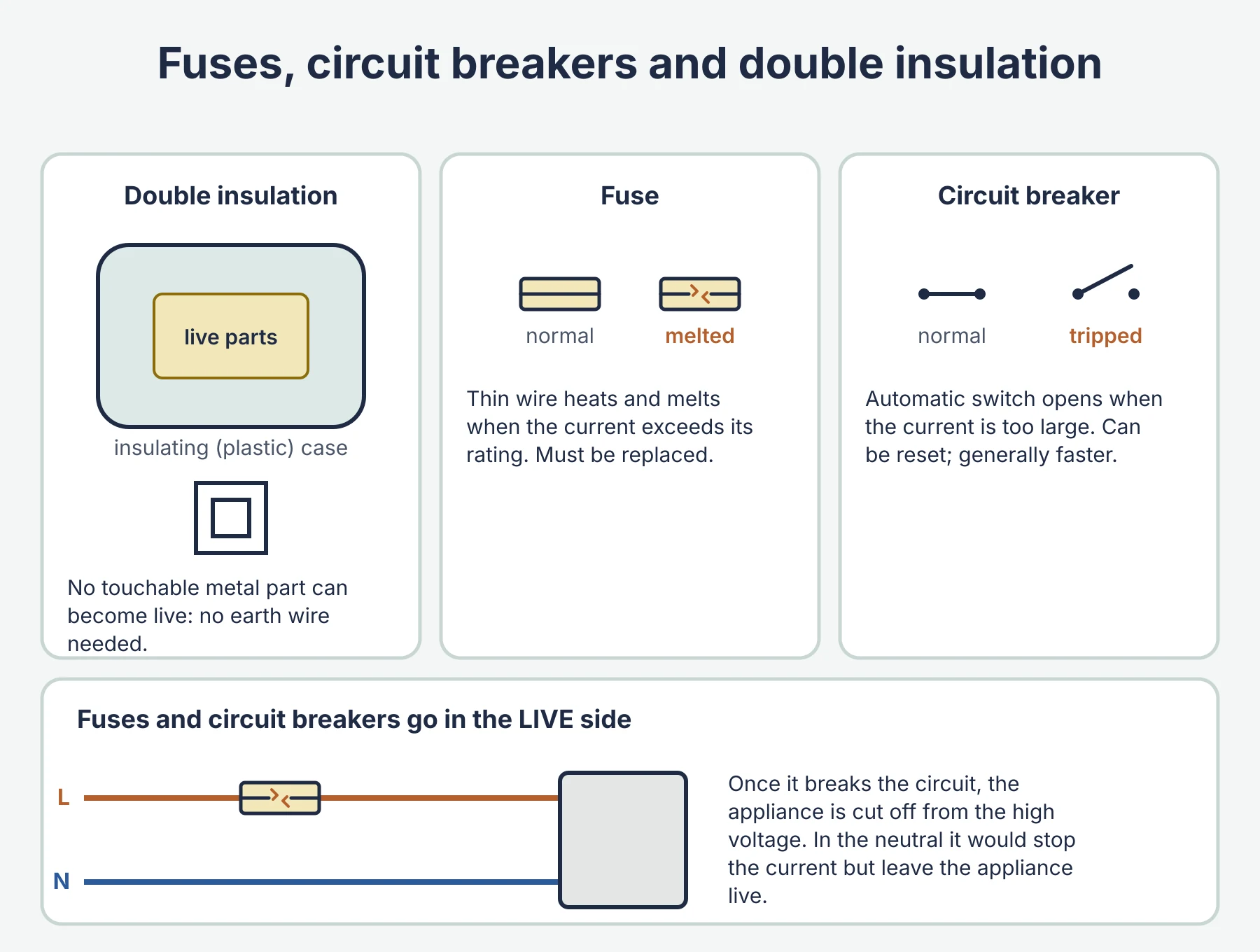
- Double insulation: no touchable metal can become live, so no earth wire is needed.
- Fuse: current above rating → wire heats and melts → circuit broken → cable does not overheat (fire risk reduced).
- Circuit breaker: current above set value → switch opens → reset after the fault is fixed; faster than a fuse.
- Why the live side? Breaking the live connection isolates the appliance from the high voltage.
Electrical heating
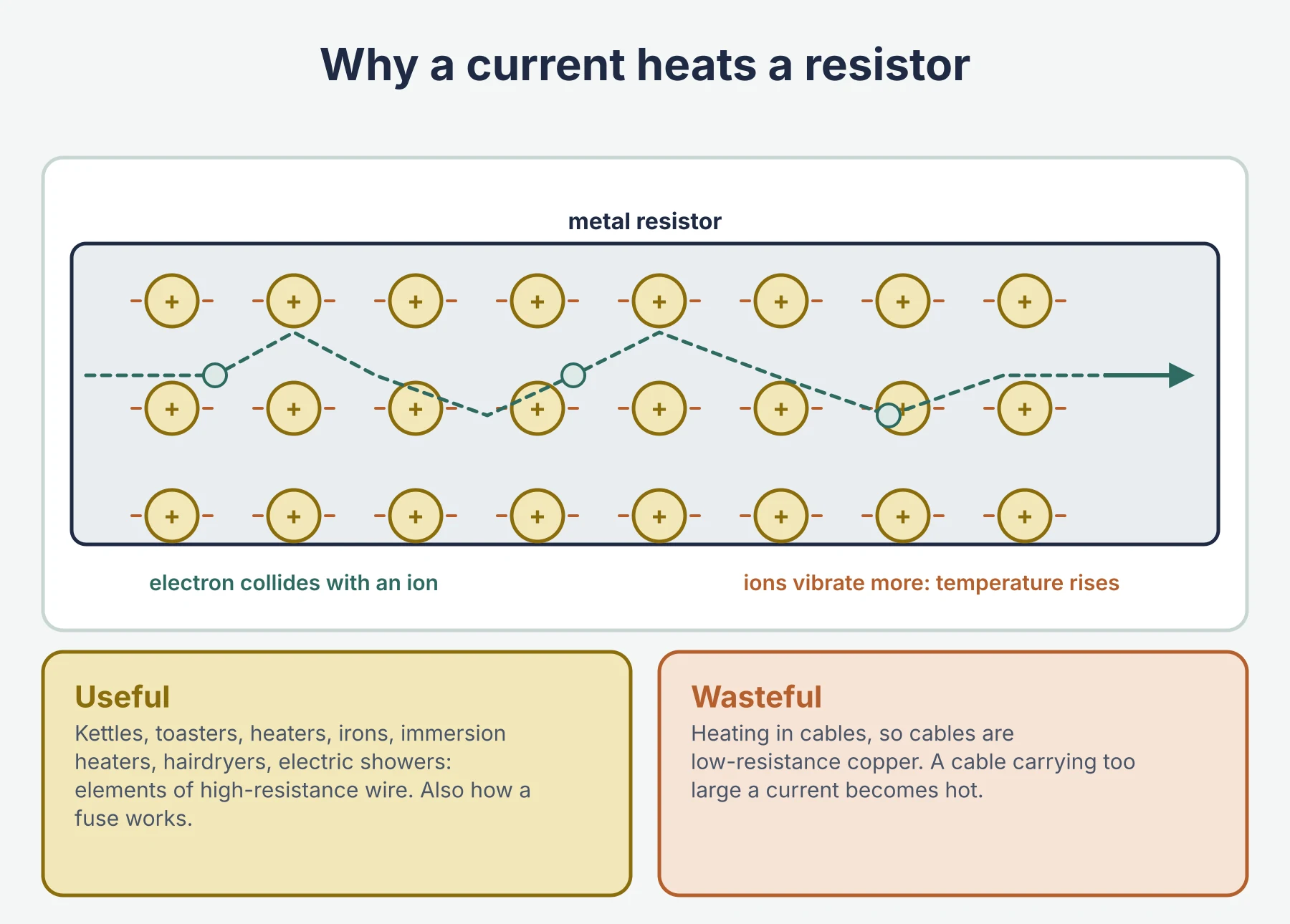
Electrons collide with the ions in the resistor’s metal lattice and transfer energy → ions vibrate more → temperature rises. Uses: kettle, toaster, iron, electric heater, immersion heater, hairdryer, shower. In cables it is wasted energy, so cables have low resistance.
Fuse selection steps
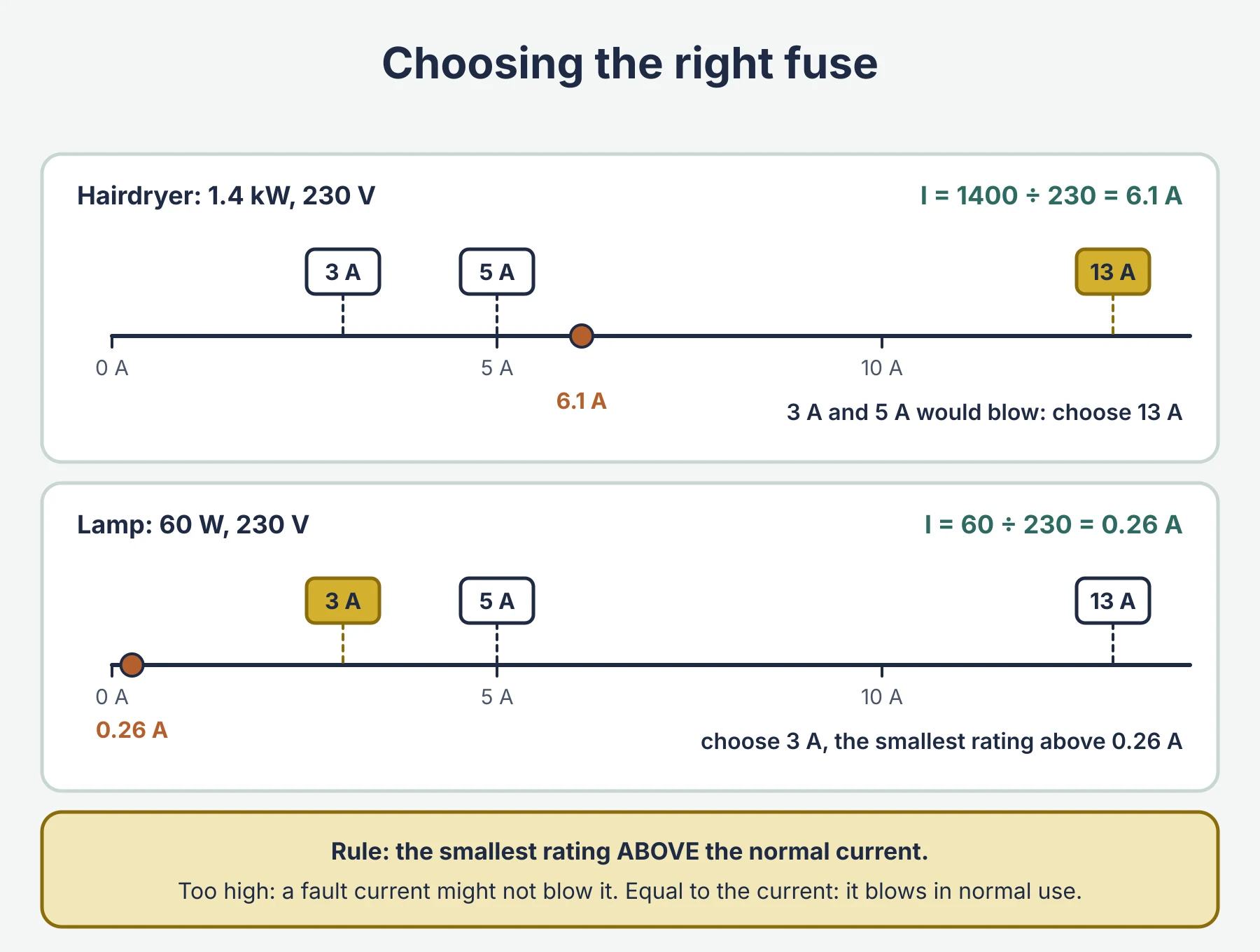
- Convert power to watts.
- I = P ÷ V.
- Pick the smallest available rating above I.
| Appliance (230 V) | Current | Fuse (3 A, 5 A or 13 A) |
|---|---|---|
| 40 W lamp | 0.17 A | 3 A |
| 700 W blender | 3.0 A | 5 A |
| 1.0 kW microwave oven | 4.3 A | 5 A |
| 2.3 kW kettle | 10 A | 13 A |
a.c. versus d.c.
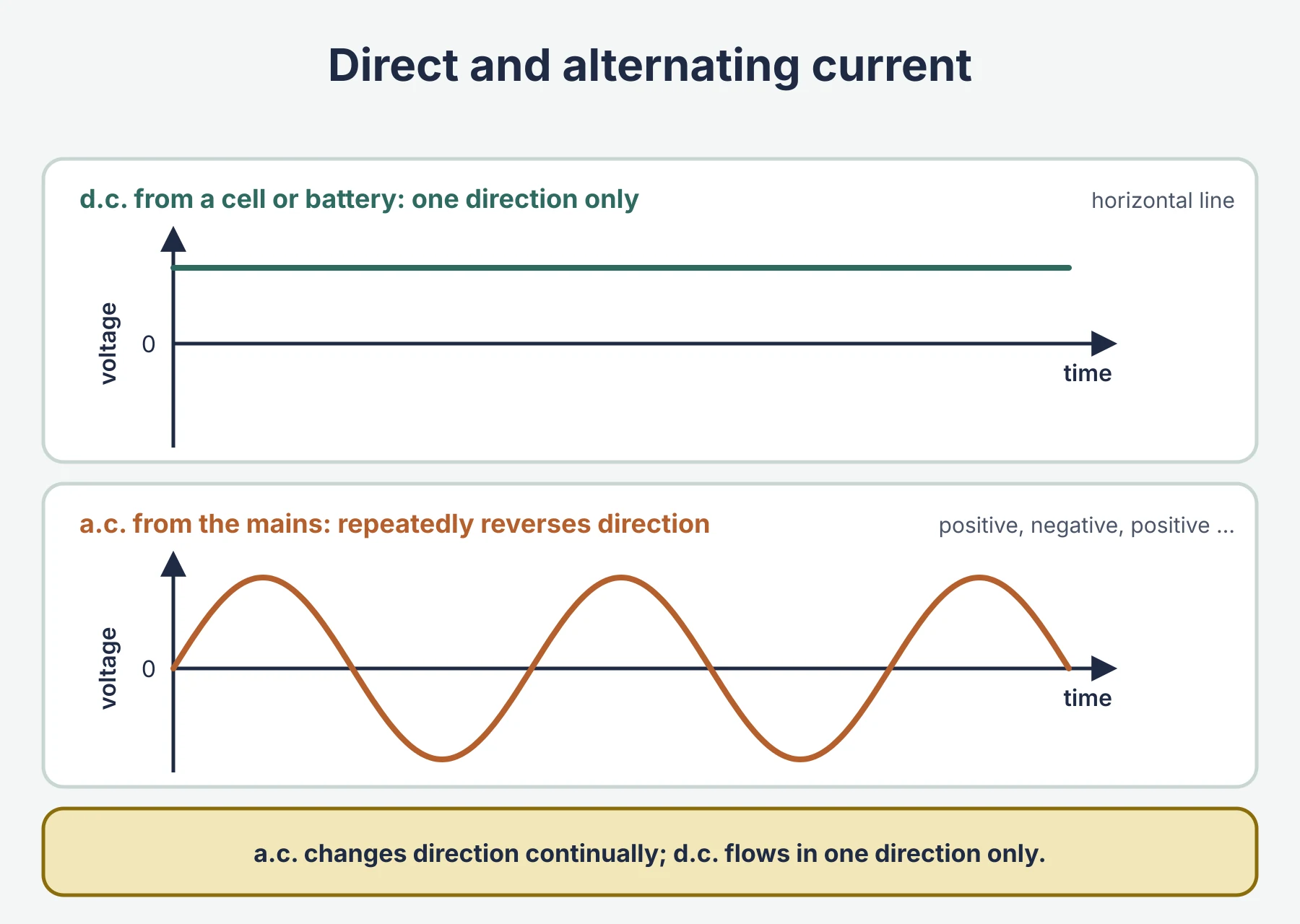
| a.c. | d.c. | |
|---|---|---|
| direction | reverses repeatedly | one direction only |
| source | mains supply | cell, battery |
| voltage−time graph | wave crossing zero | horizontal line |
Exam traps
- A fuse rated equal to the normal current blows in normal use; rated far above it, it does not protect the cable.
- The earth wire does not make an appliance safe on its own: the large fault current must then blow the fuse.
- A double-insulated appliance has no earth wire; do not say it is “earthed”.
- Electrons do not “rub” on the wire: they collide with ions.
- E = I × V × t needs time in seconds, not minutes or hours.
- “Mains is d.c.” is wrong; mains is a.c.
Self-test
- Name the wire that is connected to the metal case of an appliance.
- Explain why a fuse is placed in the live wire rather than the neutral.
- State one advantage of a circuit breaker over a fuse.
- Why does a double-insulated appliance not need an earth wire?
- Describe what happens when the live wire touches the earthed metal case of a toaster.
- Explain, in terms of electrons, why a heating element gets hot.
- State the difference between a.c. and d.c.
- Calculate the current in a 920 W appliance on 230 V.
- Choose a fuse (3 A, 5 A or 13 A) for a 2.0 kW heater on 230 V.
- A 230 V television takes 0.50 A for 3.0 hours. Calculate the energy transferred.
- Why are mains cables made of copper with a low resistance?
- A 400 W food mixer on 230 V is fitted with a 13 A fuse. Explain why this is not the best choice from 3 A, 5 A and 13 A.
Answers
- The earth wire.
- When the fuse melts it disconnects the appliance from the high voltage of the live wire; in the neutral, the appliance would stay connected to the live wire.
- Any one: it can be reset; it acts faster.
- Its case is made of an insulator, so no metal part that can be touched could become live.
- A large current flows from the live wire through the case and earth wire to the ground; the fuse melts (or breaker trips), disconnecting the supply.
- Electrons collide with the ions in the metal, transferring energy, so the ions vibrate more and the temperature rises.
- a.c. repeatedly reverses direction; d.c. flows in one direction only.
- I = P ÷ V = 920 ÷ 230 = 4.0 A.
- I = 2000 ÷ 230 = 8.7 A; choose 13 A.
- E = I × V × t = 0.50 × 230 × 10 800 = 1 242 000 J ≈ 1.2 × 10⁶ J.
- Low resistance means little energy is transferred as heat in the cable, so less energy is wasted and the cable does not overheat.
- I = 400 ÷ 230 = 1.7 A, so a 3 A fuse is the right choice. A 13 A fuse would let a fault current of up to 13 A flow without melting, so the mixer’s thin cable could overheat.
Related resources
-
Study guides
Pearson Edexcel International GCSE Physics (4PH1): Units for electricity
The ampere, coulomb, joule, ohm, second, volt and watt in Edexcel International GCSE Physics 4PH1 Topic 2: meanings, links, prefixes and unit checks.
Physics · Pearson Edexcel · IGCSE
Read guide -
Practice questions
Pearson Edexcel International GCSE Physics (4PH1): Units for electricity – Practice Questions
Original practice questions with full answers on using A, C, J, Ω, s, V and W, prefixes and unit checks for Edexcel International GCSE Physics 4PH1 Topic 2.
Physics · Pearson Edexcel · IGCSE
Try questions -
Revision notes
Pearson Edexcel International GCSE Physics (4PH1): Units for electricity – Revision Notes
Recall notes on A, C, J, Ω, s, V and W for Edexcel International GCSE Physics 4PH1 Topic 2: unit links, prefixes, conversions, exam traps and a self-test.
Physics · Pearson Edexcel · IGCSE
Revise topic
Related articles
Get free revision emails (optional)
Occasional emails with practice questions, worked explanations and links to free resources for the qualification and subjects you choose. No spam, and you can unsubscribe from any email. The free tools on this site never need an email.