
Revision Notes
Pearson Edexcel International GCSE Physics (4PH1): Units for forces and motion – Revision Notes
Recall notes on the Topic 1 units for Edexcel International GCSE Physics 4PH1: kg, m, s, m/s, m/s², N, N/kg, Nm and kg m/s, with conversions and a self-test.
- Subject
- Physics
- Level
- IGCSE
- Topic
- Forces and motion
- Author
- Marlbridge Academic Team
- Updated
- Reviewed by
- Hassan (what this means)
Aligned to Pearson Edexcel IGCSE Physics (4PH1), Issue 4. Official specification .
Syllabus page (what it covers and how it is assessed): Pearson Edexcel IGCSE Physics.
Syllabus points this page covers
4PH1
- 1a Units
Found an error? Report a correction.
Need help with this topic? Request a free trial class for IGCSE Physics (4PH1).
Condensed notes on sub-topic 1(a) Units of Pearson Edexcel International GCSE Physics (4PH1), Issue 4. For full explanations and worked examples, use the Units for forces and motion study guide.
What the specification lists
- 1.1: kg, m, m/s, m/s², N, s, N/kg
- 1.2P (Physics only, Paper 2P): Nm, kg m/s
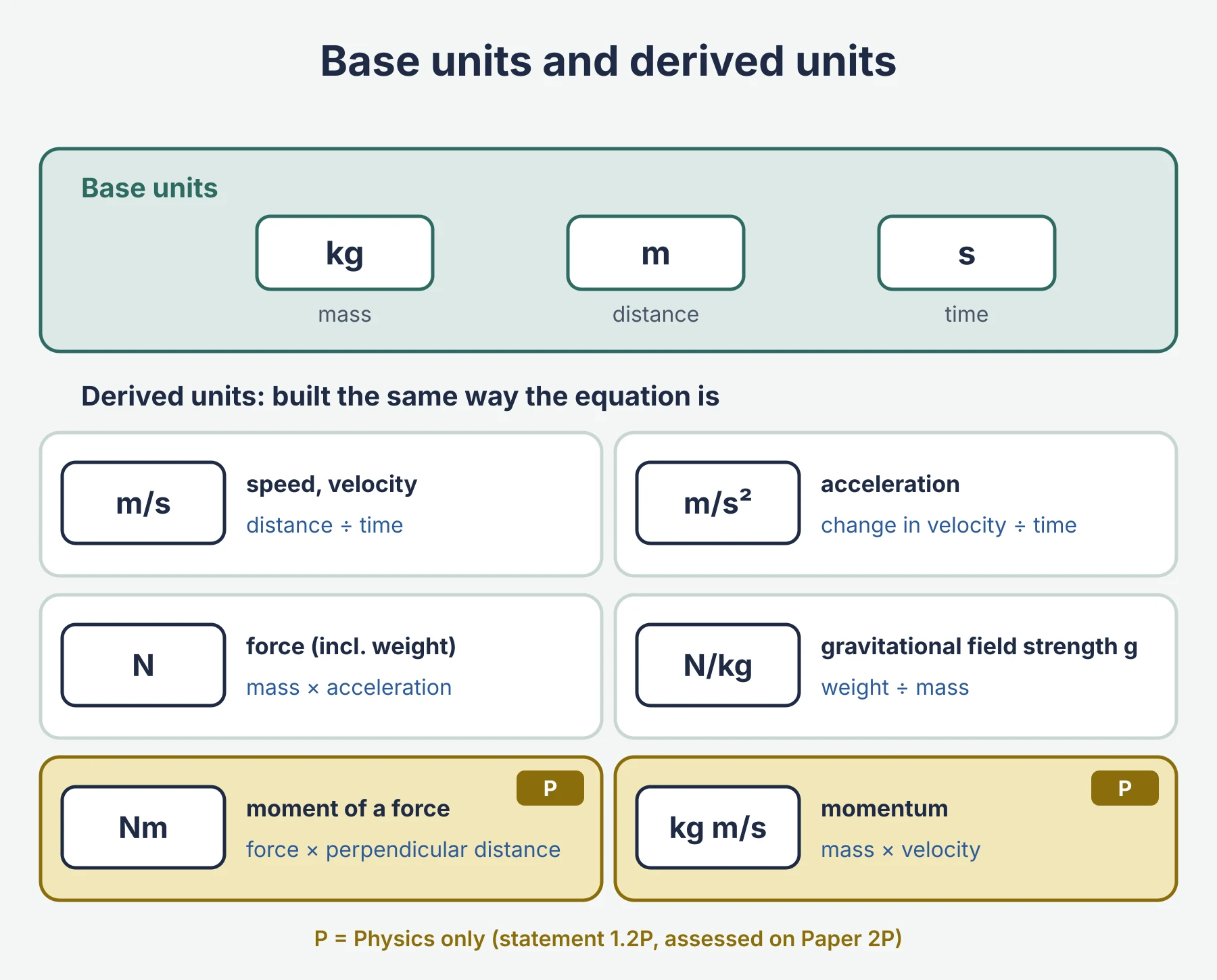
Key units table
| Unit | Quantity | Built from | In base units |
|---|---|---|---|
| kg | mass | base | kg |
| m | distance, extension, perpendicular distance | base | m |
| s | time | base | s |
| m/s | speed, velocity | distance ÷ time | m/s |
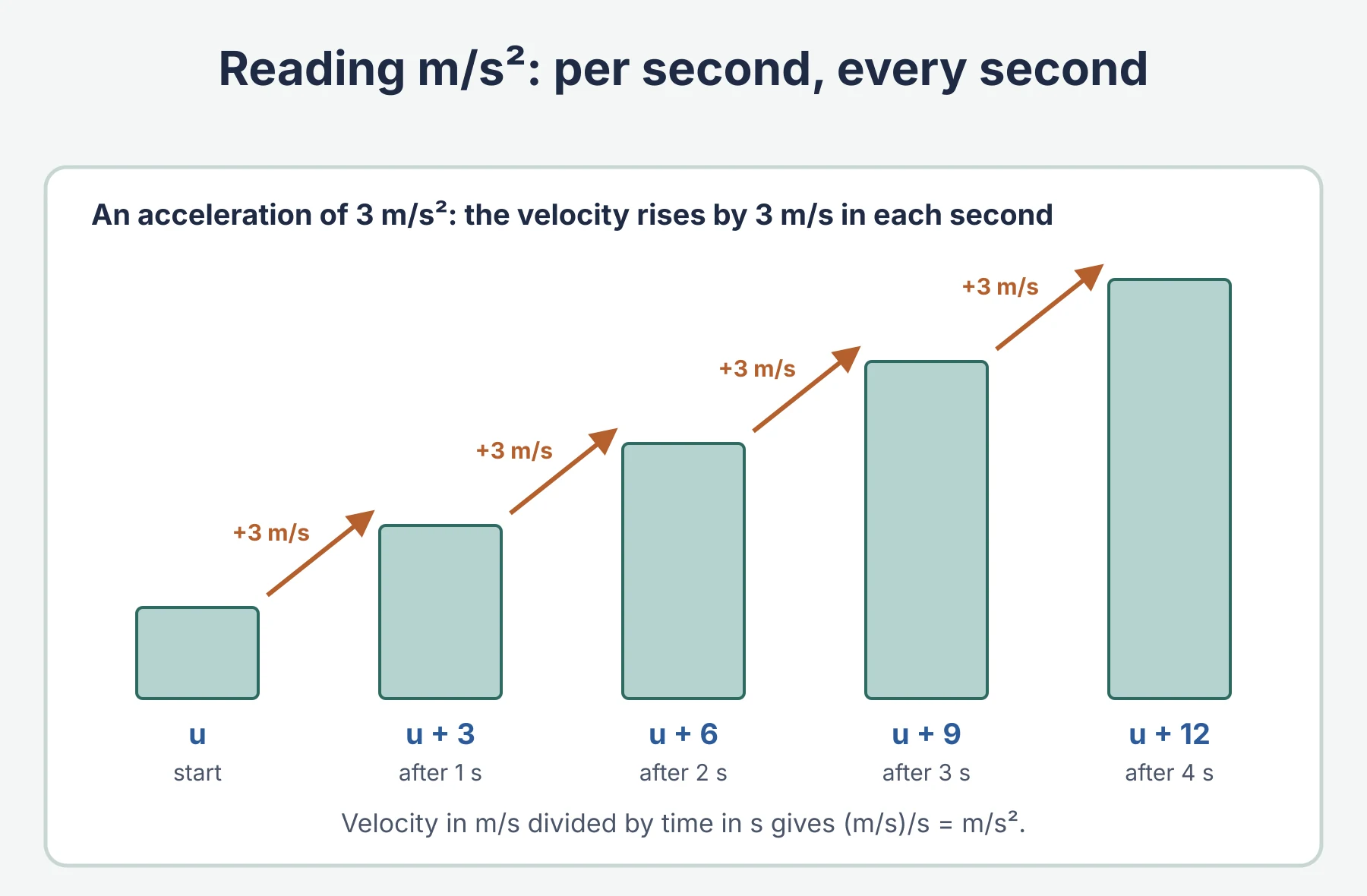
| m/s² | acceleration | change in velocity ÷ time | m/s² |
| N | force (weight, friction, drag, tension) | mass × acceleration | kg m/s² |
| N/kg | gravitational field strength g | weight ÷ mass | m/s² |
| Nm (P) | moment | force × perpendicular distance | kg m²/s² |
| kg m/s (P) | momentum | mass × velocity | kg m/s |
Links to remember
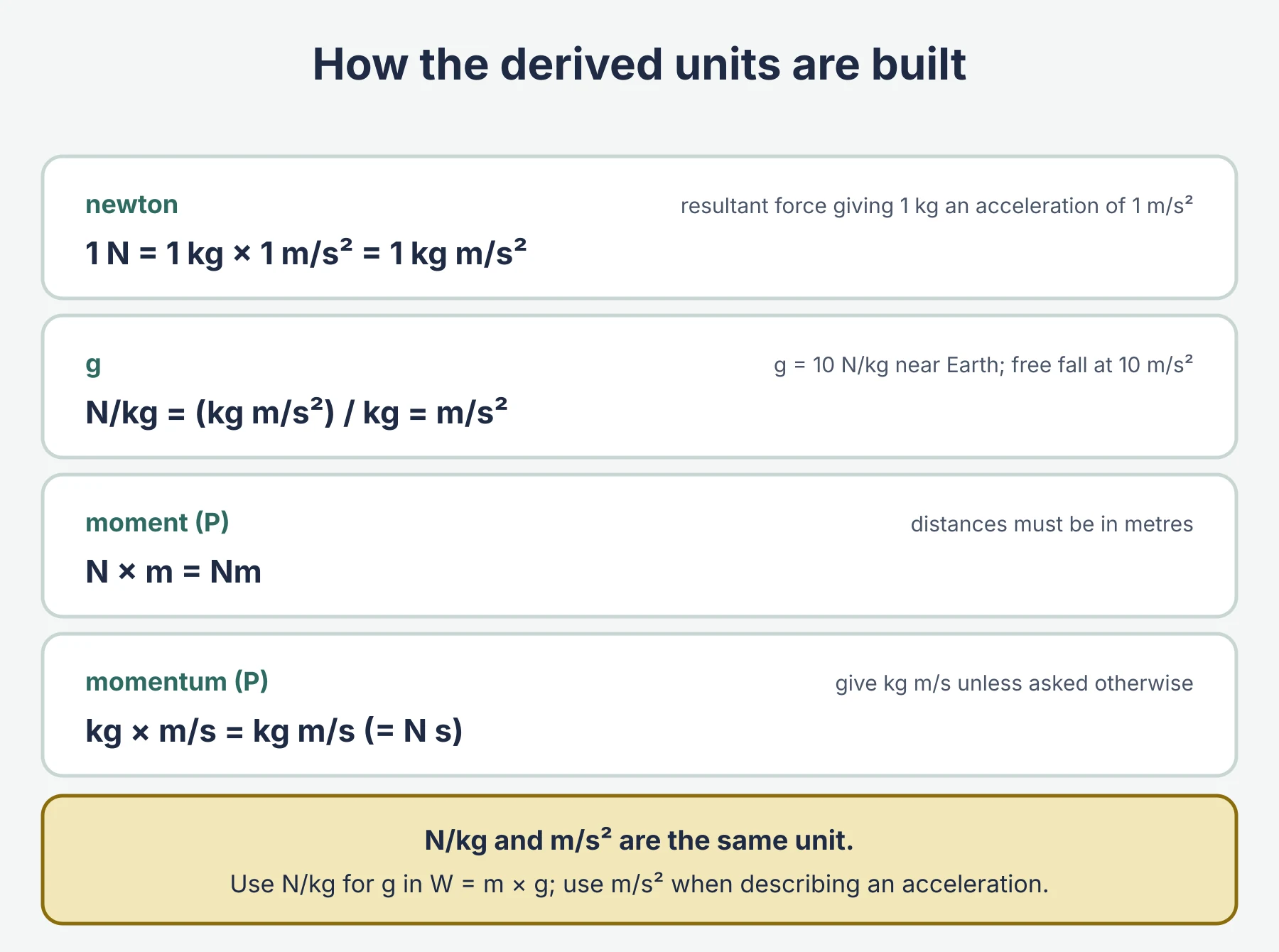
- 1 N gives 1 kg an acceleration of 1 m/s².
- N/kg and m/s² are the same unit: g = 10 N/kg means free fall without air resistance has acceleration 10 m/s².
- A change in momentum can also be written in N s (force × time). It is equal to kg m/s; quote kg m/s unless told otherwise.
- The joule is also N × m, but moments are given in Nm and energies in J. Never write J for a moment.
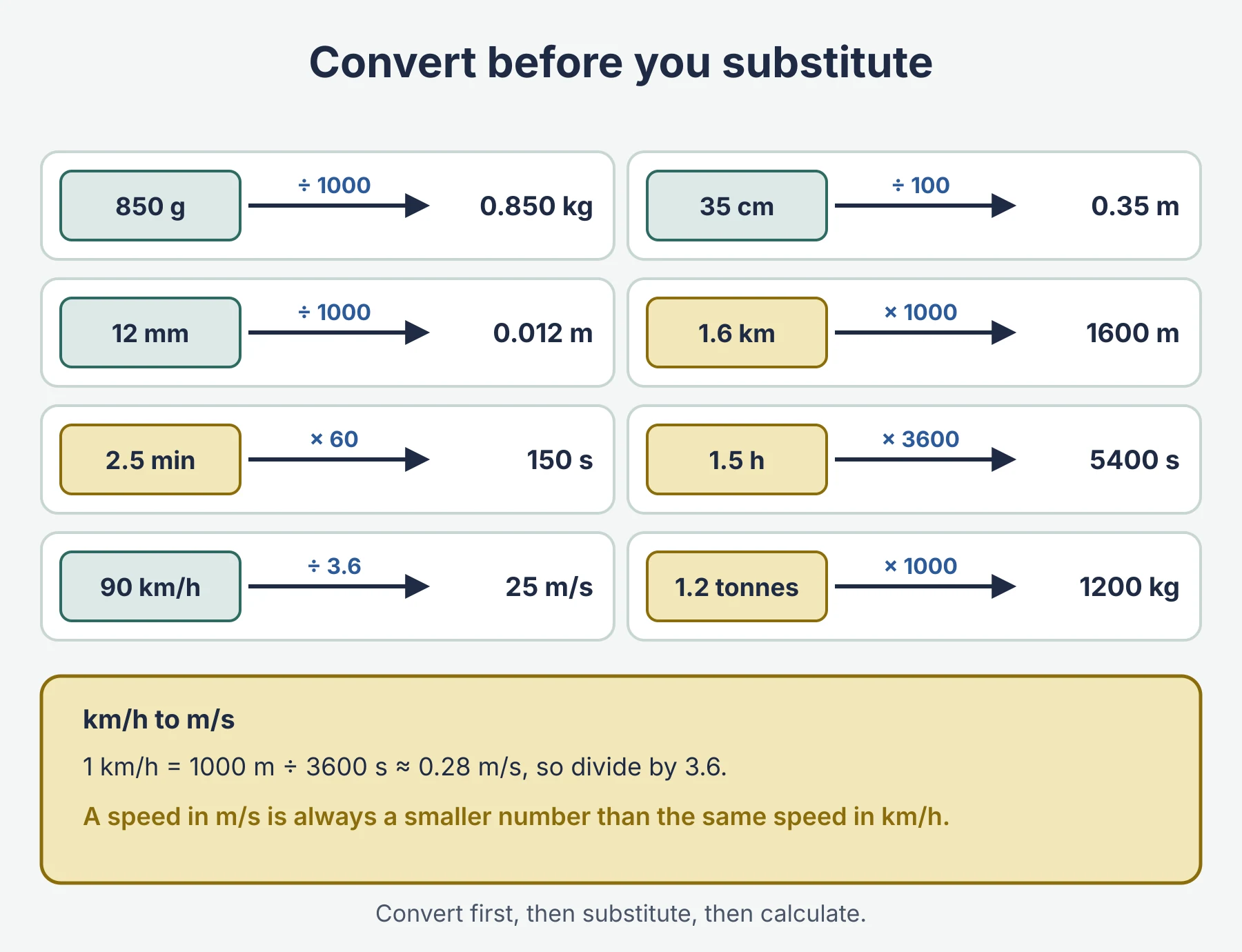
Conversion factors
| From | To | Operation | Example |
|---|---|---|---|
| g | kg | ÷ 1000 | 250 g = 0.25 kg |
| tonne | kg | × 1000 | 3.5 t = 3500 kg |
| mm | m | ÷ 1000 | 8.0 mm = 0.0080 m |
| cm | m | ÷ 100 | 60 cm = 0.60 m |
| km | m | × 1000 | 2.4 km = 2400 m |
| min | s | × 60 | 4.0 min = 240 s |
| h | s | × 3600 | 0.25 h = 900 s |
| km/h | m/s | ÷ 3.6 | 54 km/h = 15 m/s |
| m/s | km/h | × 3.6 | 30 m/s = 108 km/h |
The unit check
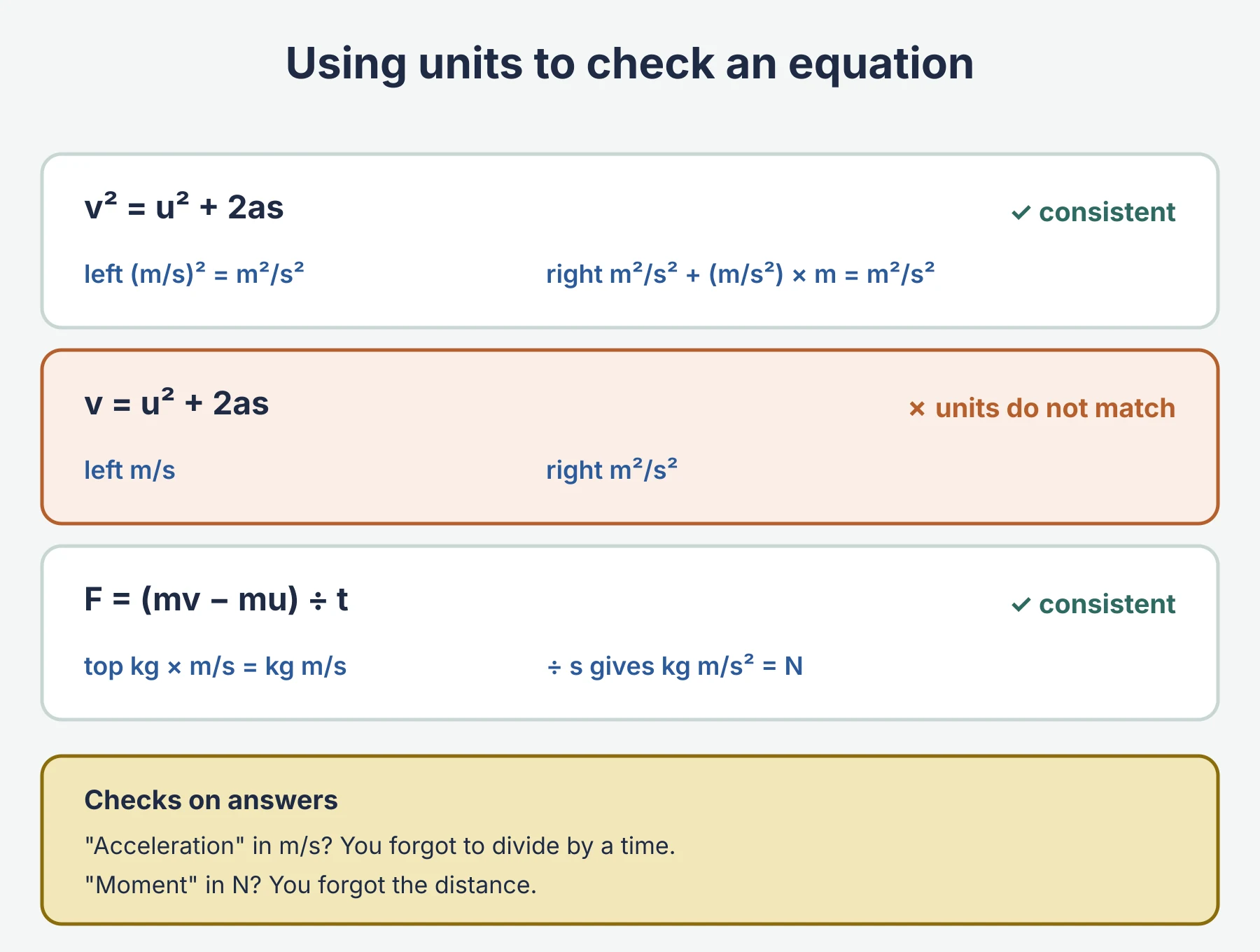
Write the units of each term. Both sides of a correct equation have the same unit.
v² = u² + 2as     m²/s² = m²/s² + (m/s²)(m)     consistent
F = (mv − mu)/t   N = (kg m/s)/s = kg m/s²        consistent
If an answer comes out in the wrong unit, the method is wrong: acceleration in m/s means no division by time; a moment in N means no distance.
Recall points
- Mass (kg) is the same everywhere; weight (N) depends on g.
- A speed in m/s is a smaller number than the same speed in km/h.
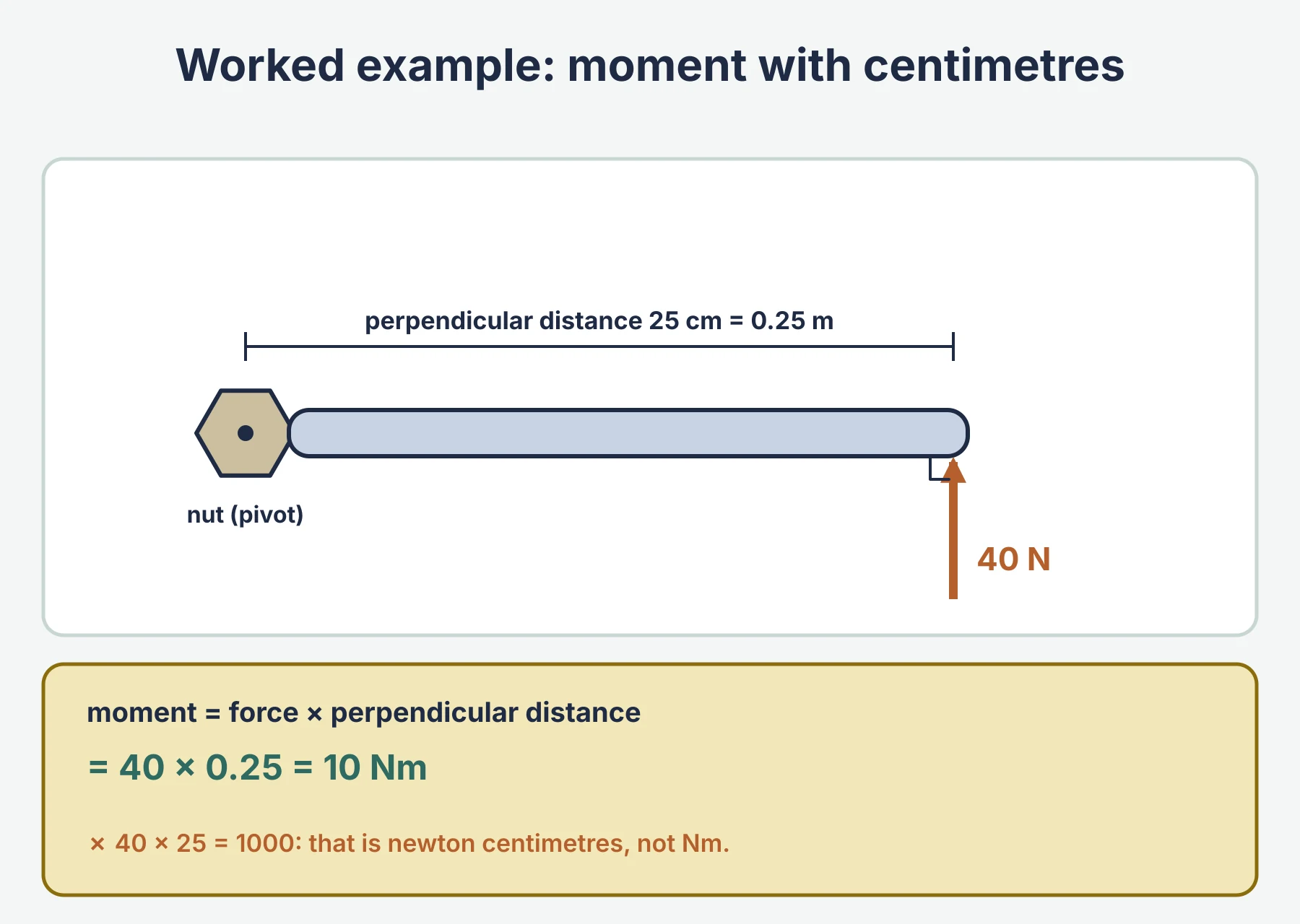
- Distances in moments must be in metres before multiplying.
- Momentum and velocity are vectors, so a negative value means the opposite direction; the unit stays the same.
- Round only at the end of a multi-step calculation, to the number of significant figures in the data (usually 2 or 3).
- Use standard form for very large or small values and keep the unit: 2.0 × 10⁻³ kg, 1.5 × 10⁴ N.
Exam traps
- “Weight = 50 kg”. Weight is a force: 50 kg has weight 500 N where g = 10 N/kg.
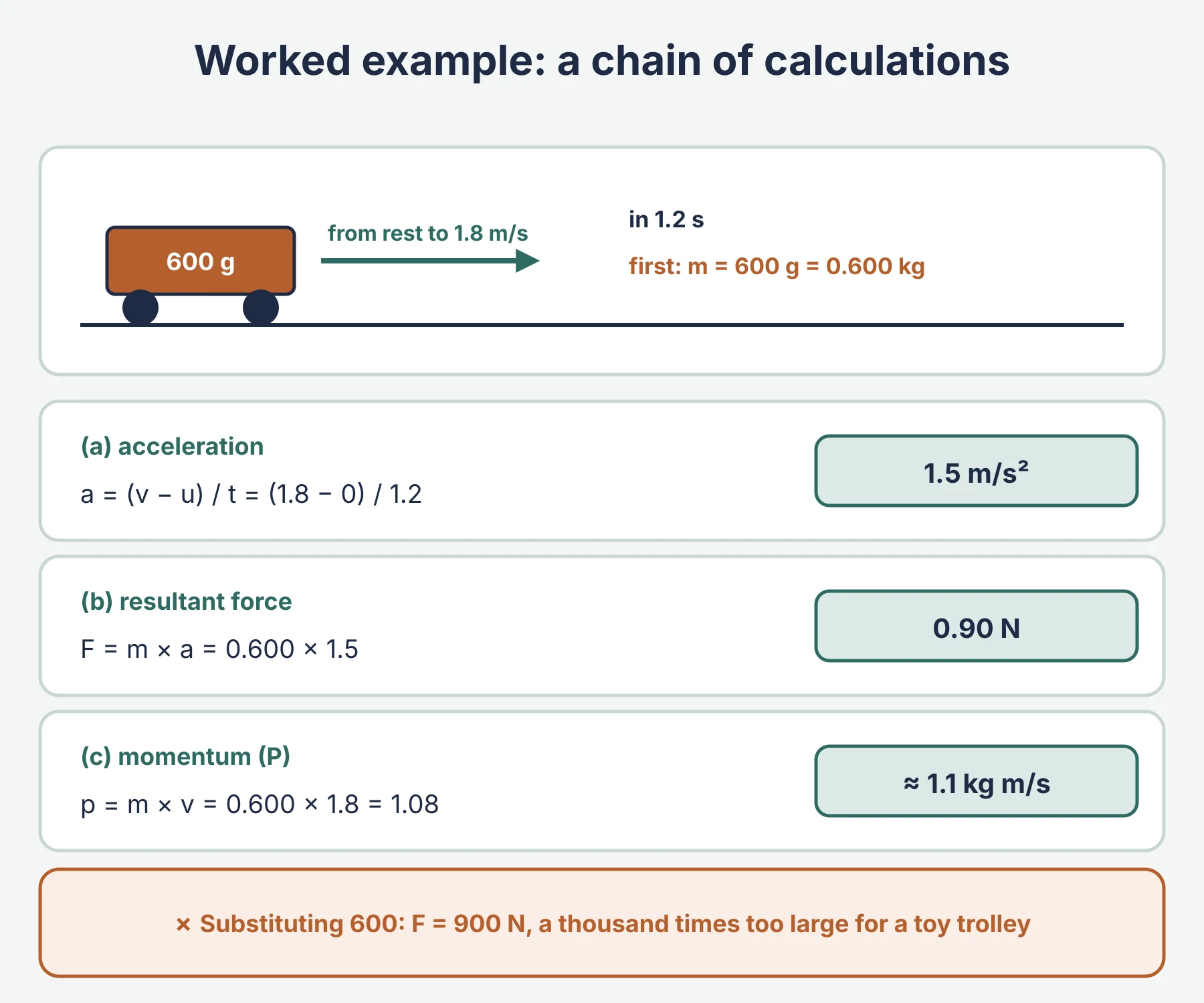
- Substituting 600 for a mass of 600 g. The force answer comes out 1000 times too large.
- Dividing km/h by 60 instead of 3.6 (that gives km per minute, not m/s).
- Using 25 for a distance of 25 cm in a moment, giving N cm.
- Writing m/s/s or m/s2 sloppily. Write m/s² (or m s⁻²); both are the same unit.
- Giving the unit as “kgm/s” run together, which can be read as kilo-gram- metre. Leave a space: kg m/s.
- Reading a graph axis in minutes or cm and forgetting to convert the gradient or area to SI units.
Self-test
- State the unit of gravitational field strength.
- Express the newton in terms of kg, m and s.
- State two quantities in Topic 1 measured in metres.
- Convert 72 km/h to m/s.
- Convert 450 g to kg and 1.5 minutes to seconds.
- State the unit of momentum and the unit of the moment of a force.
- Show that N/kg is the same unit as m/s².
- A student writes “acceleration = 4.0 m/s”. What mistake might this reveal?
- Calculate the weight of a 2.5 kg bag where g = 10 N/kg, with the unit.
- Calculate the moment of a 15 N force acting 40 cm from a pivot.
- A 0.20 kg ball moves at 90 km/h. Calculate its momentum in kg m/s.
- Why should you not give the unit of a moment as J?
Answers
- N/kg (newton per kilogram).
- 1 N = 1 kg m/s².
- Any two: distance moved, displacement, extension, perpendicular distance from a pivot, braking distance.
- 72 ÷ 3.6 = 20 m/s.
- 0.45 kg; 90 s.
- Momentum: kg m/s. Moment: Nm.
- N/kg = (kg m/s²)/kg = m/s².
- The velocity change was not divided by time, or a speed has been labelled as an acceleration.
- W = m × g = 2.5 × 10 = 25 N.
- 40 cm = 0.40 m; moment = 15 × 0.40 = 6.0 Nm.
- 90 km/h = 25 m/s; p = 0.20 × 25 = 5.0 kg m/s.
- Although N × m equals a joule, the joule is used for energy transferred; the specification gives the unit of moment as Nm, which shows the force and distance are perpendicular rather than along the same line.
Related resources
-
Study guides
Edexcel IGCSE Physics: Forces and Motion
Motion graphs, v² = u² + 2as, forces, stopping distance, Hooke's law, momentum and moments: Topic 1 of Pearson Edexcel International GCSE Physics (4PH1).
Physics · Pearson Edexcel · IGCSE
Read guide -
Practice questions
Edexcel IGCSE Physics: Forces and Motion — Practice Questions
Original practice questions with answers on motion graphs, terminal velocity, Newton's laws, momentum and moments for Edexcel International GCSE Physics 4PH1.
Physics · Pearson Edexcel · IGCSE
Try questions -
Revision notes
Edexcel IGCSE Physics: Forces and Motion — Revision Notes
Condensed recall notes on speed, acceleration, Newton laws, momentum, moments and stopping distance for Edexcel International GCSE Physics 4PH1.
Physics · Pearson Edexcel · IGCSE
Revise topic
Related articles
Get free revision emails (optional)
Occasional emails with practice questions, worked explanations and links to free resources for the qualification and subjects you choose. No spam, and you can unsubscribe from any email. The free tools on this site never need an email.