
Study Guides
Pearson Edexcel International GCSE Physics (4PH1): Units for forces and motion
The units of Topic 1 in Edexcel International GCSE Physics 4PH1: what each measures, how they link, converting data and checking answers by units.
- Subject
- Physics
- Level
- IGCSE
- Topic
- Forces and motion
- Author
- Marlbridge Academic Team
- Updated
- Reviewed by
- Hassan (what this means)
Aligned to Pearson Edexcel IGCSE Physics (4PH1), Issue 4. Official specification .
Syllabus page (what it covers and how it is assessed): Pearson Edexcel IGCSE Physics.
Syllabus points this page covers
4PH1
- 1a Units
Found an error? Report a correction.
Need help with this topic? Request a free trial class for IGCSE Physics (4PH1).
This guide covers sub-topic 1(a) Units of Topic 1, Forces and motion, in the Pearson Edexcel International GCSE in Physics (4PH1), Issue 4. The specification asks you to:
- 1.1 use the units kilogram (kg), metre (m), metre/second (m/s), metre/second² (m/s²), newton (N), second (s) and newton/kilogram (N/kg)
- 1.2P use the units newton metre (Nm) and kilogram metre/second (kg m/s)
Statement 1.2P is Physics-only, so the two units it names are assessed on Paper 2P, which covers the “P” content. For the physics these units belong to, see the Forces and Motion study guide.
Why a whole sub-topic on units?
Every calculation in Topic 1 ends in a number with a unit, and a number without the right unit is not a physical answer: “20” could be a speed, a force or a time. “Use” in 1.1 means three things you must be able to do:
- attach the correct unit to every quantity you calculate
- convert given data into these units before substituting
- use units to check that an equation, or your rearrangement of it, makes sense
The nine units and what they measure
| Unit | Symbol | Quantity in Topic 1 | Where it comes from |
|---|---|---|---|
| kilogram | kg | mass | base unit |
| metre | m | distance, displacement, extension, perpendicular distance | base unit |
| second | s | time | base unit |
| metre/second | m/s | speed, velocity | distance ÷ time |
| metre/second² | m/s² | acceleration | change in velocity ÷ time |
| newton | N | force, including weight, friction and air resistance | mass × acceleration |
| newton/kilogram | N/kg | gravitational field strength, g | weight ÷ mass |
| newton metre | Nm | moment of a force (P) | force × perpendicular distance |
| kilogram metre/second | kg m/s | momentum (P) | mass × velocity |
Three units (kg, m, s) are base units. The other six are derived: each is built by multiplying or dividing base units in the same way the defining equation multiplies or divides the quantities.
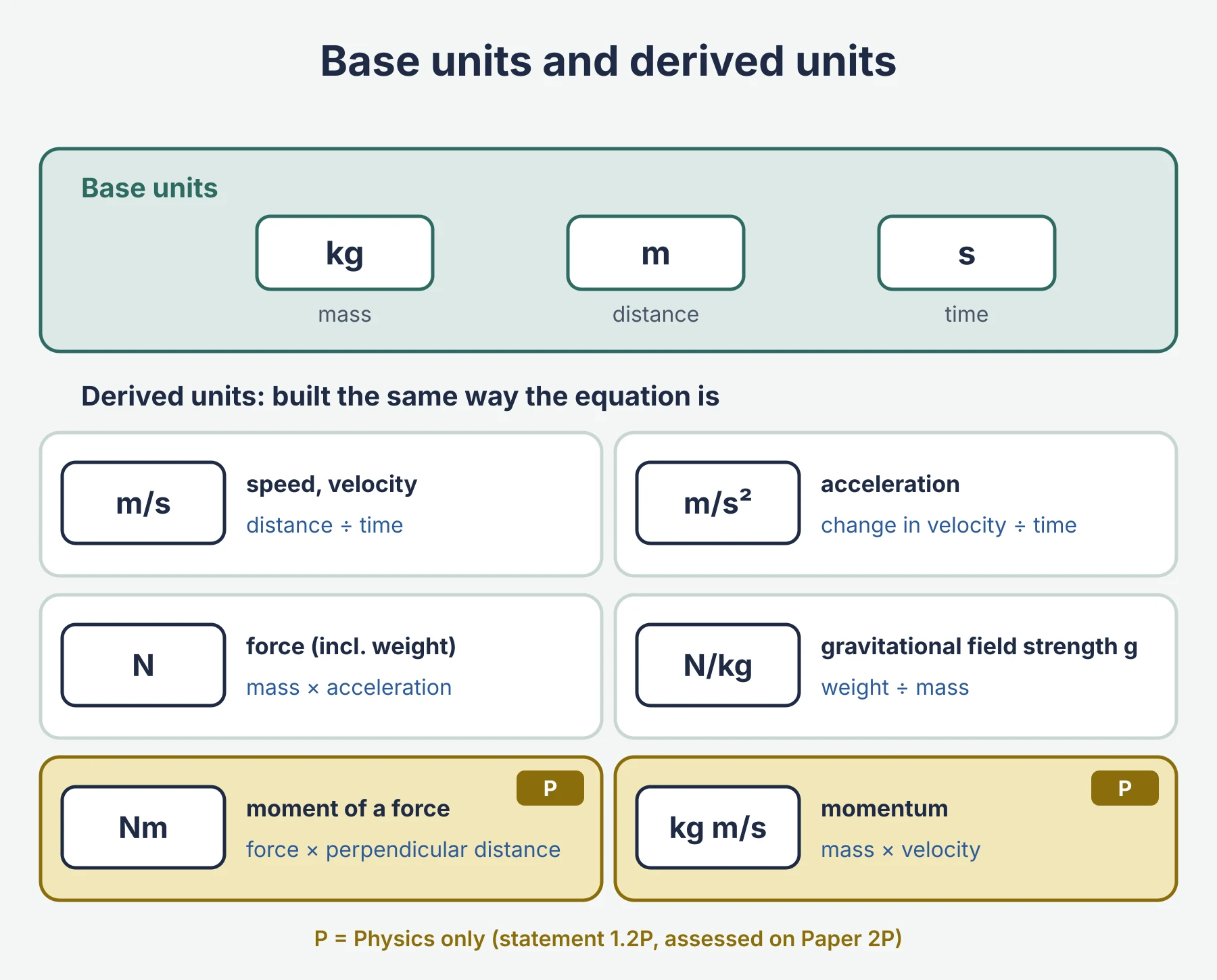
How the derived units are built
Speed. average speed = distance moved ÷ time taken, so the unit is metres ÷ seconds = m/s.
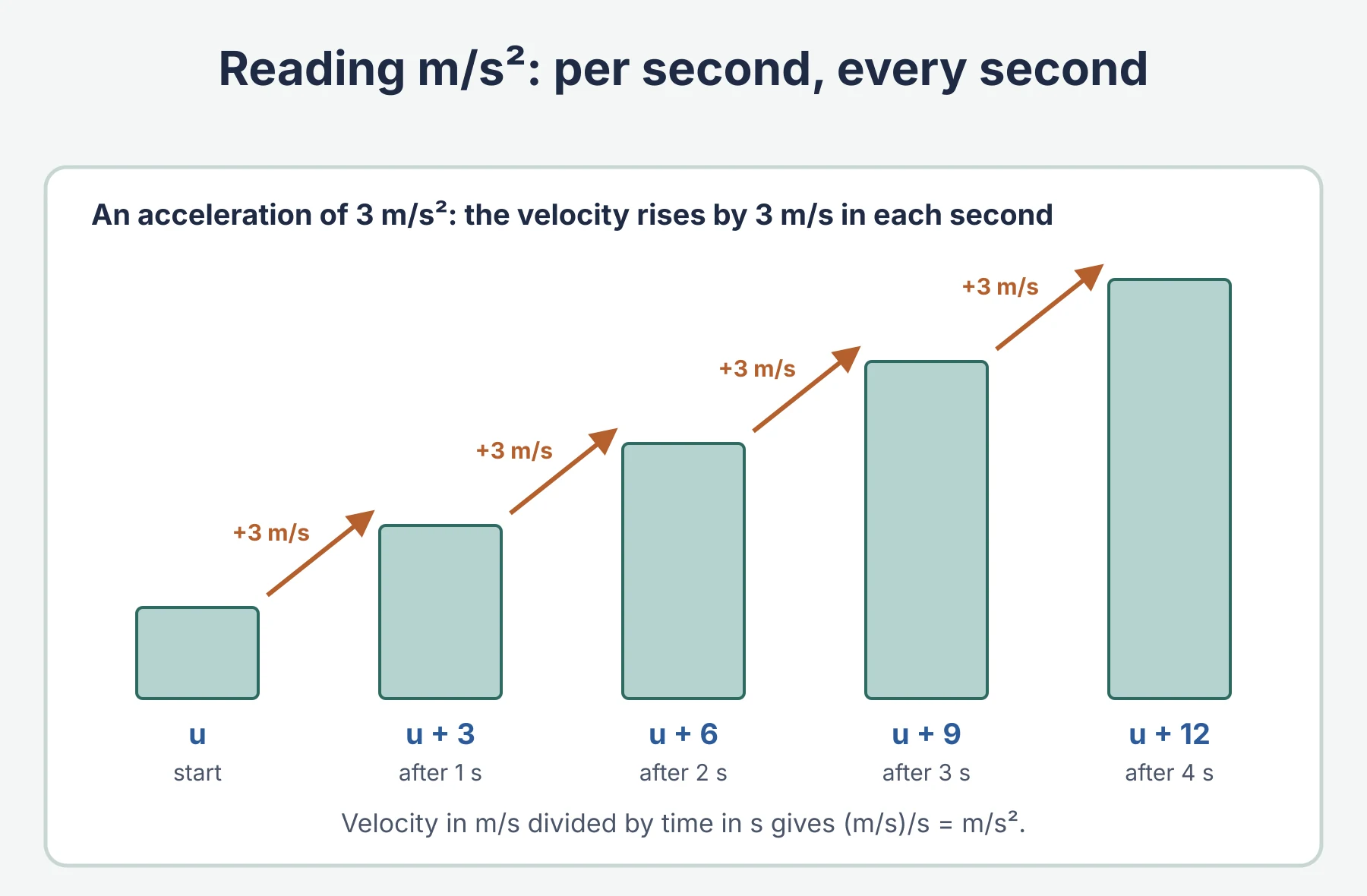
Acceleration. acceleration = change in velocity ÷ time taken. A change in velocity is measured in m/s; dividing by seconds gives (m/s)/s, which is written m/s². Read it as “metres per second, every second”: an acceleration of 3 m/s² means the velocity rises by 3 m/s in each second.
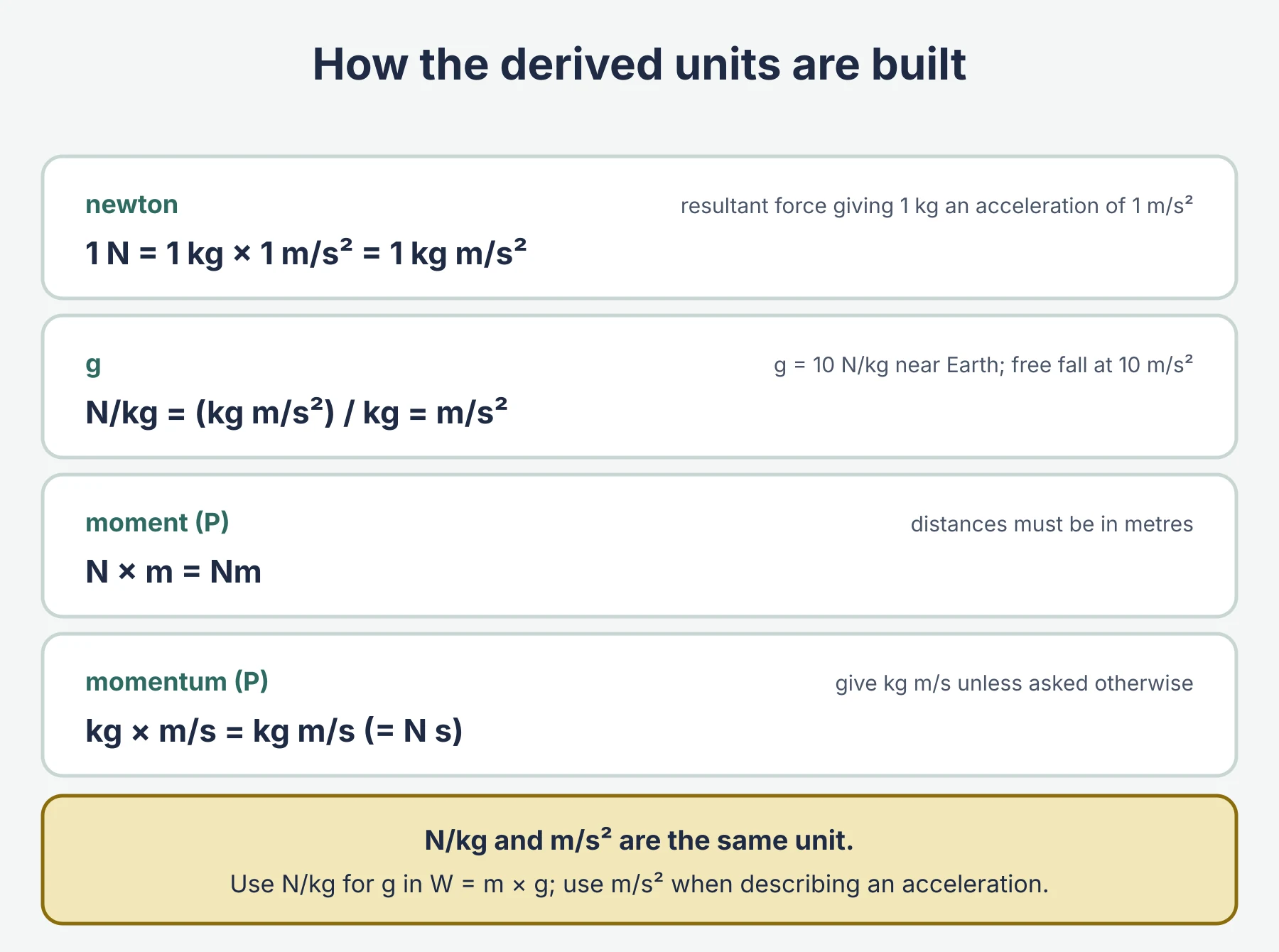
Force. force = mass × acceleration, so
1 N = 1 kg × 1 m/s² = 1 kg m/s²One newton is the resultant force that gives a 1 kg mass an acceleration of 1 m/s².
Gravitational field strength. weight = mass × g, so g = weight ÷ mass and its unit is N/kg. Because 1 N = 1 kg m/s², the unit N/kg is the same as m/s². That is why g = 10 N/kg near the Earth’s surface and an object falling freely, with no air resistance, accelerates at 10 m/s². Use N/kg when g appears in W = m × g, and m/s² when you are describing an acceleration.
Moment (P). moment = force × perpendicular distance from the pivot, so the unit is N × m = Nm. Distances must be in metres to give Nm.
Momentum (P). momentum = mass × velocity, so the unit is kg × m/s = kg m/s. Because force = change in momentum ÷ time taken, a change in momentum can also be written force × time, in newton seconds (N s). This is the same unit, but the specification lists kg m/s, so give that unless the question asks otherwise.
Converting data before you substitute
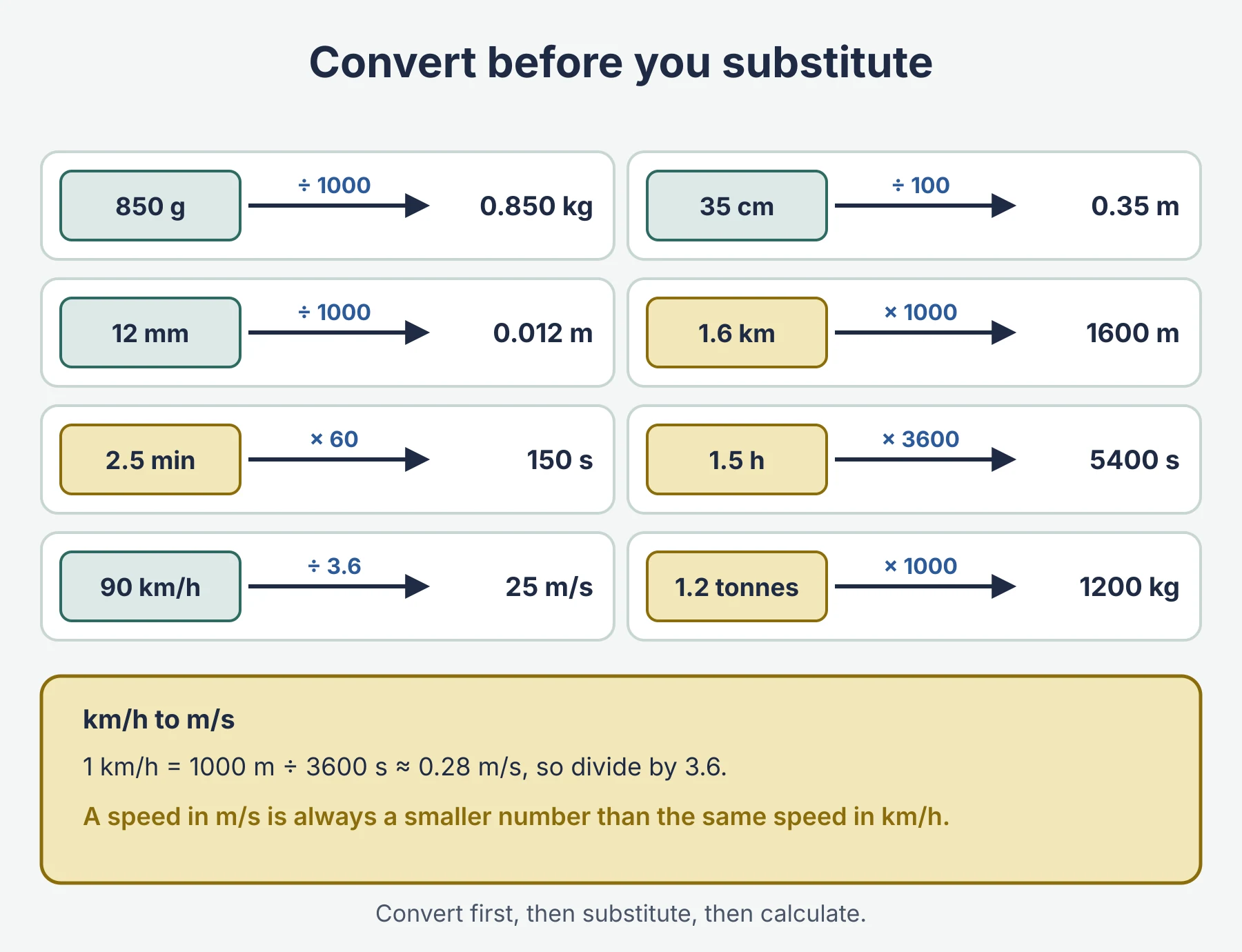
Questions often give data in convenient everyday units. Convert first, then substitute, then calculate.
| Given | Convert to | How |
|---|---|---|
| grams (g) | kg | ÷ 1000 (850 g = 0.850 kg) |
| centimetres (cm) | m | ÷ 100 (35 cm = 0.35 m) |
| millimetres (mm) | m | ÷ 1000 (12 mm = 0.012 m) |
| kilometres (km) | m | × 1000 (1.6 km = 1600 m) |
| minutes | s | × 60 (2.5 min = 150 s) |
| hours | s | × 3600 (1.5 h = 5400 s) |
| km/h | m/s | × 1000 ÷ 3600, or ÷ 3.6 (90 km/h = 25 m/s) |
| tonnes | kg | × 1000 (1.2 tonnes = 1200 kg) |
The km/h conversion trips up many candidates. One kilometre is 1000 m and one hour is 3600 s, so 1 km/h = 1000 ÷ 3600 m/s, which is about 0.28 m/s. A speed in m/s is always a smaller number than the same speed in km/h.
Using units to check an equation
The units on both sides of a correct equation must match. This lets you catch a wrong rearrangement before you lose the marks for it.
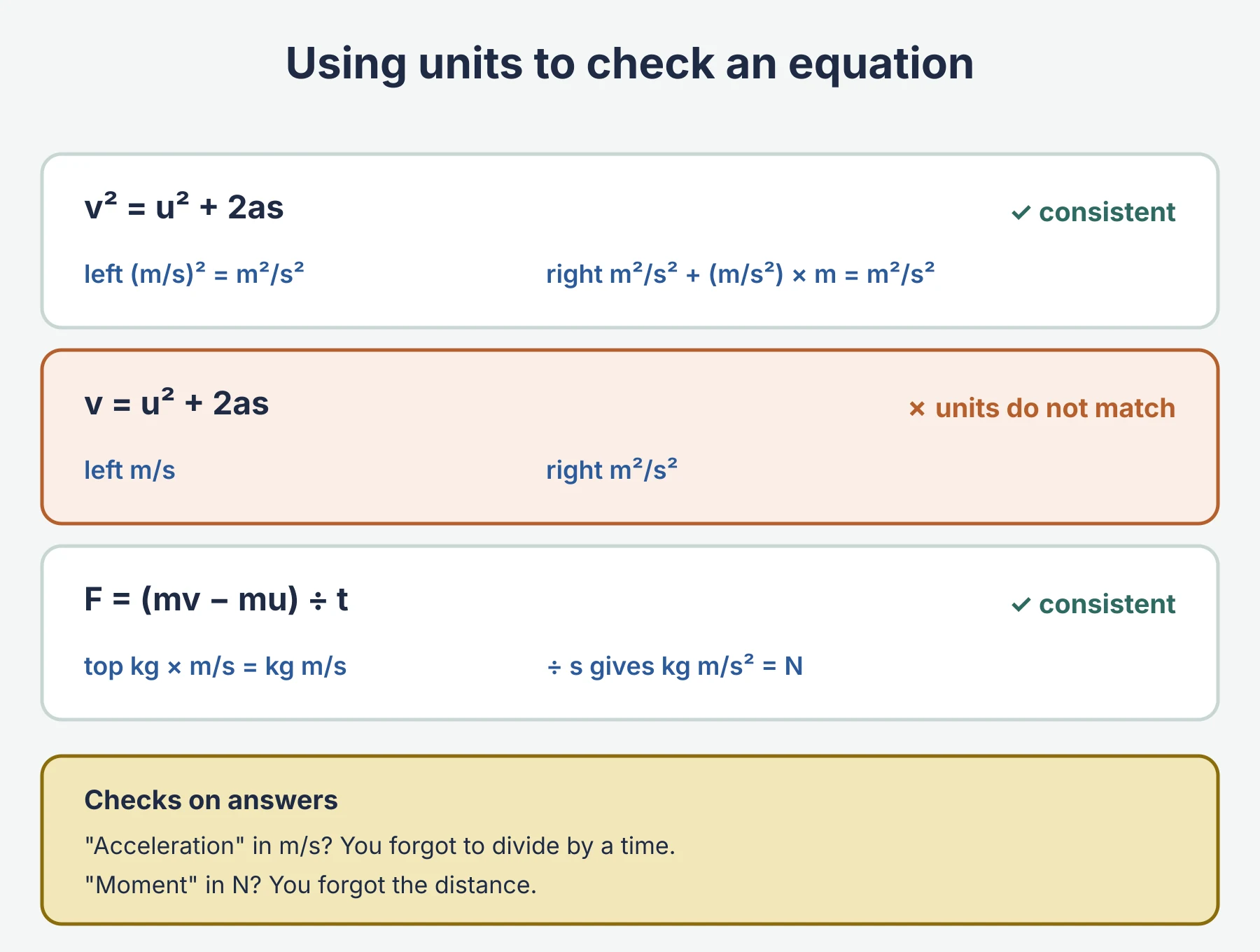
Check v² = u² + 2as:
left side:  (m/s)² = m²/s²
right side: (m/s)² + (m/s²) × m = m²/s² + m²/s²
Both sides are m²/s², so the equation is consistent. If you had written v = u² + 2as, the left side would be m/s and the right side m²/s², so something is wrong.
Check F = (mv − mu) ÷ t (P): the top is kg × m/s = kg m/s; dividing by s gives kg m/s², which is a newton. Consistent.
A unit check also works on answers. If your “acceleration” comes out in m/s, you have forgotten to divide by a time. If your “moment” is a number of newtons, you have forgotten the distance.
Worked example 1: a chain of calculations
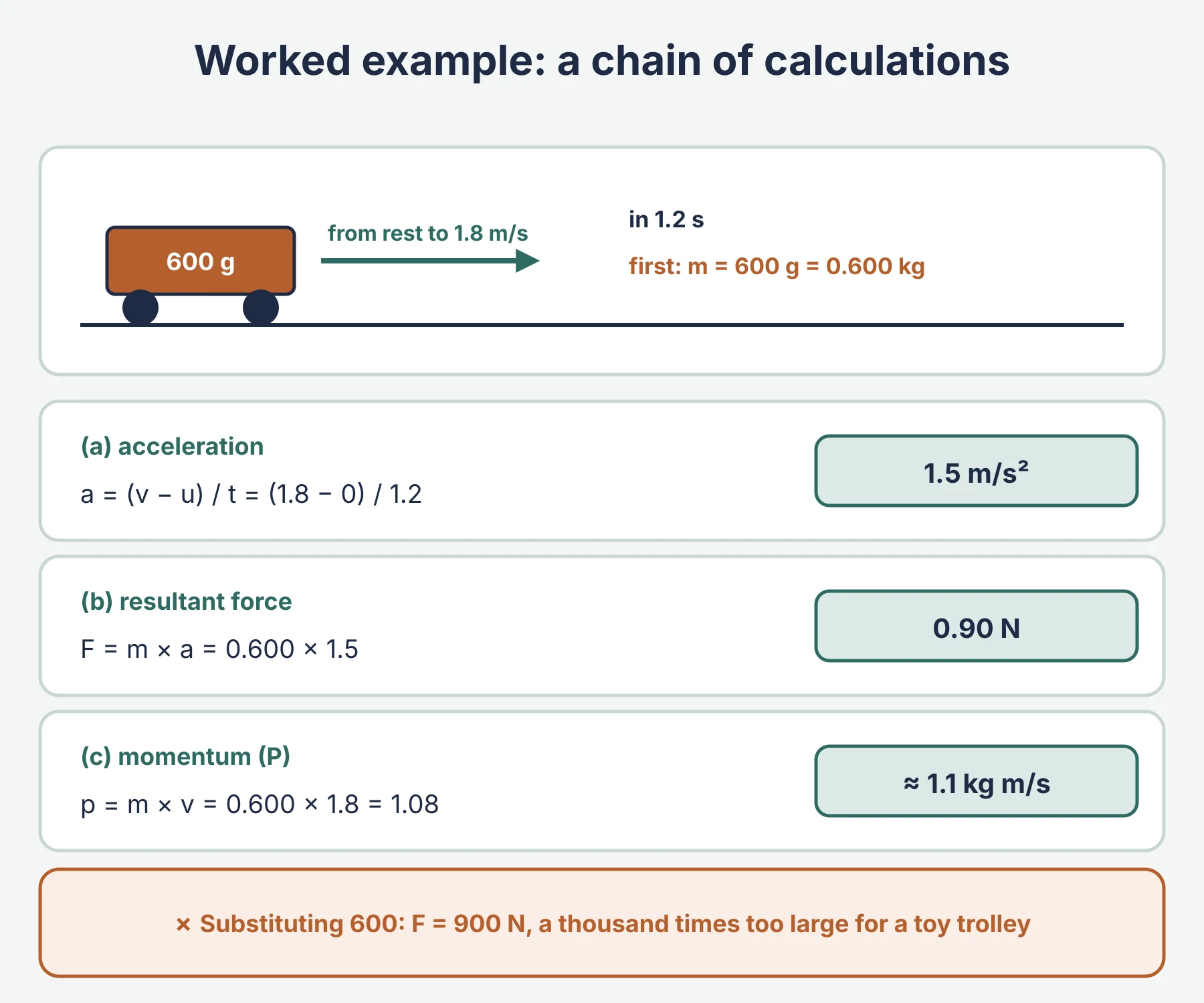
A trolley of mass 600 g starts from rest and reaches 1.8 m/s in 1.2 s. Calculate (a) its acceleration, (b) the resultant force on it and (c) its momentum at 1.8 m/s.
(a) a = (v − u) / t = (1.8 − 0) / 1.2 = 1.5 m/s²
(b) m = 600 g = 0.600 kg
    F = m × a = 0.600 × 1.5 = 0.90 N
(c) p = m × v = 0.600 × 1.8 = 1.08 kg m/s ≈ 1.1 kg m/s
Commentary. The mass is converted before it is used. If 600 had been substituted, the force would be 900 N, a thousand times too large, which a moment’s thought shows is absurd for a toy trolley. Each answer has its own unit, and the final answer is given to two significant figures to match the data.
Worked example 2: moments with centimetres
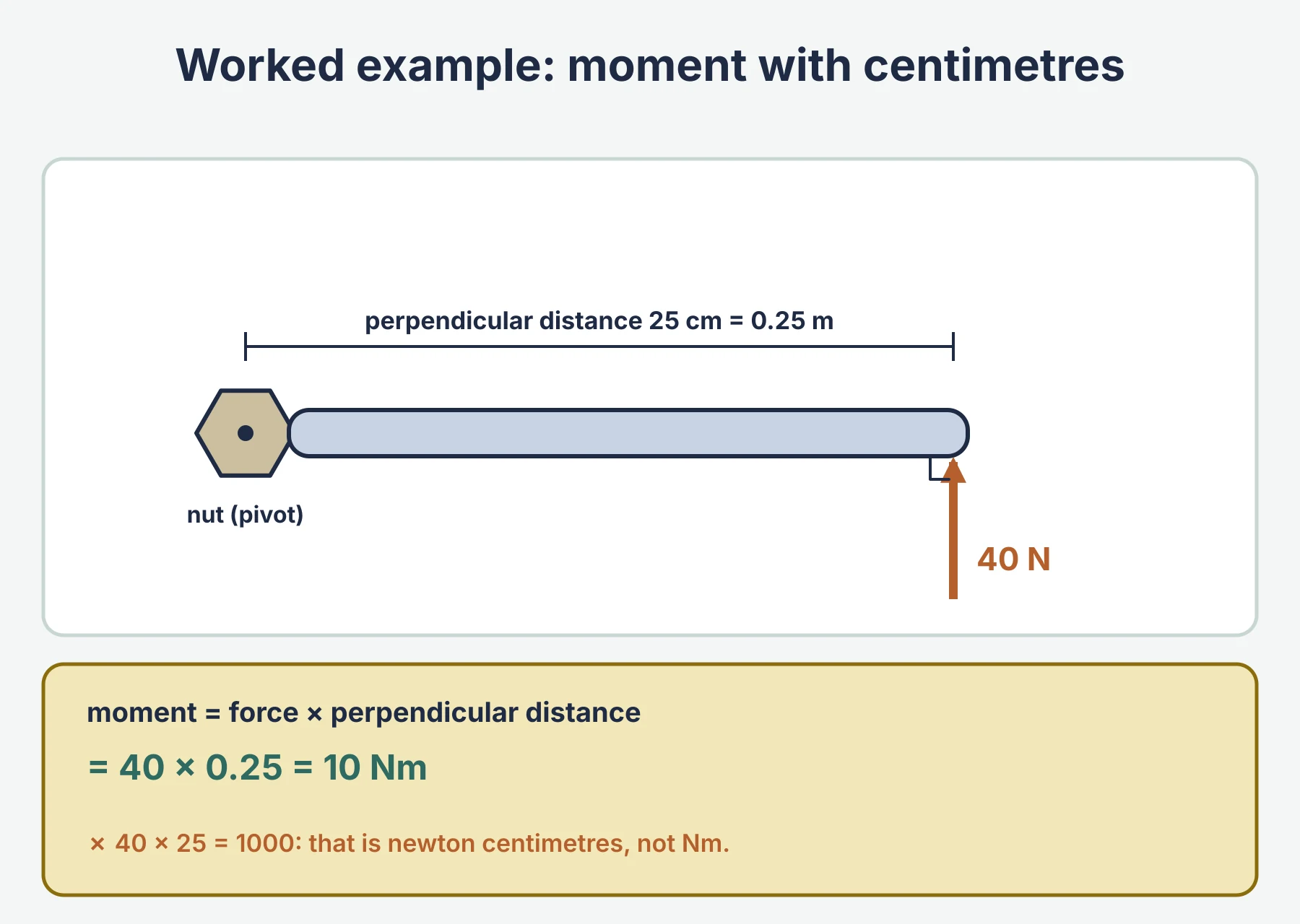
A spanner is 25 cm long. A force of 40 N is applied at right angles to the end. Calculate the moment about the nut.
perpendicular distance = 25 cm = 0.25 m
moment = force × perpendicular distance = 40 × 0.25 = 10 Nm
Using 25 directly gives 1000, which is the moment in newton centimetres, not in Nm. Convert the distance first.
Mass and weight: two different units
Mass is the amount of matter in an object, measured in kg, and it does not change from place to place. Weight is a force, measured in N, and depends on g. A 60 kg student has a weight of 60 × 10 = 600 N on Earth. Writing “weight = 60 kg” is a unit error that costs marks, even though everyday language does it all the time.
Significant figures and standard form
The specification’s mathematical skills include using an appropriate number of significant figures and numbers in standard form. Give answers to the same number of significant figures as the least precise data, usually 2 or 3. Keep full calculator values during a multi-step calculation and round only at the end. Very large or small values should be in standard form with the unit: a ship’s momentum might be 4.5 × 10⁷ kg m/s.
Common mistakes
- Writing weight in kg, or mass in N.
- Substituting grams, centimetres, minutes or km/h without converting.
- Giving acceleration in m/s, or speed in m/s².
- Writing J for a moment. The joule is also N × m, but in this specification a moment is given in Nm and the joule is kept for energy.
- Giving momentum in N, or force in kg m/s, after a rushed F = Δp ÷ t calculation.
- Rounding in the middle of a calculation, so the final answer drifts.
Exam technique with command words
- State or Give the unit: one unit, with its symbol, such as “N/kg”. No working is needed.
- Calculate: show the equation, the substitution with converted data, and the answer with its unit. Where the answer line gives a unit, make sure your number is in that unit.
- Show that: the answer is printed, so the marks are for the working. Show every conversion and give your value to one more significant figure than the printed value.
- Determine from a graph: read values off the axes with their units and convert before using them, for example a time axis in minutes.
- Condensed recall and a self-test: Units for forces and motion revision notes
- Original questions with full answers: Units for forces and motion practice questions
- The physics that uses these units: Movement and position study guide and Forces, movement, shape and momentum study guide
Written against the Pearson Edexcel International GCSE in Physics (4PH1) specification, Issue 4. Always check the current specification for your examination year.
Related resources
-
Practice questions
Pearson Edexcel International GCSE Physics (4PH1): Units for forces and motion – Practice Questions
Original practice questions with full answers on using kg, m/s, m/s², N, N/kg, Nm and kg m/s for Edexcel International GCSE Physics 4PH1 Topic 1.
Physics · Pearson Edexcel · IGCSE
Try questions -
Revision notes
Pearson Edexcel International GCSE Physics (4PH1): Units for forces and motion – Revision Notes
Recall notes on the Topic 1 units for Edexcel International GCSE Physics 4PH1: kg, m, s, m/s, m/s², N, N/kg, Nm and kg m/s, with conversions and a self-test.
Physics · Pearson Edexcel · IGCSE
Revise topic -
Study guides
Edexcel IGCSE Physics: Forces and Motion
Motion graphs, v² = u² + 2as, forces, stopping distance, Hooke's law, momentum and moments: Topic 1 of Pearson Edexcel International GCSE Physics (4PH1).
Physics · Pearson Edexcel · IGCSE
Read guide
Related articles
Get free revision emails (optional)
Occasional emails with practice questions, worked explanations and links to free resources for the qualification and subjects you choose. No spam, and you can unsubscribe from any email. The free tools on this site never need an email.