
Revision Notes
Pearson Edexcel International GCSE Physics (4PH1): Units for Magnetism and Electromagnetism – Revision Notes
Recall notes for 4PH1 sub-topic 6a: amperes, volts and watts in Topic 6, W = V × A, unitless turns ratios, mA, kV and MW conversions, traps and a self-test.
- Subject
- Physics
- Level
- IGCSE
- Topic
- Magnetism and electromagnetism
- Author
- Marlbridge Academic Team
- Updated
- Reviewed by
- Hassan (what this means)
Aligned to Pearson Edexcel IGCSE Physics (4PH1), Issue 4. Official specification .
Syllabus page (what it covers and how it is assessed): Pearson Edexcel IGCSE Physics.
Syllabus points this page covers
4PH1
- 6a Units
Found an error? Report a correction.
Need help with this topic? Request a free trial class for IGCSE Physics (4PH1).
These notes condense sub-topic 6(a) Units of Pearson Edexcel International GCSE Physics 4PH1, Issue 4: statement 6.1, “use the following units: ampere (A), volt (V) and watt (W)”. Full explanations and four worked examples are in the Units for Topic 6 study guide; exam-style questions are in the Units for Topic 6 practice questions.
The three units
| Unit | Symbol | Quantity | Built from |
|---|---|---|---|
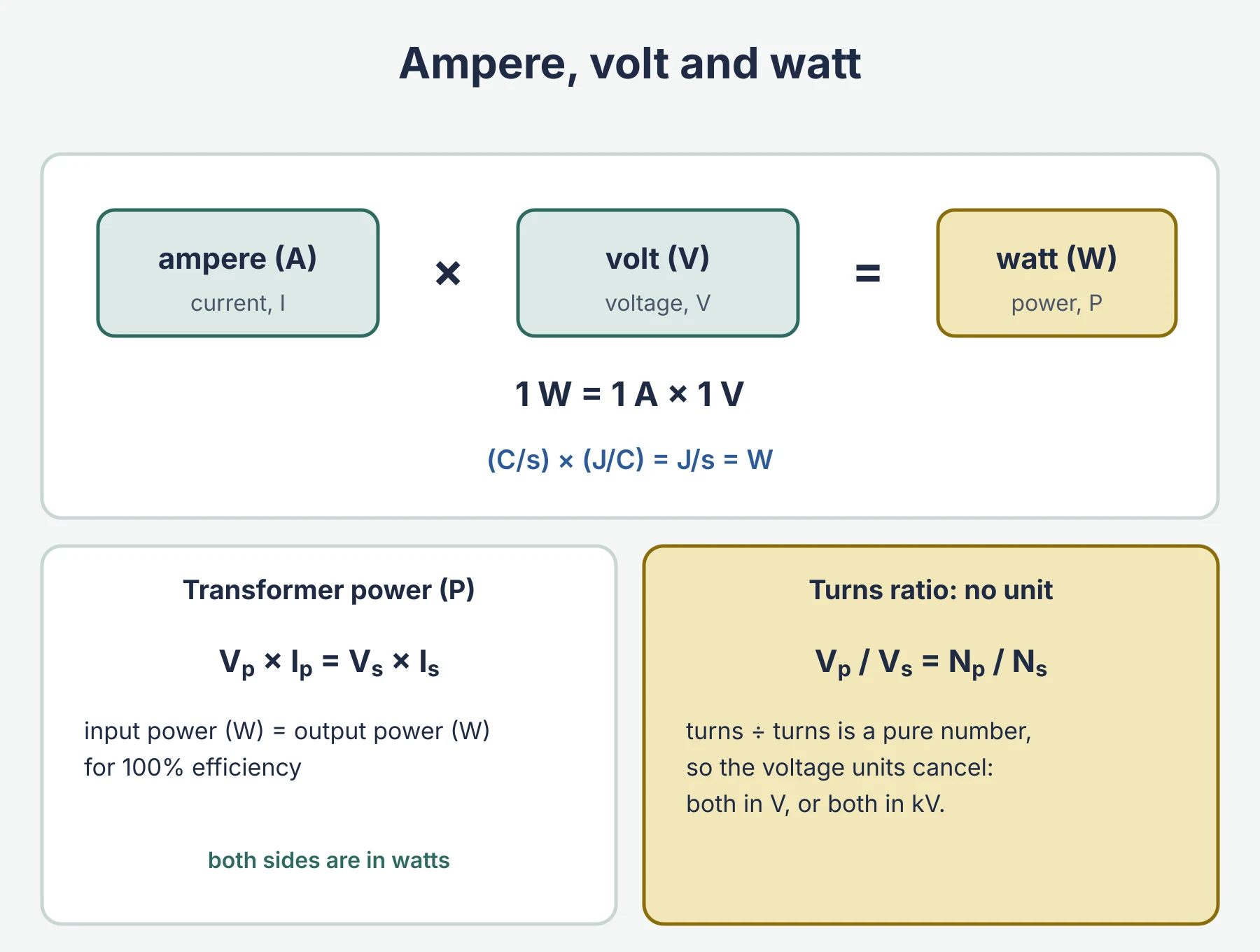
| ampere | A | current | 1 A = 1 C/s (one coulomb per second) |
| volt | V | voltage (including induced voltage) | 1 V = 1 J/C (one joule per coulomb) |
| watt | W | power | 1 W = 1 J/s = 1 V × 1 A |
Equations that use them in Topic 6
P = I × V                                   (power in W from current in A and voltage in V)
V_p / V_s = N_p / N_s                       (6.19P; turns ratio has no unit)
V_p × I_p = V_s × I_s                       (6.20P; input power = output power, 100% efficiency)
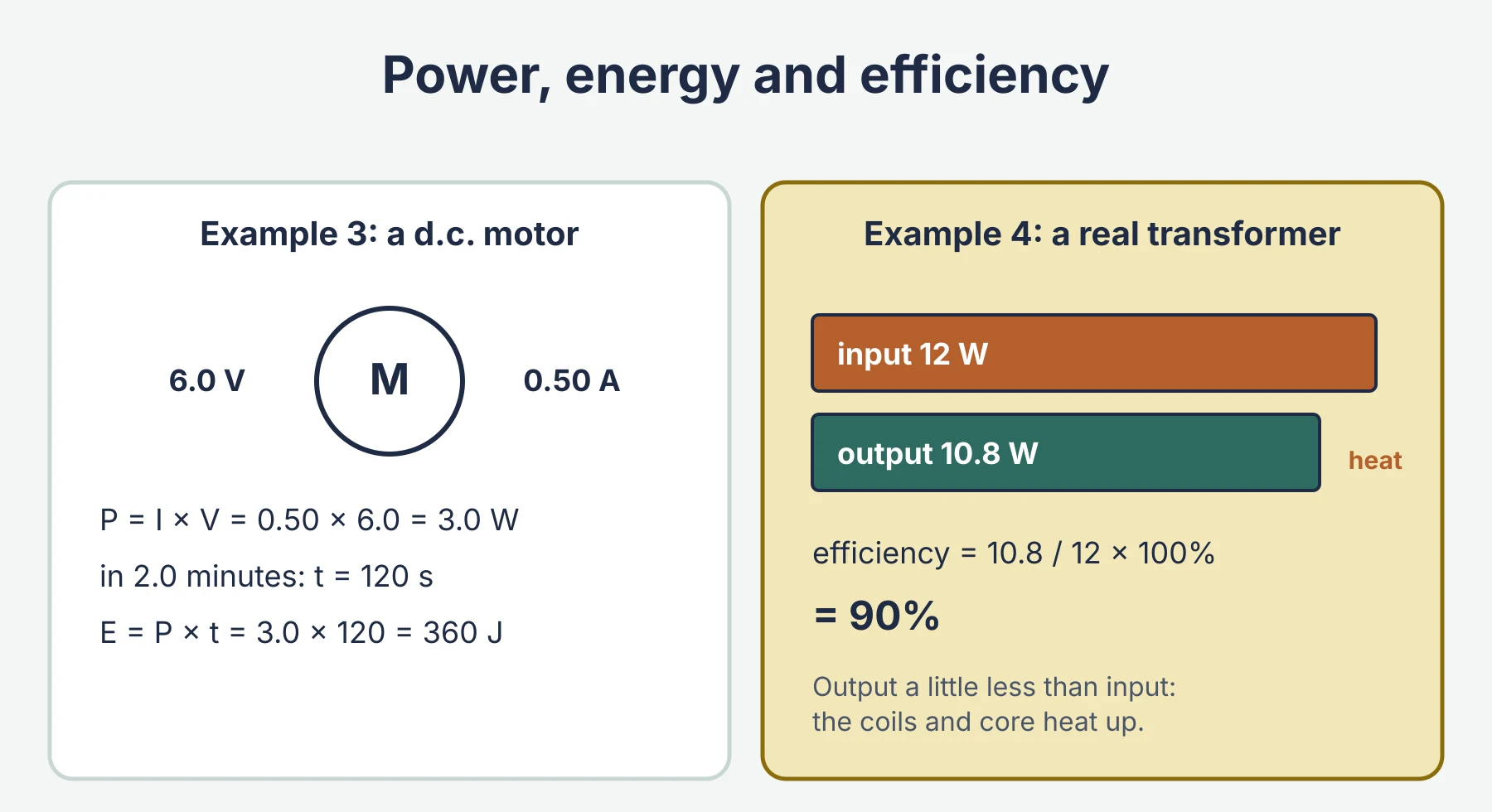
efficiency = useful power output / total power output × 100%    (from Topic 4, for real transformers)
Both transformer relationships are Physics-only, assessed on Paper 2. The turns-ratio equation is in the specification’s list of relationships you must recall.
Where the units appear
- A: current in a wire, coil or solenoid producing a field; current in an electromagnet; the current that affects the size of the force on a wire in a field (motor effect); primary and secondary currents.
- V: induced voltage in a moving wire or a coil with a changing field; generator output; primary and secondary voltages.
- W: transformer input and output power; power of motors and generators; power station output.
Conversions
| Given | In base unit |
|---|---|
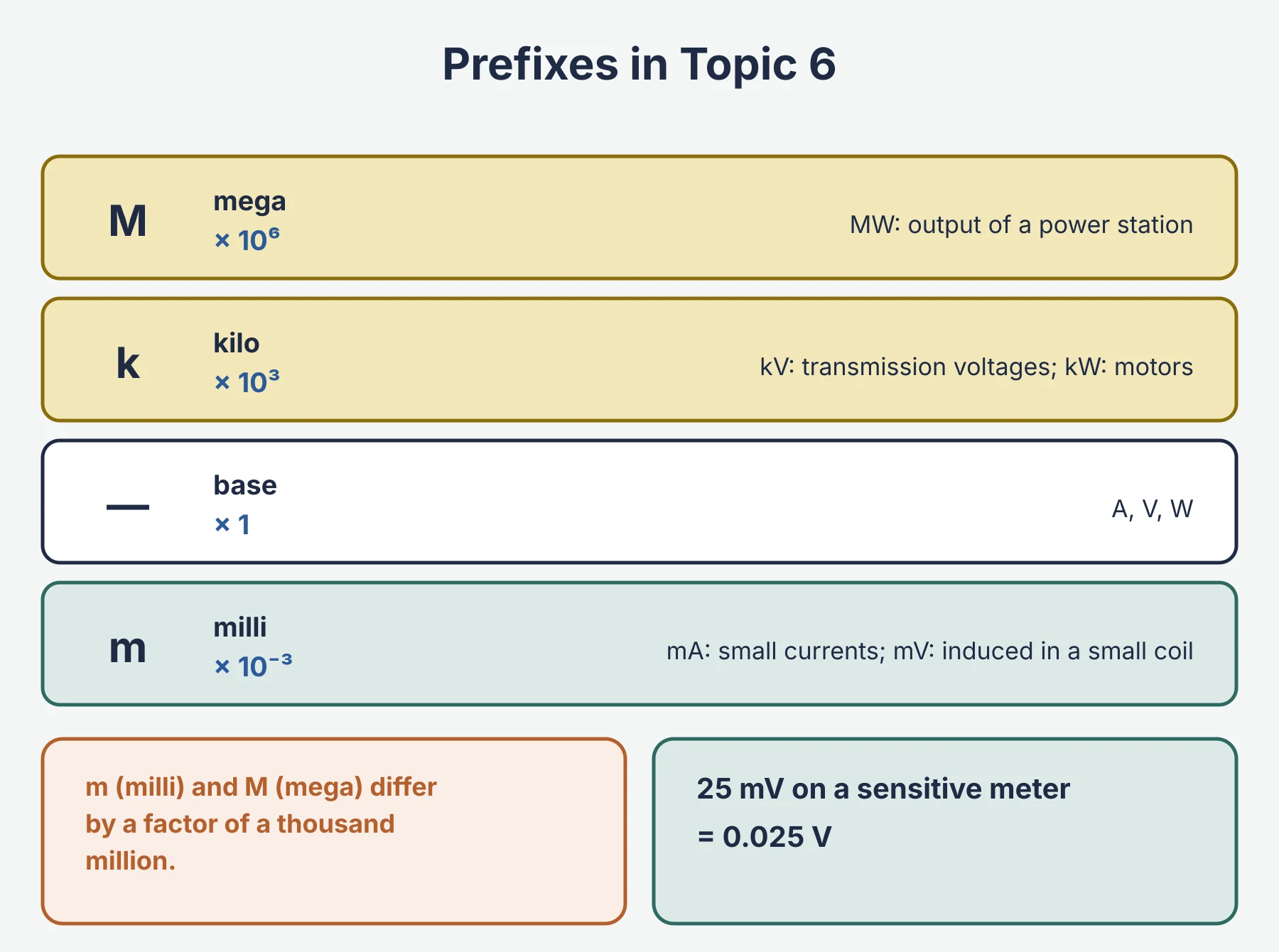
| 1 mA | 0.001 A (10⁻³ A) |
| 1 mV | 0.001 V |
| 1 kV | 1000 V (10³ V) |
| 1 kW | 1000 W |
| 1 MW | 1 000 000 W (10⁶ W) |
Transformer rules of thumb
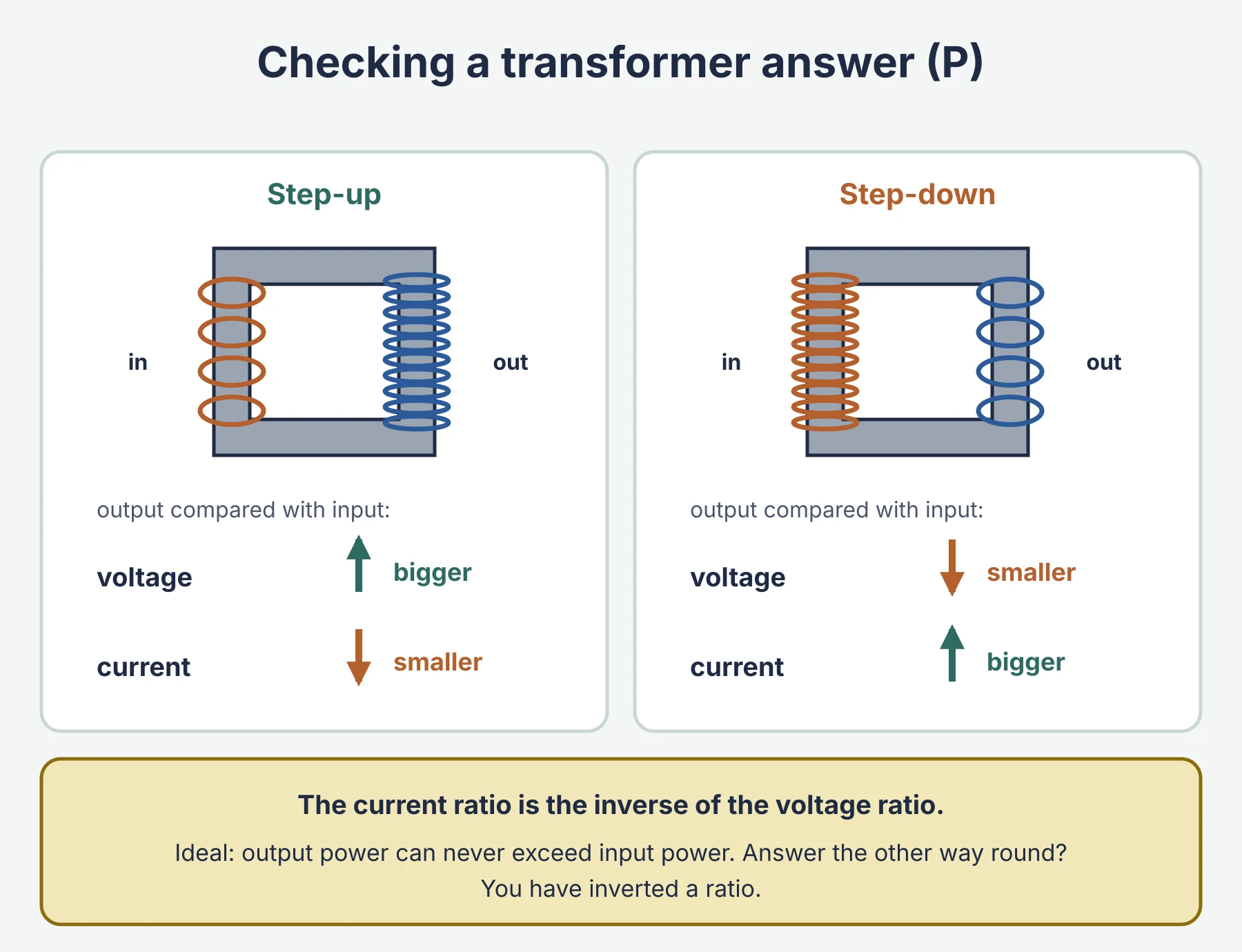
- Step-up: V_s > V_p, N_s > N_p, I_s < I_p.
- Step-down: V_s < V_p, N_s < N_p, I_s > I_p.
- For an ideal transformer, the current ratio is the inverse of the voltage ratio: I_s / I_p = V_p / V_s.
- Voltages in the turns-ratio equation can both be in V or both in kV, because the unit cancels.
- Transmission at high voltage → small current for the same power → less heating in cables.
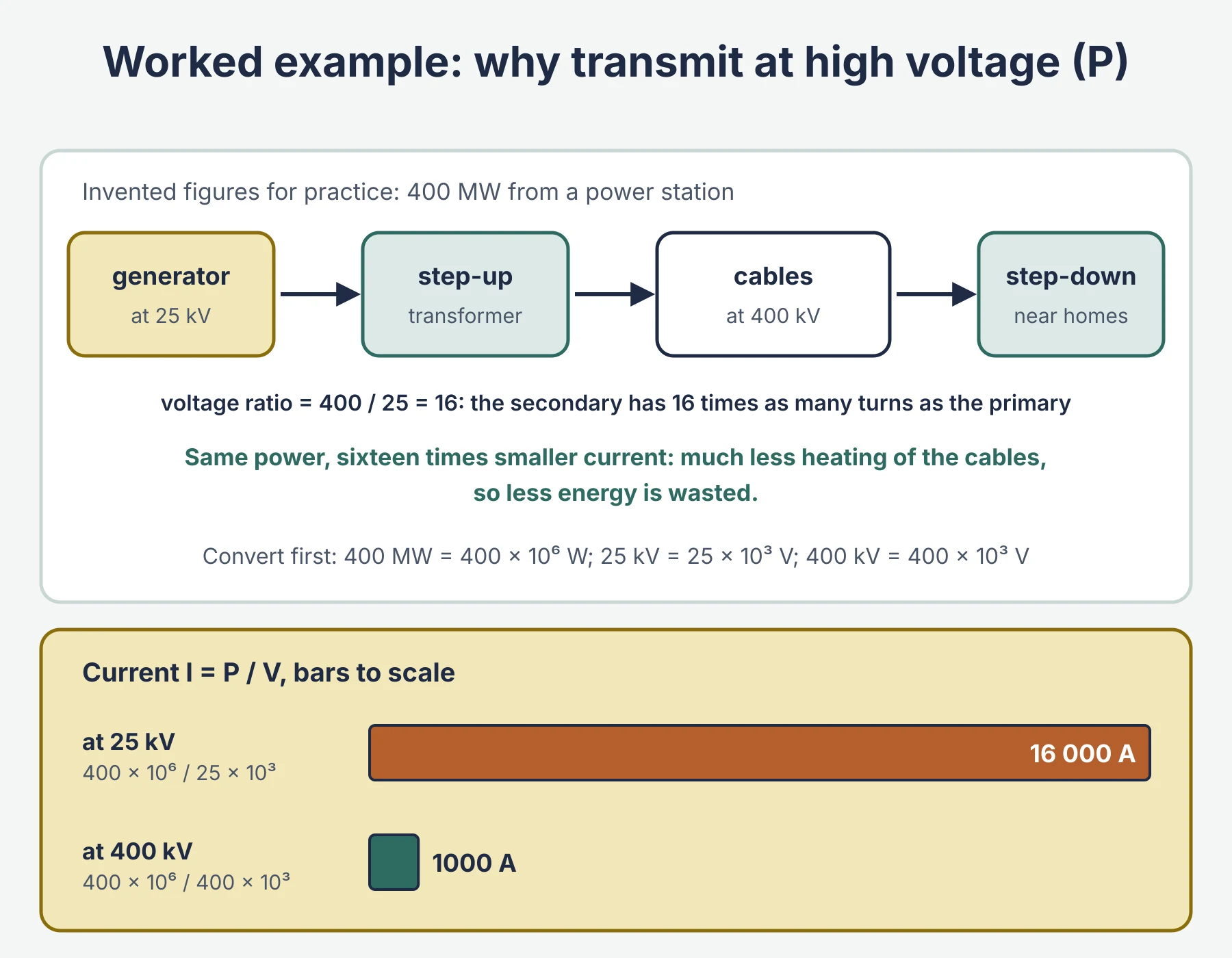
Two-step transformer pattern (P)
Many transformer questions give turns and one voltage, then ask for a current:
step 1:  V_s = V_p × N_s / N_p              (find the missing voltage)
step 2:  I_p = V_s × I_s / V_p              (input power = output power)
Quick example. A transformer has 1150 primary turns and 60 secondary turns. The primary is on 230 V mains and the
secondary supplies 1.5 A. Then V_s = 230 × 60 / 1150 = 12 V, output power = 12 × 1.5 = 18 W, and
I_p = 18 / 230 = 0.078 A = 78 mA. The small primary current and the much larger secondary current are what you should
expect from a step-down transformer.
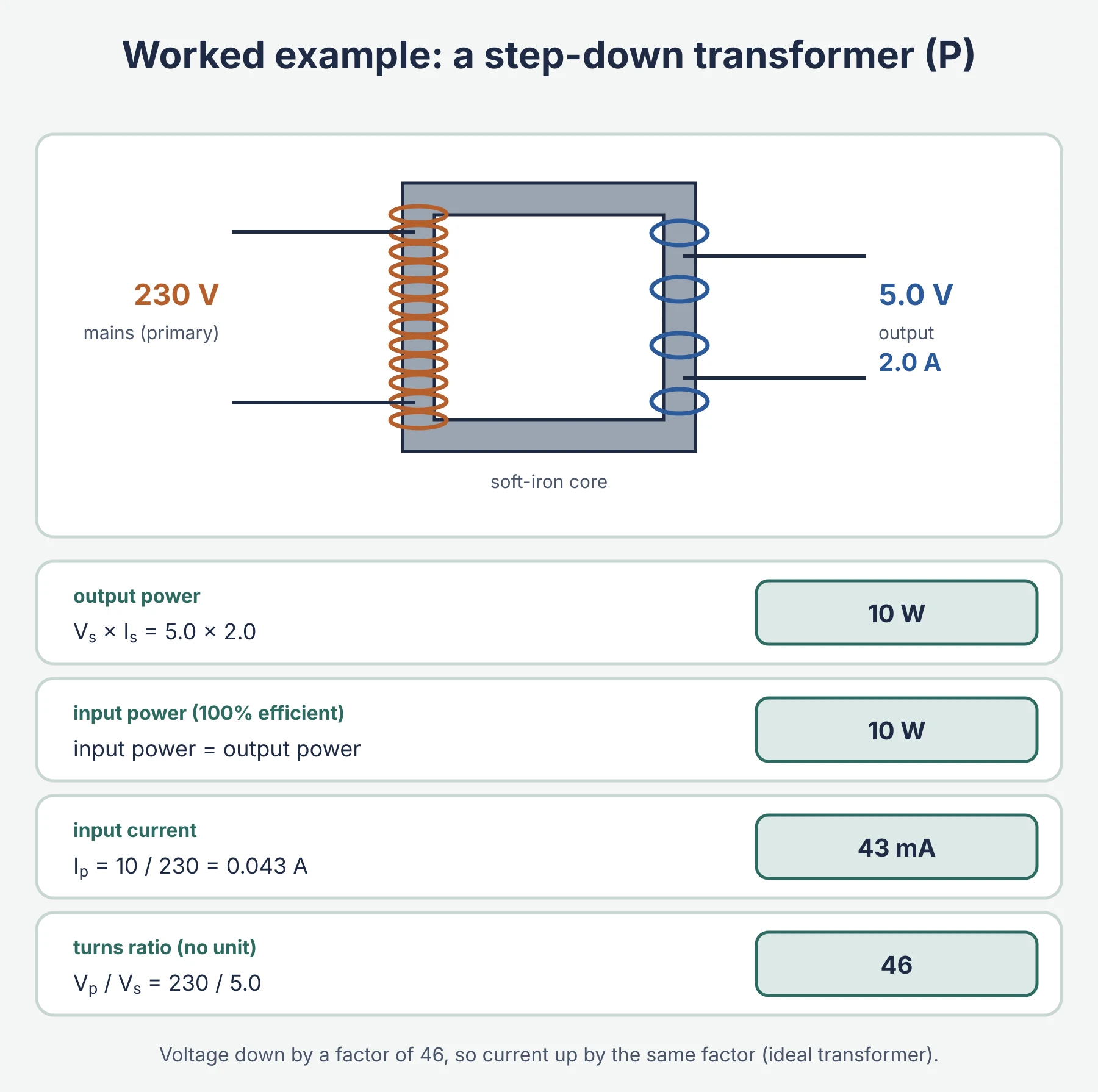
Key terms
| Term | Meaning |
|---|---|
| Ampere (A) | Unit of current; one coulomb of charge passing per second |
| Volt (V) | Unit of voltage; one joule transferred per coulomb |
| Watt (W) | Unit of power; one joule per second, equal to one volt × one ampere |
| Induced voltage | Voltage produced across a conductor moving through a field or a coil with a changing field |
| Primary / secondary | Input / output coil of a transformer |
| Turns ratio | Number of primary turns ÷ number of secondary turns; a pure number |
| Step-up transformer | Increases voltage (more secondary turns than primary) |
| Step-down transformer | Decreases voltage (fewer secondary turns than primary) |
Exam traps
- kV treated as V, or mA as A.
- Current ratio written the same way up as the voltage ratio.
- Turns ratio given a unit.
- Output power larger than input power for a transformer.
- Power quoted in A, or voltage in W.
- Unit symbols in lower case: write A, V, W.
- Mixing V and kV on the two sides of V_p / V_s = N_p / N_s.
Self-test
- Convert 250 mA to amperes.
- Convert 33 kV to volts.
- Write 1.2 MW in watts, in standard form.
- Show that one volt multiplied by one ampere is one watt.
- Explain why a turns ratio has no unit.
- A transformer changes 240 V to 12 V. Calculate its turns ratio (primary to secondary).
- An ideal transformer has an output of 12 V and 3.0 A, and an input voltage of 240 V. Calculate the output power and the input current.
- A motor runs on 12 V and takes 2.5 A. Calculate its power.
- A transformer has an input power of 50 W and an output power of 46 W. Calculate its efficiency.
- A generator delivers 500 MW at 20 kV. Calculate the current.
- In a step-up transformer, which coil carries the larger current?
- An induced voltage is 0.040 V. Write it in mV.
Answers: 1. 0.25 A. 2. 33 000 V. 3. 1.2 × 10⁶ W. 4. 1 V = 1 J/C and 1 A = 1 C/s, so 1 V × 1 A = 1 J/C × 1 C/s = 1 J/s = 1 W. 5. It is a number of turns divided by a number of turns (or a voltage divided by a voltage), so the units cancel. 6. 240 ÷ 12 = 20 (20 : 1). 7. Output power = 12 × 3.0 = 36 W; input current = 36 ÷ 240 = 0.15 A. 8. P = 2.5 × 12 = 30 W. 9. 46 ÷ 50 × 100% = 92%. 10. I = 500 × 10⁶ ÷ 20 × 10³ = 25 000 A. 11. The primary (input) coil. 12. 40 mV.
Related resources
-
Study guides
Magnetism and Electromagnetism
Magnetic field patterns, the motor effect, and generators and transformers, for Pearson Edexcel International GCSE Physics 4PH1.
Physics · Pearson Edexcel · IGCSE
Read guide -
Practice questions
Edexcel IGCSE Physics: Magnetism and Electromagnetism — Practice Questions
Original exam-style practice questions with full worked answers on the motor effect, induction and transformers for Edexcel International GCSE Physics 4PH1.
Physics · Pearson Edexcel · IGCSE
Try questions -
Revision notes
Edexcel IGCSE Physics: Magnetism and Electromagnetism — Revision Notes
Condensed recall notes on magnetic fields, the motor effect, electromagnetic induction, transformers and generators for Edexcel International GCSE Physics 4PH1.
Physics · Pearson Edexcel · IGCSE
Revise topic
Related articles
Get free revision emails (optional)
Occasional emails with practice questions, worked explanations and links to free resources for the qualification and subjects you choose. No spam, and you can unsubscribe from any email. The free tools on this site never need an email.