
Study Guides
Pearson Edexcel International GCSE Physics (4PH1): Units for Magnetism and Electromagnetism
The units of Topic 6 in Edexcel IGCSE Physics 4PH1: amperes, volts and watts in electromagnets, induction and transformers, with worked examples.
- Subject
- Physics
- Level
- IGCSE
- Topic
- Magnetism and electromagnetism
- Author
- Marlbridge Academic Team
- Updated
- Reviewed by
- Hassan (what this means)
Aligned to Pearson Edexcel IGCSE Physics (4PH1), Issue 4. Official specification .
Syllabus page (what it covers and how it is assessed): Pearson Edexcel IGCSE Physics.
Syllabus points this page covers
4PH1
- 6a Units
Found an error? Report a correction.
Need help with this topic? Request a free trial class for IGCSE Physics (4PH1).
This guide covers sub-topic 6(a) Units of Topic 6, Magnetism and electromagnetism, in the Pearson Edexcel International GCSE in Physics (4PH1), Issue 4. Statement 6.1 asks you to “use the following units: ampere (A), volt (V) and watt (W)”. For the physics these units describe, see the Magnetism and Electromagnetism study guide.
Why only three units?
Topic 6 is mostly explained in words and diagrams: field patterns, the left-hand rule, the factors that affect an induced voltage. The calculations in the topic are concentrated in the transformer statements (6.19P and 6.20P, Physics-only, so assessed on Paper 2), and those use only current, voltage and power. The three units are the same ones you used in Topic 2; what is new is where they appear.
Where each unit appears in Topic 6
| Unit | Quantity | Topic 6 context |
|---|---|---|
| ampere (A) | current, I | the current in a wire, coil or solenoid that produces a magnetic field (6.8); the current in an electromagnet (6.9P); the current whose size affects the force on a wire in a field (6.14); primary and secondary currents in a transformer (6.20P) |
| volt (V) | voltage, V | the voltage induced when a conductor moves through a field or a field changes through a coil (6.15, 6.16); input (primary) and output (secondary) voltages of a transformer (6.17P to 6.20P) |
| watt (W) | power, P | input and output power of a transformer, V_p × I_p = V_s × I_s for 100% efficiency (6.20P); the power of motors and generators |
How the three units link
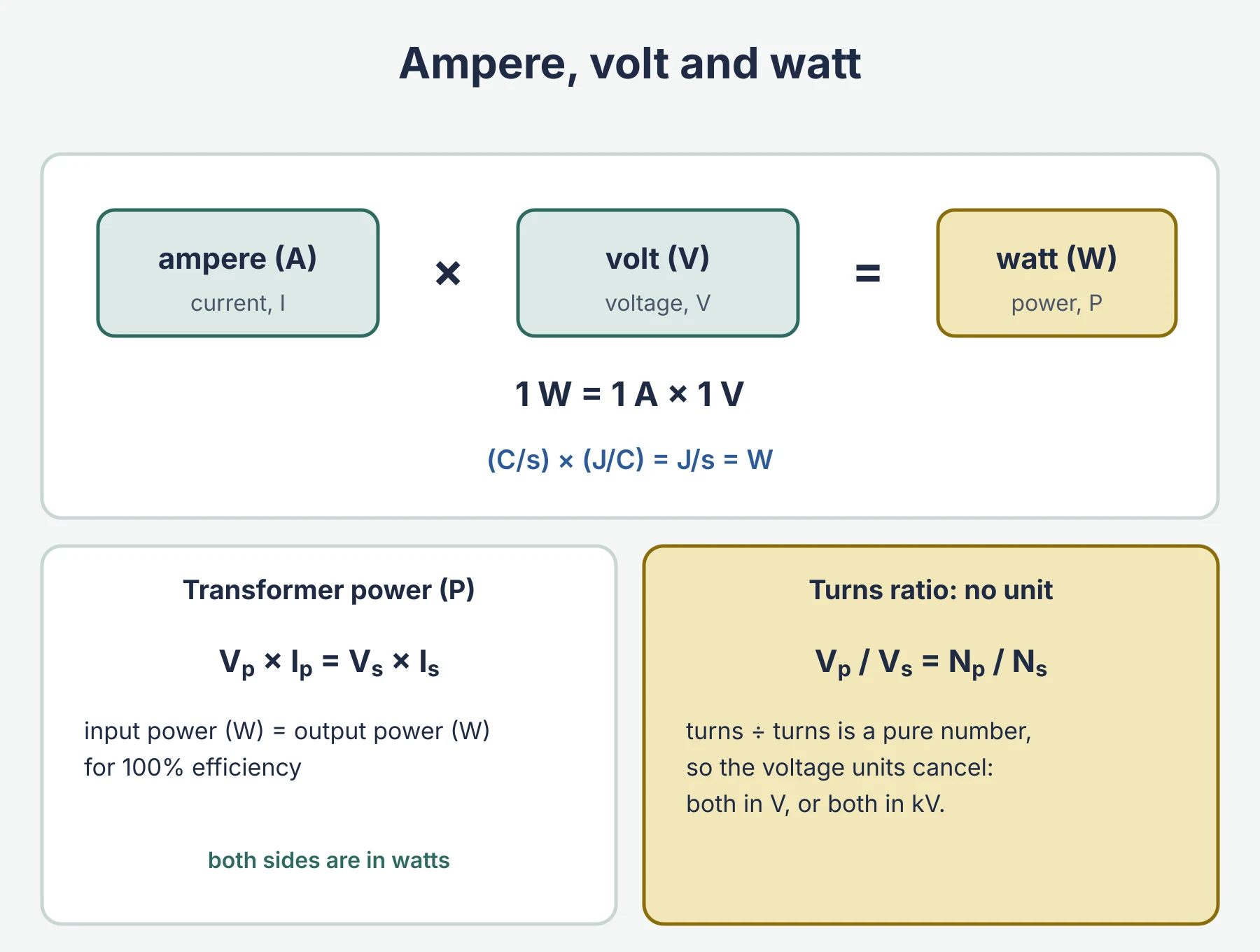
power = current × voltage so 1 W = 1 A × 1 VThis comes from Topic 2, and it is the reason the transformer power equation works: V_p × I_p is the input power in
watts and V_s × I_s is the output power in watts. You can also see it from the definitions: an ampere is a coulomb
per second and a volt is a joule per coulomb, so volts × amperes = joules per second = watts.
The turns ratio has no unit. In
input (primary) voltage / output (secondary) voltage = primary turns / secondary turnsthe right-hand side is a number of turns divided by a number of turns, so the left-hand side must also be a pure number. That is why both voltages can be in V, or both in kV, as long as they match: the unit cancels.
Prefixes you will meet
| Prefix | Symbol | Multiply by | Typical Topic 6 use |
|---|---|---|---|
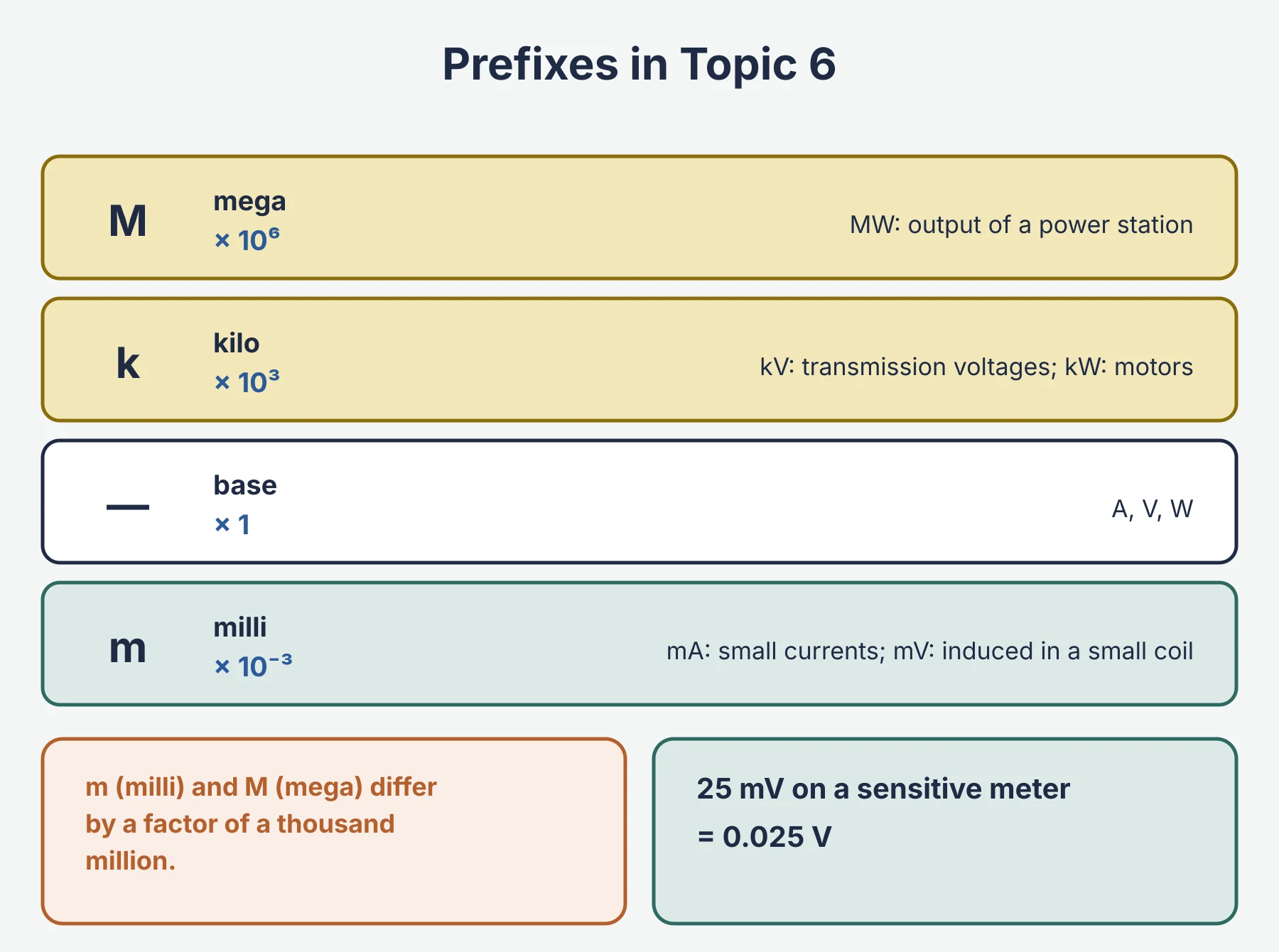
| milli | m | 10⁻³ | mA for small currents; mV for the voltage induced by a magnet moving in a small coil |
| kilo | k | 10³ | kV for transmission voltages; kW for motors |
| mega | M | 10⁶ | MW for the output of a power station |
Remember that m (milli) and M (mega) differ by a factor of a thousand million. A reading of 25 mV on a sensitive meter in an induction experiment is 0.025 V.
Worked examples
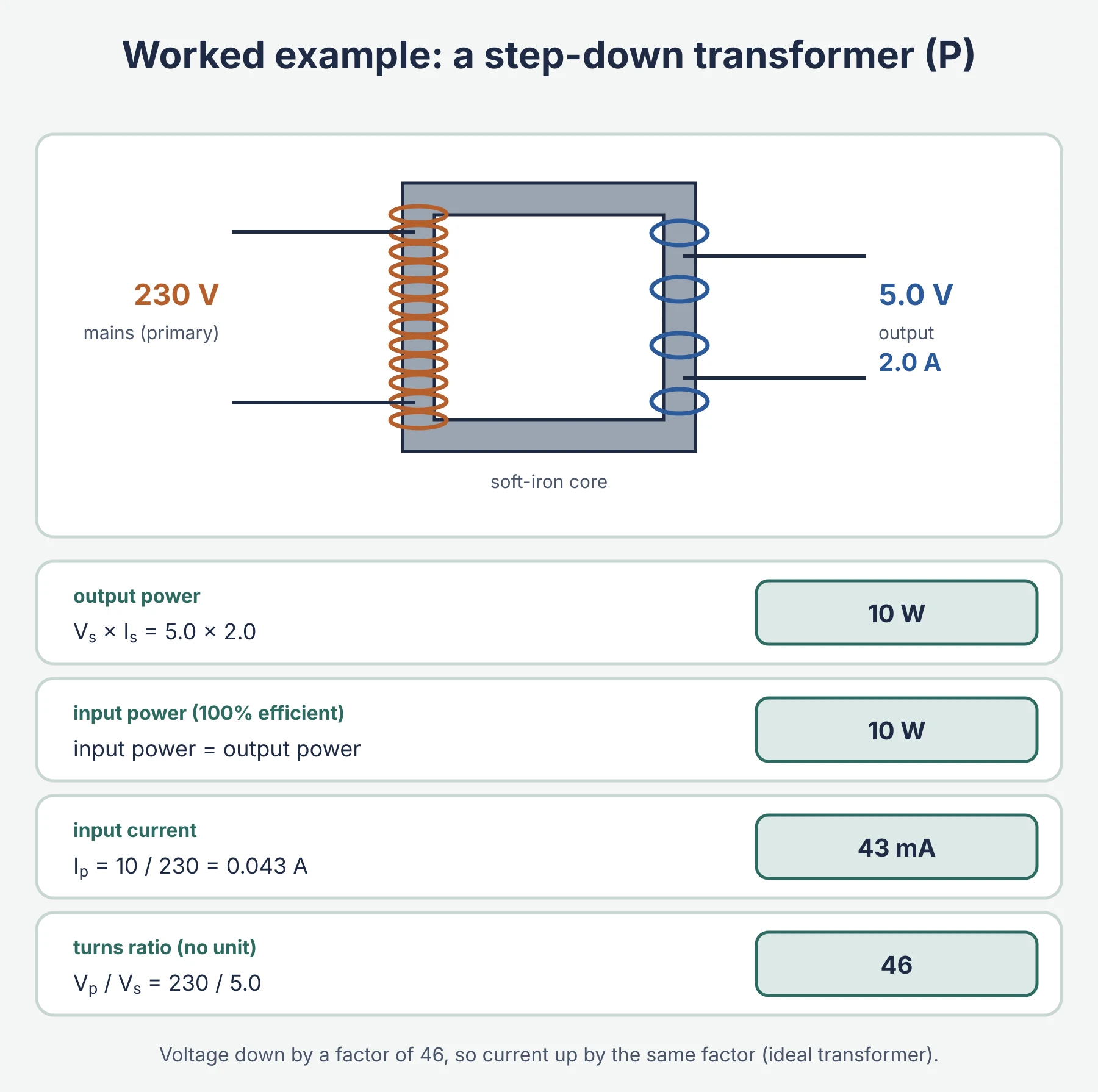
Worked example 1 (P): a step-down transformer. A phone charger contains a transformer that steps 230 V mains down to 5.0 V. The output current is 2.0 A. Assume the transformer is 100% efficient.
output power = V_s × I_s = 5.0 × 2.0 = 10 W
input power = output power = 10 W
input current I_p = 10 / 230 = 0.043 A = 43 mA
turns ratio = V_p / V_s = 230 / 5.0 = 46, so 46 primary turns for every secondary turn
The current on the low-voltage side is much larger than on the high-voltage side. For an ideal transformer, stepping the voltage down by a factor of 46 steps the current up by the same factor.
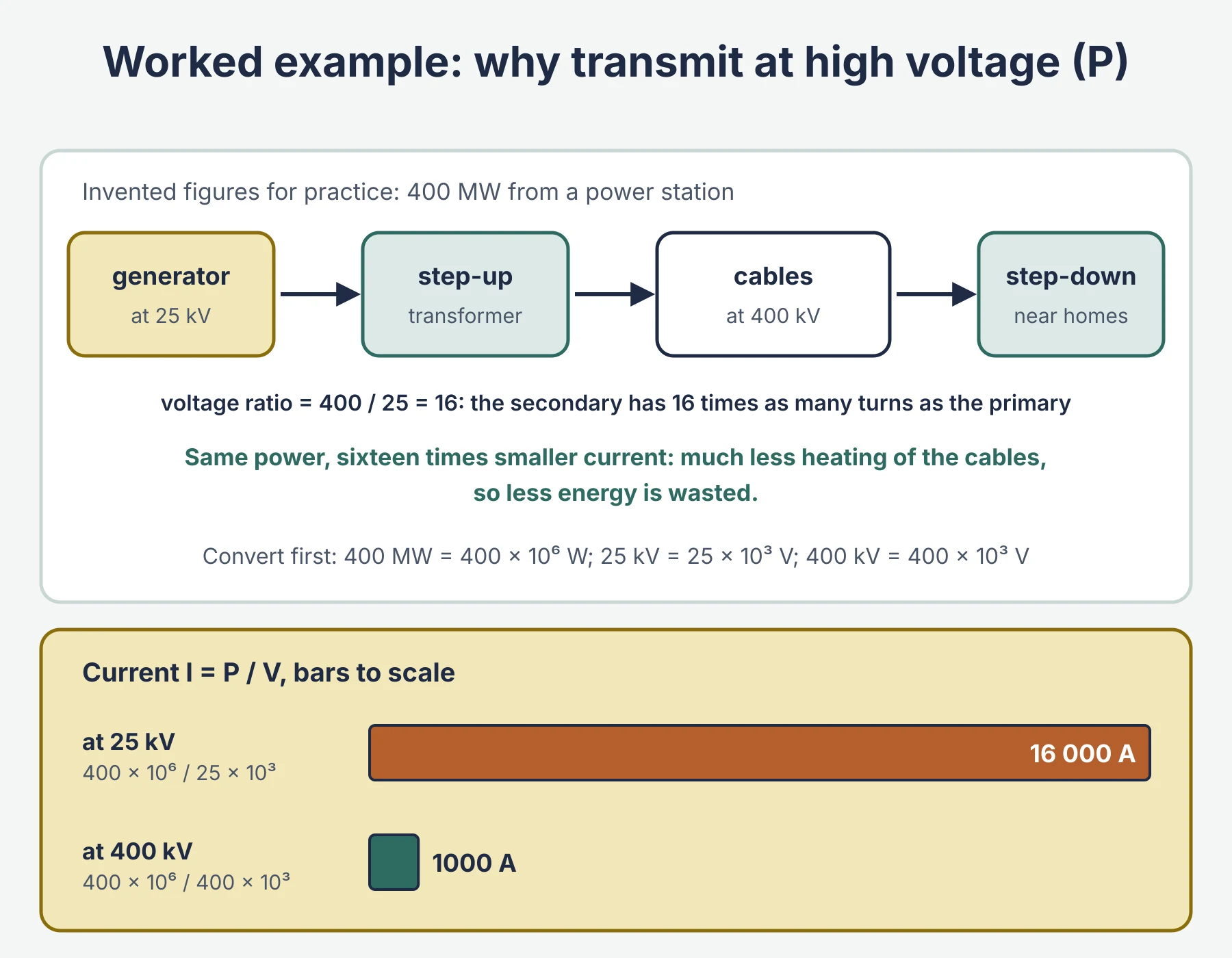
Worked example 2 (P): transmission. The figures here are invented for practice. A power station generator delivers 400 MW at 25 kV. A step-up transformer raises the voltage to 400 kV for transmission.
current at 25 kV:   I = P / V = 400 × 10⁶ / 25 × 10³ = 16 000 A
current at 400 kV:  I = P / V = 400 × 10⁶ / 400 × 10³ = 1000 A
voltage ratio = 400 / 25 = 16, so the secondary coil has 16 times as many turns as the primary
The same power is carried with a current sixteen times smaller. A smaller current heats the transmission cables much less, so less energy is wasted: this is the reason for step-up transformers in large-scale transmission (6.18P). Step-down transformers near homes then reduce the voltage again for safe use.
Notice the unit handling: 400 MW became 400 × 10⁶ W and 25 kV became 25 × 10³ V before dividing, so the current came out in amperes.
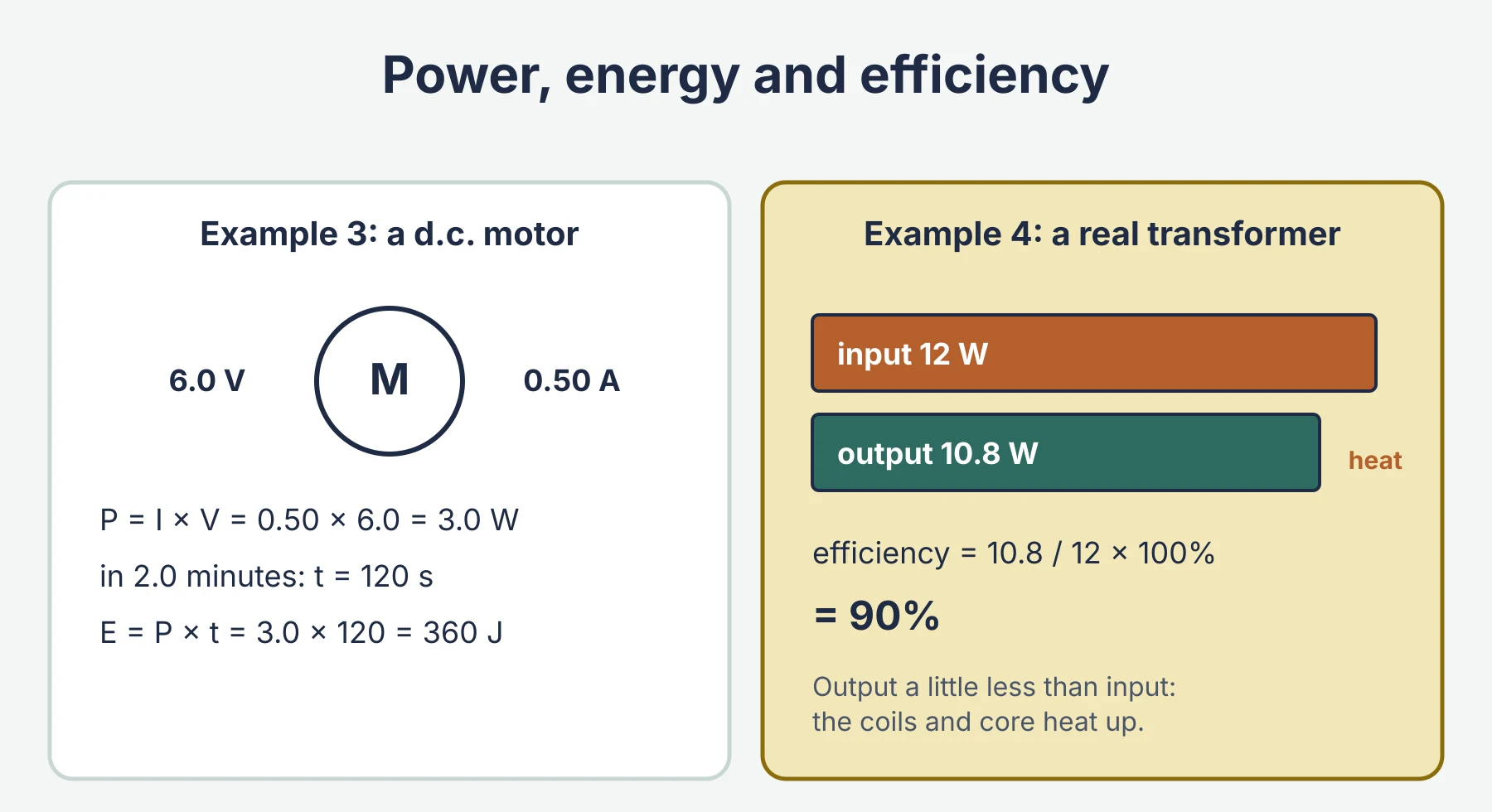
Worked example 3: a motor. A small d.c. motor runs on 6.0 V and draws 0.50 A.
P = I × V = 0.50 × 6.0 = 3.0 W
energy transferred in 2.0 minutes = P × t = 3.0 × 120 = 360 J
Worked example 4 (P): a real transformer. A transformer has an input power of 12 W and an output power of
10.8 W. Its efficiency is 10.8 / 12 × 100% = 90%. The equation V_p × I_p = V_s × I_s assumes 100% efficiency;
for a real transformer the output power is a little less than the input power, mainly because the coils and core
heat up.
Checking your answer
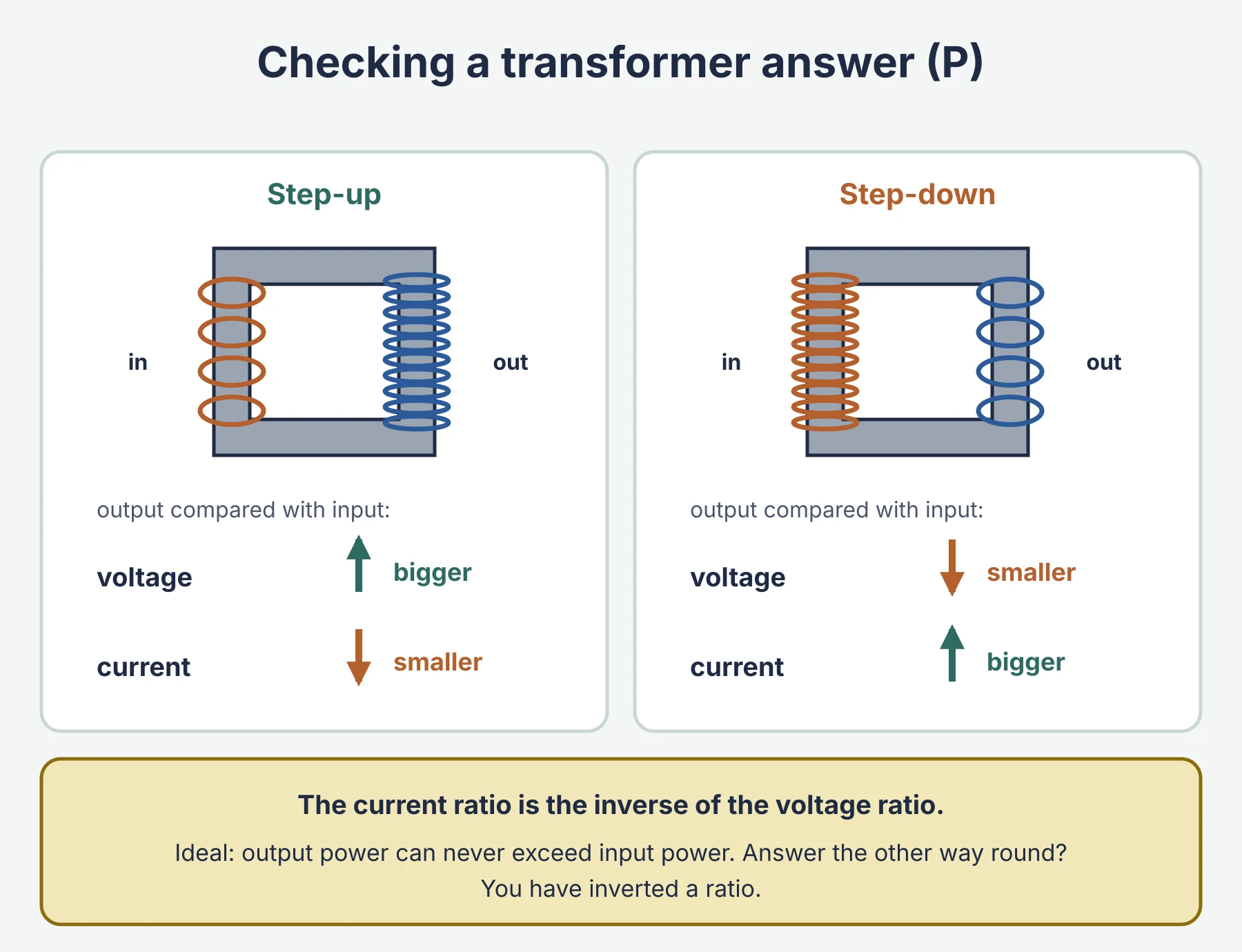
- In a step-up transformer the output voltage is bigger than the input and the output current is smaller. In a step-down transformer, the reverse. If your answer goes the other way, you have inverted a ratio.
- For an ideal transformer, the output power cannot exceed the input power. If your output power is bigger, recheck.
- Mains-voltage currents for everyday devices are usually a few amperes or less; transmission currents are hundreds or thousands of amperes; induced voltages in a classroom coil are often only millivolts.
Common mistakes
- Treating kV as V: 11 kV is 11 000 V, not 11 V.
- Using the turns ratio for currents the same way up as for voltages. From
V_p × I_p = V_s × I_s, the current ratio is the inverse of the voltage ratio. - Writing a turns ratio with a unit (“46 V” or “46 turns/V”); it is just a number.
- Giving power in amperes or voltage in watts: check that the unit matches the quantity.
- Using
P = I × Vwith one value in kV and the other in mA and forgetting to convert either. - Lower-case unit symbols: the ampere (A), volt (V) and watt (W) take capitals.
Exam technique
- Calculate: write the equation, convert all prefixed values to A, V and W, substitute, then convert the answer to the unit asked for (kV, mA, MW) if needed.
- State the unit of a quantity: power in watts (W), voltage in volts (V), current in amperes (A).
- Explain why transmission uses high voltage: link a higher voltage to a smaller current for the same power, and a smaller current to less heating in the cables.
- When a question gives a transformer’s turns and one voltage, and asks for a current, it is a two-step problem: find
the second voltage from the turns ratio, then use
V_p × I_p = V_s × I_s.
Keep going
- Units for Topic 6 revision notes
- Units for Topic 6 practice questions
- Magnetism and Electromagnetism revision notes
Written against the Pearson Edexcel International GCSE in Physics (4PH1) specification, Issue 4. Always check the current specification for your examination year.
Related resources
-
Practice questions
Pearson Edexcel International GCSE Physics (4PH1): Units for Magnetism and Electromagnetism – Practice Questions
Original 4PH1 practice on amperes, volts and watts in Topic 6: mA, kV and MW conversions, transformer power and current, and efficiency.
Physics · Pearson Edexcel · IGCSE
Try questions -
Revision notes
Pearson Edexcel International GCSE Physics (4PH1): Units for Magnetism and Electromagnetism – Revision Notes
Recall notes for 4PH1 sub-topic 6a: amperes, volts and watts in Topic 6, W = V × A, unitless turns ratios, mA, kV and MW conversions, traps and a self-test.
Physics · Pearson Edexcel · IGCSE
Revise topic -
Study guides
Magnetism and Electromagnetism
Magnetic field patterns, the motor effect, and generators and transformers, for Pearson Edexcel International GCSE Physics 4PH1.
Physics · Pearson Edexcel · IGCSE
Read guide
Related articles
Get free revision emails (optional)
Occasional emails with practice questions, worked explanations and links to free resources for the qualification and subjects you choose. No spam, and you can unsubscribe from any email. The free tools on this site never need an email.