
Revision Notes
Pearson Edexcel International GCSE Physics (4PH1): Units in radioactivity – Revision Notes
Recall notes for Edexcel 4PH1 sub-topic 7a: the becquerel, count rate units, time conversions and centimetres in radioactivity, with a 12-question self-test.
- Subject
- Physics
- Level
- IGCSE
- Topic
- Radioactivity and particles
- Author
- Marlbridge Academic Team
- Updated
- Reviewed by
- Hassan (what this means)
Aligned to Pearson Edexcel IGCSE Physics (4PH1), Issue 4. Official specification .
Syllabus page (what it covers and how it is assessed): Pearson Edexcel IGCSE Physics.
Syllabus points this page covers
4PH1
- 7a Units
Found an error? Report a correction.
Need help with this topic? Request a free trial class for IGCSE Physics (4PH1).
Condensed notes for sub-topic 7(a) Units of Pearson Edexcel International GCSE Physics (4PH1). Statement 7.1: use the becquerel (Bq), centimetre (cm), hour (h), minute (min) and second (s). Core content, examinable on both papers. Worked examples are in the Units in radioactivity study guide.
The five units at a glance
| Unit | Symbol | Used for |
|---|---|---|
| becquerel | Bq | Activity: decays per second |
| second | s | Time; count rate in counts per second |
| minute | min | Time; count rate in counts per minute |
| hour | h | Time, often for half-lives |
| centimetre | cm | Range in air, source-to-detector distance, absorber thickness |
Activity and the becquerel
- Activity = number of nuclei decaying per second.
- 1 Bq = 1 decay per second.
- 1 kBq = 1000 Bq; 1 MBq = 1 000 000 Bq.
- Activity decreases with time (statement 7.11).
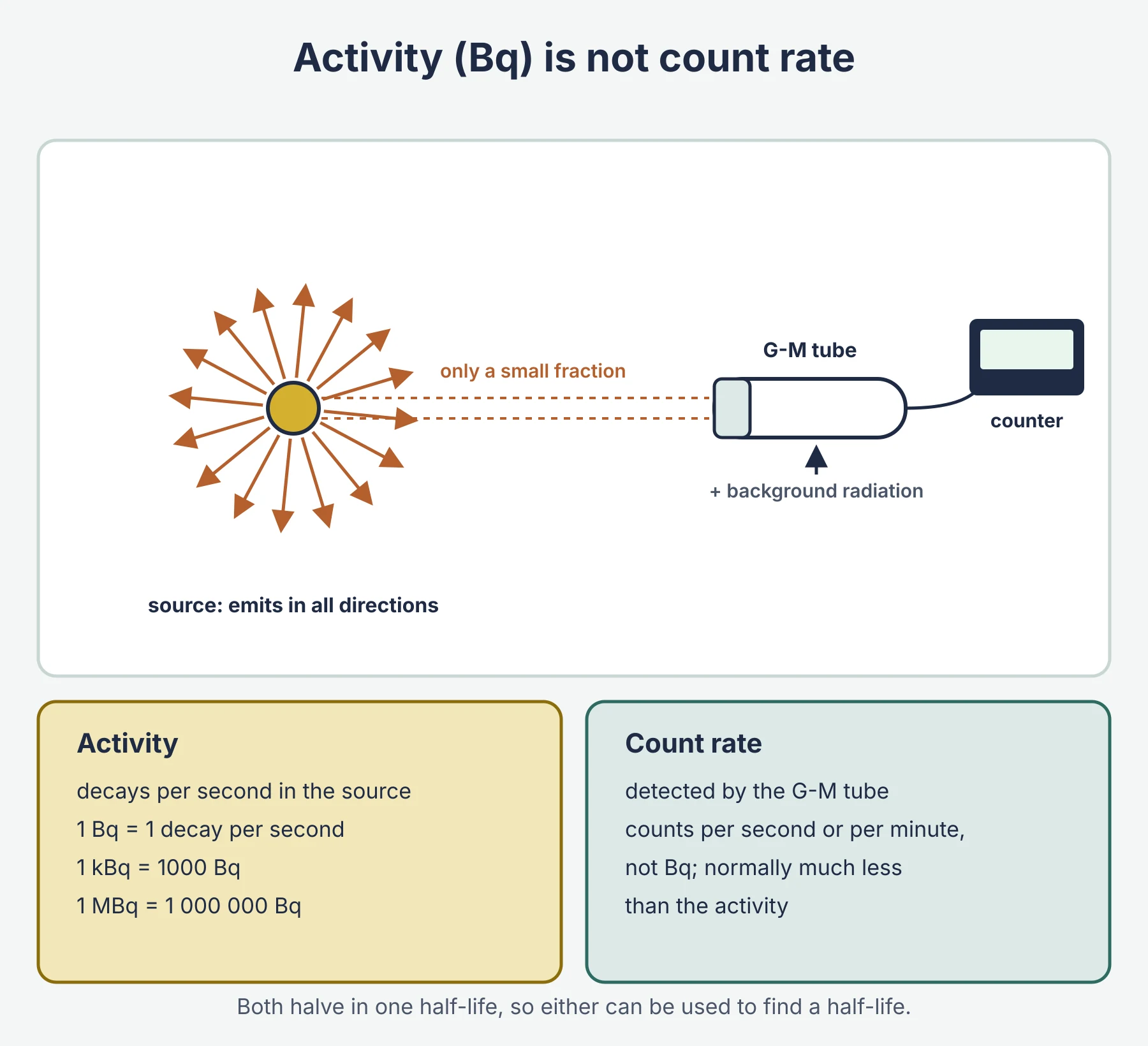
Count rate is a different quantity
- A detector measures count rate: detected counts per second or per minute.
- Unit: counts/s or counts/min. Not Bq.
- Count rate < activity, because:
- radiation is emitted in all directions and most misses the detector
- some radiation is absorbed on the way (by air, or by the detector window)
- (the reading also includes background, which must be subtracted)
- Count rate and activity both halve in one half-life.
Time conversions
1 min = 60 s
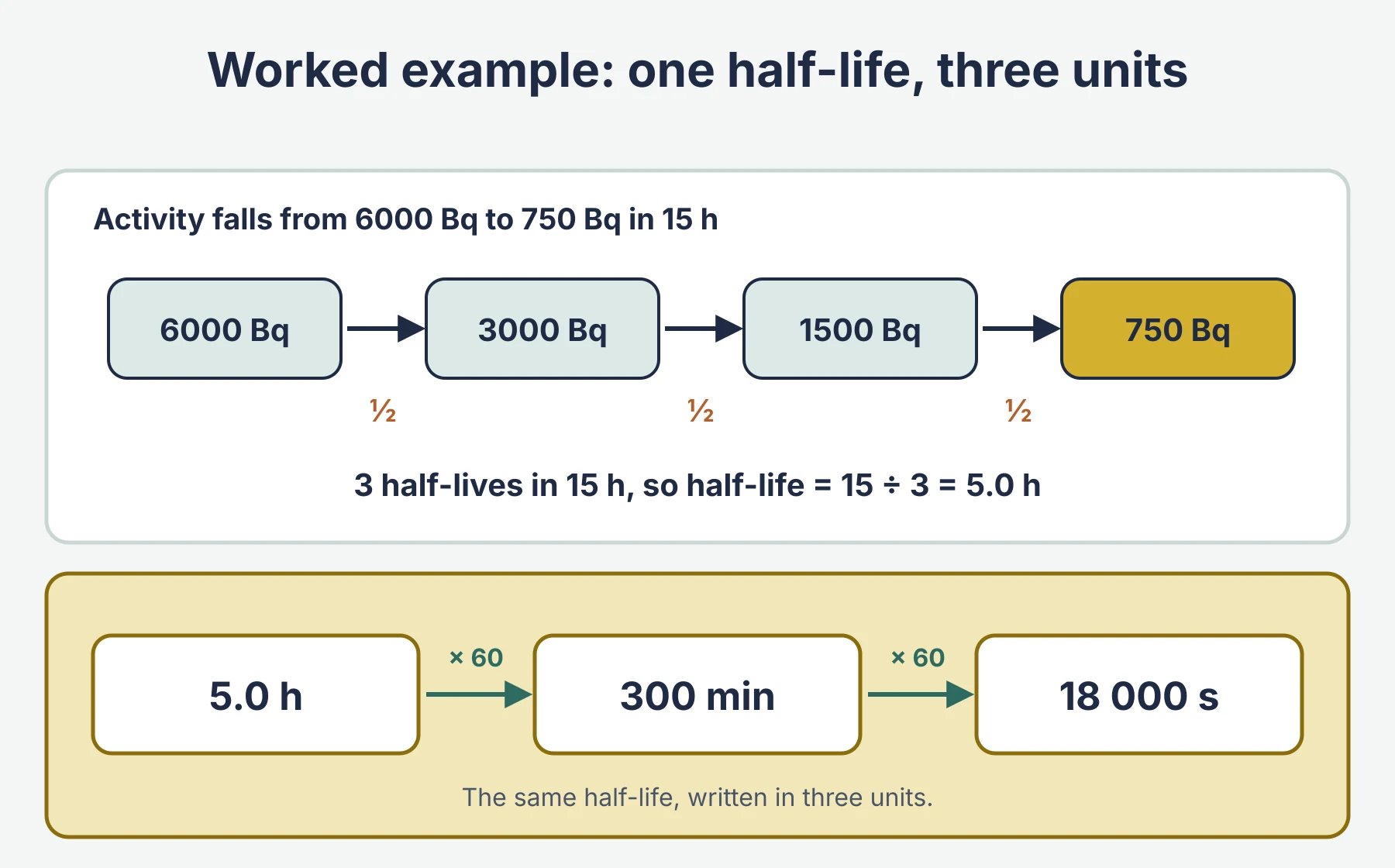
1 h = 60 min = 3600 s- Hours → minutes: × 60. Minutes → seconds: × 60. Hours → seconds: × 3600.
- Reverse direction: divide.
- Rate per minute = rate per second × 60 (the per-minute number is bigger).
- Total counts ÷ counting time = count rate, in counts per that time unit (for example, 600 counts in 2.0 min = 300 counts/min = 5.0 counts/s).
- Longer counting times give more counts and a more reliable average, because decay is random.
Half-life calculations
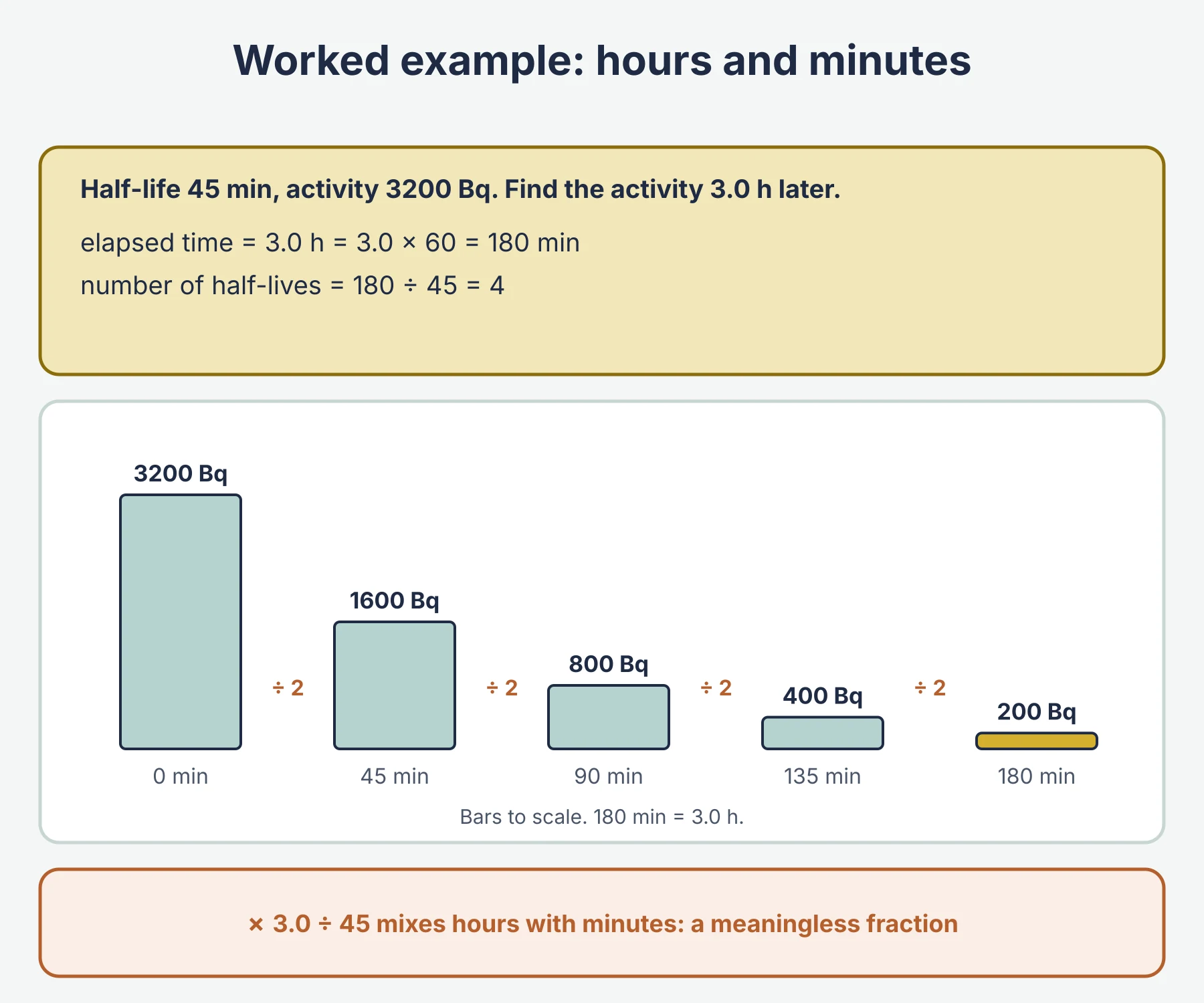
number of half-lives = elapsed time ÷ half-life (same units!)Background correction
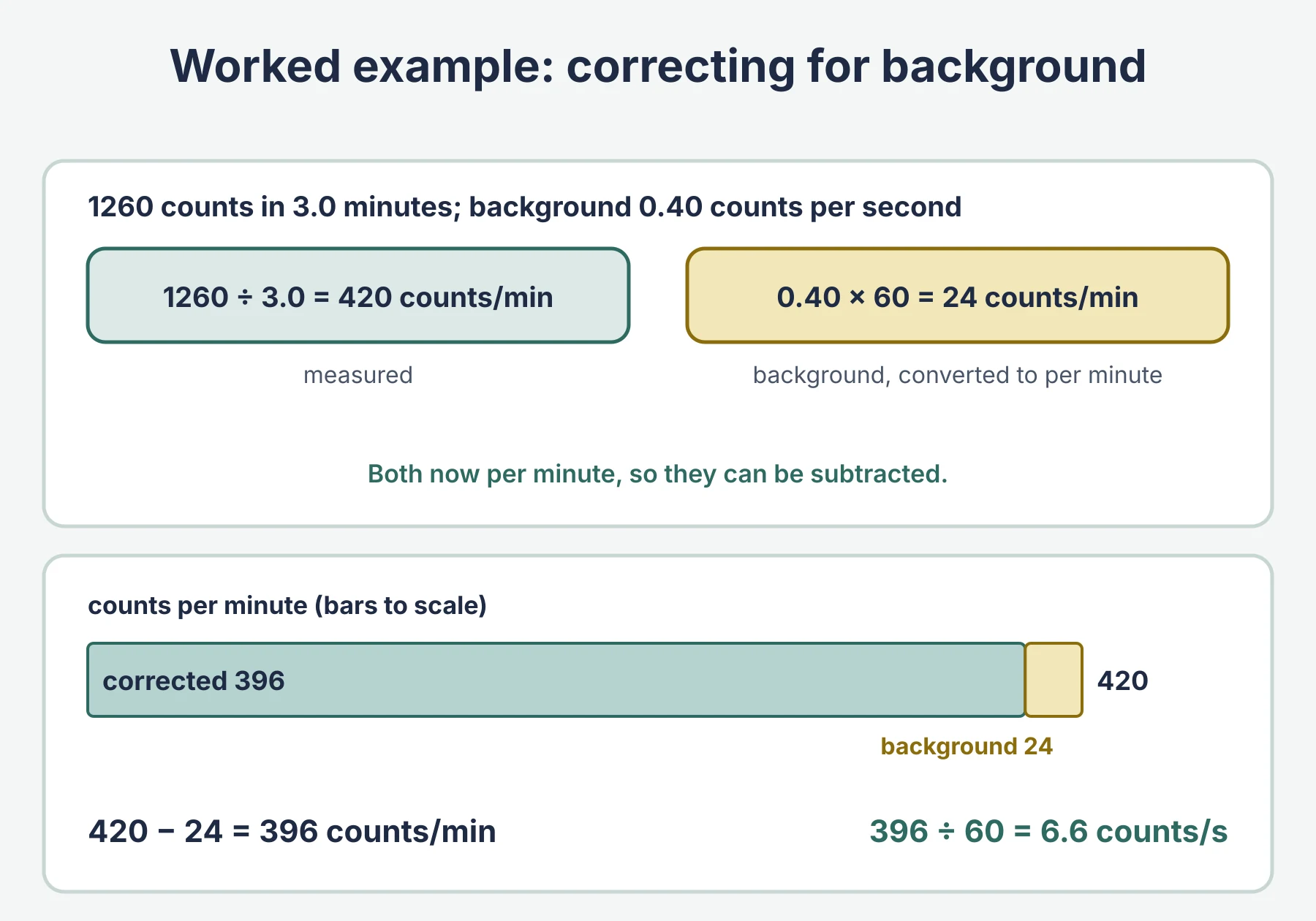
corrected count rate = measured count rate − background count rate (same units!)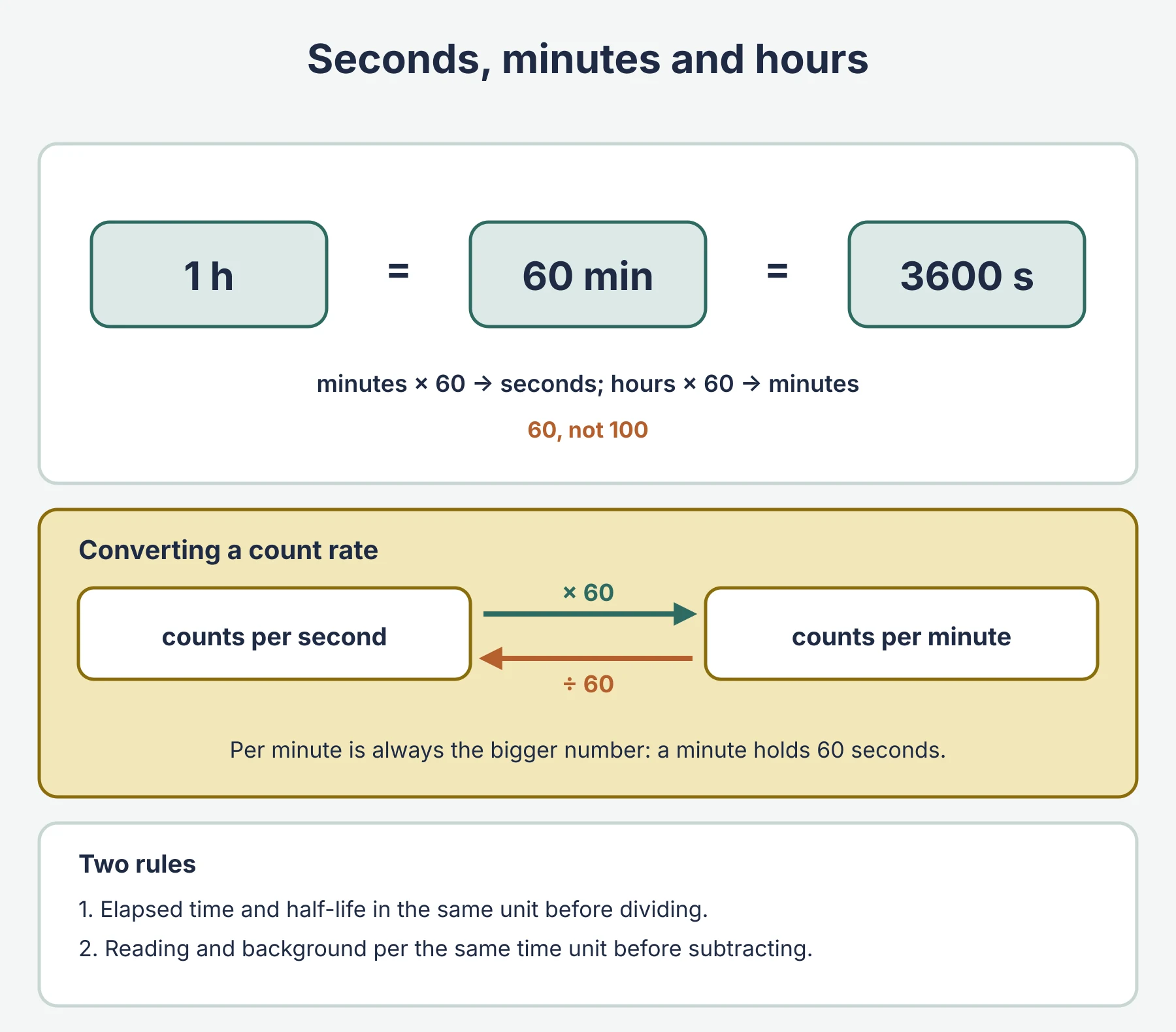
Centimetres
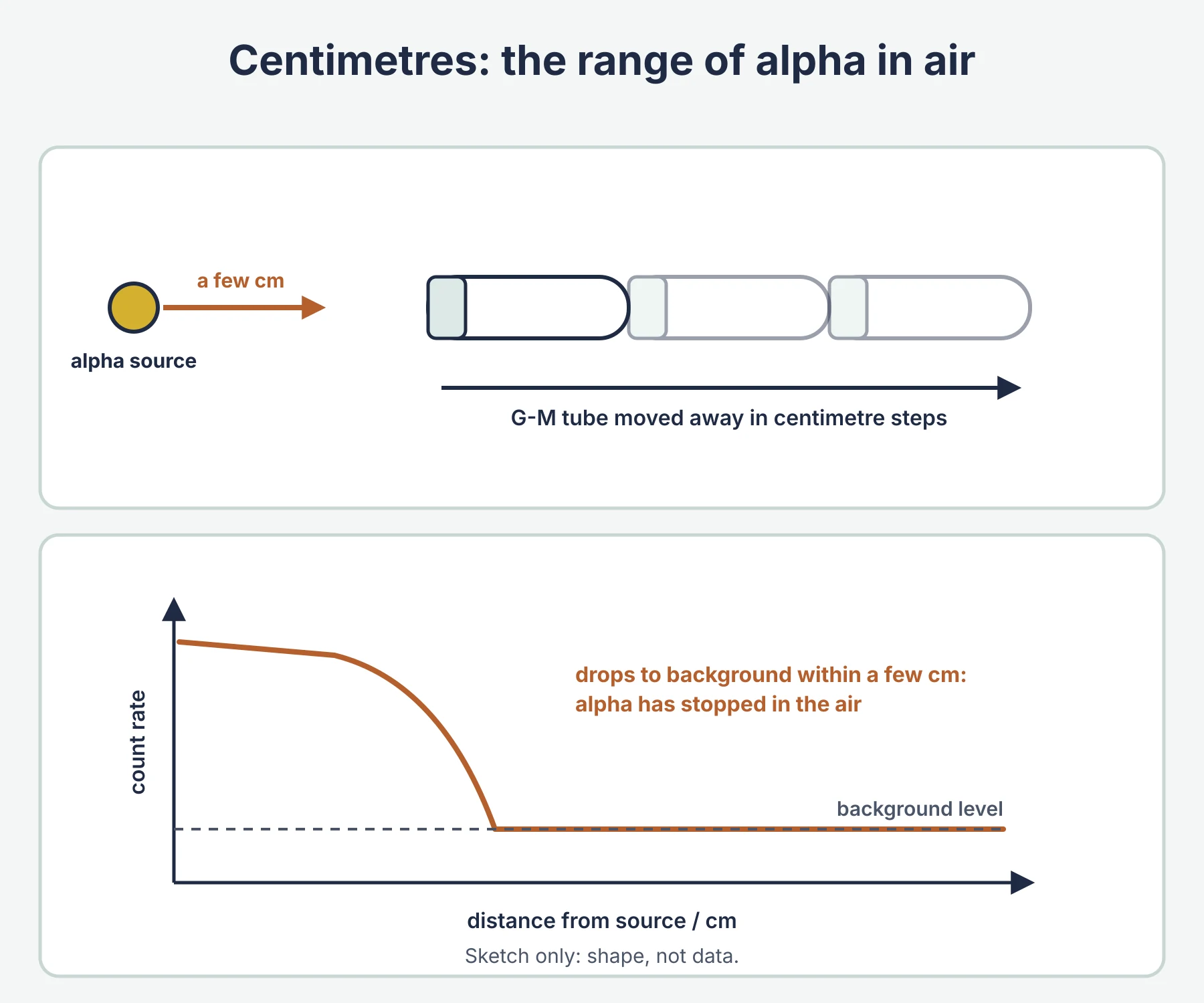
- Alpha range in air: a few cm.
- In the penetration practical, keep the source-to-detector distance fixed (in cm).
- 1 m = 100 cm; 1 cm = 10 mm.
- Greater distance from a source = lower exposure.
Mini worked example
Illustrative figures. Half-life 40 min; activity 12 000 Bq; find the activity after 2.0 h.
- 2.0 h = 120 min → 120 ÷ 40 = 3 half-lives.
- 12 000 → 6000 → 3000 → 1500 Bq.
Key terms
| Term | Meaning |
|---|---|
| Activity | Rate of decay of a source; number of decays per second |
| Becquerel (Bq) | Unit of activity; one decay per second |
| Count rate | Number of counts recorded by a detector per unit time |
| Background count rate | Count rate recorded with no source present |
| Corrected count rate | Measured count rate minus background count rate |
| Half-life | Time for the activity (or count rate) to fall to half |
| Range | Distance radiation travels through a material before being absorbed |
Exam traps
- Bq for count rate. Wrong unit: use counts/s or counts/min.
- Mismatched units when dividing elapsed time by half-life.
- Subtracting backgrounds in different units.
- ×60 versus ÷60 confusion. Ask: should the number get bigger or smaller?
- Decimal hours. 1.5 h is 90 min, not 150 min; 2.5 h is 150 min.
- No unit on the answer.
- Using the observed count after background as if it were the activity of the source.
Self-test
- What is the unit of activity, and what does one of these units mean?
- Why is the count rate from a detector usually much less than the activity of the source?
- Convert 2.5 h into seconds.
- Convert 7200 s into minutes.
- A count rate is 0.75 counts per second. What is it in counts per minute?
- Convert 2880 counts per minute into counts per second.
- A half-life is 30 min. How many half-lives are there in 1.5 h?
- A reading is 330 counts/min and background is 0.50 counts/s. Find the corrected count rate in counts/min.
- Why should the unit “Bq” not be used for the reading on a Geiger-Müller counter?
- Give one context in Topic 7 where centimetres are used.
- A sample’s activity falls from 4000 Bq to 1000 Bq in 90 min. Find the half-life in seconds.
- Express 1.5 MBq in becquerels.
Answers
- The becquerel (Bq); one decay per second.
- Radiation goes in all directions and only a fraction reaches the detector; some is absorbed on the way.
- 2.5 × 3600 = 9000 s.
- 7200 ÷ 60 = 120 min.
- 0.75 × 60 = 45 counts/min.
- 2880 ÷ 60 = 48 counts/s.
- 1.5 h = 90 min; 90 ÷ 30 = 3 half-lives.
- Background = 0.50 × 60 = 30 counts/min; corrected = 330 − 30 = 300 counts/min.
- The counter measures count rate (detected counts), not the number of decays per second in the source.
- Any one: range of alpha particles in air; distance between source and detector in the penetration practical; thickness of an absorber.
- 4000 → 2000 → 1000 is 2 half-lives; half-life = 90 ÷ 2 = 45 min = 45 × 60 = 2700 s.
- 1.5 × 1 000 000 = 1 500 000 Bq (1.5 × 10⁶ Bq).
Frequently asked questions
Is “counts per minute” a unit listed in 4PH1? Not as a single unit, but it is built from units the specification lists (minute and second), and count rates are routinely given that way.
Do I need to convert to seconds every time? No. Any time unit works, as long as elapsed time and half-life (or two count rates) are in the same unit.
Practise with the Units in radioactivity practice questions.
Related resources
-
Study guides
Radioactivity and Particles
Atomic structure and radioactive decay, half-life calculations, and nuclear fission and fusion, for Pearson Edexcel International GCSE Physics 4PH1.
Physics · Pearson Edexcel · IGCSE
Read guide -
Practice questions
Edexcel IGCSE Physics: Radioactivity and Particles — Practice Questions
Original exam-style practice questions with full worked answers on radiation types, half-life, nuclear equations and safety for Edexcel IGCSE Physics 4PH1.
Physics · Pearson Edexcel · IGCSE
Try questions -
Revision notes
Edexcel IGCSE Physics: Radioactivity and Particles — Revision Notes
Condensed recall notes on atomic structure, radiation types, half-life, nuclear equations, fission and fusion for Edexcel International GCSE Physics 4PH1.
Physics · Pearson Edexcel · IGCSE
Revise topic
Related articles
Get free revision emails (optional)
Occasional emails with practice questions, worked explanations and links to free resources for the qualification and subjects you choose. No spam, and you can unsubscribe from any email. The free tools on this site never need an email.