
Study Guides
Pearson Edexcel International GCSE Physics (4PH1): Units in radioactivity
Using the becquerel, centimetre, hour, minute and second in activity, count-rate and half-life work for Edexcel IGCSE Physics 4PH1 sub-topic 7a.
- Subject
- Physics
- Level
- IGCSE
- Topic
- Radioactivity and particles
- Author
- Marlbridge Academic Team
- Updated
- Reviewed by
- Hassan (what this means)
Aligned to Pearson Edexcel IGCSE Physics (4PH1), Issue 4. Official specification .
Syllabus page (what it covers and how it is assessed): Pearson Edexcel IGCSE Physics.
Syllabus points this page covers
4PH1
- 7a Units
Found an error? Report a correction.
Need help with this topic? Request a free trial class for IGCSE Physics (4PH1).
This guide covers sub-topic 7(a) Units of the Pearson Edexcel International GCSE in Physics (4PH1), Issue 4 specification. It has a single statement, 7.1: use the following units: becquerel (Bq), centimetre (cm), hour (h), minute (min) and second (s). The statement is core content, so it can be tested on both papers. It is short, but unit slips are one of the most common ways to lose marks in half-life and count-rate questions, so this page shows where each unit is used across Topic 7 and how to convert between them. The physics behind activity and half-life is in the Radioactivity study guide and the topic overview, Radioactivity and Particles.
Where each unit appears
| Unit | Symbol | Quantity it measures in Topic 7 | Typical context |
|---|---|---|---|
| becquerel | Bq | Activity of a source | “The activity falls from 800 Bq to 200 Bq” |
| second | s | Time; basis of the becquerel | Count rates in counts per second; short half-lives |
| minute | min | Time | Count rates in counts per minute; half-lives of minutes |
| hour | h | Time | Half-lives of hours, such as medical tracers |
| centimetre | cm | Distance, thickness | Range of alpha in air; source-to-detector distance; absorber thickness |
The becquerel
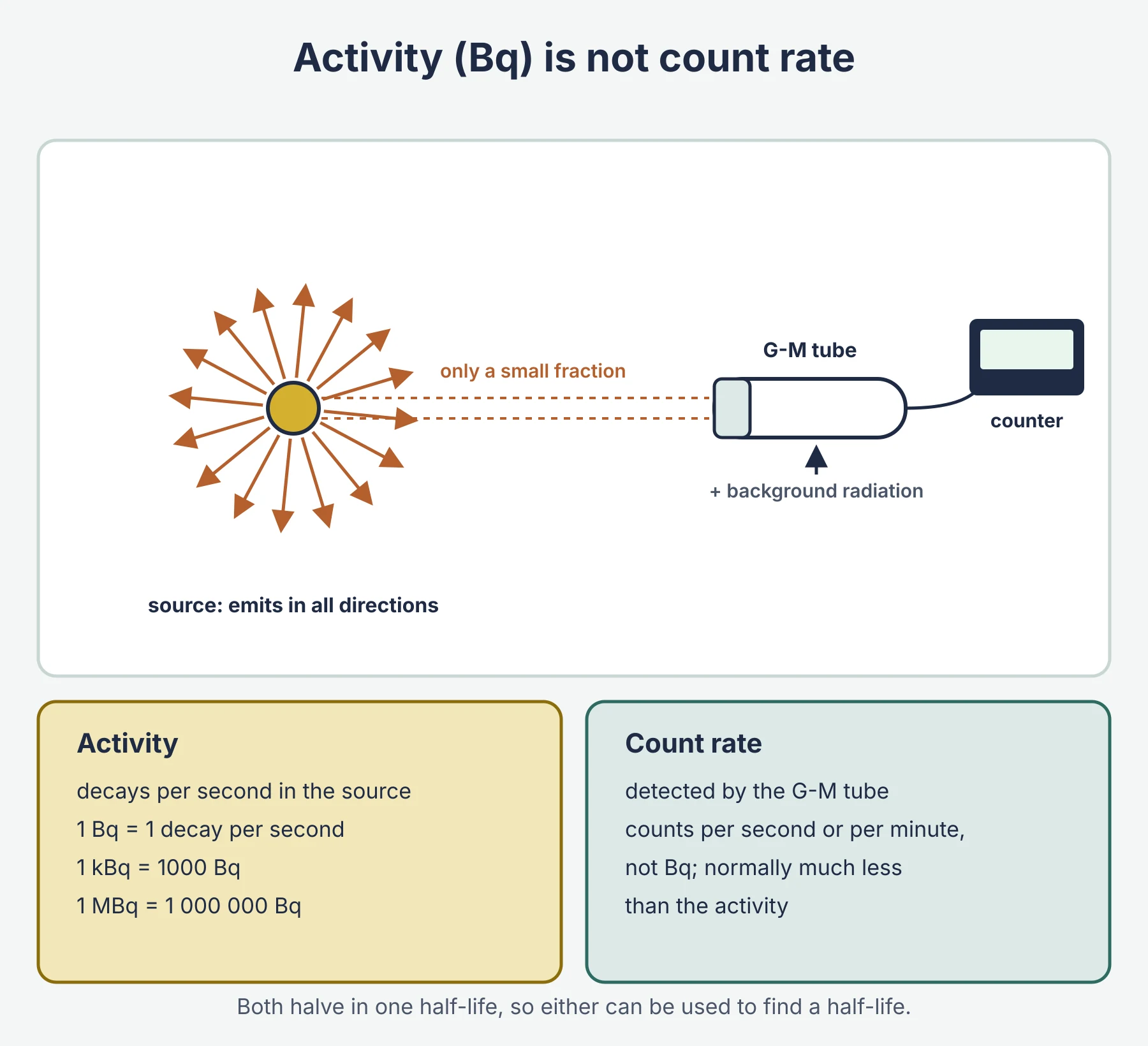
The activity of a radioactive source is the number of unstable nuclei that decay each second. Its unit is the becquerel:
1 Bq = 1 decay per secondStatement 7.11 says that activity “decreases over a period of time and is measured in becquerels”, so whenever a question talks about activity, the answer needs Bq. Large activities are often written with prefixes: 1 kBq is 1000 Bq and 1 MBq is 1 000 000 Bq.
Activity is not the same as count rate. A Geiger-Müller detector records a count rate: the number of radiation particles or rays that reach it and are detected each second or each minute. A source emits in all directions, and the detector only intercepts a small fraction; some radiation is absorbed before it arrives; the detector also picks up background radiation. So the count rate is normally much less than the activity, and its unit is counts per second or counts per minute, not Bq. Both quantities halve in one half-life, so either can be used to find a half-life.
The time units: second, minute and hour
Half-lives range from fractions of a second to many years, so questions mix time units freely. The conversions you need are:
1 min = 60 s
1 h   = 60 min = 3600 s
Two rules prevent almost every unit error:
- Before dividing elapsed time by half-life, put both in the same unit. Number of half-lives = elapsed time ÷ half-life only works if the units match.
- Count rates must be per the same time unit before you subtract background. You cannot subtract a background in counts per second from a reading in counts per minute.
When converting a count rate, think about whether the number should get bigger or smaller. A rate per minute is 60 times larger than the same rate per second, because a minute contains 60 seconds.
counts per minute = counts per second × 60
counts per second = counts per minute ÷ 60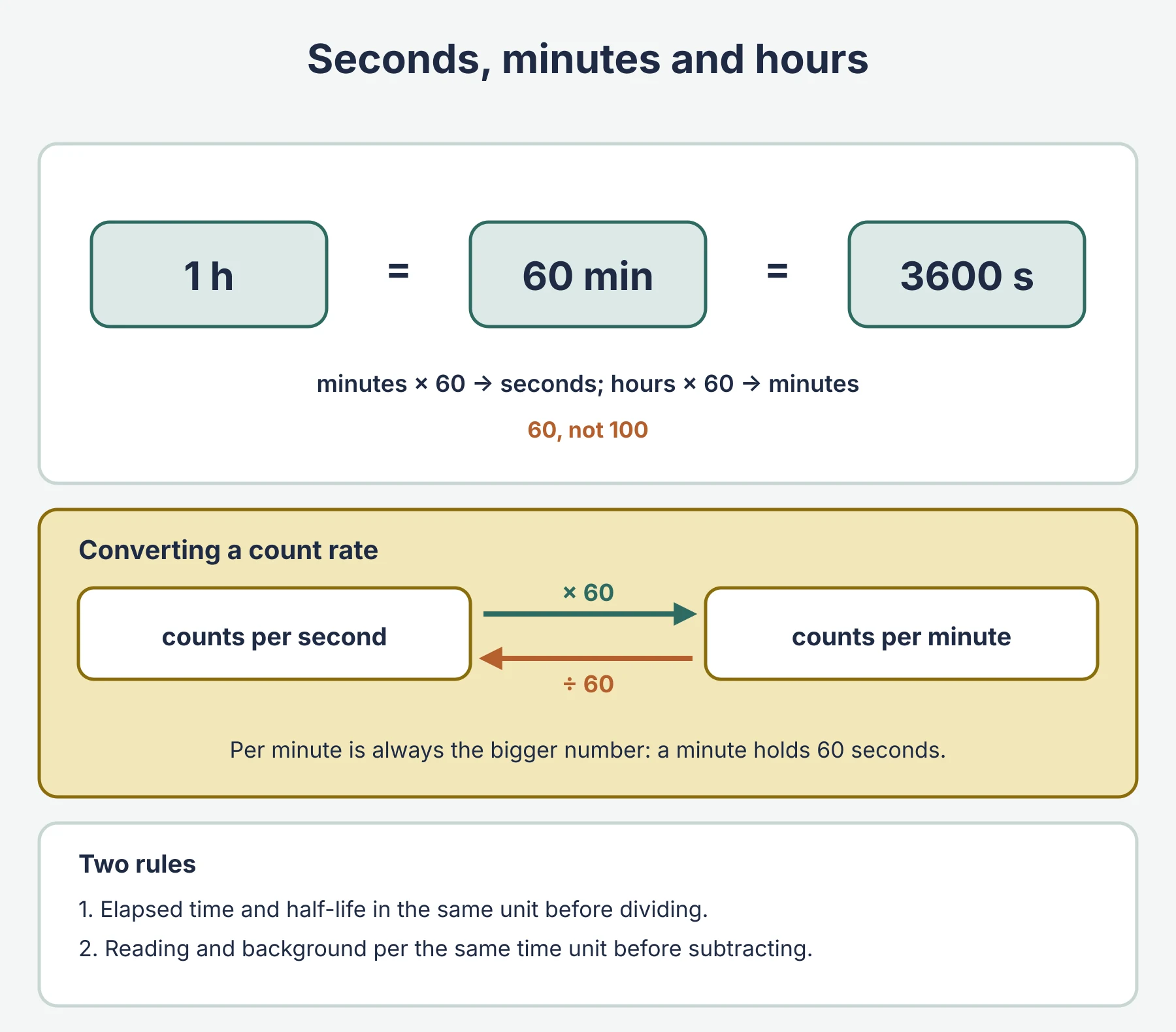
The centimetre
Distances in Topic 7 are usually small, so the centimetre is the natural unit:
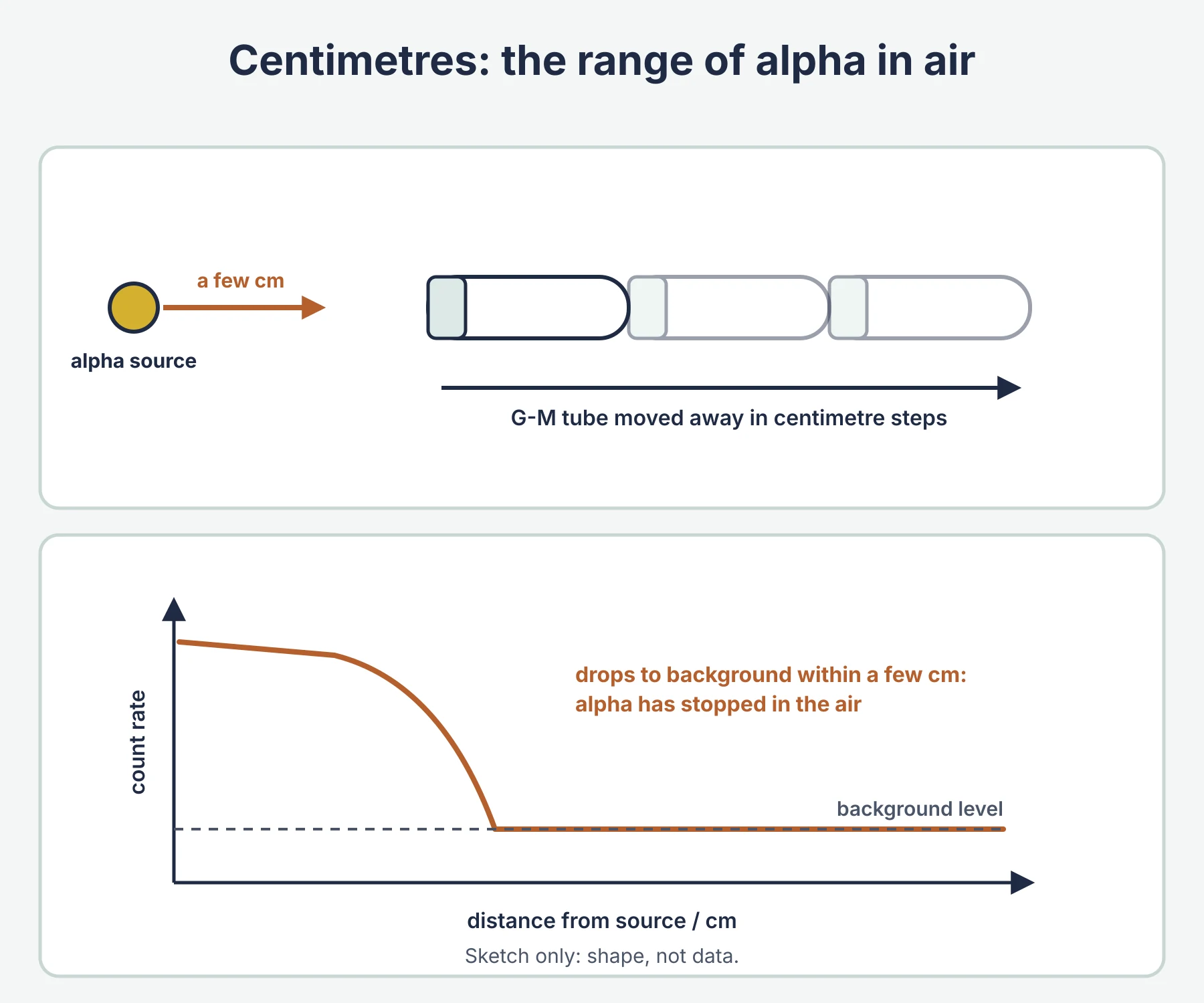
- Range of alpha in air: alpha particles travel only a few centimetres in air before they have caused so much ionisation that they stop. Moving a Geiger-Müller tube away from an alpha source in centimetre steps shows the count rate dropping to background within that short distance.
- The penetration practical (7.6): the source-to-detector distance is fixed, often a few centimetres, and must be kept the same while different absorbers (paper, aluminium, lead) are placed in between. Absorber thicknesses are measured in millimetres or centimetres.
- Safety: distance reduces exposure, which is why sources are handled with long tongs and held well away from the body.
The base SI unit of length is the metre, but radioactivity questions do not usually need distances in a formula, so working in centimetres is fine unless the question asks for metres (1 m = 100 cm).
Worked examples
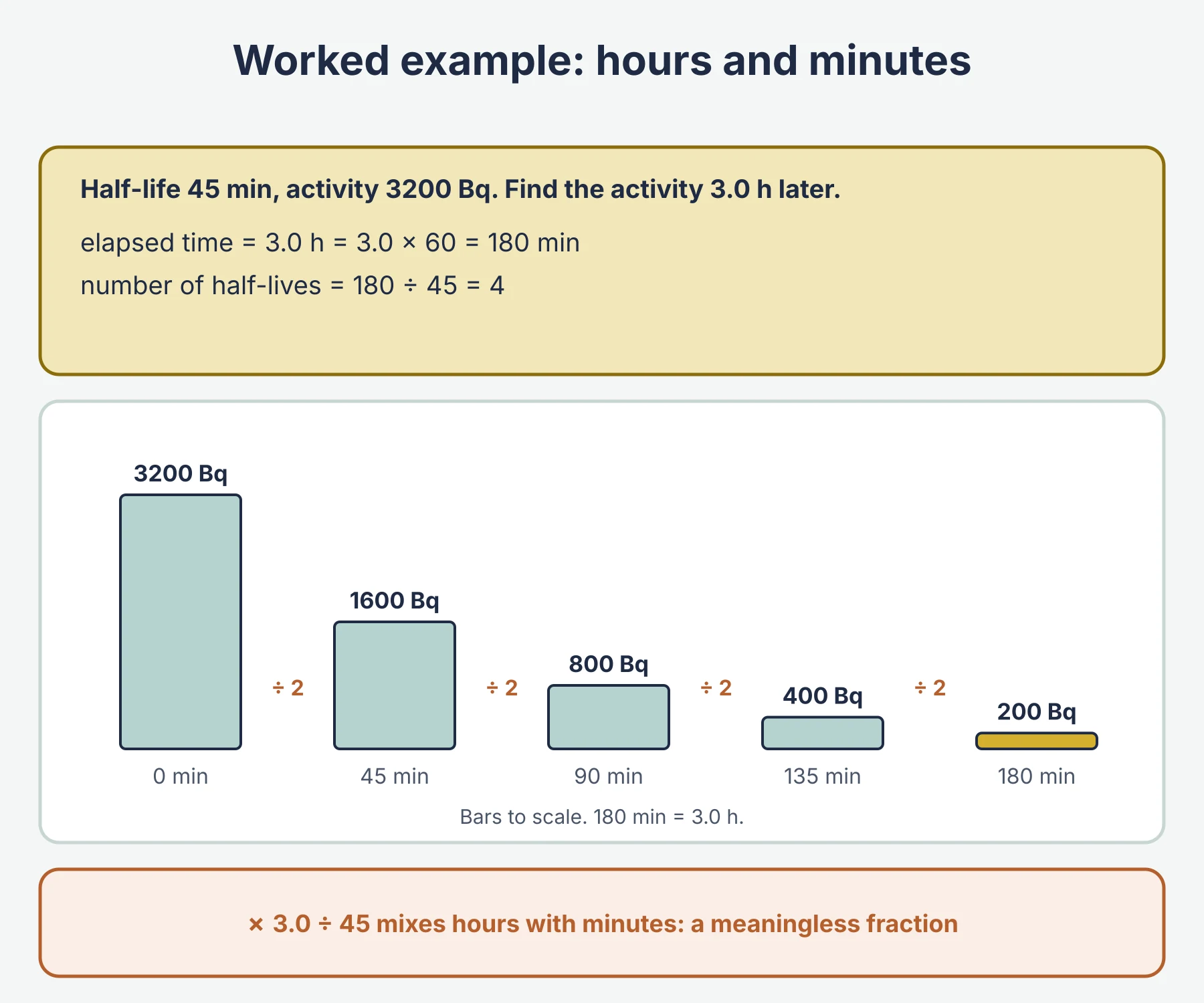
Example 1 (mixed time units). A source has a half-life of 45 min. Its activity is 3200 Bq. Calculate the activity 3.0 h later.
elapsed time = 3.0 h = 3.0 × 60 = 180 min
number of half-lives = 180 ÷ 45 = 4
3200 → 1600 → 800 → 400 → 200 Bq
Activity after 3.0 h = 200 Bq. Dividing 3.0 by 45 without converting would give a meaningless fraction of a half-life.
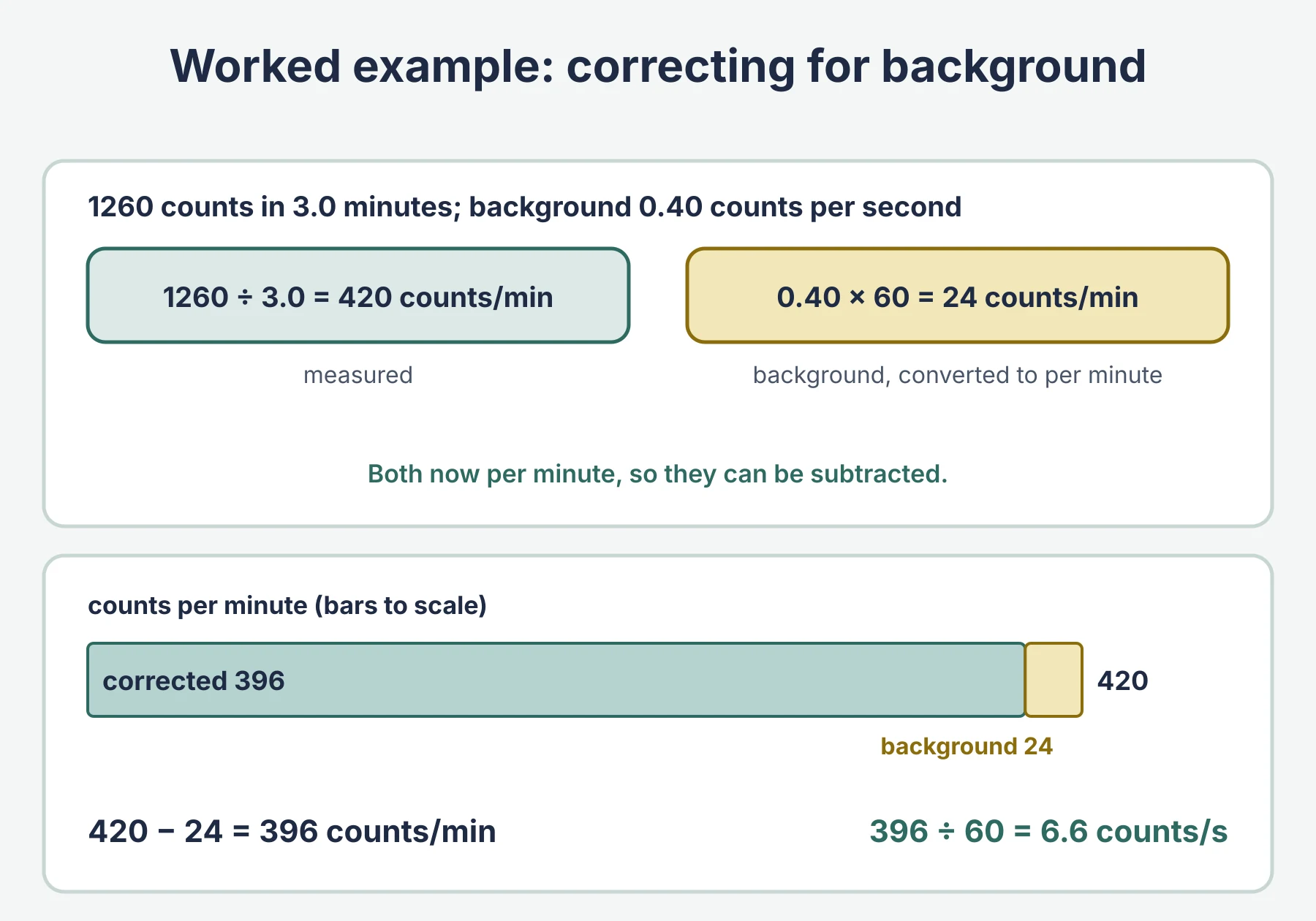
Example 2 (count rates and background). A Geiger-Müller tube records 1260 counts in 3.0 minutes near a source. The background count rate is 0.40 counts per second. Calculate the corrected count rate in counts per minute and in counts per second.
measured count rate = 1260 ÷ 3.0 = 420 counts/min
background = 0.40 × 60 = 24 counts/min
corrected count rate = 420 − 24 = 396 counts/min
in counts per second: 396 ÷ 60 = 6.6 counts/s
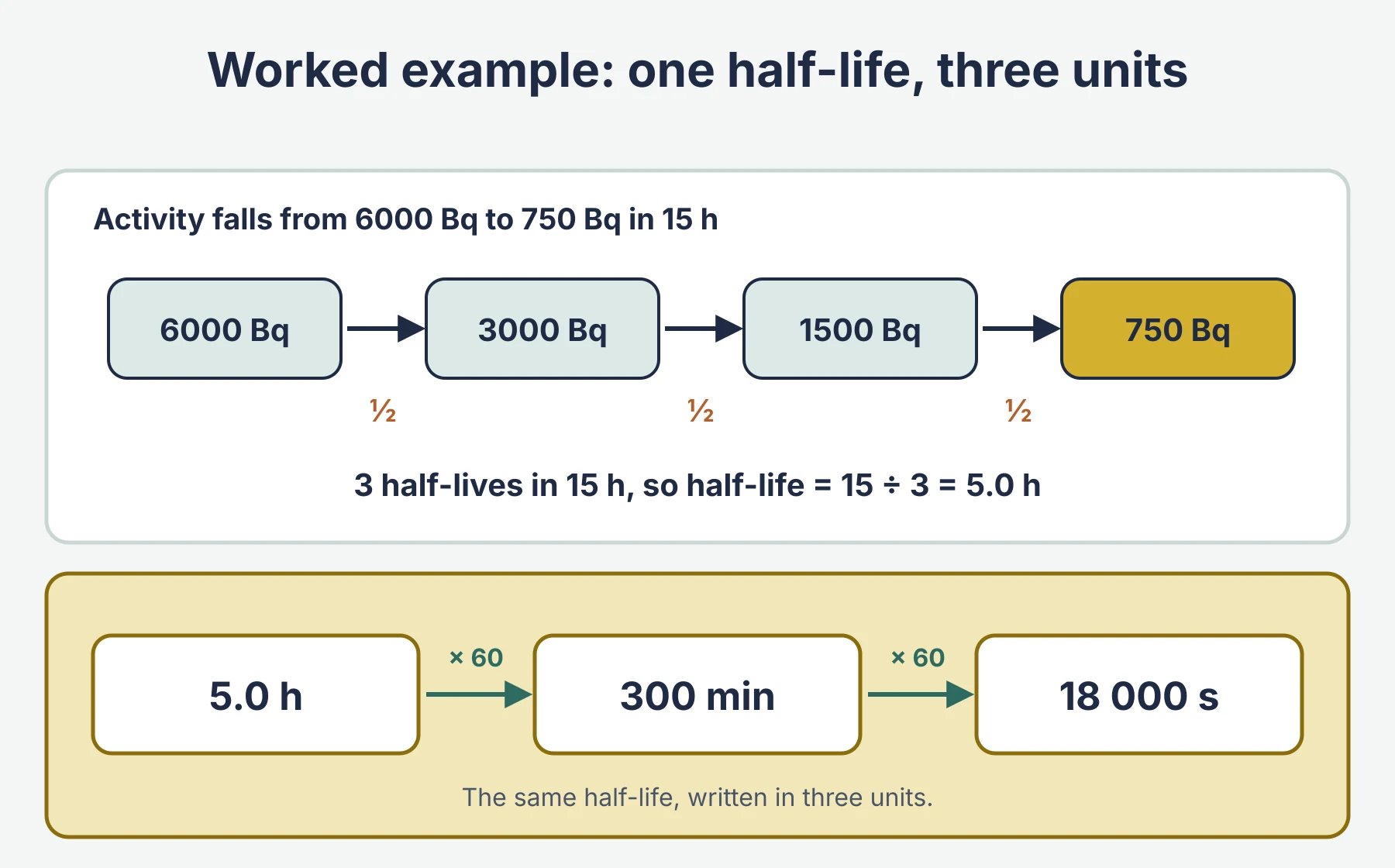
Example 3 (half-life in different units). The activity of a sample falls from 6000 Bq to 750 Bq in 15 h. Find the half-life in hours, minutes and seconds.
6000 → 3000 → 1500 → 750: 3 half-lives
half-life = 15 h ÷ 3 = 5.0 h
5.0 h = 5.0 × 60 = 300 min = 300 × 60 = 18 000 s
Example 4 (graph reading). On an activity-time graph, the time axis is labelled “time / min” and the activity axis “activity / Bq”. Read the half-life directly in minutes: find the time for the activity to fall from any value to half that value, then repeat from a second starting value and average. The answer’s unit comes from the axis label, so write it as minutes unless the question asks for a different unit.
Common mistakes
- Giving a count rate in becquerels. Bq is for activity; detectors give counts per second or per minute.
- Dividing an elapsed time in hours by a half-life in minutes.
- Multiplying by 60 when you should divide, and the reverse. Check the size of the answer: per minute should be bigger than per second.
- Subtracting a background given per second from a reading per minute.
- Using 100 instead of 60 when converting between minutes and hours or seconds and minutes.
- Leaving out the unit altogether. A half-life of “5” earns nothing without h, min or s.
Exam technique
- Calculate: write the conversion as a line of working, such as “3.0 h = 180 min”. If the final answer is wrong, a shown conversion can still earn a mark.
- Determine from a graph: read values from the axes using their labelled units; show the readings on the graph or in your working.
- State the unit of activity: the answer is “becquerel” or “Bq”; “counts per second” does not earn the mark.
- Add/Label (for example, completing a results table): put units in the column headings, such as “count rate / counts per min”, not after every number.
More resources on this topic
- Units in radioactivity revision notes for the conversions on one page
- Units in radioactivity practice questions with worked answers
- Radioactivity study guide, sub-topic 7(b)
Written against the Pearson Edexcel International GCSE in Physics (4PH1) specification, Issue 4. Always check the current specification for your examination year.
Related resources
-
Practice questions
Pearson Edexcel International GCSE Physics (4PH1): Units in radioactivity – Practice Questions
Original questions with worked answers on becquerels, count rates, time conversions and centimetre ranges in radioactivity, for Edexcel 4PH1 sub-topic 7a.
Physics · Pearson Edexcel · IGCSE
Try questions -
Revision notes
Pearson Edexcel International GCSE Physics (4PH1): Units in radioactivity – Revision Notes
Recall notes for Edexcel 4PH1 sub-topic 7a: the becquerel, count rate units, time conversions and centimetres in radioactivity, with a 12-question self-test.
Physics · Pearson Edexcel · IGCSE
Revise topic -
Study guides
Radioactivity and Particles
Atomic structure and radioactive decay, half-life calculations, and nuclear fission and fusion, for Pearson Edexcel International GCSE Physics 4PH1.
Physics · Pearson Edexcel · IGCSE
Read guide
Related articles
Get free revision emails (optional)
Occasional emails with practice questions, worked explanations and links to free resources for the qualification and subjects you choose. No spam, and you can unsubscribe from any email. The free tools on this site never need an email.