
Study Guides
Pearson Edexcel International GCSE Physics (4PH1): Radioactivity
Nuclide notation, the four radiations, nuclear equations, background radiation, half-life graphs, uses and dangers of radiation for Edexcel 4PH1 sub-topic 7b.
- Subject
- Physics
- Level
- IGCSE
- Topic
- Radioactivity and particles
- Author
- Marlbridge Academic Team
- Updated
- Reviewed by
- Hassan (what this means)
Aligned to Pearson Edexcel IGCSE Physics (4PH1), Issue 4. Official specification .
Syllabus page (what it covers and how it is assessed): Pearson Edexcel IGCSE Physics.
Syllabus points this page covers
4PH1
- 7b Radioactivity
Found an error? Report a correction.
Need help with this topic? Request a free trial class for IGCSE Physics (4PH1).
This guide covers sub-topic 7(b) Radioactivity of the Pearson Edexcel International GCSE in Physics (4PH1), Issue 4 specification: statements 7.2 to 7.16. None of them carries a “P” reference, so all of it is core content, examinable on both papers. For the whole of Topic 7 in a single overview, see Radioactivity and Particles. Units such as the becquerel are covered in detail in Units in radioactivity.
What the specification covers
| Statements | Content |
|---|---|
| 7.2, 7.3 | Atomic structure, nuclide symbols, atomic number, mass number, isotopes |
| 7.4, 7.5, 7.6 | Alpha, beta and gamma: nature, ionising and penetrating power; the penetration practical |
| 7.7, 7.8 | Effect of alpha, beta, gamma and neutron emission on the nucleus; balancing nuclear equations |
| 7.9, 7.10 | Detectors; sources of background radiation from Earth and space |
| 7.11, 7.12, 7.13 | Activity, half-life and half-life calculations, including graphs |
| 7.14, 7.15, 7.16 | Uses in industry and medicine; contamination and irradiation; dangers and waste |
Atoms and nuclide notation (7.2, 7.3)
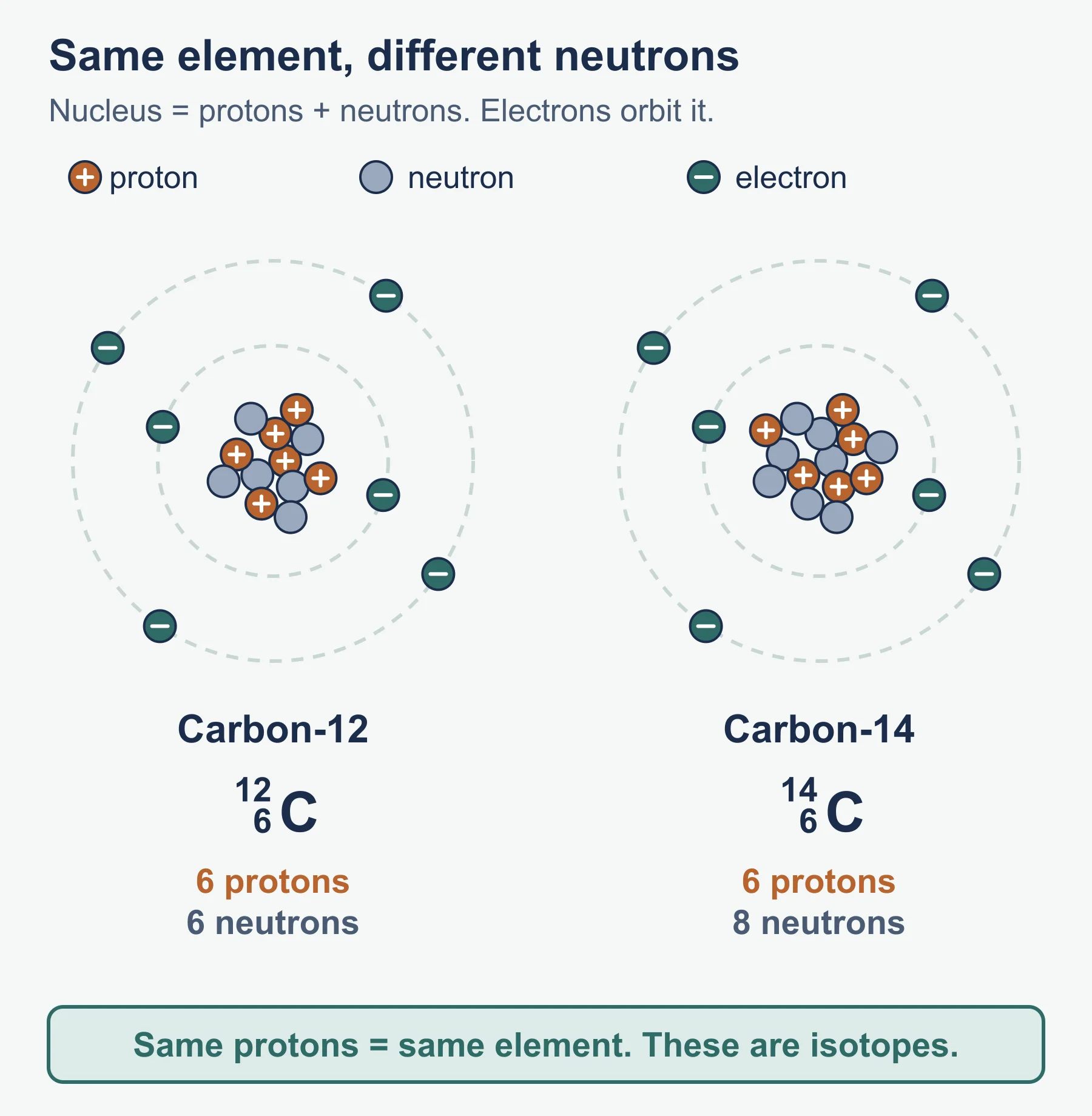
An atom has a tiny, dense nucleus of protons (charge +1) and neutrons (charge 0), with electrons (charge −1) around it. A neutral atom has equal numbers of protons and electrons.
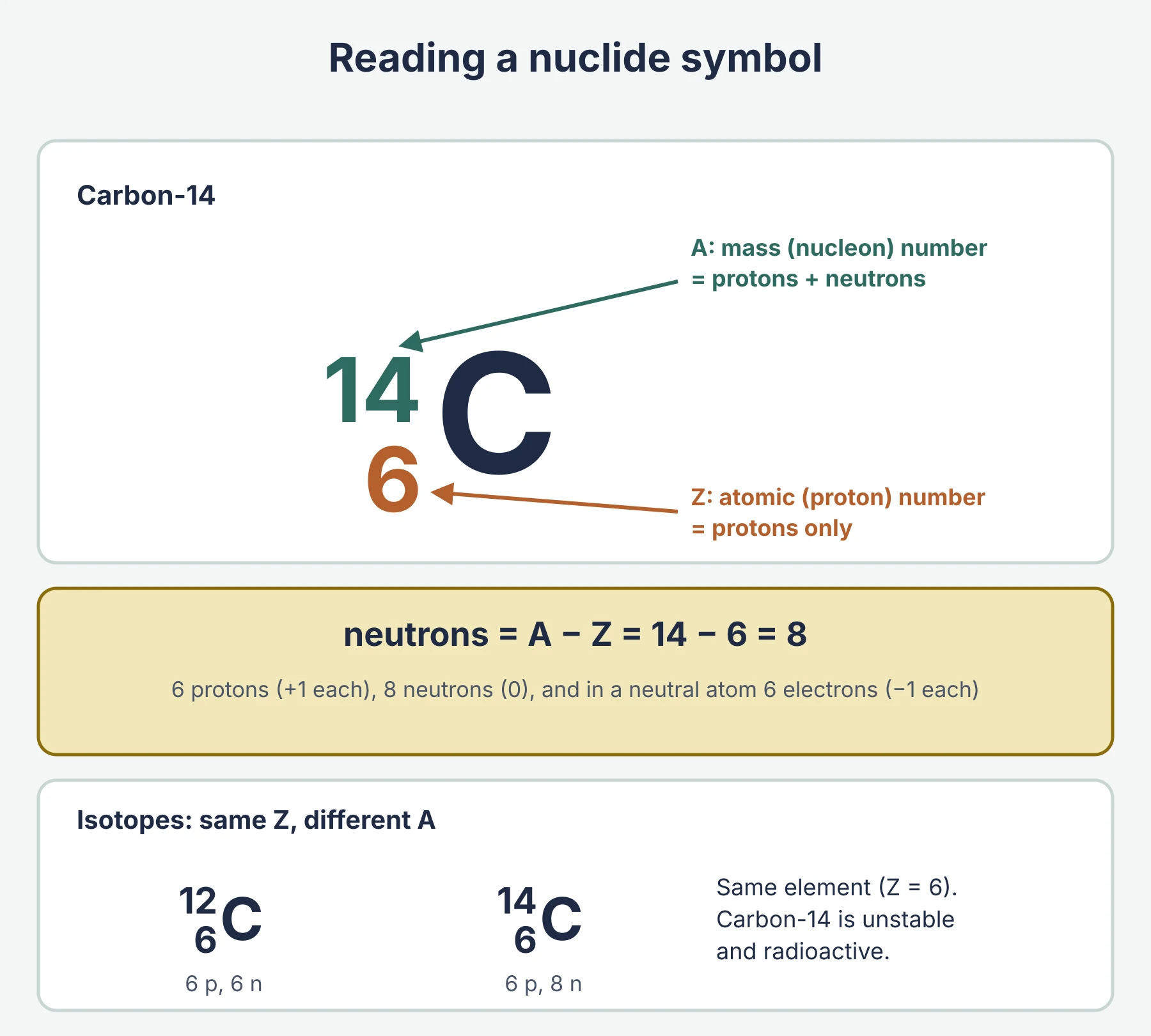
A nuclide is written as the chemical symbol with the mass number at the top left and the atomic number at the bottom left, as in ¹⁴₆C:
- A, the mass (nucleon) number: protons + neutrons
- Z, the atomic (proton) number: protons only
- number of neutrons = A − Z
So ¹⁴₆C has 6 protons and 14 − 6 = 8 neutrons. Isotopes are atoms of the same element (same Z) with different numbers of neutrons (different A). Carbon-12 (¹²₆C) and carbon-14 (¹⁴₆C) are isotopes; carbon-14 is unstable and radioactive.
The radiations (7.4, 7.5, 7.7)
Unstable nuclei emit radiation randomly: you cannot predict when a particular nucleus will decay, only the pattern for a very large number.
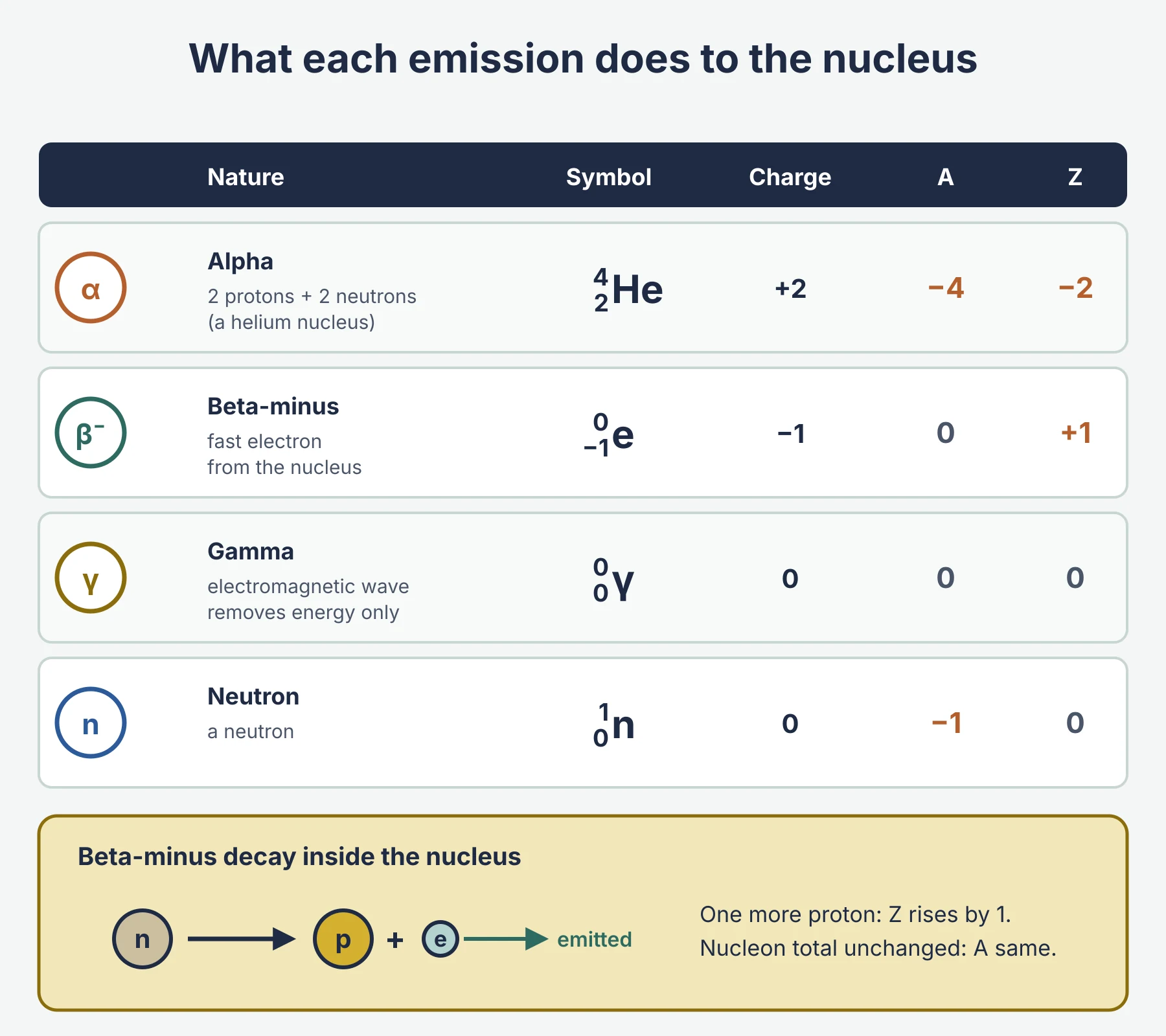
| Alpha (α) | Beta-minus (β⁻) | Gamma (γ) | Neutron (n) | |
|---|---|---|---|---|
| Nature | 2 protons + 2 neutrons (a helium nucleus) | Fast electron from the nucleus | Electromagnetic wave | Neutron |
| Symbol in equations | ⁴₂He or ⁴₂α | ⁰₋₁e or ⁰₋₁β | ⁰₀γ | ¹₀n |
| Charge | +2 | −1 | 0 | 0 |
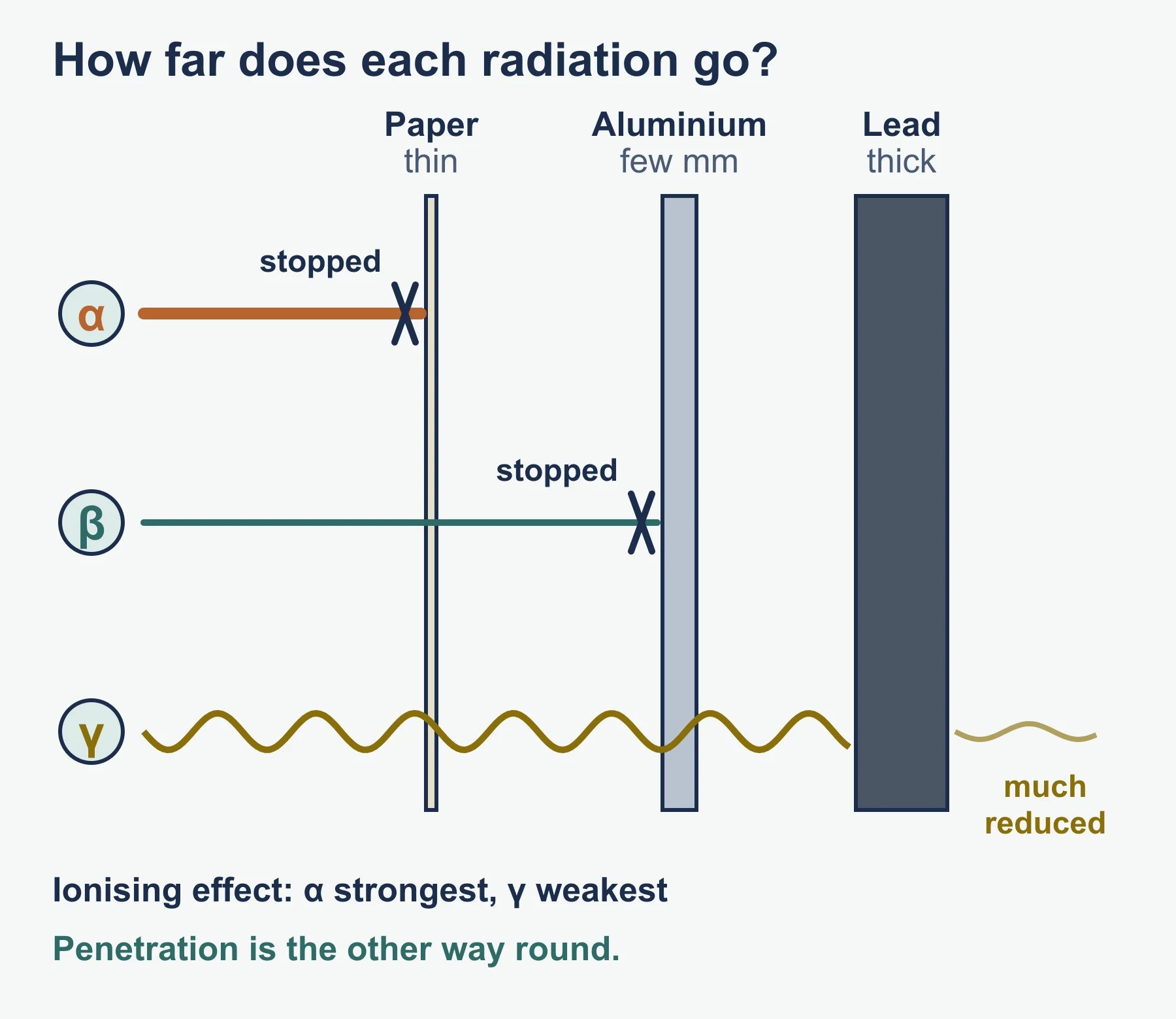
| Ionising | Strongly | Moderately | Weakly | Not compared in the specification |
| Stopped by | Paper, skin, a few cm of air | A few mm of aluminium | Greatly reduced by thick lead or concrete | Not compared in the specification |
| Change in A | −4 | 0 | 0 | −1 |
| Change in Z | −2 | +1 | 0 | 0 |
The link between ionising and penetrating power is cause and effect: alpha ionises so strongly that it loses its energy within a short distance, so it penetrates least. Gamma rarely interacts, so it travels much further.
In beta-minus decay, a neutron in the nucleus changes into a proton and the electron is emitted. That is why Z rises by 1 while A stays the same. Gamma emission only removes energy from the nucleus, so it usually follows alpha or beta decay.
Balancing nuclear equations (7.8)
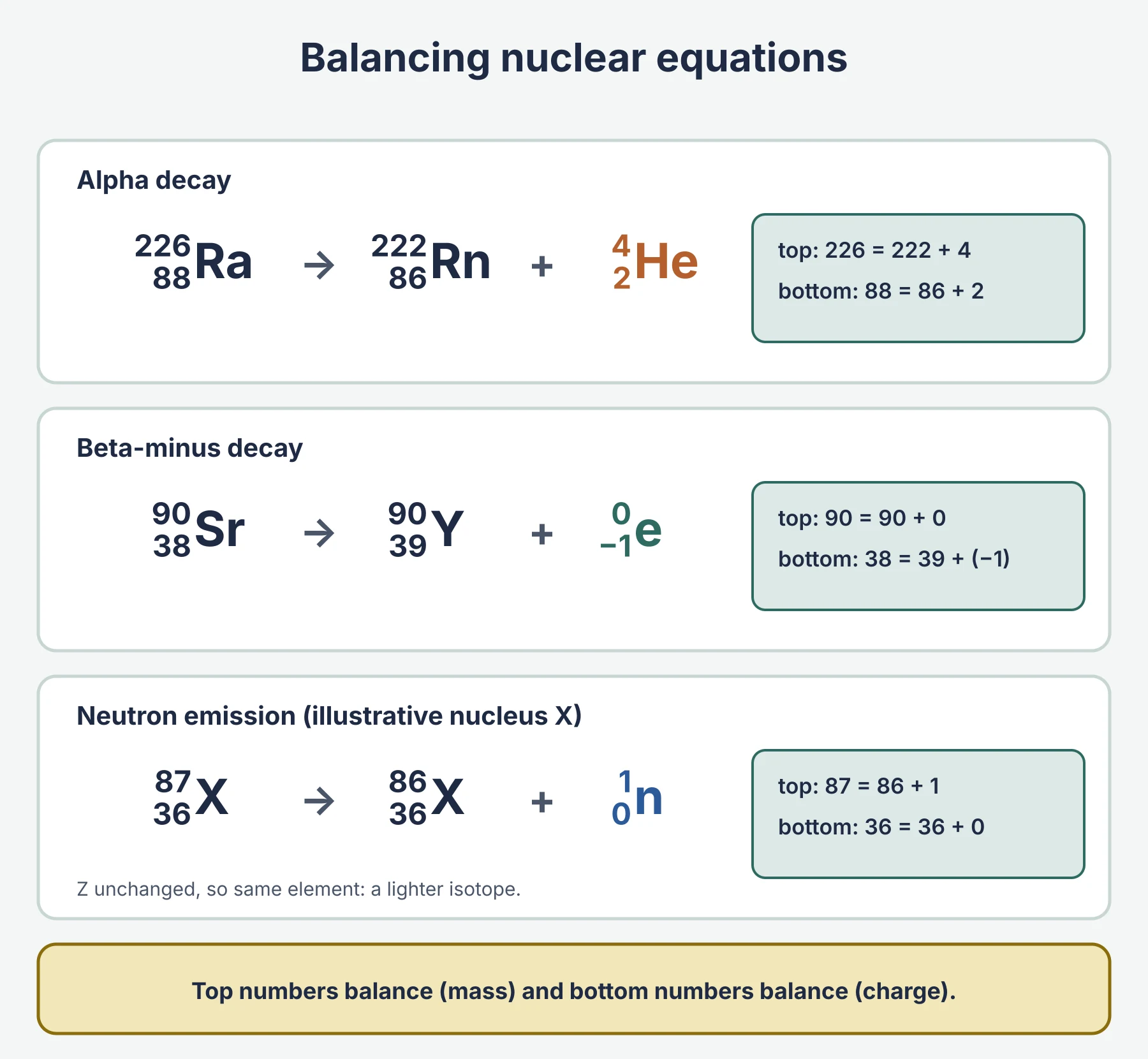
The top numbers must add up to the same total on each side (mass conserved), and so must the bottom numbers (charge conserved).
Alpha: ²²⁶₈₈Ra → ²²²₈₆Rn + ⁴₂He. Check: 226 = 222 + 4; 88 = 86 + 2.
Beta-minus: ⁹⁰₃₈Sr → ⁹⁰₃₉Y + ⁰₋₁e. Check: 90 = 90 + 0; 38 = 39 + (−1).
Neutron emission (illustrative nucleus X): ⁸⁷₃₆X → ⁸⁶₃₆X + ¹₀n. Check: 87 = 86 + 1; 36 = 36 + 0. The element is unchanged because Z is unchanged; a lighter isotope of the same element is left.
The penetration practical (7.6)
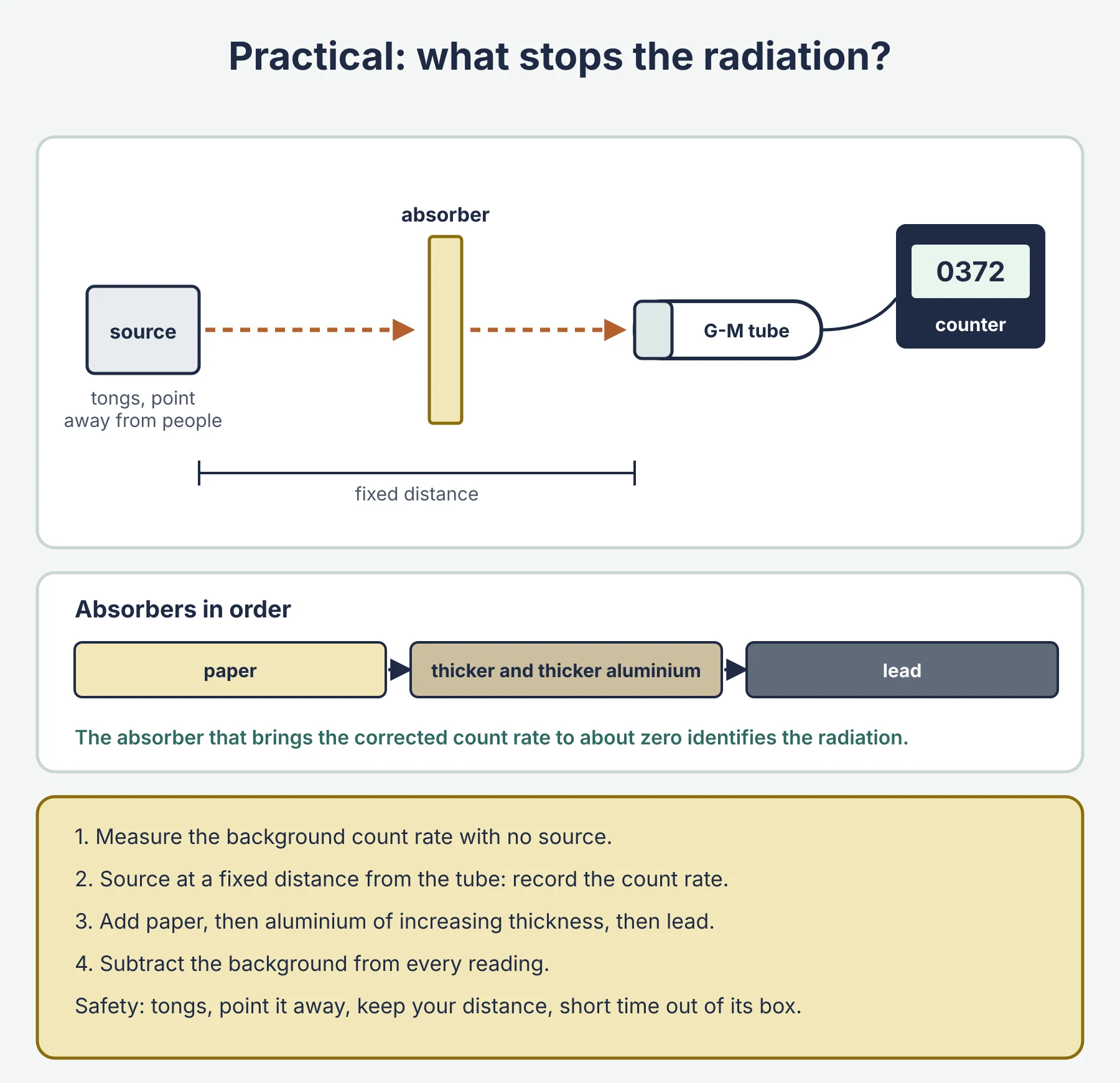
The specification allows radioactive sources or a simulation. With real sources:
- Measure the background count rate with no source present.
- Place the source a fixed distance from a Geiger-Müller tube and record the count rate.
- Put sheets of paper, then aluminium of increasing thickness, then lead between the source and the tube, recording the count rate each time.
- Subtract the background from every reading.
- The absorber that brings the corrected count rate to about zero identifies the radiation.
Safety: handle sources with tongs, keep them pointed away from people, minimise the time they are out of their lead-lined box, and keep your distance.
Detection and background (7.9, 7.10)
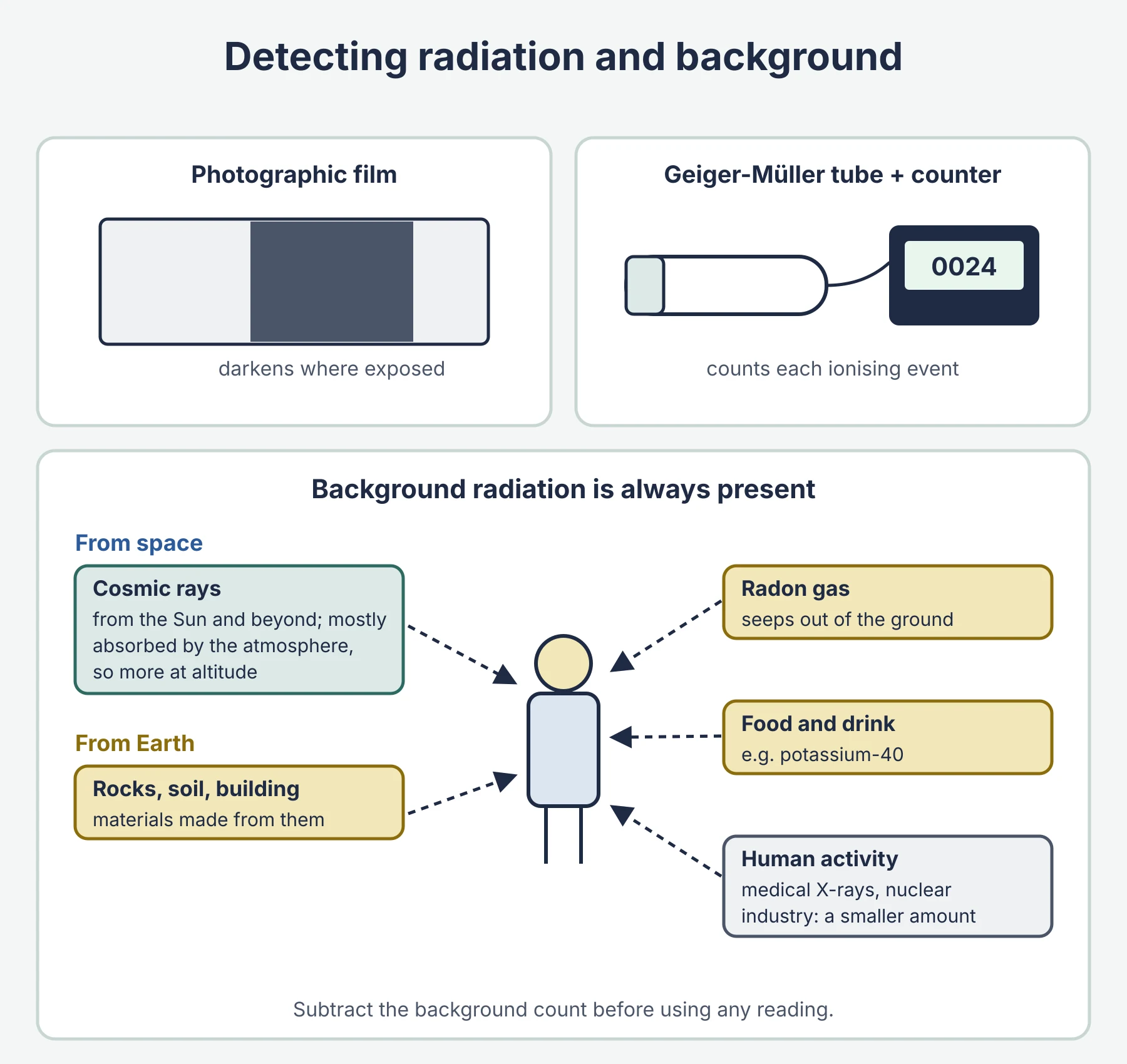
Ionising radiation can be detected with photographic film (it darkens when exposed) or a Geiger-Müller tube connected to a counter.
Background radiation is always present. The specification asks for sources from Earth and space:
- From Earth: radioactive rocks and soil, building materials made from them, and radon gas, which seeps out of the ground; radioactive isotopes in food and drink, such as potassium-40.
- From space: cosmic rays, high-energy radiation from the Sun and beyond, mostly absorbed by the atmosphere, so exposure is higher at altitude.
Human activity, such as medical X-rays and nuclear industry, adds a smaller amount.
Activity and half-life (7.11 to 7.13)
The activity of a source decreases with time because fewer unstable nuclei remain. The half-life is the time taken for the number of unstable nuclei, or the activity, to fall to half. It is different for different isotopes, from fractions of a second to billions of years.
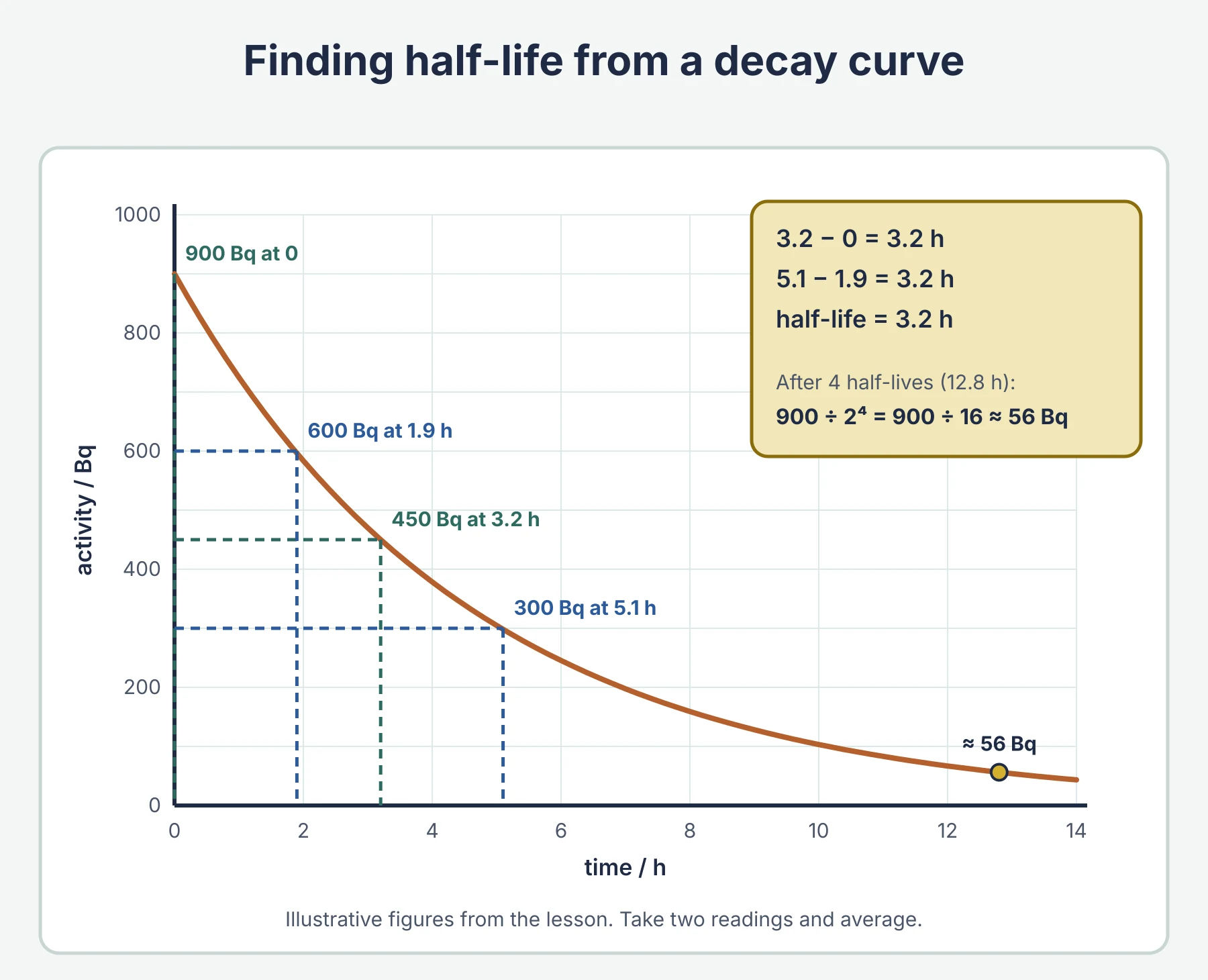
Graphical method. Plot activity (or corrected count rate) against time and draw a smooth curve. Pick a value on the activity axis, read the time; halve the value, read the time again; the difference is one half-life. Repeat from a different starting value and take the average.
Worked example. Illustrative figures. From a decay curve, the activity falls from 900 Bq to 450 Bq between t = 0 and t = 3.2 h, and from 600 Bq to 300 Bq between t = 1.9 h and t = 5.1 h. Both intervals are 3.2 h, so the half-life is 3.2 h. After four half-lives (12.8 h), the activity is 900 ÷ 2⁴ = 900 ÷ 16 ≈ 56 Bq.
Uses in industry and medicine (7.14)
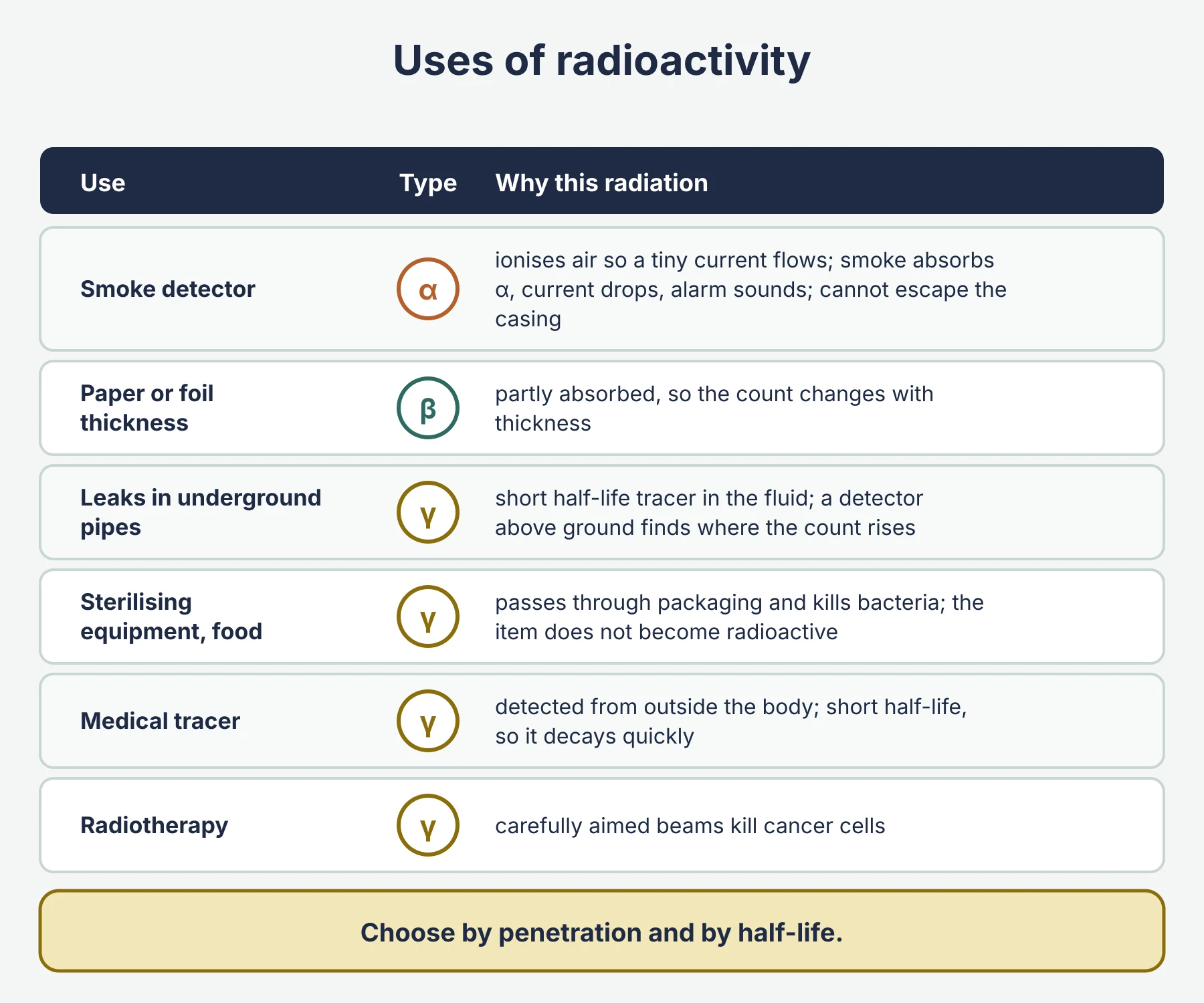
The choice of source depends on the radiation’s penetration and the isotope’s half-life.
- Smoke detectors (alpha): alpha ionises the air in a small chamber so a tiny current flows; smoke absorbs the alpha, the current drops and the alarm sounds. Alpha cannot escape the casing.
- Thickness monitoring of paper or foil (beta): partly absorbed, so the count changes with thickness.
- Finding leaks in underground pipes (gamma tracer): a short half-life gamma source is added to the fluid; a detector above ground finds where the count rises.
- Sterilising medical equipment and food (gamma): gamma passes through packaging and kills bacteria. The item does not become radioactive.
- Medical tracers (gamma, short half-life): detected from outside the body, then decays quickly.
- Radiotherapy (gamma): carefully aimed beams kill cancer cells.
Contamination, irradiation and dangers (7.15, 7.16)
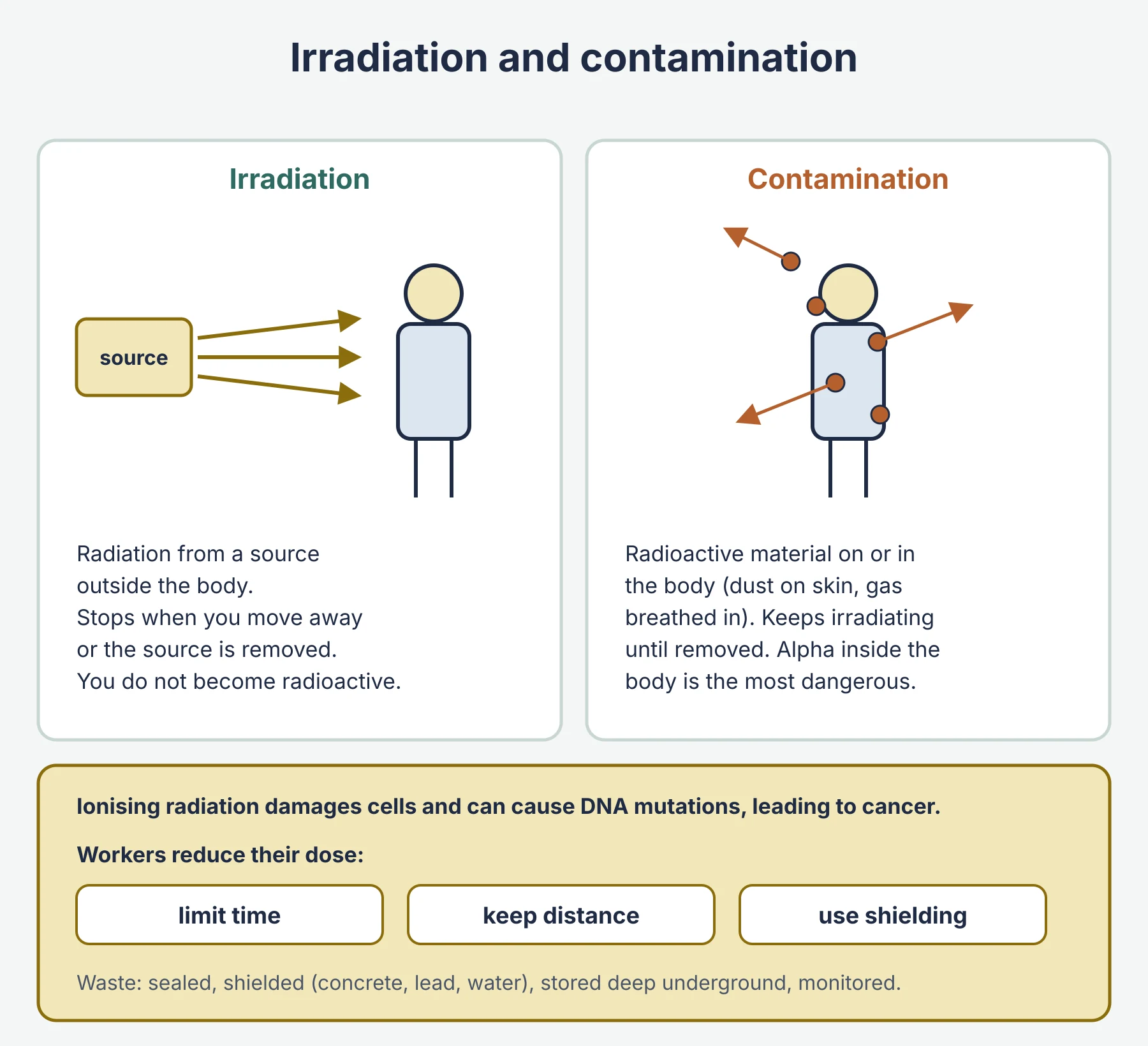
Irradiation is exposure to radiation from a source outside the body; it stops when you move away or the source is removed. Contamination means radioactive material gets onto or into something, such as dust on skin or a gas breathed in; it keeps irradiating until removed. Alpha sources are the most dangerous inside the body, because all their strongly ionising radiation is absorbed by nearby cells.
Ionising radiation can damage cells and tissue, and can cause mutations in DNA, which may lead to cancer.
Radioactive waste stays dangerous for a time that depends on its half-life; some waste remains active for thousands of years. Risks are reduced by sealing waste in containers, shielding it (concrete, lead, water), storing it securely, often deep underground in stable rock, and monitoring the site. Workers reduce their dose by limiting time, keeping their distance and using shielding.
Common mistakes
- Writing that beta is “an electron from the shells”. It comes from the nucleus.
- Balancing only the top numbers of a nuclear equation.
- Calling half-life “half the time it takes to decay completely”.
- Forgetting to subtract background before finding a half-life.
- Saying an irradiated object becomes radioactive.
- Stating alpha is harmless; it is very dangerous if inside the body.
Exam technique
- Complete (nuclear equations): check both rows add up, and name the new element only if the atomic number is given or can be found.
- Determine (half-life from a graph): draw construction lines on the graph and show two readings.
- Explain (choice of source): give the radiation type and a reason based on penetration or half-life.
- Describe (contamination versus irradiation): define both and give the key difference, whether the material is transferred.
More resources on this topic
- Radioactivity revision notes with a self-test
- Radioactivity practice questions, structured and with full answers
- Fission and fusion study guide, sub-topic 7(c)
Written against the Pearson Edexcel International GCSE in Physics (4PH1) specification, Issue 4. Always check the current specification for your examination year.
Related resources
-
Practice questions
Pearson Edexcel International GCSE Physics (4PH1): Radioactivity – Practice Questions
Original questions with mark-scheme answers on nuclides, decay equations, absorber data, half-life, uses, contamination and waste for Edexcel 4PH1 7b.
Physics · Pearson Edexcel · IGCSE
Try questions -
Revision notes
Pearson Edexcel International GCSE Physics (4PH1): Radioactivity – Revision Notes
Recall notes for Edexcel 4PH1 sub-topic 7b: nuclides, alpha, beta, gamma and neutrons, nuclear equations, background, half-life, uses and dangers.
Physics · Pearson Edexcel · IGCSE
Revise topic -
Study guides
Pearson Edexcel International GCSE Physics (4PH1): Units in radioactivity
Using the becquerel, centimetre, hour, minute and second in activity, count-rate and half-life work for Edexcel IGCSE Physics 4PH1 sub-topic 7a.
Physics · Pearson Edexcel · IGCSE
Read guide
Related articles
Get free revision emails (optional)
Occasional emails with practice questions, worked explanations and links to free resources for the qualification and subjects you choose. No spam, and you can unsubscribe from any email. The free tools on this site never need an email.