
Revision Notes
Pearson Edexcel International GCSE Physics (4PH1): Radioactivity – Revision Notes
Recall notes for Edexcel 4PH1 sub-topic 7b: nuclides, alpha, beta, gamma and neutrons, nuclear equations, background, half-life, uses and dangers.
- Subject
- Physics
- Level
- IGCSE
- Topic
- Radioactivity and particles
- Author
- Marlbridge Academic Team
- Updated
- Reviewed by
- Hassan (what this means)
Aligned to Pearson Edexcel IGCSE Physics (4PH1), Issue 4. Official specification .
Syllabus page (what it covers and how it is assessed): Pearson Edexcel IGCSE Physics.
Syllabus points this page covers
4PH1
- 7b Radioactivity
Found an error? Report a correction.
Need help with this topic? Request a free trial class for IGCSE Physics (4PH1).
Condensed notes for sub-topic 7(b) Radioactivity (statements 7.2 to 7.16) of Pearson Edexcel International GCSE Physics (4PH1). All core content. Full explanations and worked examples are in the Radioactivity study guide.
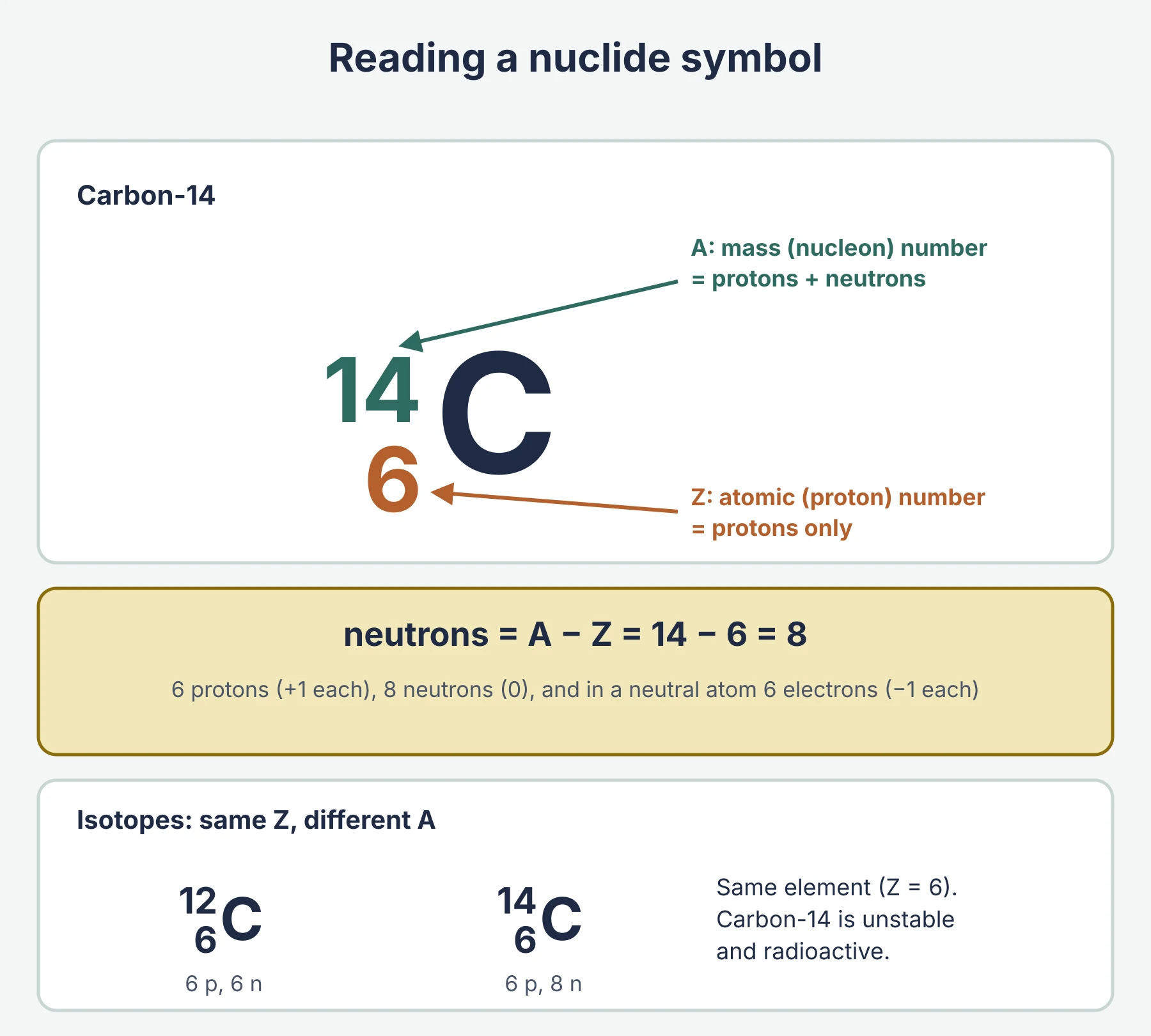
The nucleus
- Proton: charge +1, in nucleus. Neutron: charge 0, in nucleus. Electron: charge −1, around nucleus.
- Mass (nucleon) number A = protons + neutrons (top number).
- Atomic (proton) number Z = protons (bottom number).
- Neutrons = A − Z.
- Isotopes: same Z, different number of neutrons.
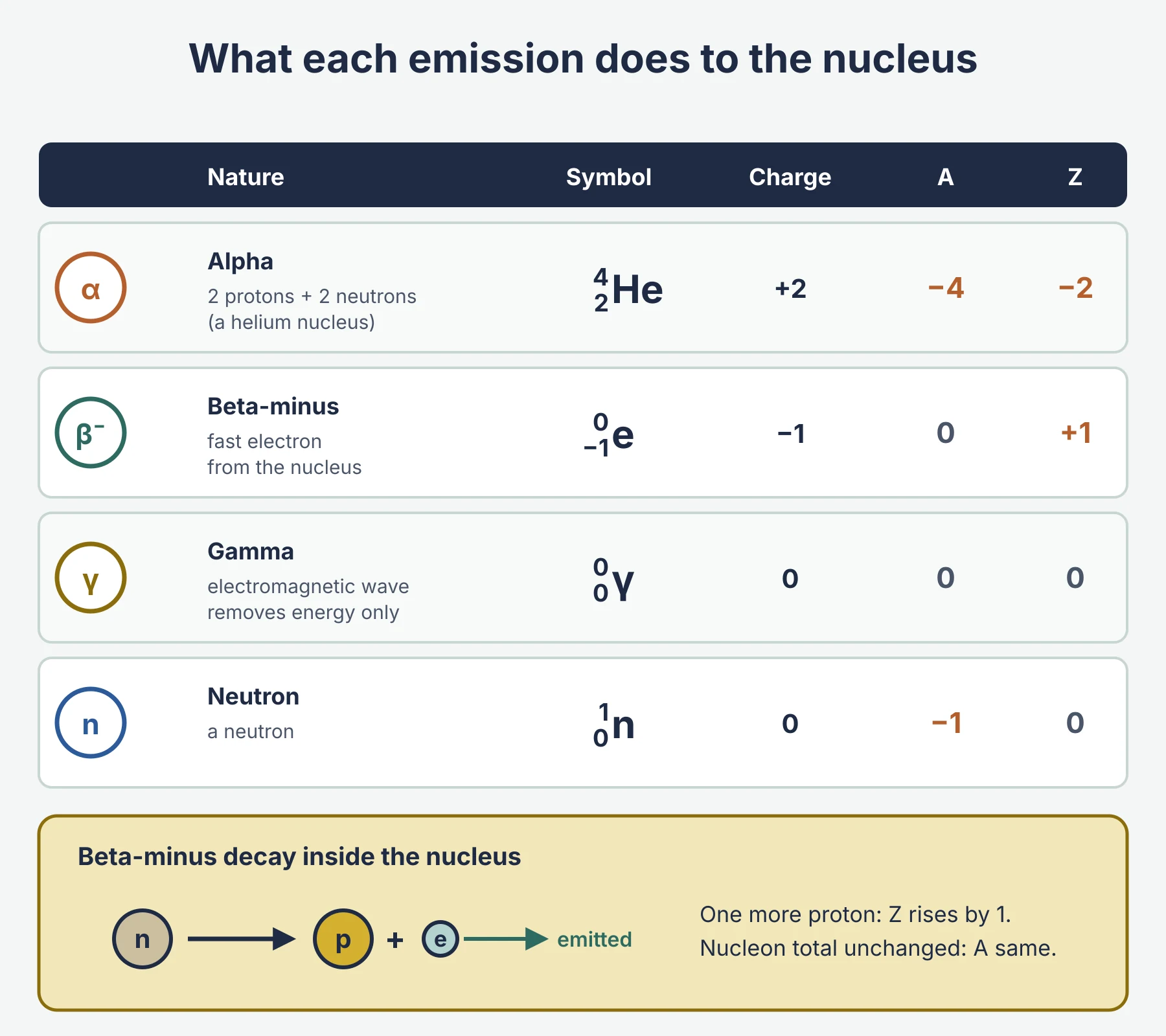
Four radiations
| α | β⁻ | γ | n | |
|---|---|---|---|---|
| What it is | Helium nucleus (2p + 2n) | Fast electron from nucleus | EM wave | Neutron |
| A changes by | −4 | 0 | 0 | −1 |
| Z changes by | −2 | +1 | 0 | 0 |
- Ionising: α strongest, γ weakest.
- Penetrating: α least (paper / few cm air), β middle (few mm aluminium), γ most (thick lead or concrete reduces it).
- Strong ionisers lose energy fast → short range.
- Decay is random and comes from unstable nuclei.
- β⁻: a neutron turns into a proton + electron; the electron leaves.
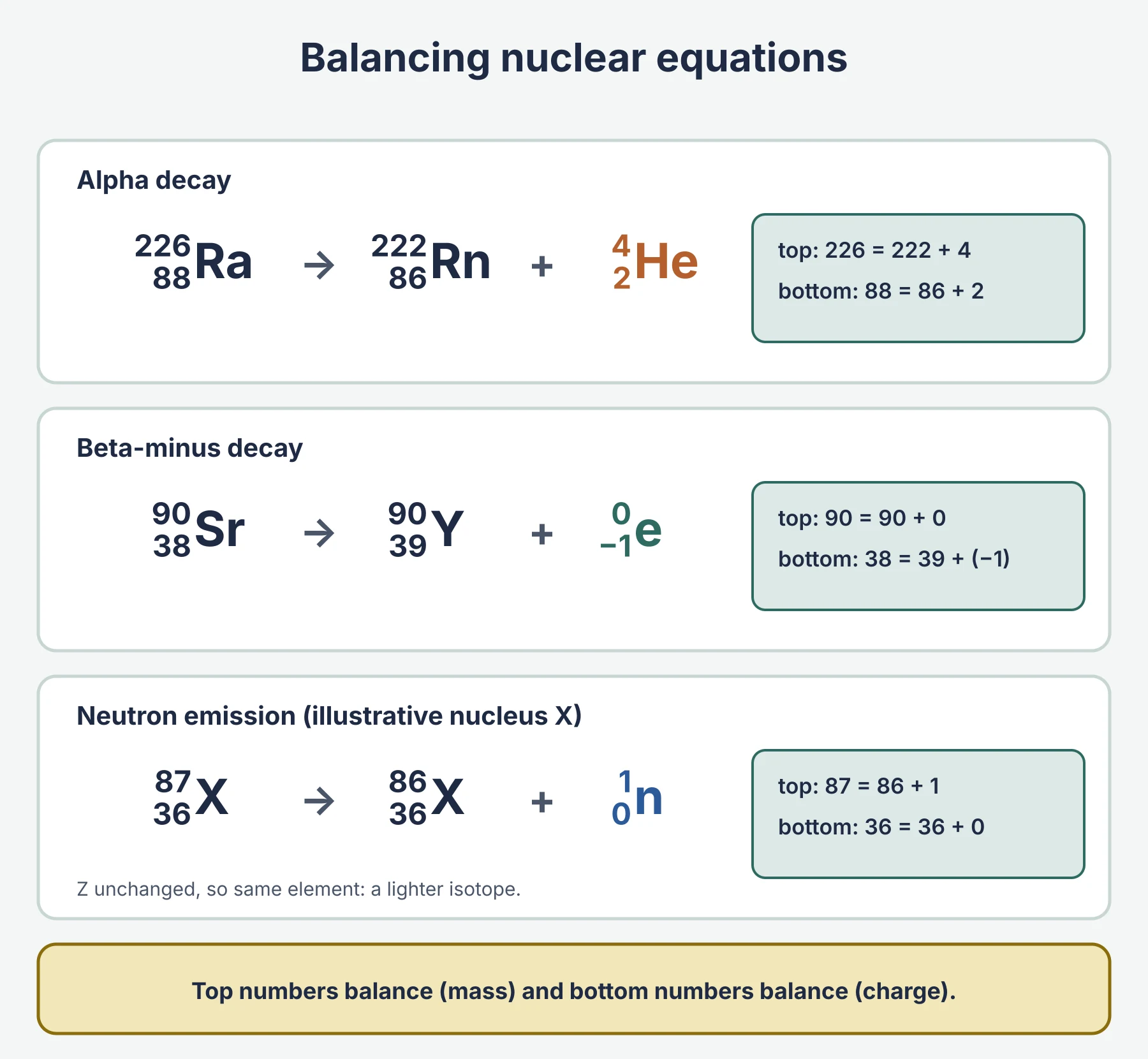
Nuclear equations
- Top numbers balance (mass). Bottom numbers balance (charge).
- α as ⁴₂He; β⁻ as ⁰₋₁e; γ as ⁰₀γ; neutron as ¹₀n.
- Example: ²¹⁰₈₄Po → ²⁰⁶₈₂Pb + ⁴₂He.
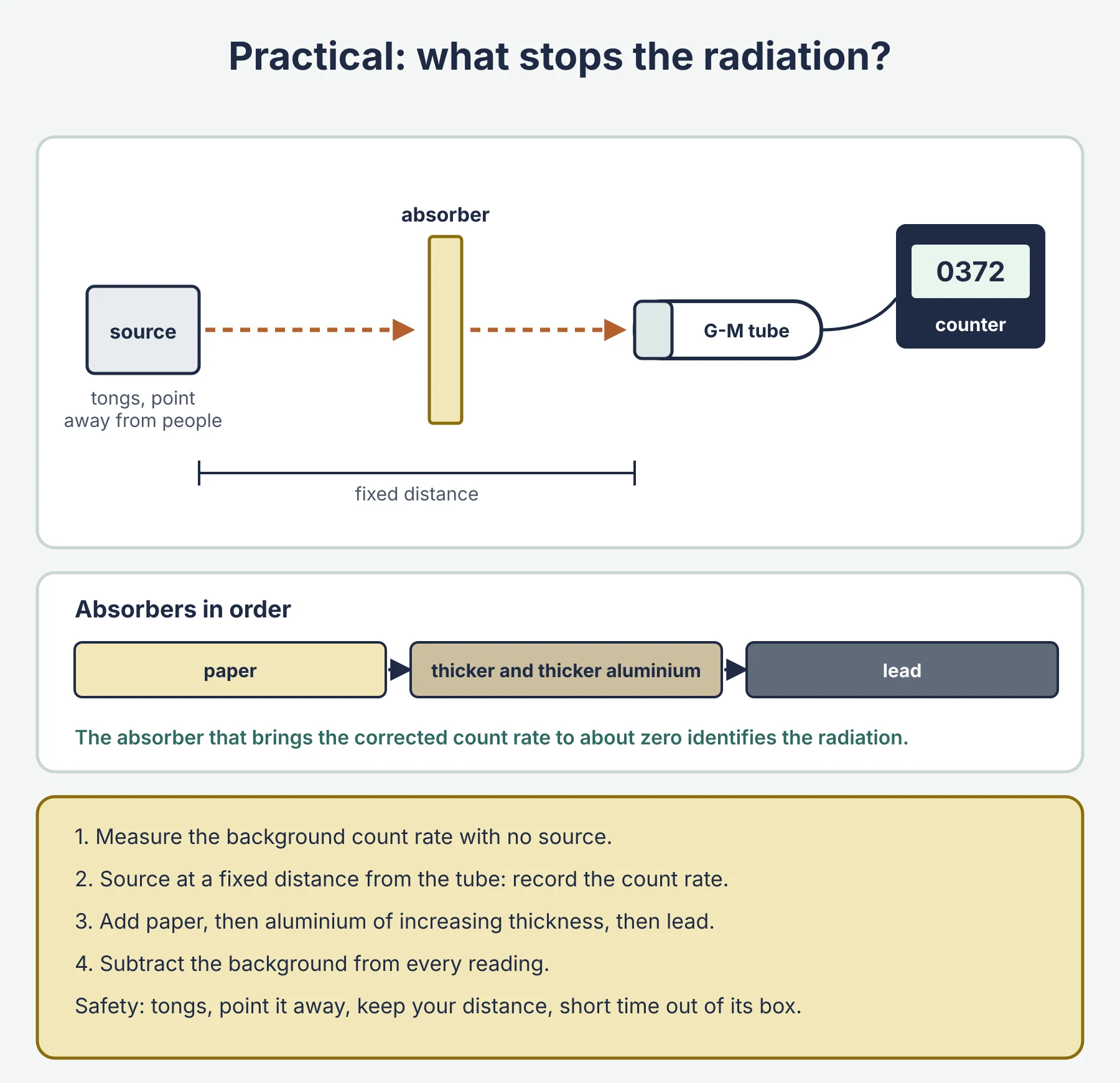
Penetration practical (7.6)
- Measure background first.
- Fixed source-to-tube distance.
- Add paper, then aluminium, then lead; record count rate each time.
- Subtract background; the absorber that stops it identifies the radiation.
- Simulations are allowed by the specification.
Detection and background
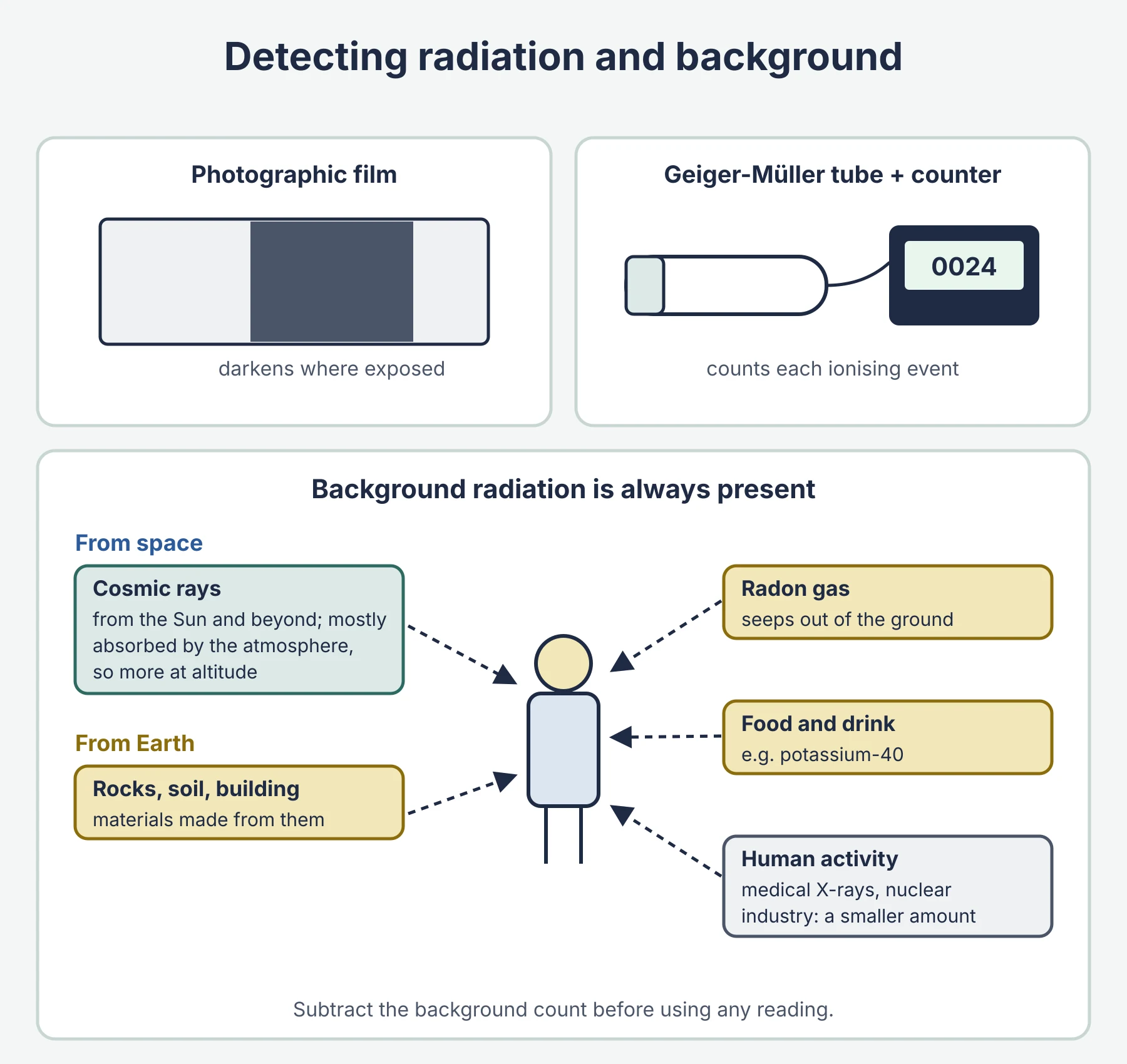
- Detectors: photographic film, Geiger-Müller tube.
- Earth: rocks, soil, building materials, radon gas, food and drink.
- Space: cosmic rays.
- Always subtract background count rate.
Half-life
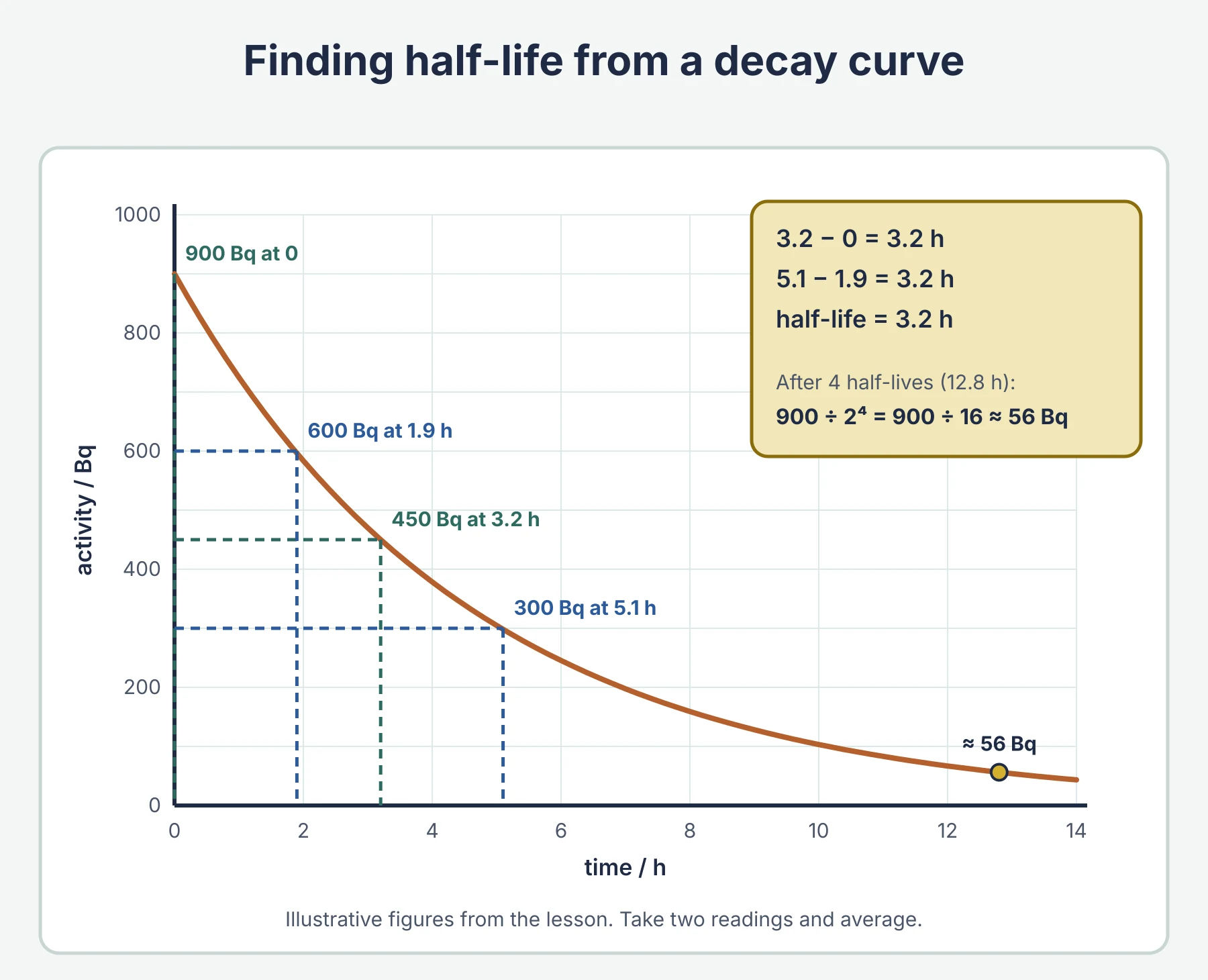
- Activity (Bq) decreases over time.
- Half-life: time for activity (or number of unstable nuclei) to halve.
- Different for different isotopes.
- After n half-lives, the fraction left is 1/2ⁿ: 1/2, 1/4, 1/8, 1/16…
- Graph method: read time to halve from two starting points; average.
Uses (7.14)
| Use | Radiation | Why |
|---|---|---|
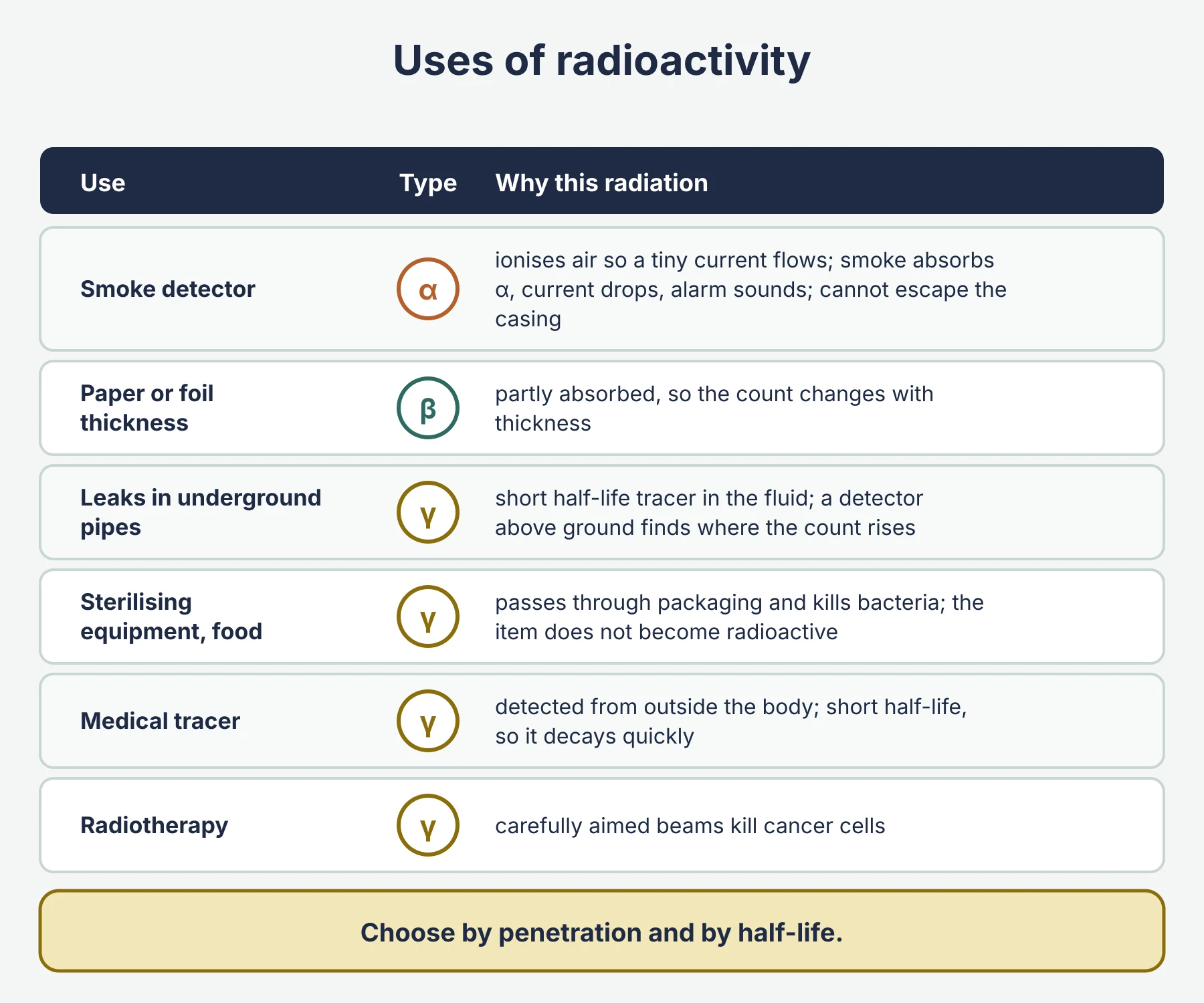
| Smoke detector | α | Ionises air; stopped by smoke; cannot escape casing |
| Paper or foil thickness | β | Partly absorbed, so count depends on thickness |
| Pipe leak tracer | γ | Passes through soil; short half-life |
| Sterilising equipment and food | γ | Penetrates packaging; kills microbes |
| Medical tracer | γ | Detected outside the body; short half-life |
| Radiotherapy | γ | Kills cancer cells in a targeted beam |
Safety
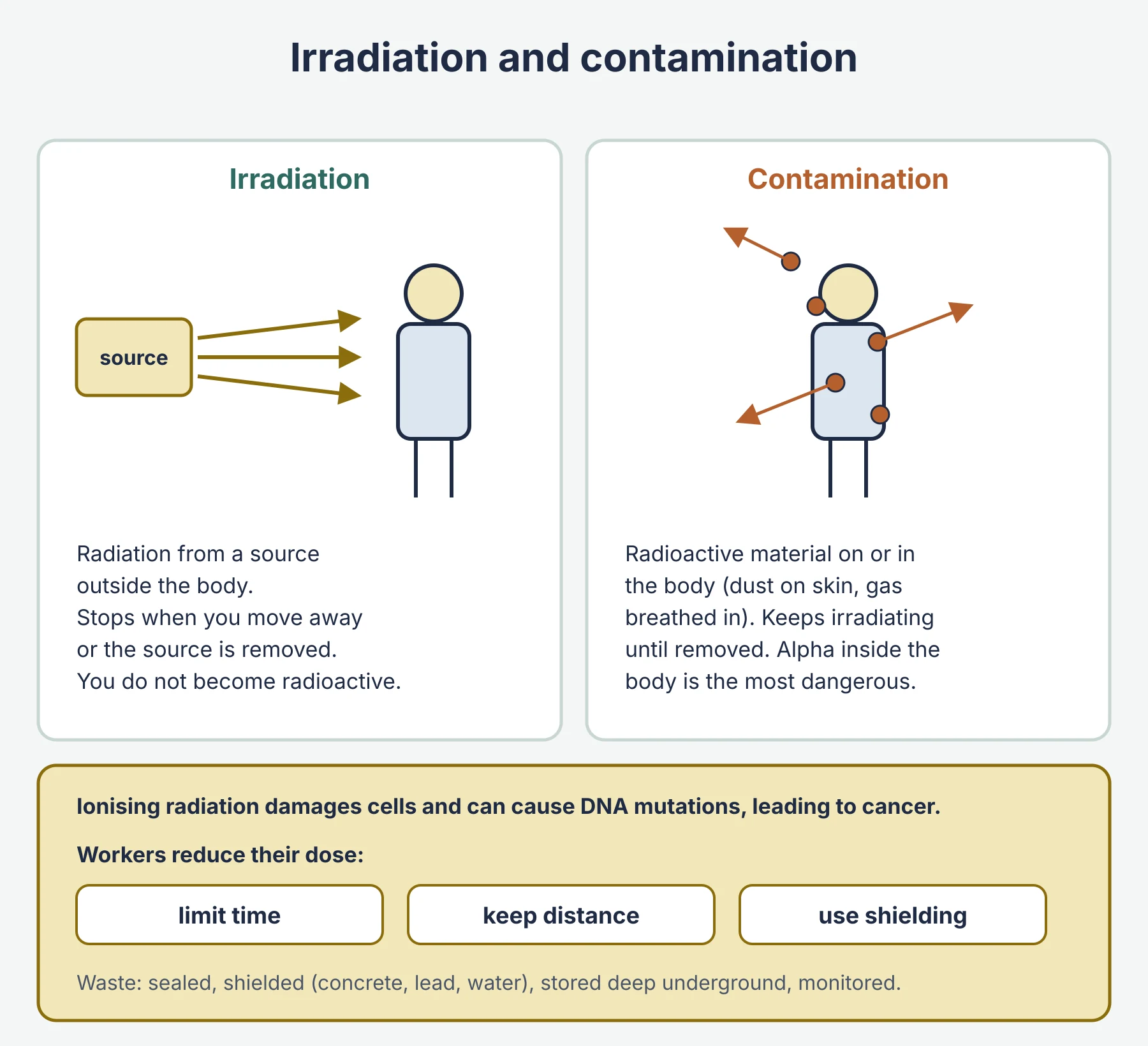
- Irradiation: exposure from an external source; stops when removed. Object does not become radioactive.
- Contamination: radioactive material on or in something; continues until removed.
- Dangers: mutations, damage to cells and tissue.
- Waste: sealed containers, shielding, secure storage (often deep underground), monitoring; long half-lives mean long storage.
- Reduce dose: less time, more distance, shielding.
Key terms
| Term | Meaning |
|---|---|
| Isotope | Atom of the same element with a different number of neutrons |
| Ionising radiation | Radiation that knocks electrons out of atoms, forming ions |
| Activity | Number of decays per second, in becquerels |
| Half-life | Time for activity or number of unstable nuclei to fall by half |
| Background radiation | Radiation always present from natural and artificial sources |
| Contamination | Unwanted radioactive material on or inside an object |
| Irradiation | Exposure to radiation from an external source |
| Mutation | Change in DNA caused, for example, by ionising radiation |
Exam traps
- β⁻ comes from the nucleus, not the electron shells.
- Balancing only A, not Z.
- Gamma changes neither A nor Z.
- Not subtracting background before calculating half-life.
- Saying sterilised food becomes radioactive.
- “Alpha is safe”: only outside the body.
Self-test
- How many neutrons are in ²³⁸₉₂U?
- What are isotopes?
- Why does alpha radiation have the shortest range?
- What happens inside the nucleus during β⁻ decay?
- Complete: ⁴⁰₁₉K → ? + ⁰₋₁e.
- State the change in A and Z for neutron emission.
- Name two sources of background radiation from Earth and one from space.
- A source’s activity falls from 1200 Bq to 150 Bq in 24 min. Find the half-life.
- Why is a short half-life chosen for a medical tracer?
- Why does gamma, not alpha, sterilise packaged equipment?
- Distinguish contamination from irradiation.
- Give two ways of reducing the risks of storing radioactive waste.
Answers
- 238 − 92 = 146.
- Atoms of the same element (same proton number) with different numbers of neutrons.
- It is strongly ionising, so it loses its energy in a short distance.
- A neutron changes into a proton, and a high-speed electron is emitted.
- ⁴⁰₂₀Ca (calcium-40).
- A decreases by 1; Z is unchanged.
- Earth: any two of rocks/soil, building materials, radon gas, food and drink. Space: cosmic rays.
- 1200 → 600 → 300 → 150 is 3 half-lives; half-life = 24 ÷ 3 = 8 min.
- Its activity falls quickly, so the patient’s dose is limited, while it still lasts long enough to be detected.
- Gamma penetrates the packaging; alpha would be stopped by it.
- Contamination: radioactive material is transferred onto or into the object and keeps emitting. Irradiation: exposure from outside; it stops when the source is removed and leaves nothing radioactive behind.
- Any two: seal in containers; shield with concrete, lead or water; store securely deep underground; monitor the site.
Frequently asked questions
Is any of 4PH1 sub-topic 7b Physics-only? No. Statements 7.2 to 7.16 have no “P” reference, so they can appear on both papers.
Must I use real sources for the penetration practical? No. Statement 7.6 allows either radioactive sources or simulations.
Next: the Radioactivity practice questions.
Related resources
-
Study guides
Pearson Edexcel International GCSE Physics (4PH1): Units in radioactivity
Using the becquerel, centimetre, hour, minute and second in activity, count-rate and half-life work for Edexcel IGCSE Physics 4PH1 sub-topic 7a.
Physics · Pearson Edexcel · IGCSE
Read guide -
Practice questions
Pearson Edexcel International GCSE Physics (4PH1): Units in radioactivity – Practice Questions
Original questions with worked answers on becquerels, count rates, time conversions and centimetre ranges in radioactivity, for Edexcel 4PH1 sub-topic 7a.
Physics · Pearson Edexcel · IGCSE
Try questions -
Revision notes
Pearson Edexcel International GCSE Physics (4PH1): Units in radioactivity – Revision Notes
Recall notes for Edexcel 4PH1 sub-topic 7a: the becquerel, count rate units, time conversions and centimetres in radioactivity, with a 12-question self-test.
Physics · Pearson Edexcel · IGCSE
Revise topic
Related articles
Get free revision emails (optional)
Occasional emails with practice questions, worked explanations and links to free resources for the qualification and subjects you choose. No spam, and you can unsubscribe from any email. The free tools on this site never need an email.