
Study Guides
Pearson Edexcel International GCSE Physics (4PH1): Fission and fusion
Fission of U-235, chain reactions, control rods, moderator, shielding, and fusion in stars and why it needs extreme conditions, for Edexcel 4PH1 sub-topic 7c.
- Subject
- Physics
- Level
- IGCSE
- Topic
- Radioactivity and particles
- Author
- Marlbridge Academic Team
- Updated
- Reviewed by
- Hassan (what this means)
Aligned to Pearson Edexcel IGCSE Physics (4PH1), Issue 4. Official specification .
Syllabus page (what it covers and how it is assessed): Pearson Edexcel IGCSE Physics.
Syllabus points this page covers
4PH1
- 7c Fission and fusion
Found an error? Report a correction.
Need help with this topic? Request a free trial class for IGCSE Physics (4PH1).
This guide covers sub-topic 7(c) Fission and fusion of the Pearson Edexcel International GCSE in Physics (4PH1), Issue 4 specification: statements 7.17 to 7.26. None has a “P” reference, so all of it is core content, examinable on both papers. It builds on nuclide notation and nuclear equations from the Radioactivity study guide; a short summary of the whole topic is in Radioactivity and Particles.
What the specification asks for
- 7.17 nuclear reactions, including fission, fusion and radioactive decay, can be a source of energy
- 7.18 how a nucleus of U-235 can be split by collision with a neutron, releasing energy as kinetic energy of the fission products
- 7.19 fission of U-235 produces two radioactive daughter nuclei and a small number of neutrons
- 7.20 how a chain reaction can be set up
- 7.21 the role of the control rods and moderator
- 7.22 the role of shielding around a nuclear reactor
- 7.23 the difference between fusion and fission
- 7.24 fusion as the creation of larger nuclei from smaller nuclei, with a loss of mass and a release of energy
- 7.25 fusion is the energy source for stars
- 7.26 why fusion does not happen at low temperatures and pressures, due to electrostatic repulsion of protons
Nuclear reactions as energy sources (7.17)
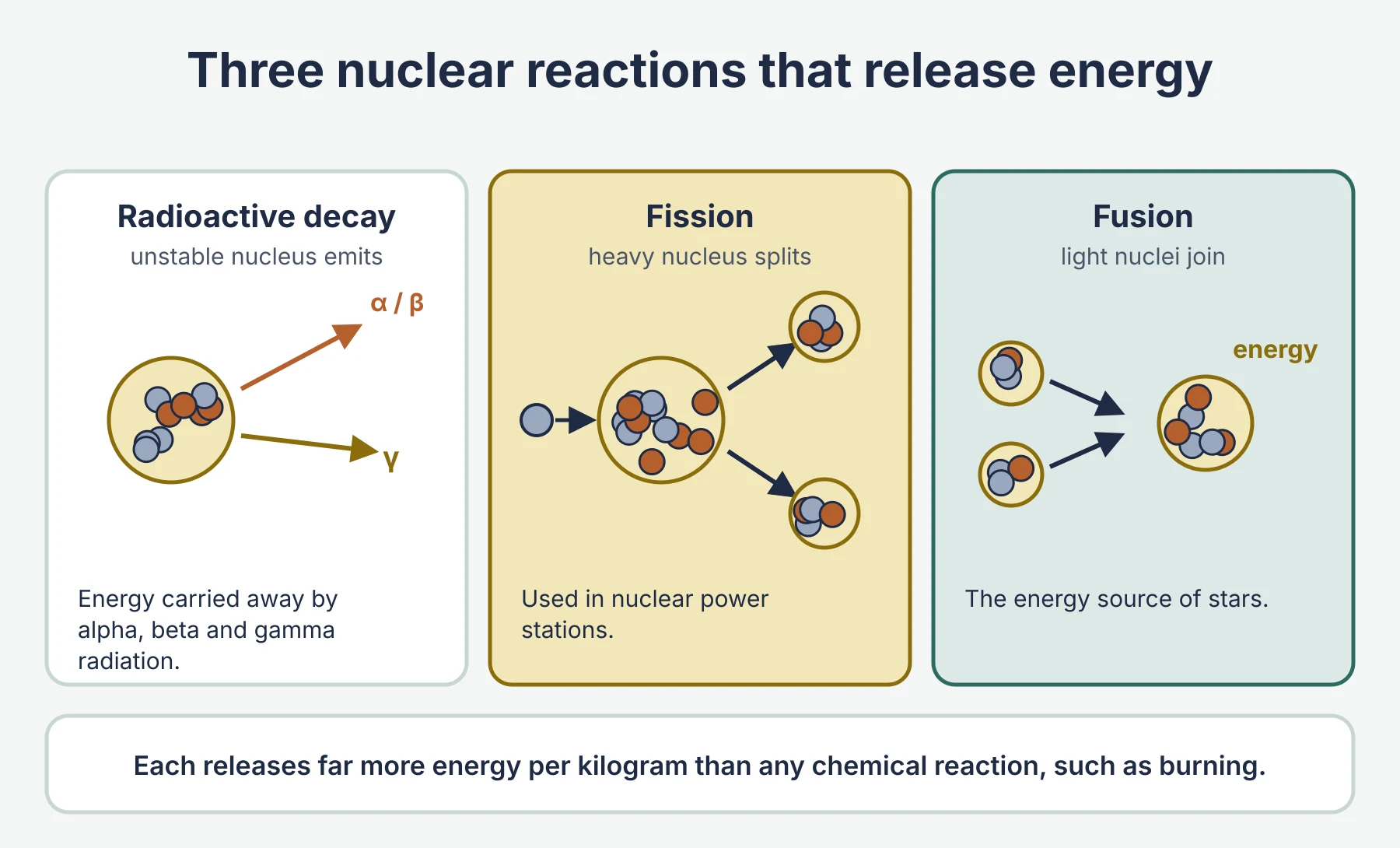
Three kinds of nuclear reaction release energy: radioactive decay (the energy carried away by alpha, beta and gamma radiation), fission (splitting heavy nuclei) and fusion (joining light nuclei). Each releases far more energy per kilogram of fuel than any chemical reaction, such as burning. Nuclear power stations use fission; stars use fusion.
How fission happens (7.18, 7.19)
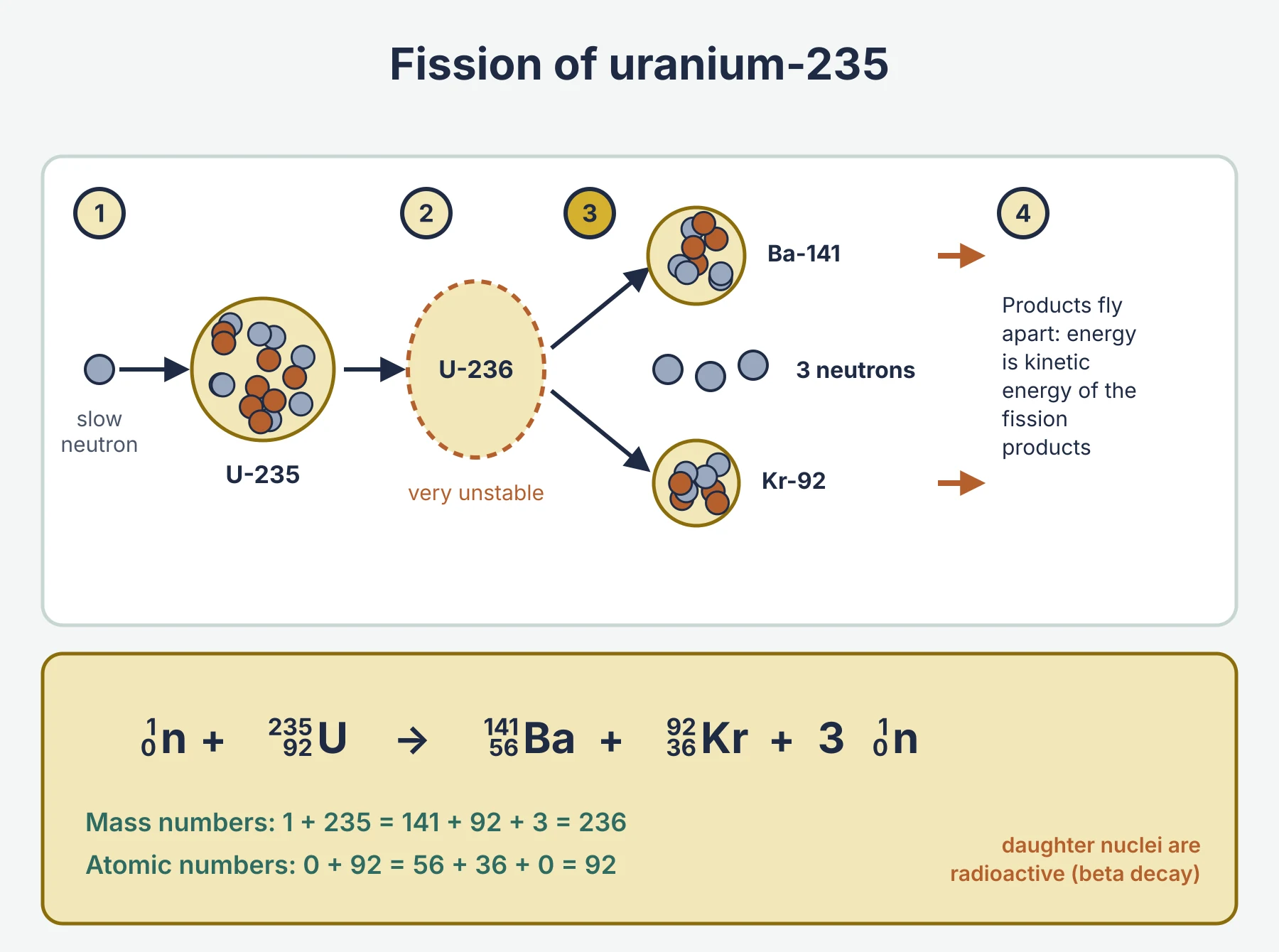
- A slow-moving neutron is absorbed by a uranium-235 nucleus.
- The nucleus becomes very unstable (it is now uranium-236).
- It splits into two smaller nuclei of roughly similar size, called daughter nuclei, and releases two or three neutrons.
- The products fly apart at high speed: the energy released is mostly kinetic energy of the fission products. In a reactor this becomes thermal energy as the fragments collide with surrounding atoms.
One possible fission, with the neutron shown on the left:
¹₀n + ²³⁵₉₂U → ¹⁴¹₅₆Ba + ⁹²₃₆Kr + 3 ¹₀nCheck: mass numbers 1 + 235 = 141 + 92 + 3 = 236; atomic numbers 0 + 92 = 56 + 36 + 0 = 92. The daughter nuclei are not always barium and krypton; U-235 can split in many different ways, but the pattern of two daughter nuclei plus a few neutrons is always the same.
The daughter nuclei are radioactive. They have too many neutrons to be stable, so they decay, mostly by beta emission. This is why spent fuel is dangerous and must be handled as radioactive waste.
Chain reactions (7.20)
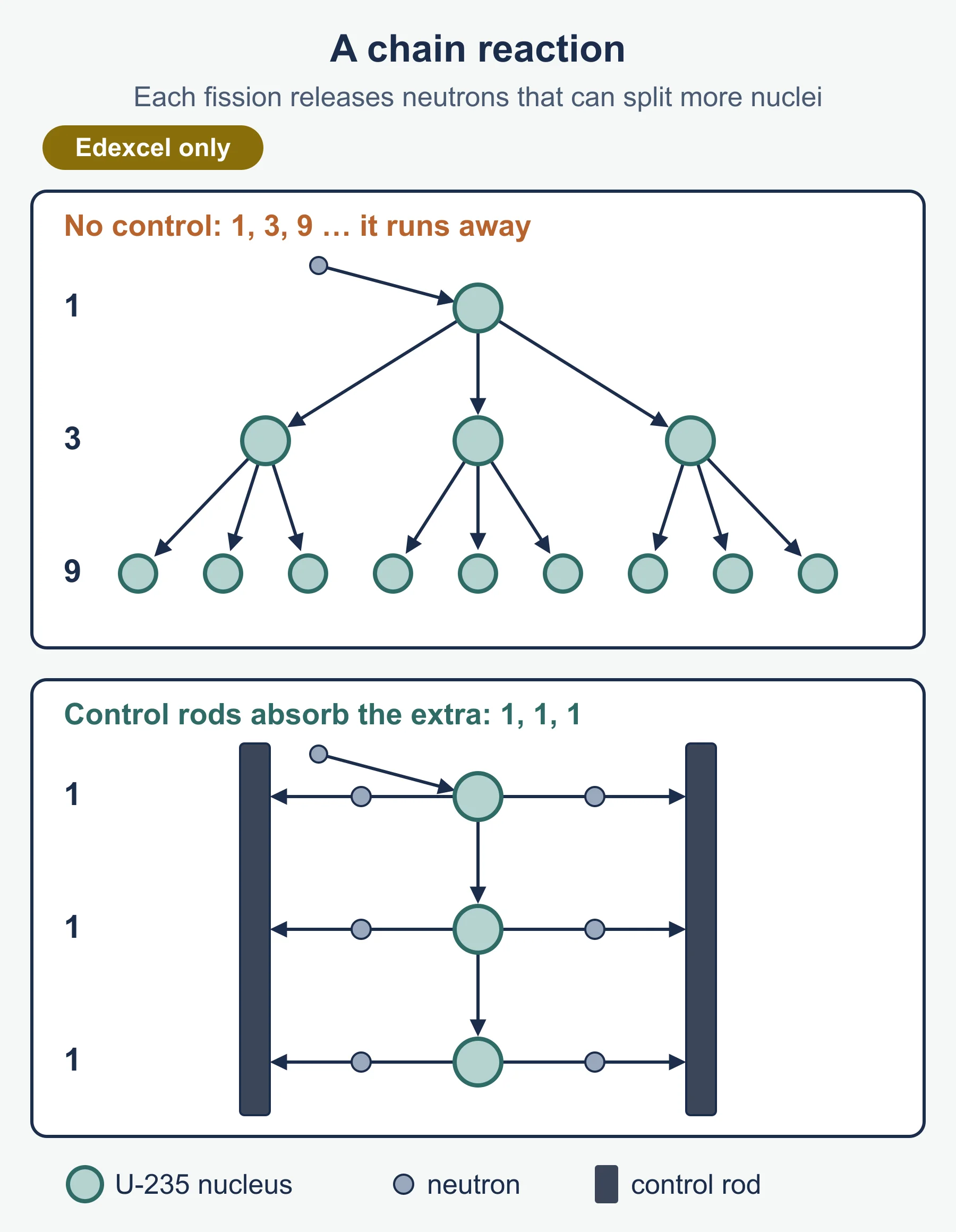
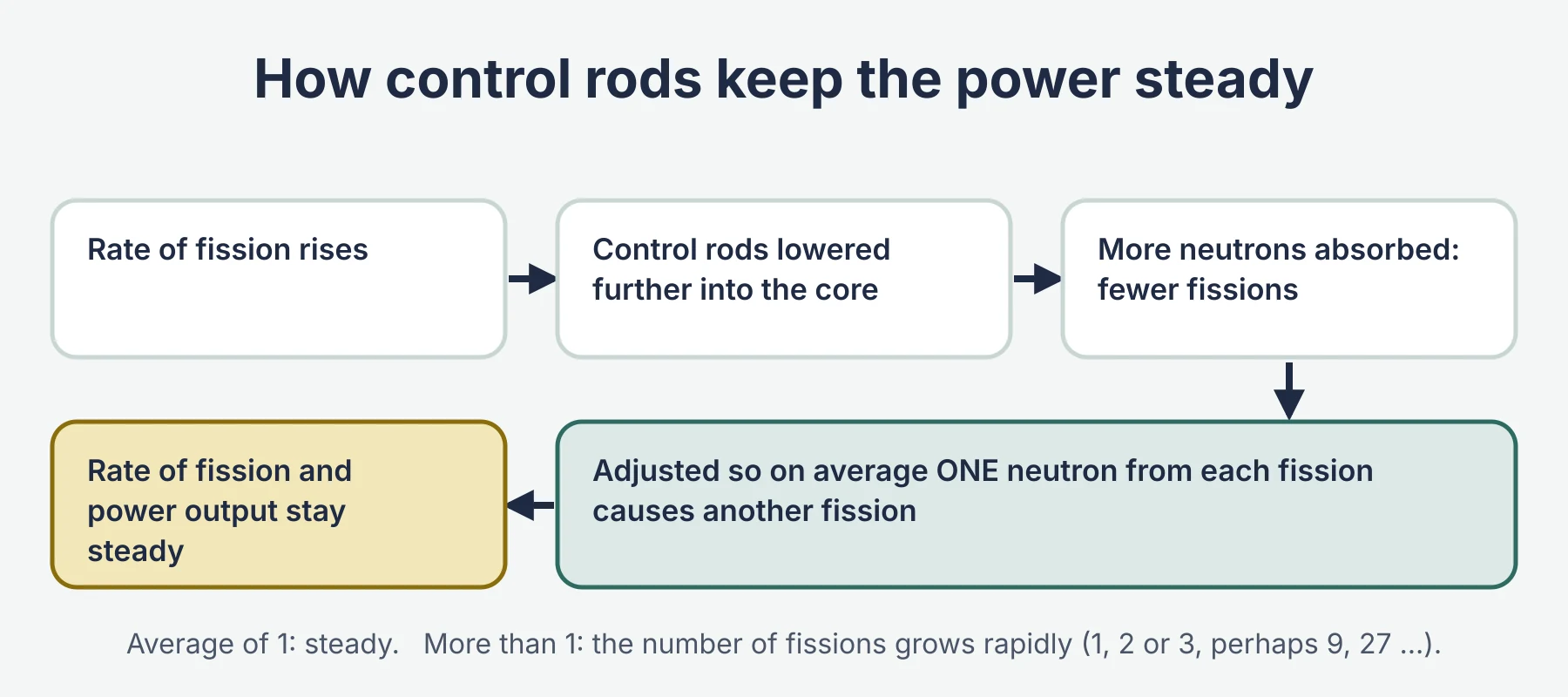
Each fission releases two or three neutrons. If on average at least one of these goes on to cause another fission, the reaction keeps itself going: a chain reaction. If more than one does, the number of fissions grows rapidly: 1, then 2 or 3, then perhaps 9, 27… each generation following the last in a tiny fraction of a second. Uncontrolled, this releases energy explosively. In a power station, the chain reaction is controlled so that, on average, exactly one neutron from each fission causes a further fission, giving a steady energy output.
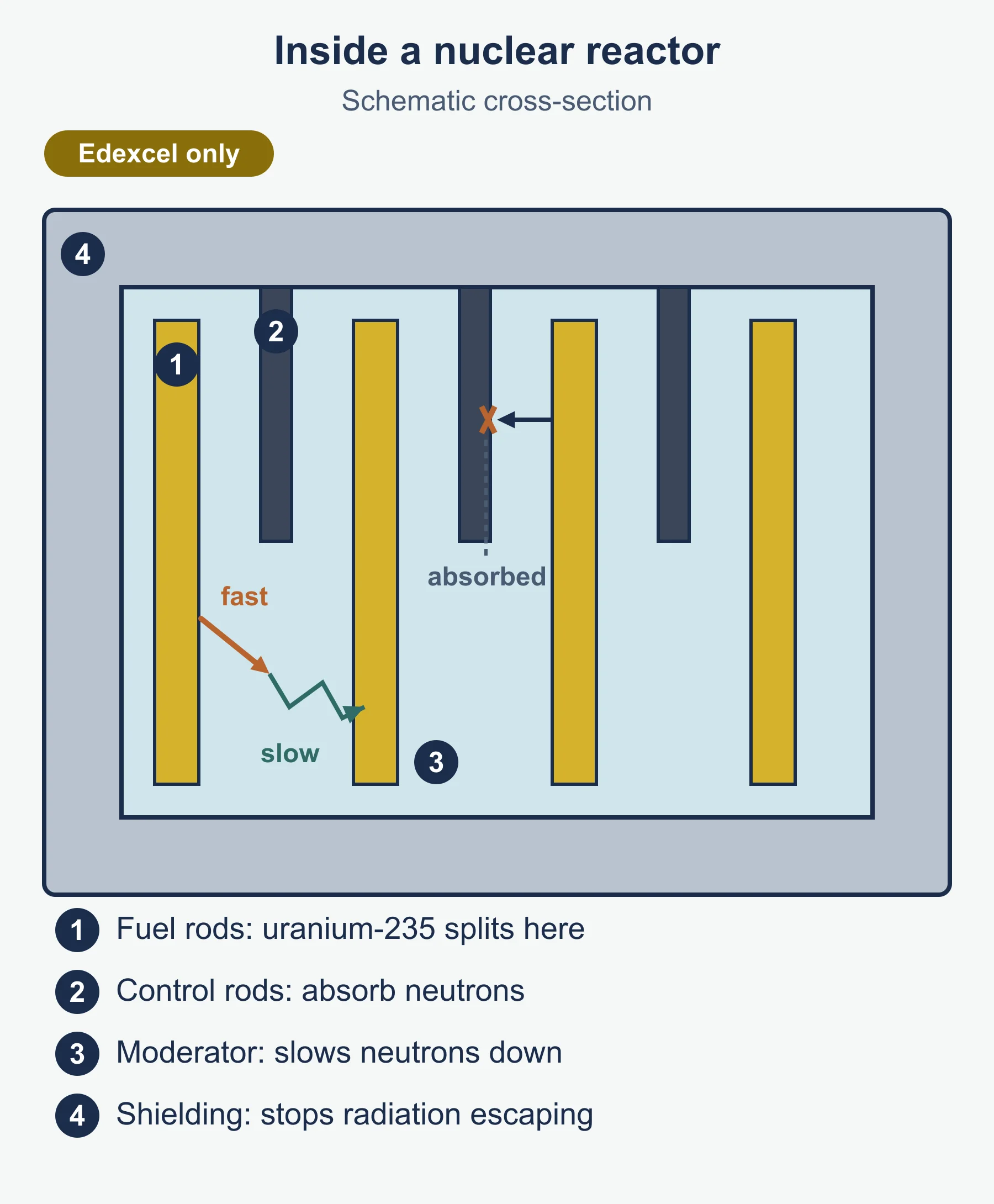
Inside the reactor (7.21, 7.22)
| Part | Material (typical) | Role |
|---|---|---|
| Fuel rods | Uranium enriched in U-235 | Where fission happens |
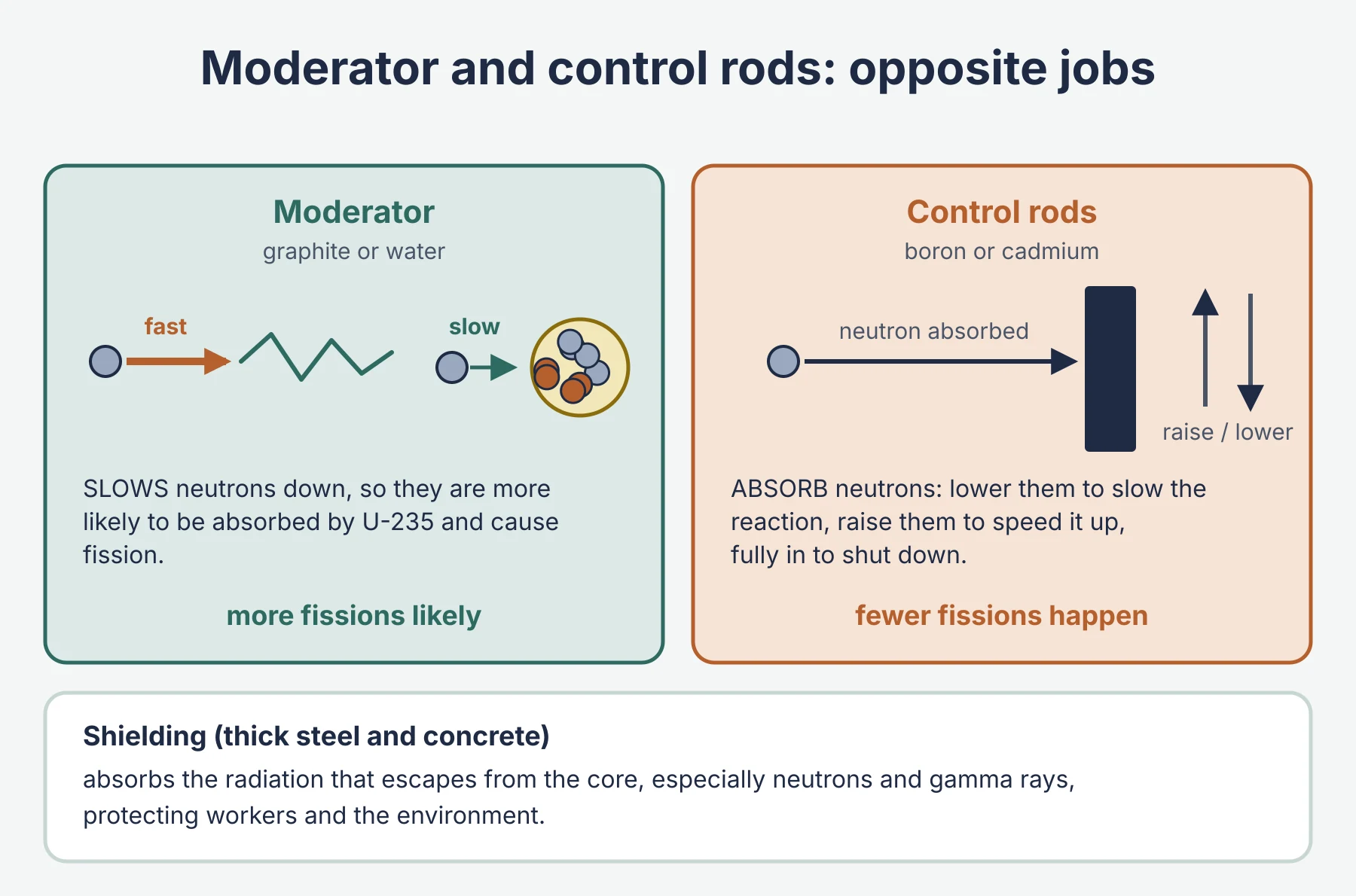
| Moderator | Graphite or water | Slows down the fast neutrons released by fission, so they are more likely to be absorbed by U-235 nuclei and cause further fission |
| Control rods | Boron or cadmium | Absorb neutrons, controlling the rate of fission; lowered further in to slow the reaction, raised to speed it up, fully inserted to shut the reactor down |
| Shielding | Thick steel and concrete | Absorbs the radiation (especially neutrons and gamma rays) that escapes from the core, protecting workers and the environment |
A frequent confusion is to treat the moderator and control rods as doing the same thing. They have opposite effects on the reaction: the moderator makes more fissions likely by slowing neutrons; the control rods make fewer fissions happen by removing neutrons.
Fusion (7.24, 7.25)
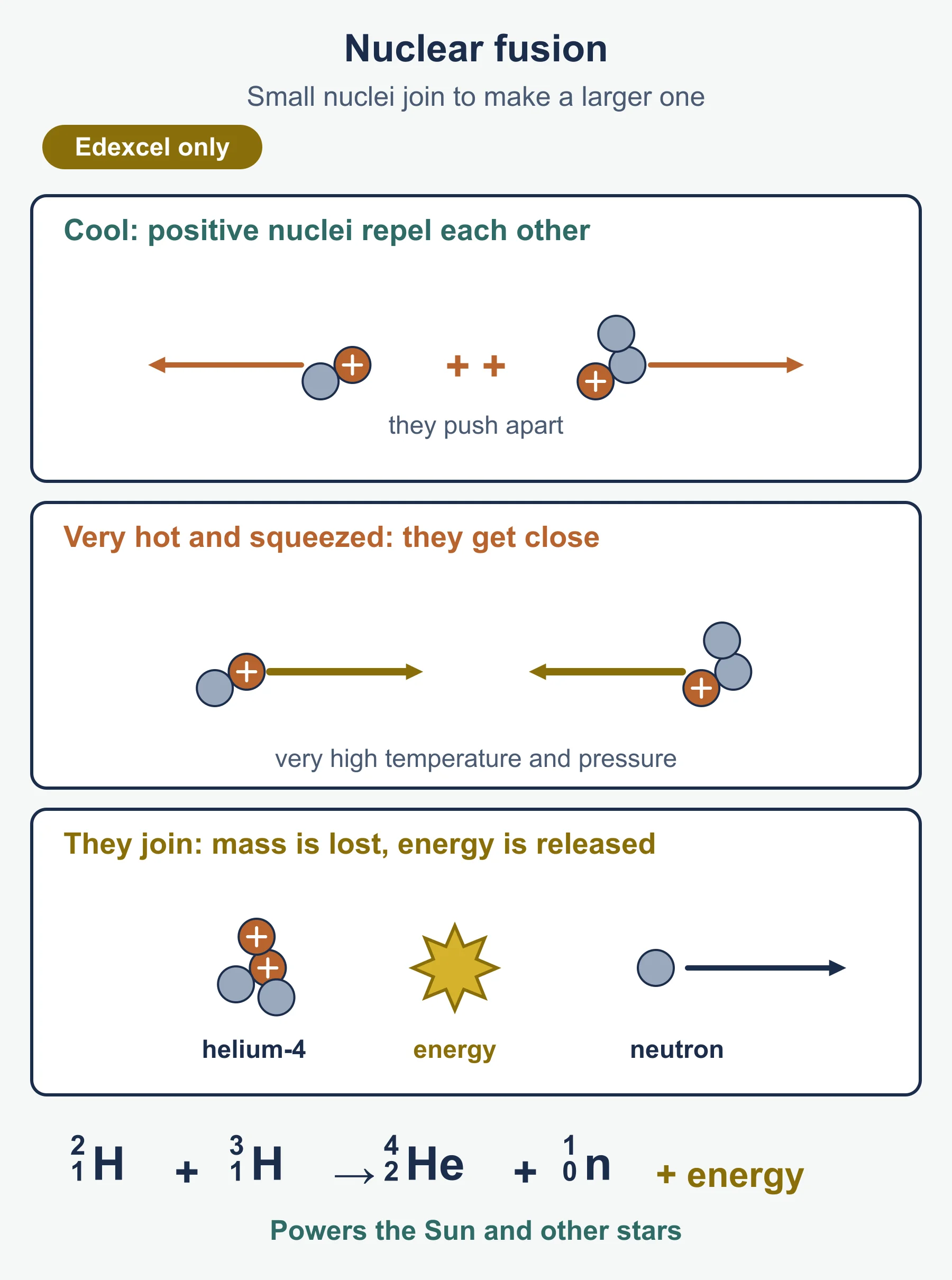
Fusion is the joining of two light nuclei to form a heavier (larger) nucleus. The total mass of the products is slightly less than the mass of the nuclei that fused, and this loss of mass is accompanied by a release of energy.
One example uses two isotopes of hydrogen, deuterium and tritium:
²₁H + ³₁H → ⁴₂He + ¹₀nCheck: 2 + 3 = 4 + 1; 1 + 1 = 2 + 0.
Fusion is the energy source for stars. In a main sequence star such as the Sun, hydrogen nuclei fuse, in several steps, to form helium, releasing the energy that the star radiates.
Why fusion needs extreme conditions (7.26)
Nuclei are positively charged because they contain protons. Two nuclei repel each other electrostatically, and the repulsion becomes enormous as they get very close. To fuse, they must come close enough for the attraction that holds nuclei together to take over.
- At low temperatures, nuclei move too slowly: they are pushed apart before they get close enough. Only at temperatures of millions of degrees Celsius do they move fast enough to overcome the repulsion.
- At low pressures (low density), collisions are too rare for fusion to happen at a useful rate. High pressure packs the nuclei closely, so collisions are frequent.
Stars provide both conditions in their cores, where gravity squeezes the gas. On Earth, these conditions are very hard to create and contain, which is why fusion is not yet used in power stations.
Fission versus fusion (7.23)
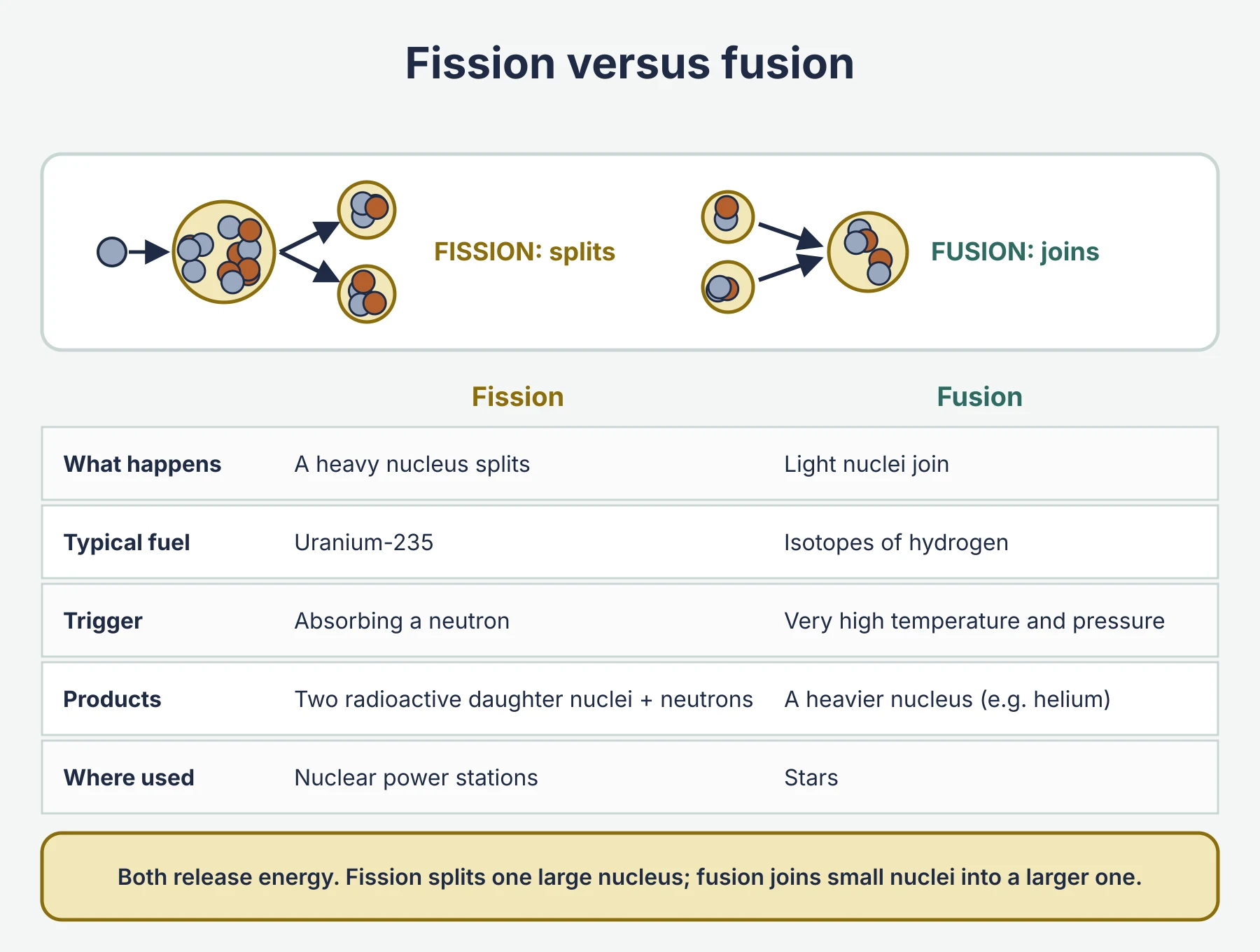
| Fission | Fusion | |
|---|---|---|
| What happens | A heavy nucleus splits | Light nuclei join |
| Typical fuel | Uranium-235 | Isotopes of hydrogen |
| Trigger | Absorbing a neutron | Very high temperature and pressure |
| Products | Two radioactive daughter nuclei + neutrons | A heavier nucleus (e.g. helium) |
| Where used | Nuclear power stations | Stars |
Both release energy. The key difference to state is the direction: fission splits one large nucleus into smaller ones; fusion joins small nuclei into a larger one.
Worked example: an “explain” answer
Explain how the control rods are used to keep the power output of a reactor constant. (3 marks)
Model answer: control rods absorb neutrons [1]. If the rate of fission rises, the rods are lowered further into the core so that more neutrons are absorbed and fewer fissions occur [1]. They are adjusted so that, on average, one neutron from each fission goes on to cause another fission, keeping the rate of fission, and so the power output, steady [1].
Common mistakes
- Saying the moderator absorbs neutrons. It slows them.
- Saying fission is started by a proton, or by heat.
- Forgetting that the daughter nuclei are radioactive.
- Writing that fusion “needs high temperature to melt the nuclei”; it is about speed to overcome repulsion.
- Explaining the need for high temperature without mentioning that protons, and so nuclei, are positively charged.
- Mixing up which process powers stars.
Exam technique
- Describe (fission): give the sequence in order: neutron absorbed, nucleus splits, two daughter nuclei, two or three neutrons, kinetic energy.
- Explain (fusion conditions): link each condition to its reason: high temperature → high speed → overcomes electrostatic repulsion; high pressure → frequent collisions.
- Explain the difference (7.23): make a direct comparison in one sentence, not two separate descriptions.
- Complete (equations): balance both rows, remembering to multiply the neutron numbers.
More resources on this topic
- Fission and fusion revision notes with a self-test
- Fission and fusion practice questions with mark-scheme answers
- Stellar evolution study guide, where fusion powers the main sequence
Written against the Pearson Edexcel International GCSE in Physics (4PH1) specification, Issue 4. Always check the current specification for your examination year.
Related resources
-
Practice questions
Pearson Edexcel International GCSE Physics (4PH1): Fission and fusion – Practice Questions
Original questions with full answers on fission equations, chain reactions, reactor control, shielding and the conditions for fusion, for Edexcel 4PH1 7c.
Physics · Pearson Edexcel · IGCSE
Try questions -
Revision notes
Pearson Edexcel International GCSE Physics (4PH1): Fission and fusion – Revision Notes
Recall notes for Edexcel 4PH1 sub-topic 7c: U-235 fission, chain reactions, moderator, control rods, shielding and fusion, with a 12-question self-test.
Physics · Pearson Edexcel · IGCSE
Revise topic -
Study guides
Pearson Edexcel International GCSE Physics (4PH1): Radioactivity
Nuclide notation, the four radiations, nuclear equations, background radiation, half-life graphs, uses and dangers of radiation for Edexcel 4PH1 sub-topic 7b.
Physics · Pearson Edexcel · IGCSE
Read guide
Related articles
Get free revision emails (optional)
Occasional emails with practice questions, worked explanations and links to free resources for the qualification and subjects you choose. No spam, and you can unsubscribe from any email. The free tools on this site never need an email.