
Revision Notes
Pearson Edexcel International GCSE Physics (4PH1): Fission and fusion – Revision Notes
Recall notes for Edexcel 4PH1 sub-topic 7c: U-235 fission, chain reactions, moderator, control rods, shielding and fusion, with a 12-question self-test.
- Subject
- Physics
- Level
- IGCSE
- Topic
- Radioactivity and particles
- Author
- Marlbridge Academic Team
- Updated
- Reviewed by
- Hassan (what this means)
Aligned to Pearson Edexcel IGCSE Physics (4PH1), Issue 4. Official specification .
Syllabus page (what it covers and how it is assessed): Pearson Edexcel IGCSE Physics.
Syllabus points this page covers
4PH1
- 7c Fission and fusion
Found an error? Report a correction.
Need help with this topic? Request a free trial class for IGCSE Physics (4PH1).
Condensed notes for sub-topic 7(c) Fission and fusion (statements 7.17 to 7.26) of Pearson Edexcel International GCSE Physics (4PH1). All core content. Explanations and a model answer are in the Fission and fusion study guide.
Energy from the nucleus
- Fission, fusion and radioactive decay all release energy (7.17).
- Far more energy per kilogram than burning fuels.
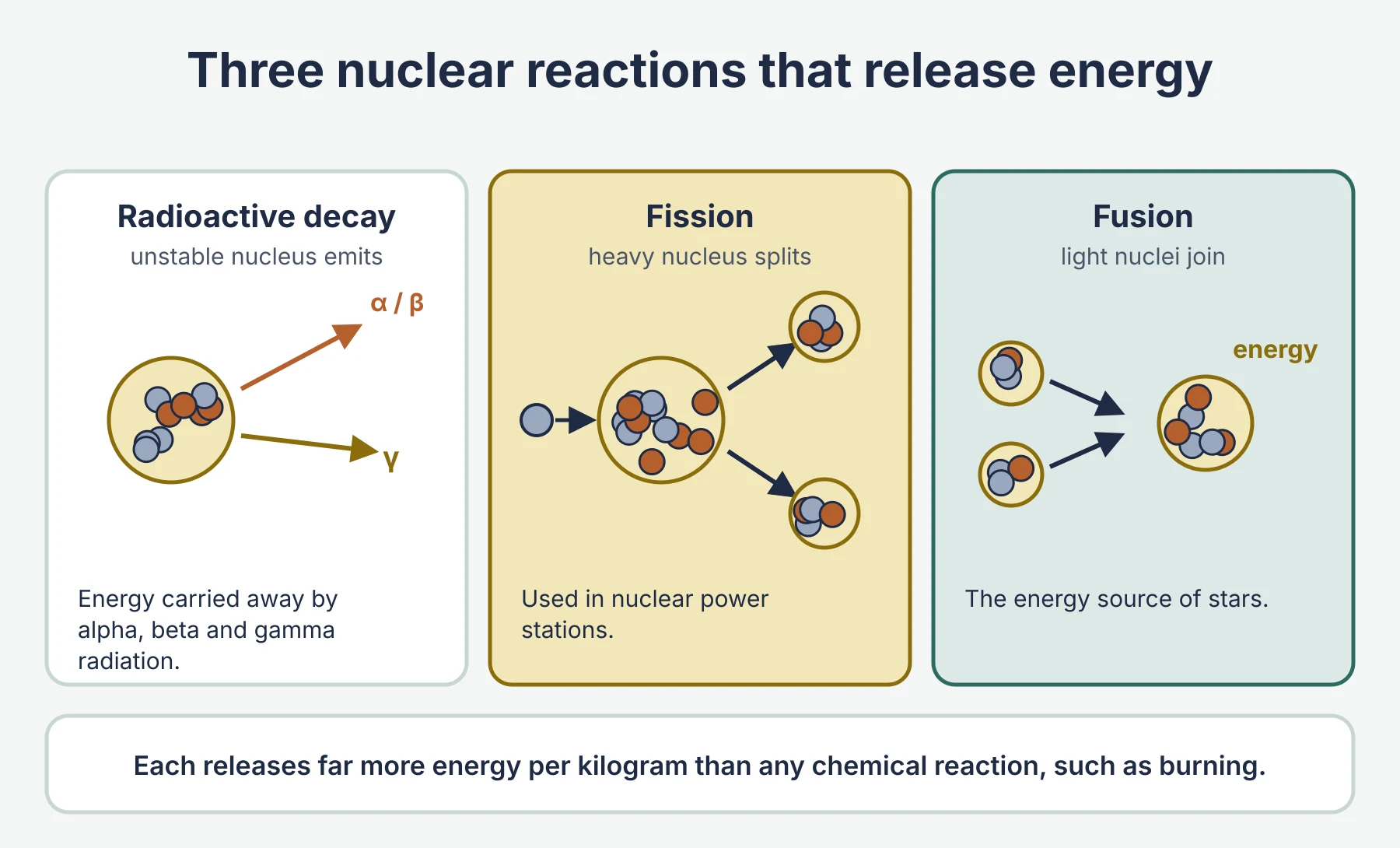
Fission of uranium-235
- U-235 nucleus absorbs a (slow) neutron.
- Becomes unstable and splits into two daughter nuclei.
- Releases 2 or 3 neutrons.
- Energy released mainly as kinetic energy of the fission products.
- Daughter nuclei are radioactive (mostly beta emitters).
- Many different pairs of daughters are possible.
- Example: ¹₀n + ²³⁵₉₂U → ¹⁴⁴₅₆Ba + ⁸⁹₃₆Kr + 3 ¹₀n (check: 236 = 144 + 89 + 3; 92 = 56 + 36).
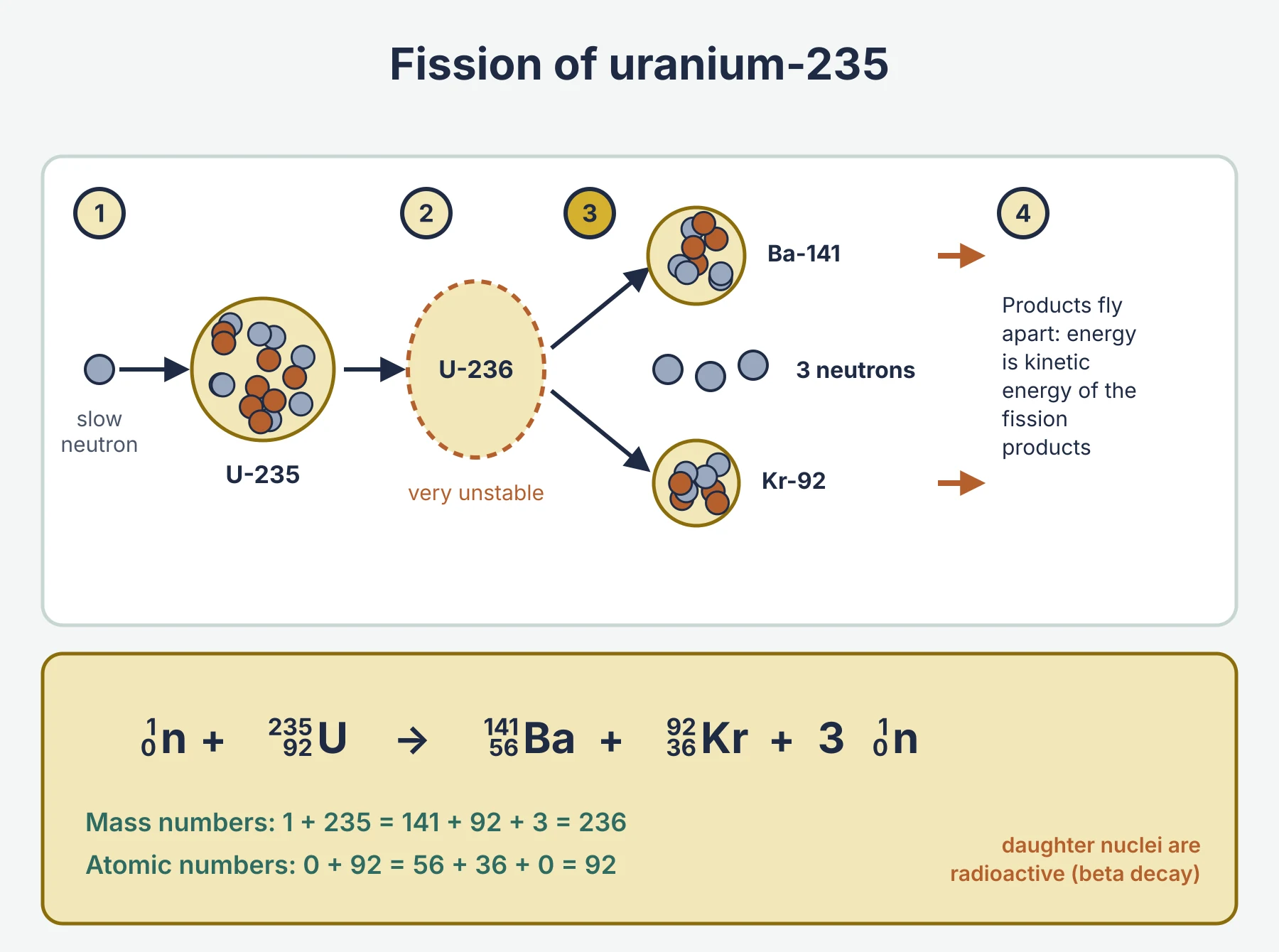
Chain reaction
- Neutrons from one fission cause more fissions.
- Self-sustaining if, on average, at least one neutron per fission causes another.
- Uncontrolled: rapidly growing number of fissions, explosive.
- Controlled (reactor): on average one neutron per fission causes another, so the rate is steady.
- Why uncontrolled growth is so fast: if every fission triggered two more, the generations would run 1, 2, 4, 8, 16… After only 10 generations, 1024 nuclei would be splitting at once, and each generation takes a tiny fraction of a second.
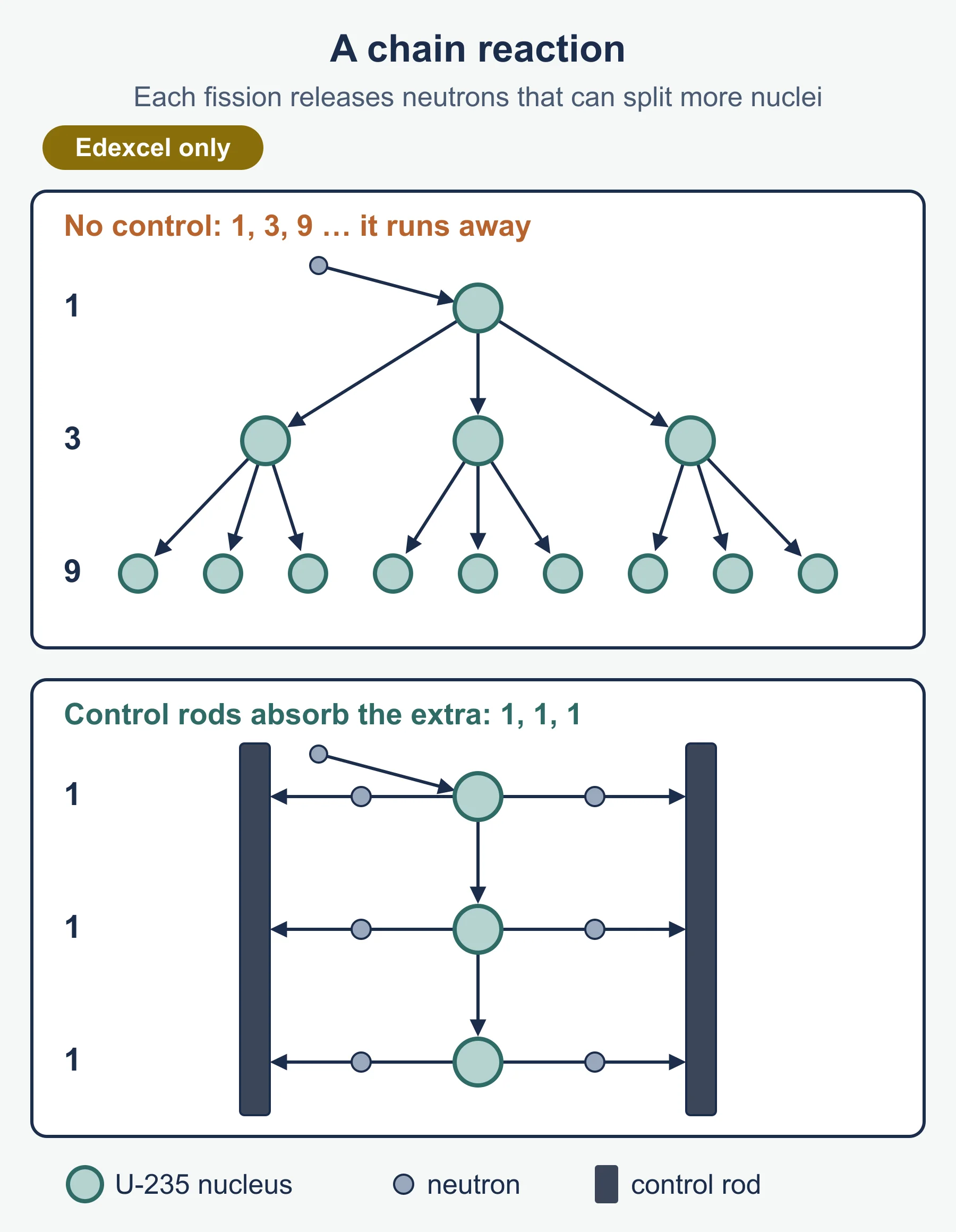
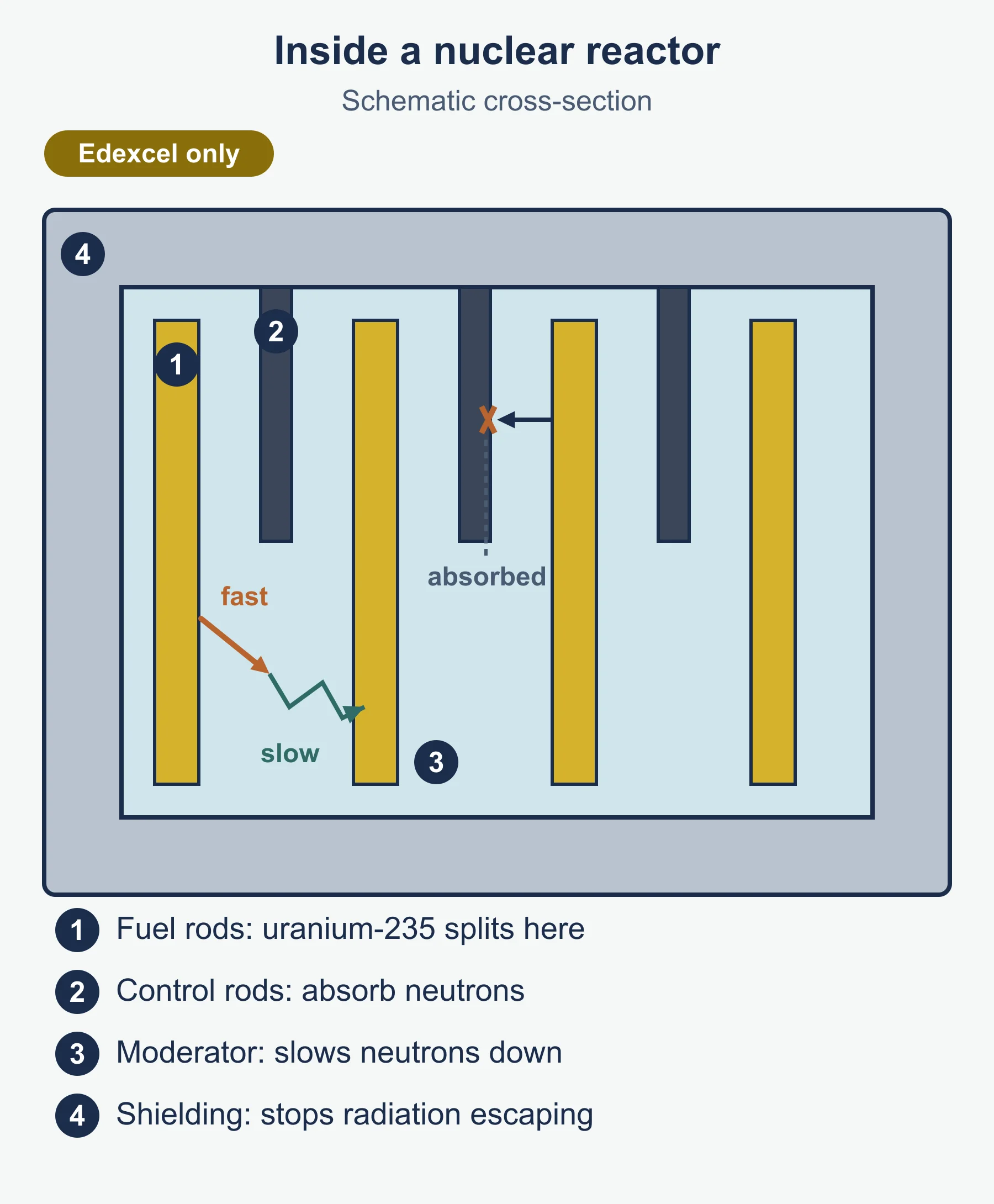
Reactor parts
| Part | Does what | Effect on fission rate |
|---|---|---|
| Moderator (graphite, water) | Slows fast neutrons | More fissions likely |
| Control rods (boron, cadmium) | Absorb neutrons | Fewer fissions; lower = slower |
| Shielding (thick concrete, steel) | Absorbs escaping radiation | None; protects people |
- Control rods fully lowered = reactor shut down.
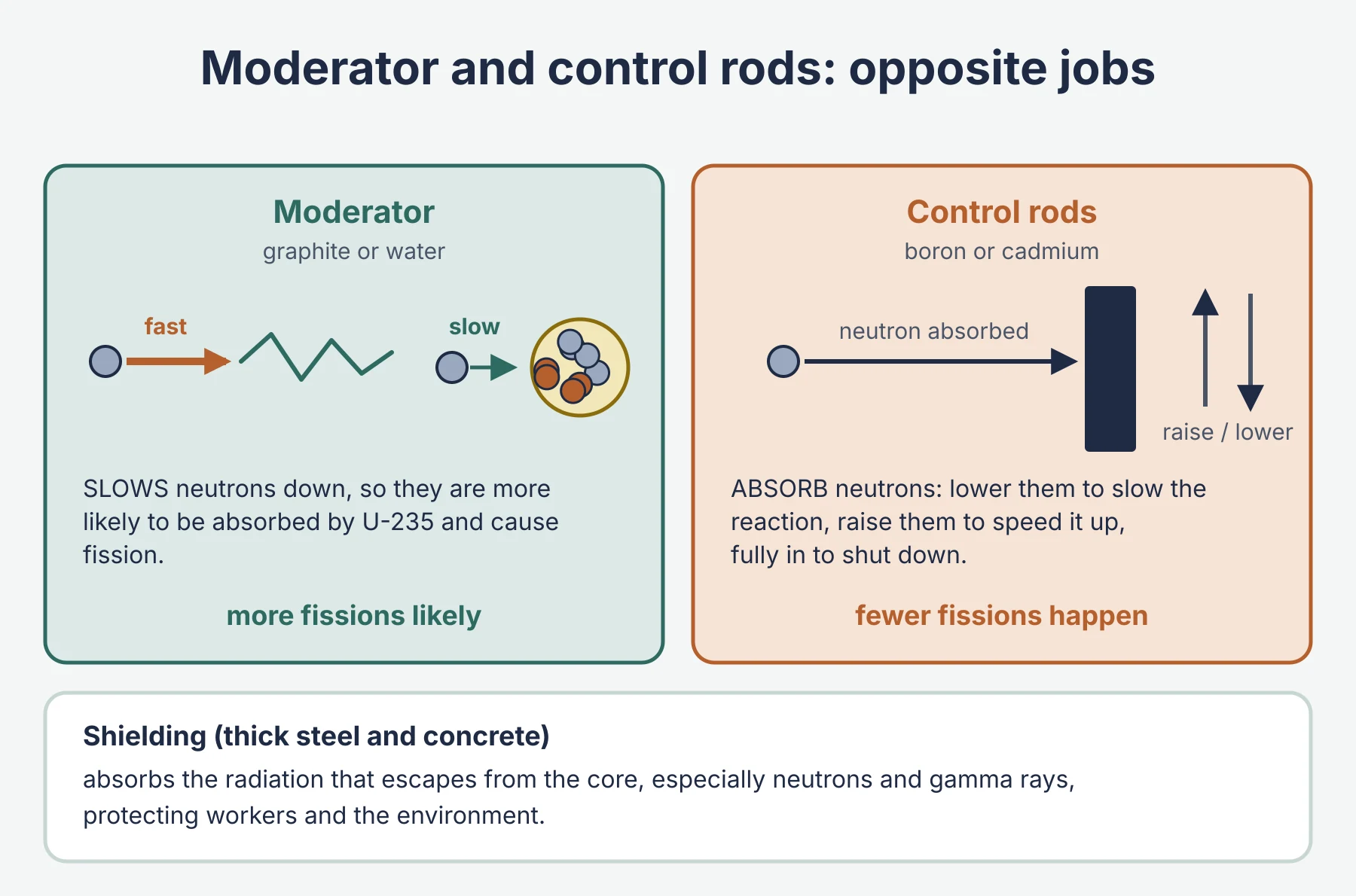
Fusion
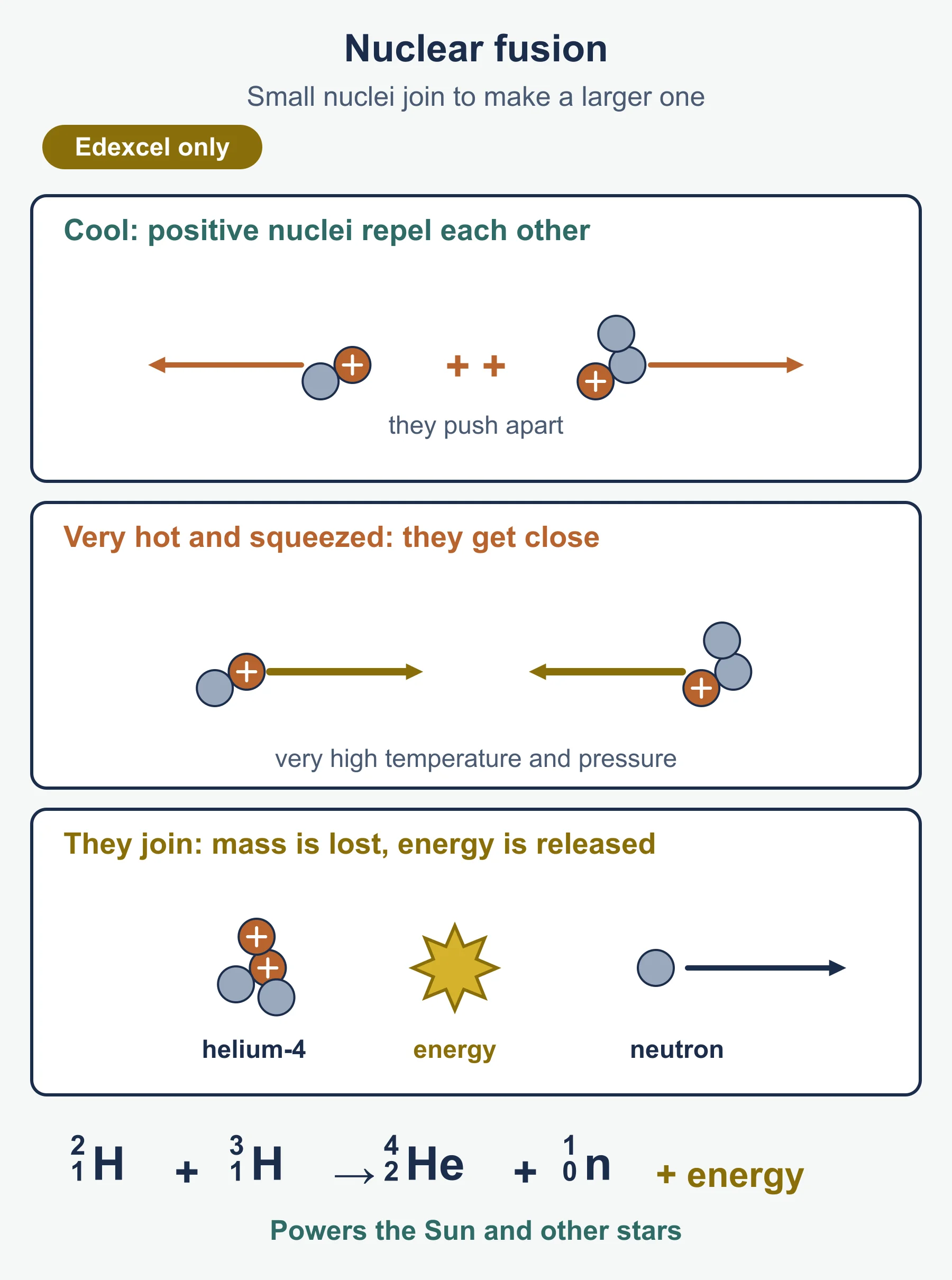
- Two light nuclei join to form a larger nucleus.
- Mass of products less than mass of reactants → energy released.
- Example: ²₁H + ³₁H → ⁴₂He + ¹₀n.
- Energy source of stars: hydrogen fuses to helium in main sequence stars.
Why fusion needs high temperature and pressure
- Nuclei contain protons → positively charged → electrostatic repulsion.
- High temperature → nuclei move very fast → can get close enough despite the repulsion.
- High pressure → nuclei closely packed → frequent collisions.
- Low temperature and pressure: nuclei never get close enough often enough → no fusion.
- Found in stars’ cores; very hard to achieve and contain on Earth.
Fission or fusion?
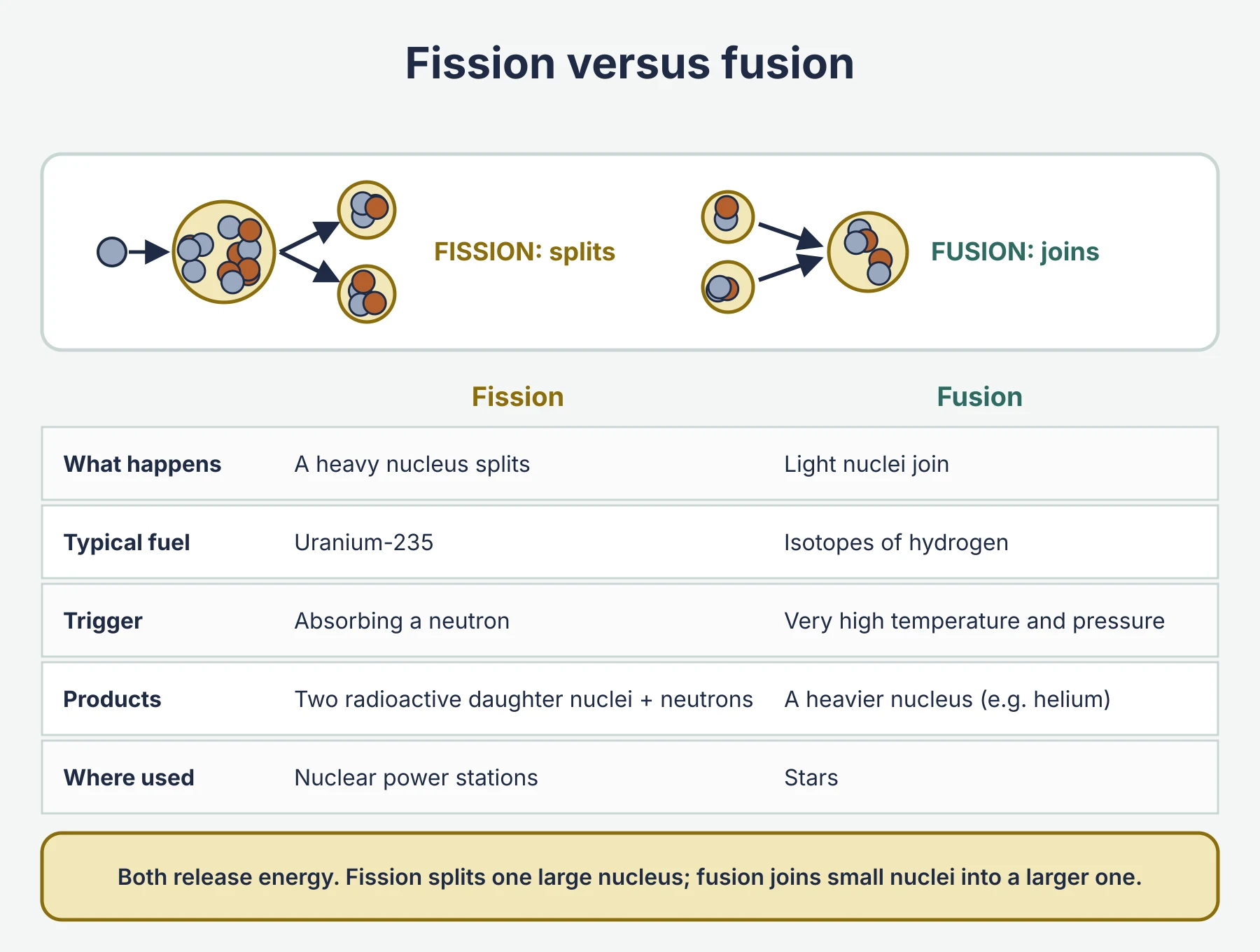
| Fission | Fusion | |
|---|---|---|
| Nuclei | Heavy nucleus splits | Light nuclei join |
| Started by | Neutron absorption | Extreme temperature and pressure |
| Where | Nuclear reactors | Stars |
| Products | Radioactive daughter nuclei + neutrons | Heavier nucleus (+ neutron in some reactions) |
Key terms
| Term | Meaning |
|---|---|
| Nuclear fission | Splitting of a large nucleus into two smaller nuclei, releasing energy |
| Daughter nuclei | The two smaller nuclei produced by fission |
| Chain reaction | Neutrons from each fission go on to cause further fissions |
| Moderator | Material that slows neutrons so they are more likely to cause fission |
| Control rods | Rods that absorb neutrons to control the rate of fission |
| Shielding | Thick material round the reactor that absorbs escaping radiation |
| Nuclear fusion | Joining of small nuclei to form a larger nucleus, with loss of mass and release of energy |
| Electrostatic repulsion | Force pushing apart objects with like charges, such as two nuclei |
Exam traps
- Moderator absorbs neutrons: wrong; it slows them. Control rods absorb.
- “Fission is splitting an atom”: say the nucleus splits.
- Forgetting the daughters are radioactive.
- Fusion “needs heat to start burning”: no burning; high speed is needed to overcome repulsion.
- Not naming protons/positive charge when explaining electrostatic repulsion.
- Unbalanced equations: count all the neutrons released.
Self-test
- Name three types of nuclear reaction that can be a source of energy.
- What must a U-235 nucleus absorb for fission to start?
- List the products of the fission of U-235.
- In what form is most of the energy released by fission?
- Why are spent fuel rods dangerous?
- Describe how a chain reaction is set up.
- What is the role of the moderator?
- What happens to the rate of fission when control rods are lowered further into the core? Why?
- Why is a reactor surrounded by thick concrete?
- Describe nuclear fusion.
- Explain why fusion does not happen at room temperature.
- State the main difference between fission and fusion.
Answers
- Fission, fusion and radioactive decay.
- A neutron.
- Two (radioactive) daughter nuclei, two or three neutrons, and energy.
- Kinetic energy of the fission products.
- They contain radioactive daughter nuclei produced by fission.
- Each fission releases neutrons; if these strike other U-235 nuclei, they cause further fissions, which release more neutrons, and so on.
- It slows down neutrons so that they are more likely to be absorbed by U-235 nuclei and cause fission.
- It decreases, because the rods absorb more neutrons, so fewer are available to cause fission.
- Shielding absorbs radiation escaping from the core, protecting workers and the surroundings.
- Two light nuclei join to form a larger nucleus; the products have less mass than the reactants, and energy is released.
- Nuclei are positively charged and repel each other; at low temperatures they move too slowly to get close enough to fuse.
- Fission splits a large nucleus into smaller ones; fusion joins small nuclei to make a larger one.
Frequently asked questions
Is fission and fusion Physics-only content in 4PH1? No. Statements 7.17 to 7.26 have no “P” reference, so they can be examined on both papers.
Do I need E = mc² for 4PH1? No. Statement 7.24 asks you to know that fusion involves a loss of mass and a release of energy; no calculation is required.
Test yourself with the Fission and fusion practice questions.
Related resources
-
Study guides
Pearson Edexcel International GCSE Physics (4PH1): Radioactivity
Nuclide notation, the four radiations, nuclear equations, background radiation, half-life graphs, uses and dangers of radiation for Edexcel 4PH1 sub-topic 7b.
Physics · Pearson Edexcel · IGCSE
Read guide -
Practice questions
Pearson Edexcel International GCSE Physics (4PH1): Radioactivity – Practice Questions
Original questions with mark-scheme answers on nuclides, decay equations, absorber data, half-life, uses, contamination and waste for Edexcel 4PH1 7b.
Physics · Pearson Edexcel · IGCSE
Try questions -
Revision notes
Pearson Edexcel International GCSE Physics (4PH1): Radioactivity – Revision Notes
Recall notes for Edexcel 4PH1 sub-topic 7b: nuclides, alpha, beta, gamma and neutrons, nuclear equations, background, half-life, uses and dangers.
Physics · Pearson Edexcel · IGCSE
Revise topic
Related articles
Get free revision emails (optional)
Occasional emails with practice questions, worked explanations and links to free resources for the qualification and subjects you choose. No spam, and you can unsubscribe from any email. The free tools on this site never need an email.