
Study Guides
Pearson Edexcel International GCSE Physics (4PH1): Units for Solids, Liquids and Gases
The units of Topic 5 in Edexcel IGCSE Physics 4PH1: Pa, kg/m³, m² and m³, °C and K, J/kg °C, and the area, volume and density conversions.
- Subject
- Physics
- Level
- IGCSE
- Topic
- Solids, liquids and gases
- Author
- Marlbridge Academic Team
- Updated
- Reviewed by
- Hassan (what this means)
Aligned to Pearson Edexcel IGCSE Physics (4PH1), Issue 4. Official specification .
Syllabus page (what it covers and how it is assessed): Pearson Edexcel IGCSE Physics.
Syllabus points this page covers
4PH1
- 5a Units
Found an error? Report a correction.
Need help with this topic? Request a free trial class for IGCSE Physics (4PH1).
This guide covers sub-topic 5(a) Units of Topic 5, Solids, liquids and gases, in the Pearson Edexcel International GCSE in Physics (4PH1), Issue 4. The specification asks you to:
- 5.1 use the units degree Celsius (°C), Kelvin (K), joule (J), kilogram (kg), kilogram/metre³ (kg/m³), metre (m), metre² (m²), metre³ (m³), metre/second (m/s), metre/second² (m/s²), newton (N) and pascal (Pa);
- 5.2P use the unit joules/kilogram degree Celsius (J/kg °C).
Statement 5.2P is Physics-only, so specific heat capacity and its unit are assessed only on Paper 2. For the physics these units belong to, see the Solids, Liquids and Gases study guide.
Why Topic 5 units need extra care
Topic 5 is where squared and cubed units appear. Converting centimetres to metres is easy; converting cm² to m² or cm³ to m³ is where most unit errors in this topic come from, because the conversion factor is squared or cubed too. Topic 5 also has two temperature scales that must not be mixed up.
Which unit goes with which quantity
| Quantity | Symbol | Unit | Where it appears in Topic 5 |
|---|---|---|---|
| Mass | m | kg | ρ = m/V; ΔQ = m × c × ΔT |
| Volume | V | m³ | ρ = m/V; p₁V₁ = p₂V₂ |
| Area | A | m² | p = F/A |
| Length, height, depth | h | m | p = h × ρ × g |
| Density | ρ | kg/m³ | ρ = m/V; p = h × ρ × g |
| Force | F | N | p = F/A |
| Pressure | p | Pa | p = F/A; p = h × ρ × g; gas laws |
| Gravitational field strength | g | m/s² (= N/kg) | p = h × ρ × g |
| Temperature | θ or T | °C, or K for gas laws | ΔT in ΔQ = m × c × ΔT; T in p₁/T₁ = p₂/T₂ |
| Energy | ΔQ | J | ΔQ = m × c × ΔT |
| Specific heat capacity (P) | c | J/kg °C | ΔQ = m × c × ΔT |
| Speed of molecules | v | m/s | kinetic theory |
The pascal and how it is built
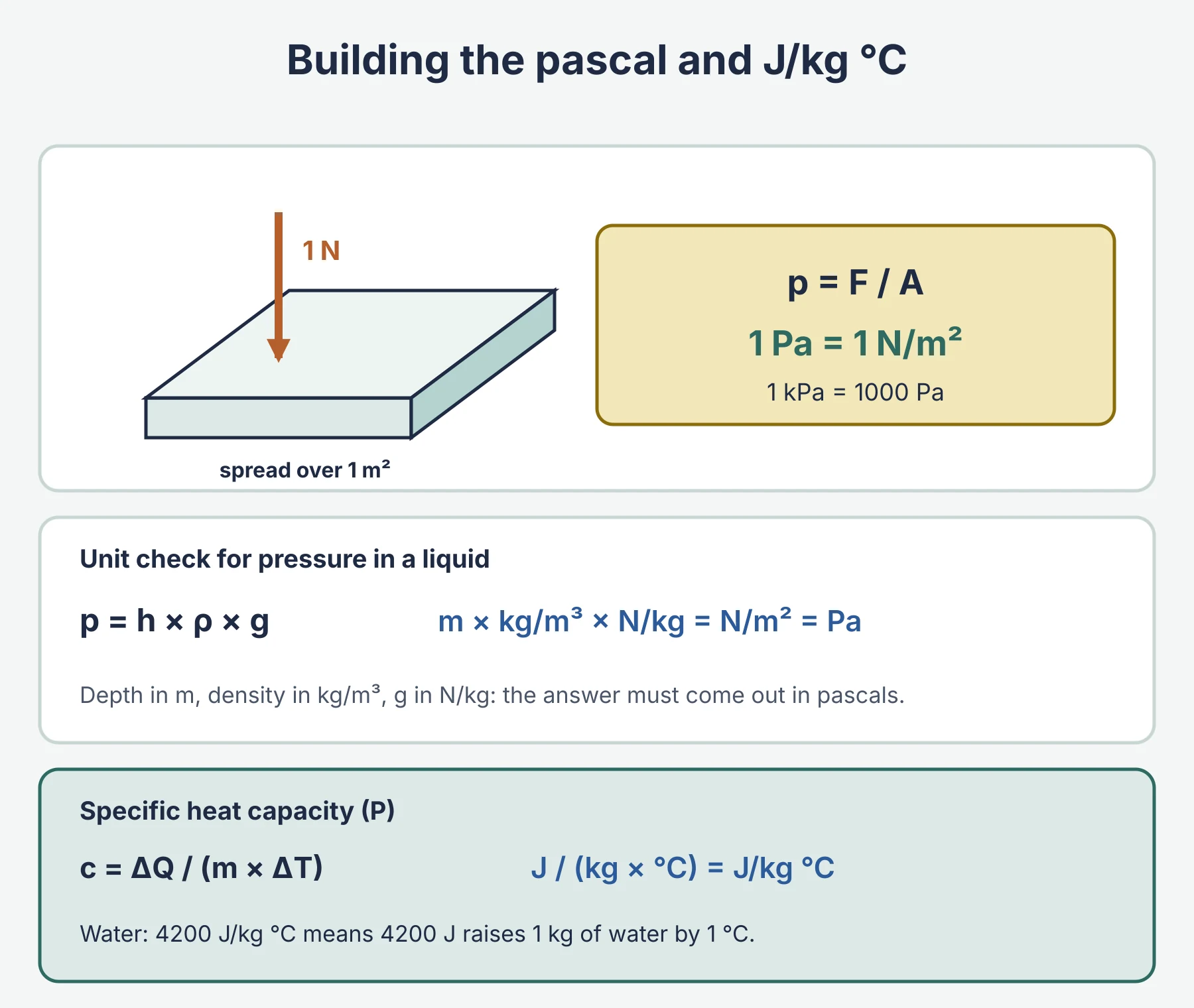
pressure = force / area           so   1 Pa = 1 N/m²  (one newton per square metre)
p = h × ρ × g                     so   m × kg/m³ × N/kg = N/m² = Pa
The second line is a useful check: if you have used depth in metres, density in kg/m³ and g in N/kg, the answer must come out in pascals. A pascal is small (about the pressure of a sheet of paper resting on a table), so pressures are often given in kilopascals: 1 kPa = 1000 Pa.
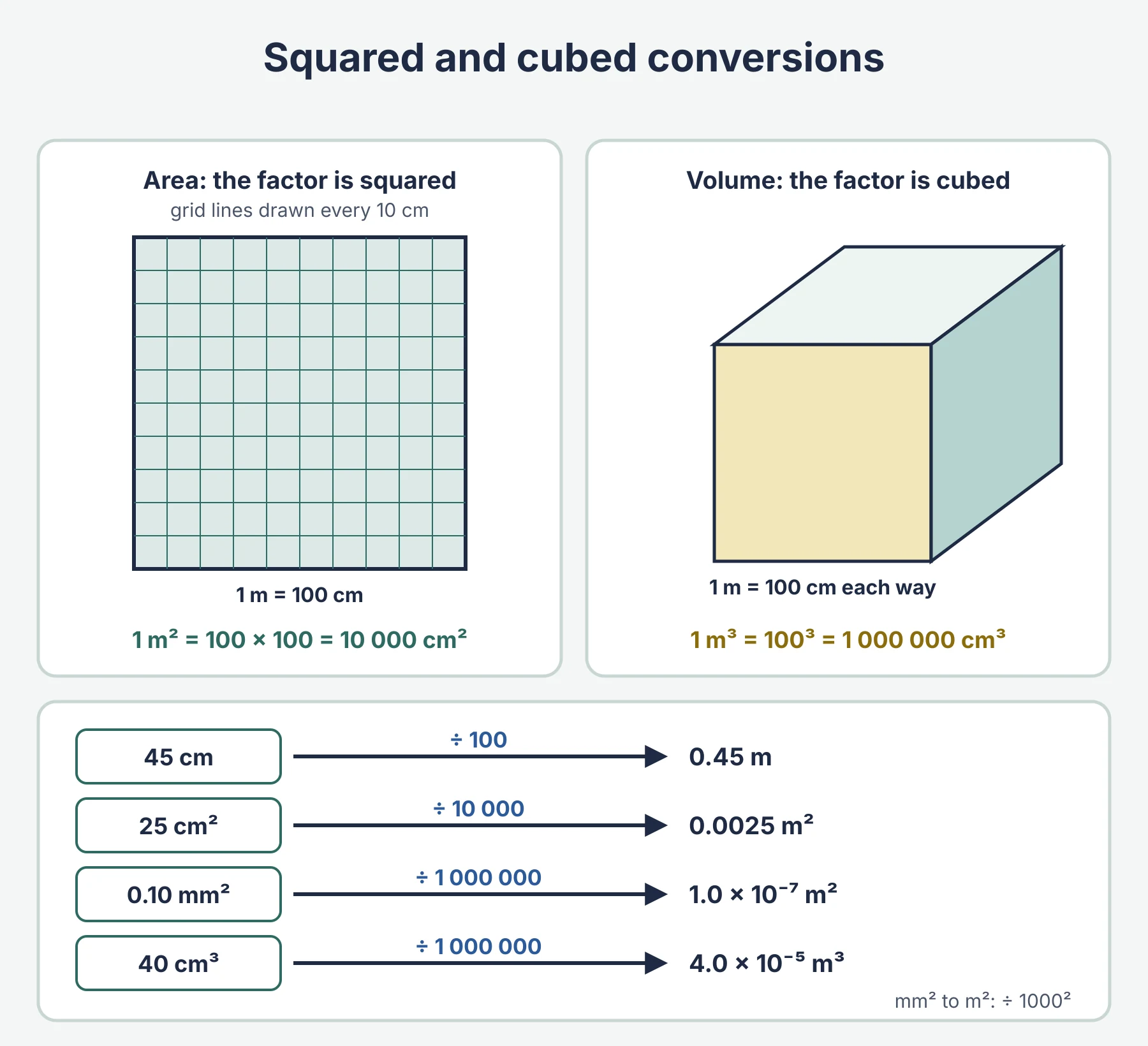
Squared and cubed conversions
| Conversion | Factor | Example |
|---|---|---|
| cm to m | ÷ 100 | 45 cm = 0.45 m |
| cm² to m² | ÷ 100² = ÷ 10 000 | 25 cm² = 0.0025 m² |
| mm² to m² | ÷ 1000² = ÷ 1 000 000 | 0.10 mm² = 1.0 × 10⁻⁷ m² |
| cm³ to m³ | ÷ 100³ = ÷ 1 000 000 | 40 cm³ = 4.0 × 10⁻⁵ m³ |
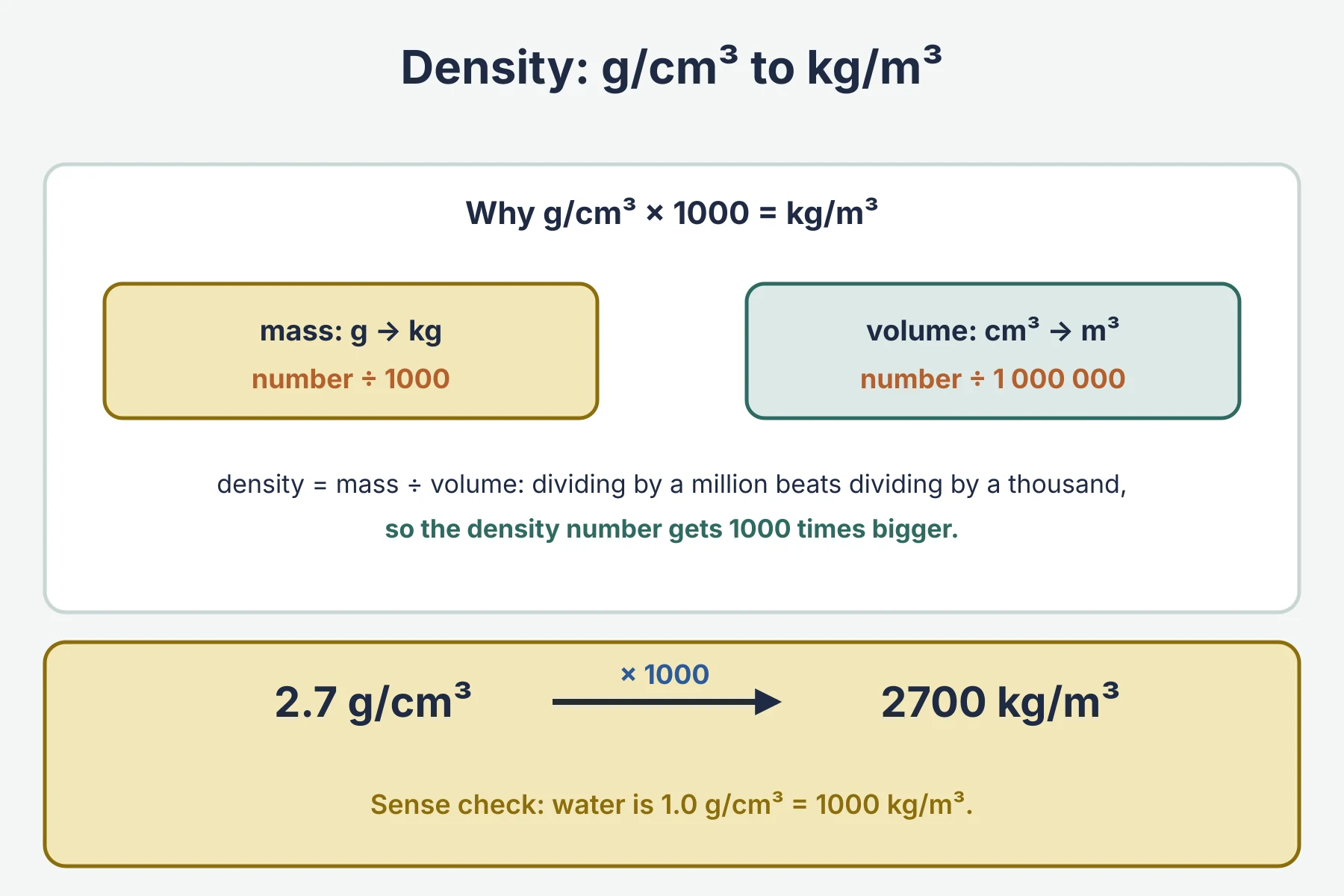
| g/cm³ to kg/m³ | × 1000 | 2.7 g/cm³ = 2700 kg/m³ |
The density conversion goes the “unexpected” way: mass is divided by 1000 (g to kg) but volume is divided by 1 000 000 (cm³ to m³), so the number gets bigger by 1000. A quick sense check: water is 1.0 g/cm³ = 1000 kg/m³.
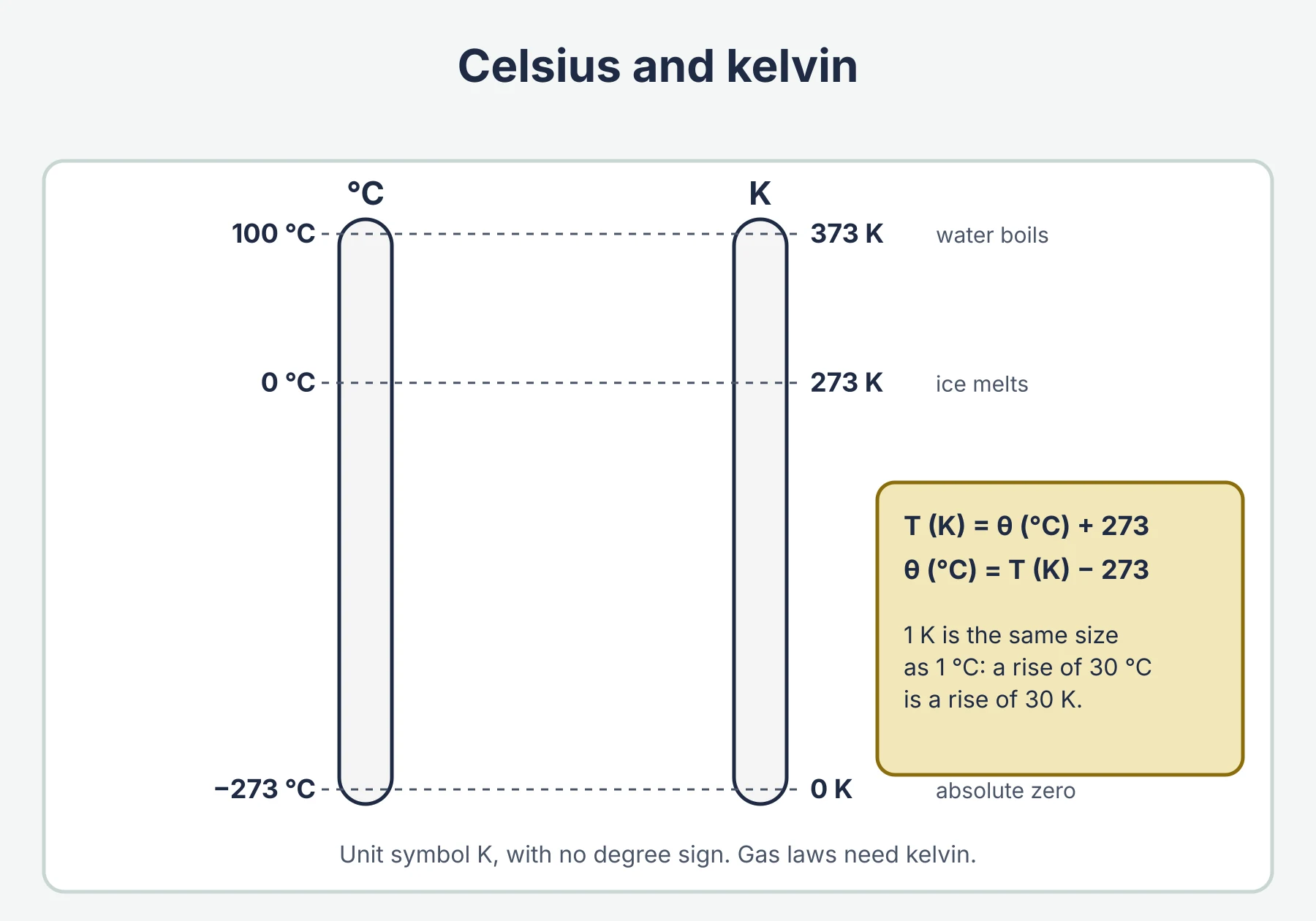
Celsius and kelvin
T (K) = θ (°C) + 273 θ (°C) = T (K) − 273- 0 K = −273 °C (absolute zero); 0 °C = 273 K; 100 °C = 373 K.
- One kelvin is the same size as one degree Celsius, so a temperature change is the same number on both scales: a rise from 20 °C to 50 °C is a rise of 30 °C and of 30 K.
- The specification writes “Kelvin (K)”; the unit symbol is K, with no degree sign.
In ΔQ = m × c × ΔT you can use a change in °C directly. In the gas law p₁/T₁ = p₂/T₂ you must use kelvin, because
the relationship is a proportion that only works from absolute zero.
The unit of specific heat capacity (5.2P)
c = ΔQ / (m × ΔT) so the unit is J / (kg × °C) = J/kg °CRead it as “joules per kilogram per degree Celsius”: the energy needed to raise 1 kg of the material by 1 °C. Water’s value, 4200 J/kg °C, means 4200 J raises 1 kg of water by 1 °C.
Worked examples
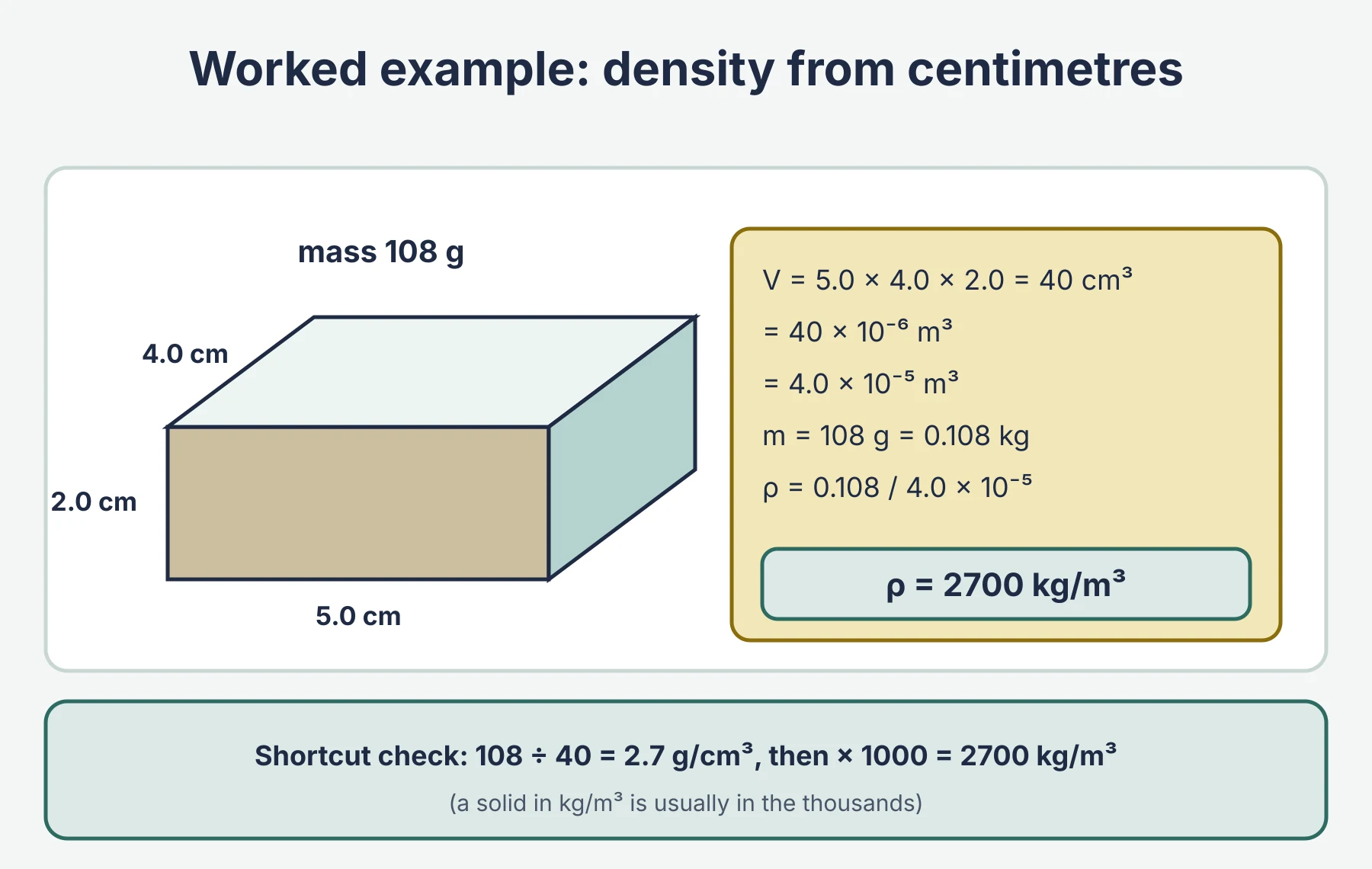
Worked example 1: density from centimetre measurements. A metal block measures 5.0 cm × 4.0 cm × 2.0 cm and has a mass of 108 g. Find its density in kg/m³.
V = 5.0 × 4.0 × 2.0 = 40 cm³ = 40 × 10⁻⁶ m³ = 4.0 × 10⁻⁵ m³
m = 108 g = 0.108 kg
ρ = m / V = 0.108 / 4.0 × 10⁻⁵ = 2700 kg/m³
Check by the shortcut: 108 ÷ 40 = 2.7 g/cm³, and × 1000 gives 2700 kg/m³.
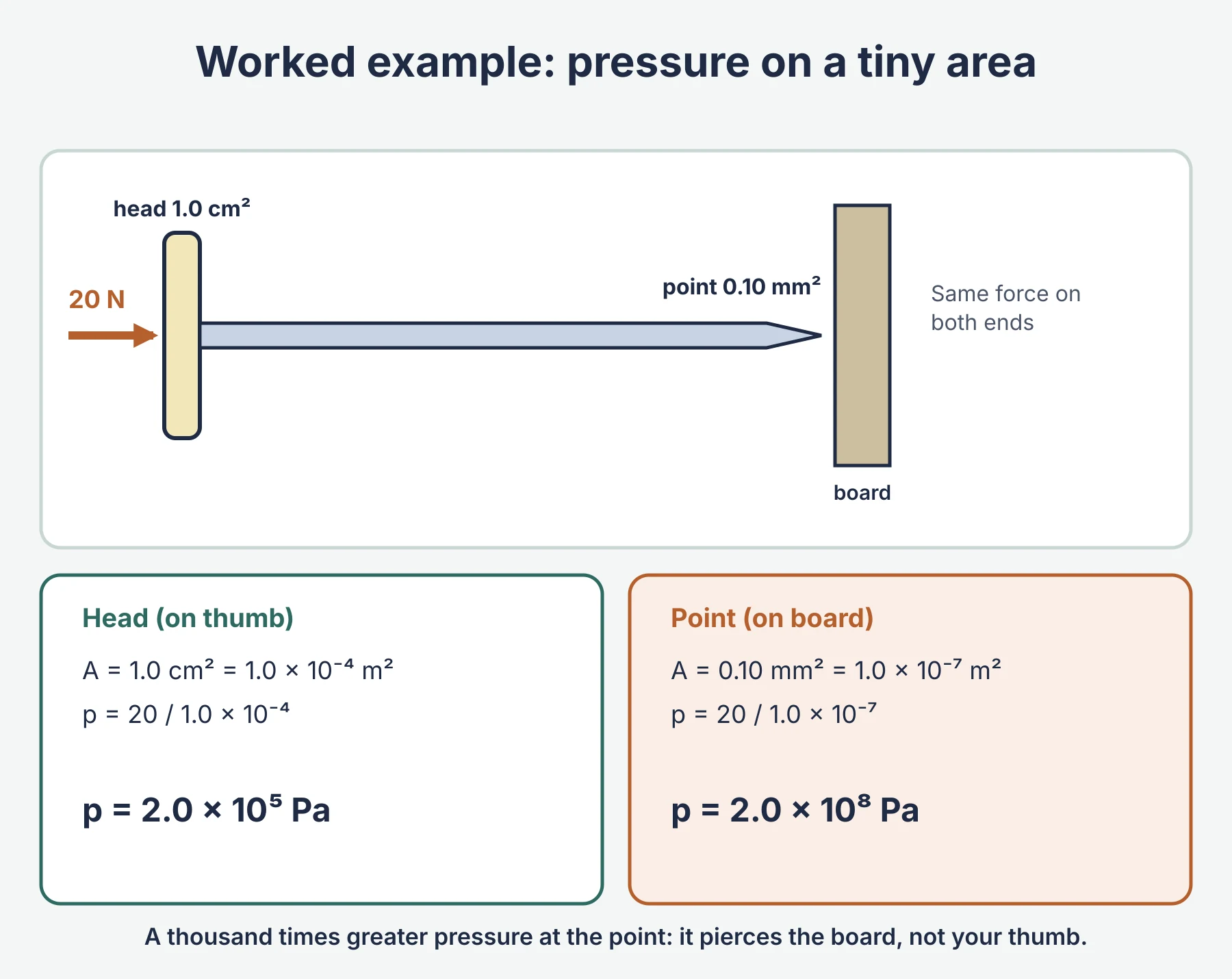
Worked example 2: pressure on a tiny area. A thumb pushes a drawing pin with a force of 20 N. The point has an area of 0.10 mm²; the head has an area of 1.0 cm².
point: A = 0.10 mm² = 1.0 × 10⁻⁷ m²     p = 20 / 1.0 × 10⁻⁷ = 2.0 × 10⁸ Pa
head:  A = 1.0 cm² = 1.0 × 10⁻⁴ m²      p = 20 / 1.0 × 10⁻⁴ = 2.0 × 10⁵ Pa
The same force gives a pressure a thousand times greater at the point, which is why it pierces the board but not your thumb.
Worked example 3 (P): grams in ΔQ = m × c × ΔT. A 500 g aluminium block (c = 900 J/kg °C) warms from 18 °C to 38 °C.
m = 0.500 kg        ΔT = 38 − 18 = 20 °C
ΔQ = 0.500 × 900 × 20 = 9000 J = 9.0 kJ
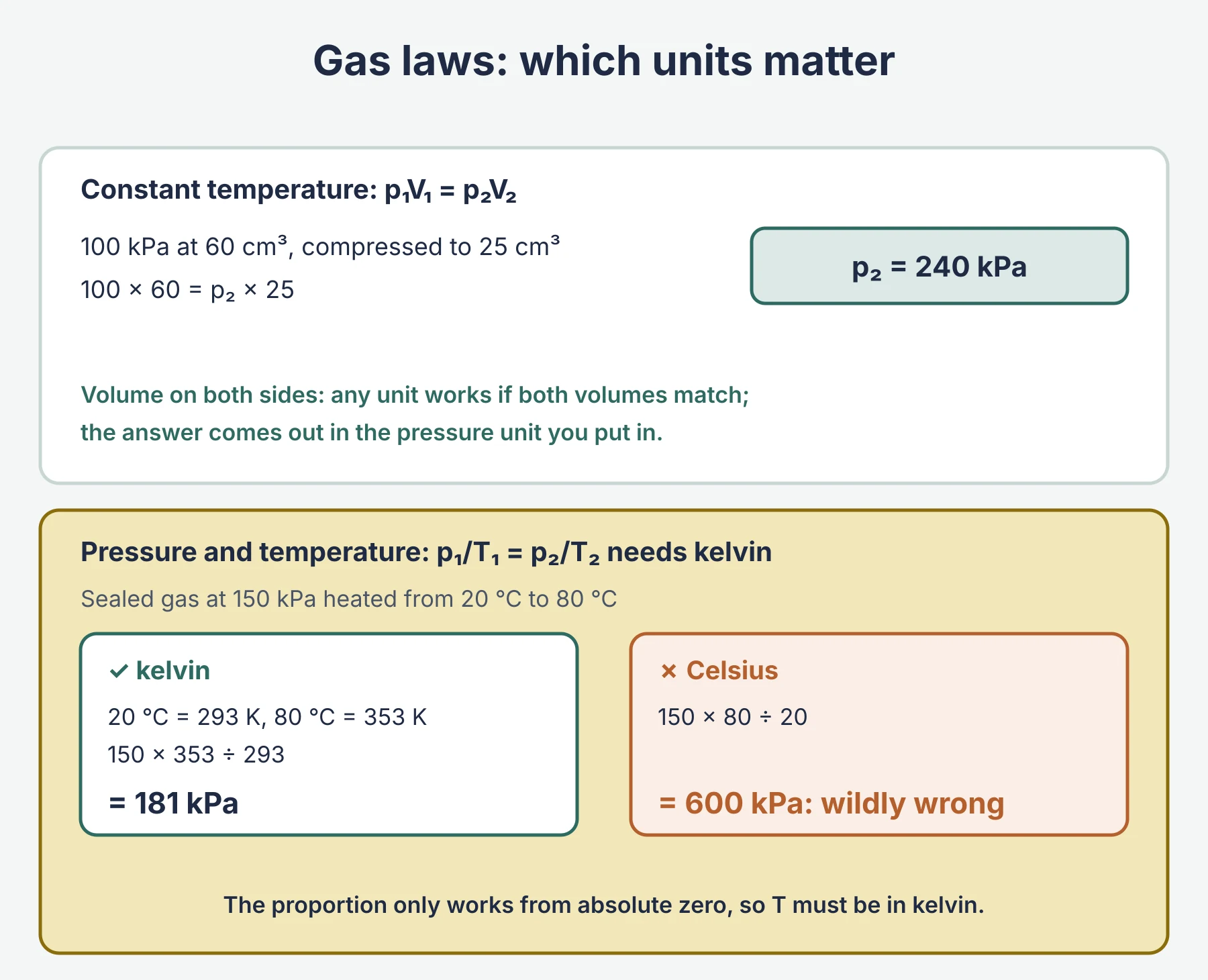
Worked example 4: when the units can stay as given. A gas in a syringe at 100 kPa is compressed at constant temperature from 60 cm³ to 25 cm³.
p₁V₁ = p₂V₂ 100 × 60 = p₂ × 25 p₂ = 240 kPaBecause the equation has volume on both sides, any volume unit works as long as both volumes use the same one, and the
answer comes out in whatever pressure unit you put in. Temperature is different: in p₁/T₁ = p₂/T₂ the temperatures
must be in kelvin. Heating a sealed gas at 150 kPa from 20 °C (293 K) to 80 °C (353 K) gives 150 × 353 ÷ 293 =
181 kPa. Using Celsius would give 600 kPa, which is wildly wrong.
Common mistakes
- Dividing cm² by 100 instead of 10 000, or cm³ by 100 instead of 1 000 000.
- Converting g/cm³ to kg/m³ by dividing by 1000 instead of multiplying.
- Using °C in the pressure-temperature gas law.
- Writing “°K” or “degrees Kelvin”. The unit is the kelvin, symbol K.
- Mixing kPa and Pa, or cm³ and m³, within one gas-law calculation.
- Leaving mass in grams in
ΔQ = m × c × ΔTwhen c is in J/kg °C.
Exam technique
- Calculate: convert every value to the units in the table above on its own line before substituting; then the answer comes out in the standard unit (Pa, kg/m³, J).
- Give the unit: pressure answers can be in Pa or kPa, and densities in kg/m³ or g/cm³, but if the answer line shows a unit, use that one.
- Standard form is useful here: 2.0 × 10⁸ Pa is clearer than 200 000 000 Pa, and harder to miscount.
- A sense check catches most unit errors: a solid’s density in kg/m³ is usually in the thousands; atmospheric pressure is about 100 000 Pa.
Keep going
- Units for Topic 5 revision notes
- Units for Topic 5 practice questions
- Solids, Liquids and Gases revision notes
Written against the Pearson Edexcel International GCSE in Physics (4PH1) specification, Issue 4. Always check the current specification for your examination year.
Related resources
-
Practice questions
Pearson Edexcel International GCSE Physics (4PH1): Units for Solids, Liquids and Gases – Practice Questions
Original 4PH1 practice on Topic 5 units: cm² and cm³ conversions, g/cm³ to kg/m³, Celsius and kelvin, pascals and J/kg °C, with full answers.
Physics · Pearson Edexcel · IGCSE
Try questions -
Revision notes
Pearson Edexcel International GCSE Physics (4PH1): Units for Solids, Liquids and Gases – Revision Notes
Recall notes for 4PH1 sub-topic 5a: Pa, kg/m³, m² and m³ conversions, Celsius and kelvin, J/kg °C, when units may stay as given, traps and a self-test.
Physics · Pearson Edexcel · IGCSE
Revise topic -
Study guides
Solids, Liquids and Gases
Density and pressure, specific heat capacity and changes of state, and the kinetic theory of gases, for Pearson Edexcel International GCSE Physics 4PH1.
Physics · Pearson Edexcel · IGCSE
Read guide
Related articles
Get free revision emails (optional)
Occasional emails with practice questions, worked explanations and links to free resources for the qualification and subjects you choose. No spam, and you can unsubscribe from any email. The free tools on this site never need an email.