
Revision Notes
Pearson Edexcel International GCSE Physics (4PH1): Units for Solids, Liquids and Gases – Revision Notes
Recall notes for 4PH1 sub-topic 5a: Pa, kg/m³, m² and m³ conversions, Celsius and kelvin, J/kg °C, when units may stay as given, traps and a self-test.
- Subject
- Physics
- Level
- IGCSE
- Topic
- Solids, liquids and gases
- Author
- Marlbridge Academic Team
- Updated
- Reviewed by
- Hassan (what this means)
Aligned to Pearson Edexcel IGCSE Physics (4PH1), Issue 4. Official specification .
Syllabus page (what it covers and how it is assessed): Pearson Edexcel IGCSE Physics.
Syllabus points this page covers
4PH1
- 5a Units
Found an error? Report a correction.
Need help with this topic? Request a free trial class for IGCSE Physics (4PH1).
These notes condense sub-topic 5(a) Units of Pearson Edexcel International GCSE Physics 4PH1, Issue 4: statement 5.1 (°C, K, J, kg, kg/m³, m, m², m³, m/s, m/s², N, Pa) and the Physics-only statement 5.2P (J/kg °C, assessed on Paper 2). Full explanations and worked examples are in the Units for Topic 5 study guide; exam-style questions are in the Units for Topic 5 practice questions.
Units by equation
| Equation | Units to substitute | Answer unit |
|---|---|---|
| ρ = m / V | kg, m³ | kg/m³ |
| p = F / A | N, m² | Pa |
| p = h × ρ × g | m, kg/m³, N/kg (or m/s²) | Pa |
| ΔQ = m × c × ΔT (P) | kg, J/kg °C, °C (or K: same size) | J |
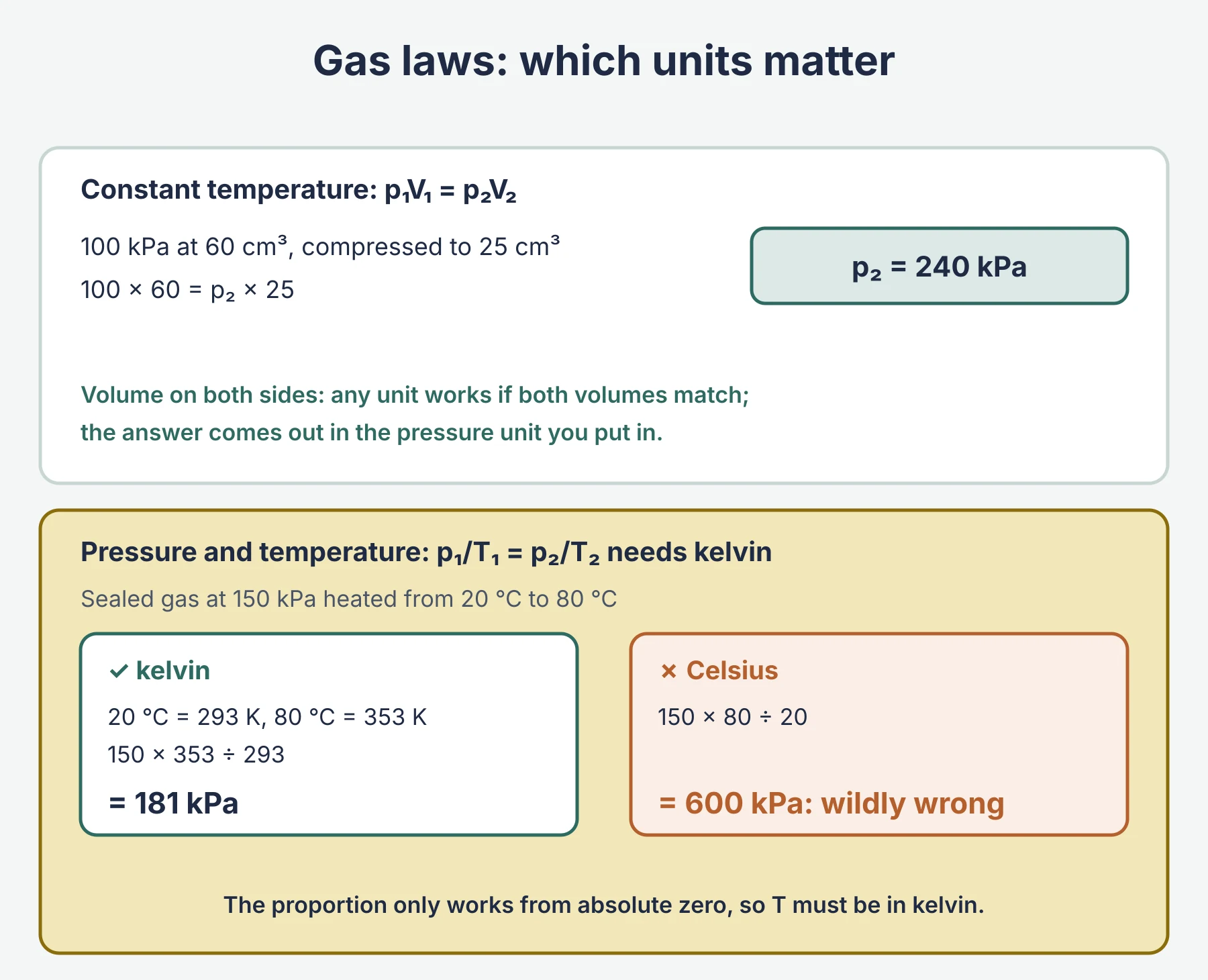
| p₁V₁ = p₂V₂ | any pressure unit, any volume unit, used consistently | same units as given |
| p₁/T₁ = p₂/T₂ | any pressure unit; T in kelvin only | same pressure unit as given |
Building the units
1 Pa = 1 N/m²
m × kg/m³ × N/kg = N/m² = Pa        (check for p = h ρ g)
J ÷ (kg × °C) = J/kg °C             (unit of c)
1 kPa = 1000 Pa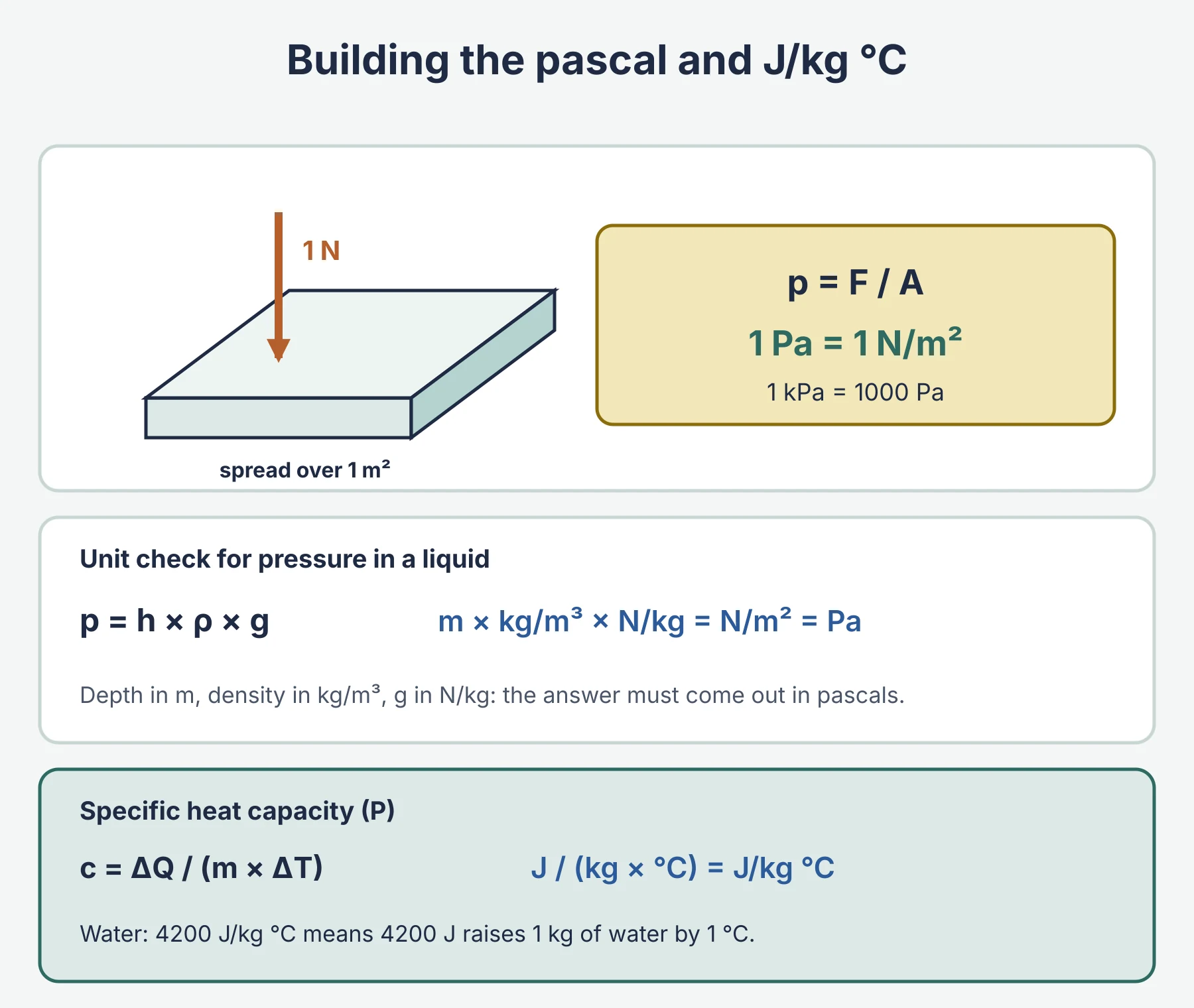
Conversion factors
| From | To | Do this |
|---|---|---|
| cm | m | ÷ 100 |
| mm | m | ÷ 1000 |
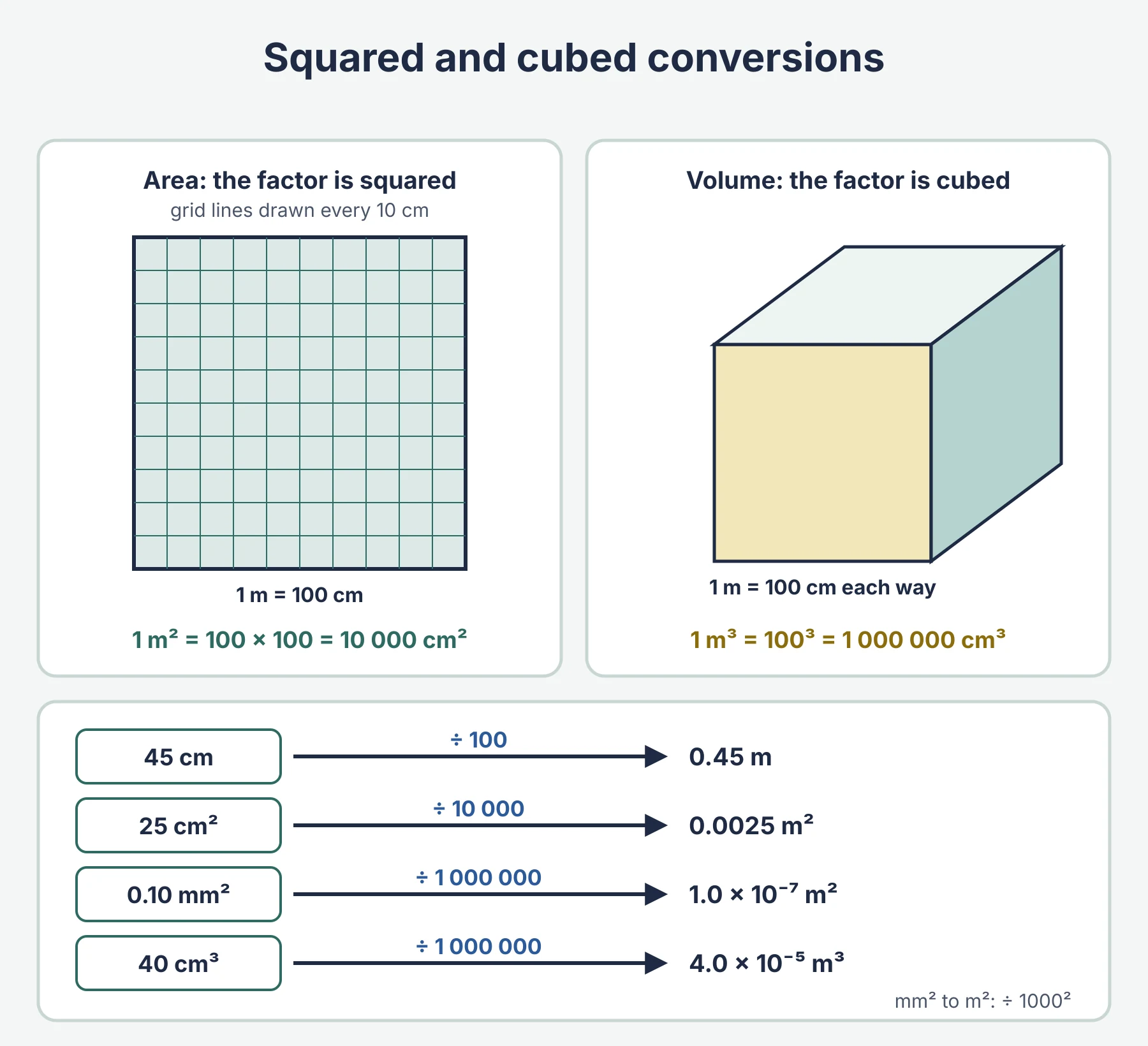
| cm² | m² | ÷ 10 000 (10⁴) |
| mm² | m² | ÷ 1 000 000 (10⁶) |
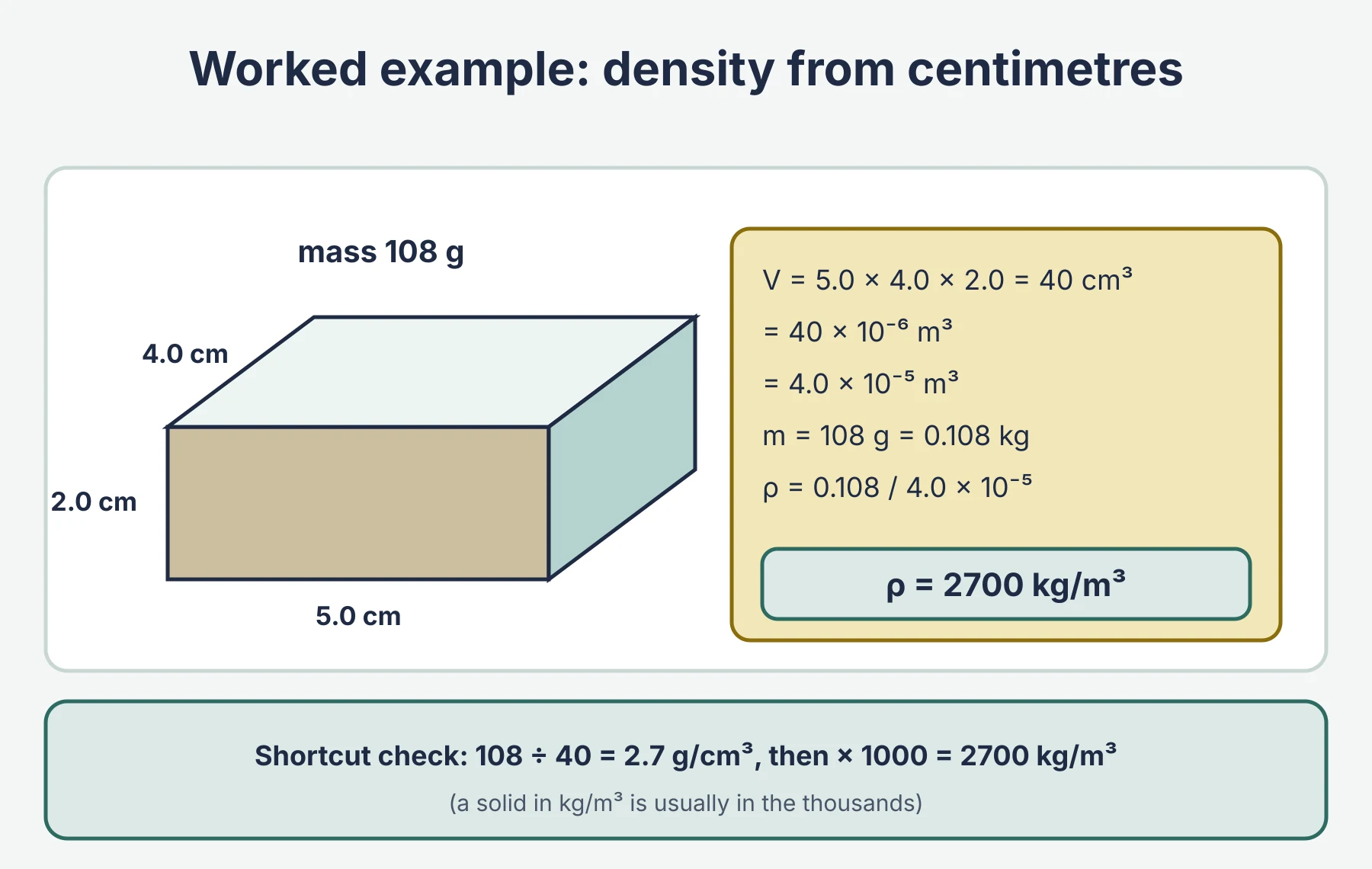
| cm³ | m³ | ÷ 1 000 000 (10⁶) |
| litre | m³ | ÷ 1000 (1 litre = 1000 cm³) |
| g | kg | ÷ 1000 |
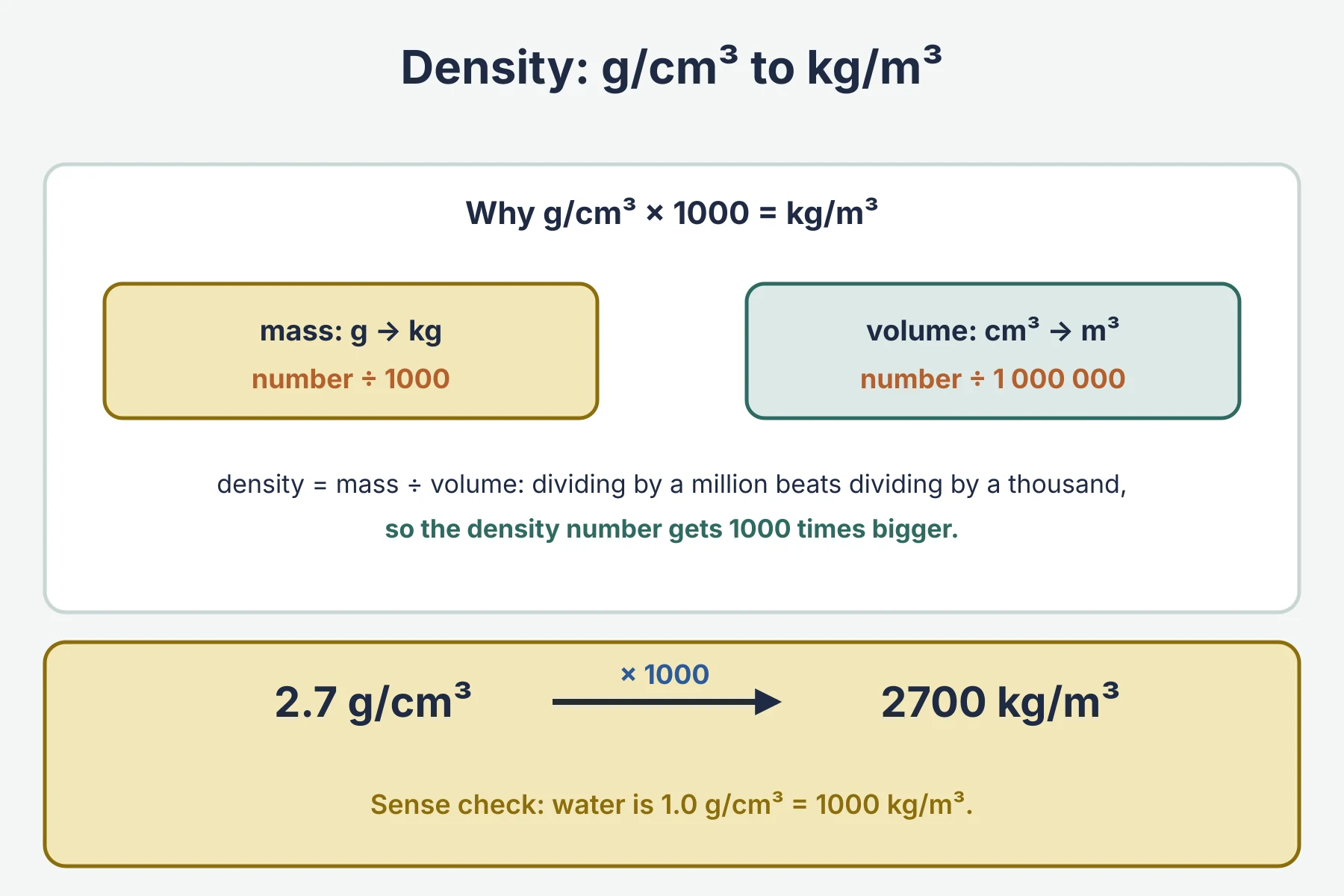
| g/cm³ | kg/m³ | × 1000 |
| kPa | Pa | × 1000 |
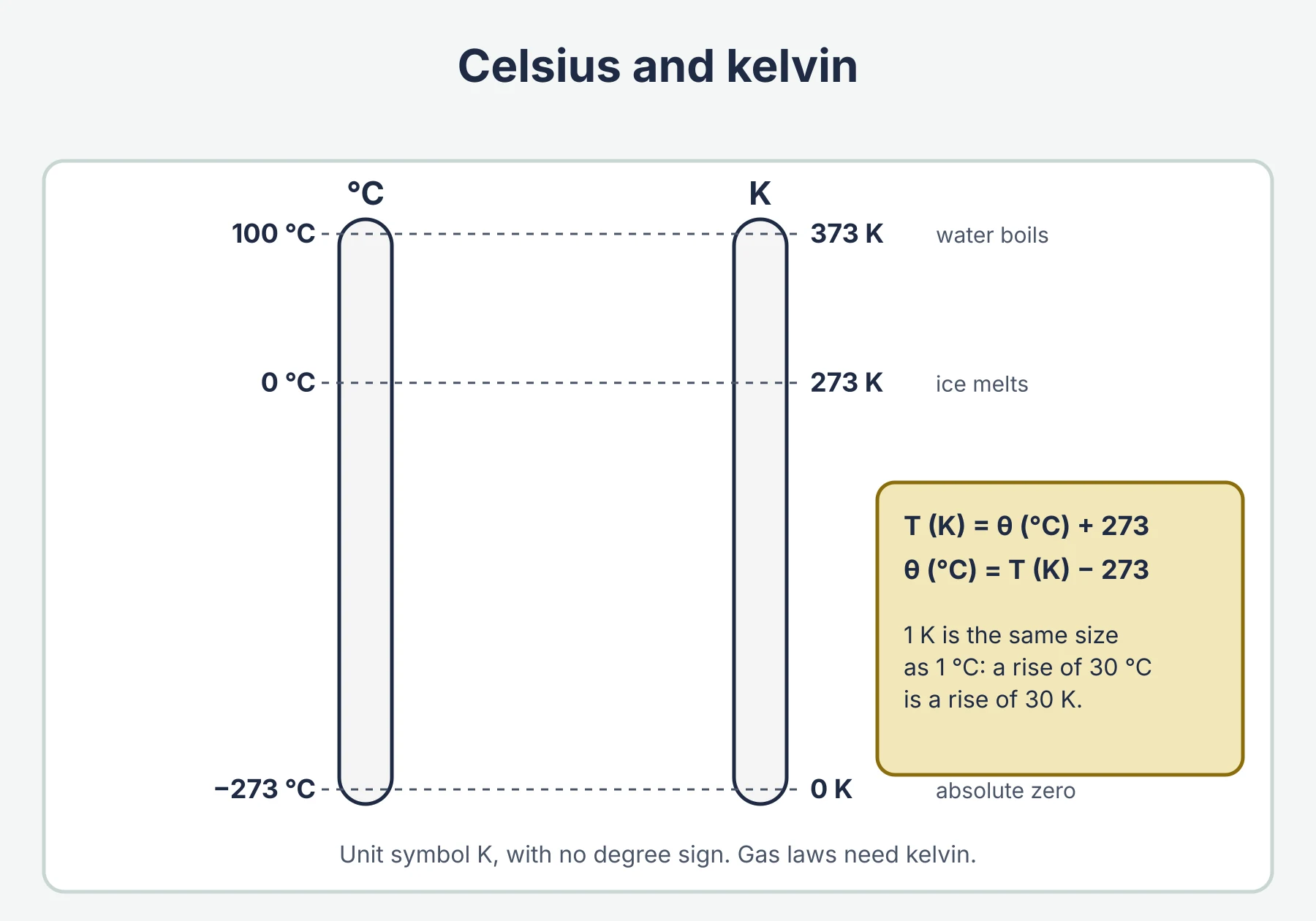
| °C | K | + 273 |
| K | °C | − 273 |
Why area and volume factors are bigger: 1 m = 100 cm, so 1 m² = 100 × 100 cm² and 1 m³ = 100 × 100 × 100 cm³.
Temperature facts
- Absolute zero: 0 K = −273 °C. Nothing can be colder.
- Freezing point of water 0 °C = 273 K; boiling point 100 °C = 373 K.
- Changes are equal on both scales: a 25 °C rise is a 25 K rise.
- Use kelvin whenever a temperature is in a ratio or proportion (p ∝ T); a temperature change can stay in °C.
- The symbol is K, not °K.
Sense checks
- Water: 1000 kg/m³. Most metals: thousands of kg/m³. Air: about 1 kg/m³.
- Atmospheric pressure: about 100 000 Pa (100 kPa).
- Specific heat capacity of water: 4200 J/kg °C; metals are usually a few hundred.
- A density answer of 2.7 kg/m³ for a metal means a factor of 1000 has been lost.
Key terms
| Term | Meaning |
|---|---|
| Pascal (Pa) | Unit of pressure; one newton per square metre |
| Kilogram per cubic metre (kg/m³) | Unit of density: mass in kilograms of each cubic metre |
| Kelvin (K) | Unit of the absolute temperature scale, starting at absolute zero; same size as 1 °C |
| Degree Celsius (°C) | Temperature unit with 0 °C at the freezing point of water |
| J/kg °C | Unit of specific heat capacity: joules to warm 1 kg by 1 °C |
| Square metre (m²) | Unit of area, equal to 10 000 cm² |
| Cubic metre (m³) | Unit of volume, equal to 1 000 000 cm³ |
Exam traps
- cm² ÷ 100 or cm³ ÷ 100: the factor must be squared or cubed.
- g/cm³ to kg/m³ by dividing: it is × 1000.
- Celsius in p₁/T₁ = p₂/T₂.
- Converting a temperature change by adding 273. A rise of 20 °C is a rise of 20 K, not 293 K.
- Grams in ΔQ = m × c × ΔT.
- Mixing kPa and Pa, or cm³ and m³, on the two sides of p₁V₁ = p₂V₂.
- Writing “°K”.
Self-test
- Express the pascal in terms of newtons and metres.
- Convert 35 cm² to m².
- Convert 250 cm³ to m³ in standard form.
- Convert 0.92 g/cm³ to kg/m³.
- Convert 27 °C to kelvin.
- Convert 77 K to °C.
- A liquid warms from 15 °C to 40 °C. State the temperature rise in kelvin.
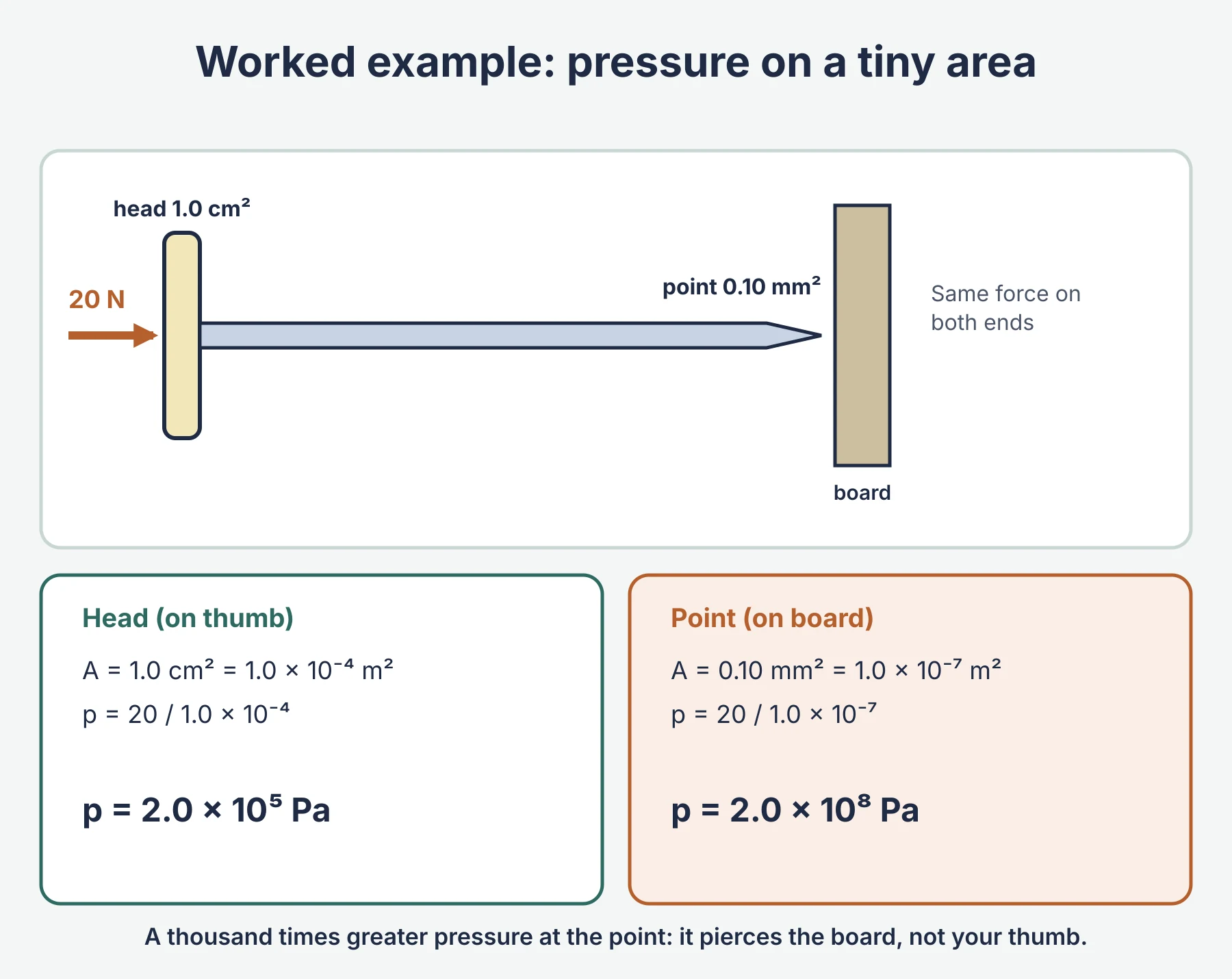
- A 60 N force acts on an area of 15 cm². Calculate the pressure in kPa.
- Calculate the pressure difference 30 cm below the surface of oil of density 800 kg/m³ (g = 10 N/kg).
- Calculate the energy needed to warm 250 g of water by 12 °C (c = 4200 J/kg °C).
- Show that the unit of h × ρ × g is the pascal.
- Explain why kelvin must be used in p₁/T₁ = p₂/T₂ but a temperature change in °C can be used in ΔQ = m × c × ΔT.
Answers: 1. 1 Pa = 1 N/m². 2. 35 ÷ 10 000 = 0.0035 m². 3. 250 ÷ 1 000 000 = 2.5 × 10⁻⁴ m³. 4. 920 kg/m³. 5. 300 K. 6. −196 °C. 7. 25 K. 8. A = 0.0015 m²; p = 60 ÷ 0.0015 = 40 000 Pa = 40 kPa. 9. p = 0.30 × 800 × 10 = 2400 Pa. 10. ΔQ = 0.250 × 4200 × 12 = 12 600 J. 11. m × kg/m³ × N/kg = (m × kg × N) ÷ (m³ × kg) = N/m² = Pa. 12. Pressure is proportional to temperature only when temperature is measured from absolute zero, so the ratio needs kelvin; a temperature change is the same number in °C and K because the units are the same size.
Related resources
-
Study guides
Solids, Liquids and Gases
Density and pressure, specific heat capacity and changes of state, and the kinetic theory of gases, for Pearson Edexcel International GCSE Physics 4PH1.
Physics · Pearson Edexcel · IGCSE
Read guide -
Practice questions
Edexcel IGCSE Physics: Solids, Liquids and Gases — Practice Questions
Original exam-style practice questions with full worked answers on density, pressure, the gas laws and specific heat capacity for Edexcel IGCSE Physics 4PH1.
Physics · Pearson Edexcel · IGCSE
Try questions -
Revision notes
Edexcel IGCSE Physics: Solids, Liquids and Gases — Revision Notes
Condensed recall notes on density, pressure, the gas laws, kinetic theory and specific heat capacity for Edexcel International GCSE Physics 4PH1.
Physics · Pearson Edexcel · IGCSE
Revise topic
Related articles
Get free revision emails (optional)
Occasional emails with practice questions, worked explanations and links to free resources for the qualification and subjects you choose. No spam, and you can unsubscribe from any email. The free tools on this site never need an email.