
Revision Notes
Pearson Edexcel International GCSE Physics (4PH1): Units for waves – Revision Notes
Recall notes on degrees, hertz, metres, m/s and seconds for Edexcel International GCSE Physics 4PH1 waves: prefixes, standard form, exam traps and a self-test.
- Subject
- Physics
- Level
- IGCSE
- Topic
- Waves
- Author
- Marlbridge Academic Team
- Updated
- Reviewed by
- Hassan (what this means)
Aligned to Pearson Edexcel IGCSE Physics (4PH1), Issue 4. Official specification .
Syllabus page (what it covers and how it is assessed): Pearson Edexcel IGCSE Physics.
Syllabus points this page covers
4PH1
- 3a Units
Found an error? Report a correction.
Need help with this topic? Request a free trial class for IGCSE Physics (4PH1).
Condensed notes on sub-topic 3(a) Units (statement 3.1) of Pearson Edexcel International GCSE Physics (4PH1), Issue 4. For full explanations and worked examples, use the Units for waves study guide.
The list
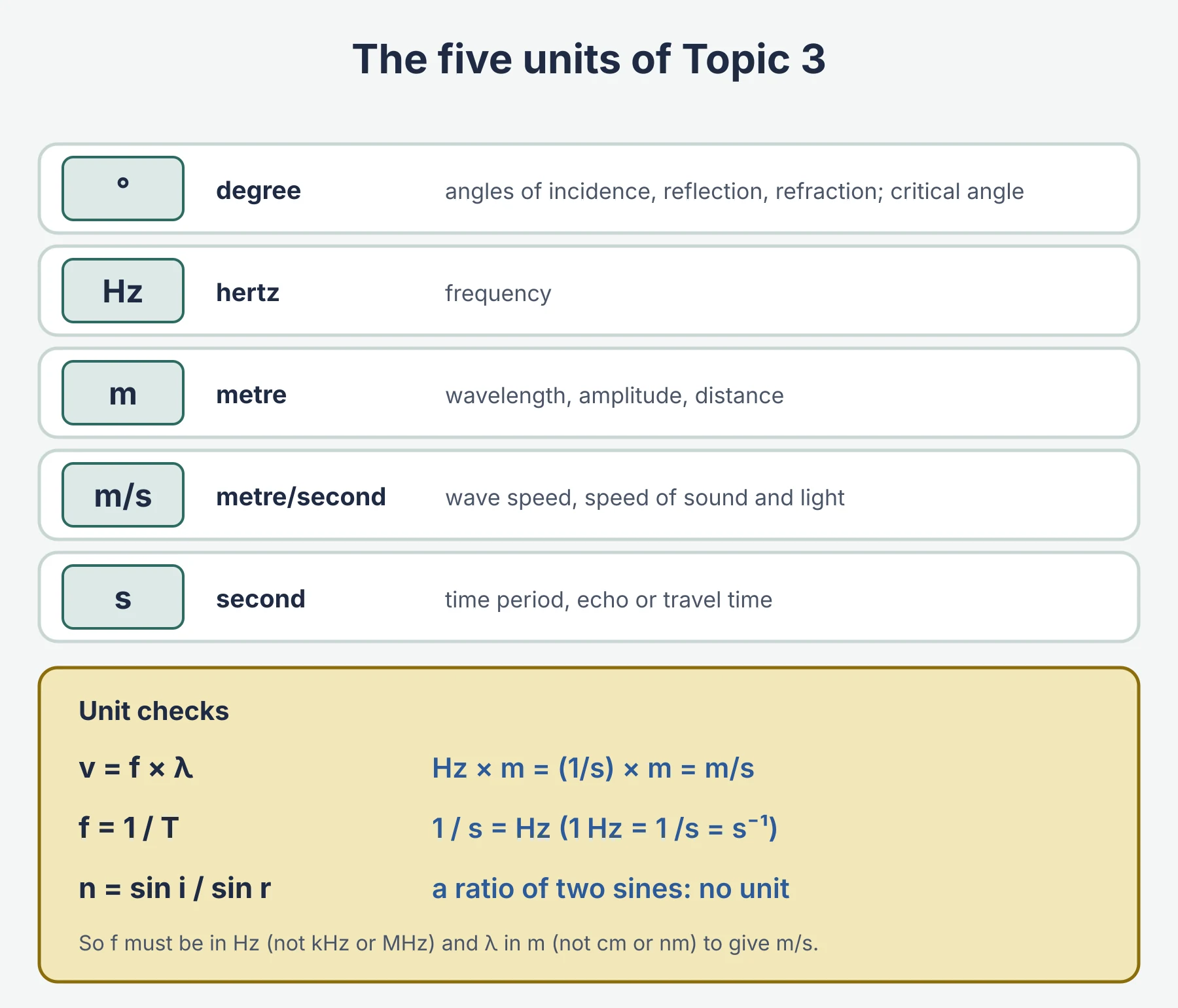
Statement 3.1: degree (°), hertz (Hz), metre (m), metre/second (m/s), second (s).
Key units table
| Unit | Quantity | Note |
|---|---|---|
| ° | angles of incidence, reflection, refraction; critical angle c | measured from the normal |
| Hz | frequency f | 1 Hz = 1 wave per second = 1/s |
| m | wavelength λ, amplitude, distance | convert cm, mm, μm, nm |
| m/s | wave speed v | sound in air ≈ 340 m/s; EM waves 3.0 × 10⁸ m/s in free space |
| s | time period T, travel time | convert ms |
| (none) | refractive index n | ratio of sines, no unit |
Equations and unit checks
v = f × λ        Hz × m = (1/s) × m = m/s
f = 1 / T        1 / s = Hz
n = sin i / sin r    no unit
sin c = 1 / n        no unit
Prefix ladder
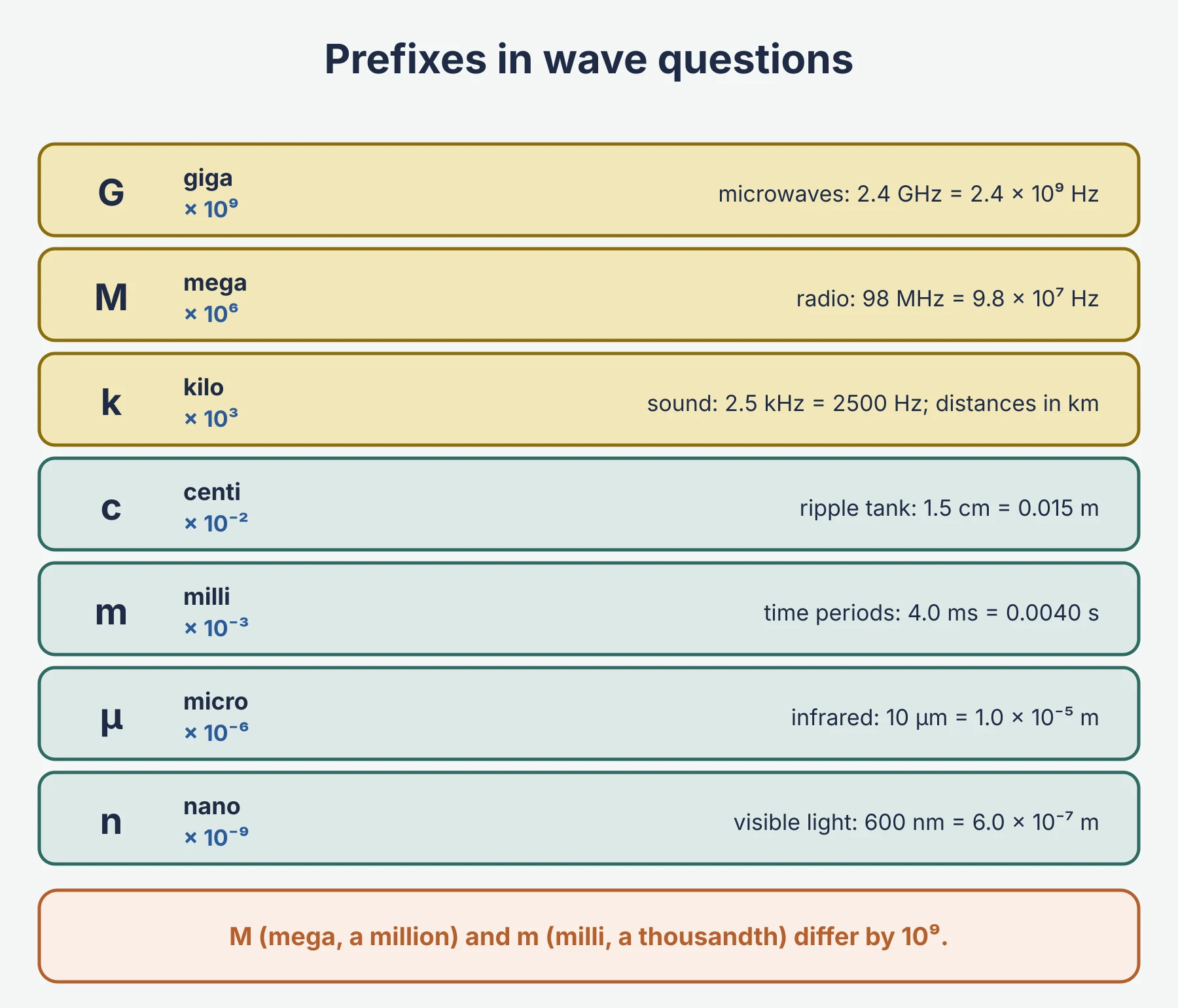
| Symbol | Power | Example |
|---|---|---|
| G | 10⁹ | 5.0 GHz = 5.0 × 10⁹ Hz |
| M | 10⁶ | 200 MHz = 2.0 × 10⁸ Hz |
| k | 10³ | 1.7 kHz = 1700 Hz |
| c | 10⁻² | 2.0 cm = 0.020 m |
| m | 10⁻³ | 5.0 ms = 0.0050 s; 3.0 mm = 0.0030 m |
| μ | 10⁻⁶ | 12 μm = 1.2 × 10⁻⁵ m |
| n | 10⁻⁹ | 450 nm = 4.5 × 10⁻⁷ m |
Quick conversions to recall
- 1 kHz = 1000 Hz; 1 MHz = 1 000 000 Hz
- period 1 ms ↔ frequency 1000 Hz
- period 20 ms ↔ frequency 50 Hz
- 1 nm = 0.000 000 001 m
Angle rules
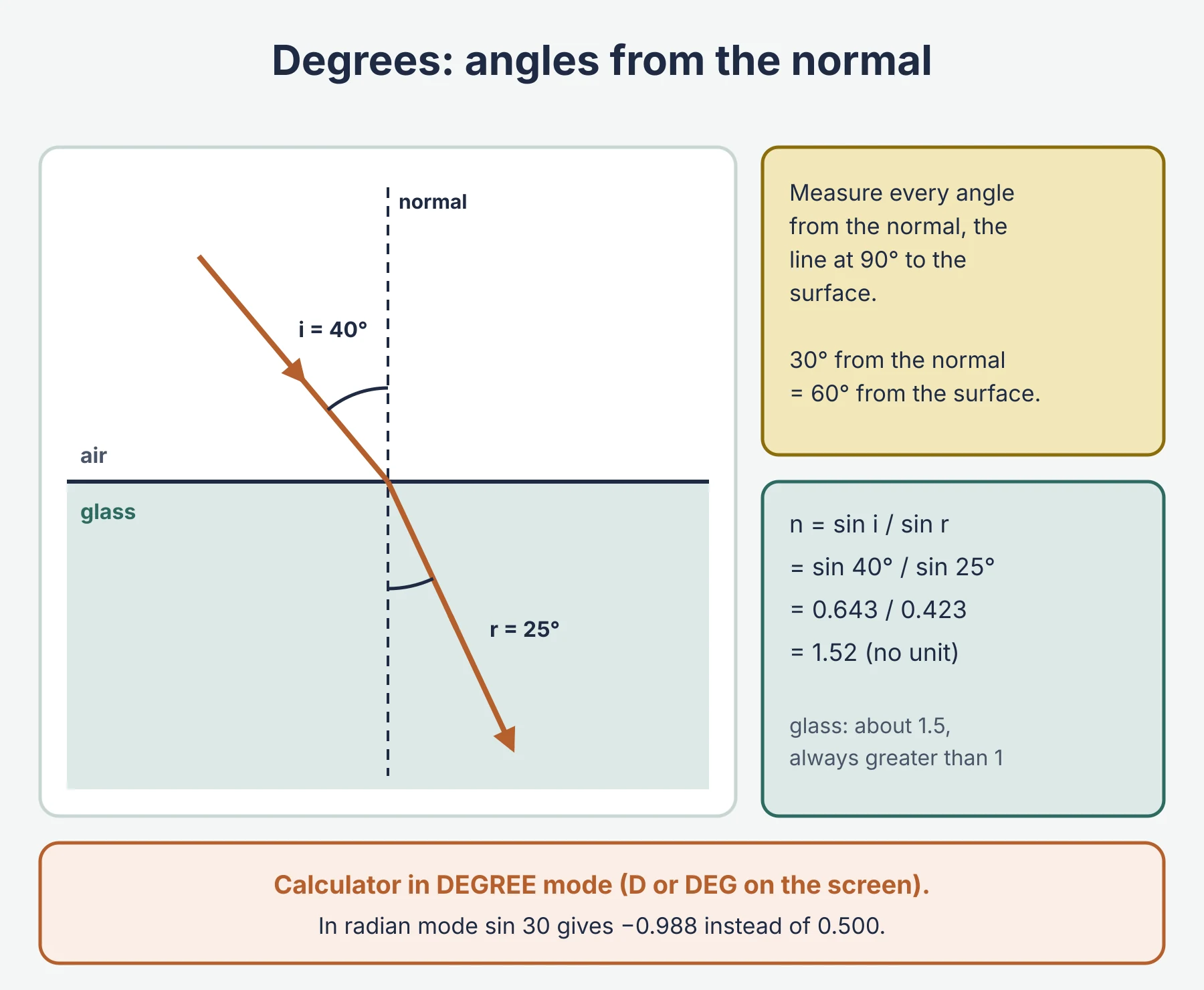
- Angles are measured between the ray and the normal.
- Angle from the surface = 90° − angle from the normal.
- Calculator in degree mode for sin and sin⁻¹.
- sin of any angle is at most 1: if you get sin c greater than 1, the equation has been inverted.
Sense checks
- Visible light wavelengths are hundreds of nanometres (around 4 × 10⁻⁷ to 7 × 10⁻⁷ m); frequencies are around 10¹⁴ Hz.
- Audible sound frequencies range from tens of hertz to many thousands of hertz; wavelengths in air are centimetres to metres.
- Water waves in a ripple tank have wavelengths of a few centimetres and speeds of centimetres per second.
- Refractive index of glass is about 1.5; any n must be greater than 1.
Significant figures and standard form
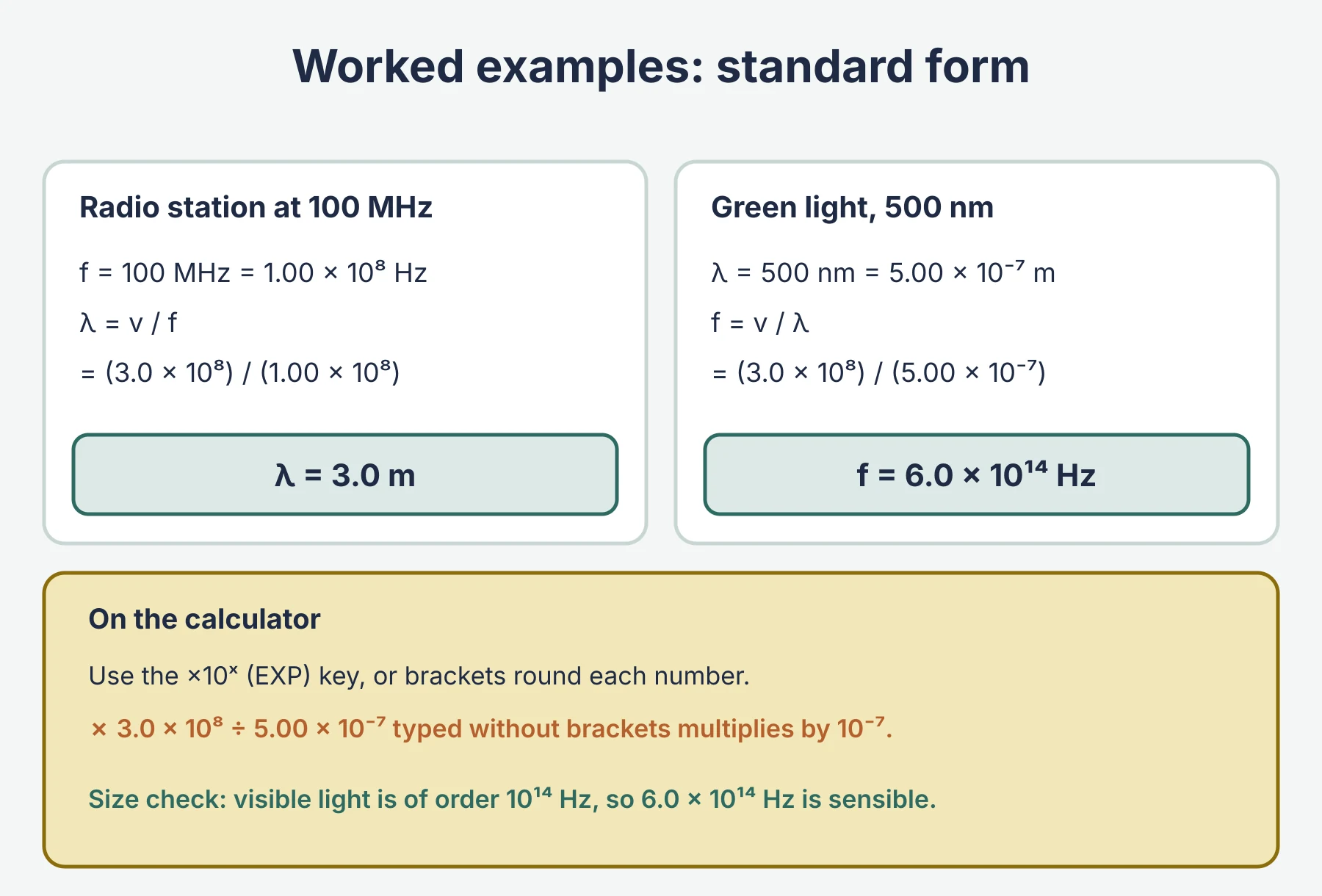
- Give the answer to the same number of significant figures as the least precise data, usually 2 or 3.
- Very large or very small values go in standard form, with the unit: 5.0 × 10¹⁴ Hz, 4.0 × 10⁻⁷ m.
- Keep the full calculator value between steps; round once, at the end.
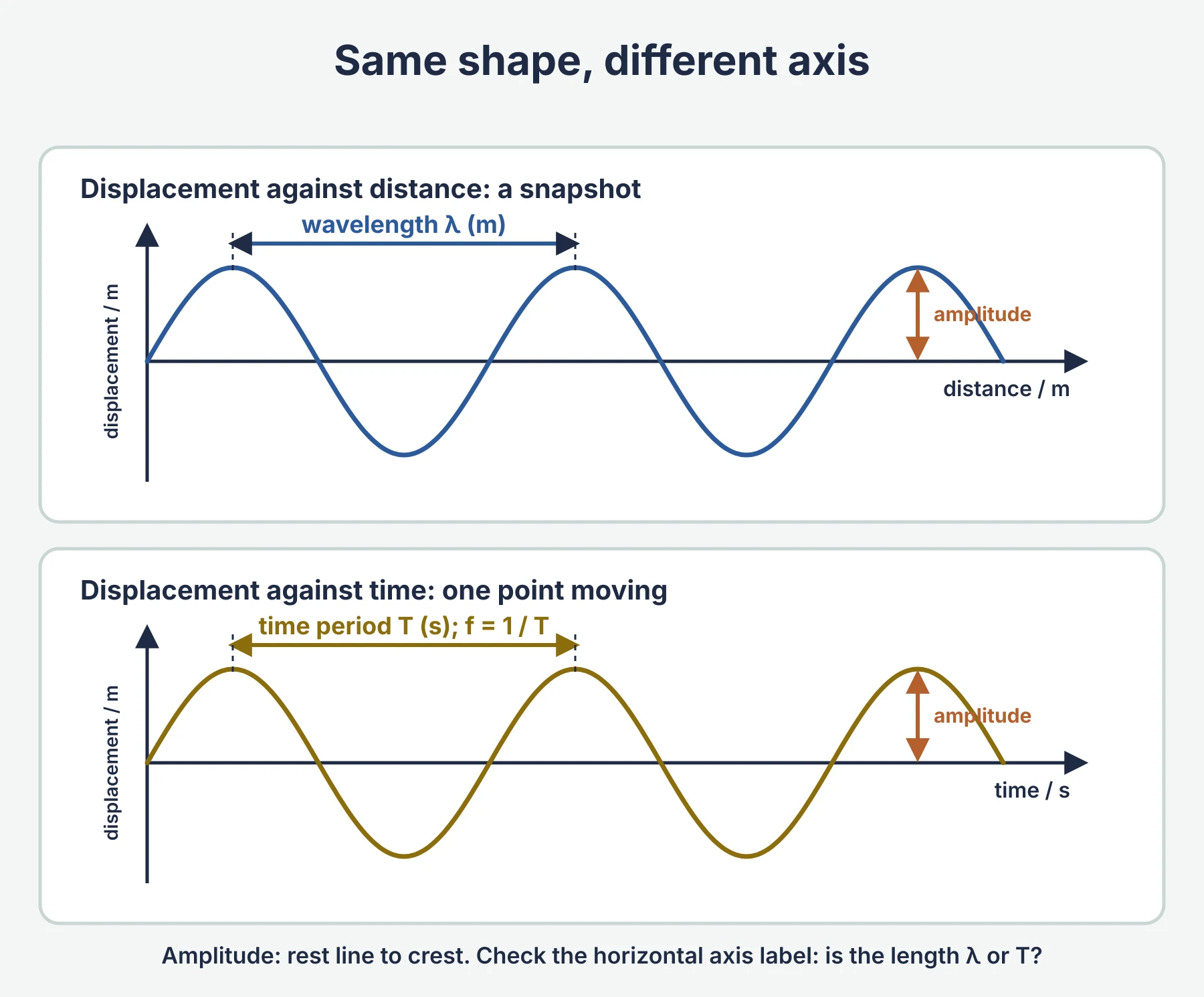
Which graph, which unit?
| Graph | Horizontal axis unit | Repeat length gives | Then |
|---|---|---|---|
| displacement−distance | m (or cm) | wavelength λ | v = f × λ |
| displacement−time | s (or ms) | period T | f = 1 ÷ T |
Amplitude comes from the vertical axis on either graph: rest line to crest.
Worked chain
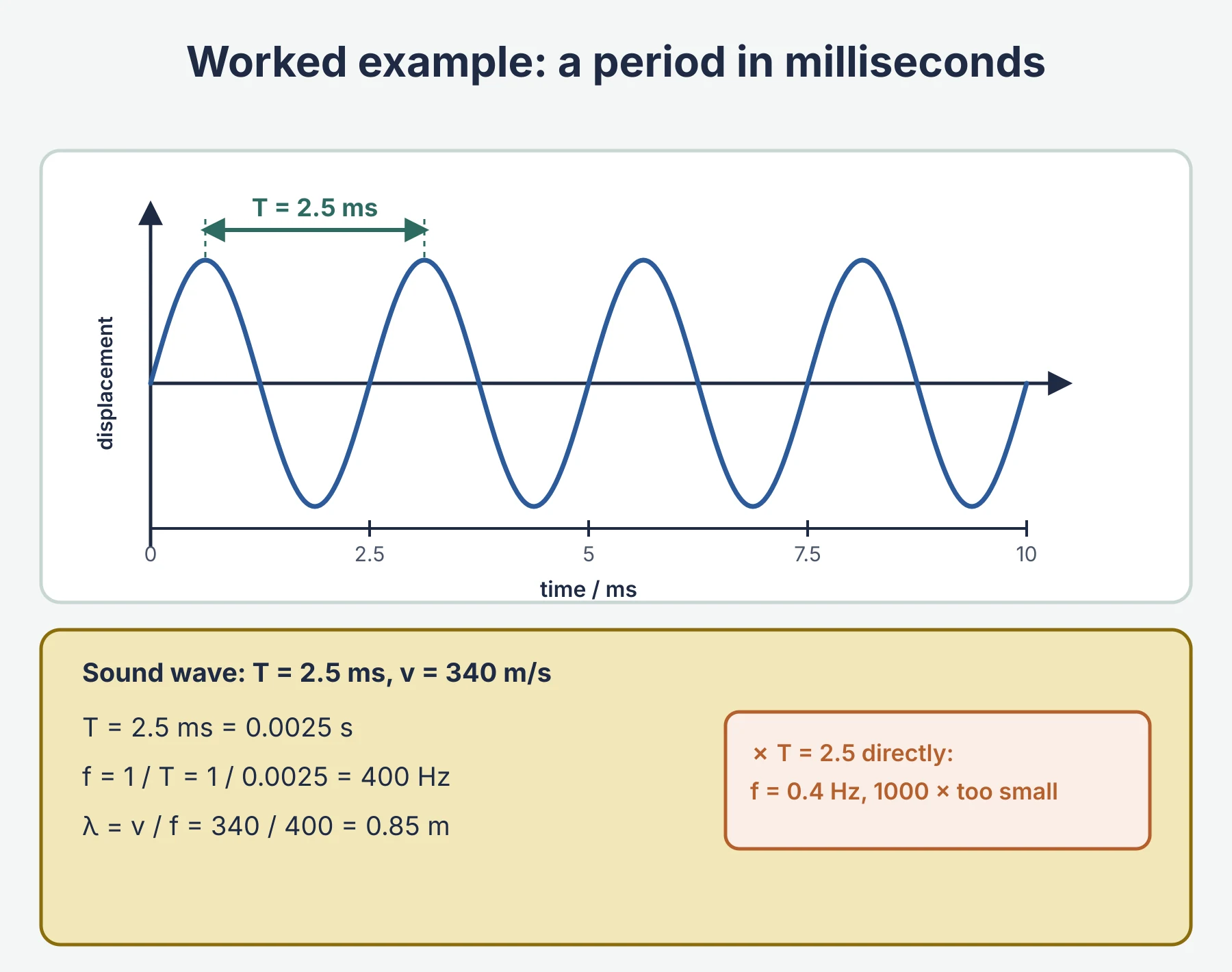
A displacement−time graph shows one complete wave in 4.0 ms; the wave travels at 340 m/s.
T = 4.0 ms = 0.0040 s
f = 1 / 0.0040 = 250 Hz
λ = 340 / 250 = 1.36 m ≈ 1.4 m
Three units, three conversions checked: ms to s, Hz from 1/s, m from (m/s) ÷ Hz.
Exam traps
- Substituting MHz or kHz directly into v = f × λ.
- Using cm or nm as metres.
- Measuring an angle from the surface.
- Calculator in radians: sin 30 shows −0.988, not 0.5.
- Giving refractive index a unit.
- Using T in ms in f = 1 ÷ T, giving a frequency 1000 times too small.
- Confusing m (milli) and M (mega).
- Dividing standard-form numbers without brackets or the EXP key.
Self-test
- State the unit of frequency and express it in terms of the second.
- State the unit of refractive index.
- Convert 2.4 GHz to Hz in standard form.
- Convert 650 nm to metres in standard form.
- A wave has a period of 0.020 s. Calculate its frequency.
- A sound has a frequency of 1.7 kHz and travels at 340 m/s. Calculate its wavelength.
- A radio wave has a wavelength of 1500 m and travels at 3.0 × 10⁸ m/s. Calculate its frequency.
- A ray meets a mirror at 35° to the surface. State its angle of incidence.
- A student calculates sin c = 1.6. What has gone wrong?
- Show that Hz × m is equivalent to m/s.
- A ripple tank wave has wavelength 2.5 cm and frequency 8.0 Hz. Calculate its speed in m/s.
- An oscilloscope shows one complete wave across 4 divisions at 0.5 ms per division. Calculate the period and frequency.
Answers
- Hertz (Hz); 1 Hz = 1/s (s⁻¹).
- It has no unit.
- 2.4 × 10⁹ Hz.
- 6.5 × 10⁻⁷ m.
- f = 1 ÷ 0.020 = 50 Hz.
- λ = 340 ÷ 1700 = 0.20 m.
- f = 3.0 × 10⁸ ÷ 1500 = 2.0 × 10⁵ Hz.
- 90° − 35° = 55°.
- The student has used sin c = n instead of sin c = 1 ÷ n; a sine can never be greater than 1.
- Hz = 1/s, so Hz × m = m/s.
- v = 8.0 × 0.025 = 0.20 m/s.
- T = 4 × 0.5 ms = 2.0 ms = 0.0020 s; f = 1 ÷ 0.0020 = 500 Hz.
Related resources
-
Study guides
Waves
Wave properties, the Doppler effect, the EM spectrum, reflection, refraction and sound: Topic 3 of Pearson Edexcel International GCSE Physics (4PH1).
Physics · Pearson Edexcel · IGCSE
Read guide -
Practice questions
Edexcel IGCSE Physics: Waves — Practice Questions
Original practice questions with worked answers on wave properties, the Doppler effect, the EM spectrum, refraction and sound for Edexcel IGCSE Physics 4PH1.
Physics · Pearson Edexcel · IGCSE
Try questions -
Revision notes
Edexcel IGCSE Physics: Waves — Revision Notes
Recall notes on wave properties, the Doppler effect, the electromagnetic spectrum, refraction and sound for Edexcel International GCSE Physics 4PH1.
Physics · Pearson Edexcel · IGCSE
Revise topic
Related articles
Get free revision emails (optional)
Occasional emails with practice questions, worked explanations and links to free resources for the qualification and subjects you choose. No spam, and you can unsubscribe from any email. The free tools on this site never need an email.