
Study Guides
Pearson Edexcel International GCSE Physics (4PH1): Units for waves
The degree, hertz, metre, metre/second and second in Edexcel International GCSE Physics 4PH1 Topic 3: meanings, prefixes, standard form and angle work.
- Subject
- Physics
- Level
- IGCSE
- Topic
- Waves
- Author
- Marlbridge Academic Team
- Updated
- Reviewed by
- Hassan (what this means)
Aligned to Pearson Edexcel IGCSE Physics (4PH1), Issue 4. Official specification .
Syllabus page (what it covers and how it is assessed): Pearson Edexcel IGCSE Physics.
Syllabus points this page covers
4PH1
- 3a Units
Found an error? Report a correction.
Need help with this topic? Request a free trial class for IGCSE Physics (4PH1).
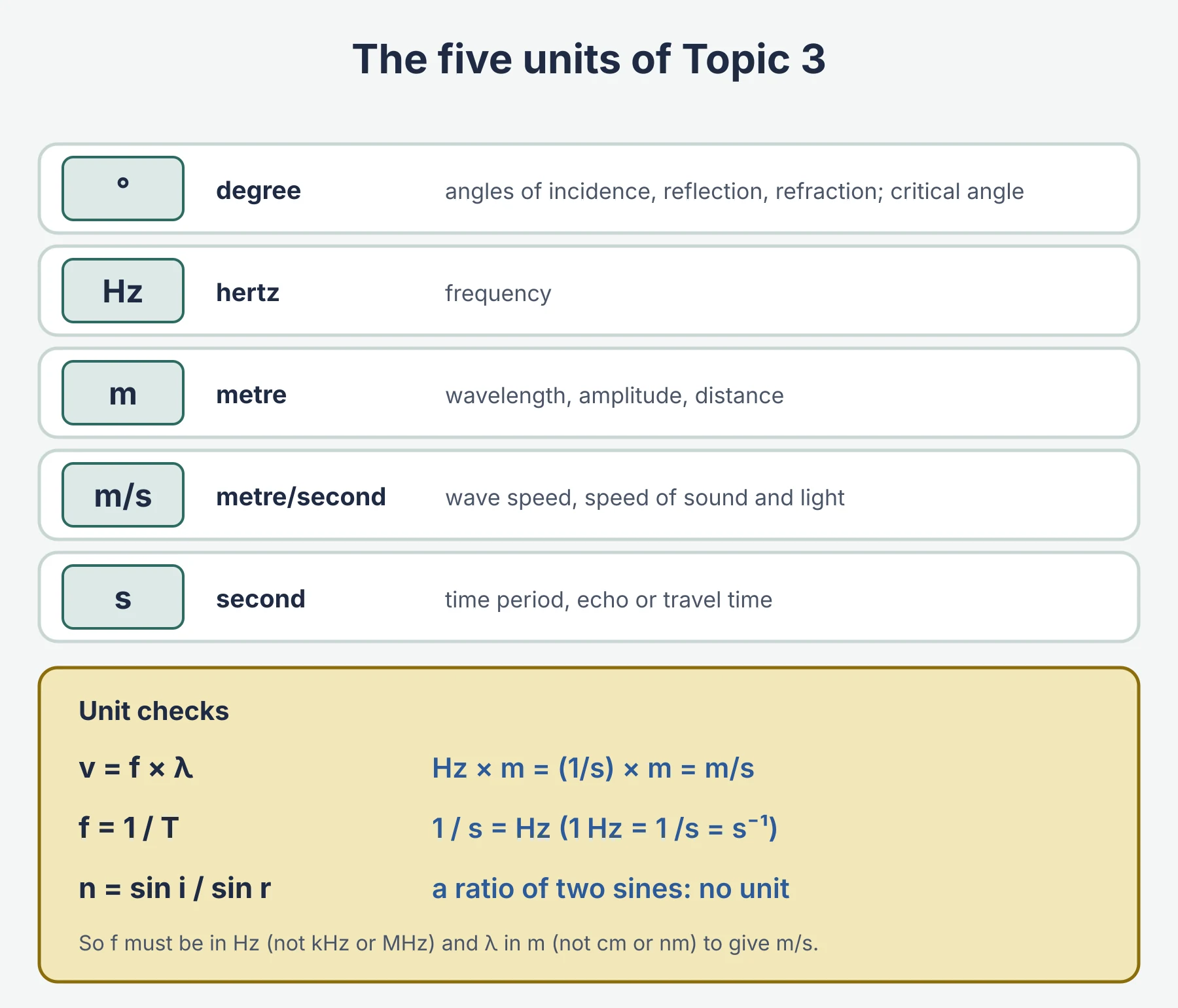
This guide covers sub-topic 3(a) Units of Topic 3, Waves, in the Pearson Edexcel International GCSE in Physics (4PH1), Issue 4. Statement 3.1 asks you to use the units degree (°), hertz (Hz), metre (m), metre/second (m/s) and second (s). It has no “P”, so it is assessed on both papers. For the wave physics itself, see the Waves study guide.
The five units
| Unit | Symbol | Quantities in Topic 3 |
|---|---|---|
| degree | ° | angle of incidence, reflection, refraction; critical angle |
| hertz | Hz | frequency |
| metre | m | wavelength, amplitude, distance |
| metre/second | m/s | wave speed, speed of sound, speed of light |
| second | s | time period, time for an echo or a wave to travel |
Only two equations in this topic produce a numerical unit:
v = f × λ      (m/s) = (Hz) × (m)
f = 1 / T      (Hz)  = 1 / (s)
The refractive index equations, n = sin i ÷ sin r and sin c = 1 ÷ n, use angles in degrees, but n itself has no unit: it is a ratio of two sines.
The hertz
Frequency is the number of waves passing a point (or the number of oscillations of a source) each second. One hertz is one wave per second:
1 Hz = 1 /s (also written s⁻¹)Because f = 1 ÷ T, a wave with a time period of 0.5 s has a frequency of 2 Hz, and a period of 0.001 s gives 1000 Hz.
Check v = f × λ with units: Hz × m = (1/s) × m = m/s. This is why frequency must be in Hz (not kHz or MHz) and wavelength in m (not cm or nm) for the speed to come out in m/s.
Prefixes in wave questions
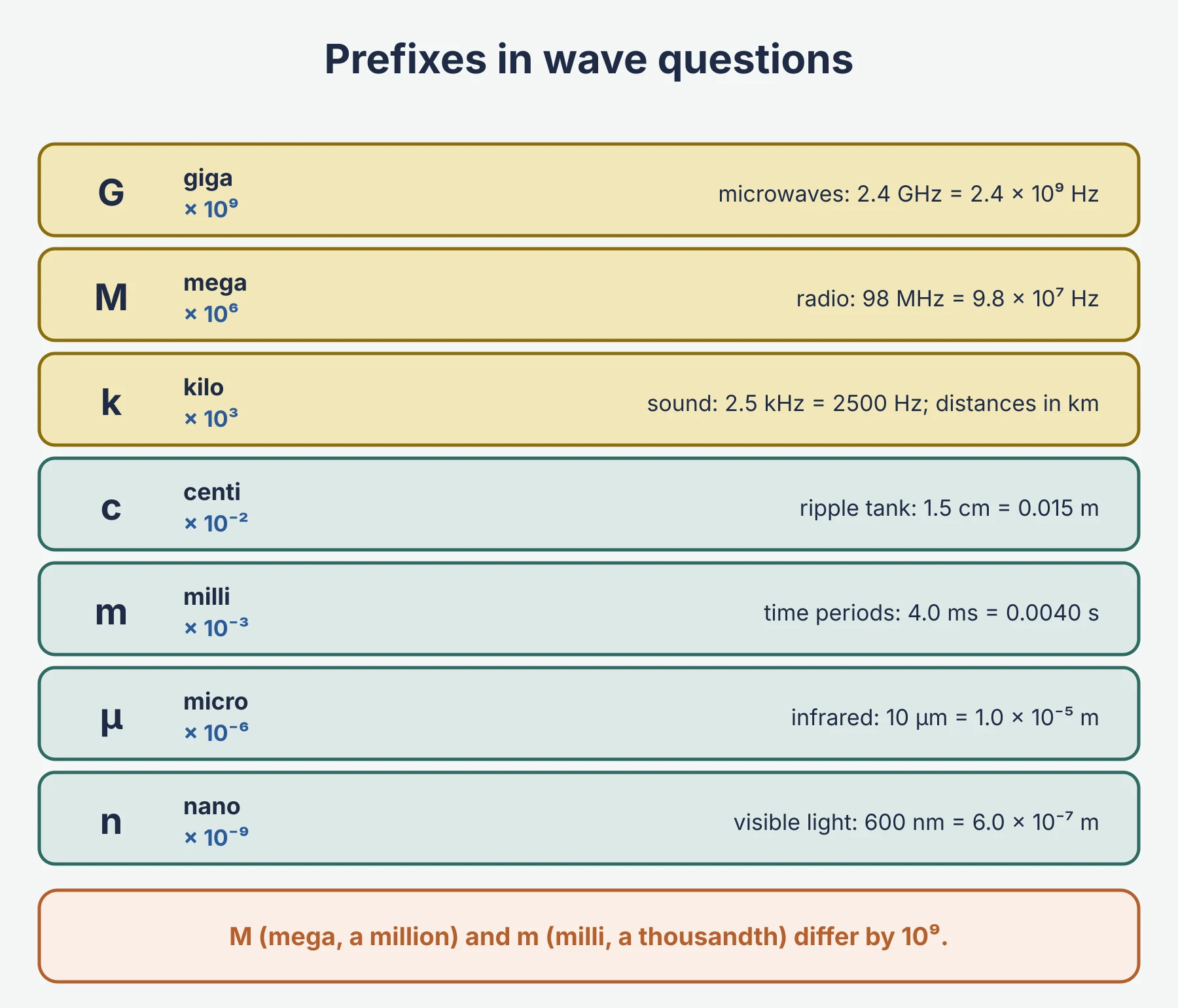
Waves span a huge range of sizes, so prefixes and standard form are everywhere in Topic 3.
| Prefix | Symbol | Multiplier | Typical use |
|---|---|---|---|
| giga | G | × 10⁹ | microwave frequencies: 2.4 GHz = 2.4 × 10⁹ Hz |
| mega | M | × 10⁶ | radio frequencies: 98 MHz = 9.8 × 10⁷ Hz |
| kilo | k | × 10³ | sound frequencies: 2.5 kHz = 2500 Hz; distances: km |
| centi | c | × 10⁻² | water wavelengths in a ripple tank: 1.5 cm = 0.015 m |
| milli | m | × 10⁻³ | time periods: 4.0 ms = 0.0040 s |
| micro | μ | × 10⁻⁶ | infrared wavelengths: 10 μm = 1.0 × 10⁻⁵ m |
| nano | n | × 10⁻⁹ | visible wavelengths: 600 nm = 6.0 × 10⁻⁷ m |
Watch the capital and lower-case letters. M (mega, a million) and m (milli, a thousandth) differ by a factor of 10⁹.
Standard form for electromagnetic waves
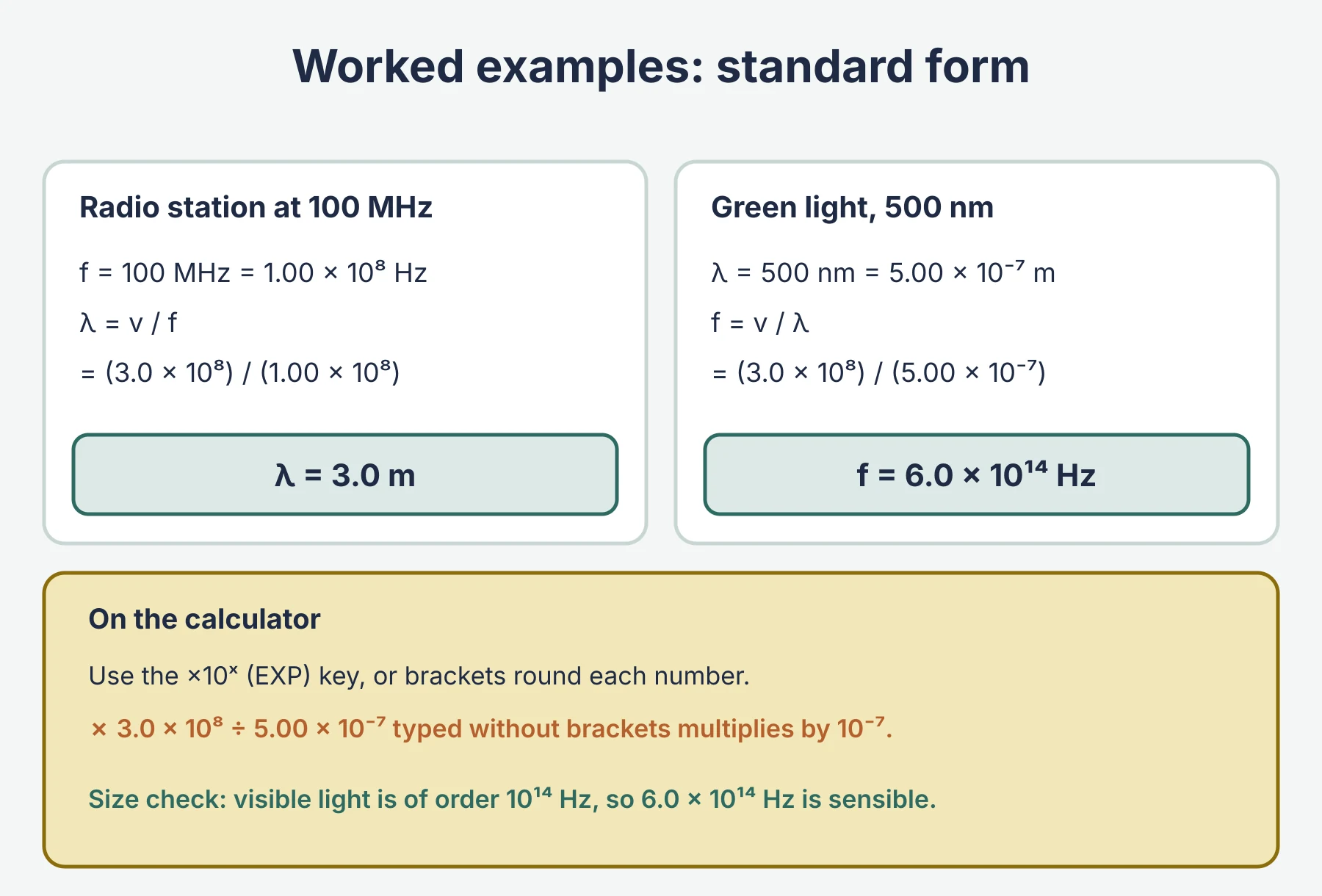
All electromagnetic waves travel at the same speed in free space; questions that need the value normally give it, as 3.0 × 10⁸ m/s. Calculations with it are best done in standard form.
Worked example 1: a radio wave. A radio station broadcasts at 100 MHz. Calculate the wavelength.
f = 100 MHz = 1.00 × 10⁸ Hz
λ = v / f = (3.0 × 10⁸) / (1.00 × 10⁸) = 3.0 m
Worked example 2: visible light. Green light has a wavelength of 500 nm. Calculate its frequency.
λ = 500 nm = 5.00 × 10⁻⁷ m
f = v / λ = (3.0 × 10⁸) / (5.00 × 10⁻⁷) = 6.0 × 10¹⁴ Hz
Commentary. Enter standard form with the calculator’s ×10ˣ (EXP) key, or put each number in brackets: typing 3.0 × 10⁸ ÷ 5.00 × 10⁻⁷ without brackets multiplies by 10⁻⁷ instead of dividing by it. Dividing by a negative power of ten gives a large answer, which matches the idea that very short wavelengths have very high frequencies. Check the answer’s size: visible light has frequencies of order 10¹⁴ Hz, so 6.0 × 10¹⁴ Hz is sensible.
Time units and the period
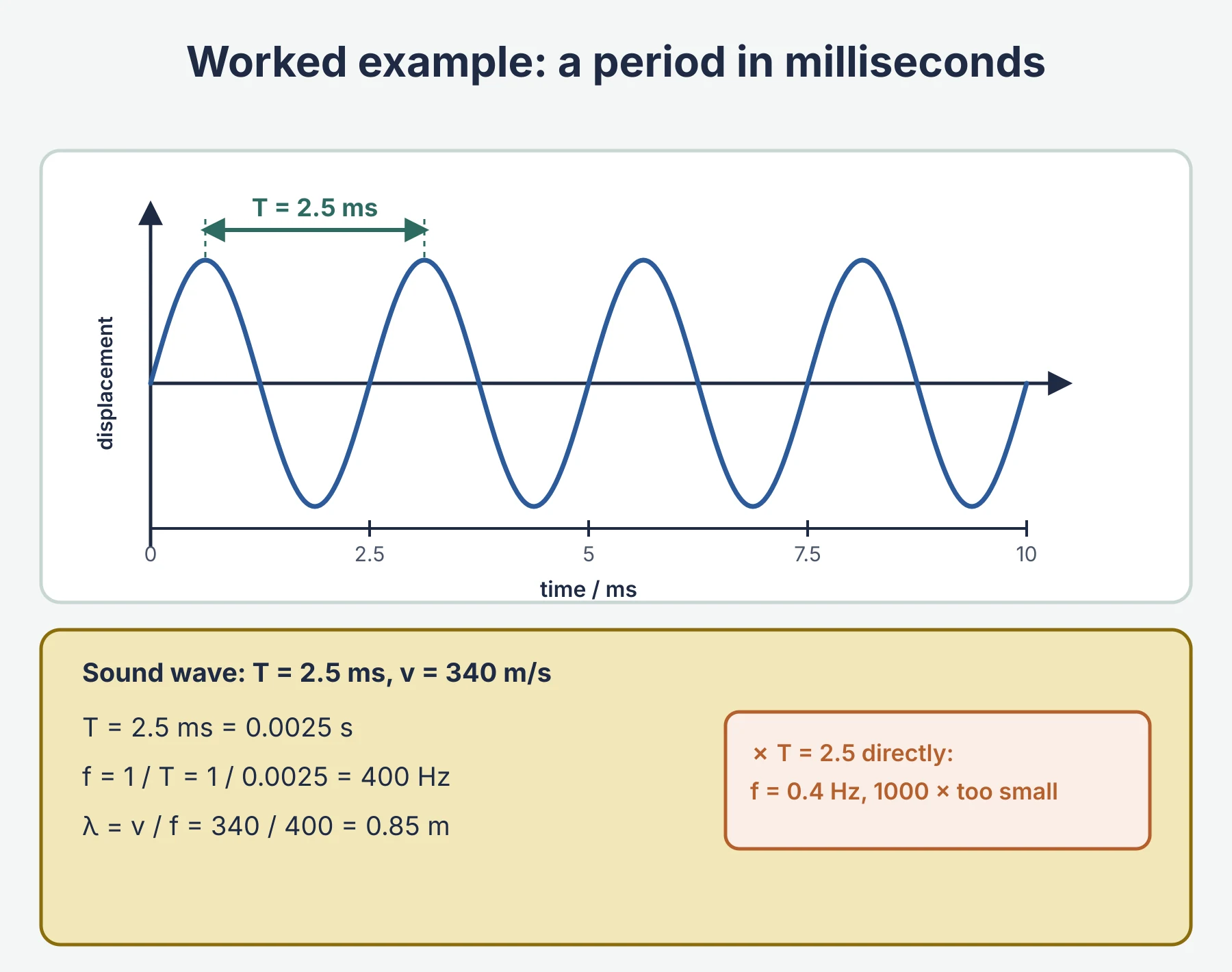
Times in wave questions are often given in milliseconds, especially on an oscilloscope trace or when one wave takes a fraction of a second.
Worked example 3. A sound wave has a time period of 2.5 ms. It travels at 340 m/s. Calculate its frequency and wavelength.
T = 2.5 ms = 0.0025 s
f = 1 / T = 1 / 0.0025 = 400 Hz
λ = v / f = 340 / 400 = 0.85 m
Using T = 2.5 directly would give f = 0.4 Hz, a thousand times too small.
The degree
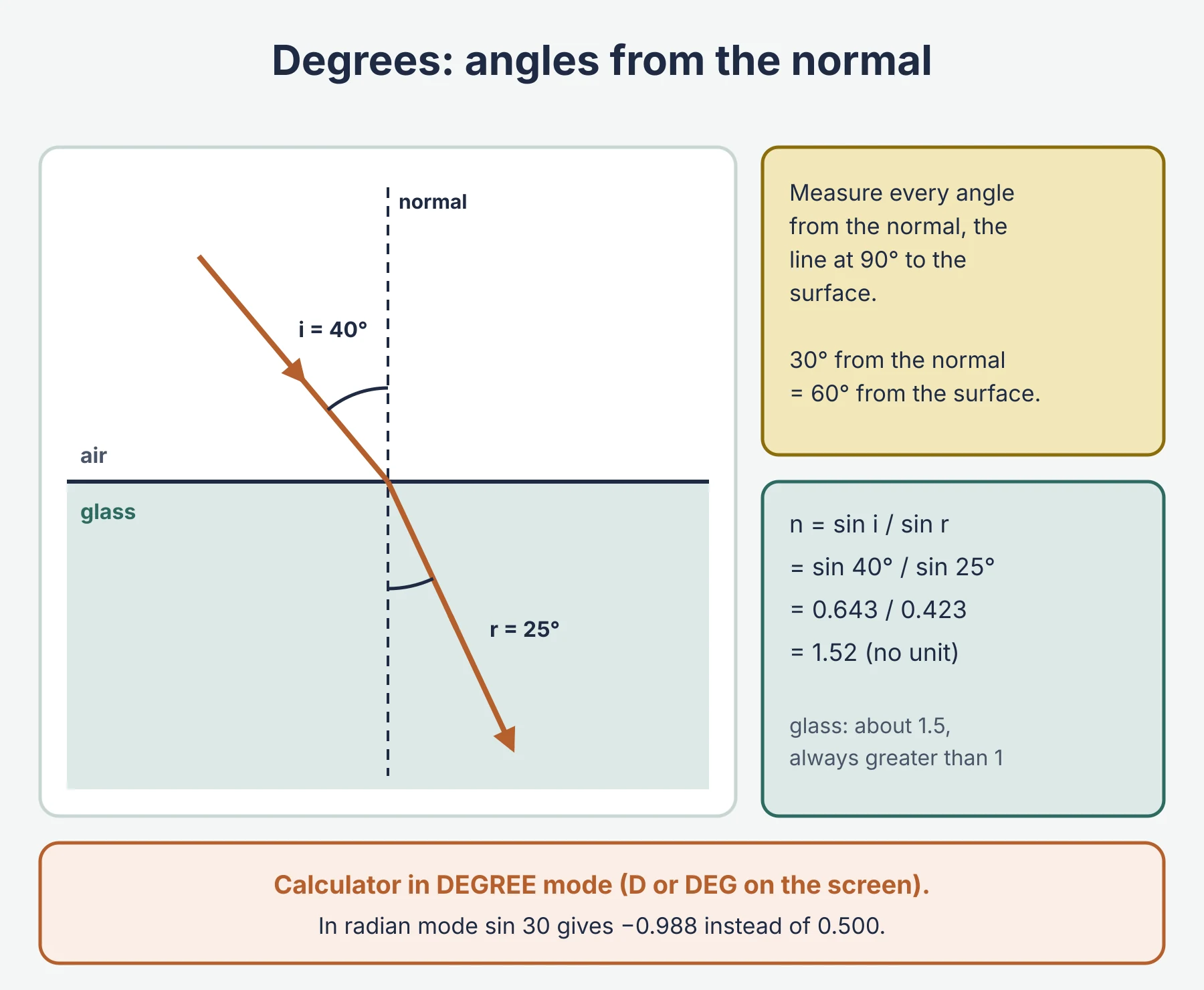
Angles in Topic 3 are measured in degrees and always from the normal, the line at 90° to the surface where the ray meets it. An angle of incidence of 30° means 30° from the normal, which is 60° from the surface.
When using sin or sin⁻¹ on a calculator, the calculator must be in degree mode (usually “D” or “DEG” shown on the screen). In radian mode, sin 30 gives −0.988 instead of 0.500. The specification’s mathematical skills include using a calculator to handle sin x and sin⁻¹ x with x in degrees.
Worked example 4. Light enters glass at an angle of incidence of 40° and refracts at 25°.
n = sin i / sin r = sin 40° / sin 25° = 0.643 / 0.423 = 1.52n has no unit. A quick sense check: n for glass is about 1.5, and it is always greater than 1.
Reading the axes of wave graphs
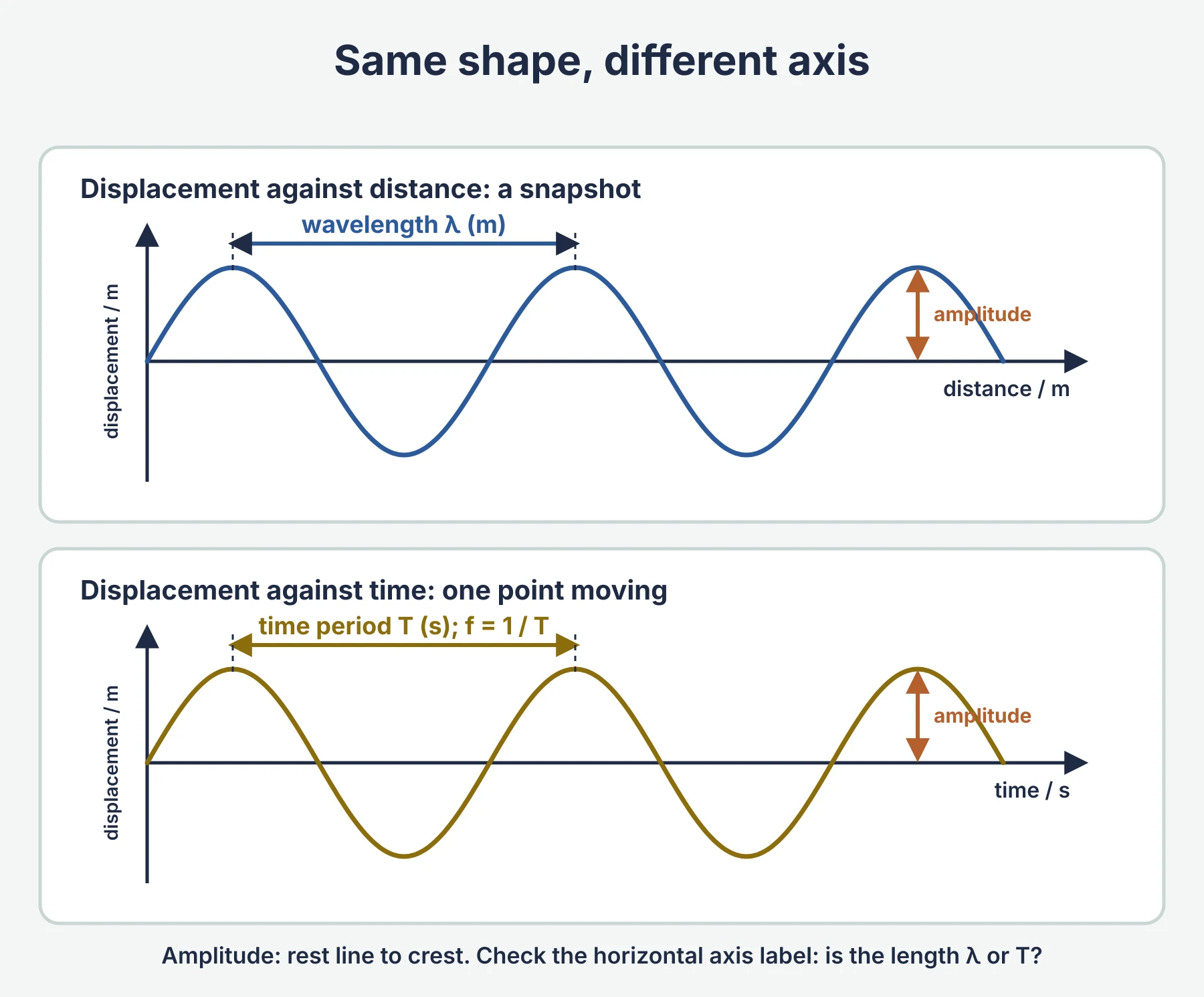
Two kinds of wave graph look alike but give different quantities, and the unit on the horizontal axis tells you which is which.
- Displacement against distance (axis in m or cm): a snapshot of the wave at one instant. The repeat length along the axis is the wavelength, in metres.
- Displacement against time (axis in s or ms): how one point moves. The repeat length along the axis is the time period, in seconds, and f = 1 ÷ T.
On both, the amplitude is read from the vertical axis, from the rest line to a crest, in metres. Always check the axis label before deciding whether a length you have measured is a λ or a T.
Common mistakes
- Using kHz, MHz or GHz in v = f × λ without converting to Hz.
- Using cm or nm for wavelength without converting to m.
- Measuring angles from the surface instead of the normal.
- Leaving the calculator in radian mode.
- Writing a unit for refractive index.
- Dividing by a value typed as “× 10 ^” without brackets; use the EXP key or brackets.
- Writing “Hz/s” or “m/Hz”. Frequency is in Hz; wavelength is in m.
Exam technique with command words
- Calculate: give the equation, convert prefixes, substitute, and give the answer with a unit (except for n), in standard form if very large or small.
- Show that: give your value to one more significant figure than the printed one, with every conversion visible.
- Determine from an oscilloscope trace or a wave diagram: read the scale (for example ms per division, or cm per square) and convert to SI units before using f = 1 ÷ T or v = f × λ.
- State the unit: “hertz (Hz)”, or for n, “no unit”.
- Units for waves revision notes
- Units for waves practice questions
- Using these units: Properties of waves study guide and The electromagnetic spectrum study guide
Written against the Pearson Edexcel International GCSE in Physics (4PH1) specification, Issue 4. Always check the current specification for your examination year.
Related resources
-
Practice questions
Pearson Edexcel International GCSE Physics (4PH1): Units for waves – Practice Questions
Original practice questions with full answers on using degrees, hertz, metres, m/s and seconds, prefixes and standard form for Edexcel IGCSE Physics 4PH1 waves.
Physics · Pearson Edexcel · IGCSE
Try questions -
Revision notes
Pearson Edexcel International GCSE Physics (4PH1): Units for waves – Revision Notes
Recall notes on degrees, hertz, metres, m/s and seconds for Edexcel International GCSE Physics 4PH1 waves: prefixes, standard form, exam traps and a self-test.
Physics · Pearson Edexcel · IGCSE
Revise topic -
Study guides
Waves
Wave properties, the Doppler effect, the EM spectrum, reflection, refraction and sound: Topic 3 of Pearson Edexcel International GCSE Physics (4PH1).
Physics · Pearson Edexcel · IGCSE
Read guide
Related articles
Get free revision emails (optional)
Occasional emails with practice questions, worked explanations and links to free resources for the qualification and subjects you choose. No spam, and you can unsubscribe from any email. The free tools on this site never need an email.