
Study Guides
Pearson Edexcel International GCSE Physics (4PH1): The electromagnetic spectrum
The order, shared speed, uses and harmful effects of electromagnetic waves, with protective measures, for Edexcel International GCSE Physics 4PH1, sub-topic 3c.
- Subject
- Physics
- Level
- IGCSE
- Topic
- Waves
- Author
- Marlbridge Academic Team
- Updated
- Reviewed by
- Hassan (what this means)
Aligned to Pearson Edexcel IGCSE Physics (4PH1), Issue 4. Official specification .
Syllabus page (what it covers and how it is assessed): Pearson Edexcel IGCSE Physics.
Syllabus points this page covers
4PH1
- 3c The electromagnetic spectrum
Found an error? Report a correction.
Need help with this topic? Request a free trial class for IGCSE Physics (4PH1).
This guide goes deep on sub-topic 3(c) The electromagnetic spectrum, statements 3.10 to 3.13 of the Pearson Edexcel International GCSE in Physics (4PH1), Issue 4. None of the statements carries a “P”, so all can be assessed on both papers. For Topic 3 as a whole, see the Waves study guide.
What the specification asks
- 3.10 know that light is part of a continuous electromagnetic spectrum that includes radio, microwave, infrared, visible, ultraviolet, x-ray and gamma ray radiations, and that all these waves travel at the same speed in free space
- 3.11 know the order of the electromagnetic spectrum in terms of decreasing wavelength and increasing frequency, including the colours of the visible spectrum
- 3.12 explain some of the uses of electromagnetic radiations: radio waves for broadcasting and communications; microwaves for cooking and satellite transmissions; infrared for heaters and night vision equipment; visible light for optical fibres and photography; ultraviolet for fluorescent lamps; x-rays for observing the internal structure of objects and materials, including for medical applications; gamma rays for sterilising food and medical equipment
- 3.13 explain the detrimental effects of excessive exposure of the human body to electromagnetic waves (microwaves: internal heating of body tissue; infrared: skin burns; ultraviolet: damage to surface cells and blindness; gamma rays: cancer, mutation) and describe simple protective measures against the risks
A continuous spectrum with one speed (3.10)
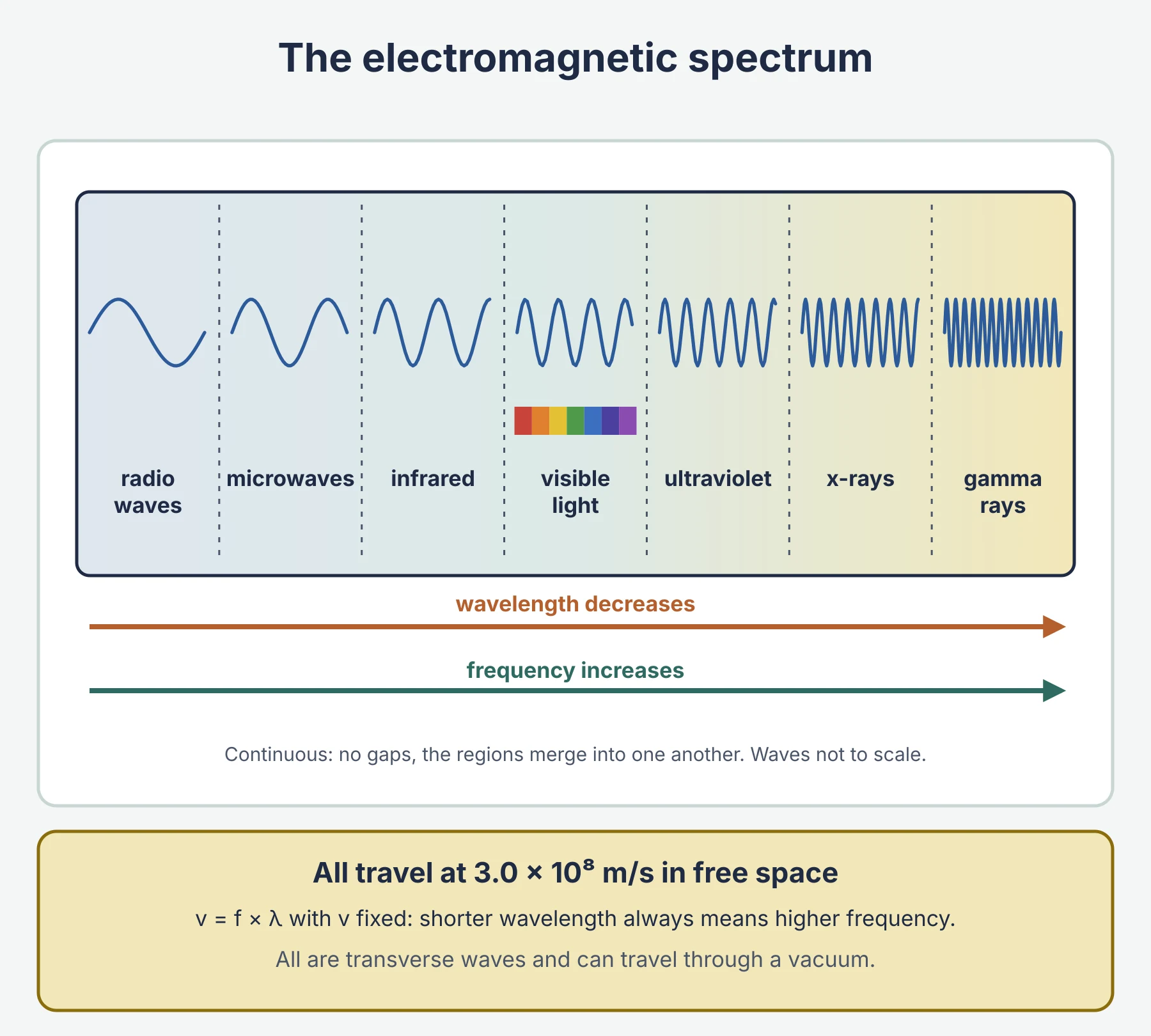
Electromagnetic (EM) waves are transverse waves that can travel through a vacuum. They form a continuous spectrum: there are no gaps between the named groups, which merge into one another. The names are labels for ranges of wavelength.
All EM waves travel at the same speed in free space (a vacuum), 3.0 × 10⁸ m/s. Air slows them only very slightly, so the same value is used in air. Because v is fixed, v = f × λ means that a shorter wavelength always goes with a higher frequency.
The order (3.11)
In order of decreasing wavelength and increasing frequency:
| Region | Typical wavelength | Notes |
|---|---|---|
| radio waves | metres to kilometres | longest wavelength, lowest frequency |
| microwaves | millimetres to centimetres | |
| infrared | micrometres up to about a millimetre | emitted by warm and hot objects |
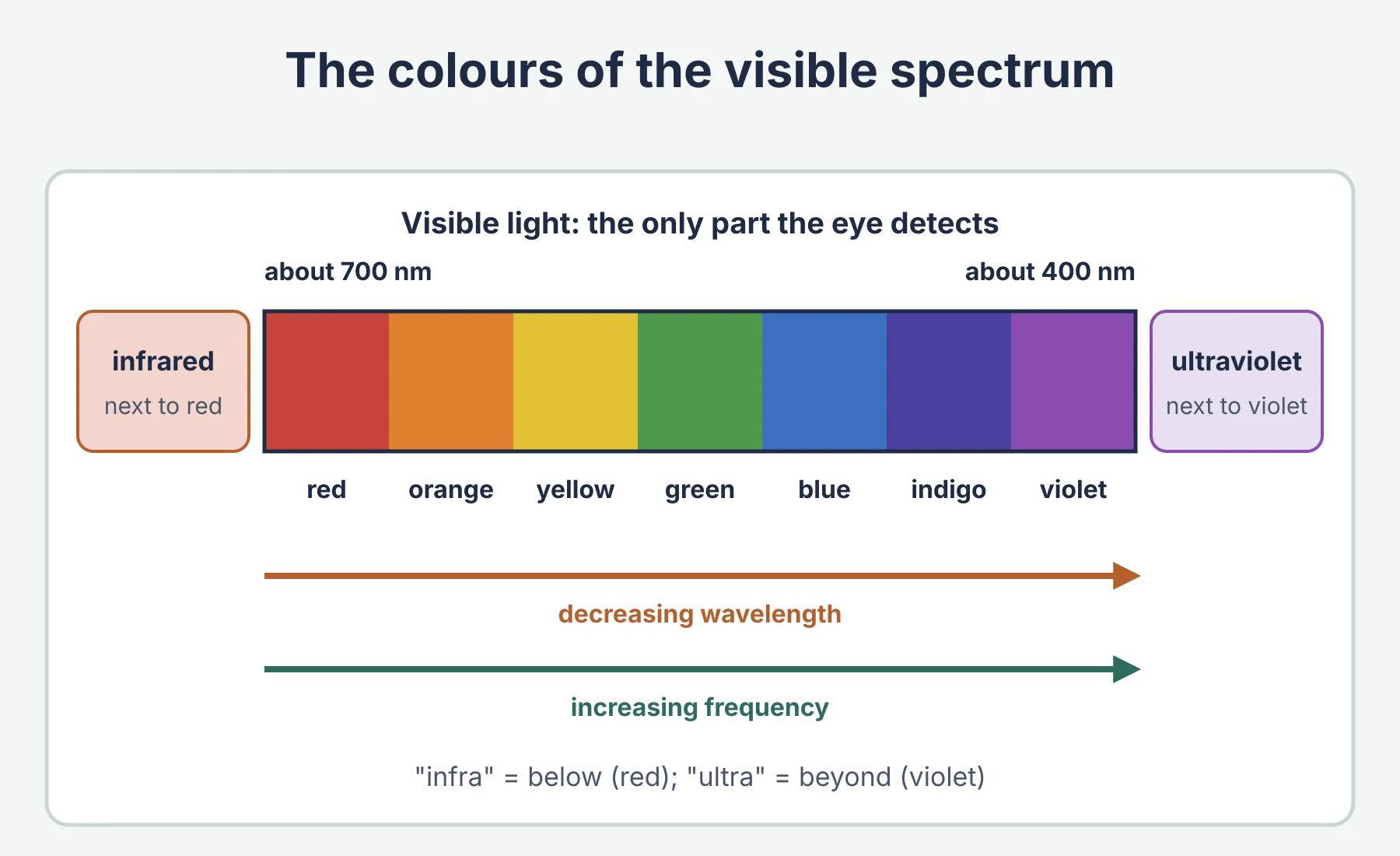
| visible light | about 400 nm (violet) to 700 nm (red) | the only part the eye detects |
| ultraviolet | below about 400 nm | |
| x-rays | about 10⁻⁸ to 10⁻¹¹ m | |
| gamma rays | shorter still | shortest wavelength, highest frequency |
The boundaries are approximate, and x-rays and gamma rays overlap in wavelength; the names partly reflect how they are produced. You need the order, not the numbers.
The visible spectrum, in order of decreasing wavelength: red, orange, yellow, green, blue, indigo, violet. Red is next to infrared; violet is next to ultraviolet. A mnemonic for the whole spectrum from radio to gamma helps, as does remembering that “infra” means below (red) and “ultra” means beyond (violet).
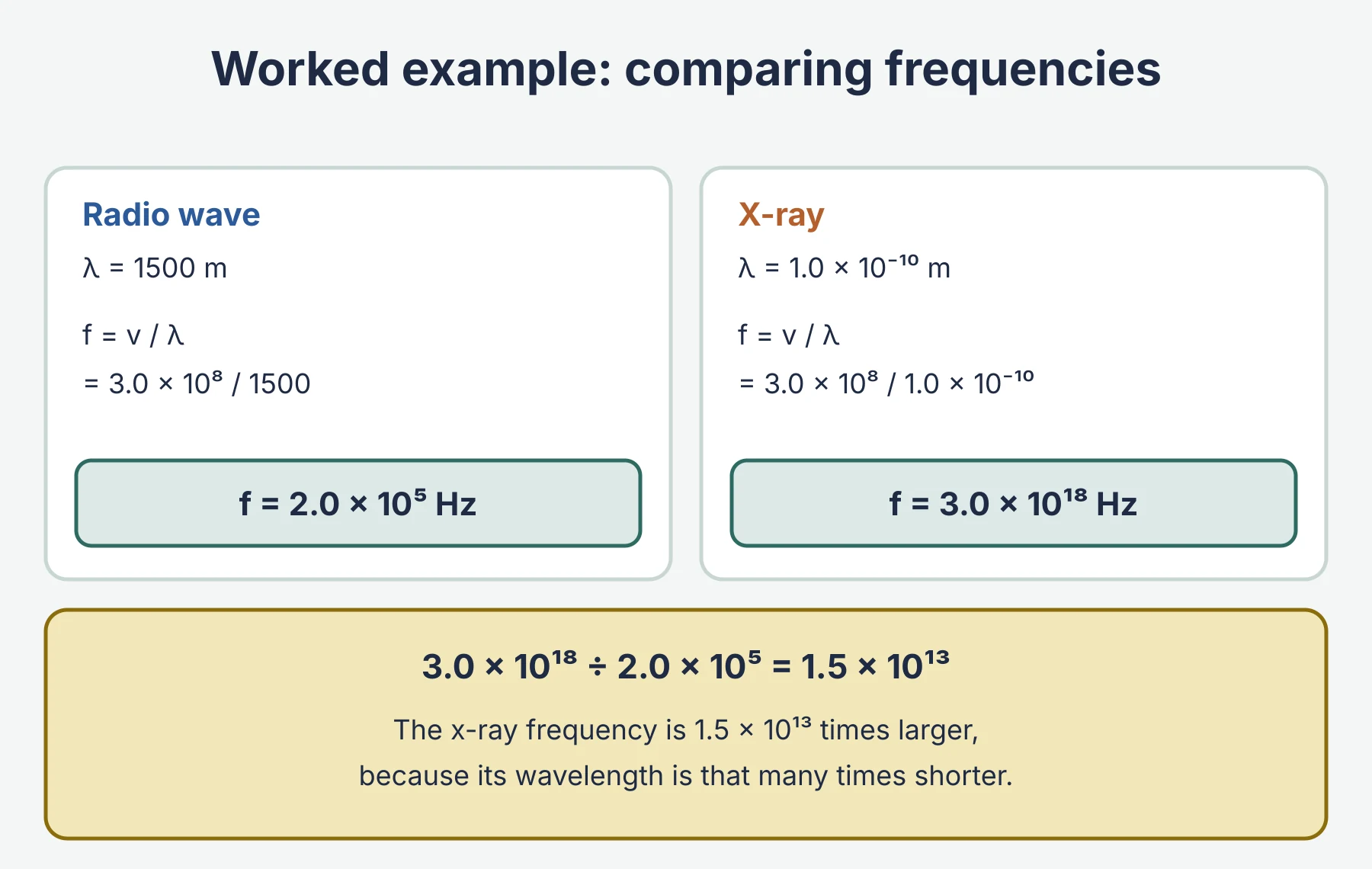
Worked example 1. A radio wave has a wavelength of 1500 m, and an x-ray has a wavelength of 1.0 × 10⁻¹⁰ m. Compare their frequencies.
radio: f = v / λ = 3.0 × 10⁸ / 1500 = 2.0 × 10⁵ Hz
x-ray: f = 3.0 × 10⁸ / 1.0 × 10⁻¹⁰ = 3.0 × 10¹⁸ Hz
The x-ray frequency is 1.5 × 10¹³ times larger, because its wavelength is that many times shorter.
Uses and why each works (3.12)
The specification uses the command word explain, so link each use to a property.
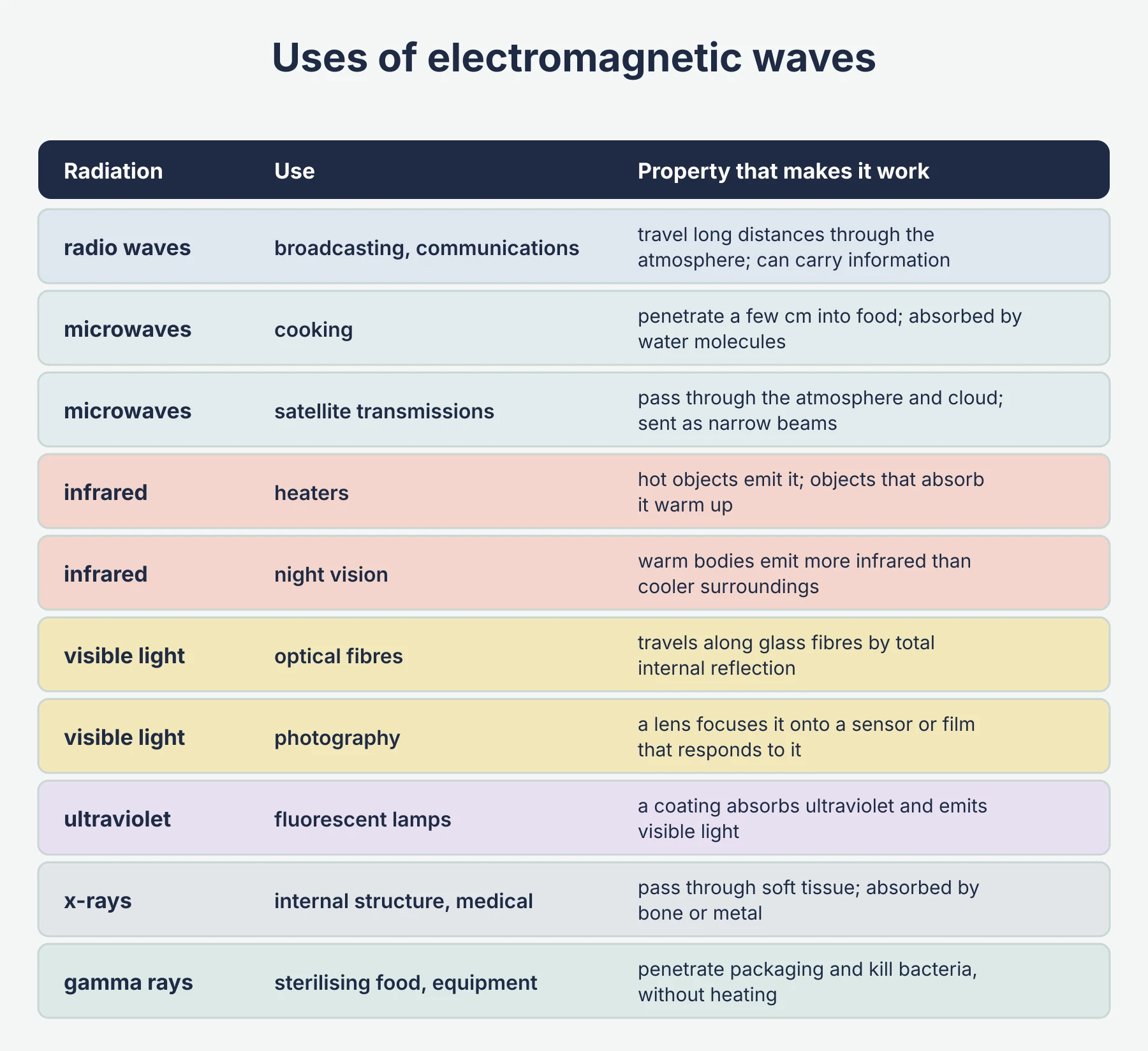
- Radio waves: broadcasting and communications. They travel long distances through the atmosphere and can be made to carry information (sound, pictures, data) by varying the wave.
- Microwaves: cooking. Microwaves penetrate a few centimetres into food and are absorbed by water molecules, which gain energy, heating the food from inside.
- Microwaves: satellite transmissions. They pass through the atmosphere, including cloud, to and from satellites in orbit, and can be sent as narrow beams to a dish.
- Infrared: heaters. Hot objects emit infrared, and objects that absorb it warm up, so an electric heater or grill transfers energy as infrared.
- Infrared: night vision equipment. Warm bodies emit more infrared than cooler surroundings; night vision cameras detect this, so people and animals show up in the dark.
- Visible light: optical fibres. Light travels along glass fibres by total internal reflection, carrying information as pulses of light, for example in endoscopes and data cables.
- Visible light: photography. A camera’s lens focuses visible light onto a sensor (or film) that responds to it to record an image.
- Ultraviolet: fluorescent lamps. Inside the tube, ultraviolet is produced; a coating on the inside of the glass absorbs the ultraviolet and emits visible light.
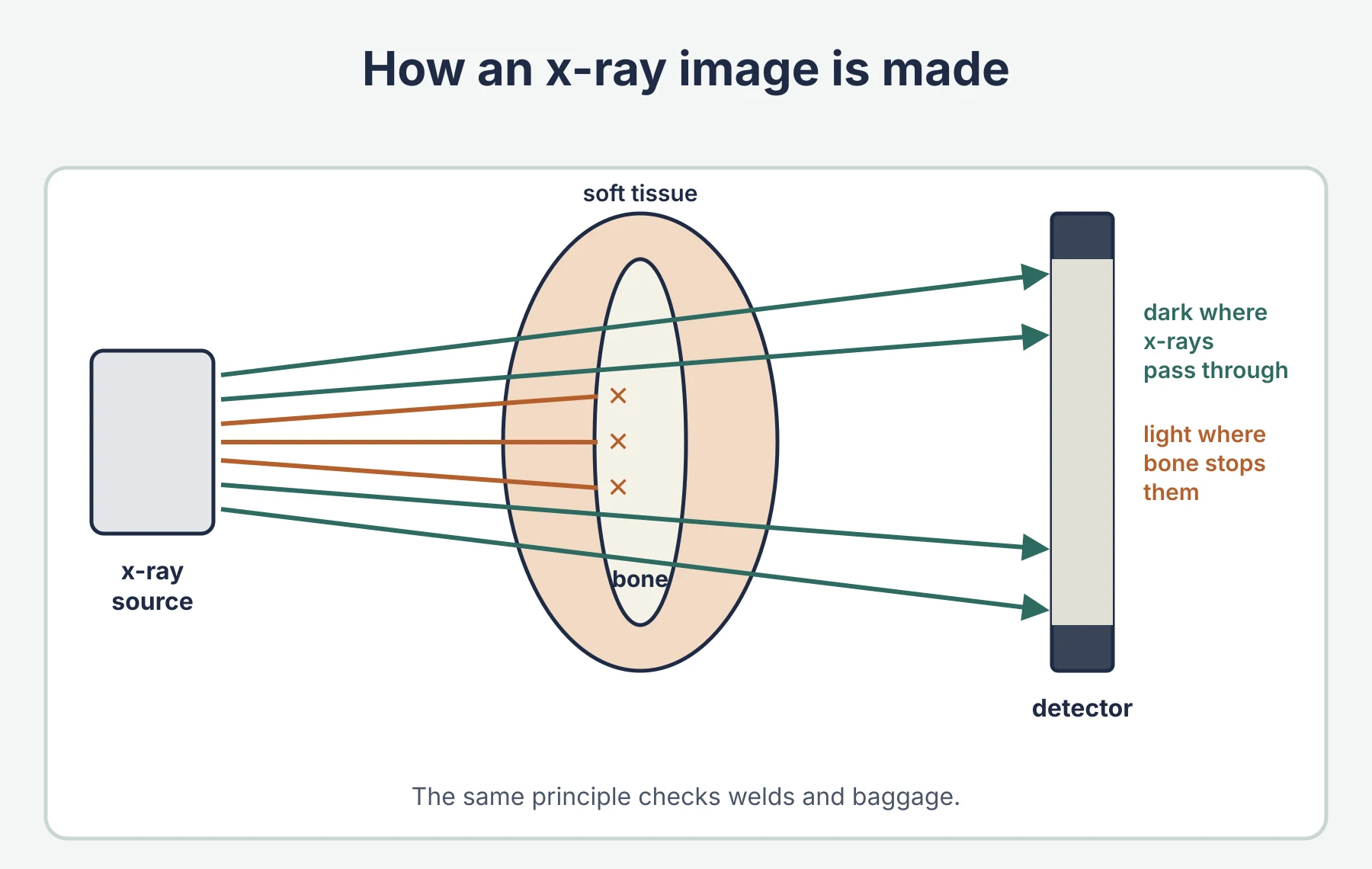
- X-rays: internal structure. X-rays pass through soft tissue but are absorbed by denser materials such as bone or metal. A detector behind the body records where they pass and where they are stopped, giving an image of bones, and the same principle is used to check welds or baggage.
- Gamma rays: sterilising food and medical equipment. Gamma rays penetrate packaging and kill bacteria and other microorganisms, so equipment can be sterilised after it is sealed, without heating it.
Harmful effects and protection (3.13)
| Radiation | Effect of excessive exposure | Simple protective measures |
|---|---|---|
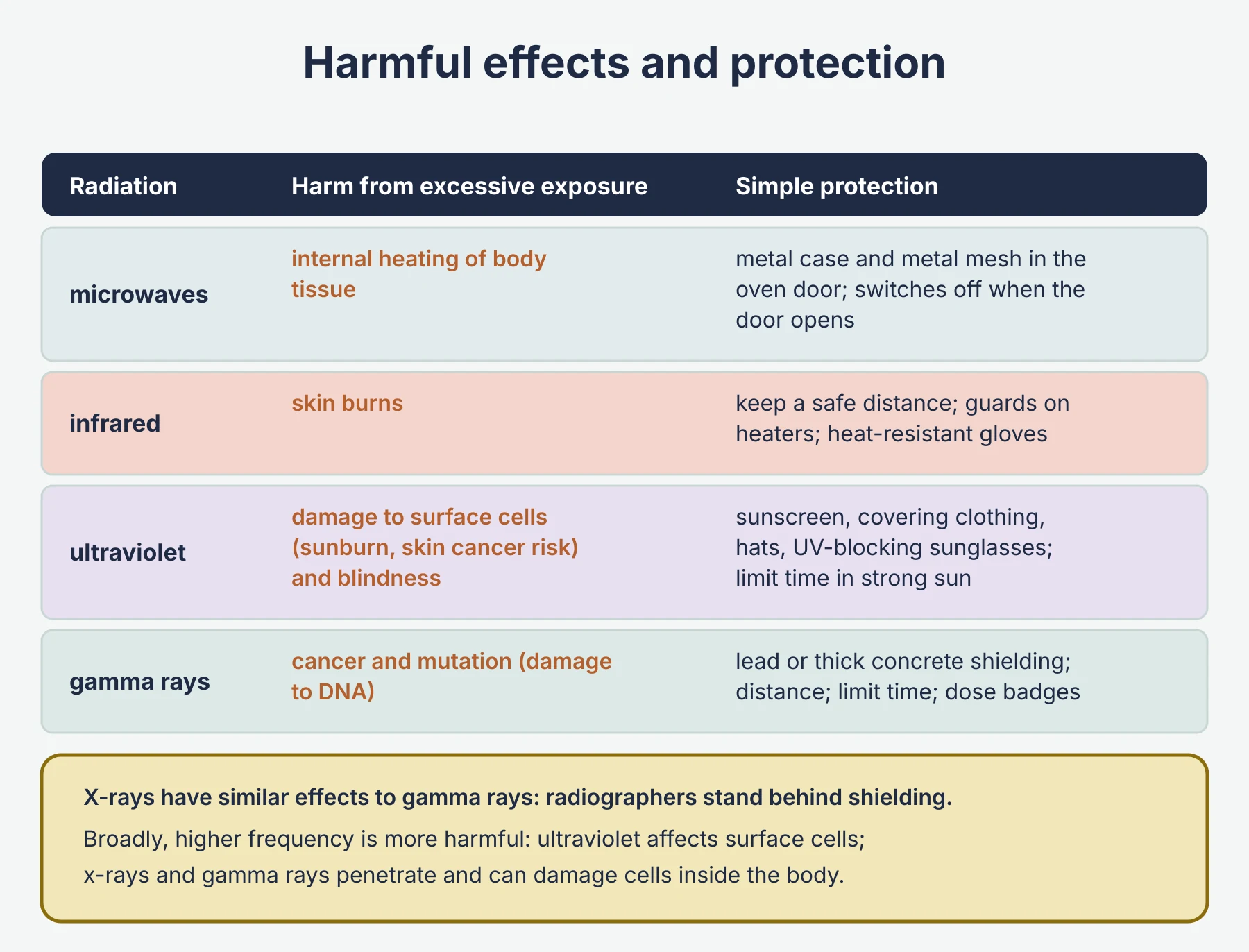
| microwaves | internal heating of body tissue | ovens have a metal case and a metal mesh in the door that stop microwaves escaping; the oven switches off when the door opens |
| infrared | skin burns | keep a safe distance from heaters; use guards on heaters; heat-resistant gloves near hot objects |
| ultraviolet | damage to surface cells (sunburn, skin cancer risk) and blindness | sunscreen, covering clothing, hats, UV-blocking sunglasses or goggles; limit time in strong sunlight |
| gamma rays | cancer and mutation (damage to DNA in cells) | lead or thick concrete shielding; keep distance; limit exposure time; monitor dose with badges |
X-rays have similar effects to gamma rays, which is why radiographers stand behind shielding and patients’ exposure is kept small.
The pattern is that, broadly, higher-frequency radiation is more harmful: ultraviolet affects surface cells, while x-rays and gamma rays penetrate the body and can damage cells inside it.
Annotated model answer. Explain why a person working with a gamma-ray steriliser stands behind thick lead walls. [2]
“Gamma rays can cause cancer and mutation by damaging cells [1]. Lead absorbs most of the gamma radiation, so the dose reaching the worker is much smaller [1].”
Why it scores: it names the specific harm from 3.13 and links the measure to how it reduces exposure.
Common mistakes
- Saying EM waves travel at different speeds in a vacuum.
- Reversing the order: radio has the longest wavelength and the lowest frequency.
- Placing violet next to infrared, or red next to ultraviolet.
- Attaching a use to the wrong radiation; learn each radiation with the uses that 3.12 names for it.
- Writing “radiation is dangerous” without naming the specific effect for that radiation.
- Saying microwaves “heat food by radiation” without mentioning absorption by water molecules.
Exam technique with command words
- State the order: write all seven in a line with an arrow labelled “increasing frequency”.
- Explain a use: name the property that makes the radiation suitable.
- Describe a protective measure: say what it is and how it reduces exposure.
- Calculate: use v = f × λ with v = 3.0 × 10⁸ m/s and standard form.
- The electromagnetic spectrum revision notes
- The electromagnetic spectrum practice questions
- Wave equations: Properties of waves study guide
Written against the Pearson Edexcel International GCSE in Physics (4PH1) specification, Issue 4. Always check the current specification for your examination year.
Related resources
-
Practice questions
Pearson Edexcel International GCSE Physics (4PH1): The electromagnetic spectrum – Practice Questions
Original questions with full answers on the order, speed, uses, harmful effects and protection for electromagnetic waves, for Edexcel IGCSE Physics 4PH1.
Physics · Pearson Edexcel · IGCSE
Try questions -
Revision notes
Pearson Edexcel International GCSE Physics (4PH1): The electromagnetic spectrum – Revision Notes
Recall notes on the order, speed, uses, dangers and protective measures of electromagnetic waves, with a self-test, for Edexcel International GCSE Physics 4PH1.
Physics · Pearson Edexcel · IGCSE
Revise topic -
Study guides
Pearson Edexcel International GCSE Physics (4PH1): Units for waves
The degree, hertz, metre, metre/second and second in Edexcel International GCSE Physics 4PH1 Topic 3: meanings, prefixes, standard form and angle work.
Physics · Pearson Edexcel · IGCSE
Read guide
Related articles
Get free revision emails (optional)
Occasional emails with practice questions, worked explanations and links to free resources for the qualification and subjects you choose. No spam, and you can unsubscribe from any email. The free tools on this site never need an email.