
Revision Notes
Pearson Edexcel International GCSE Physics (4PH1): The electromagnetic spectrum – Revision Notes
Recall notes on the order, speed, uses, dangers and protective measures of electromagnetic waves, with a self-test, for Edexcel International GCSE Physics 4PH1.
- Subject
- Physics
- Level
- IGCSE
- Topic
- Waves
- Author
- Marlbridge Academic Team
- Updated
- Reviewed by
- Hassan (what this means)
Aligned to Pearson Edexcel IGCSE Physics (4PH1), Issue 4. Official specification .
Syllabus page (what it covers and how it is assessed): Pearson Edexcel IGCSE Physics.
Syllabus points this page covers
4PH1
- 3c The electromagnetic spectrum
Found an error? Report a correction.
Need help with this topic? Request a free trial class for IGCSE Physics (4PH1).
Condensed notes on sub-topic 3(c) The electromagnetic spectrum (statements 3.10 to 3.13) of Pearson Edexcel International GCSE Physics (4PH1), Issue 4. For full explanations, use the Electromagnetic spectrum study guide.
Core facts
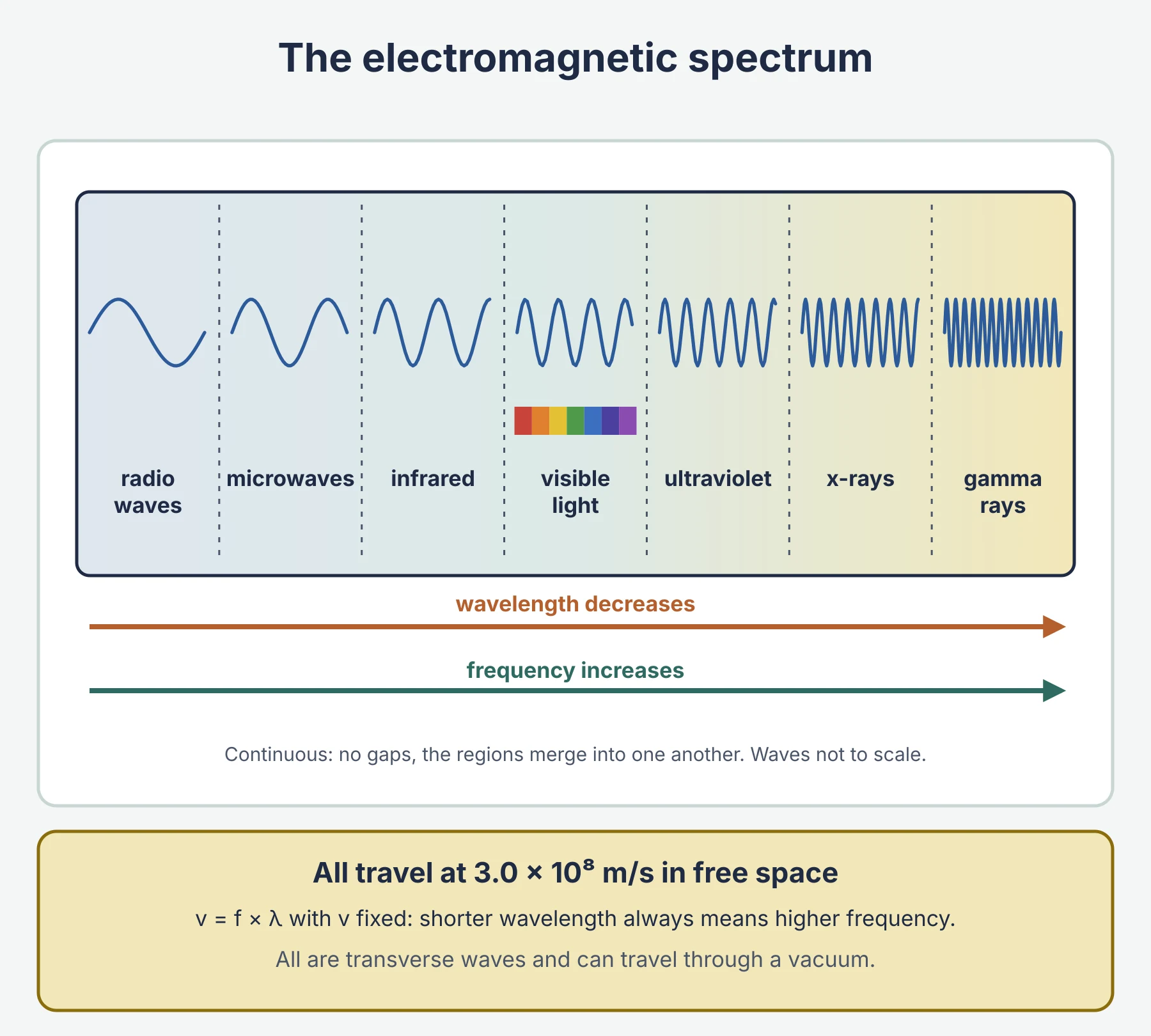
- EM waves form a continuous spectrum; the names label ranges.
- All are transverse and travel through a vacuum.
- All travel at the same speed in free space: 3.0 × 10⁸ m/s.
- v = f × λ with v fixed, so shorter λ ↔ higher f.
The order
radio → microwave → infrared → visible → ultraviolet → x-ray → gamma
      decreasing wavelength, increasing frequency →
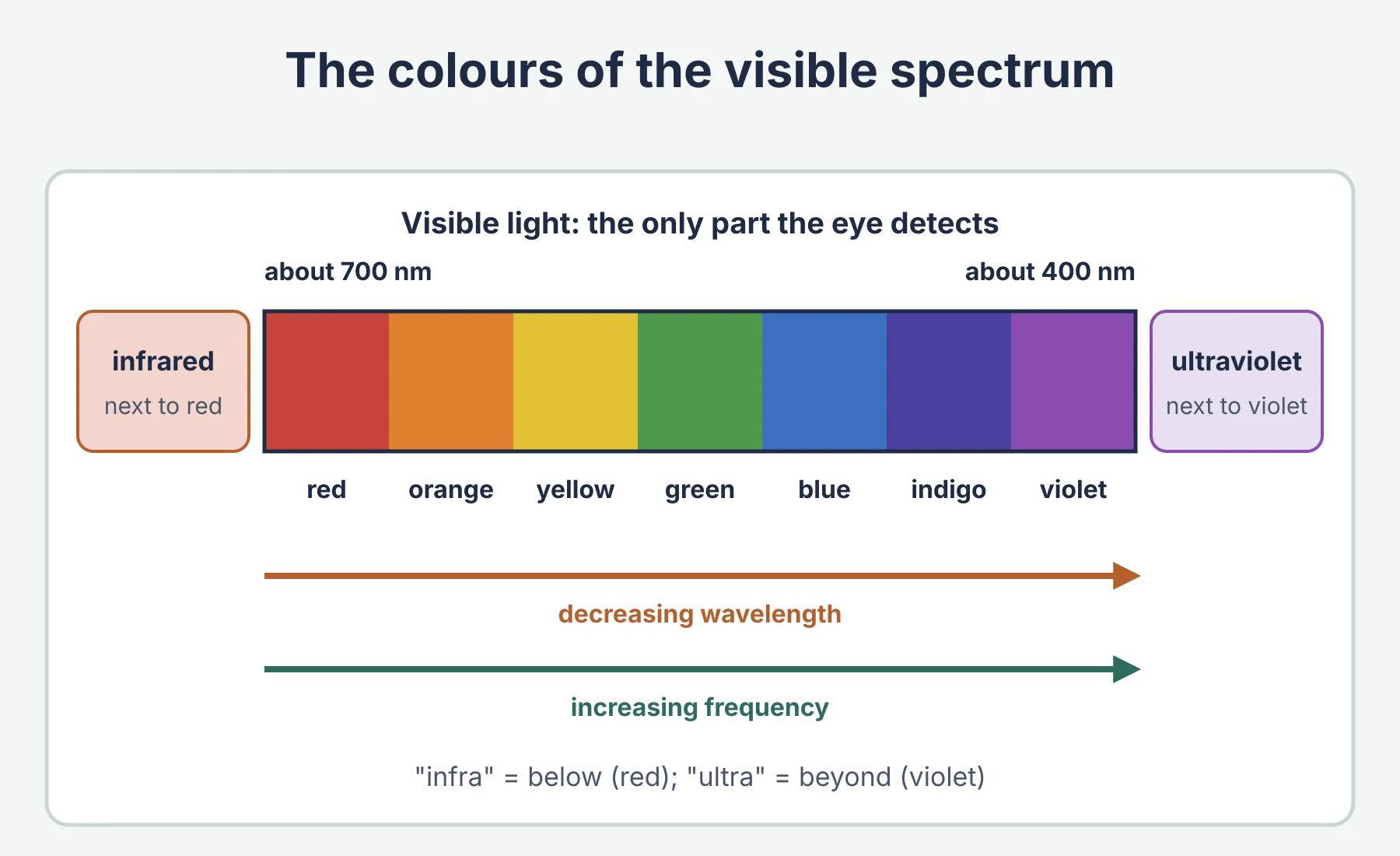
Visible, decreasing wavelength: red, orange, yellow, green, blue, indigo, violet. Red borders infrared; violet borders ultraviolet.
Uses (3.12) with the reason
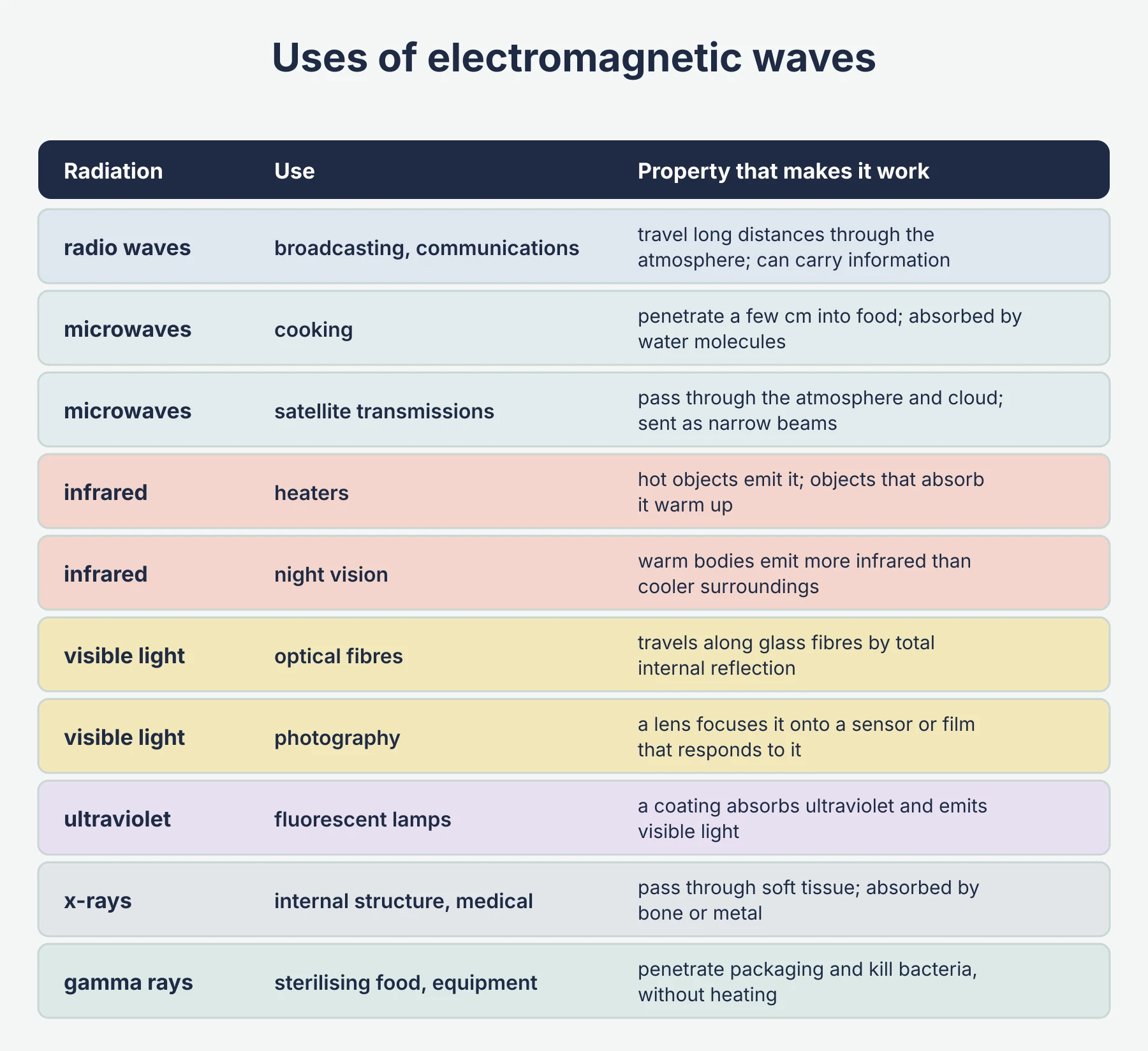
| Radiation | Use | Why it works |
|---|---|---|
| radio | broadcasting, communications | travels long distances; carries information |
| microwave | cooking | absorbed by water molecules in food, heating it |
| microwave | satellite transmissions | passes through the atmosphere and cloud |
| infrared | heaters | emitted by hot objects; absorbed, warming things |
| infrared | night vision | warm bodies emit more infrared than surroundings |
| visible | optical fibres | total internal reflection carries light pulses |
| visible | photography | sensor or film records the focused light |
| ultraviolet | fluorescent lamps | coating absorbs UV and emits visible light |
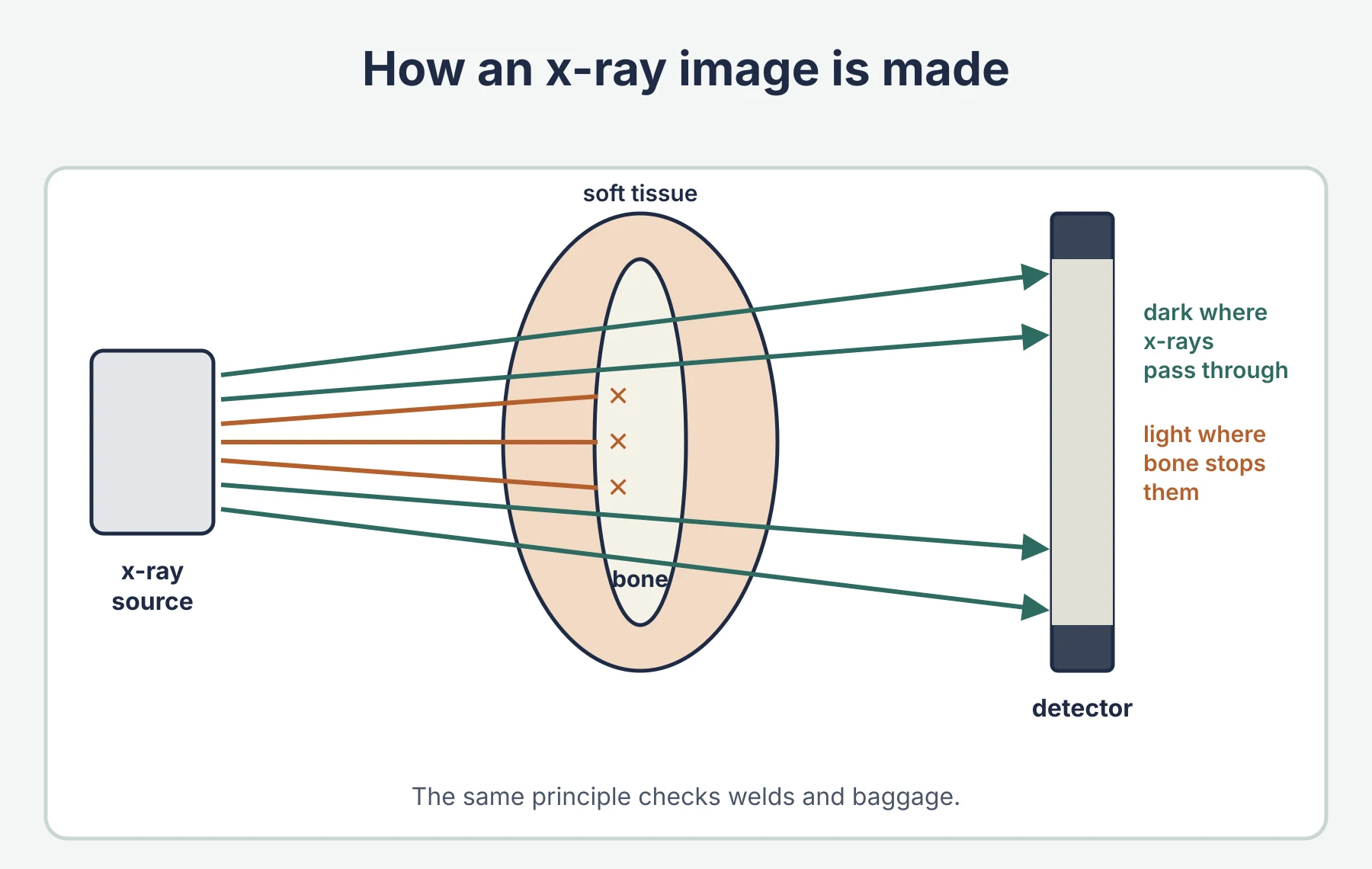
| x-ray | internal structure, medical images | pass through soft tissue, absorbed by bone and metal |
| gamma | sterilising food and medical equipment | penetrates packaging, kills microorganisms |
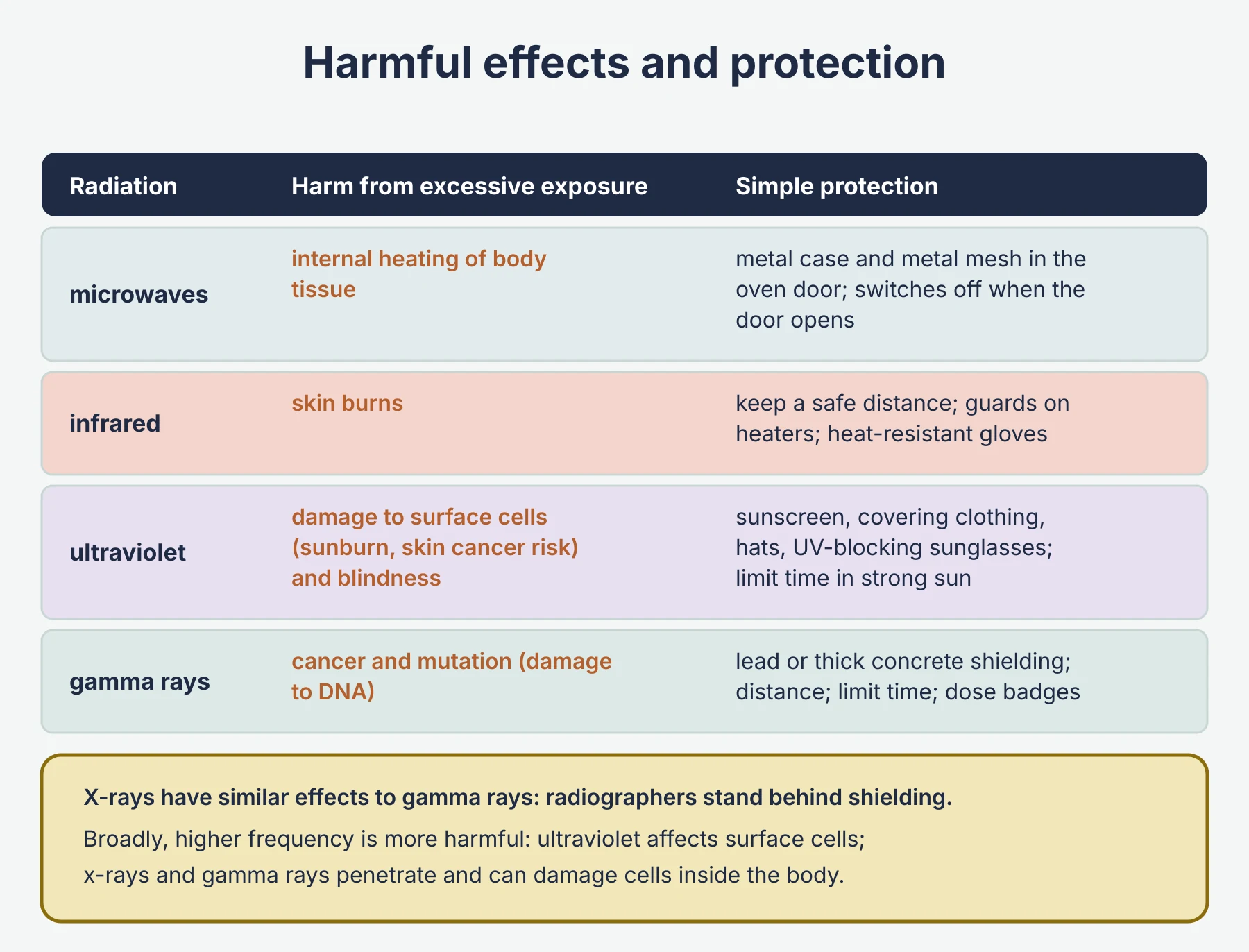
Harmful effects (3.13) and protection
| Radiation | Effect | Protection |
|---|---|---|
| microwave | internal heating of body tissue | metal case and door mesh on ovens; door cut-out |
| infrared | skin burns | distance, heater guards, heat-resistant gloves |
| ultraviolet | damage to surface cells; blindness | sunscreen, clothing, UV-blocking glasses, limit exposure |
| gamma | cancer, mutation | lead or concrete shielding, distance, limited time |
X-rays carry similar risks to gamma rays: radiographers use shielding.
Key terms
| Term | Meaning |
|---|---|
| electromagnetic spectrum | continuous range of transverse waves travelling at the same speed in a vacuum |
| free space | a vacuum |
| frequency | waves per second (Hz); increases from radio to gamma |
| wavelength | length of one wave (m); decreases from radio to gamma |
| sterilise | kill bacteria and other microorganisms |
| fluorescent | absorbs one radiation (UV) and emits visible light |
| mutation | change to the DNA in a cell |
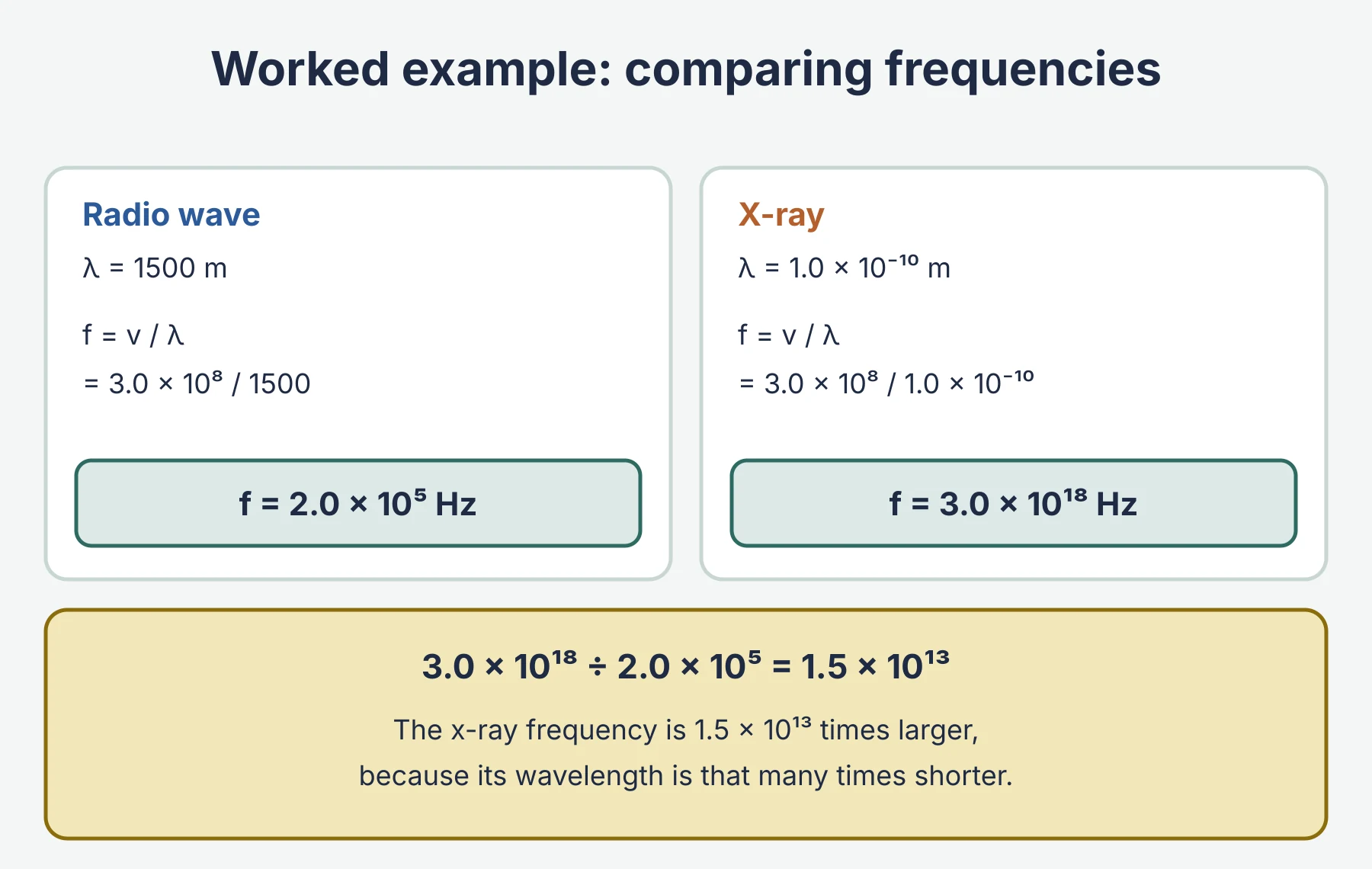
Calculations
f = v / λ λ = v / f v = 3.0 × 10⁸ m/s- 3.0 m radio wave: f = 1.0 × 10⁸ Hz.
- 12 cm microwave: f = 3.0 × 10⁸ ÷ 0.12 = 2.5 × 10⁹ Hz.
- 600 nm light: f = 3.0 × 10⁸ ÷ 6.0 × 10⁻⁷ = 5.0 × 10¹⁴ Hz.
Neighbours that get confused
- Infrared or ultraviolet? Infrared lies beyond red (longer wavelength than visible) and is linked with heating and burns. Ultraviolet lies beyond violet (shorter wavelength) and is linked with surface cell damage, blindness and fluorescent lamps.
- Microwaves or radio? Both carry signals; microwaves are the shorter wavelength, used for satellites and cooking.
- X-rays or gamma? X-rays are used for images of internal structure; gamma rays for sterilising.
Answer frames
Explain a use (property → effect → use): “Gamma rays penetrate packaging and kill microorganisms, so sealed medical equipment can be sterilised.”
Explain a hazard and protection (radiation → specific harm → measure → how it helps): “Excessive ultraviolet damages surface cells of the skin; sunscreen absorbs much of the ultraviolet before it reaches the skin, so the damage is reduced.”
Compare two radiations: put both in the spectrum order, then compare wavelength, frequency and one use or one hazard of each, in matching sentences.
Exam traps
- All EM waves have the same speed in a vacuum; only f and λ differ.
- Radio = longest λ, lowest f. Gamma = shortest λ, highest f.
- The visible order runs red to violet with decreasing wavelength.
- Give the specific harm (e.g. “internal heating of body tissue”), not “it is dangerous”.
- For a use, say why the radiation is suitable.
- Fluorescent lamps: UV is converted to visible light by the coating.
- Convert nm, cm and MHz before using v = f × λ.
Self-test
- List the EM spectrum in order of increasing frequency.
- State what all EM waves have in common in free space.
- Which visible colour has the longest wavelength?
- Name the radiation used to sterilise medical equipment.
- Explain why microwaves are used for cooking.
- Explain how night vision equipment works.
- State the harmful effect of excessive ultraviolet and one protective measure.
- State two harmful effects of gamma rays.
- Explain how x-rays are used to image a broken bone.
- A microwave has a wavelength of 3.0 cm. Calculate its frequency.
- Light has a frequency of 7.5 × 10¹⁴ Hz. Calculate its wavelength in nm.
- Explain how a fluorescent lamp uses ultraviolet.
Answers
- Radio, microwave, infrared, visible, ultraviolet, x-ray, gamma.
- They travel at the same speed (3.0 × 10⁸ m/s).
- Red.
- Gamma rays.
- They are absorbed by water molecules in the food, which gain energy, so the food heats up.
- Warm bodies emit more infrared than cooler surroundings; the equipment detects infrared and forms an image from it.
- Damage to surface cells (or blindness); any one of sunscreen, covering clothing, UV-blocking sunglasses, limiting time in the sun.
- Cancer; mutation.
- X-rays pass through soft tissue but are absorbed by bone; a detector behind the patient records the pattern, so the bone and break show up.
- f = 3.0 × 10⁸ ÷ 0.030 = 1.0 × 10¹⁰ Hz.
- λ = 3.0 × 10⁸ ÷ 7.5 × 10¹⁴ = 4.0 × 10⁻⁷ m = 400 nm.
- Ultraviolet is produced inside the tube; a coating on the glass absorbs it and emits visible light.
Related resources
-
Study guides
Pearson Edexcel International GCSE Physics (4PH1): Units for waves
The degree, hertz, metre, metre/second and second in Edexcel International GCSE Physics 4PH1 Topic 3: meanings, prefixes, standard form and angle work.
Physics · Pearson Edexcel · IGCSE
Read guide -
Practice questions
Pearson Edexcel International GCSE Physics (4PH1): Units for waves – Practice Questions
Original practice questions with full answers on using degrees, hertz, metres, m/s and seconds, prefixes and standard form for Edexcel IGCSE Physics 4PH1 waves.
Physics · Pearson Edexcel · IGCSE
Try questions -
Revision notes
Pearson Edexcel International GCSE Physics (4PH1): Units for waves – Revision Notes
Recall notes on degrees, hertz, metres, m/s and seconds for Edexcel International GCSE Physics 4PH1 waves: prefixes, standard form, exam traps and a self-test.
Physics · Pearson Edexcel · IGCSE
Revise topic
Related articles
Get free revision emails (optional)
Occasional emails with practice questions, worked explanations and links to free resources for the qualification and subjects you choose. No spam, and you can unsubscribe from any email. The free tools on this site never need an email.