
Study Guides
Pearson Edexcel International GCSE Physics (4PH1): Light and sound
Reflection, refraction practicals, refractive index, critical angle, optical fibres and the sound practicals for Edexcel IGCSE Physics 4PH1, sub-topic 3d.
- Subject
- Physics
- Level
- IGCSE
- Topic
- Waves
- Author
- Marlbridge Academic Team
- Updated
- Reviewed by
- Hassan (what this means)
Aligned to Pearson Edexcel IGCSE Physics (4PH1), Issue 4. Official specification .
Syllabus page (what it covers and how it is assessed): Pearson Edexcel IGCSE Physics.
Syllabus points this page covers
4PH1
- 3d Light and sound
Found an error? Report a correction.
Need help with this topic? Request a free trial class for IGCSE Physics (4PH1).
This guide goes deep on one sub-topic: 3(d) Light and sound, statements 3.14 to 3.29 of the Pearson Edexcel International GCSE in Physics (4PH1), Issue 4 specification. Statements 3.24P to 3.29P (hearing range, the speed of sound practical and the oscilloscope work) are Physics-only, so they are assessed only on Paper 2. For the whole of Topic 3 in one place, see the Waves study guide.
What 3(d) asks you to do
The light half of the sub-topic is mostly about ray diagrams and two equations: you must use the law of reflection,
draw rays being reflected and refracted, carry out two named practicals (refraction through rectangular blocks,
semi-circular blocks and triangular prisms; the refractive index of glass using a glass block), use n = sin i / sin r
and sin c = 1/n, and describe how total internal reflection is used in optical fibres and prisms. The sound half asks
you to know that sound is longitudinal, and (Physics only) to measure the speed of sound in air, use a microphone and
oscilloscope to display a sound and find its frequency, and link pitch to frequency and loudness to amplitude.
Drawing ray diagrams that earn the marks
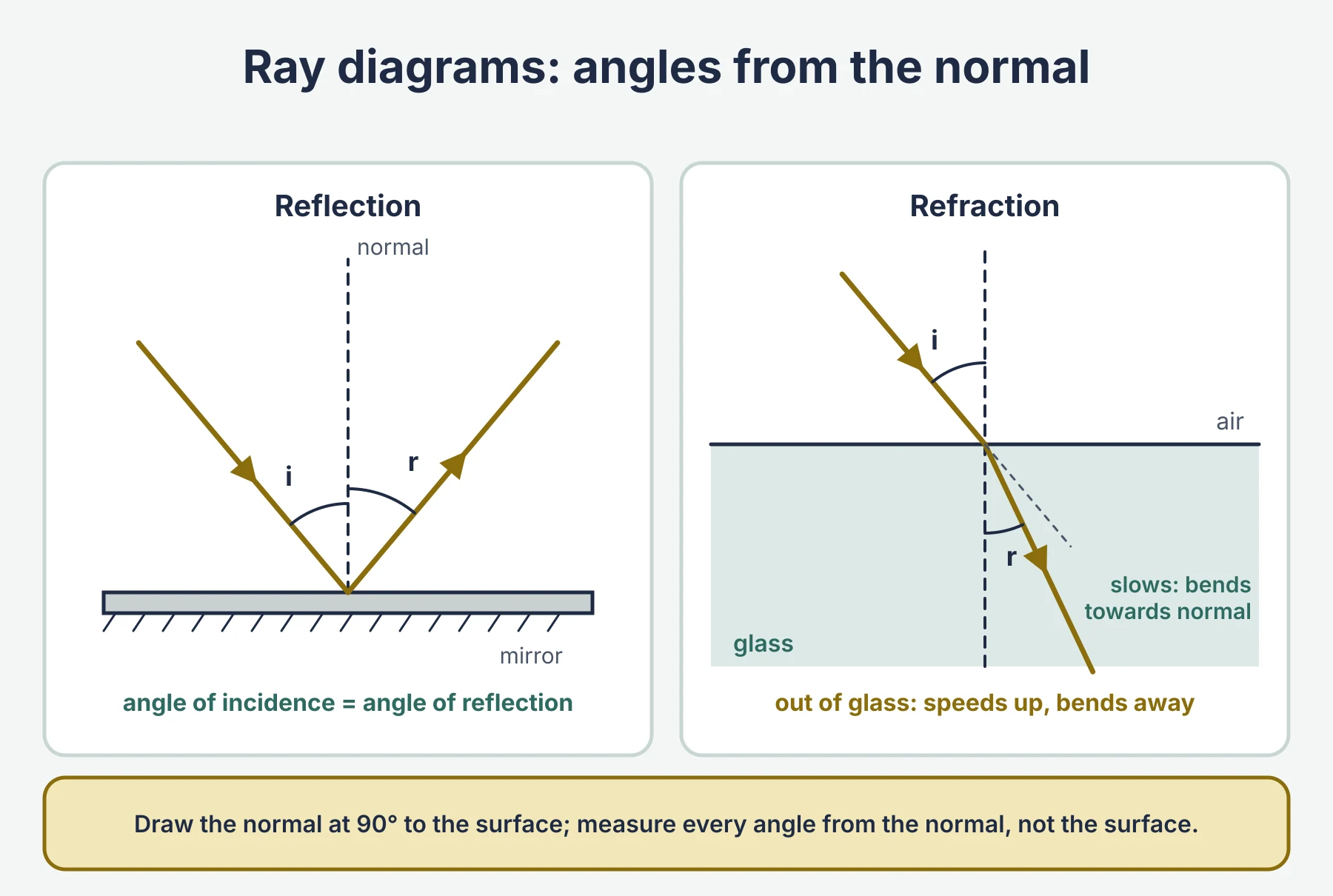
Every ray diagram is built around the normal: a dashed line drawn at 90° to the surface where the ray meets it. All angles of incidence, reflection and refraction are measured between the ray and the normal.
Reflection (3.15, 3.16). The angle of incidence equals the angle of reflection. Draw the incident ray with a ruler, add the normal with a protractor, measure the angle and mark the same angle on the other side of the normal. Put an arrowhead on each ray showing the direction light travels.
Refraction (3.16). Light changes speed when it crosses into a different material, and that change of speed makes it change direction unless it meets the surface along the normal. Going from air into glass or water it slows and bends towards the normal; coming out it speeds up and bends away from the normal.
The refraction practical with three block shapes (3.17)
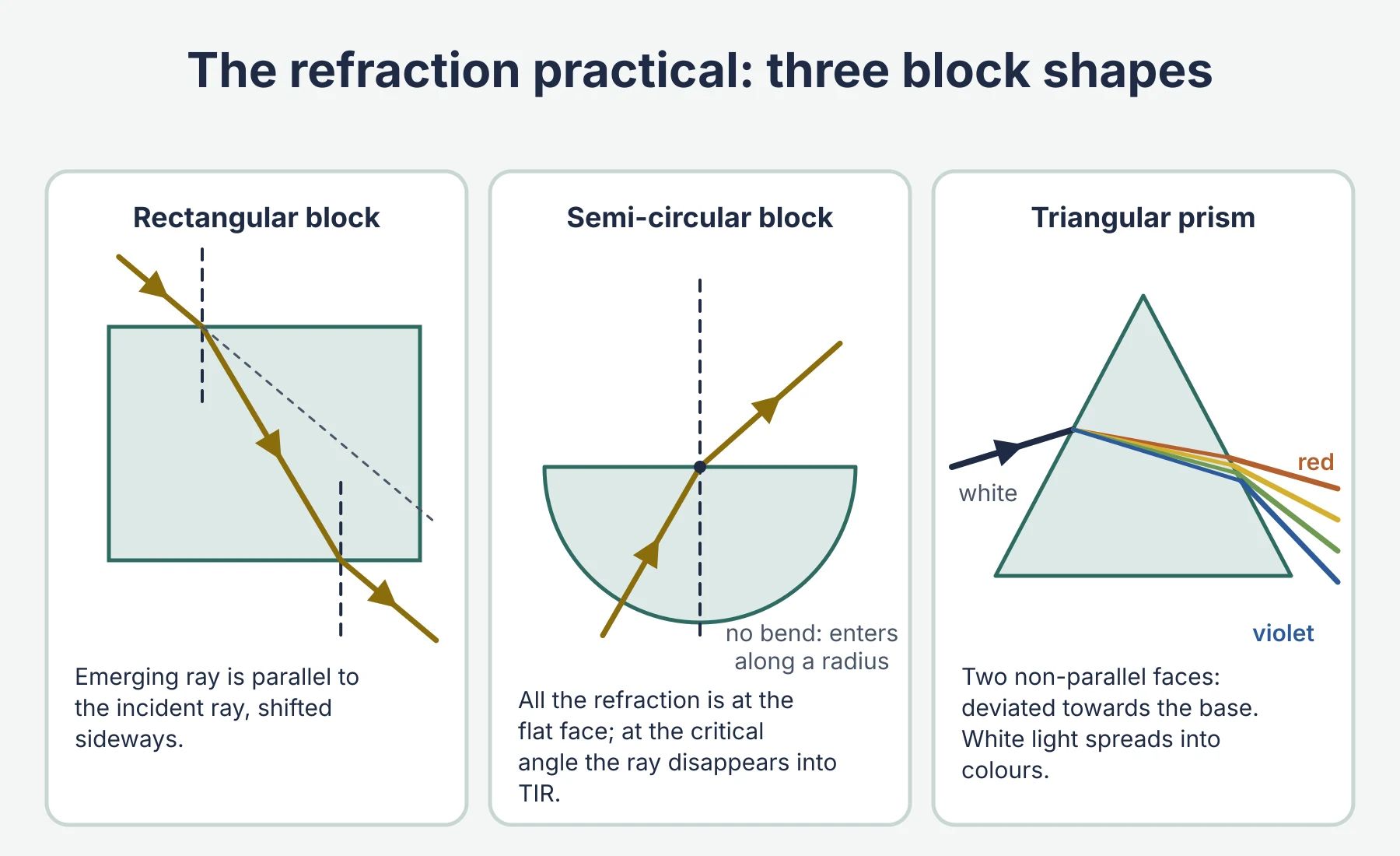
Each block shape shows something different, which is why the specification names all three.
- Rectangular block. Trace the block outline on paper, aim a narrow ray from a ray box at one long face, mark the ray going in and coming out with crosses, then join them up through the outline. The emerging ray is parallel to the incident ray but shifted sideways, because the bending on the way in is undone on the way out.
- Semi-circular block. Aim the ray at the centre of the flat face from the curved side. The ray enters the curved face along a radius, so it meets that surface along the normal and does not bend there. All the refraction happens at the flat face, which makes this the cleanest set-up for watching the refracted ray get closer to the surface as the angle increases, then disappear into total internal reflection at the critical angle.
- Triangular prism. The ray refracts at two faces that are not parallel, so it is deviated towards the base of the prism and does not come out parallel to the way it went in. With white light, each colour refracts by a slightly different amount, so the emerging light spreads into the colours of the visible spectrum.
Measuring the refractive index of glass (3.18, 3.19)
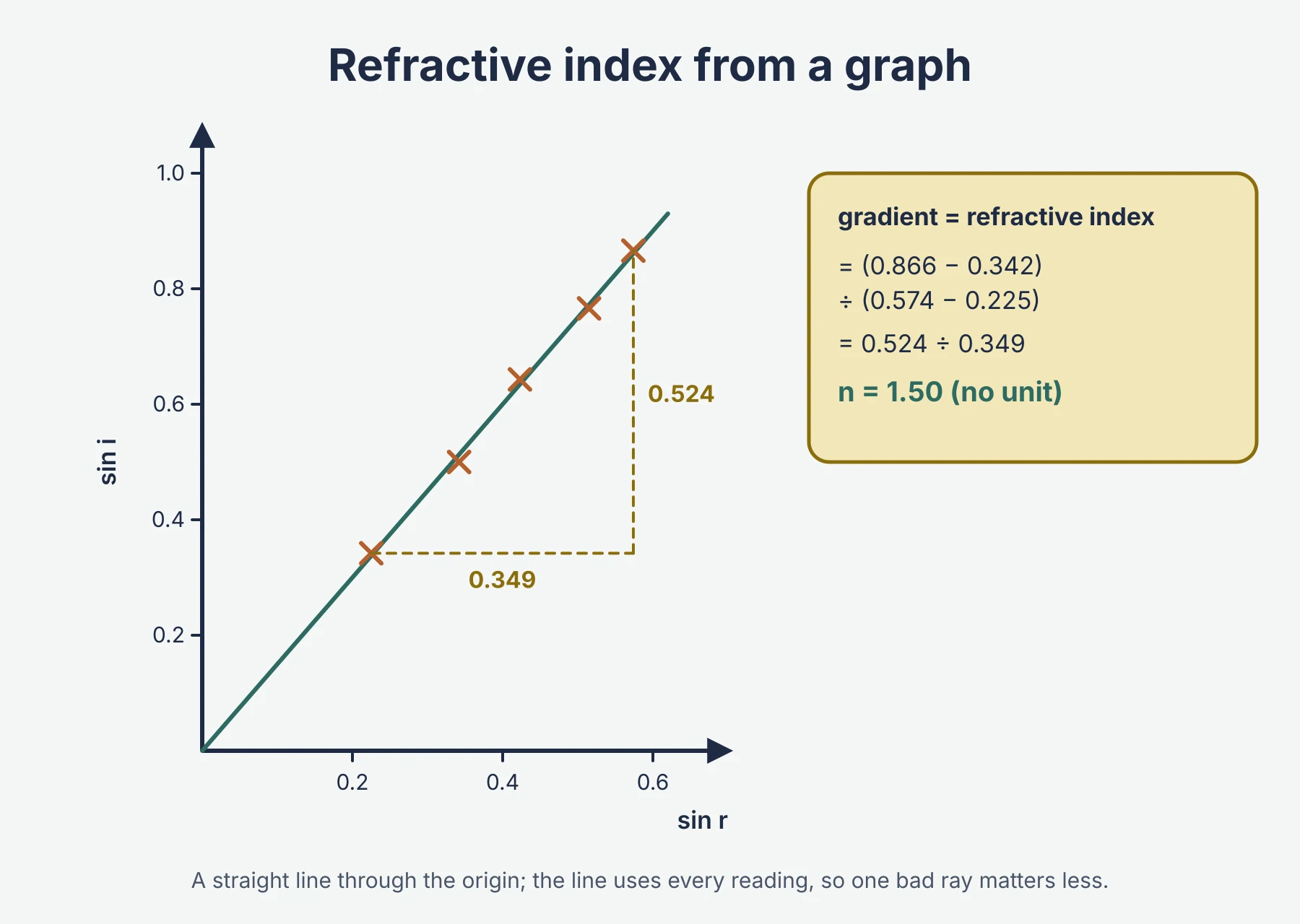
Using the rectangular block, measure the angle of refraction r for several angles of incidence i (for example 20°,
30°, 40°, 50°, 60°). Plot sin i on the y-axis against sin r on the x-axis. Because n = sin i / sin r, the graph is
a straight line through the origin and its gradient is the refractive index. A graph uses every reading at once, so
one badly drawn ray has less effect than it would in a single calculation.
Worked example 1. A student’s readings give sin r = 0.225, 0.342, 0.423, 0.515, 0.574 for sin i = 0.342,
0.500, 0.643, 0.766, 0.866. Using the line of best fit, two well-separated points on it are (0.225, 0.342) and
(0.574, 0.866).
gradient = (0.866 − 0.342) / (0.574 − 0.225) = 0.524 / 0.349 = 1.50
n = 1.50 (no unit: refractive index is a ratio)
Errors worth naming in an evaluation: a wide ray, a normal not at exactly 90°, and angles read only to the nearest degree. A narrow slit, crosses marked far apart and repeated readings all help.
Total internal reflection and the critical angle (3.20 to 3.22)
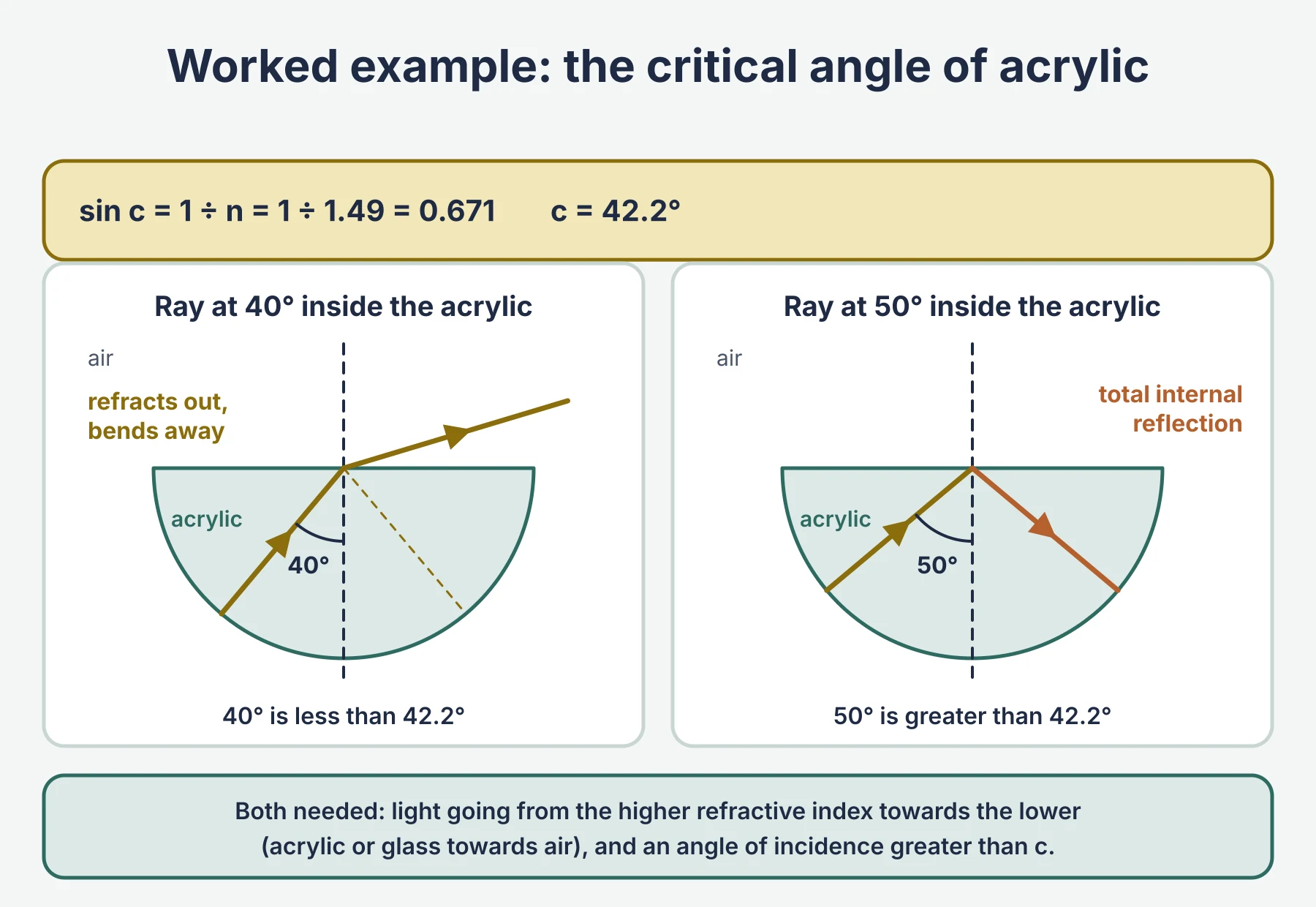
When light inside glass meets the glass-to-air boundary, some is reflected and some refracts out. As the angle of incidence inside the glass grows, the refracted ray bends further from the normal until, at the critical angle c, it travels along the boundary (angle of refraction 90°). For any angle of incidence greater than c, no light refracts out and all of it is reflected: total internal reflection. Two conditions must both hold: the light is going from the material with the higher refractive index towards the lower one, and the angle of incidence is greater than c.
Worked example 2. Acrylic has a refractive index of 1.49. Find its critical angle, then decide what happens to a ray inside the acrylic that meets the surface at 40° and at 50°.
sin c = 1/n = 1/1.49 = 0.671      c = 42.2°
40° is less than 42.2°: the ray refracts out into the air (bending away from the normal)
50° is greater than 42.2°: total internal reflection
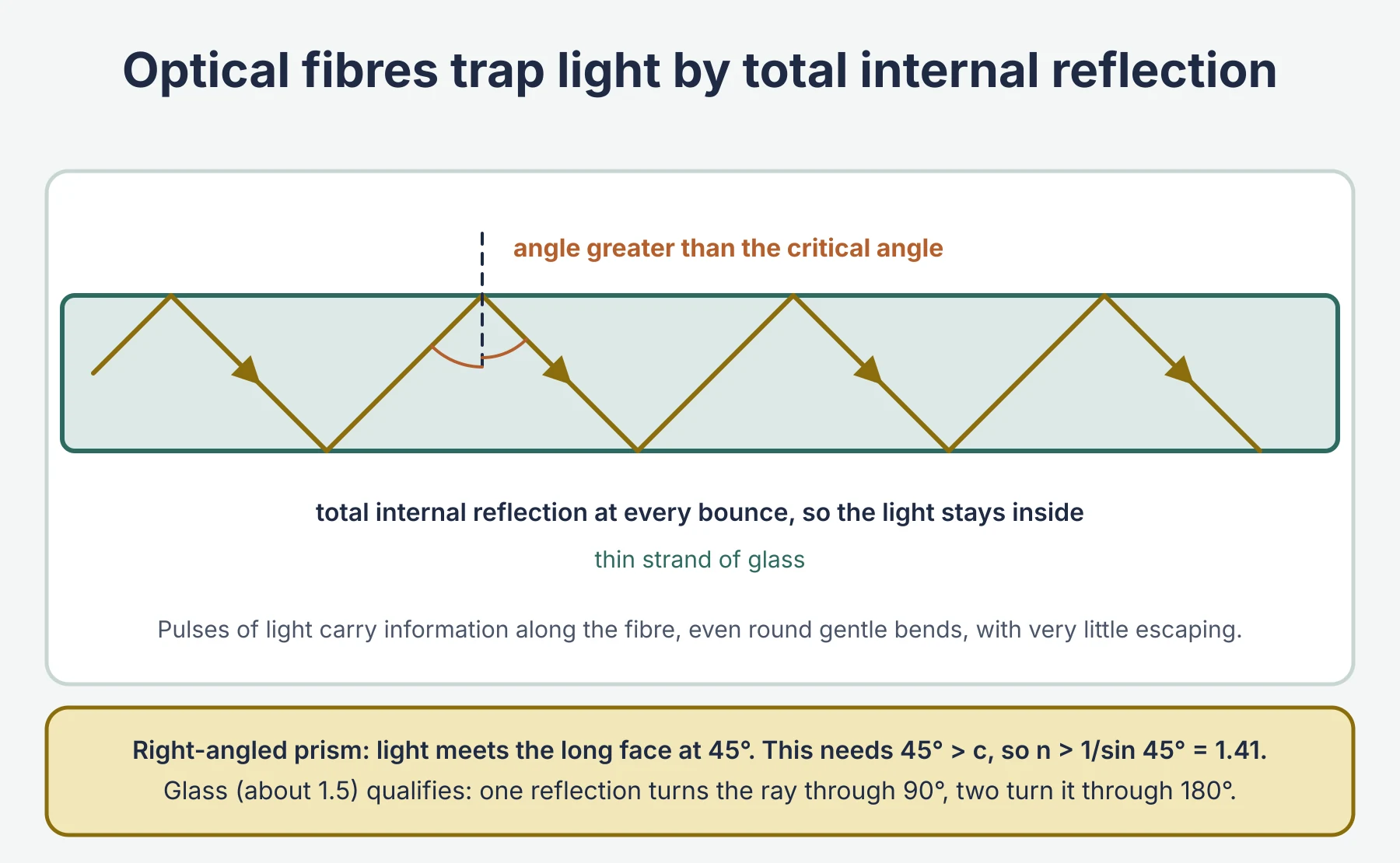
Optical fibres. A fibre is a thin strand of glass. Light entering one end strikes the side wall at an angle greater than the critical angle, is totally internally reflected, crosses the fibre, and is reflected again, many times, so it follows the fibre even round gentle bends. Pulses of light carry information along the fibre with very little escaping through the sides.
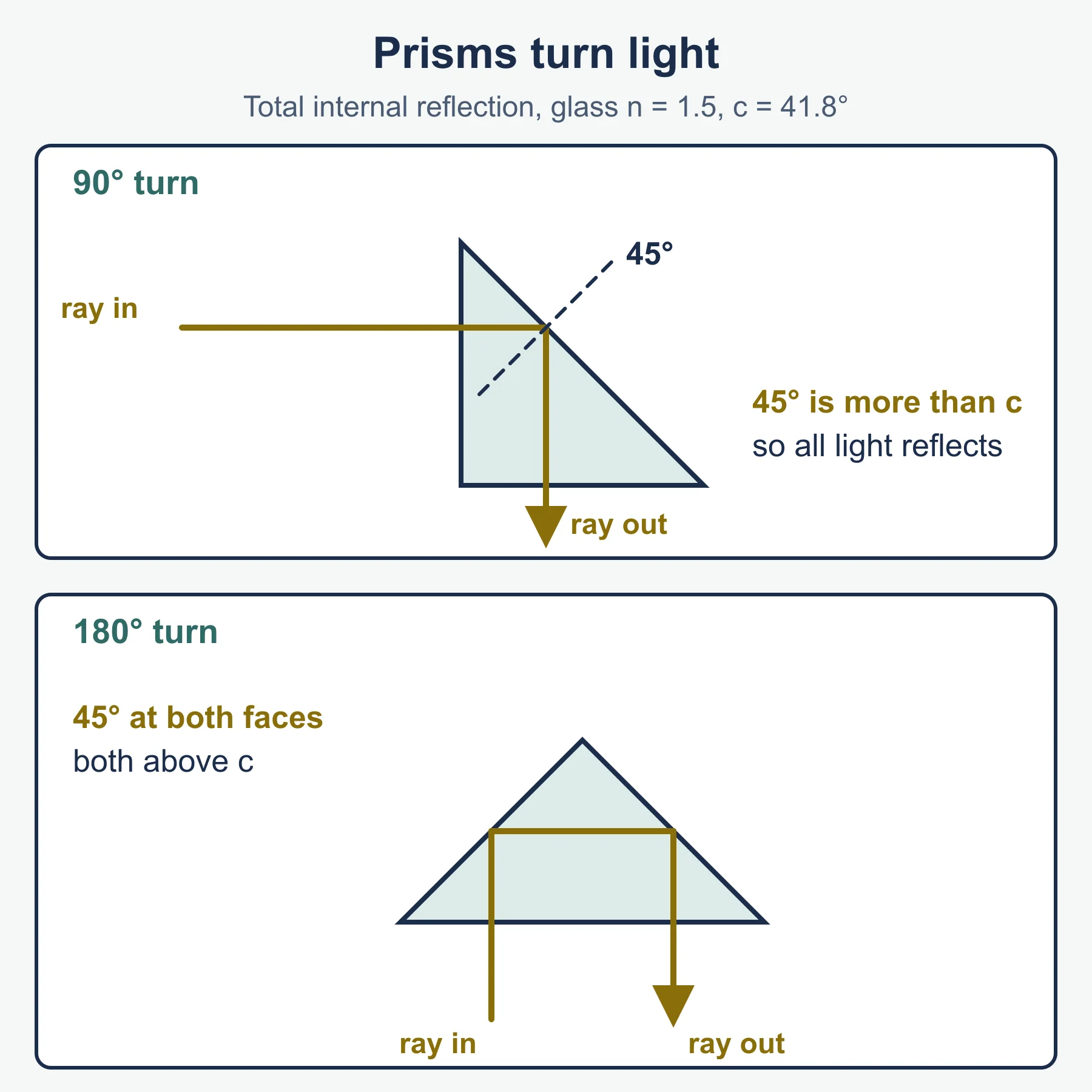
Prisms. In a right-angled glass prism, light entering one short face at 90° meets the long face at 45°. This only
works if 45° is greater than the critical angle, which needs n greater than 1/sin 45° = 1.41. Glass (about 1.5)
qualifies. One reflection turns the ray through 90°; entering through the long face instead gives two reflections
and turns it through 180°, sending it back the way it came, displaced sideways.
Sound waves (3.23 to 3.29)
Sound is a longitudinal wave: air particles vibrate back and forth along the direction the sound travels, making compressions and rarefactions. Like light, sound reflects (an echo) and refracts (it changes speed and direction when it passes into a different medium, or into air at a different temperature).
Hearing range (3.24P). Humans can hear frequencies from 20 Hz to 20 000 Hz. A frequency outside that range is still sound, but we cannot hear it.
Measuring the speed of sound in air (3.25P). Two common methods:
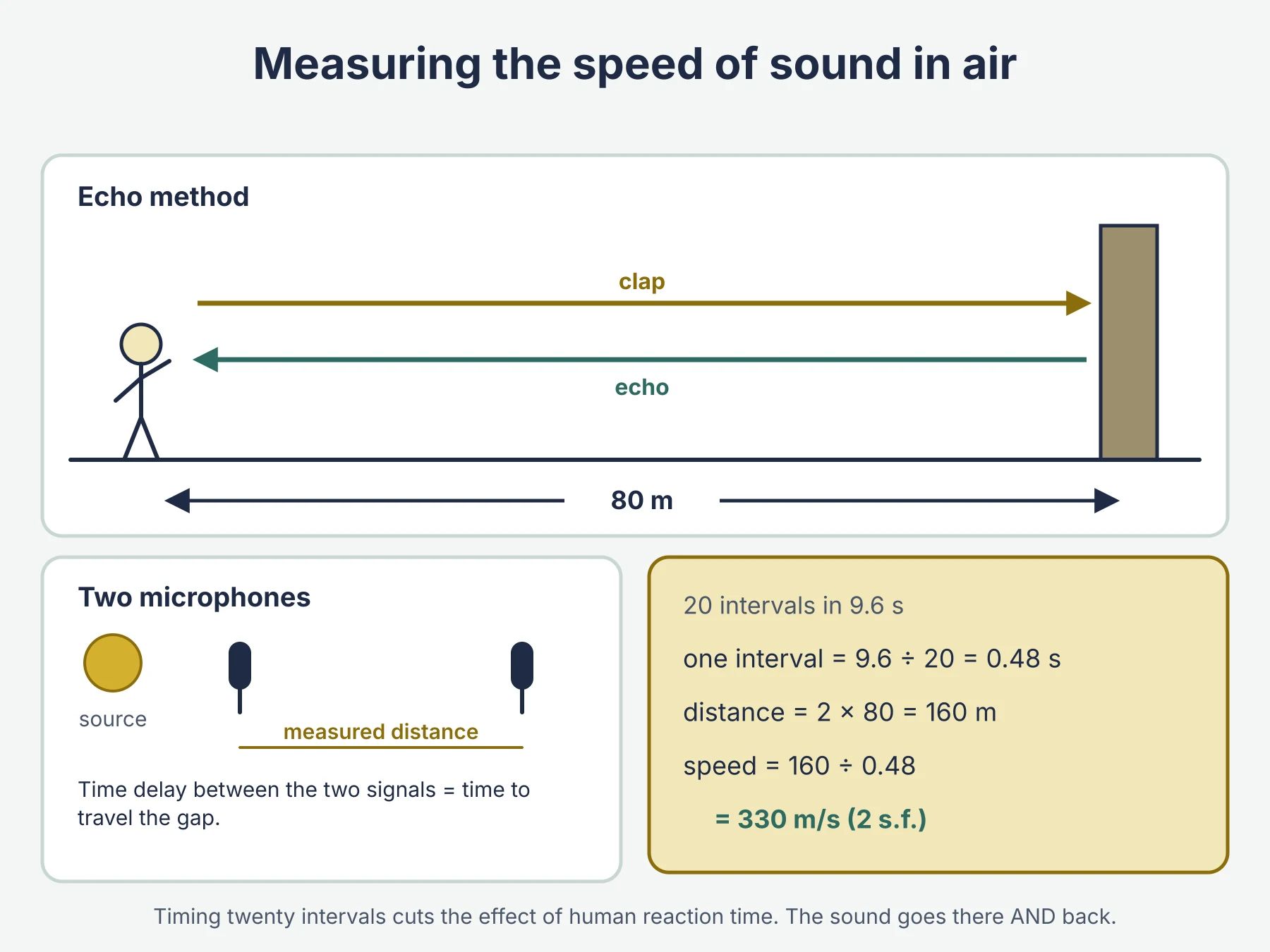
- Echo method. Stand a measured distance from a large flat wall and clap. Clap again each time the echo returns, so the claps and echoes fall into a steady rhythm. Time a large number of intervals and divide to find the time for one interval, which is the time for sound to travel to the wall and back.
- Two microphones. Place two microphones a measured distance apart in line with the sound source and connect them to an oscilloscope or a fast timer. The time delay between the two signals is the time for sound to travel the gap between them.
Worked example 3. A wall is 80 m away. Twenty clap-to-echo intervals take 9.6 s.
time for one interval = 9.6 / 20 = 0.48 s
distance travelled in that time = 2 × 80 = 160 m
speed = distance / time = 160 / 0.48 = 330 m/s (2 s.f.)
Timing twenty intervals instead of one cuts the effect of human reaction time, which would be large compared with 0.48 s.
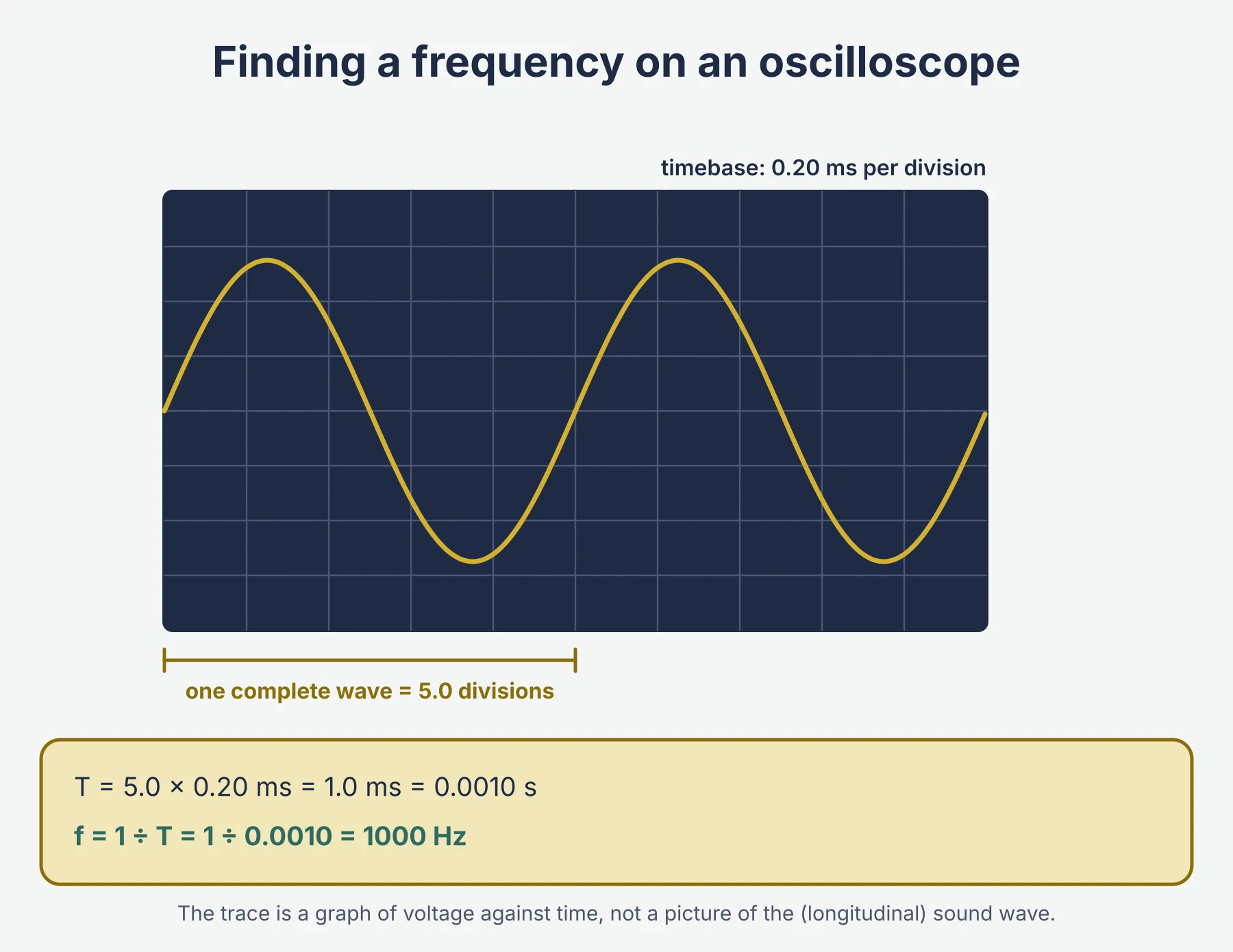
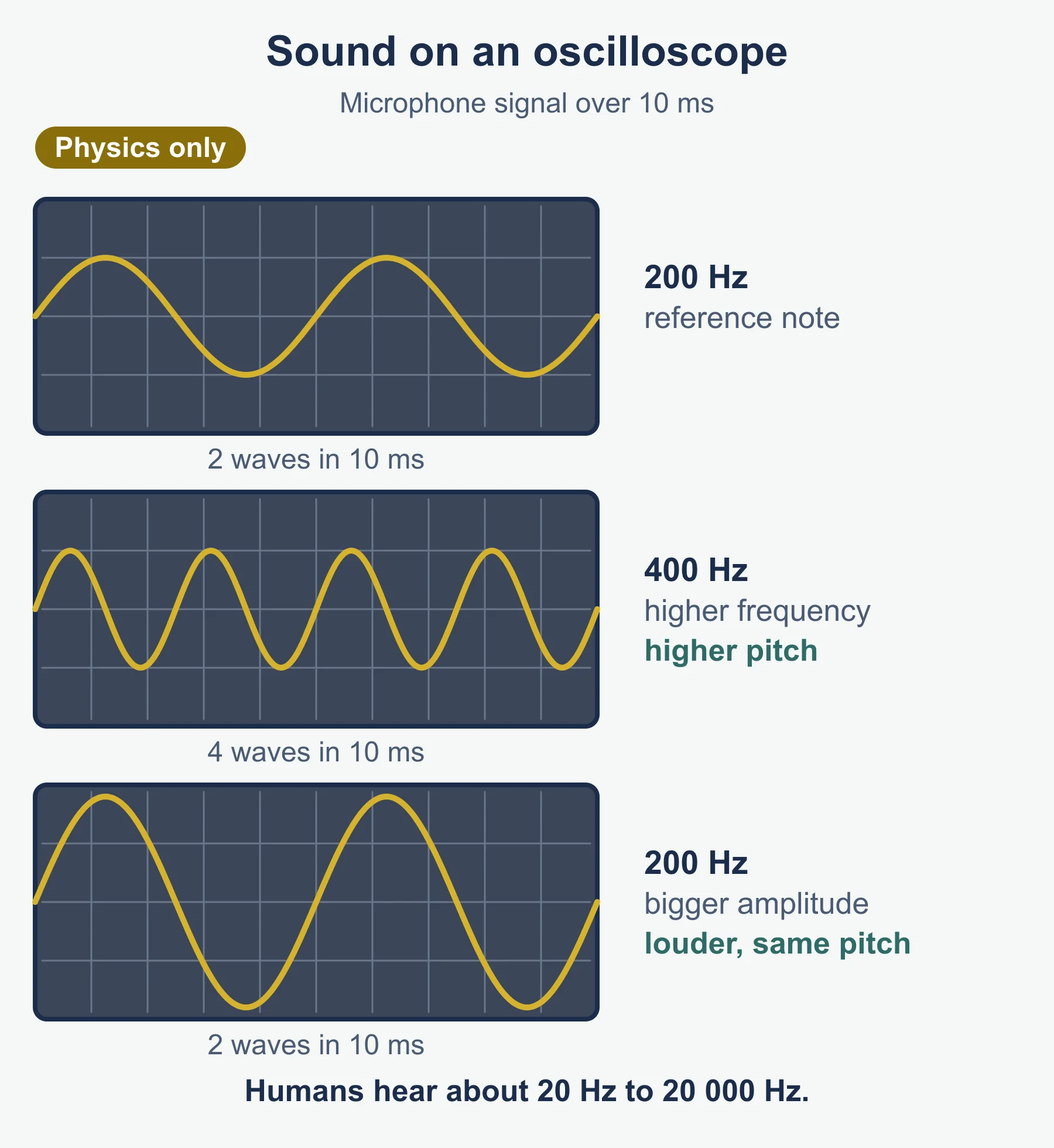
The oscilloscope (3.26P, 3.27P). A microphone turns the pressure changes of a sound into a changing voltage; the
oscilloscope plots that voltage against time. The trace looks like a transverse wave even though sound is
longitudinal, because it is a graph, not a picture of the wave. To find the frequency, count the horizontal
squares (divisions) for one complete wave, multiply by the timebase setting to get the period, then use f = 1/T.
Worked example 4. One complete wave spans 5.0 divisions and the timebase is 0.20 ms per division.
T = 5.0 × 0.20 ms = 1.0 ms = 0.0010 s
f = 1/T = 1/0.0010 = 1000 Hz
Pitch and loudness (3.28P, 3.29P). A higher-frequency vibration of the source gives a higher pitch, seen as more waves across the screen. A larger amplitude of vibration gives a louder sound, seen as a taller trace. Changing one does not change the other.
Common mistakes
- Measuring angles from the surface instead of the normal. Examiners look at the angle, not just the bend.
- Dividing the angles instead of their sines:
n = 40/25is not the refractive index of anything. - Forgetting to halve (or double) the distance in an echo calculation: the sound goes there and back.
- Stating total internal reflection happens “when the angle is big”. Say greater than the critical angle, and say the light is travelling from glass (or water) towards air.
- Reading the timebase as the period. The period is the timebase setting multiplied by the number of divisions per wave.
Exam technique for 4PH1 command words
- Draw a ray diagram: ruler, normals, arrowheads, and angles that look right (a refracted ray bending the wrong way loses the mark however neat it is).
- Describe a practical: give the equipment, what you measure, and how you use the readings, in order. For the
refractive index practical, say you plot
sin iagainstsin rand find the gradient. - Explain total internal reflection or optical fibres: link the cause (angle greater than the critical angle) to the effect (all light reflected, so it stays inside the fibre).
- Calculate: write the equation, substitute, give the answer with a unit (or say it has none, as for
n).
Keep going
- Light and sound revision notes for condensed recall and a self-test
- Light and sound practice questions with full mark-scheme answers
- Waves revision notes for the rest of Topic 3
Written against the Pearson Edexcel International GCSE in Physics (4PH1) specification, Issue 4. Always check the current specification for your examination year.
Related resources
-
Practice questions
Pearson Edexcel International GCSE Physics (4PH1): Light and sound – Practice Questions
Original 4PH1 questions on reflection, refractive index, critical angle, prisms, fibres, the speed of sound and oscilloscopes, with mark-scheme answers.
Physics · Pearson Edexcel · IGCSE
Try questions -
Revision notes
Pearson Edexcel International GCSE Physics (4PH1): Light and sound – Revision Notes
Recall notes for 4PH1 sub-topic 3d: ray rules, n = sin i / sin r, critical angle, optical fibres, speed of sound and oscilloscope readings.
Physics · Pearson Edexcel · IGCSE
Revise topic -
Study guides
Pearson Edexcel International GCSE Physics (4PH1): Properties of waves
Transverse and longitudinal waves, wave definitions, v = fλ, f = 1/T, the Doppler effect, reflection and refraction for Edexcel IGCSE Physics 4PH1, 3b.
Physics · Pearson Edexcel · IGCSE
Read guide
Related articles
Get free revision emails (optional)
Occasional emails with practice questions, worked explanations and links to free resources for the qualification and subjects you choose. No spam, and you can unsubscribe from any email. The free tools on this site never need an email.