
Revision Notes
Pearson Edexcel International GCSE Physics (4PH1): Light and sound – Revision Notes
Recall notes for 4PH1 sub-topic 3d: ray rules, n = sin i / sin r, critical angle, optical fibres, speed of sound and oscilloscope readings.
- Subject
- Physics
- Level
- IGCSE
- Topic
- Waves
- Author
- Marlbridge Academic Team
- Updated
- Reviewed by
- Hassan (what this means)
Aligned to Pearson Edexcel IGCSE Physics (4PH1), Issue 4. Official specification .
Syllabus page (what it covers and how it is assessed): Pearson Edexcel IGCSE Physics.
Syllabus points this page covers
4PH1
- 3d Light and sound
Found an error? Report a correction.
Need help with this topic? Request a free trial class for IGCSE Physics (4PH1).
These notes condense sub-topic 3(d) Light and sound (statements 3.14 to 3.29) of Pearson Edexcel International GCSE Physics 4PH1, Issue 4. Statements 3.24P to 3.29P are Physics-only and appear only on Paper 2. For full explanations and worked examples, use the Light and sound study guide; to test yourself under exam conditions, use the Light and sound practice questions.
Equations
n = sin i / sin r          (refractive index; no unit)
sin c = 1 / n              (critical angle c)
f = 1 / T                  (frequency from the period on an oscilloscope)
speed = distance / time    (speed of sound; echo distance is there AND back)
Both refraction equations are in the specification’s list of relationships you must recall: they are not provided in the exam, either as written or rearranged.
Light: the rules in one place
- Light is a transverse wave; it reflects and refracts.
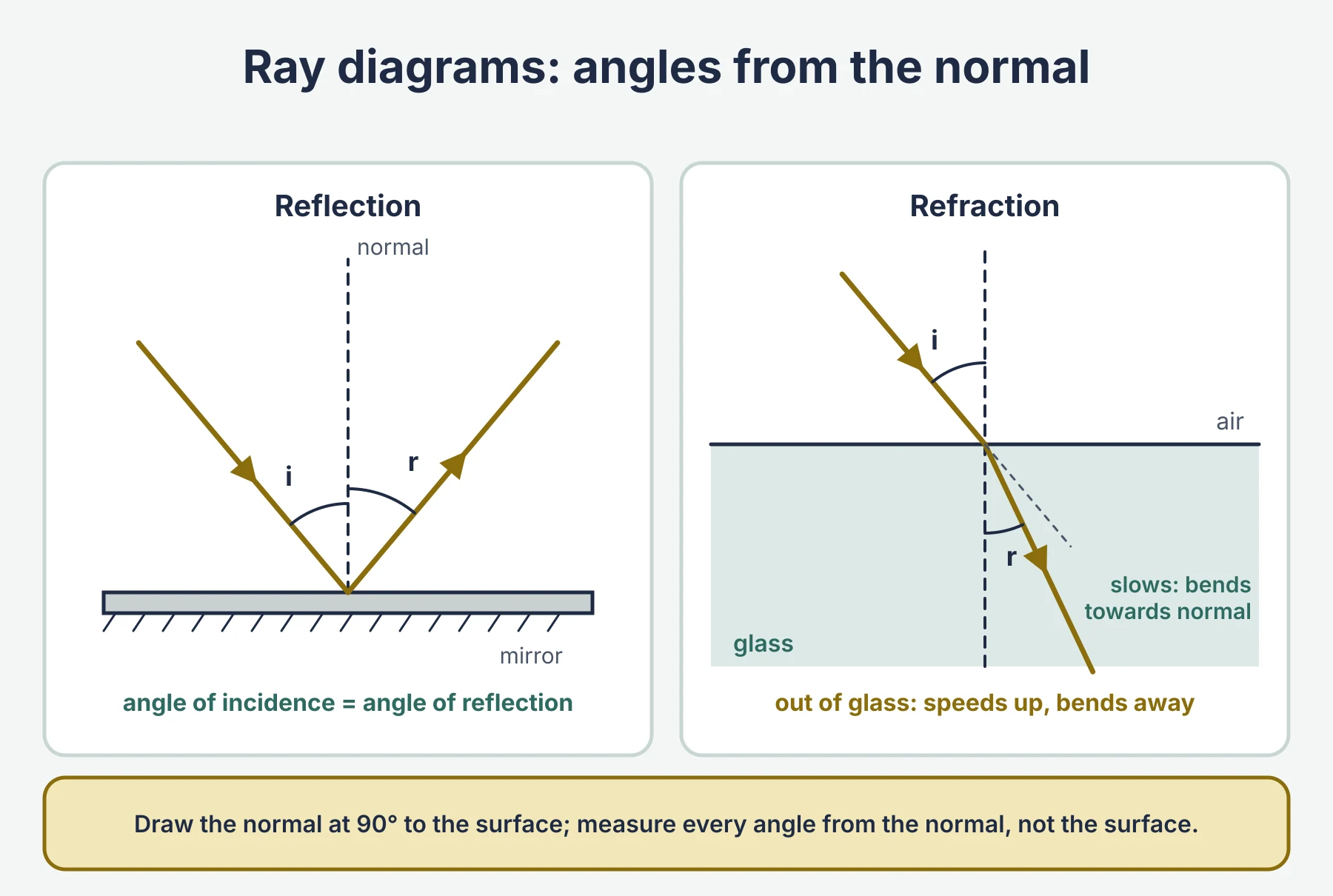
- Law of reflection: angle of incidence = angle of reflection, both measured from the normal.
- Into a material with a higher refractive index (air to glass): light slows, bends towards the normal.
- Out of it (glass to air): light speeds up, bends away from the normal.
- A ray meeting a surface along the normal (angle of incidence 0°) passes straight through without bending, though its speed still changes.
- The larger
nis, the more the light slows and bends, and the smaller the critical angle.
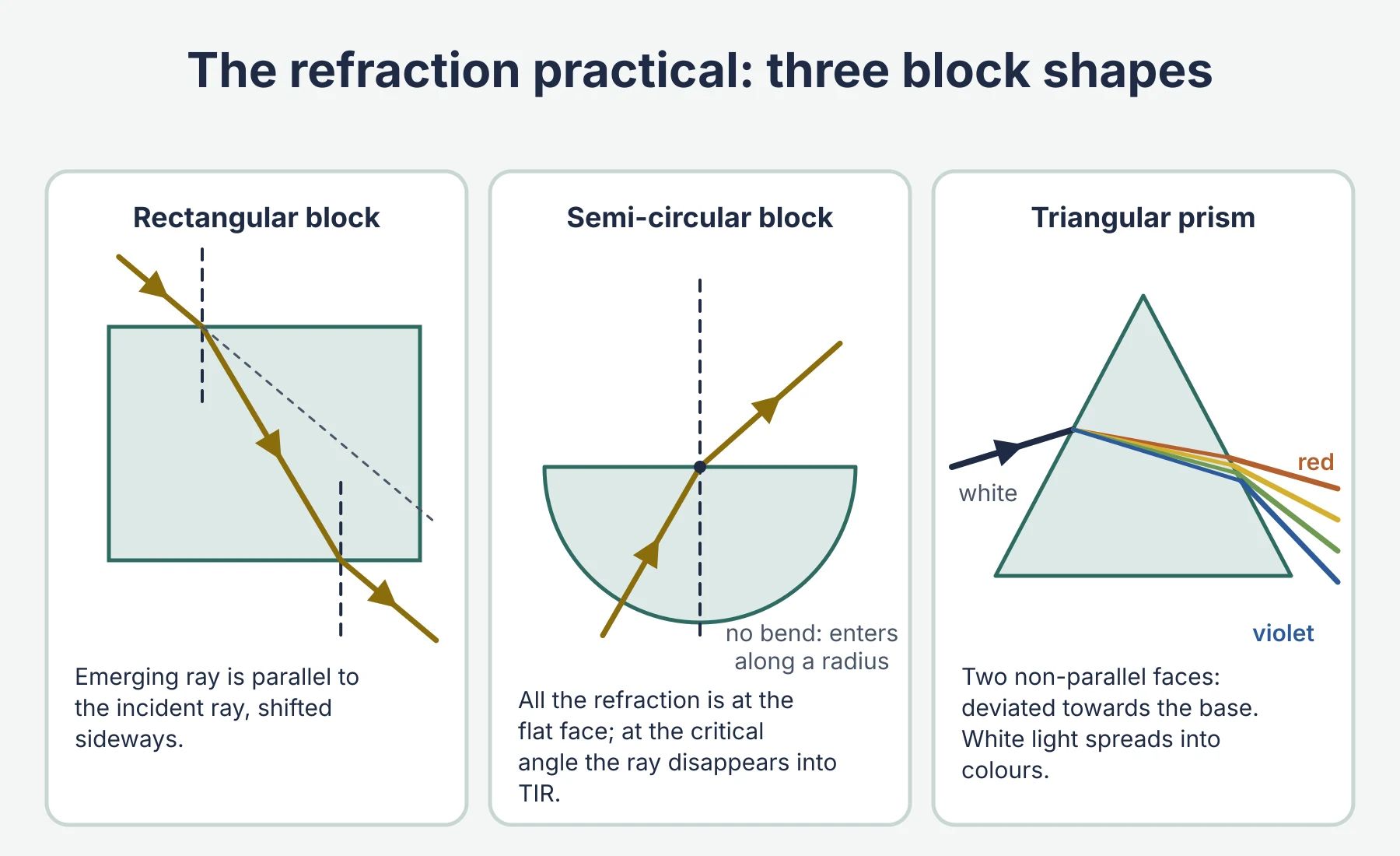
The three blocks in practical 3.17
| Block | What you see | Why it is used |
|---|---|---|
| Rectangular | Emerging ray parallel to incident ray, shifted sideways | Measuring pairs of i and r for refractive index |
| Semi-circular | Ray aimed at the centre is unbent at the curved face; bends only at the flat face | Watching the critical angle and total internal reflection |
| Triangular prism | Ray deviated towards the base; white light spreads into colours | Refraction at non-parallel faces |
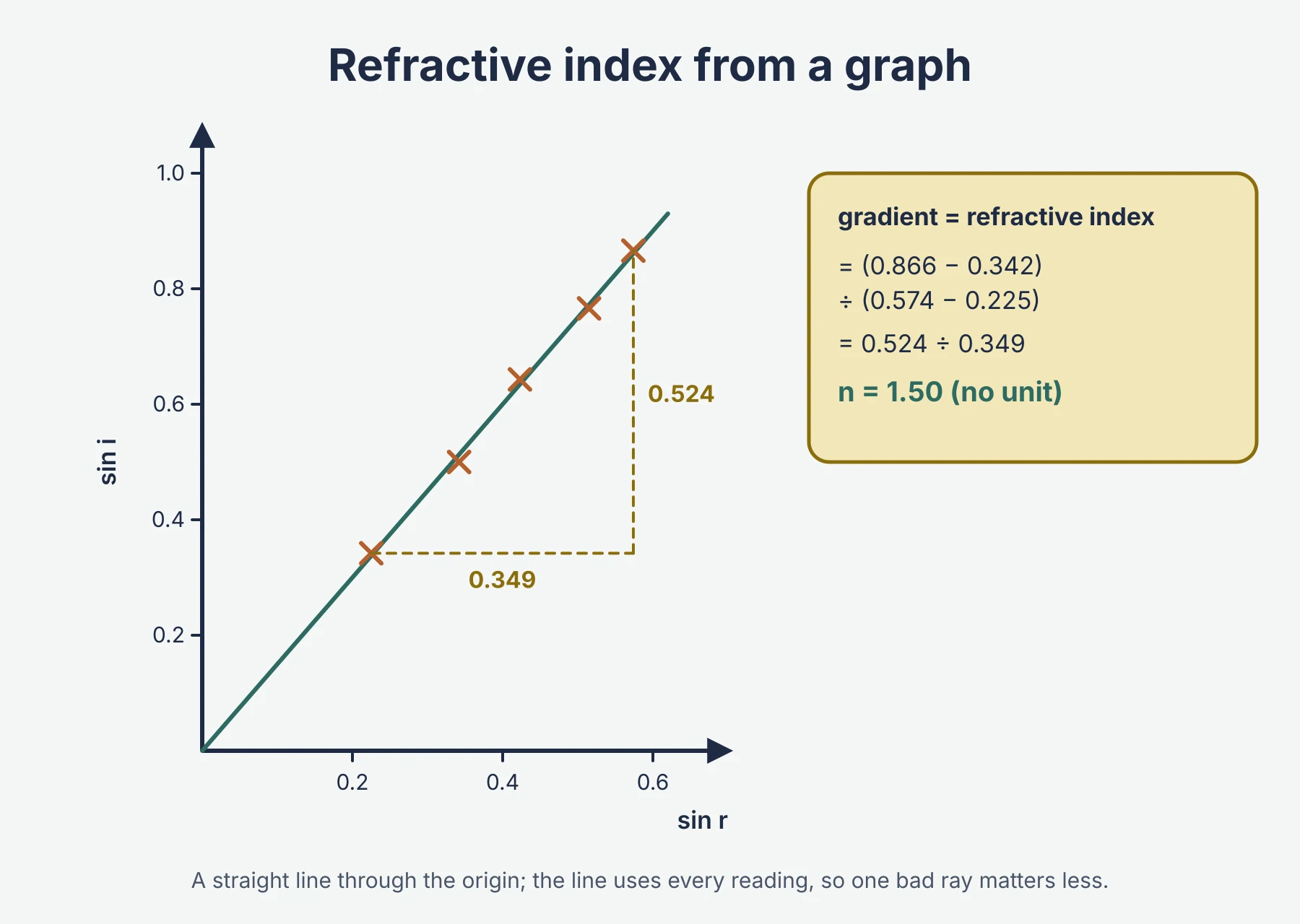
Practical 3.19 (refractive index): vary i, measure r, plot sin i (y) against sin r (x); gradient = n.
A straight line through the origin confirms sin i / sin r is constant.
Total internal reflection
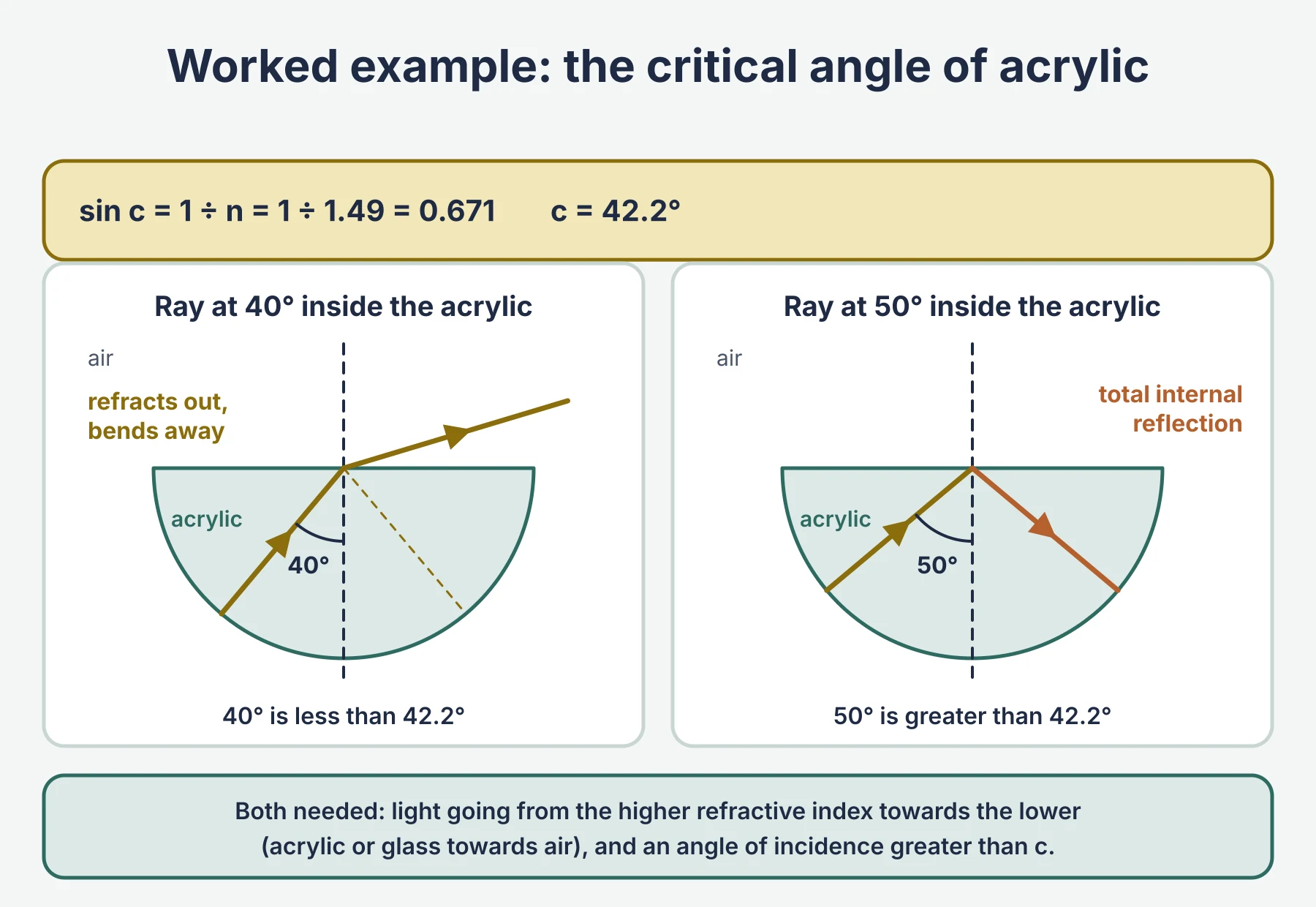
Both conditions are needed:
- light travels from the higher-
nmaterial towards the lower-none (glass to air, water to air); - angle of incidence greater than the critical angle.
At exactly c, the refracted ray runs along the boundary (refraction angle 90°).
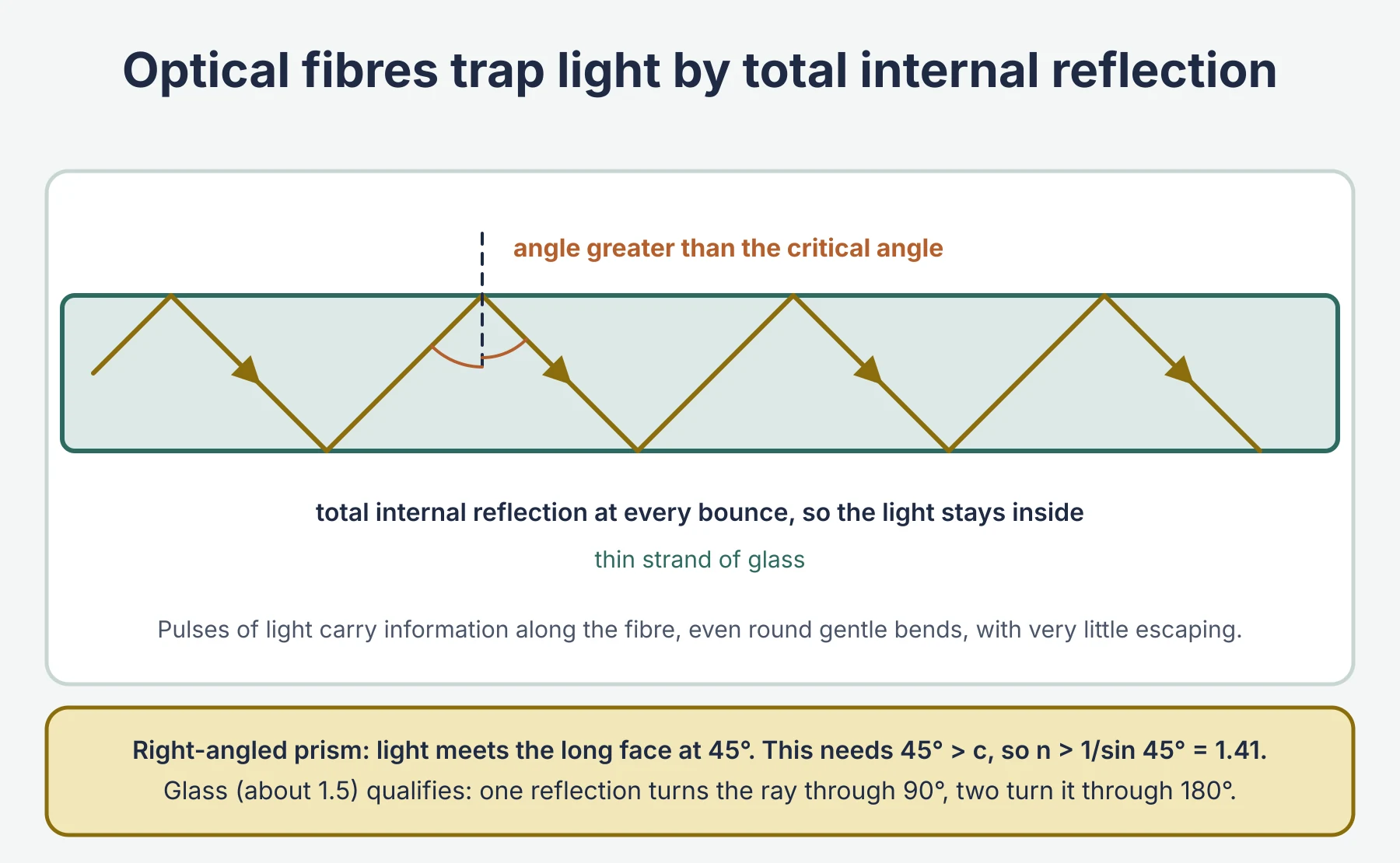
Optical fibres: light hits the fibre wall at more than c, is totally internally reflected again and again, and
carries information (pulses of light) along the fibre.
Prisms: a 45° right-angled glass prism turns light through 90° (one reflection) or 180° (two reflections). It works
because glass has a critical angle below 45°; a material would need n above 1.41 for this.
Sound
- Sound is longitudinal: vibrations parallel to the direction of travel, forming compressions and rarefactions.
- Sound reflects (echoes) and refracts.
- Hearing range (3.24P): 20 Hz to 20 000 Hz.
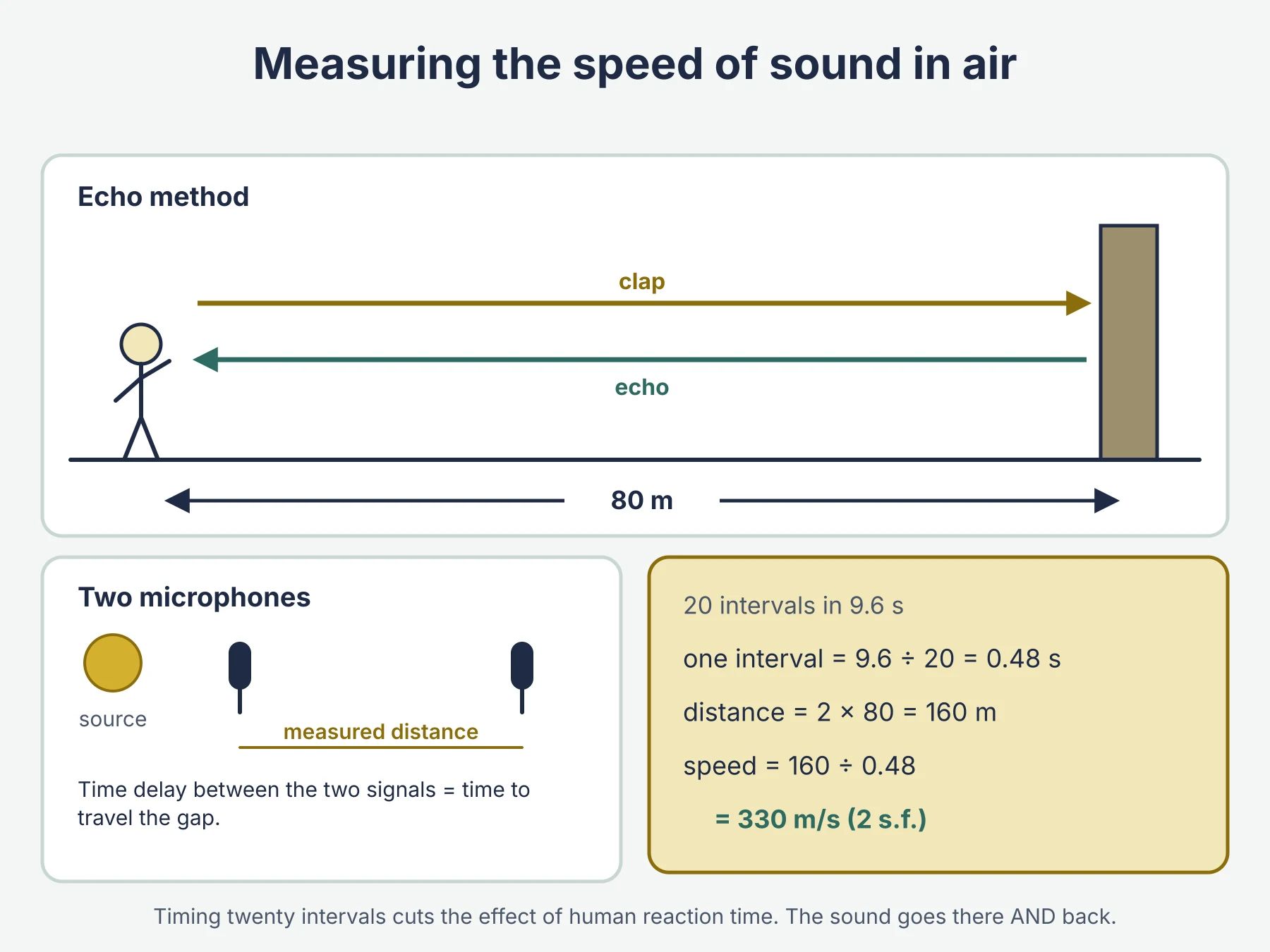
- Speed of sound practical (3.25P): echo method (time many clap-echo intervals, use distance there and back) or two microphones a measured distance apart with an oscilloscope or timer (time delay between signals).
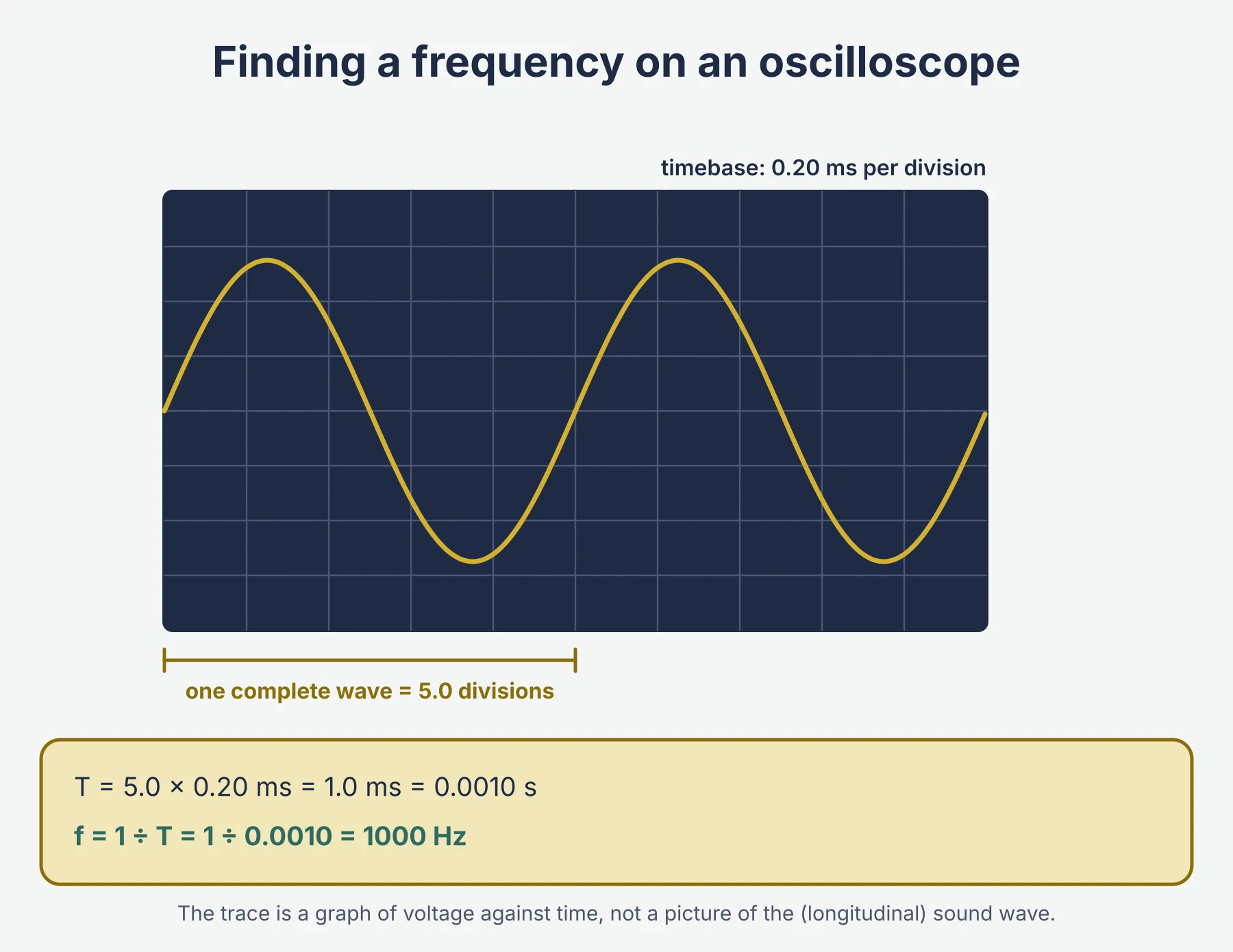
- Oscilloscope (3.26P, 3.27P): microphone converts sound to a varying voltage; the trace is voltage against time. Period = (divisions for one wave) × (timebase setting). Frequency = 1/period.
- Pitch (3.28P) depends on frequency: more waves on the screen, higher pitch.
- Loudness (3.29P) depends on amplitude: taller trace, louder sound.
Key terms
| Term | Meaning |
|---|---|
| Normal | Line at 90° to a surface at the point where a ray meets it |
| Angle of incidence | Angle between incoming ray and the normal |
| Angle of refraction | Angle between refracted ray and the normal |
| Refractive index, n | sin i / sin r for light entering a material from air; a ratio with no unit |
| Critical angle, c | Angle of incidence inside the material at which the refracted ray travels along the boundary |
| Total internal reflection | All light reflected back inside the material, when the angle of incidence exceeds c |
| Optical fibre | Thin glass strand that carries light by repeated total internal reflection |
| Compression / rarefaction | Region of a sound wave where particles are closer together / further apart |
| Timebase | Oscilloscope setting: time represented by one horizontal division |
| Pitch | How high or low a sound is; set by frequency |
| Loudness | How loud a sound is; set by amplitude |
Exam traps
- Using the angle between ray and surface. If a question gives that angle, subtract it from 90° first.
- Typing
n = 1/sin cthe wrong way round and gettingsin cabove 1 (impossible). - Saying a ray “reflects” at the boundary of a semi-circular block when the angle is below
c: some light reflects weakly, but most refracts out. Total internal reflection needs an angle abovec. - Echo calculations: speed = 2d / t. A wall 100 m away means 200 m of travel.
- Quoting the oscilloscope trace as evidence that sound is transverse. The trace is a voltage-time graph.
- Mixing pitch with loudness. Same pitch, louder: peaks the same distance apart but taller.
- Giving
na unit, or giving an angle without the degree sign.
Self-test
- State the law of reflection.
- Light passes from air into water. State what happens to its speed and which way it bends.
- A ray in air strikes glass at 45° to the normal and refracts at 28°. Calculate the refractive index.
- Calculate the critical angle of water, refractive index 1.33.
- A ray inside a glass block (n = 1.52) meets the surface at 45°. Does it leave the block? Show your reasoning.
- Give the two conditions needed for total internal reflection.
- Why does a ray aimed at the centre of the flat face of a semi-circular block not bend at the curved surface?
- Which graph do you plot to find the refractive index of glass, and how do you get
nfrom it? - State the range of human hearing.
- A wall is 120 m away. The echo of a clap returns after 0.70 s. Calculate the speed of sound.
- An oscilloscope timebase is 0.5 ms per division. One wave covers 4 divisions. Calculate the frequency.
- A sound becomes louder but keeps the same pitch. Describe the change to the oscilloscope trace.
Answers: 1. Angle of incidence equals angle of reflection, both measured from the normal. 2. It slows down and bends
towards the normal. 3. n = sin 45° / sin 28° = 0.707 / 0.469 = 1.51. 4. sin c = 1/1.33 = 0.752, so c = 48.8°.
5. sin c = 1/1.52 = 0.658, so c = 41.1°; 45° is greater than 41.1°, so it is totally internally reflected and
does not leave. 6. Light travels from the higher refractive index material towards the lower one, and the angle of
incidence is greater than the critical angle. 7. It travels along a radius, so it meets the curved surface along the
normal (angle of incidence 0°). 8. sin i against sin r; n is the gradient. 9. 20 Hz to 20 000 Hz.
10. v = 2 × 120 / 0.70 = 240 / 0.70 = 340 m/s (2 s.f.). 11. T = 4 × 0.5 ms = 2.0 ms = 0.0020 s, so
f = 1/0.0020 = 500 Hz. 12. The peaks stay the same distance apart (same frequency) but the trace becomes taller
(larger amplitude).
Related resources
-
Study guides
Pearson Edexcel International GCSE Physics (4PH1): Properties of waves
Transverse and longitudinal waves, wave definitions, v = fλ, f = 1/T, the Doppler effect, reflection and refraction for Edexcel IGCSE Physics 4PH1, 3b.
Physics · Pearson Edexcel · IGCSE
Read guide -
Practice questions
Pearson Edexcel International GCSE Physics (4PH1): Properties of waves – Practice Questions
Original questions with full answers on wave types, wave definitions, v = fλ, f = 1/T, refraction and the Doppler effect for Edexcel IGCSE Physics 4PH1.
Physics · Pearson Edexcel · IGCSE
Try questions -
Revision notes
Pearson Edexcel International GCSE Physics (4PH1): Properties of waves – Revision Notes
Recall notes on wave types, wave definitions, v = fλ, f = 1/T, the Doppler effect and refraction, with a self-test, for Edexcel IGCSE Physics 4PH1.
Physics · Pearson Edexcel · IGCSE
Revise topic
Related articles
Get free revision emails (optional)
Occasional emails with practice questions, worked explanations and links to free resources for the qualification and subjects you choose. No spam, and you can unsubscribe from any email. The free tools on this site never need an email.