
Revision Notes
Pearson Edexcel International GCSE Physics (4PH1): Properties of waves – Revision Notes
Recall notes on wave types, wave definitions, v = fλ, f = 1/T, the Doppler effect and refraction, with a self-test, for Edexcel IGCSE Physics 4PH1.
- Subject
- Physics
- Level
- IGCSE
- Topic
- Waves
- Author
- Marlbridge Academic Team
- Updated
- Reviewed by
- Hassan (what this means)
Aligned to Pearson Edexcel IGCSE Physics (4PH1), Issue 4. Official specification .
Syllabus page (what it covers and how it is assessed): Pearson Edexcel IGCSE Physics.
Syllabus points this page covers
4PH1
- 3b Properties of waves
Found an error? Report a correction.
Need help with this topic? Request a free trial class for IGCSE Physics (4PH1).
Condensed notes on sub-topic 3(b) Properties of waves (statements 3.2 to 3.9) of Pearson Edexcel International GCSE Physics (4PH1), Issue 4. For full explanations and worked examples, use the Properties of waves study guide.
Equations
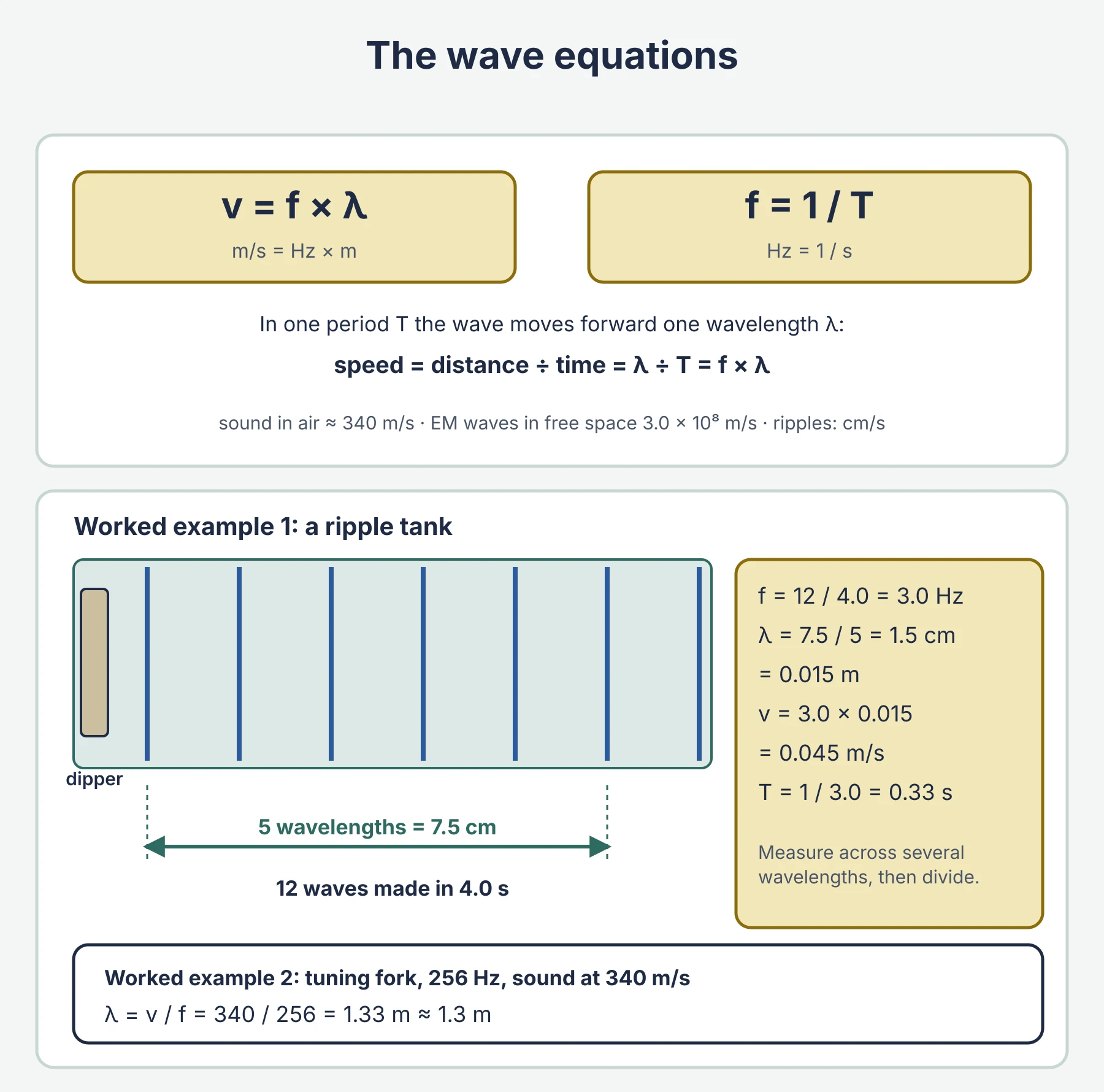
v = f × λ        (know and use)   v in m/s, f in Hz, λ in m
f = 1 / T        (use)            T in s
Rearranged: λ = v ÷ f; f = v ÷ λ; T = 1 ÷ f.
Key terms
| Term | Definition |
|---|---|
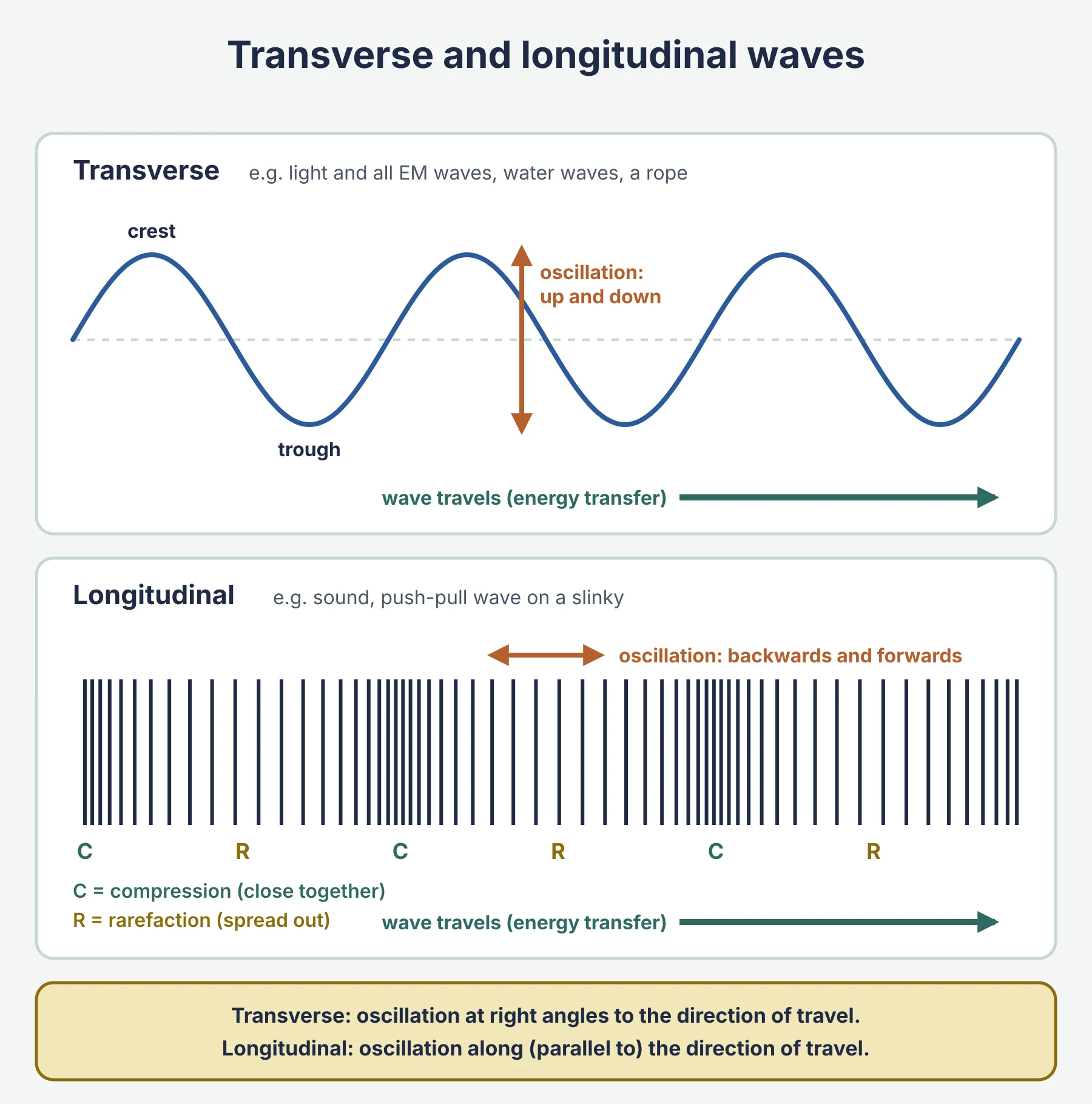
| transverse wave | oscillations perpendicular to the direction of wave travel |
| longitudinal wave | oscillations parallel to the direction of wave travel |
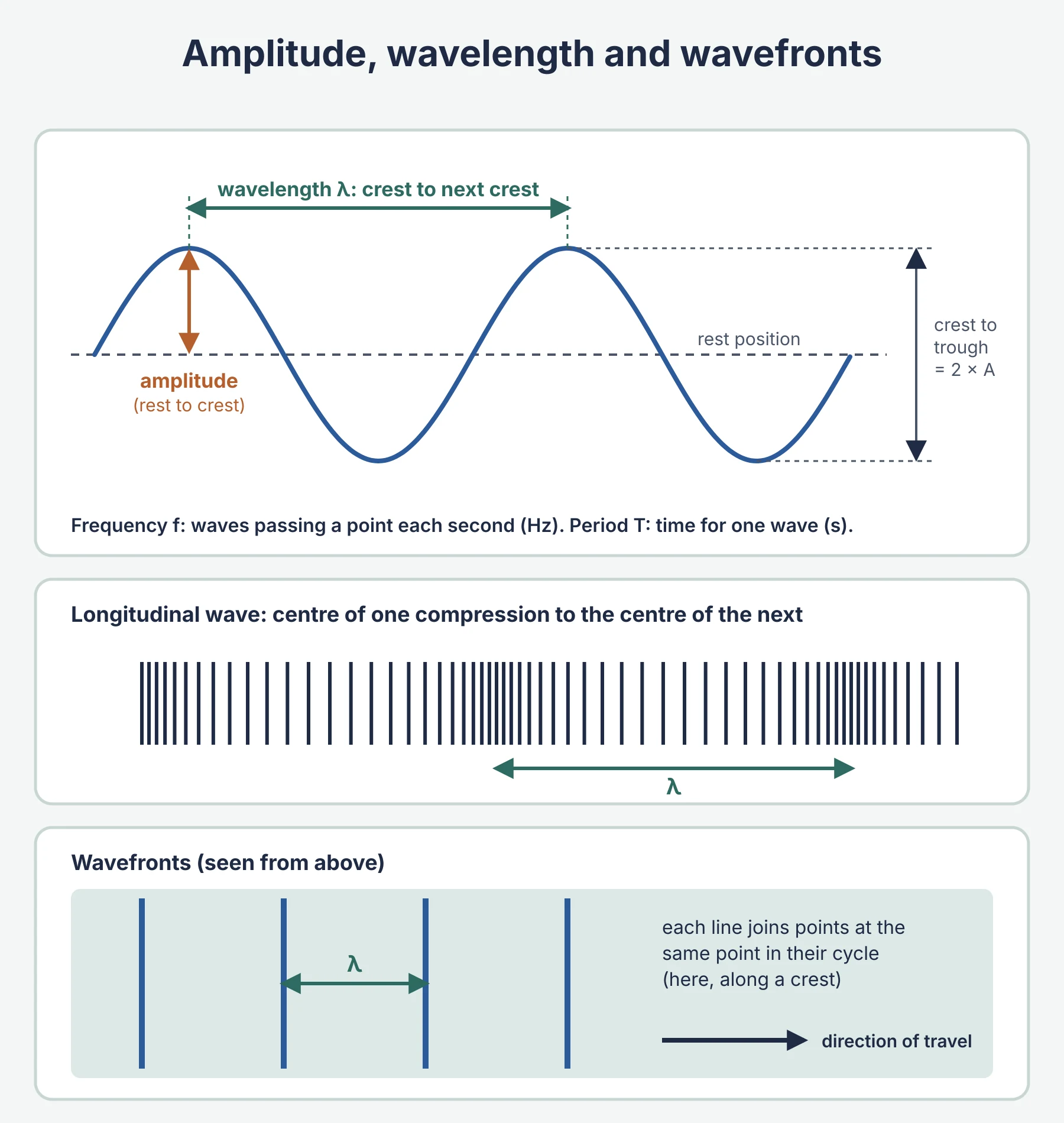
| amplitude | maximum displacement from the rest position |
| wavelength | distance between the same points on two adjacent waves |
| frequency | number of waves passing a point per second (Hz) |
| period | time for one complete wave (s) |
| wavefront | line joining points at the same stage of the cycle (e.g. a crest) |
| compression | region where particles in a longitudinal wave are close together |
| rarefaction | region where particles are spread apart |
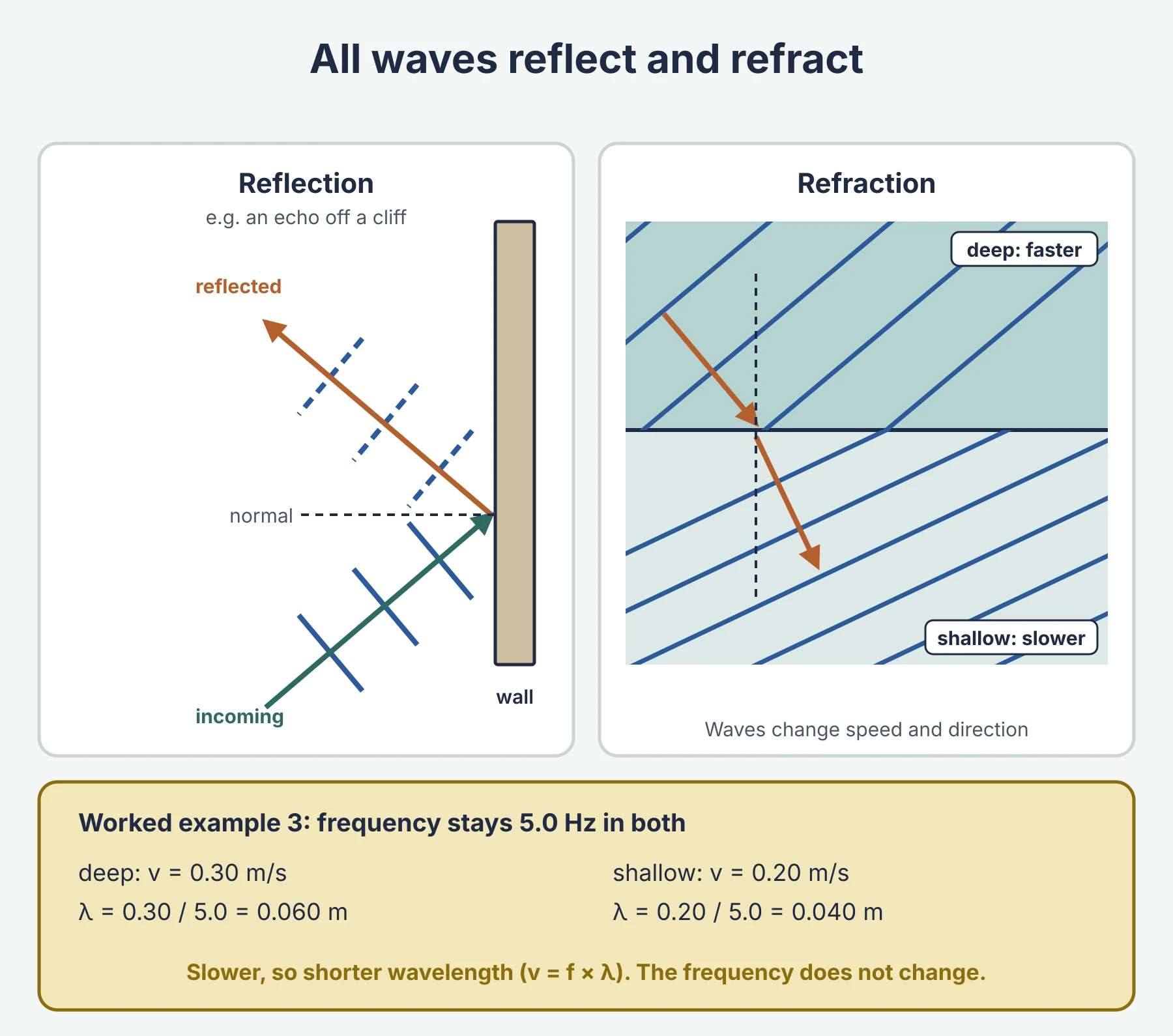
| reflection | wave bouncing back from a boundary |
| refraction | change in speed (and often direction) on entering a new medium |
| Doppler effect | change in observed frequency and wavelength when the source moves relative to the observer |
Wave types at a glance
- Transverse: light, all EM waves, water waves, rope waves; crests and troughs.
- Longitudinal: sound, push-pull slinky waves; compressions and rarefactions.
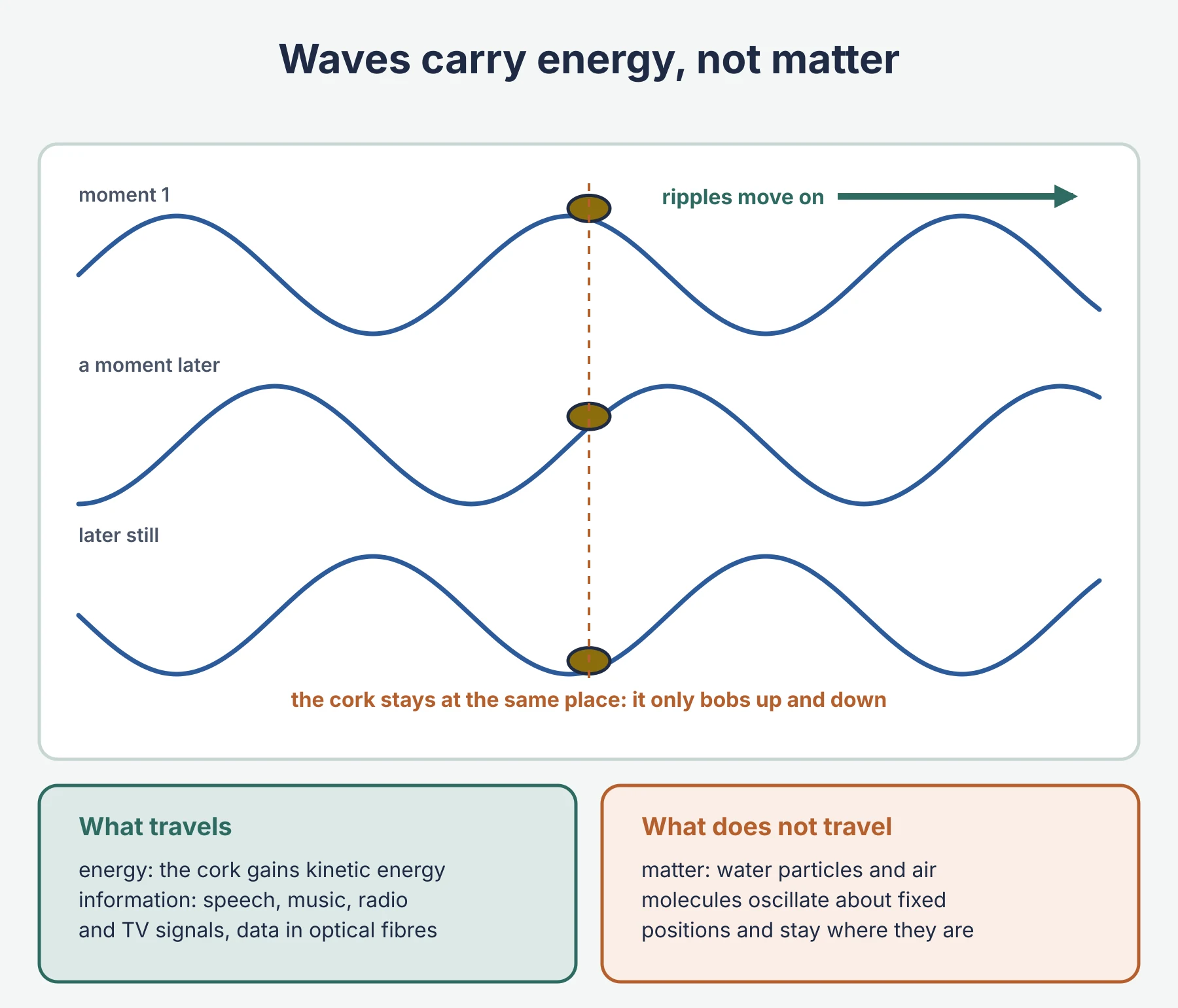
- Both transfer energy and information, not matter: particles oscillate about fixed positions.
Typical speeds for context
| Wave | Speed |
|---|---|
| sound in air | about 340 m/s |
| EM waves in free space | 3.0 × 10⁸ m/s |
| ripple tank water waves | a few cm/s |
Refraction checklist
- Speed changes at the boundary.
- Wavelength changes in the same proportion as speed.
- Frequency stays the same.
- Direction changes if the wave meets the boundary at an angle (not along the normal).
- Water waves: slower in shallow water, so wavelength shorter.
Doppler effect sequence
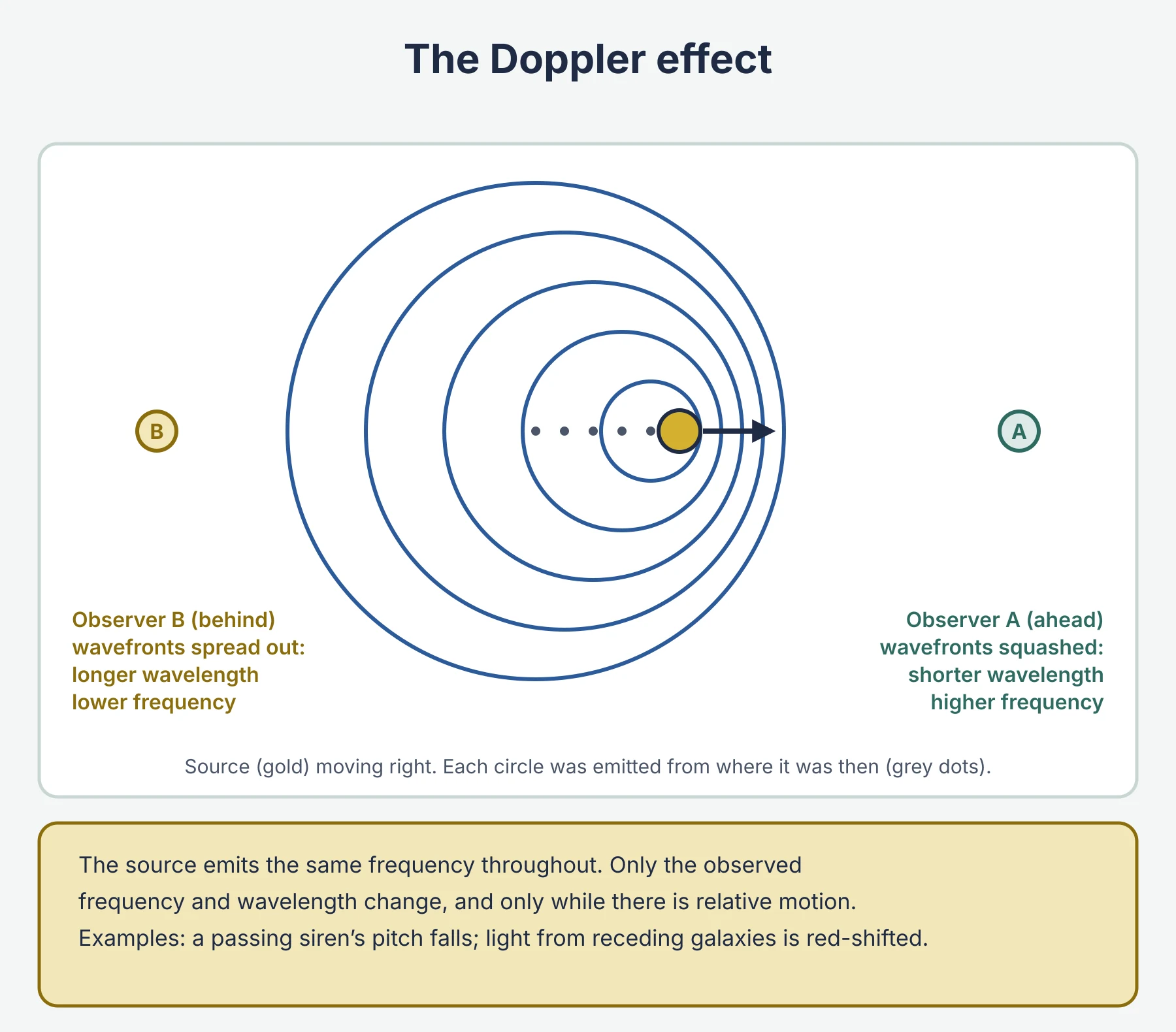
Source moves towards observer → each wave emitted closer → wavefronts bunched → shorter observed λ → higher observed f (higher pitch for sound). Source moves away → wavefronts spread → longer λ → lower f. The source’s own frequency does not change.
Measuring a wave
- Wavelength: measure across several waves and divide, for accuracy.
- Frequency: count waves passing a point in a measured time, f = number ÷ time.
- Then v = f × λ.
Two wave graphs
- Displacement−distance graph: a snapshot; crest-to-crest distance along the axis is the wavelength.
- Displacement−time graph: one point’s motion; crest-to-crest time is the period, so f = 1 ÷ T.
- On both, amplitude = rest line to crest.
Model sentences
- Transverse: “The particles oscillate at right angles to the direction in which the wave transfers energy.”
- Longitudinal: “The particles oscillate along the direction in which the wave transfers energy, forming compressions and rarefactions.”
- Refraction: “The wave changes speed as it enters the new medium; its frequency stays the same, so its wavelength changes, and if it arrives at an angle its direction changes.”
- Energy, not matter: “Each particle oscillates about a fixed position; only energy and information travel with the wave.”
Exam traps
- Amplitude is rest position to crest, not trough to crest.
- Wavelength is crest to crest along the wave, not up and down.
- Sound is longitudinal, light is transverse.
- In refraction, frequency is constant.
- Convert cm, kHz and ms before substituting.
- “The siren’s frequency changes”: no, the observed frequency changes.
- “Particles move along with the wave”: no, they oscillate in place.
Self-test
- Explain the difference between a transverse and a longitudinal wave.
- Give one example of each type of wave.
- Define the wavelength of a wave.
- A wave’s crest is 3.0 cm above the rest position and its trough 3.0 cm below. State the amplitude.
- What evidence shows that a water wave does not transfer water across a pond?
- A wave has frequency 50 Hz and wavelength 6.8 m. Calculate its speed.
- A wave has a period of 0.040 s. Calculate its frequency.
- Sound of frequency 680 Hz travels at 340 m/s. Calculate its wavelength.
- Water waves pass from deep to shallow water. State what happens to their speed, wavelength and frequency.
- Explain why a passing ambulance siren sounds lower in pitch as it moves away.
- Name the parts of a longitudinal wave where particles are close together and far apart.
- A dipper makes 20 waves in 5.0 s; the waves have a wavelength of 2.0 cm. Calculate their speed in m/s.
Answers
- In a transverse wave the oscillations are perpendicular to the direction of travel; in a longitudinal wave they are parallel to it.
- Transverse: light (or any EM wave, water wave). Longitudinal: sound.
- The distance from one point on a wave to the same point on the next wave, for example crest to crest.
- 3.0 cm.
- A floating object bobs up and down but stays in the same place as the waves pass.
- v = 50 × 6.8 = 340 m/s.
- f = 1 ÷ 0.040 = 25 Hz.
- λ = 340 ÷ 680 = 0.50 m.
- Speed decreases; wavelength decreases; frequency stays the same.
- As it moves away, each wave is emitted further from you, so the wavefronts are spread out; the observed wavelength is longer and the observed frequency (pitch) is lower.
- Compressions (close together) and rarefactions (far apart).
- f = 20 ÷ 5.0 = 4.0 Hz; v = 4.0 × 0.020 = 0.080 m/s.
Related resources
-
Study guides
Pearson Edexcel International GCSE Physics (4PH1): The electromagnetic spectrum
The order, shared speed, uses and harmful effects of electromagnetic waves, with protective measures, for Edexcel International GCSE Physics 4PH1, sub-topic 3c.
Physics · Pearson Edexcel · IGCSE
Read guide -
Practice questions
Pearson Edexcel International GCSE Physics (4PH1): The electromagnetic spectrum – Practice Questions
Original questions with full answers on the order, speed, uses, harmful effects and protection for electromagnetic waves, for Edexcel IGCSE Physics 4PH1.
Physics · Pearson Edexcel · IGCSE
Try questions -
Revision notes
Pearson Edexcel International GCSE Physics (4PH1): The electromagnetic spectrum – Revision Notes
Recall notes on the order, speed, uses, dangers and protective measures of electromagnetic waves, with a self-test, for Edexcel International GCSE Physics 4PH1.
Physics · Pearson Edexcel · IGCSE
Revise topic
Related articles
Get free revision emails (optional)
Occasional emails with practice questions, worked explanations and links to free resources for the qualification and subjects you choose. No spam, and you can unsubscribe from any email. The free tools on this site never need an email.